Flying Eagle Cent Identification Guide: 1856 Pattern, Key Dates, and Values
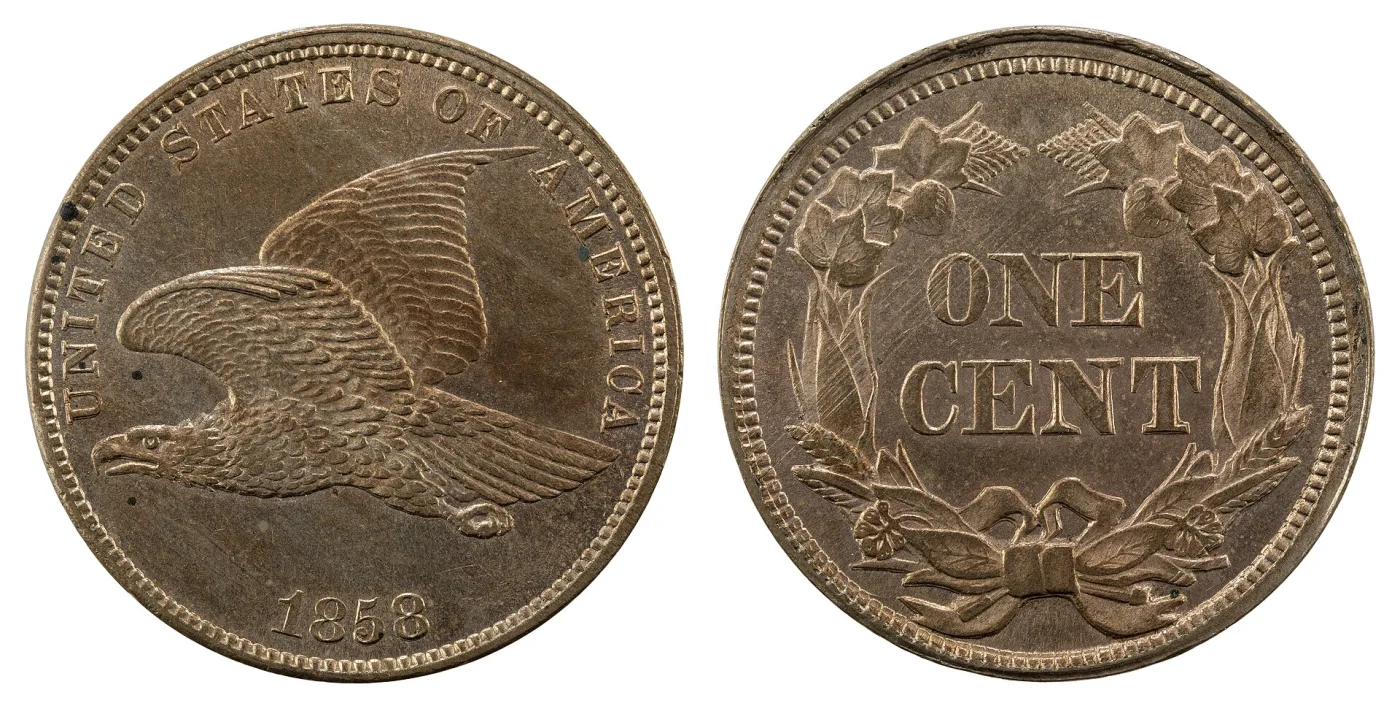
The Flying Eagle Cent, struck for circulation only in 1857 and 1858, is one of the most historically significant coins in American numismatics. It marked the end of the heavy copper large cent and ushered in the modern small cent format that the United States still uses today. Designed by Chief Engraver James Barton Longacre, the Flying Eagle Cent borrowed its central motif from Christian Gobrecht’s earlier silver dollar pattern, creating a powerful image of an eagle in flight that has captivated collectors for over 165 years.
Despite its short two-year run for circulation, the Flying Eagle series contains one of the most famous rarities in U.S. coinage: the 1856 pattern. Originally struck as a sample to convince Congress to authorize the new small cent, the 1856 was distributed to legislators and dignitaries, and surviving examples now command five to six figures. Beyond that headline rarity, collectors pursue the Large Letters and Small Letters varieties of 1858, the dramatic 1858/7 overdate, and a small handful of proof issues.
This guide walks through every aspect of identifying, grading, and valuing Flying Eagle Cents. You will learn how to distinguish authentic examples from counterfeits, recognize the major varieties, interpret the unusual copper-nickel composition, and understand why this short series sits at the foundation of every serious U.S. type set. The Flying Eagle Cent was directly replaced by the Indian Head Penny in 1859, and the two series share the same diameter, weight, and composition during their early years.
History and Background of the Flying Eagle Cent
By the early 1850s, the United States had a problem with its one-cent coin. The Large Cent, in production since 1793 alongside the smaller Half Cent and by the 1850s appearing in its final Braided Hair form, was nearly the size of a modern half dollar and contained almost a full cent’s worth of copper at then-current metal prices. As copper prices rose during the California Gold Rush boom, the Mint was actually losing money on every cent it produced. Banks refused to accept large cents at face value in bulk, and the public increasingly viewed the heavy coins as inconvenient.
The Mint Act of February 21, 1857 solved both problems at once. It authorized a new small cent of 88% copper and 12% nickel, weighing just 4.67 grams (compared to 10.89 grams for the large cent). The act also demonetized the Spanish silver coins that had circulated alongside U.S. coinage since the colonial era, making the new small cent the primary coin of small commerce. Mint Director James Ross Snowden championed the Flying Eagle design and oversaw a frantic production schedule to meet public demand.
The Pattern Process and the 1856
Before Congress would authorize the new composition, the Mint needed to demonstrate that the design and composition could be successfully struck. Chief Engraver James Barton Longacre prepared dies dated 1856, and the Mint produced a limited number of pattern coins to distribute to congressmen, senators, the President, and other officials. Although technically a pattern, the 1856 was struck in the same alloy and dimensions as the eventual circulating coin and is considered an integral part of the series by collectors. Estimates of the original mintage range from 600 to 2,000 pieces, with restrikes produced through the early 1860s adding further confusion.
Production Difficulties
The Flying Eagle Cent’s high-relief design caused immediate striking problems. The eagle on the obverse and the wreath on the reverse occupy directly opposite positions on the coin, meaning metal had to flow into both deep recesses simultaneously during striking. The result was that the eagle’s head and tail — the highest points of the design — were almost always weakly struck. By mid-1858, the Mint was already preparing the lower-relief Indian Head replacement, which entered production in 1859 and remained in service until 1909. Longacre would later go on to design the bronze Two Cent Piece in 1864 (the first U.S. coin with “In God We Trust”) and the Shield Nickel in 1866, continuing to shape U.S. coinage for two decades. His earlier work included the Liberty Head Double Eagle of 1849 — the $20 gold workhorse that financed the Civil War and remained in production until 1907.
Design Details and Symbolism
The Flying Eagle Cent’s design is one of the most visually striking in 19th-century American coinage. Its compact, action-filled obverse and traditional agricultural reverse together capture mid-century American ideals.
Obverse: The Flying Eagle
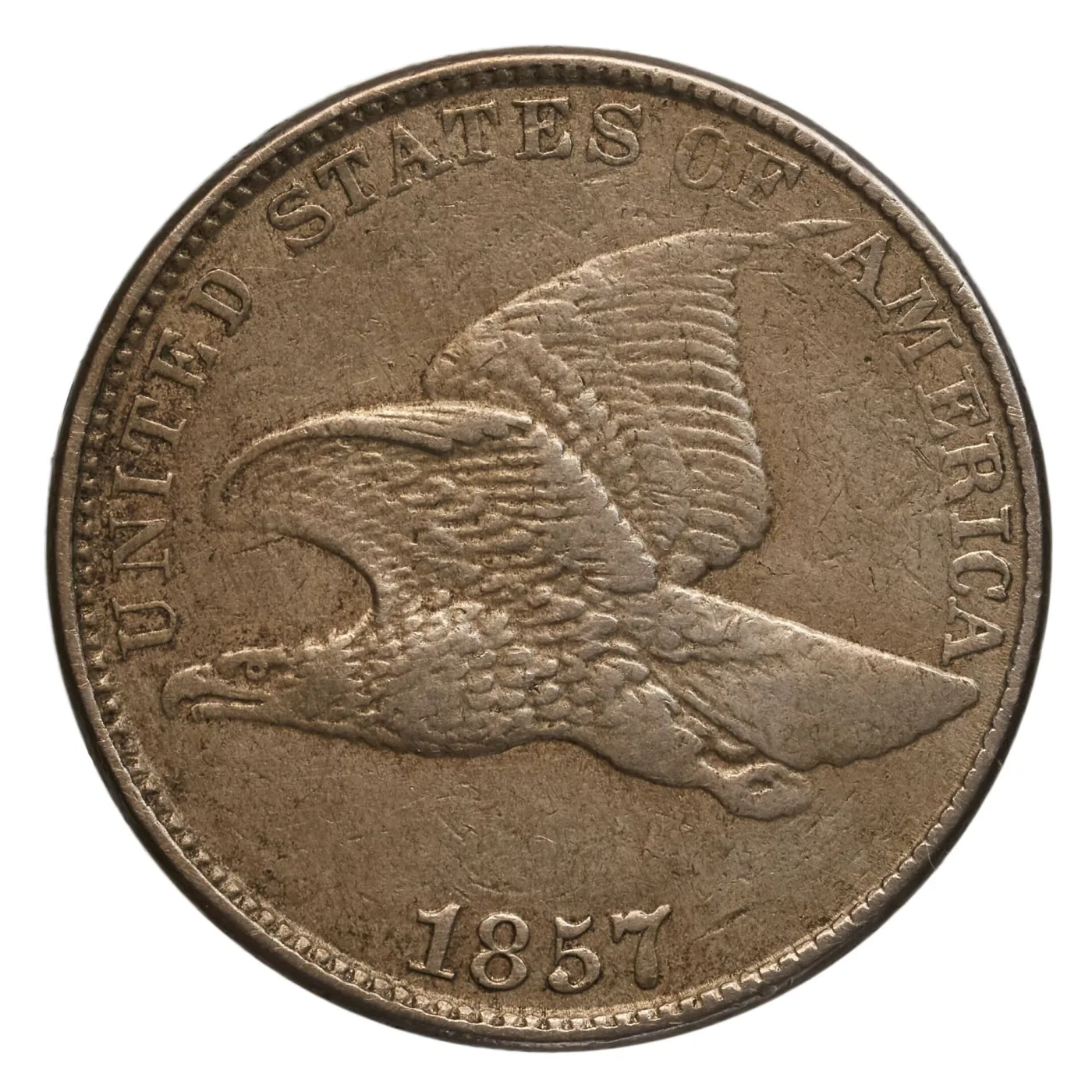
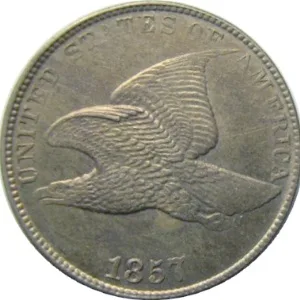
The obverse features a powerful eagle in flight, wings spread and head extended, soaring across the field of the coin. The design is adapted directly from the obverse of Christian Gobrecht’s 1836-1839 silver dollar pattern, which itself was based on a sketch by artist Titian Peale. The eagle flies to the viewer’s left, with “UNITED STATES OF AMERICA” arcing above and the date below. There is no inscription of “LIBERTY” or any motto on the obverse, and the field is otherwise plain except for the central figure.
Reverse: Agricultural Wreath
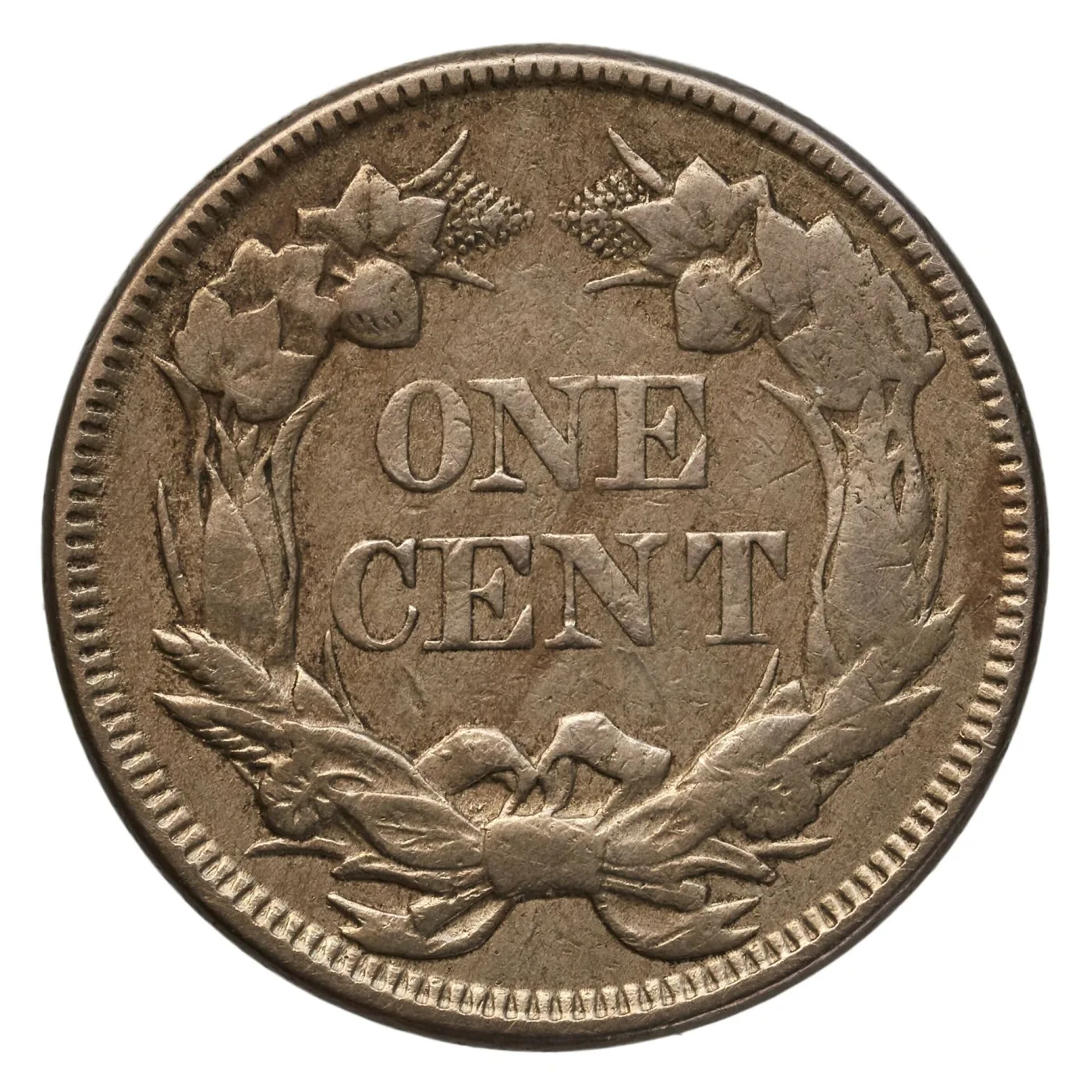
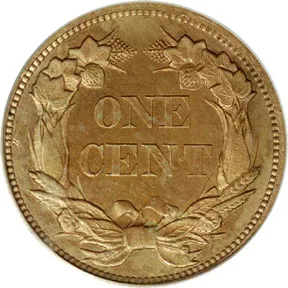
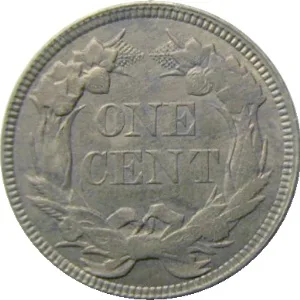
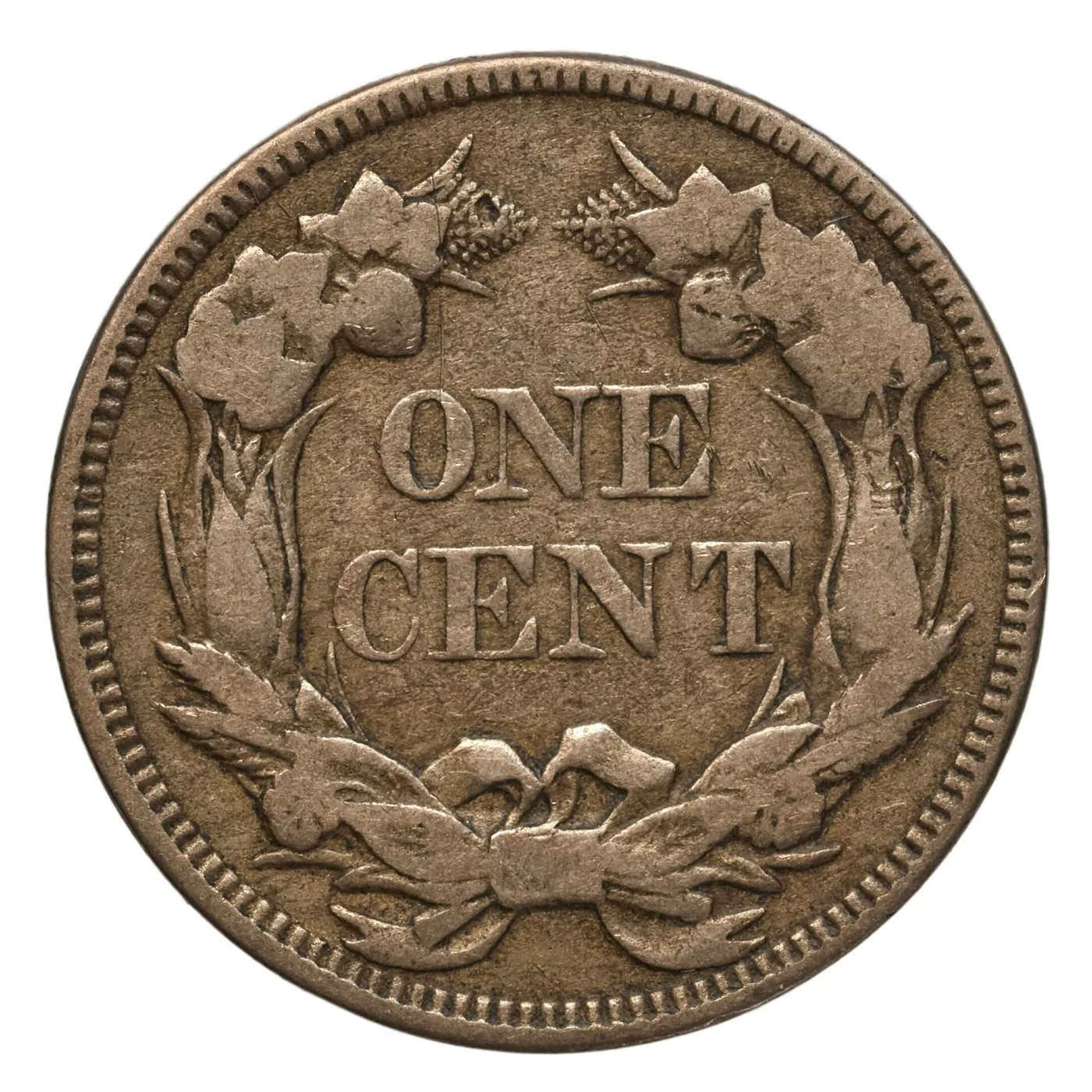
The reverse displays “ONE CENT” within a wreath composed of cotton, corn, wheat, and tobacco — the four major American agricultural products of the era. This wreath was designed by Longacre and would later appear, with modifications, on the Indian Head cent and other denominations. The design is bold and well-defined, and the wreath details are typically among the better-struck features of the coin even when the obverse shows weakness.
No Mint Mark
All Flying Eagle Cents were struck at the Philadelphia Mint and carry no mint mark. Branch mints did not produce small cents during this era, simplifying identification. If a Flying Eagle Cent appears to bear any kind of mint mark, it is either a contemporary counterfeit, a modern fantasy piece, or a genuine coin with a die scratch or contact mark mistaken for a letter.
Composition and Physical Specifications
The Flying Eagle Cent introduced the copper-nickel small cent format that would persist through 1864. Understanding its composition is critical for both identification and authentication.
Copper-Nickel Alloy
The coin was struck in 88% copper and 12% nickel, an alloy known as “nickel” in the parlance of the time even though it is mostly copper. The nickel content gives the coin a distinctly pale, yellowish-tan appearance that differs noticeably from later bronze cents. Collectors sometimes refer to these copper-nickel cents as “white cents” because of their lighter color, though they are nowhere near as white as a modern five-cent piece.
Specifications
Diameter: 19mm. Weight: 4.67 grams. Edge: plain (no reeding). Thickness: approximately 1.95mm. These specifications match the early Indian Head Penny issues from 1859 to mid-1864, when the bronze composition was introduced and the weight reduced to 3.11 grams. A digital scale calibrated to 0.01g is the single most useful authentication tool for this series — counterfeits frequently fail the weight check before any visual inspection is needed.
Metal Behavior and Toning
Copper-nickel coins do not develop the rich red or chocolate-brown patina associated with bronze cents. Instead, they tone toward gray, tan, or a mottled olive color over time. Cleaned copper-nickel cents often appear unnaturally bright with a pinkish hue, which is a warning sign of harsh cleaning or chemical exposure. Naturally toned, original-surface examples are highly prized and command significant premiums over cleaned coins of equivalent technical grade.
How to Identify a Flying Eagle Cent
Flying Eagle Cents are generally easy to identify even when worn, but several quick checks separate genuine pieces from counterfeits and altered coins.
Step 1: Verify the Obverse Design
Look for the left-flying eagle with wings spread, occupying nearly the full diameter of the coin. The eagle should have visible feather detail (depending on grade), an extended head, and trailing tail feathers. “UNITED STATES OF AMERICA” should be legible around the upper rim, with the date at the bottom. The design fills the field — there is no laurel border, stars, or additional inscriptions.
Step 2: Verify the Reverse Wreath
The reverse should show “ONE CENT” centered within an agricultural wreath. The wreath includes corn ears, cotton bolls, tobacco leaves, and wheat heads — four distinct plants tied with a ribbon at the base. There is no shield at the top, distinguishing this reverse from the 1860 and later Indian Head reverses. Any Flying Eagle Cent claimed to have a shield reverse is either a fantasy piece or a misattribution.
Step 3: Confirm the Date
Genuine business-strike Flying Eagle Cents are dated 1857 or 1858. Coins dated 1856 are rare patterns and require professional authentication. The date numerals on Flying Eagle Cents are slim and have characteristic shapes that experienced collectors learn to recognize. Counterfeit dates often show slightly thickened numerals, irregular spacing, or tooling marks visible under magnification.
Step 4: Weigh and Measure
Weigh the coin on a precise scale. A genuine Flying Eagle Cent weighs 4.67 grams with a tolerance of about ±0.13 grams. Diameter should be 19mm. Coins falling outside these specifications by more than a small margin are suspect. The thickness of a Flying Eagle Cent is also greater than that of later bronze cents, and you can often spot a lighter bronze fake just by feel if you have handled both types.
Step 5: Check the Edge and Color
The edge should be plain (smooth, no reeding) and a uniform pale tan-gray color matching the obverse and reverse. Two-tone edges, where the rim shows a different color than the center, often indicate plating or a cast counterfeit. The overall color should be a warm tan or olive-tan, not the pinkish-orange of pure copper or the gray-white of pure nickel. For more tips on visual identification across coin series, see our complete coin identification guide.
The 1856 Flying Eagle Pattern
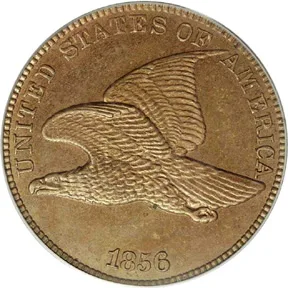
The 1856 Flying Eagle Cent is the most famous and valuable coin in the series, and one of the most collected pattern coins in all of U.S. numismatics. Despite its pattern status, it is universally included in date sets of the series.
Original Mintage and Distribution
The original 1856 mintage is debated, with most sources estimating between 800 and 2,000 pieces struck for distribution to legislators and officials. The coins were used to demonstrate the new small cent and lobby for its authorization. Because the recipients were politicians and other notables — many of whom kept their pieces as souvenirs — survival rates are remarkably high for such a low-mintage issue. Today, perhaps 1,500 to 2,500 examples exist across all grades, including restrikes.
Restrikes and Their Impact
After the 1856 was authorized as a regular issue concept, the Mint quietly produced restrikes through the early 1860s to satisfy collector demand. These restrikes are technically the same coin and are not generally distinguished in the marketplace, though die-state experts can sometimes attribute specific examples. The existence of restrikes explains why the 1856 is more available than its supposed mintage would suggest.
Values and Authentication
An 1856 Flying Eagle Cent in low circulated grade (Good to Fine) sells for $7,500 to $12,000. In Extremely Fine, expect $15,000 to $20,000. Mint State examples in MS-63 typically bring $25,000 to $35,000, with MS-65 and finer examples reaching $50,000 to $100,000 or more. Proof examples are also recognized and bring premiums over comparable Mint State coins. Because of these values, the 1856 is one of the most counterfeited U.S. coins, and any example purchased should be encapsulated by PCGS or NGC.
Common 1856 Counterfeits
The most common counterfeit method is altering an 1858 by tooling the final “8” into a “6.” Look at the bottom of the date numeral under magnification: a genuine 1856 has a distinctive “fancy 6” with a closed loop, while altered 8s often show tooling marks, an asymmetric loop, or remnants of the original digit. Cast counterfeits also exist and typically fail weight, diameter, or detail-sharpness tests.
The 1857 Flying Eagle Cent
The 1857 is the first year of regular Flying Eagle production and the most readily available date in the series. Mintage was a substantial 17,450,000 pieces, reflecting the enormous public demand for the new small cents.
Issue Highlights
1857 Flying Eagle Cents were so popular at release that crowds reportedly lined up outside the Philadelphia Mint to exchange Spanish silver and large cents for them. Many were saved as souvenirs of the new design, which is one reason high-grade examples remain reasonably available today. The 1857 is the most common coin to use for type set examples and is therefore the entry point for most collectors of the series.
Strike Quality
1857 Flying Eagle Cents are notorious for striking weakness, particularly on the eagle’s head and tail and on the corresponding reverse wreath details. Even high-grade Mint State examples typically show some weakness in these areas. Coins with strong central detail command significant premiums, sometimes 50% to 100% more than typical examples of the same numerical grade. This pattern of striking weakness is a hallmark of the series and helps distinguish authentic coins from cast counterfeits, which often show artificially uniform detail.
Values for the 1857
In Good condition, the 1857 sells for $30 to $50. Fine: $50 to $75. Extremely Fine: $100 to $175. About Uncirculated: $200 to $325. MS-63: $400 to $600. MS-65: $1,800 to $3,000. Premium examples with strong strikes can exceed these ranges substantially, while weakly struck “common” examples may sell at the lower end. Proof 1857 examples are extremely rare with mintages estimated at fewer than 100 pieces, and they bring $15,000 to $35,000 in PR-63 to PR-65.
1858 Large Letters vs. Small Letters
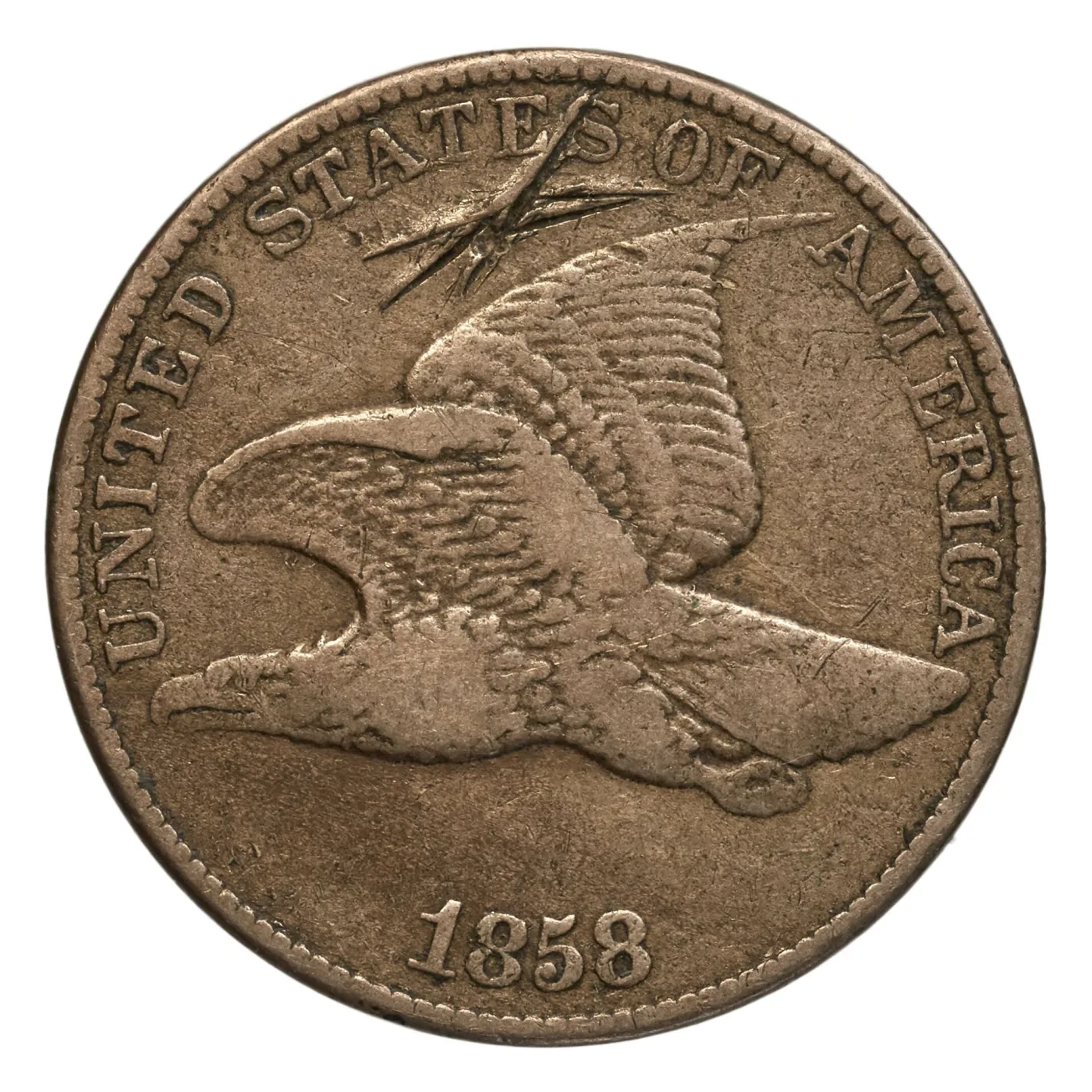
The 1858 Flying Eagle Cent comes in two major obverse varieties distinguished by the size of the lettering in “UNITED STATES OF AMERICA.” Both varieties are scarcer than the 1857 but available in most grades.
Large Letters (LL)
On the Large Letters variety, the inscription is bold and the letters are tall and substantial. Most diagnostic: the letters “AM” in “AMERICA” touch each other at the base. The Large Letters variety was used early in 1858 production and is the more common of the two. Mintage for both 1858 varieties combined was 24,600,000, with the Large Letters representing the larger share — perhaps 60-70% of the total.
Small Letters (SL)
On the Small Letters variety, the inscription is noticeably more delicate, with thinner, slightly shorter letters. The “AM” in “AMERICA” is clearly separated. Small Letters coins were produced later in 1858 as part of the Mint’s experimentation with reducing the relief problems of the design. The two varieties trade at similar prices in most grades, though Small Letters tends to bring a small premium in higher grades because they are less commonly encountered.
Identification Tips
Use a 5x to 10x loupe to examine the lettering carefully. The most reliable diagnostic is the AM spacing, but the overall thickness and height of all letters in the inscription should be examined together. Even worn examples can usually be attributed to one variety or the other if the lettering is at all visible. If you are building a complete date set, owning both varieties is considered standard.
1858 Values
Both varieties in Good: $30 to $50. Fine: $55 to $80. Extremely Fine: $110 to $190. AU: $225 to $350. MS-63: $450 to $700. MS-65: $2,000 to $3,500. Strongly struck examples and Small Letters in higher grades trade at the upper end of these ranges.

The 1858/7 Overdate Variety
One of the most popular and dramatic varieties in 19th-century U.S. coinage, the 1858/7 overdate shows clear remnants of a “7” beneath the second “8” of the date. It is found only on Large Letters obverse coins.
How the Overdate Occurred
In late 1857, the Mint prepared dies dated 1857. Some of these dies were not yet used when the calendar turned to 1858, and rather than discard them, Mint workers re-punched the final digit to convert “7” to “8.” The reworking left visible traces of the underlying “7,” most prominently as a horizontal serif protruding from the upper-left of the second “8.”
Diagnostic Features
Look for these features on a suspected 1858/7: a clear horizontal flag at the upper-left of the second 8 (the top serif of the underlying 7); a small bulge at the lower-right of the same digit; doubled or thickened appearance to the second 8 compared to the first 8; and on strongly struck examples, traces of the curved tail of the 7 inside the lower loop of the 8.
Strong, Weak, and Late Die State
Three sub-states are recognized. Strong overdate coins show all diagnostic features clearly and bring the highest premiums. Weak overdate coins show only the upper flag and partial doubling, typically due to die wear that polished away the underlying details. Late die state coins barely show the overdate at all and trade at modest premiums over normal 1858 examples.
1858/7 Values
Strong overdate in Good: $90 to $140. Fine: $250 to $400. EF: $700 to $1,200. AU: $1,500 to $2,500. MS-63: $5,000 to $8,000. MS-65: $20,000 to $35,000. Weak overdate examples bring 30-50% of these prices, while late die state examples trade at $40 to $100 premiums over normal 1858s. Authentication by PCGS or NGC is essential for any 1858/7 above the $200 to $300 level because of the variety’s value and the difficulty of attributing it correctly.
Proof Flying Eagle Cents
Proof Flying Eagle Cents were struck in tiny quantities for collectors and dignitaries during 1856, 1857, and 1858. They are extremely rare and highly prized.
1856 Proofs
A small fraction of the 1856 mintage was struck as proofs, though distinguishing business strikes from proofs of this date can be difficult because the Mint used dies of similar quality for both. Recognized 1856 proofs show fully mirrored fields, sharp design details, and squared-off rims. Estimates of total 1856 proofs range from 50 to 200 pieces. Values for certified proofs run $30,000 to $100,000+ depending on grade and surface quality.
1857 Proofs
Estimated mintage is 50 to 100 pieces, making the 1857 proof one of the rarest in the entire small cent series. Values: PR-60 around $12,000; PR-63 around $20,000; PR-65 around $40,000; PR-67 and finer reaching six figures.
1858 Proofs
1858 proofs come in both Large Letters and Small Letters obverses, with Large Letters being scarcer. Estimated mintages are 100-200 pieces total. PR-63 examples sell for $15,000 to $20,000, with higher grades climbing rapidly. Cameo proofs (sharp contrast between mirrored fields and frosted devices) bring substantial premiums.
Authenticating Proofs
Proof attribution requires expertise. Look for fully mirrored fields visible from edge to edge, square rims with sharp corners, and crisp design details. Worn or mishandled proofs can lose their mirror surfaces and be confused with business strikes. Always rely on PCGS or NGC certification for proof Flying Eagle Cents.
Grading Flying Eagle Cents
Grading Flying Eagle Cents requires understanding both the standard Sheldon scale and the series-specific complications of strike weakness and copper-nickel surfaces.
Key Grading Focal Points
The eagle’s head, breast feathers, and tail are the highest points of the design and the first to wear. On the reverse, the high points of the wreath leaves and the bow of the ribbon show wear earliest. Because strike weakness in these areas is common even on Mint State coins, grading services distinguish between actual wear (tiny scratches and friction visible under magnification) and weak strike (smooth, rounded relief without surface disruption).
Grade Descriptions
Good (G-4 to G-6): Eagle outline is clear with no internal feather detail. Date is fully readable. Wreath outline is visible on the reverse but leaf detail is mostly worn smooth. ONE CENT is bold.
Very Good (VG-8 to VG-10): Some feather detail visible on the eagle’s wings near the body. Wreath shows partial leaf detail. Date and inscriptions are sharp.
Fine (F-12 to F-15): Approximately half of the eagle’s feather detail is visible. Wreath shows distinct leaves. Some weakness on head and tail is acceptable at this grade.
Very Fine (VF-20 to VF-35): Most feather detail is sharp on the eagle except for the very highest points. Wreath leaves show clear vein detail. Eyes and beak are sharp.
Extremely Fine (EF-40 to EF-45): All design details are sharp with only slight wear on the highest points: eagle’s head, tail, and breast. Mint luster may be present in protected areas.
About Uncirculated (AU-50 to AU-58): Traces of wear are visible only on the highest points. AU-58 examples appear virtually uncirculated with only the slightest friction. Significant mint luster remains.
Mint State (MS-60 to MS-70): No wear is present. Coins in this range are differentiated by surface preservation, luster quality, strike sharpness, and eye appeal. Strike quality is especially important for Flying Eagle grading because the difference between a softly struck MS-63 and a sharply struck MS-63 can be hundreds or thousands of dollars in market value. Mastering grading for this series benefits from comparison study with other 19th-century coins like the Seated Liberty Dollar and Morgan Silver Dollar.
Striking Problems and Die Quality
Strike quality is arguably the single most important factor in grading and valuing Flying Eagle Cents. Understanding the underlying causes helps explain why so many examples appear weak.
Why the Strikes Were Weak
The eagle on the obverse and the wreath on the reverse occupy directly opposing positions on the coin. During striking, both designs needed to be impressed into the planchet at full depth simultaneously. The high relief of the design, combined with the hardness of the copper-nickel alloy (which is significantly harder than pure copper or bronze), required striking pressures that frequently exceeded the Mint’s equipment capabilities. The result was incomplete metal flow into the highest design points.
Common Weakness Areas
Look for weakness on: the eagle’s head feathers above the eye; the eagle’s tail feathers, particularly the central feathers; the eagle’s breast and leg feathers; the wreath leaves opposite the eagle’s head and tail. Coins with strong detail in these areas command premium prices. The grading services note “well struck” or “fully struck” coins on their inserts when warranted, and these notations significantly impact value.
Die Cracks and Other Die Issues
Late die state Flying Eagle Cents often show die cracks, particularly near the rim and through the lettering. These features can add value as they help identify specific die marriages and date the coin’s production within the year. The most dramatic die break on a Flying Eagle Cent is the so-called “Cud at AM” on certain 1858 dies, where a portion of the die rim broke away creating a raised blob of metal on the coin.
Counterfeit Detection and Authentication
The high values of 1856 and 1858/7 Flying Eagle Cents make them frequent targets for counterfeiters. Even common-date 1857s and 1858s in high grade are sometimes faked.
Date Alterations
The most common counterfeit is an altered 1858 made to look like an 1856. Examine the second numeral of the date carefully under 10x magnification. A genuine 1856 has a “fancy 6” with a fully closed loop and a specific shape. Altered coins typically show tooling marks, an unnatural loop shape, or remnants of the original 8 still visible.
Cast Counterfeits
Cast (mold-made) counterfeits exist for all major Flying Eagle dates. Diagnostic features include slightly fuzzy detail, incorrect weight (usually too light), pitted or grainy surfaces under magnification, and visible mold seams on the edge. The plain edge of a Flying Eagle Cent makes mold seams especially detectable on cast fakes.
Modern Replicas and Fantasy Pieces
Modern replicas are widely available and often marked “COPY” as required by U.S. law since 1973. Older replicas may not be marked. Fantasy pieces with impossible date and mint mark combinations (1856-S, 1859 Flying Eagle, etc.) are clearly modern productions and have no authentic counterparts.
Professional Authentication
For any Flying Eagle Cent worth more than $200 to $300, professional authentication by PCGS or NGC is strongly recommended. The cost is modest compared to the value at risk, and a certified holder provides authentication, an objective grade, and tamper-evident encapsulation. The same authentication principles apply to other valuable 19th-century cents like the Lincoln Wheat Penny series.
Current Market Values by Date and Grade
Flying Eagle Cent values vary dramatically by date, variety, grade, and strike quality. The following are typical 2026 retail ranges for properly graded coins.
Common Dates (1857 and 1858 Both Varieties)
Good: $30 to $50. Very Good: $40 to $65. Fine: $50 to $80. Very Fine: $75 to $130. Extremely Fine: $110 to $190. About Uncirculated: $225 to $350. MS-63: $450 to $700. MS-65: $2,000 to $3,500. MS-66: $7,500 to $12,000. MS-67: $25,000+ when available.
Major Varieties
1858/7 Strong Overdate: ranges from $90 (Good) to $35,000+ (MS-65). 1858/7 Weak Overdate: $40 to $200 in circulated grades, with proportional Mint State increases. Premium-strike examples of any date and variety can bring 50% to 100% more than the figures above.
Pattern and Proof Issues
1856 Pattern (any state): $7,500 to $100,000+ depending on grade. 1857 Proof: $12,000 to $100,000+. 1858 Proof: $7,000 to $80,000+. Cameo and Deep Cameo designations bring additional premiums on proof issues.
Market Trends
The Flying Eagle market has been remarkably stable over the past decade, with steady demand from type collectors, series collectors, and date set builders. Premium-strike examples have outpaced typical examples in price appreciation. The 1856 has remained a “trophy coin” with strong floors due to consistent demand and limited supply. For collectors building broader pre-Civil War type sets, Flying Eagle Cents pair well with the Seated Liberty Dollar and similar mid-19th-century series.
Collecting Strategies and Tips
The Flying Eagle Cent series is short, which makes it accessible to collectors at many budget levels. Several common collecting approaches exist.
Type Coin Collection
The simplest approach is to acquire a single representative example of the series for a U.S. type set. An 1857 or 1858 in Extremely Fine or About Uncirculated condition is the typical type-set choice, costing $150 to $325. This gives type collectors representation of the short-lived copper-nickel small cent format without the complications of variety attribution.
Complete Date and Variety Set
A complete Flying Eagle set includes: 1857, 1858 Large Letters, 1858 Small Letters, 1858/7 Overdate, and (for a “complete” set) the 1856 pattern. The first four can be assembled in mid-circulated grades for $350 to $600. Adding the 1856 pushes the budget to $8,000 to $12,000+ depending on grade. This is a commonly pursued goal because the set is short enough to feel attainable and includes a major rarity.
Premium Quality Focus
Some collectors focus on acquiring well-struck, original-surface examples of each issue. This approach prioritizes quality over completeness and rewards careful searching. A premium-strike 1857 in MS-65 with full feather detail can take years to find and may cost twice as much as a typical MS-65 example.
Variety Specialization
The Flying Eagle series has a number of less-publicized varieties beyond the major ones above. Repunched dates, die clashes, and minor doubling exist for both 1857 and 1858. Cherry-picking unattributed examples from dealer inventories is one of the most rewarding ways to build a Flying Eagle collection on a budget.
Proper Storage and Preservation
Copper-nickel cents have specific preservation needs that differ from both pure copper and modern clad coins.
Avoid PVC and Sulfur
Never store Flying Eagle Cents in PVC-containing flips or albums. PVC releases hydrochloric acid over time, which causes a green slime on copper-nickel surfaces that is difficult to remove without harming the coin. Use Mylar flips, inert hard plastic capsules, or the original holders from grading services. Avoid paper envelopes containing sulfur, which causes uneven gray-black toning.
Humidity Control
Store coins in a cool, dry environment with stable humidity below 50%. Silica gel packets in your storage area help absorb moisture. Avoid attics, basements, garages, and rooms that experience temperature swings. Sudden humidity changes can cause condensation that leads to spotting on copper-nickel surfaces.
Handling
Always hold Flying Eagle Cents by their edges. Skin oils contain acids and chlorides that can etch the copper-nickel surface within hours, leaving permanent fingerprints. Use clean cotton or nitrile gloves when handling Mint State or proof examples. Work over a soft padded surface to protect against accidental drops.
Never Clean
Cleaning a Flying Eagle Cent destroys both its natural toning and microscopic surface detail. Cleaned coins receive “details” grades from third-party services and sell at 30% to 70% discounts compared to original-surface examples. Even a coin that looks dark or unattractive is worth more in its natural state than after a chemical or abrasive cleaning. The same warning applies to all early U.S. coins, including pre-1900 issues like the Indian Head Penny and Shield Nickel.
Frequently Asked Questions
Why is the 1856 Flying Eagle Cent so valuable?
The 1856 is a pattern coin produced before the Mint Act of 1857 authorized small cent production. Only an estimated 800 to 2,000 original pieces were struck for distribution to legislators and dignitaries, plus a smaller number of restrikes. Its low mintage, historical significance as the first small cent, and inclusion in date sets of the series have made it one of the most desirable U.S. coins.
How can I tell if my Flying Eagle Cent is the 1858/7 overdate?
Look at the second "8" in the date under 10x magnification. The 1858/7 shows a horizontal flag at the upper-left of the second 8 (representing the top of the underlying 7) and often a bulge at the lower right. Strong examples show clear remnants of the 7's tail inside the lower loop of the 8. Compare to images of certified examples from PCGS and NGC websites.
What is the difference between Large Letters and Small Letters 1858?
The most reliable diagnostic is the spacing between "A" and "M" in "AMERICA." On Large Letters, the A and M touch at the base. On Small Letters, they are clearly separated. Overall, Large Letters lettering is bolder and taller, while Small Letters lettering is thinner and slightly shorter.
Are Flying Eagle Cents made of silver?
No. Flying Eagle Cents are made of 88% copper and 12% nickel. The lighter color compared to bronze cents sometimes leads people to assume silver content, but no Flying Eagle Cents contain silver. The pale tan-gray color comes from the nickel content.
Why are so many Flying Eagle Cents weakly struck?
The high-relief design placed the eagle directly opposite the wreath, requiring metal to flow into deep recesses on both sides simultaneously. The hard copper-nickel alloy made this difficult, and Mint equipment of the era often could not deliver sufficient pressure. The result is widespread weakness on eagle head, tail, and breast feathers, even on uncirculated examples.
What replaced the Flying Eagle Cent?
The Indian Head Cent, designed by James Barton Longacre and introduced in 1859, replaced the Flying Eagle Cent. The Indian Head used the same copper-nickel composition until 1864, then transitioned to bronze. The Indian Head series ran from 1859 to 1909 before being replaced by the Lincoln Cent.
Can I find Flying Eagle Cents in circulation today?
No. Flying Eagle Cents have been out of circulation for well over a century and any surviving examples are in collections, dealer inventories, or estate holdings. They are commonly available through coin dealers, auctions, and online numismatic marketplaces.
Should I clean a dark or dirty Flying Eagle Cent?
Never clean a Flying Eagle Cent. Cleaning removes the original surface and natural toning, leaves microscopic scratches, and dramatically reduces the coin's value. Coins identified as cleaned by grading services receive "details" grades and sell at significant discounts. Even unattractive original-surface coins are worth more than cleaned examples of the same technical grade.