Draped Bust Half Dime Identification Guide: Small Eagle, Heraldic Eagle, Key Dates, and Values
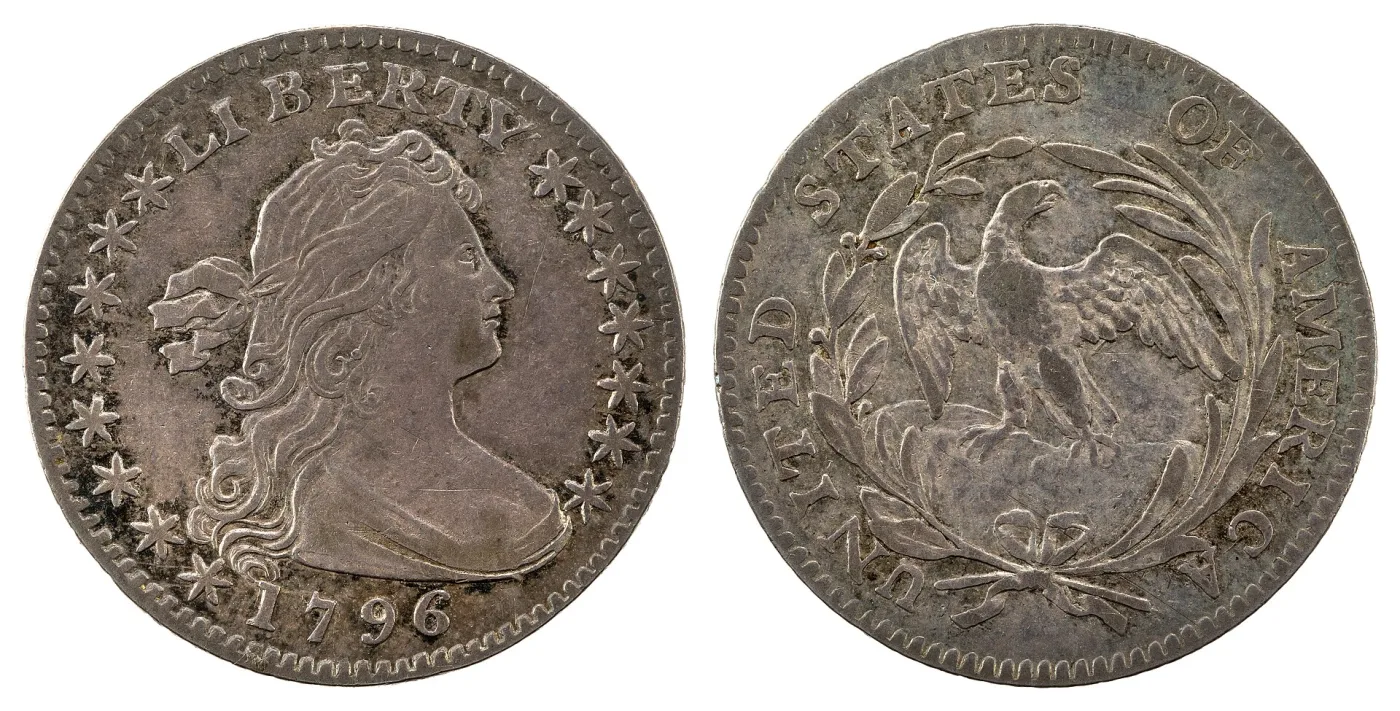
The Draped Bust Half Dime ran from 1796 to 1805 — a short, irregular series that ranks among the most coveted early-silver type coins in all of American numismatics. Struck only intermittently over a ten-year span, with several years skipped entirely, the Draped Bust Half Dime was produced in tiny mintages on the Philadelphia Mint’s hand-operated screw press. Every example was struck on an individually weighed planchet, attributed to a hand-engraved die marriage, and pressed without a retaining collar, so no two are exactly alike. This was the second federal design for the five-cent silver piece, following the brief Flowing Hair Half Dimes of 1794-1795, and it preceded a 24-year gap before the denomination resumed with the Capped Bust Half Dime in 1829.
The design — Robert Scot’s draped Liberty adapted from a Gilbert Stuart drawing — is the same one that appears on the contemporary Draped Bust Dollar and the rest of the period’s silver and copper coinage. Because the half dime was struck in such small numbers and survives in such limited quantity, even common dates carry four-figure premiums in collectible grades, and the legendary 1802 is one of the great rarities of the entire series. This guide walks through every aspect of identifying, attributing, grading, and valuing Draped Bust Half Dimes: how to recognize the two reverse types, navigate the date-by-date rarity landscape, spot the famous 1796 LIKERTY and 1800 LIBEKTY blundered-die varieties, authenticate suspect coins, grade the soft early strikes, and price your half dimes accurately at today’s market.
Whether you have a single inherited five-cent silver piece or are pursuing a complete date-and-type run, this guide will give you the working knowledge to identify any Draped Bust Half Dime with confidence.
History: The Half Dime in the 1790s
The half dime is the oldest denomination in American federal coinage. The very first coins struck under the Mint Act of 1792 were the legendary 1792 half dismes — reportedly produced from silver supplied by George Washington himself — and the five-cent silver piece occupied a place of symbolic importance from the Mint’s earliest days. Regular half dime production began in 1794 with the Flowing Hair design, the same wild-haired Liberty that appears on the first Flowing Hair Dollar.
In 1796 the Mint replaced the Flowing Hair portrait with Robert Scot’s new Draped Bust design across the silver series. The half dime, dime, quarter, half dollar, and dollar all adopted the same draped Liberty within a year or two of each other. The Draped Bust Half Dime was struck in 1796 and 1797, then skipped 1798 and 1799 entirely, resumed in 1800 through 1803, skipped 1804, and made a final appearance in 1805 before the denomination was suspended altogether.
From 1806 to 1828, no half dimes were struck at all: the Mint concentrated its limited silver capacity on the dime, quarter, and half dollar, and the five-cent silver piece was simply not a priority. The denomination did not return until 1829, when improved close-collar steam-press technology made it practical to strike small uniform planchets at speed. That revival produced the Capped Bust Half Dime, which in turn gave way to the long-running Seated Liberty Half Dime in 1837.
The Designers: Robert Scot and Gilbert Stuart
The Draped Bust design originated with a drawing by the famous portraitist Gilbert Stuart, who is said to have based Liberty’s features on Philadelphia socialite Ann Willing Bingham. Mint engraver John Eckstein prepared a model from Stuart’s sketch, and Chief Engraver Robert Scot (1745-1823) cut the working dies. Scot is the same engraver responsible for the entire first generation of federal coinage, including the Draped Bust Dollar and the early Large Cent series. The draped, softly classical Liberty marked a deliberate move away from the rougher Flowing Hair portrait toward a more refined European-style allegory.
Design: Scot’s Draped Bust
Understanding every design element is essential for accurate attribution and authentication. The half dime is the smallest of the Draped Bust silver coins, so the design is densely packed and details are easily lost to wear and to the soft strikes typical of the period.
Obverse (Heads Side)
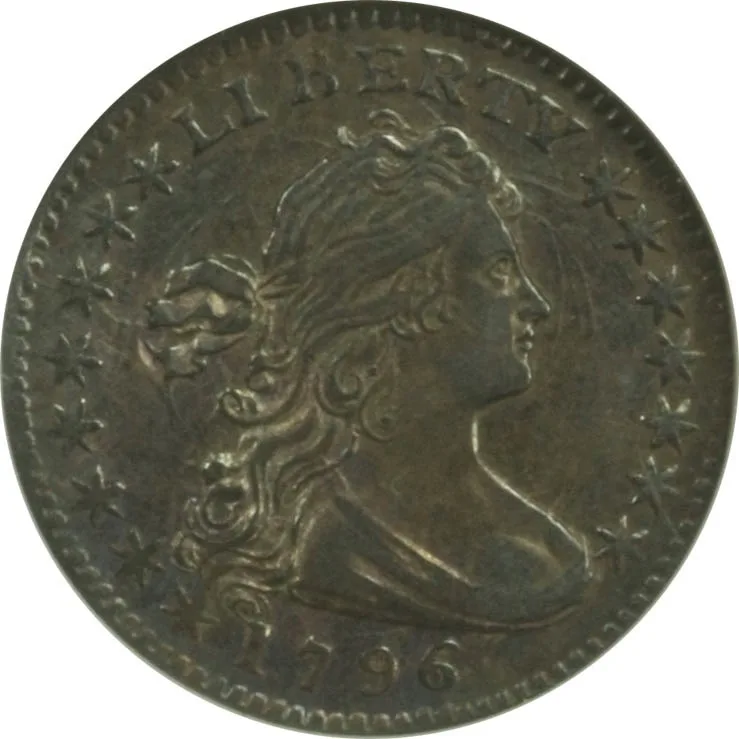
The obverse depicts Liberty facing right, her hair flowing loosely and tied behind with a ribbon, her bust draped in a flowing classical gown. The word LIBERTY arcs across the top, the date sits in the exergue beneath the bust, and stars flank the portrait — the number of stars varies by year and is one of the primary attribution diagnostics (more on this below). Unlike the later Capped Bust Half Dime, Liberty wears no cap; her uncovered, ribbon-tied hair is the defining feature of the Draped Bust portrait.
Reverse (Tails Side)
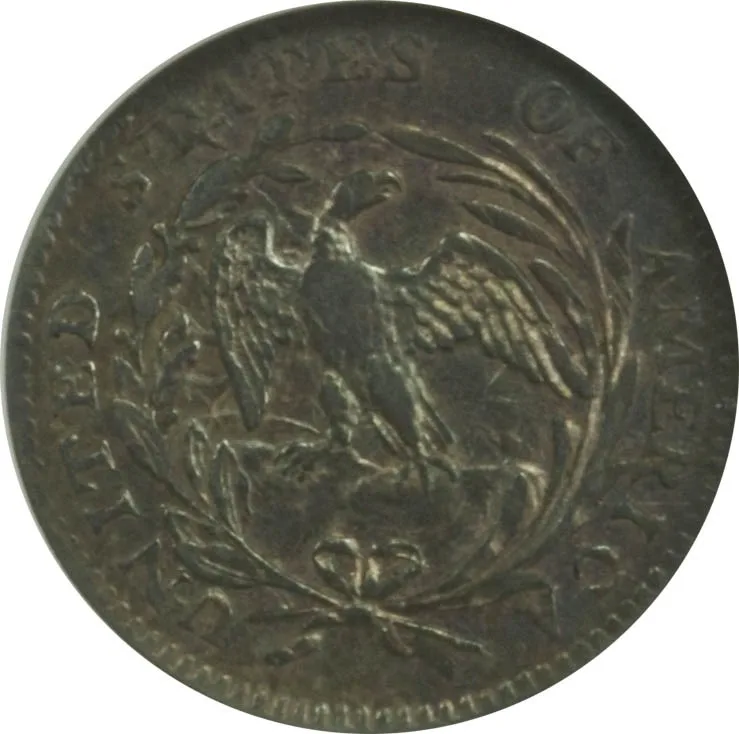
The reverse comes in two distinct types — the Small Eagle (1796-1797) and the Heraldic Eagle (1800-1805) — covered in detail in the next section. Neither reverse carries any statement of denomination or value. There is no “5 C.” or “HALF DIME” anywhere on a Draped Bust Half Dime; the denomination was understood from the coin’s size. This is a key diagnostic: any “Draped Bust” five-cent piece bearing a “5 C.” marking is not genuine, because that abbreviation did not appear on the half dime until the Capped Bust series of 1829.
Edge
All Draped Bust Half Dimes have a reeded edge. Because the coins were struck on an open collar (no retaining ring around the planchet at the moment of striking), diameters vary slightly from coin to coin, and the reeding can appear uneven. This is normal for the open-collar era and is itself a diagnostic of a genuine period strike.
Designer Initials
The Draped Bust Half Dime is unsigned — Scot placed no initial on the coin. New collectors sometimes search the field for a designer mark; there is none. The absence of initials is normal for this series.
The Two Reverse Types: Small Eagle and Heraldic Eagle
The single most important identification step for a Draped Bust Half Dime is determining which of the two reverse types you have. The reverse type, combined with the date, immediately places the coin in its rarity tier.
Small Eagle Reverse (1796-1797)
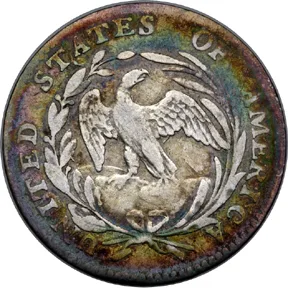
The first reverse shows a small, naturalistic eagle perched on a cloud, surrounded by an open wreath of palm and olive branches, with the legend UNITED STATES OF AMERICA around the rim. This is the same “small eagle” motif found on the early Draped Bust Dollar of 1795-1798. The eagle looks delicate and almost dove-like — collectors sometimes call it the “scrawny eagle.” Only the 1796 and 1797 half dimes use this reverse, and both years are scarce and highly prized.
Heraldic Eagle Reverse (1800-1805)
The second reverse, introduced after the 1798-1799 production gap, shows a heraldic (Great Seal) eagle with a Union shield on its breast, a ribbon reading E PLURIBUS UNUM in its beak, arrows and an olive branch in its talons, and a cluster of stars and clouds above. This is the same heraldic eagle used on the later Draped Bust Dollar and the period gold coinage. All half dimes dated 1800 through 1805 use this reverse.
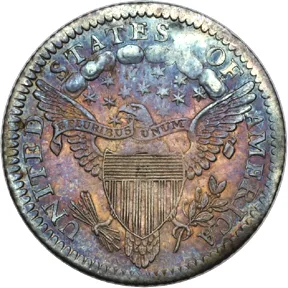
Why the Type Matters
Because no half dimes were struck in 1798 or 1799, the reverse change neatly divides the series into two collectible types: the two-year Small Eagle (1796-1797) and the four-date Heraldic Eagle (1800-1803, 1805). A type collector who wants one of each must acquire two coins; a date collector pursues all six issued dates. The Small Eagle coins are generally scarcer and more expensive than common Heraldic Eagle dates, but the 1802 Heraldic Eagle stands alone as the series’ supreme rarity.
Composition and Specifications
Knowing the metal content and weight is essential for both authentication and bullion-floor valuation. Half dime specifications were stable across the entire Draped Bust run.
Weight and Fineness
- Weight: 1.35 grams (nominal).
- Diameter: approximately 16.5 mm (open-collar strikes vary slightly).
- Composition: 0.8924 silver / 0.1076 copper (89.24% silver — the “standard silver” specification set by the 1792 Mint Act).
- Edge: Reeded.
Silver Content
A Draped Bust Half Dime contains approximately 0.0387 troy ounces of pure silver — exactly half the silver content of the contemporary Draped Bust Dime. At a silver spot of $30/oz the bullion floor is only about $1.16. In practice no genuine Draped Bust Half Dime should ever trade anywhere near melt: the numismatic premium for every date in the series runs into the hundreds or thousands of dollars, dwarfing the trivial silver value.
Weight as Authentication Tool
Use a jeweler’s scale accurate to 0.01 grams. Tolerance for genuine coins is roughly ± 0.05 g, though period planchet adjustment means some honest variation occurs. Cast counterfeits often weigh under standard because period casting alloys were less dense, and base-metal struck fakes can be caught by weight combined with specific-gravity testing. The same authentication discipline applies to the entire early federal silver family — the parallel diagnostics on the larger denomination appear in the Draped Bust Dollar guide.
Mint Marks: A Philadelphia-Only Series
Every Draped Bust Half Dime was struck at the Philadelphia Mint, the only United States mint in operation during this period. There are no branch-mint Draped Bust Half Dimes — the first branch-mint half dime would not appear until the 1838-O Seated Liberty Half Dime from New Orleans, decades later.
What This Means for Identification
No Draped Bust Half Dime carries a mint mark. Any “Draped Bust” half dime offered with an “O,” “S,” “CC,” or “D” mint mark is either a counterfeit or an altered fantasy piece. This is one of the simplest authentication tests in early American silver: if it has a mint mark, it isn’t a genuine Draped Bust Half Dime.
The Implication for Series Difficulty
Because the series is Philadelphia-only, the attribution variables are limited to date, reverse type, and die variety (V- or LM-number). There is no date-and-mint-mark matrix to chase. The challenge in this series is not finding the right mint mark — it is finding any example at all, since survivors of every date are scarce and the 1802 is famously elusive.

The V and LM Variety Systems
Like its sister denominations, the Draped Bust Half Dime was struck from hand-prepared dies on which the stars, date, and design elements were individually positioned. Each die produces distinct micro-diagnostics, and the small number of die marriages across the series are individually catalogued. Two reference systems are in use.
Valentine (V) Numbers
The classic reference is Daniel Valentine’s 1931 monograph “The United States Half Dimes,” which assigned “V” numbers to the die marriages of the early half dime series. For decades, collectors attributed Draped Bust Half Dimes by Valentine number — for example, 1797 V-2 (the popular 15-stars variety).
Logan-McCloskey (LM) Numbers
The modern standard is the Logan-McCloskey numbering system from Russell Logan and John McCloskey’s “Federal Half Dimes 1792-1837” (1998), published by the John Reich Collectors Society. LM numbers cover the entire bust half dime era — Flowing Hair, Draped Bust, and Capped Bust — and are the references you will see on PCGS and NGC variety-attributed slabs today. Most catalogs cross-reference the older V numbers alongside LM numbers, so attributions are often written as “1800 LM-1 (V-1).”
How the Numbers Work and Why They Matter
Each unique obverse-reverse die pairing receives a number, and attribution requires matching obverse diagnostics (star count and position, date placement, die cracks) with reverse diagnostics. Because the half dime had so few die marriages, the variety system here is far simpler than the deep die-marriage runs of the contemporary Large Cent or the later Capped Bust Half Dime. For Draped Bust Half Dimes the most consequential attributions are the date, the reverse type, and a handful of dramatic varieties such as the star-count and blundered-die issues discussed below.
Key Dates and Major Varieties
The Draped Bust Half Dime has one supreme key — the 1802 — and several other scarce or condition-sensitive issues. Memorize these, because they are where premiums and counterfeits concentrate. All values below assume problem-free, original coins.
Scarce Dates and Major Varieties
- 1802 (the series king): The great rarity of the series, with a reported mintage around 3,060 and roughly 35-45 examples believed to survive in all grades. Most known pieces are well worn. Even a low-grade Good example brings five figures, and higher grades reach into the hundreds of thousands at auction. This is one of the classic early-American rarities, comparable in collector lore to the 1804 dollar within its own series.
- 1796 (first year, Small Eagle): The first Draped Bust Half Dime. Scarce in all grades and always in demand as a first-year, type, and date coin.
- 1796 LIKERTY: A famous blundered-die variety where Liberty’s name appears to read LIKERTY (see the dedicated section below). Highly collectible and premium-priced.
- 1797 15 Stars and 1797 16 Stars: The 1797 obverse appears in 13-, 15-, and 16-star configurations. The 15- and 16-star varieties are popular and the most frequently encountered; the 13-star is scarcer.
- 1800 LIBEKTY: A second famous blundered-die variety where the legend appears to read LIBEKTY. A signature variety of the Heraldic Eagle type.
- 1803 Large 8 / Small 8: Two date-punch varieties distinguished by the size of the final digit; the Small 8 is scarcer.
“Common” Dates
By the standards of this rare series, the 1800, 1801, 1803, and 1805 Heraldic Eagle issues are the more available dates — but “common” is relative. Even these dates are genuinely scarce, with surviving populations in the low thousands, and they command strong four-figure prices in collectible grades. There is no truly inexpensive Draped Bust Half Dime.
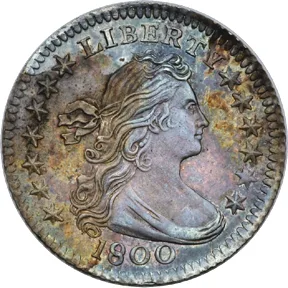
Condition Rarities
Almost no one set aside half dimes in the early 1800s; they were small-change coins that circulated hard. As a result, high-grade survivors of any date are extremely scarce, and Mint State examples are major rarities. A date that brings $1,500 in Good might bring $25,000 or more in Mint State. The series rewards condition-conscious collectors as much as date and type collectors.
Blundered Dies: LIKERTY and LIBEKTY
Two of the most beloved varieties in early American numismatics are the Draped Bust Half Dime’s blundered-die LIBERTY misspellings. Because dies were engraved by hand with individual letter punches, occasional errors slipped through — and on a series this small and scarce, they became celebrated rarities rather than mere curiosities.
1796 LIKERTY
On one 1796 obverse die, the “B” in LIBERTY was so weakly or incorrectly entered that the word appears to read LIKERTY. The defect is visible to the naked eye on a well-preserved example and is a permanent feature of every coin struck from that die. The 1796 LIKERTY is one of the most famous blundered-die varieties of the entire Draped Bust era and commands a substantial premium over a normal 1796.
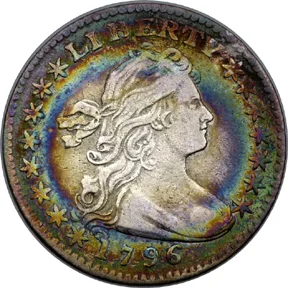
1800 LIBEKTY
On a 1800 Heraldic Eagle obverse die, a similar engraving slip makes the legend appear to read LIBEKTY — the “R” rendered to resemble a “K.” This is the signature variety of the 1800 date and is widely collected. Like the LIKERTY, it is a die-stage feature present on every strike from that die, not a post-mint alteration.
How to Confirm a Blundered-Die Variety
Examine the lettering under 10x magnification. A genuine LIKERTY or LIBEKTY shows the malformed letter cut crisply into the die with the same surface and toning as the surrounding legend — the defect is part of the struck design, not scratched, tooled, or altered after minting. Be wary of coins where the “error” appears to be post-mint damage or where the date and lettering do not match a catalogued die marriage. Because these varieties carry large premiums, third-party authentication is strongly recommended before buying.
Grading Draped Bust Half Dimes
Draped Bust Half Dime grading follows the Sheldon 70-point scale, but the soft strikes and tiny size of the series make grading genuinely difficult. Accurate grading matters enormously because price-grade curves are steep — moving up one or two grades on a scarce date can multiply value several times over.
Key Wear Points
On the obverse, the earliest wear shows on the high points of Liberty’s hair, on her cheek and the central drapery folds across the bust. On the reverse, wear first flattens the eagle’s head and the tops of the wings (Small Eagle) or the eagle’s breast feathers and the clouds (Heraldic Eagle). Because the coin is so small, wear concentrates quickly and even slight rub dramatically reduces detail.
Grade Definitions
- About Good (AG-3): Date and major outlines visible; much of the lettering worn into the rim.
- Good (G-4 to G-6): Full date and full rim. LIBERTY partly readable. Bust and eagle outlines complete but flat.
- Very Good (VG-8 to VG-10): All major features visible. Some hair and drapery detail returns. LIBERTY readable.
- Fine (F-12 to F-15): LIBERTY clear. Hair shows partial detail. Eagle shows feather separation in protected areas.
- Very Fine (VF-20 to VF-35): Most hair detail distinct. Drapery lines clear. Eagle feathers well defined.
- Extremely Fine (XF-40 to XF-45): Light wear on highest points only. Sharp detail. Some original luster may remain in protected areas.
- About Uncirculated (AU-50 to AU-58): Trace wear on highest points only. Significant original luster.
- Mint State (MS-60 to MS-70): No wear. Graded by strike quality, surface preservation, and luster. Genuine Mint State Draped Bust Half Dimes are major rarities.
Strike Quality
Open-collar screw-press strikes are notoriously uneven. Many Draped Bust Half Dimes show striking weakness on the obverse stars, on Liberty’s hair, and on portions of the eagle — softness that can be mistaken for wear. Adjustment marks (faint parallel file marks where an overweight planchet was filed down before striking) are common and are a sign of originality, not damage. Always distinguish honest wear from original strike softness; experienced graders and the standard references describe typical strike characteristics for individual die marriages.
Authentication and Spotting Counterfeits
Because Draped Bust Half Dimes are scarce and valuable, they attract counterfeiters and alterers. The most dangerous fakes target the key 1802 and the famous LIKERTY and LIBEKTY varieties. Threats fall into three categories: cast and struck counterfeits, altered dates (changing a common date into a rare one), and “added” varieties (tooling an ordinary coin to fake a blunder).
Weight and Specific Gravity
Standard weight is 1.35 g ± 0.05 g. Specific gravity for the 89.24% silver alloy is approximately 10.34. Cast lead-tin counterfeits typically test well below that, and base-metal silver-plated fakes are lower still. A precision scale and a specific-gravity test are the most reliable starting tools — especially valuable on a coin this small, where visual diagnostics are harder to read.
Altered Dates
The 1802 is so valuable that altering a common Heraldic Eagle date (such as 1801 or 1803) into an 1802 is a known fraud. Examine the date digits under magnification for tooling, re-engraving, or surface disturbance around the numerals. A genuine 1802 must also match a catalogued die marriage in every detail — date position, star placement, die cracks, and reverse diagnostics. Any 1802 offered without third-party certification should be treated with extreme caution.
Mint Mark Additions
Any Draped Bust Half Dime with a mint mark is fake. Period. The Philadelphia Mint used no mint mark, and no branch mint struck half dimes until the 1838-O Seated Liberty Half Dime. A mint mark on a “Draped Bust” half dime is an immediate red flag.
Surface and Variety Diagnostics
Genuine Draped Bust Half Dimes show honest open-collar reeding, occasional adjustment marks, and die characteristics matching a known marriage. Cast counterfeits show pebbly surfaces, soft details, and seam tooling at the rim; struck modern fakes are often too smooth or have mushy lettering. A coin that does not match any catalogued die marriage should be treated with suspicion. The same authentication discipline applies across the period — see the Draped Bust Dollar guide for closely related counterfeit-detection methods.
Third-Party Grading
For any Draped Bust Half Dime — and absolutely for the 1802, the LIKERTY, the LIBEKTY, or any uncirculated example — third-party authentication through PCGS or NGC is essential. Given the values involved, no significant Draped Bust Half Dime should be bought raw without expert examination.
Current Market Values and Price Guide
Values below are approximate retail for problem-free, original coins as of 2026. Auction results, cleaned or problem coins, scarce die marriages, and exceptional specimens vary widely. Note that even the “common” dates in this series are scarce and expensive.
Heraldic Eagle Common Dates (1800, 1801, 1803, 1805)
- G-4: $700-$1,100
- VG-8: $1,000-$1,500
- F-12: $1,500-$2,200
- VF-20: $2,500-$4,000
- XF-40: $5,000-$8,000
- AU-50: $9,000-$15,000
- MS-63: $25,000-$45,000+
Small Eagle and Better Dates
- 1796 (first year, Small Eagle): G-4 $1,500, F-12 $4,000, XF $12,000+, MS major rarity.
- 1796 LIKERTY: Strong premium over normal 1796; G-4 $2,000+, XF $15,000+.
- 1797 15 Stars / 16 Stars: G-4 $1,200-$1,600, F-12 $3,000-$4,500, XF $9,000+.
- 1800 LIBEKTY: Premium over normal 1800; G-4 $1,000+, XF $7,000+.
- 1803 Small 8: Scarcer than Large 8; meaningful premium across grades.
The 1802 Key Date
- 1802: AG-3 $20,000-$30,000, G-4 $35,000-$60,000, VG-F $80,000-$150,000+, and the finest known examples reach several hundred thousand dollars at auction. Roughly 35-45 are believed to exist.
Pricing Resources
For current market data, consult the PCGS Price Guide, NGC Price Guide, and recent auction archives at Heritage Auctions, Stack’s Bowers, and Great Collections. The “Greysheet” (Coin Dealer Newsletter) provides wholesale bid/ask pricing. For die-marriage-specific results and population context, the John Reich Collectors Society’s John Reich Journal publishes specialist data not captured in general price guides.
Building a Draped Bust Half Dime Collection
The Draped Bust Half Dime can be collected at several levels, but every level requires a meaningful budget given the scarcity of the series. Here are the most popular strategies.
Type Coin (1 Coin)
The simplest approach: a single representative example for an early-silver type set. Most collectors choose a problem-free common-date Heraldic Eagle (1800, 1801, 1803, or 1805) in VG to Fine, which runs roughly $1,000-$2,200 — by far the most affordable way to own the design.
Two-Type Set (2 Coins)
One Small Eagle (1796 or 1797) and one Heraldic Eagle (any common date). This captures both reverses and is a satisfying mid-level goal. Budget several thousand dollars depending on grade, with the Small Eagle being the more expensive of the two.
Date Set (6 Issued Dates)
One example of each date struck: 1796, 1797, 1800, 1801, 1803, and 1805 — plus the formidable 1802 for a truly complete set. Without the 1802, a circulated date set is challenging but achievable for a dedicated collector over time. With the 1802, the set becomes a major lifetime accomplishment costing well into six figures.
Variety Set (Specialist)
Add the celebrated varieties: 1796 LIKERTY, 1797 13/15/16 Stars, 1800 LIBEKTY, and 1803 Large/Small 8. Pursuing these by V- or LM-number is the deepest form of Draped Bust Half Dime collecting. The same kind of specialist die-marriage collecting drives the parallel Capped Bust Half Dime and Flowing Hair series.
Condition Set
Pursue the highest grade attainable for each date. Because Mint State survivors are so rare, a true high-grade set is the province of advanced collectors with substantial budgets and great patience.
Cleaning, Toning, and Preservation
Draped Bust Half Dimes are well over 200 years old. Most have circulated extensively, and many have been cleaned or tampered with at some point in their long lives. Knowing what to look for protects a significant investment.
Original Surfaces
An original Draped Bust Half Dime shows soft, even patina — typically gray, gold, or russet toning from long storage — and unbroken surfaces in the protected areas of the design. On Mint State pieces, look for soft cartwheel luster. Faint adjustment marks beneath the design are normal striking artifacts and do not reduce value the way scratches or cleaning do. The fields should never look brilliantly bright on a circulated coin — bright, “washed-out” surfaces signal cleaning.
Signs of Cleaning
Look for unnaturally bright fields, concentric hairline scratches (wheel polishing), random hairlines (rag wiping), pitted or frosty surfaces (acid dip), and milky residue in protected areas (incomplete rinsing). Cleaned Draped Bust Half Dimes are worth roughly 30-50% of problem-free pricing — a large penalty on coins this valuable.
Storage Recommendations
Store Draped Bust Half Dimes in inert holders: PCGS / NGC slabs (for certified coins), Mylar 2x2 flips, or Saflips. Avoid PVC-containing soft flips, which leach acids and damage silver over time. Keep storage cool and dry (under 50% relative humidity). Never clean a Draped Bust Half Dime, no matter how dirty it looks — cleaning destroys value irreversibly and is easily detected by graders. If a coin truly needs conservation, send it to NCS (NGC’s conservation service) or PCGS Restoration rather than attempting home methods. The same preservation principles apply to all early federal silver — see the broader Complete Coin Identification Guide for general advice.
Frequently Asked Questions
What is the rarest Draped Bust Half Dime?
The 1802 is the undisputed key date and one of the great rarities of early American coinage, with roughly 35-45 examples believed to survive. Most are heavily worn, and even low-grade pieces bring five figures. After the 1802, the Small Eagle 1796 and 1797 issues and the blundered-die varieties (1796 LIKERTY, 1800 LIBEKTY) are the most sought-after.
What is the difference between the Small Eagle and Heraldic Eagle reverses?
The Small Eagle reverse (1796-1797) shows a small, naturalistic eagle perched on a cloud within an open wreath. The Heraldic Eagle reverse (1800-1805) shows a Great Seal eagle with a Union shield, E PLURIBUS UNUM ribbon, and stars and clouds above. The reverse type, combined with the date, is the first thing to determine when identifying a Draped Bust Half Dime.
Why were no half dimes made in 1798, 1799, or 1804?
The early Mint struck coins as bullion depositors requested them and as dies and capacity allowed, so production of any single denomination was irregular. No half dimes were struck in 1798, 1799, or 1804, and the denomination was suspended entirely after 1805, not resuming until the Capped Bust Half Dime of 1829.
Does a Draped Bust Half Dime have a denomination on it?
No. The Draped Bust Half Dime carries no statement of value — there is no "5 C." or "HALF DIME" anywhere on the coin. The denomination was understood from the coin's size. Any "Draped Bust" five-cent piece marked with a value is not genuine.
Are there mint marks on Draped Bust Half Dimes?
No. Every Draped Bust Half Dime was struck at Philadelphia, which used no mint mark. Any Draped Bust Half Dime with a mint mark is fake. The first branch-mint US half dime is the 1838-O Seated Liberty Half Dime.
How much is a typical Draped Bust Half Dime worth?
Even "common" Heraldic Eagle dates (1800, 1801, 1803, 1805) bring roughly $700-$1,100 in G-4, $1,500-$2,200 in F-12, and $5,000-$8,000 in XF-40. Small Eagle dates and the famous varieties run higher, and the 1802 brings tens to hundreds of thousands of dollars. There is no inexpensive Draped Bust Half Dime — always check the date AND reverse type before pricing.
Should I clean my Draped Bust Half Dime?
Absolutely not. Cleaning destroys 30-70% of value irreversibly and is easily detected by graders. Even "gentle" methods like distilled water rinses can disturb original surfaces. On a coin worth four or five figures, the financial stakes are enormous. If conservation is genuinely needed, send it to NCS or PCGS Restoration — never attempt home cleaning.
How does the Draped Bust Half Dime compare to the Capped Bust Half Dime?
The Draped Bust Half Dime (1796-1805) is the earlier, much scarcer series with Robert Scot's draped Liberty, struck on an open collar in tiny mintages — every date is expensive. The Capped Bust Half Dime (1829-1837) is the later revival with John Reich's capped Liberty, struck on a close collar in larger numbers, and is far more affordable and beginner-friendly. Both are 89.24% silver and Philadelphia-only.