Half Cent Identification Guide: Liberty Cap, Draped Bust, Classic Head, Braided Hair, Key Dates, and Values
The Half Cent is the smallest face-value coin ever struck for circulation by the United States Mint, and arguably the most overlooked. Produced from 1793 through 1857 in pure copper, the Half Cent passed through four distinct major design types and represents the entire arc of early American copper coinage in a single denomination. It was among the first coins authorized by the Mint Act of 1792 alongside the large cent — the true federal coinage that succeeded the privately contracted 1787 Fugio Cent, the first coin ever issued under the authority of the United States — and its 64-year run spans the federal era from George Washington’s first administration through James Buchanan’s. Yet despite its historical significance, mintages were tiny by modern standards, several years saw no production at all, and the final two decades of the series were almost entirely proof-only — making the Half Cent one of the most rewarding and accessible early American series for the patient collector.
Half Cents come in four headline types: Liberty Cap (1793-1797), Draped Bust (1800-1808), Classic Head (1809-1836), and Braided Hair (1840-1857). Each type was the work of a different Mint engraver, reflects a different era of American coinage technology, and presents its own identification, attribution, and grading challenges. Within these types live some of the most legendary American copper rarities: the 1793 first-year issue with its Roman-styled Liberty Head, the 1796 With Pole and No Pole varieties, the 1811 with mintage of just 63,140, and the proof-only original strikings of 1840-1848 that exist in mintages of fewer than two dozen pieces each.
This guide is the comprehensive 2026 reference for identifying, attributing, grading, authenticating, and valuing Half Cents. You will learn how to distinguish the four major types at a glance, how to attribute the Cohen and Breen die varieties that drive specialist premiums, how to recognize the proof-only and original-versus-restrike issues, how to detect the most common counterfeits and altered dates, and how to price your coin accurately in today’s market. Whether you are pulling a mystery copper from an old estate, building a four-coin Half Cent type set for a U.S. type collection, or chasing one of the great American copper rarities, the Half Cent rewards study with one of the richest fields in early American numismatics.
History and Background of the Half Cent
The Half Cent was authorized by the Mint Act of April 2, 1792, the same legislation that created the United States Mint and established the basic structure of American coinage. Although decimal denominations like the dime and dollar are remembered as the act’s signature creations, the Half Cent and the large cent were the first coins struck for general circulation, beginning production in 1793. The denomination was conceived as essential subsidiary coinage in an era when many transactions still used Spanish reales, English pence, and a chaotic mix of foreign and colonial coppers — a federal half cent could substitute precisely for the half-penny that ordinary commerce demanded.
Throughout its 64-year run the Half Cent suffered chronic neglect. The Mint produced it sporadically: there was no production in 1798, 1799, 1801, 1812-1824, 1827, 1830, 1837-1839, or 1858 (after the series ended). Mintages were almost always small relative to the large cent, sometimes by a factor of ten or more. The denomination was unpopular in commerce — it was simply too small to bother with for most transactions, and merchants and customers alike preferred to round up to the cent. Despite these difficulties, the Half Cent persisted because Congress declined to formally abolish it until the Mint Act of February 21, 1857, which also ended the large cent and ushered in the small cent era of the Flying Eagle Cent.
Companion to the Large Cent
For its entire run the Half Cent was the smaller companion to the U.S. Large Cent, which uses parallel design progression — Liberty Cap, Draped Bust, Classic Head, and Coronet/Braided Hair. The two denominations share engravers, design vocabulary, and to some extent technology. Many of the great rarities in early American copper involve both denominations: collectors who pursue Half Cents almost invariably collect early large cents as well, and the variety reference systems for the two series (Cohen for Half Cents, Sheldon and Newcomb for large cents) developed together.
End of the Series
By the 1850s the Half Cent had become almost vestigial. The 1849-1857 mintages averaged only about 40,000 per year, and most of these went directly to dealers and collectors rather than commerce. The 1857 final-year issue had a mintage of just 35,180. The Mint Act of 1857 finally retired the denomination along with the large cent, replacing both with the smaller, lighter copper-nickel small cent that made the leap into modern American coinage.
The Four Major Types at a Glance
Half Cent type identification is the first and most important step in attributing any coin in the series. The four types are visually distinct and span the full range of early American Mint engraving styles.
Liberty Cap (1793-1797)
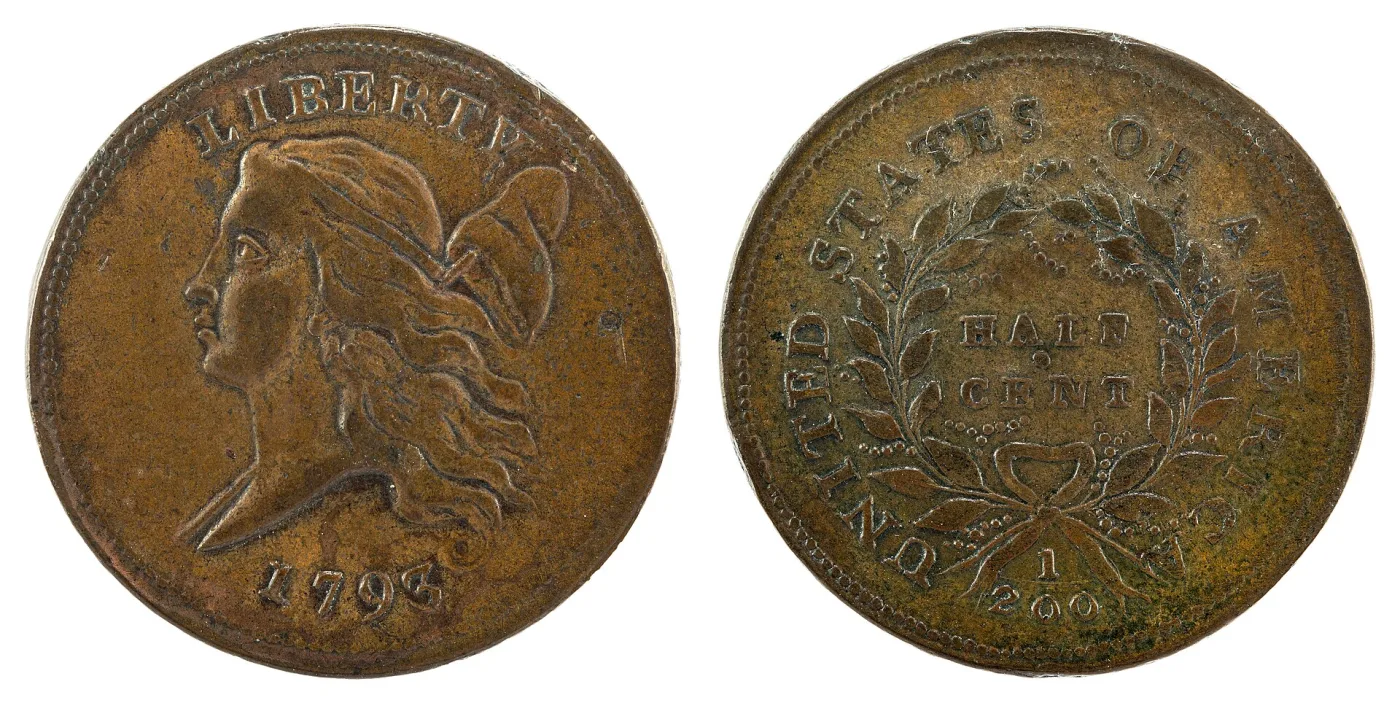
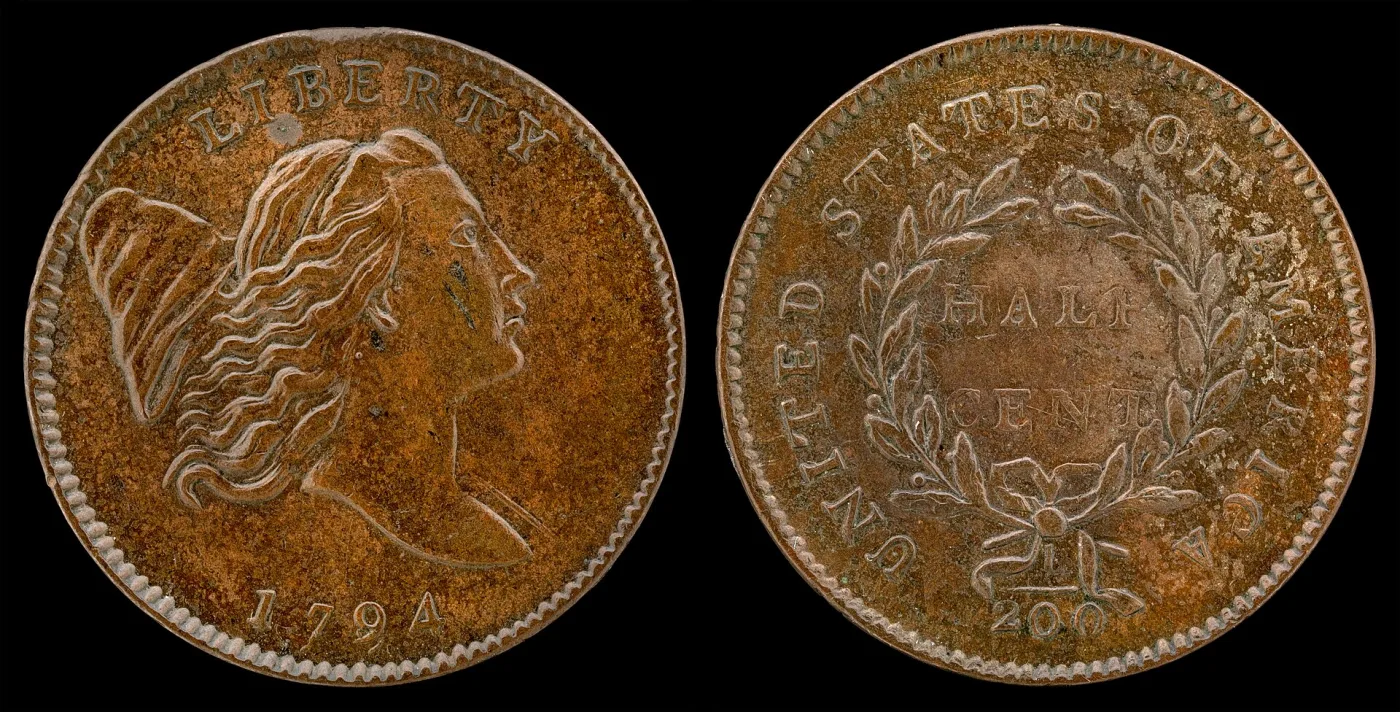
The earliest type shows Liberty facing left in 1793 only, then facing right from 1794 onward. A Phrygian liberty cap perches on a pole behind the head. The reverse displays the denomination “HALF CENT” within a wreath, with “1/200” beneath as a fraction indicating the coin’s value as a fraction of a dollar. The 1793 type is the only one-year sub-type and is the most desirable single year of the series.
Draped Bust (1800-1808)
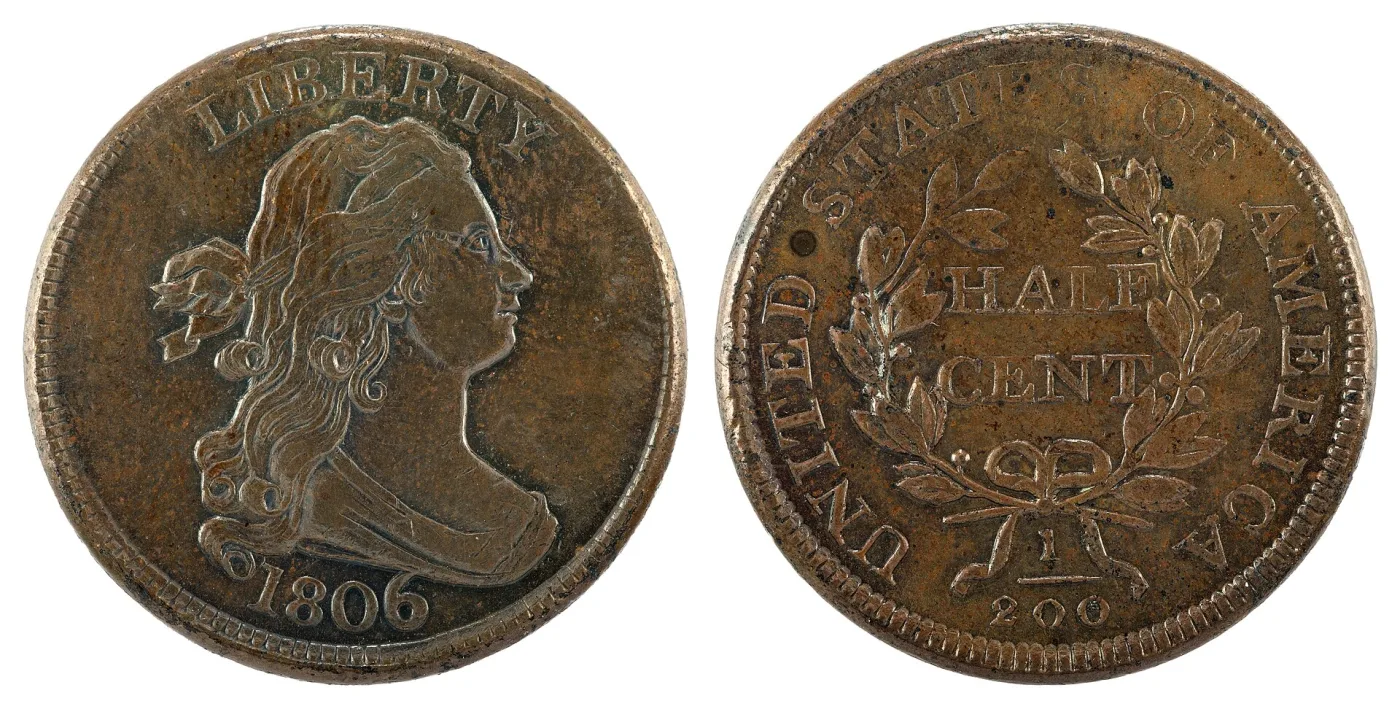
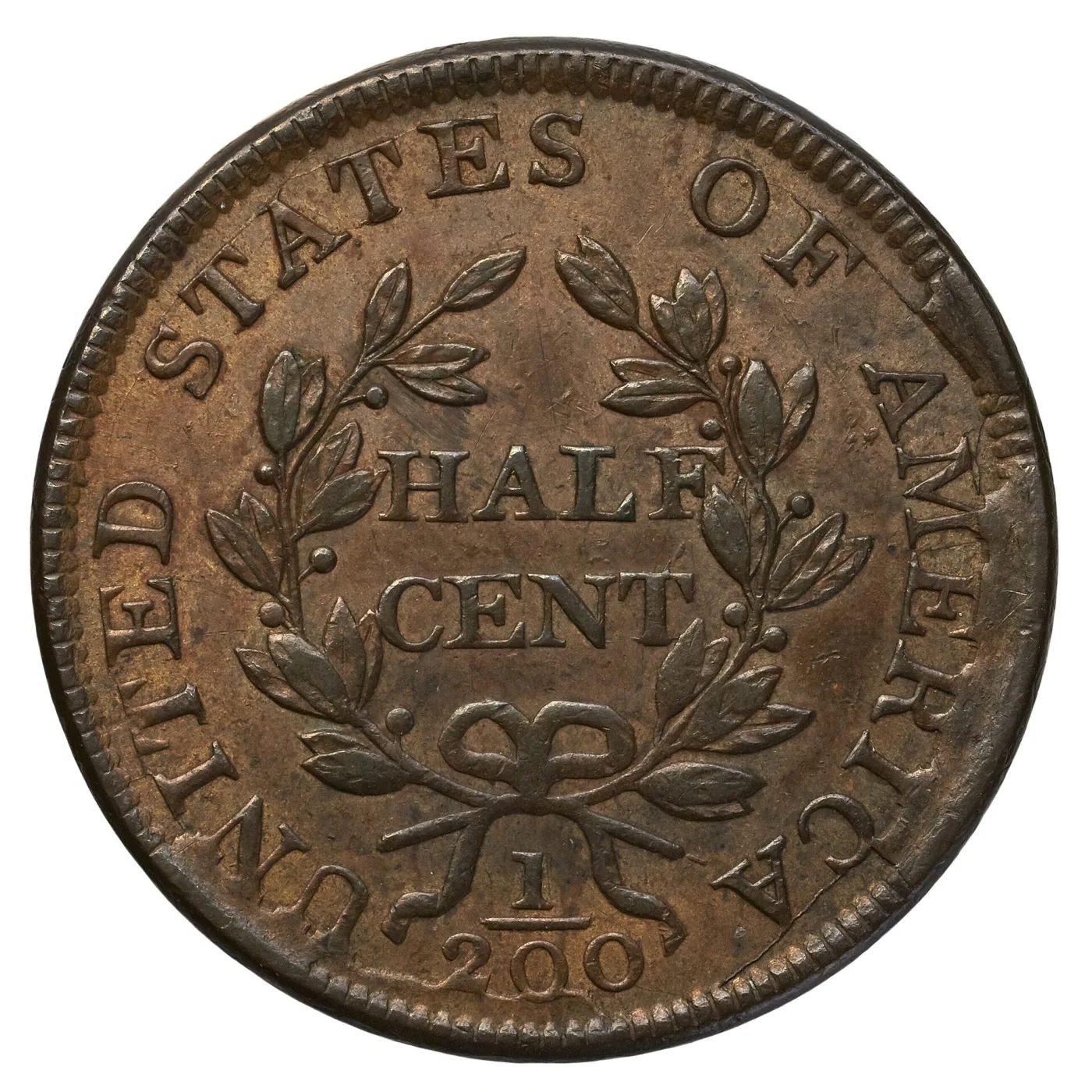
The Draped Bust Half Cent type by Robert Scot shows Liberty facing right with flowing hair partly tied behind and a piece of drapery (often a ribbon) at the bust line. The reverse retains the wreath with “HALF CENT” and the “1/200” fraction. This type was used for both Half Cents and large cents and shares its design vocabulary with other denominations of the era, most prominently the silver Draped Bust Dollar that introduced the portrait to US coinage in 1795. There was no production in 1798, 1799, or 1801 — the type begins effectively in 1800.
Classic Head (1809-1836)
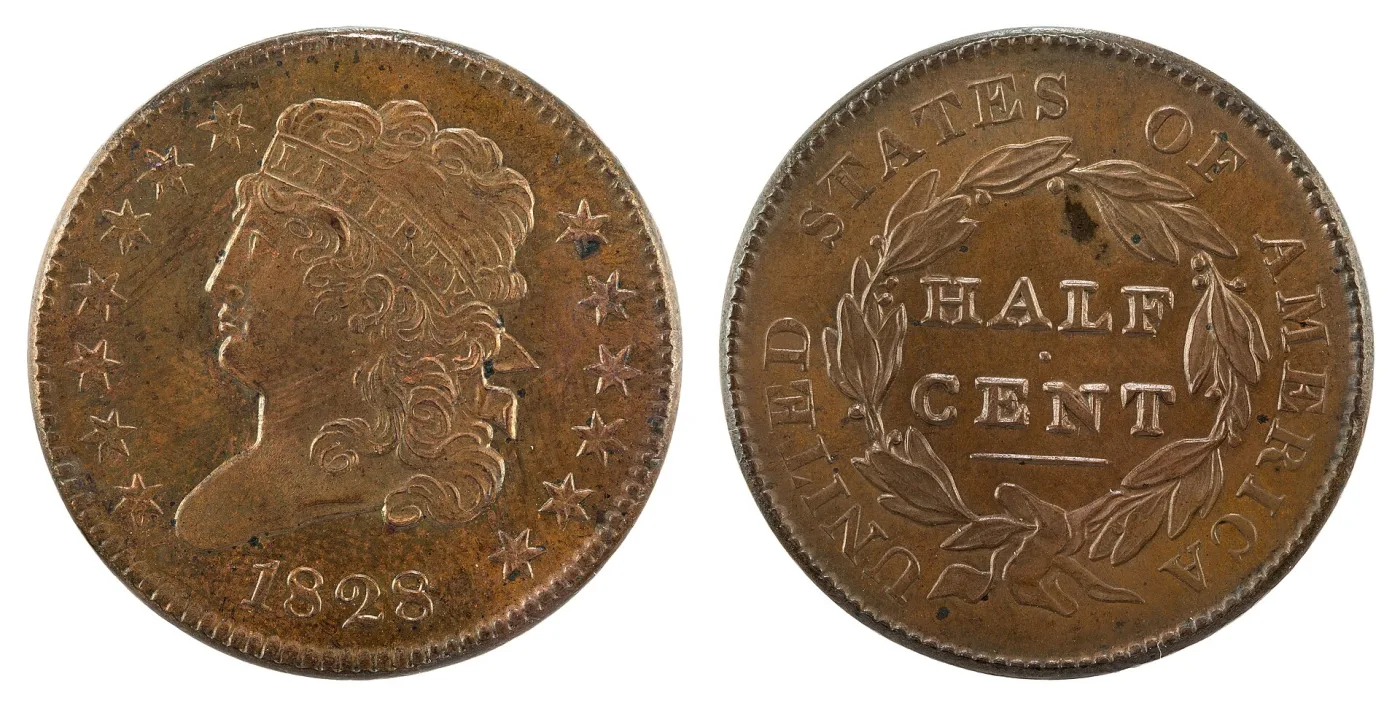
John Reich’s Classic Head Half Cent type shows Liberty facing left, wearing a band inscribed “LIBERTY” across the forehead — the so-called “Classic” or Greek-revival style. The reverse drops the “1/200” fraction and shows just “HALF CENT” within a wreath. Production in this type was extremely irregular: nothing was struck from 1812 through 1824, nothing in 1827, nothing in 1830, and several years (1831, 1836) are nominally proof-only or have unusual production characteristics.
Braided Hair (1840-1857)
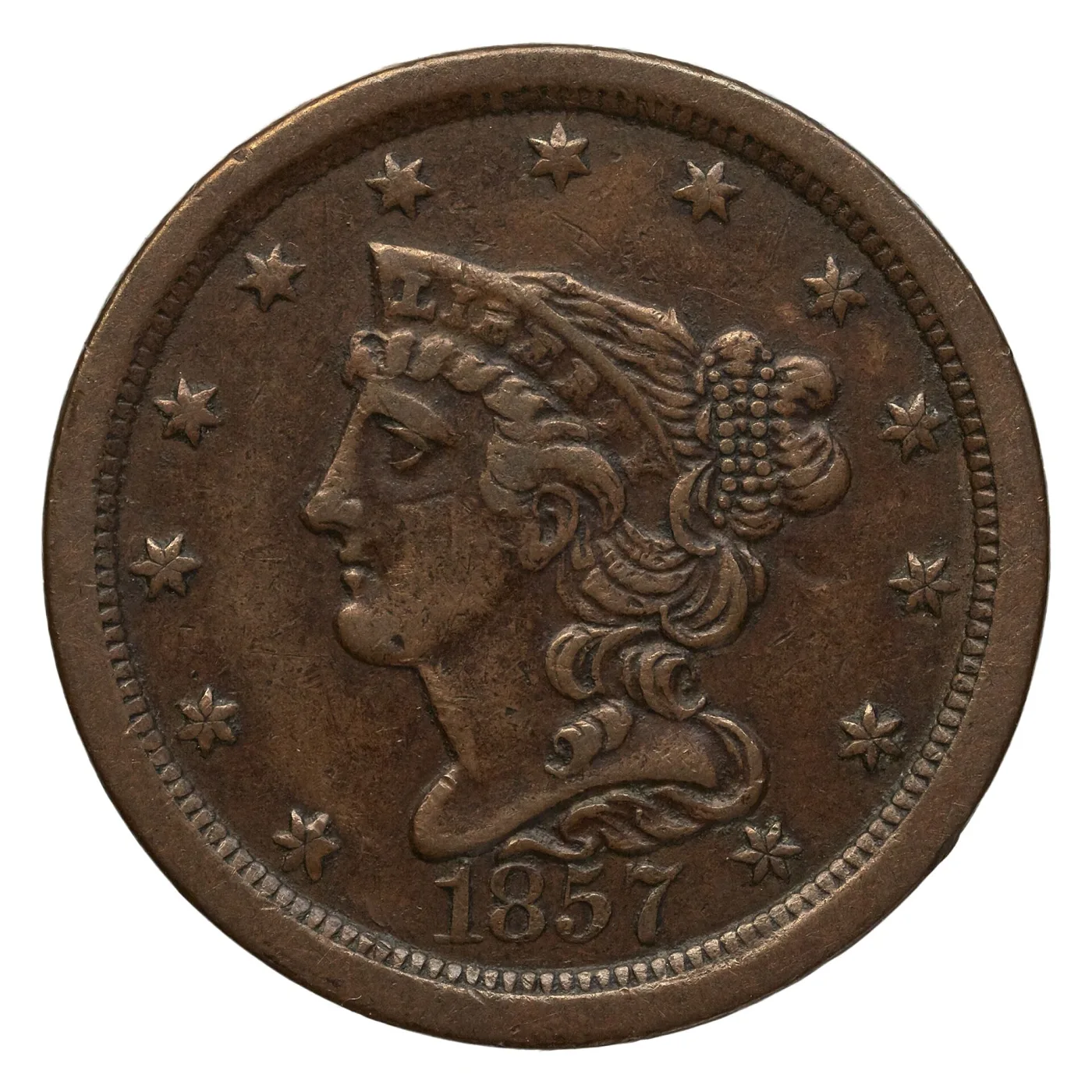
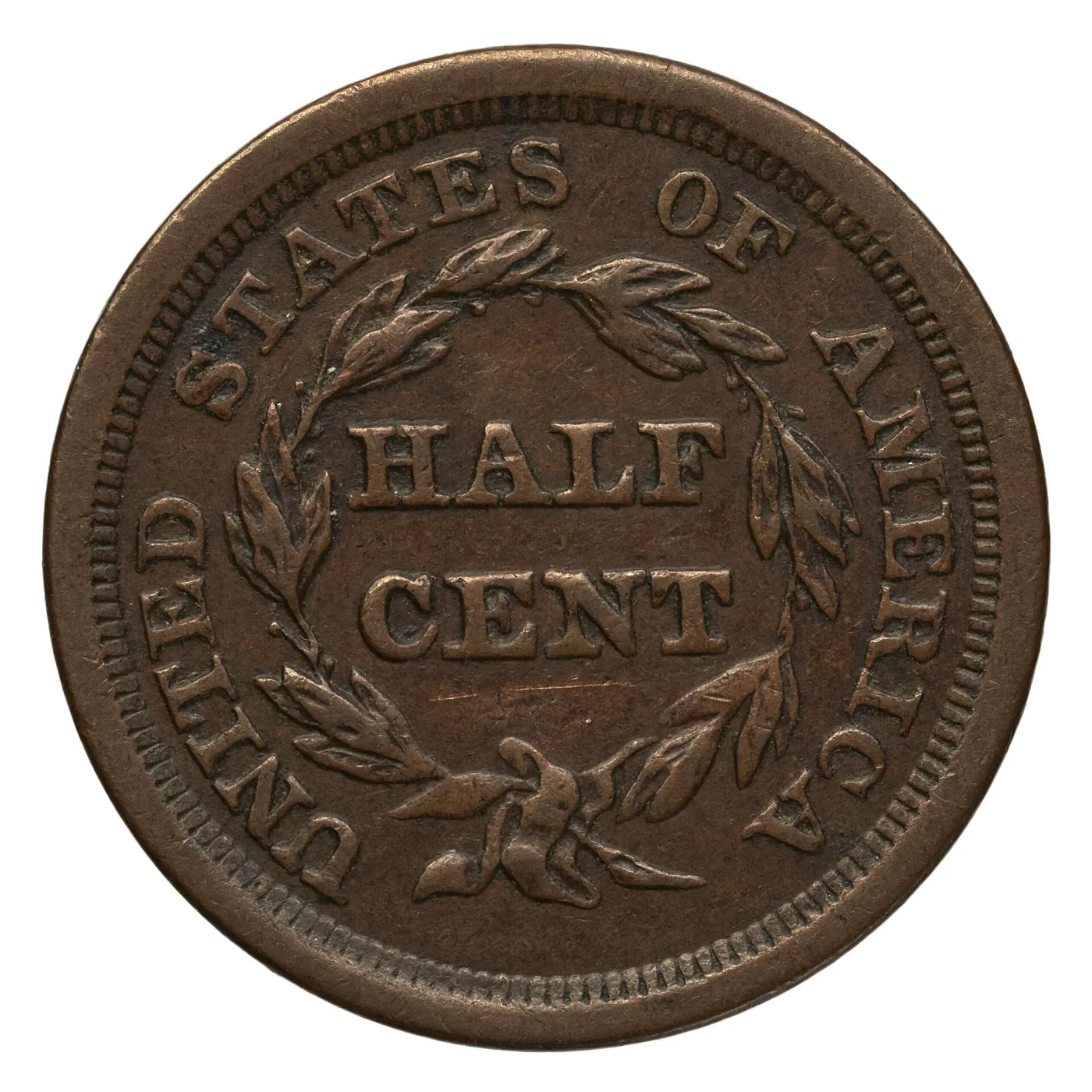
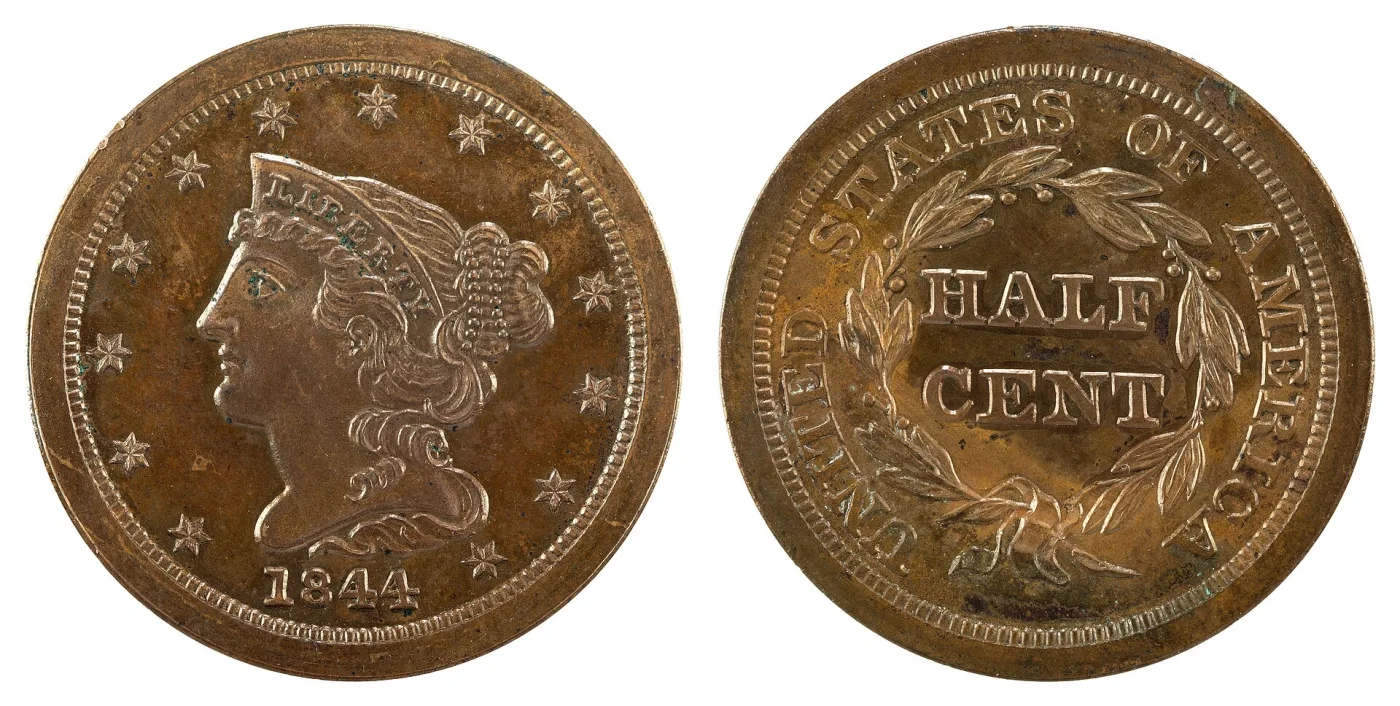
The final type by Christian Gobrecht shows Liberty facing left with hair tied in a tight bun behind, secured by a beaded cord — the “braided hair” style that also appears on contemporary Seated Liberty series. The reverse uses an open wreath with “HALF CENT” inside. Business strikes did not begin until 1849; the dates 1840-1848 are all proof-only originals or restrikes. The type ends with the abolition of the denomination in 1857.
Liberty Cap Half Cent (1793-1797)
The Liberty Cap Half Cent is the foundational issue of the series and one of the most coveted single-year coins in American numismatics for its 1793 issue. For full date-by-date coverage, the With Pole and No Pole varieties, the edge types, and the great 1796 key date, see the dedicated Liberty Cap Half Cent identification guide.
1793 — Liberty Facing Left
The 1793 Half Cent has Liberty facing left, with the cap on a pole projecting from her shoulder. Mintage: 35,334 — the entire production for the inaugural year of the series. This is a one-year type design (the head reversal in 1794 makes 1793 the only Liberty-facing-left half cent). Values: Good $4,500, Fine $7,500, EF $18,000, AU $35,000, MS-63 $90,000+. All known examples are in private hands or museum collections; the coin is rare in any grade.
1794 — Liberty Facing Right
Beginning in 1794 Liberty faces right, with the cap and pole behind her head. Mintage: 81,600. Two major head styles exist: a “high relief” head (early dies) and a “normal head” (later dies). Cohen catalogs nine die varieties. Values: Good $700, Fine $1,400, EF $3,500, AU $7,500, MS-63 $25,000+.
1795 — With and Without Pole
1795 introduced two reverse fraction styles: “1/200” and “Plain Edge” versus “Lettered Edge” varieties. The pole behind Liberty’s head was sometimes inadvertently removed in die preparation, creating the No Pole variety. Mintage approximately 139,690. Values for common variety: Good $400, Fine $800, EF $2,400, AU $5,500, MS-63 $18,000.
1796 — The Great Rarity
The 1796 Half Cent is the rarest regular-issue date in the series. Combined mintage was only 1,390 pieces across two varieties (With Pole and No Pole). Modern survival is estimated at fewer than 200 examples total. Values: With Pole Good $35,000, Fine $80,000, EF $150,000+, AU $300,000+, MS-63 $700,000+. No Pole Good $45,000, Fine $90,000, EF $180,000+. The 1796 is on most short lists of “great American copper rarities” alongside the 1793 Chain Cent.
1797 — Final Liberty Cap Year
Mintage 127,840. Multiple varieties exist including 1 above 1, Plain Edge, and Lettered Edge. The 1797 is the most accessible Liberty Cap year after 1794. Values: Good $400, Fine $850, EF $2,800, AU $6,500, MS-63 $20,000.
Draped Bust Half Cent (1800-1808)
The Draped Bust type provides the most accessible entry into early Half Cent collecting. Mintages were higher than Liberty Cap years and surviving examples appear regularly in dealer inventories.
Date Run and Mintages
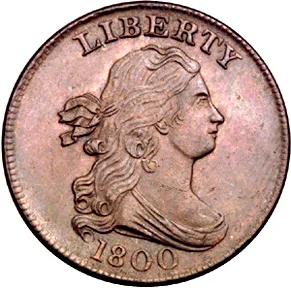
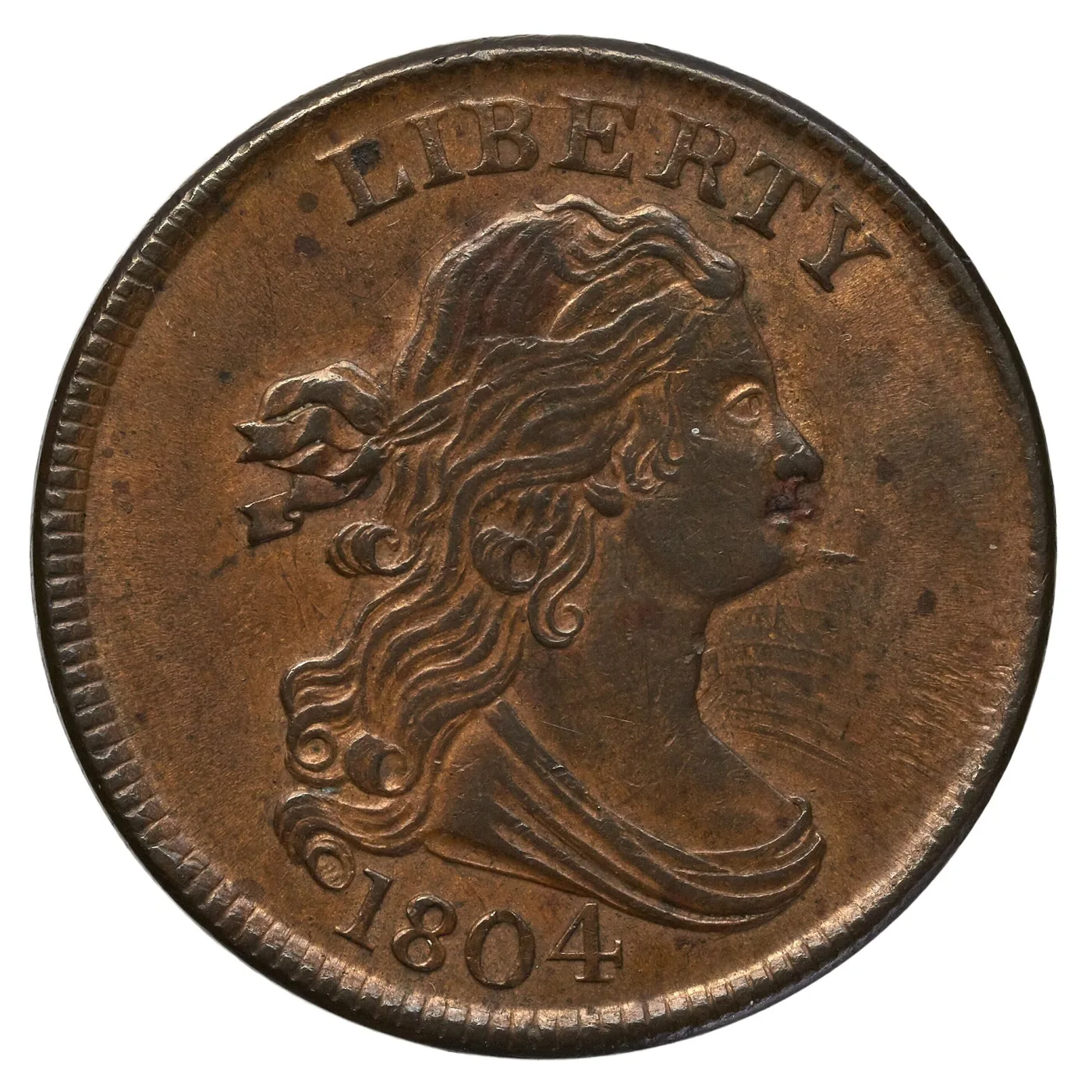
1800: 202,908. (No production 1801.) 1802: 14,366 — a major key. 1803: 92,000. 1804: 1,055,312 — by far the highest mintage of the type and the standard type-coin date. 1805: 814,464. 1806: 356,000. 1807: 476,000. 1808: 400,000.
1802 — The Type Key
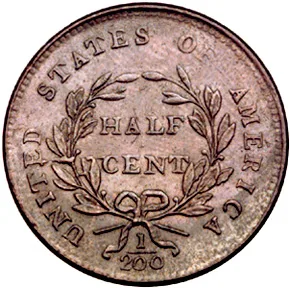
The 1802 Half Cent has mintage of just 14,366 and is the key date of the Draped Bust type. Two varieties exist: 1802/0 (overdate, Reverse of 1800) and 1802/0 (Reverse of 1802). The 1802/0 Reverse of 1800 is the rarer variety and a major rarity in the series. Values: 1802 normal Good $900, Fine $2,500, EF $9,000, AU $22,000+. 1802/0 Reverse of 1800 Good $4,000, Fine $11,000, EF $40,000+.
1804 Varieties — A Specialist’s Playground
1804 Half Cents include numerous varieties: Plain 4, Crosslet 4, Stems to Wreath, Stemless Wreath, and “Spiked Chin” (a die break across Liberty’s chin). Cohen attributes thirteen die marriages for 1804 alone. Most varieties trade at modest premiums except for the Stemless Wreath, which is significantly scarcer. Values for common 1804: Good $80, Fine $160, EF $500, AU $1,200, MS-63 $3,000.
1805-1808 — Common Dates
The 1805-1808 dates are all reasonably available in circulated grades. The 1808/7 overdate is a recognized variety with significant premium. Values for common dates: Good $80, Fine $160, EF $500, AU $1,100, MS-63 $2,800. The 1808/7 overdate adds 50%-200% depending on grade.
Type Coin Selection
For a U.S. type set, the Draped Bust Half Cent is most often filled with an 1804, 1806, 1807, or 1808 in EF to AU grade. Budget $400-$1,500 for a properly graded type example, or $2,500-$5,000 for MS-60 to MS-63 with original brown surfaces.
Classic Head Half Cent (1809-1836)
The Classic Head Half Cent has the longest type span (28 years) but the most irregular production. Long stretches with no coinage make complete date sets challenging.
Production Pattern
1809-1811 saw regular production. Then nothing was struck from 1812 through 1824 — a thirteen-year gap covering the War of 1812 economic disruption and an extended period when Treasury saw no need for additional half cents. Production resumed in 1825-1826, then nothing in 1827, then 1828-1829, then nothing in 1830, then 1831-1836 with most years producing tiny mintages. 1831 is famously proof-only with mintage estimated at 2,200. 1836 is also proof-only.
1809 — Common Date
Mintage: 1,154,572 — the highest of the type. The 1809 is the standard type-coin date. Multiple varieties exist including 1809/6 overdate. Values: Good $80, Fine $130, EF $375, AU $850, MS-63 $1,800.
1810-1811 — The First Wave
1810: 215,000. 1811: 63,140 — the lowest business-strike mintage of the type and a major key. Values 1810: Good $80, Fine $160, EF $475, AU $1,000, MS-63 $2,500. Values 1811: Good $400, Fine $1,200, EF $4,500, AU $9,500, MS-63 $25,000+. The 1811 has both Wide Date and Close Date varieties.
1825-1829 — Mid-Type Run
1825: 63,000. 1826: 234,000. 1828: 606,000 (with 12 Stars and 13 Stars varieties). 1829: 487,000. Values: Good $50, Fine $100, EF $275, AU $600, MS-63 $1,400. The 1828 12 Stars carries a 50% premium over the 13 Stars.
1831 — Proof-Only Original and Restrikes
The 1831 Half Cent is one of the most studied issues in the series. The original mintage was approximately 2,200 in proof, but restrikes were produced from rusted dies in the 1850s and 1860s, creating two distinct populations: original 1831 proofs (small, very expensive) and 1831 restrikes (larger population, still scarce). Original 1831 PR-63 $40,000+; restrikes PR-63 $5,000-$10,000 depending on die state.
1832-1836 — Late Classic Head
1832-1835 each had mintages of 51,000 to 154,000 in business strikes. 1836 was proof-only. Values for 1832-1835: Good $50, Fine $90, EF $250, AU $550, MS-63 $1,300. 1836 PR-63 $25,000+ (very rare).
Braided Hair Half Cent (1840-1857)
The final type of the Half Cent series is unique in American numismatics for being almost entirely proof-only for its first decade.
1840-1848 — Proof-Only Originals and Restrikes
No business strikes were produced for any date from 1840 through 1848. All examples for these dates are proofs, and within that population a critical distinction exists between “Originals” (struck in the year of date) and “Restrikes” (struck from rusted original dies in the 1850s and 1860s, often by Mint employees for collector profit). Originals are dramatically scarcer — sometimes only 12-20 examples are known per date. Restrikes exist in larger numbers but still typically under 200 examples per date.
Values for 1840-1848 originals: PR-63 $40,000-$70,000; PR-65 $80,000-$150,000+. Values for restrikes: PR-63 $4,500-$8,000; PR-65 $10,000-$20,000. Distinguishing originals from restrikes requires expert attribution based on die-state diagnostics — most collectors send these coins to PCGS or NGC for definitive determination. The 1842 and 1846 are particularly studied because their original/restrike ratios differ significantly.
1849 First Restrike and Small Date
1849 is the first year of regular Braided Hair business strikes, but the 1849 Small Date is a proof-only restrike (treated as part of the 1840-1848 group), while the 1849 Large Date is the first business strike. Mintage 39,864. Values 1849 Large Date: Good $100, Fine $160, EF $375, AU $700, MS-63 $1,500.
1850-1857 — Regular Business Strikes
1850: 39,812. 1851: 147,672. 1852: proof-only. 1853: 129,694. 1854: 55,358. 1855: 56,500. 1856: 40,430. 1857: 35,180. Most of these are reasonably available in circulated grades, though most went directly to dealers and survived in higher average condition than earlier copper. Values: Good $80, Fine $130, EF $300, AU $600, MS-63 $1,200, MS-65 BN $3,000-$5,000.
1852 Proof-Only
1852 Half Cents exist only as proofs (originals and restrikes), with combined survival under 200 examples. Originals $30,000+ in PR-63; restrikes $6,000-$10,000 in PR-63.
Color Designations
For Mint State Braided Hair Half Cents, color designation matters: Brown (BN) is dark with no original red; Red Brown (RB) shows partial original mint red; Red (RD) shows full original red. Red examples command 2x to 5x the premium of Brown for the same numerical grade. Original red on Braided Hair Half Cents is genuinely rare because copper of this era oxidizes readily.
Composition and Physical Specifications
The Half Cent’s specifications shifted slightly across the four types as the Mint refined its copper supply and rolling technology.
Liberty Cap Specifications
1793-1795: 6.74 grams, 22mm-23.5mm diameter, plain edge or lettered edge (“TWO HUNDRED FOR A DOLLAR”). 1795-1797: weight reduced to 5.44 grams, diameter 23.5mm, plain edge. The transition happened mid-1795 by Mint Director’s order to use less copper. Composition: 100% copper.
Draped Bust Specifications
23.5mm diameter, 5.44 grams, plain edge, 100% copper. Specifications stable across the type.
Classic Head Specifications
23.5mm diameter, 5.44 grams, plain edge, 100% copper. Specifications match the Draped Bust type.
Braided Hair Specifications
23mm diameter, 5.44 grams, plain edge, 100% copper. Slight diameter reduction from the earlier types.
Color and Surface
All Half Cents are pure copper and tone in the standard copper progression: original Mint Red, then Red-Brown, then chocolate Brown, and eventually deep blackish-brown. Original red on circulation Half Cents is essentially unknown because the coins entered commerce immediately. Mint State examples that retain red are restricted to coins that were saved by collectors at the time of issue or that survived in original Mint storage.
How to Identify a Half Cent
Half Cents are easy to identify once you recognize their key diagnostic features. The copper color, the wreath reverse, and the “HALF CENT” denomination are unmistakable.
Step 1: Recognize the Copper Coin
The Half Cent is brown, red-brown, or sometimes black copper — never silver, never silver-clad, never copper-nickel. Weight is approximately 5.4 grams (about 1.2x a modern penny but not as heavy as a modern quarter). Diameter is 22-24mm — slightly larger than a modern penny but not as large as the contemporary U.S. large cent (28-29mm).
Step 2: Read the Reverse
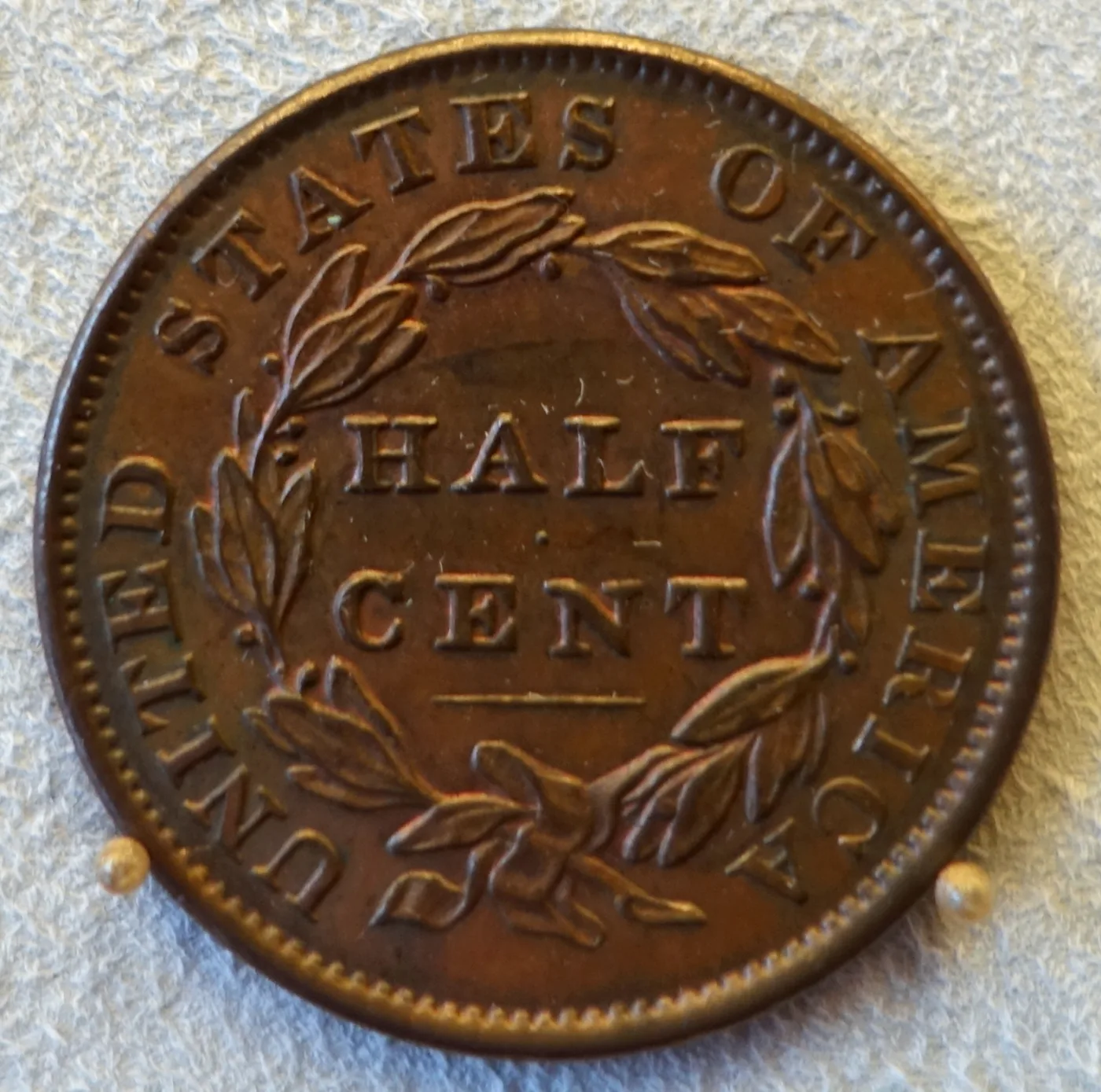
The reverse must say “HALF CENT” within a wreath. If it says “ONE CENT” or “1 CENT,” you have a U.S. large cent or another denomination, not a Half Cent. The “1/200” fraction below the wreath confirms a Liberty Cap or Draped Bust type. Classic Head and Braided Hair Half Cents drop the fraction.
Step 3: Identify the Type by the Obverse
Liberty Cap (1793-1797): Liberty with cap on pole. Draped Bust (1800-1808): Liberty with flowing hair and drapery. Classic Head (1809-1836): Liberty with band inscribed LIBERTY across the forehead. Braided Hair (1840-1857): Liberty with hair in a tight bun behind. The obverse design alone identifies the type.
Step 4: Confirm the Date
Half Cent dates run from 1793 to 1857 with several gap years. Any date outside this range or in a gap year (1798, 1799, 1801, 1812-1824, 1827, 1830, 1837-1839) is impossible and indicates a counterfeit, altered date, or severely worn coin where you have misread the date.
Step 5: Look for Edge Treatment
Most Half Cents have plain edges. Early Liberty Cap and Draped Bust issues sometimes have lettered edges reading “TWO HUNDRED FOR A DOLLAR.” The lettered-edge varieties are scarcer and command premiums. For broader copper coin identification, see our complete coin identification guide.
Cohen and Breen Variety Attribution
Half Cent specialists use two principal reference systems to identify die varieties: Cohen numbers (from Roger Cohen’s American Half Cents: The “Little Half Sisters,” first published 1971, second edition 1982) and Breen numbers (from Walter Breen’s Encyclopedia of United States Half Cents 1793-1857, 1983).
What a Variety Is
A die variety is a coin struck from a specific pair of obverse and reverse dies. Because early American dies were prepared by hand, no two dies are identical, and minute differences in date placement, lettering, star positioning, and design details allow specialists to distinguish dies within a single date. For some Half Cent dates, dozens of die marriages are known.
Cohen Numbers
Cohen assigned a single number to each known die marriage by date — for example, Cohen-1 (or C-1) is the first die marriage attributed for that year. The 1804 has thirteen Cohen varieties (C-1 through C-13). Common-date varieties trade at par with the date; rare die marriages (low survival numbers) trade at significant premiums.
Breen Numbers
Breen assigned more granular numbers (often using letters like B-1a, B-1b) to capture sub-varieties. Breen’s numbering is sometimes more exhaustive than Cohen but the two systems are largely cross-referenced in modern dealer listings.
Why Variety Attribution Matters
For most circulated common dates, variety attribution is academic — collectors buy what they can find at the date level. But for rare die marriages, the variety can mean the difference between a $200 coin and a $5,000 coin. Examples include 1796 NC-2 (Non-Collectible-2, just a handful known), various 1804 sub-varieties, 1806 Stemless Wreath, and several 1849-1857 cherrypick varieties. Specialists examine every Half Cent under 5x or 10x magnification to identify the die marriage before sale or purchase.
Resources for Attribution
The Early American Coppers (EAC) club is the principal organization for Half Cent and large cent specialists. EAC’s quarterly journal Penny-Wise publishes attribution updates and population data. PCGS and NGC both offer variety attribution as part of certification for Half Cents, and major auction houses provide Cohen/Breen attribution in their lot descriptions.

Originals vs Restrikes (1840-1857)
The original/restrike distinction is one of the most important and most misunderstood concepts in Half Cent collecting. It applies primarily to the Braided Hair proof-only dates 1840-1848 and to several scarce Classic Head proof-only dates including 1831 and 1836.
What Are Originals?
Originals are coins struck during the year of the date on the coin. For the 1840-1848 Half Cents, originals were struck in tiny numbers (typically 12-30 examples per year) for inclusion in collector proof sets and presentation pieces. They were never intended for circulation.
What Are Restrikes?
Restrikes are coins struck from the same dies but at a later date — often years or decades after the date on the coin. The Mint produced Half Cent restrikes in two main waves: one in the 1850s under Mint Director James Snowden, who was a numismatist and supplied collectors with whatever they wanted; and another in the 1860s when Mint employees including the famous Theodore Eckfeldt used Mint dies for personal sale to collectors. Restrikes are sometimes called “Snowden restrikes” or “Eckfeldt restrikes” depending on the era.
How to Tell Them Apart
The distinction is made by die-state analysis. Originals were struck early in the die’s life, when the die was clean and sharp. Restrikes were struck later, often after the dies had developed rust pits, cracks, or other damage from storage. Specialists examine the dies for specific diagnostic features: rust pits in particular fields, the presence or absence of specific die cracks, and the overall sharpness of the strike. For some dates, originals and restrikes also used different reverse dies (a “Reverse of 1840” used for some originals, a “Reverse of 1856” used for some restrikes), making attribution more straightforward.
Value Differences
Originals are dramatically more valuable than restrikes. A 1841 Original PR-63 is approximately $50,000-$70,000; a 1841 Restrike PR-63 is $5,000-$8,000. The difference reflects original-survival population: perhaps 12-15 originals exist for each 1840-1848 date, while restrikes survive in 100-200 examples each.
Authentication is Essential
Because the value differential is so large, professional authentication is essential for any 1840-1848 Half Cent. PCGS and NGC both specifically attribute originals versus restrikes on the holder. Buying raw 1840-1848 Half Cents is risky for non-specialists — even some long-time collectors have been fooled by skillful sellers presenting restrikes as originals.
Proof Half Cents
Proof Half Cents are an important sub-collection within the series and represent some of the highest-grade survivors of the type.
Early Proofs
True proof Half Cents from the Liberty Cap and Draped Bust eras are extraordinarily rare, with many “proof” attributions being early-die-state business strikes rather than true proofs. Authentication is challenging and reserved for specialists.
Classic Head Proofs
Proof Classic Head Half Cents exist for many years, with mintages typically under 100. The 1831 and 1836 are proof-only issues. Other proof dates (1825, 1828, 1829, 1832-1835) are scarce but available with patience. Values: PR-63 $4,000-$10,000 depending on year; PR-65 $10,000-$25,000.
Braided Hair Proofs
Proof Braided Hair Half Cents include both the proof-only originals and restrikes (1840-1848, plus 1852) and proof versions of the regular business-strike dates (1849-1857). Proof mintages for the regular dates range from approximately 50 to 600. Cameo and Deep Cameo designations exist and add 50% to 200% premiums.
Cameo and Color
For copper proofs, both cameo contrast and color matter. Brown proofs are most common; Red Brown proofs are scarcer; Red proofs are rare and command large premiums. Combined Cameo + Red designations on Half Cent proofs are exceedingly rare and command premiums measured in multiples of base proof prices.
Grading Half Cents
Grading early American copper requires attention to specific high points of wear that differ from modern coinage. Half Cent grading is generally similar to large cent grading but with some series-specific considerations.
Wear Points by Type
Liberty Cap: Wear shows first on Liberty’s hair detail, the cheek, and the high points of the cap. On the reverse, the wreath leaves and the lettering of “HALF CENT” wear first.
Draped Bust: Wear shows on Liberty’s hair, especially the curl above the forehead, and on the drapery folds. The reverse wreath leaves are the first reverse wear points.
Classic Head: The “LIBERTY” band on the forehead is the most important wear indicator — fully readable LIBERTY with all letters bold indicates Fine or better. Hair detail above the forehead is the secondary indicator.
Braided Hair: The hair braid behind Liberty’s head and the LIBERTY on the coronet are the principal wear points. The braid should show distinct strands in Fine and finer grades.
Grade Descriptions
Good (G-4): Date and main devices clear; most internal detail worn smooth. LIBERTY mostly worn off on Classic Head and Braided Hair types.
Very Good (VG-8): Some internal detail visible. LIBERTY partially readable.
Fine (F-12): About half of design detail visible. LIBERTY fully readable. Hair detail begins to emerge.
Very Fine (VF-20 to VF-35): Most design detail sharp. Hair shows distinct strands. All design elements clearly defined.
Extremely Fine (EF-40 to EF-45): All details sharp with only slight wear on the highest points. Some mint luster may remain in protected areas (rare on copper).
About Uncirculated (AU-50 to AU-58): Traces of wear only on the highest points. AU-58 examples appear nearly uncirculated.
Mint State (MS-60 to MS-70): No wear. For copper, color designation (BN, RB, RD) is recorded alongside the numerical grade. Surface preservation, strike sharpness, and originality of color drive premium for high-end Mint State examples. The grading approach here is similar to that used for the Flying Eagle Cent, Indian Head Penny, and other early small cents that followed the Half Cent.
EAC Grading vs Slab Grading
The Early American Coppers club uses a stricter grading standard than commercial third-party grading services. EAC grades typically run 4-8 points lower than PCGS or NGC grades on the same coin. EAC grading emphasizes original surface, strike sharpness, and absence of problems even on circulated coins. Both systems are valid and used in dealer commerce; collectors should understand which standard a price is quoted in.
Counterfeit Detection and Authentication
Half Cents are heavily counterfeited in the high-end market, particularly the 1793 first-year issue, the 1796, and the proof-only dates of 1840-1848.
Cast Counterfeits
Cast counterfeits of valuable Half Cents have been produced since the 19th century. Diagnostic features include slightly fuzzy detail throughout, incorrect weight (usually too light), pitted or grainy surfaces under magnification, and visible mold seams on the edge. Color is often subtly wrong — too uniform, too red, or oddly mottled. A high-quality digital scale (0.01g precision) is essential equipment.
Altered Dates
The most common alteration on Half Cents is altering a common 1809 to read 1811, or altering 1804 varieties to mimic scarcer varieties. Examination under 10x magnification will usually reveal tooling marks, residual original numerals, or wrong proportions on the altered digits.
Modern Replicas
Modern replica Half Cents are widely sold by hobby retailers and museum gift shops. Most are clearly marked “COPY” as required by the Hobby Protection Act of 1973, but unmarked older replicas circulate. Any Half Cent that looks too clean, too sharp, or has a “perfect” appearance unusual for a 19th-century coin should be regarded with suspicion.
Original/Restrike Authentication
For 1840-1848 dates, originals versus restrikes can only be reliably distinguished by die-state analysis by qualified specialists. PCGS, NGC, and major auction houses offer this attribution. Buying these dates raw without certified attribution is high-risk for non-specialists.
Professional Authentication
For any Half Cent with retail value above $200-$300, professional authentication and grading by PCGS or NGC is strongly recommended. Holders provide authentication, an objective grade, color designation, and tamper-evident encapsulation. The same authentication principles apply broadly to early American copper, including the Shield Nickel, Two Cent Piece, and other small denominations of the post-Half Cent era.
Current Market Values by Date and Grade
Half Cent values vary enormously by type, date, variety, and grade. The following are representative 2026 retail ranges for properly graded common-variety coins.
Liberty Cap Type Values
1793: Good $4,500, Fine $7,500, EF $18,000, AU $35,000, MS-63 $90,000+. 1794: Good $700, Fine $1,400, EF $3,500, AU $7,500, MS-63 $25,000+. 1795: Good $400, Fine $800, EF $2,400, AU $5,500, MS-63 $18,000. 1796: Good $35,000, Fine $80,000, EF $150,000+. 1797: Good $400, Fine $850, EF $2,800, AU $6,500, MS-63 $20,000.
Draped Bust Type Values
1800: Good $80, Fine $160, EF $475, AU $1,100, MS-63 $2,800. 1802: Good $900, Fine $2,500, EF $9,000, AU $22,000+. 1803-1808 common varieties: Good $80, Fine $160, EF $500, AU $1,200, MS-63 $3,000. 1804 Spiked Chin and other varieties trade at modest premiums.
Classic Head Type Values
1809: Good $80, Fine $130, EF $375, AU $850, MS-63 $1,800. 1810: Good $80, Fine $160, EF $475, AU $1,000, MS-63 $2,500. 1811: Good $400, Fine $1,200, EF $4,500, AU $9,500, MS-63 $25,000+. 1825-1829: Good $50, Fine $100, EF $275, AU $600, MS-63 $1,400. 1832-1835: Good $50, Fine $90, EF $250, AU $550, MS-63 $1,300. 1831 (proof only) Original PR-63 $40,000+, Restrike PR-63 $5,000-$10,000. 1836 (proof only) PR-63 $25,000+.
Braided Hair Type Values
1849 Large Date: Good $100, Fine $160, EF $375, AU $700, MS-63 $1,500. 1850-1857 common dates: Good $80, Fine $130, EF $300, AU $600, MS-63 $1,200, MS-65 BN $3,000-$5,000. RD designations roughly triple the BN price. 1852 (proof only) Original $30,000+, Restrike $6,000-$10,000.
Type Coin Pricing
For type-set buyers, the most affordable Liberty Cap Half Cent is a 1797 in low circulated grade ($400-$1,000); the most affordable Draped Bust is a 1804 or 1806 in EF ($500-$700); the most affordable Classic Head is a 1828 or 1829 in EF ($275); and the most affordable Braided Hair is a 1851 or 1853 in EF ($300). A complete four-coin Half Cent type set in EF can be assembled for approximately $1,500-$2,500.
Market Trends
Half Cent prices have been steadily rising over the past two decades as the early American copper field has become better understood and more accessible to general collectors. Common-date material has appreciated modestly; major rarities (1793, 1796, 1840-1848 originals) have appreciated substantially. The market is supported by EAC member demand and by general U.S. type collectors building 19th-century type sets.
Collecting Strategies and Tips
Half Cents support several collecting approaches at very different budget levels, from a four-coin type set under $2,500 to specialist date-and-variety sets exceeding $1 million.
Type Coin Collection
The most accessible approach is to acquire one example of each major type: Liberty Cap, Draped Bust, Classic Head, and Braided Hair. Budget $1,500-$2,500 for EF-AU examples; $5,000-$15,000 for MS-63 to MS-65 BN. This four-coin set fits comfortably in a U.S. type album and represents the entire arc of the denomination.
Complete Date Set
A complete date set of Half Cents includes 31 distinct dates plus the 1840-1848 proof-only group. Excluding the 1796 and the 1840-1848 originals, a complete date set in mixed circulated grades is achievable for $25,000-$50,000. Adding the 1796 in any grade adds $35,000-$300,000 depending on grade. A complete set with originals for 1840-1848 is a true rarity and would cost well over $1 million.
Date and Major Variety Set
A “Red Book” set including major varieties (1795 With Pole, No Pole, Lettered Edge; 1797 varieties; 1800 Reverse of 1800; 1802/0 varieties; 1804 Stemless; 1808/7; 1828 12 Stars; 1809/6; 1849 Small Date) extends the date set to 50-60 coins and adds substantial cost.
Cohen Variety Set
Half Cent specialists pursue every known Cohen die marriage — over 200 distinct varieties. This is the EAC member’s typical pursuit and requires deep knowledge of attribution diagnostics. Acquisition prices range from common-date prices for common varieties to five-figure sums for the rarest die marriages. The Cohen set is rarely completed; partial sets focused on a single type (Liberty Cap Cohen, Draped Bust Cohen) are more achievable.
Single Type Specialization
Many collectors focus on one type — most often the Classic Head or Braided Hair, which are most accessible. A complete date-and-variety set within one type is a manageable multi-year project that builds genuine expertise.
Cherrypicking
Half Cents in dealer stocks are often unattributed at the variety level, particularly for common dates. Patient cherrypicking with a 10x loupe and the Cohen reference can yield finds of $100-$2,000 die varieties for the cost of common-date material. EAC meetings and shows are the best venues for this kind of pursuit.
Proper Storage and Preservation
Half Cents are pure copper, the most reactive metal in U.S. coinage, and require careful storage. Improper handling can convert an attractive original-color coin to a problem coin in months.
Avoid PVC and Sulfur
Never store Half Cents in PVC-containing flips or albums. PVC releases hydrochloric acid that creates green slime on copper surfaces — permanent damage that destroys both eye appeal and value. Use Mylar flips, inert hard plastic capsules, or third-party grading service holders. Avoid older paper envelopes containing sulfur, which causes uneven gray-black toning and can permanently destroy original red and red-brown surfaces.
Humidity Control
Copper is highly hygroscopic and prone to spotting in humid environments. Store coins in a cool, dry location with stable humidity below 45%. Silica gel packets in your storage area help absorb moisture. Avoid attics, basements, garages, and rooms with temperature swings. Sudden humidity changes can cause condensation that leads to copper spots, also called “carbon spots,” which are permanent and disfiguring.
Avoid Touching Copper Surfaces
Skin oils contain salts and acids that immediately begin to etch copper. Always hold Half Cents by their edges. For Mint State or proof examples, use clean cotton or nitrile gloves. Even brief contact with bare fingers can leave fingerprints that develop into permanent marks within months.
Never Clean Copper
Cleaning copper destroys both natural patina and microscopic surface detail. Cleaned copper coins are described in dealer parlance as “harshly cleaned,” “lightly cleaned,” or “polished,” all of which receive details grades from third-party services and trade at 30%-70% discounts to original-surface examples. Even unattractive original copper is worth more than cleaned copper of the same technical grade. Specialists particularly value coins with original “EAC color” — natural medium-to-dark brown patina with no evidence of intervention.
Long-Term Storage
For long-term storage of valuable copper, consider third-party grading service holders, which provide an inert sealed environment. Coins in EAC member raw form should be kept in inert paper envelopes (acid-free, sulfur-free) inside Mylar flips, or in inert hard plastic capsules. Check stored coins annually for signs of new spotting or color change, and address any problems immediately by relocating the coin to a drier or more inert environment.
Frequently Asked Questions
What is a Half Cent worth in 2026?
Common-date Half Cents in well-circulated grades typically retail for $50-$150. Better dates and Mint State examples range from $300 to $5,000+. Major rarities (1793, 1796, 1840-1848 originals) range from $5,000 to several hundred thousand dollars. Always identify the type, date, variety, and grade before estimating value.
Why did the U.S. mint a half cent?
The Mint Act of 1792 authorized the Half Cent as essential subsidiary copper coinage to support commerce in an era when many transactions were in fractional amounts and Spanish/colonial half-pennies still circulated. Although the denomination was unpopular in commerce, Congress kept it on the books for 64 years before finally abolishing it in 1857.
What's the rarest Half Cent?
For business strikes, the 1796 with combined mintage of 1,390 is the rarest regular issue. For proof-only issues, the 1840-1848 Originals exist in tiny populations of 12-30 examples per date. Specific rare Cohen die marriages (1796 NC-2 and similar "Non-Collectible" varieties) are rarer still in absolute terms.
Why did Half Cent production stop in 1812-1824?
The thirteen-year gap from 1812 through 1824 reflected economic disruption from the War of 1812, restricted Mint copper supply, and an effectively saturated commercial demand for half cents from earlier high-mintage years. Treasury simply saw no need to produce additional half cents during this period. Production resumed in 1825 when copper supply normalized and existing inventory had drawn down.
What's the difference between original and restrike Half Cents?
Originals were struck in the year of date for collector inclusion in proof sets. Restrikes were struck later (typically the 1850s-1860s) from the same dies but after the dies had developed rust pits, cracks, or other diagnostic die-state changes. Originals are dramatically scarcer and more valuable. The distinction is made by die-state analysis and is best determined by professional certification.
Are Half Cents made of pure copper?
Yes. All U.S. Half Cents from 1793 through 1857 are 100% copper. There are no silver, gold, or alloyed Half Cents. The denomination's color is the warm brown or red-brown of pure copper at various stages of patination.
How do I know which Half Cent type I have?
Look at the obverse design. Liberty Cap (1793-1797): cap on a pole. Draped Bust (1800-1808): drapery at the bust. Classic Head (1809-1836): band inscribed LIBERTY across the forehead. Braided Hair (1840-1857): hair tied in a tight bun. The date alone usually identifies the type because the type ranges don't overlap.
Should I clean my dirty Half Cent?
Never. Cleaning copper destroys original patina and microscopic surface detail, removing 30%-70% of the coin's value. Cleaned coins receive details grades from PCGS and NGC. Even an unattractive original-color coin is worth more than a cleaned coin of the same technical grade. The same warning applies to all early American copper, large cents, and small cents.
Can I find Half Cents in circulation today?
No. Half Cents have been out of circulation for well over a century. They are found only through coin dealers, auctions, estate sales, and inherited collections. They are not legal tender for current transactions.
What replaced the Half Cent?
Nothing directly. The Mint Act of 1857 abolished both the Half Cent and the large cent and introduced the smaller, lighter copper-nickel small cent — the Flying Eagle Cent, soon followed by the Indian Head Cent. The half-cent denomination simply disappeared because price levels had risen enough that fractional cents were no longer needed in commerce.