Large Cent Identification Guide: Chain, Wreath, Liberty Cap, Draped Bust, Classic Head, Coronet, Braided Hair, Key Dates, and Values
The Large Cent is the foundational copper coin of the United States — the first coin struck for circulation by the federal Mint, the daily money of the early Republic that succeeded the patchwork of colonial and early American coppers, and one of the richest collecting fields in American numismatics. Produced from 1793 through 1857 in pure copper at a diameter of roughly 28-29mm and weight of approximately 10.89 grams (later 10.89g standard), the Large Cent passed through seven distinct major design types in 64 years and survived more political, economic, and technological upheaval than any other denomination of its era. It was the workhorse of American commerce when a cent could buy real goods, and it was the canvas on which engravers Henry Voigt, Robert Scot, John Reich, and Christian Gobrecht refined the visual language of federal coinage.
Large Cents come in seven headline types: Chain (1793 only), Wreath (1793 only), Liberty Cap (1793-1796), Draped Bust (1796-1807), Classic Head (1808-1814), Coronet/Matron Head (1816-1839), and Braided Hair (1839-1857). Each represents a different chapter in early Mint history, each presents distinct identification and grading challenges, and each contains storied rarities and subtle die varieties that drive specialist premiums measured in five and six figures. The 1793 Chain Cent is among the most coveted single-year coins in American numismatics; the 1799 is one of the great key dates of the entire 19th century; and the 1804 is a perennial favorite of advanced collectors.
This guide is the comprehensive 2026 reference for identifying, attributing, grading, authenticating, and valuing Large Cents. You will learn how to distinguish the seven major types at a glance, how to navigate the Sheldon and Newcomb variety attribution systems that govern specialist collecting, how to recognize the most counterfeited dates, how to grade copper accurately by EAC and slab standards, and how to price your coin in today’s market. Whether you have inherited a coffee can full of “Indian-head pennies” that turn out to be Large Cents, are building a U.S. type set, or pursuing the legendary Half Cent’s big brother in serious depth, the Large Cent rewards study with one of the deepest and most beloved fields in early American numismatics.
History and Background of the Large Cent
The Large Cent was authorized by the Mint Act of April 2, 1792, the founding legislation of the United States Mint. Although Congress also authorized silver and gold coinage, the cent and the half cent were the first coins struck for circulation, beginning in March 1793 from a Philadelphia Mint that was still under construction. The distinction matters: five years earlier the 1787 Fugio Cent had been the first coin authorized by the United States, but it was produced under a private contract rather than by the federal Mint. The earliest coppers were rolled, planchet-cut, and struck by hand on screw presses powered by mint workers — a remarkably labor-intensive process that nevertheless produced approximately 36,103 Chain Cents in just over a month before the design was abandoned.
The Large Cent was sized to contain roughly one cent’s worth of copper (subject to the Mint’s bullion accounting), making it a “full-bodied” coin in an era when most subsidiary coinage was expected to carry intrinsic value close to its face. This is why the coin is so large — nearly the size of a modern half dollar. As copper prices rose through the 1840s and 1850s, the Mint progressively reduced the weight, but never enough to satisfy commerce, and the denomination became increasingly uneconomical. The Mint Act of February 21, 1857 finally retired the Large Cent (and the Half Cent) and replaced it with the smaller, lighter copper-nickel Flying Eagle Cent.
Daily Money of the Early Republic
For 64 years the Large Cent was the most common coin in American pockets. Mintages frequently exceeded one million pieces per year — enormous numbers for the era — and the coin circulated heavily, often for decades. As a result, surviving Large Cents are typically heavily worn: Good and Very Good are by far the most common grades for early dates, and any pre-1814 Large Cent in EF or better commands a substantial premium for condition alone. The coin was used in every kind of commerce, from settling change at a country store to paying tolls and church-pew rents.
End of the Series
By the 1850s rising copper prices made the Large Cent unprofitable to strike. Mint Director James Ross Snowden experimented with smaller, lighter cents in 1856 (the famous 1856 Flying Eagle Cent pattern) and in 1857 Congress finally retired the denomination. Mintage of the final 1857 Braided Hair Large Cent was just 333,456 — far below the multi-million-piece mintages of earlier decades — and many were quickly redeemed and melted in the years that followed. Replacement of the Large Cent by the small cent was a watershed in American coinage history, ending the era of full-weight subsidiary coinage and beginning the era of token coinage that continues today — a shift foreshadowed in the 1830s by the privately struck, cent-sized Hard Times Tokens that filled in for scarce federal coppers.
The Seven Major Types at a Glance
Large Cent type identification is the indispensable first step in any attribution. The seven major types are visually distinct and span the full range of early Mint engraving styles.
Chain Cent (1793)
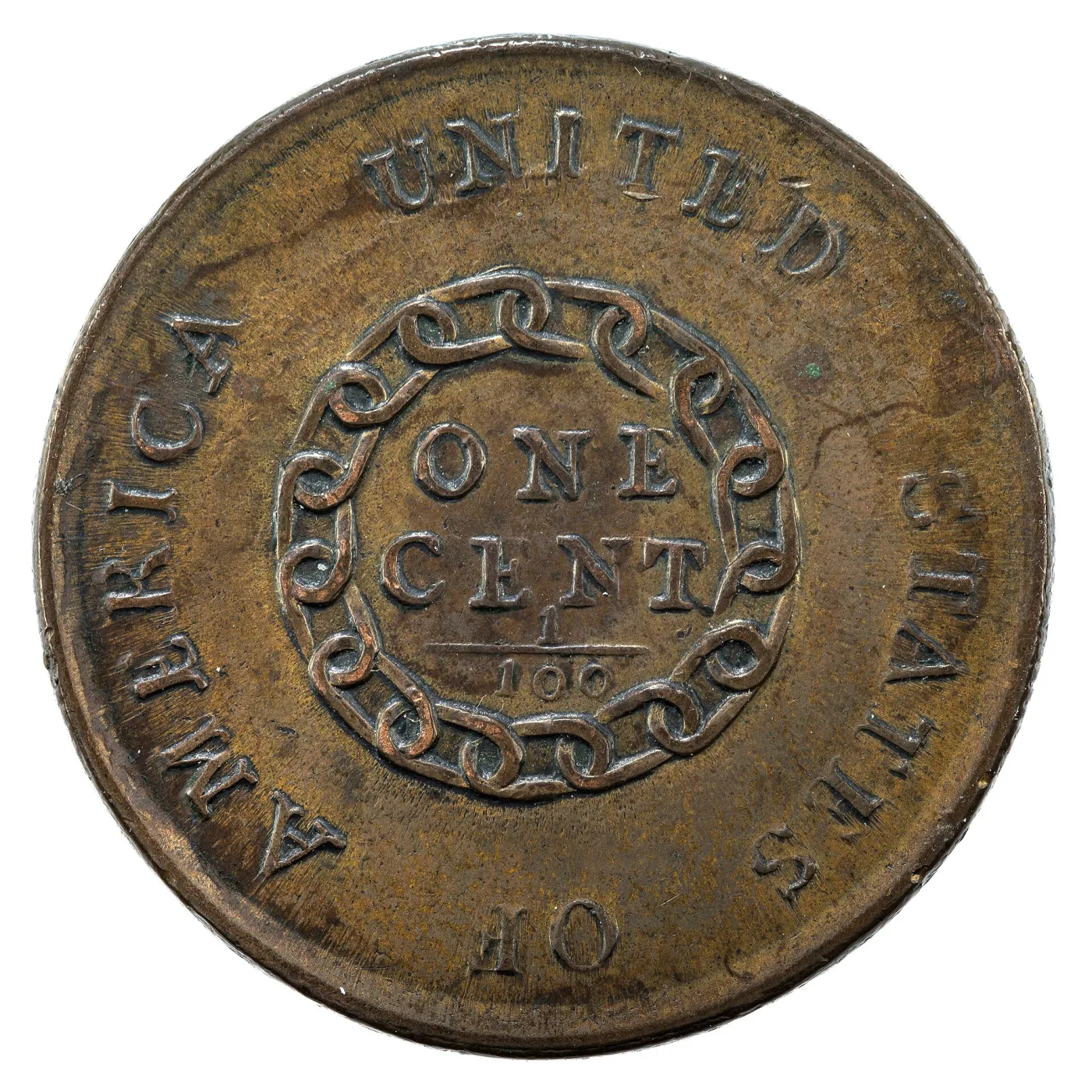
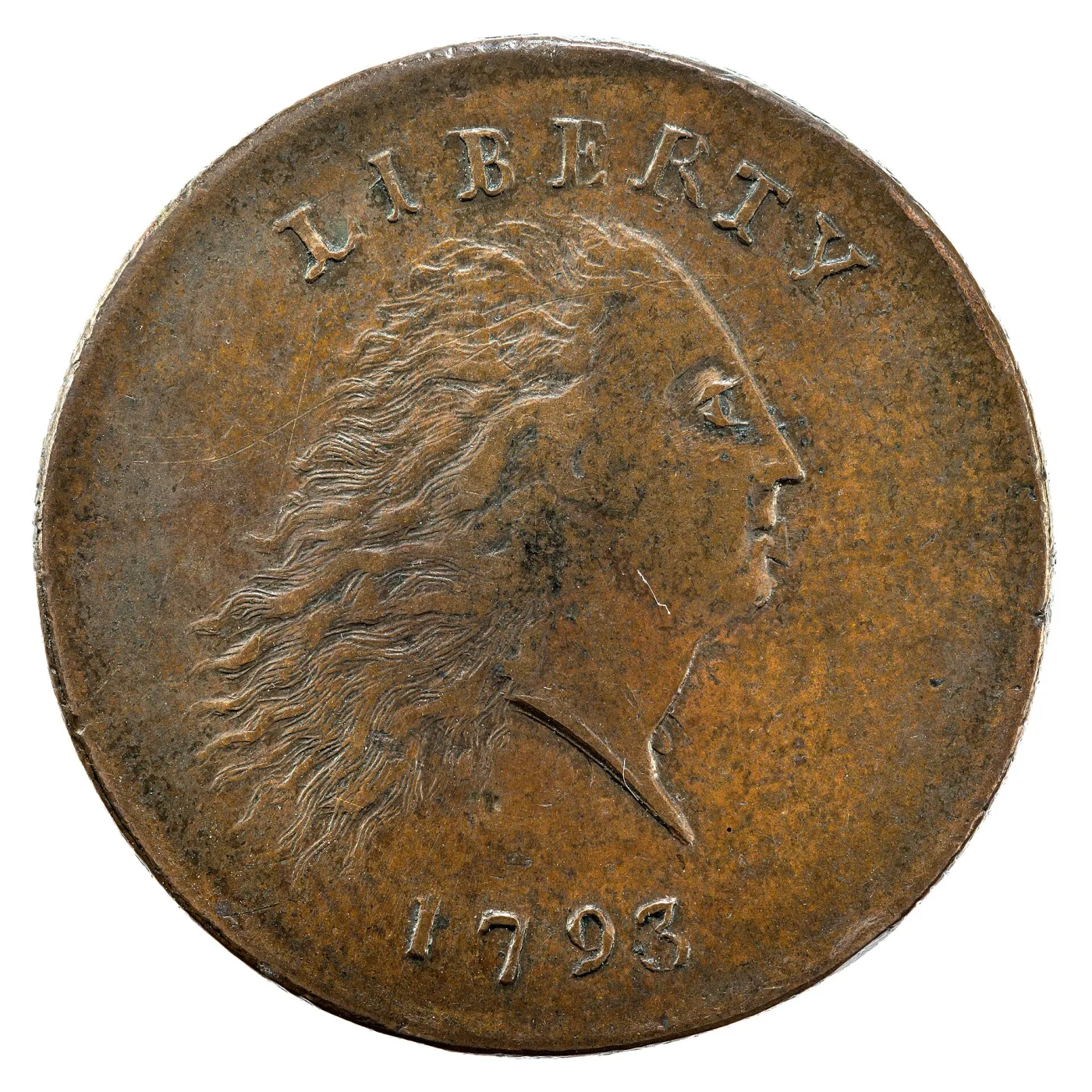
The first U.S. cent. Obverse: Liberty facing right with flowing hair, looking somewhat startled. Reverse: a chain of fifteen interlocked links representing the states, surrounding “ONE CENT” and “1/100.” Issued only in 1793, with mintage of approximately 36,103. The Chain Cent is among the most desirable and famous American coins.
Wreath Cent (1793)
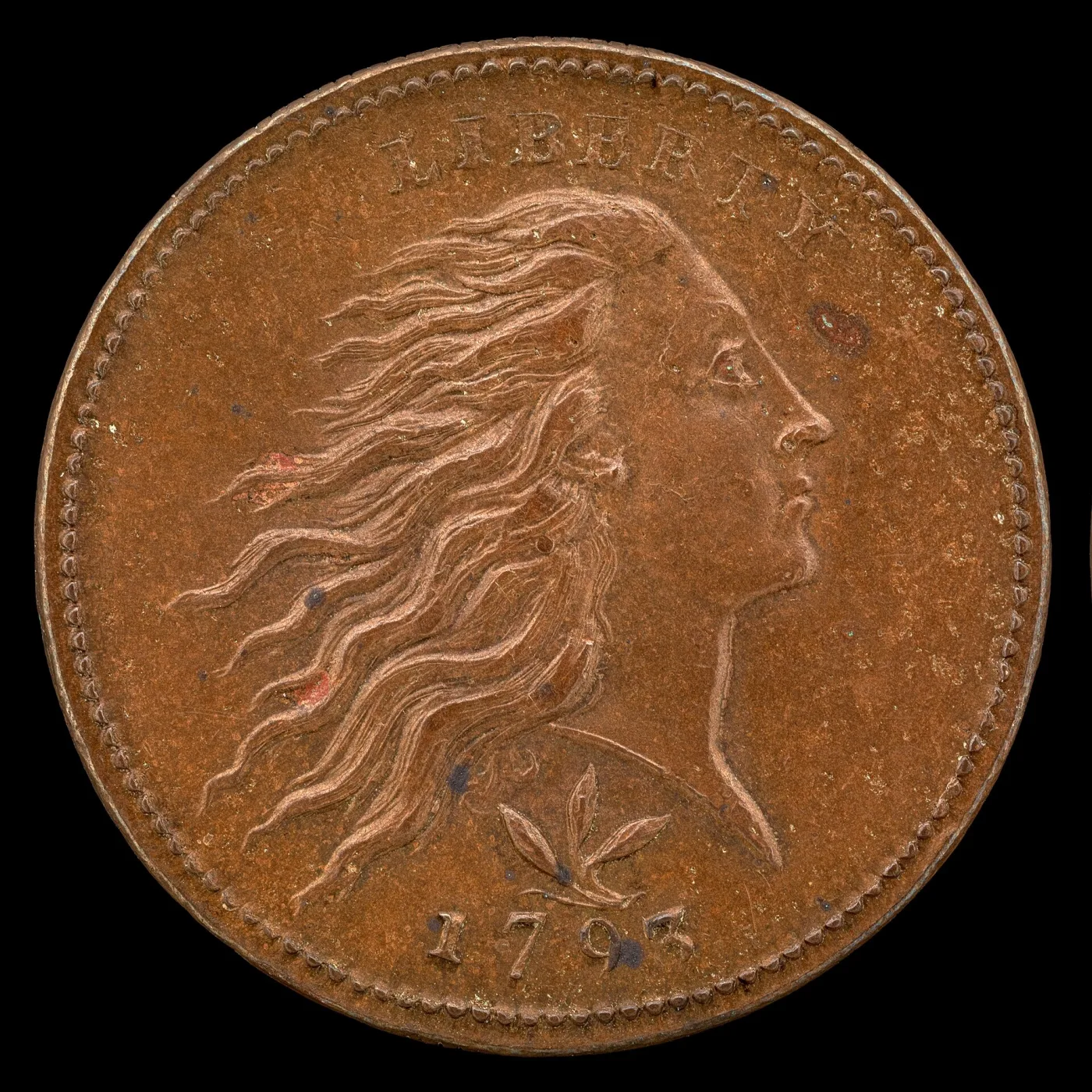
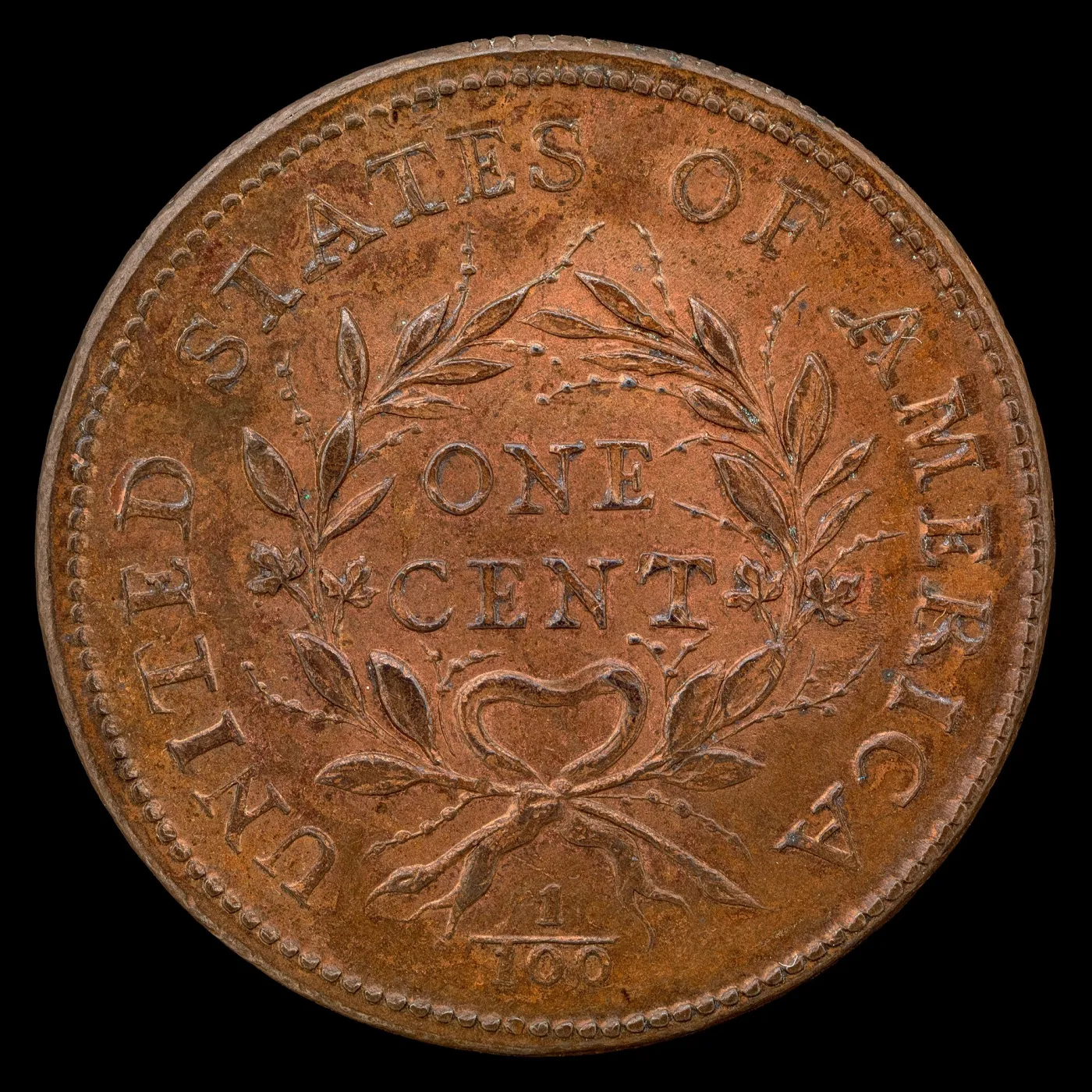
The Chain reverse drew immediate criticism (a chain was thought to suggest slavery, and the design was awkward) and was replaced mid-1793 by a wreath. Obverse: Liberty facing right with flowing hair, slightly improved engraving. Reverse: an open laurel-style wreath surrounding “ONE CENT” with “1/100” below. Mintage approximately 63,353. Like the Chain Cent, struck only in 1793.
Liberty Cap (1793-1796)
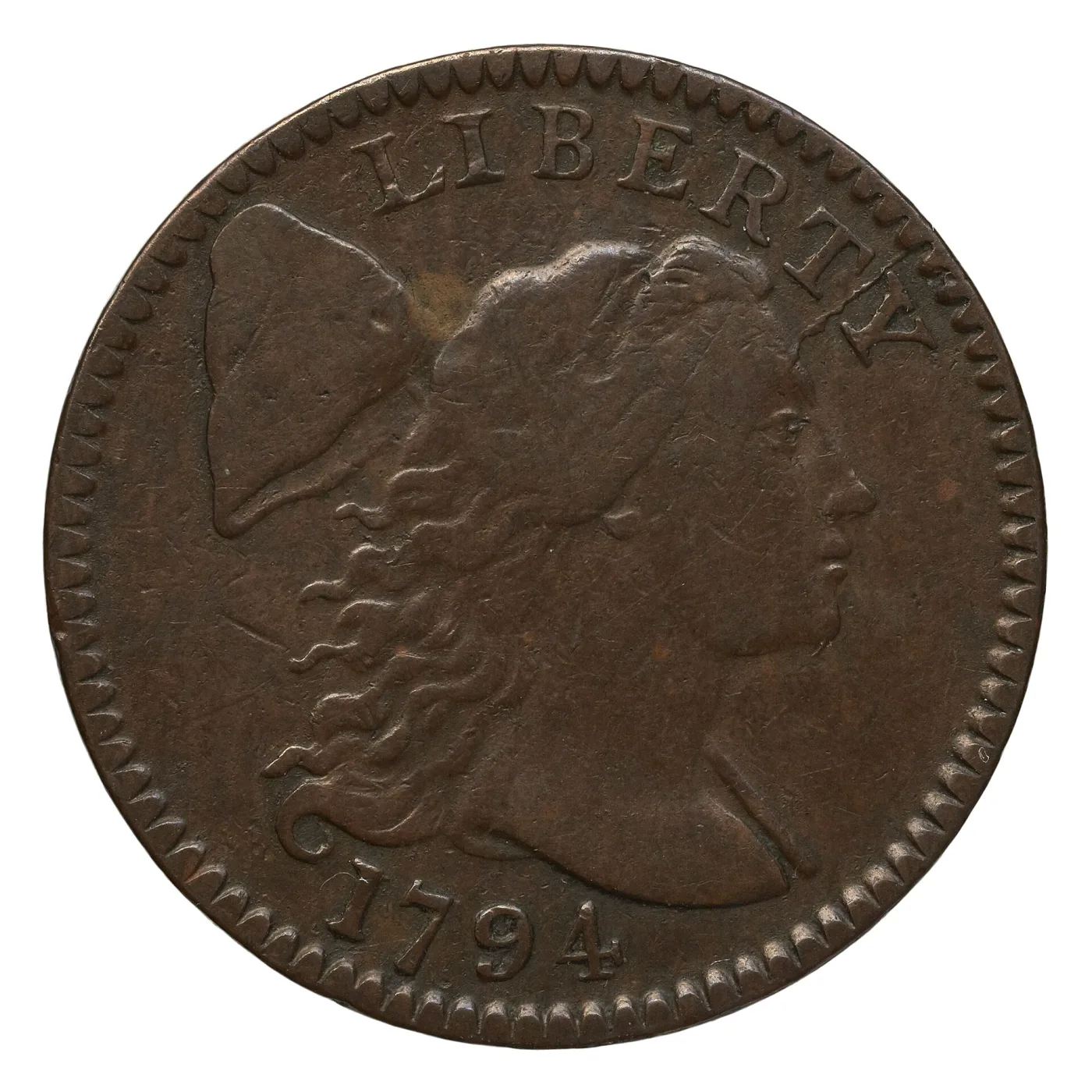
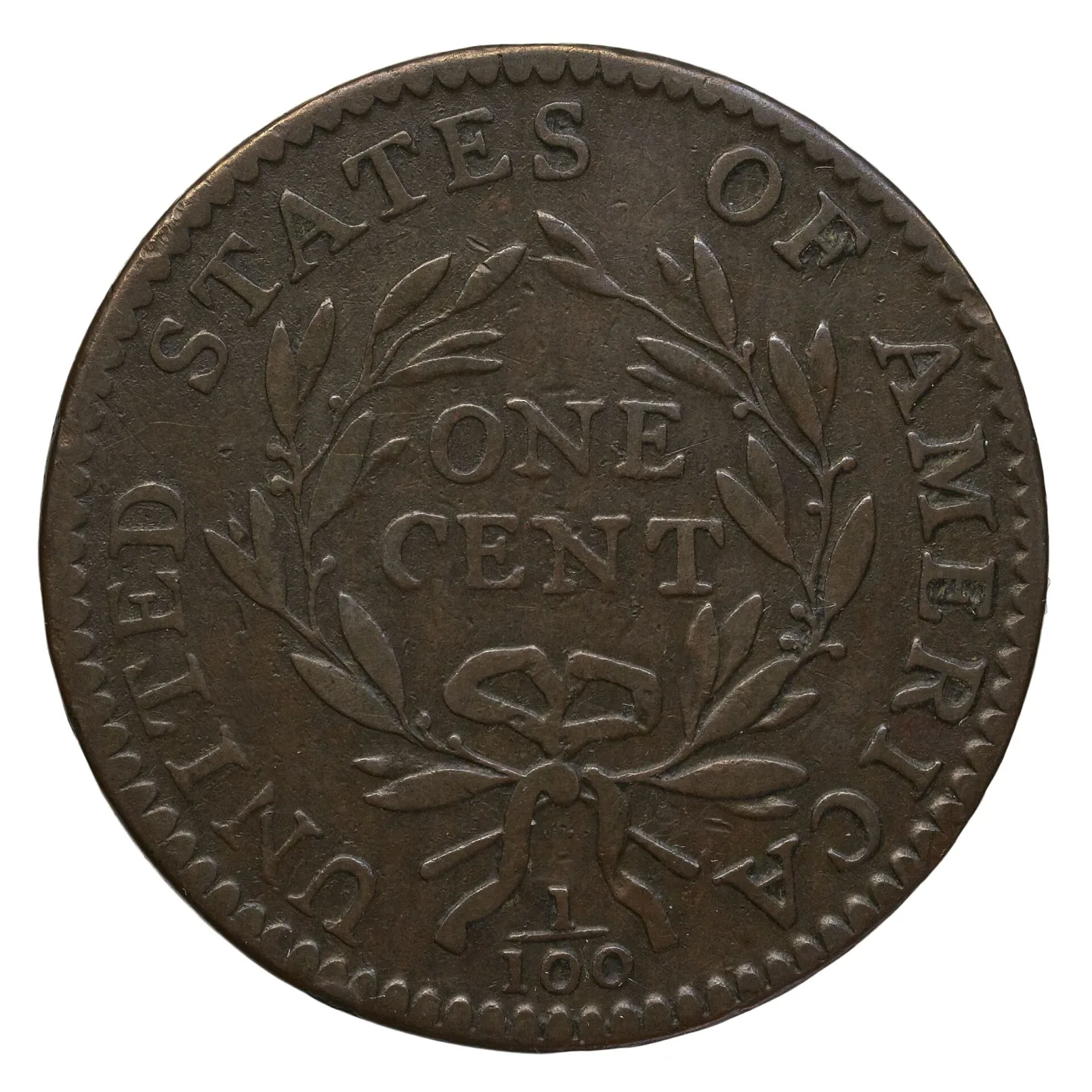
The third 1793 design and the first that lasted. Obverse: Liberty facing right with a Phrygian liberty cap on a pole behind her head. Reverse: open wreath. Two sub-types: “Beaded Border” (1793 only) and “Denticled Border” (1794 onward). Struck through 1796. For the Chain, Wreath, and Liberty Cap issues in full detail, see the dedicated Liberty Cap large cent guide.
Draped Bust (1796-1807)
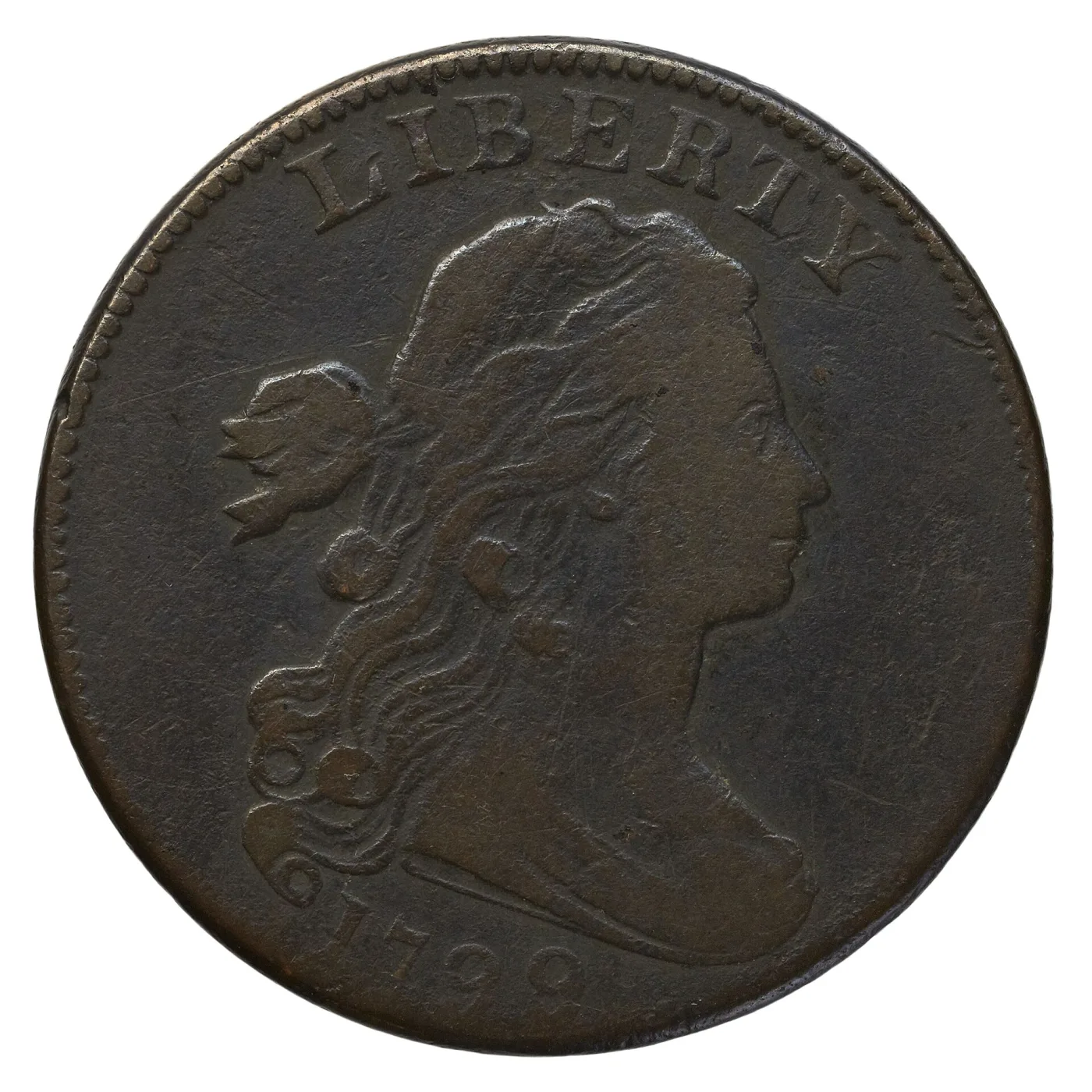
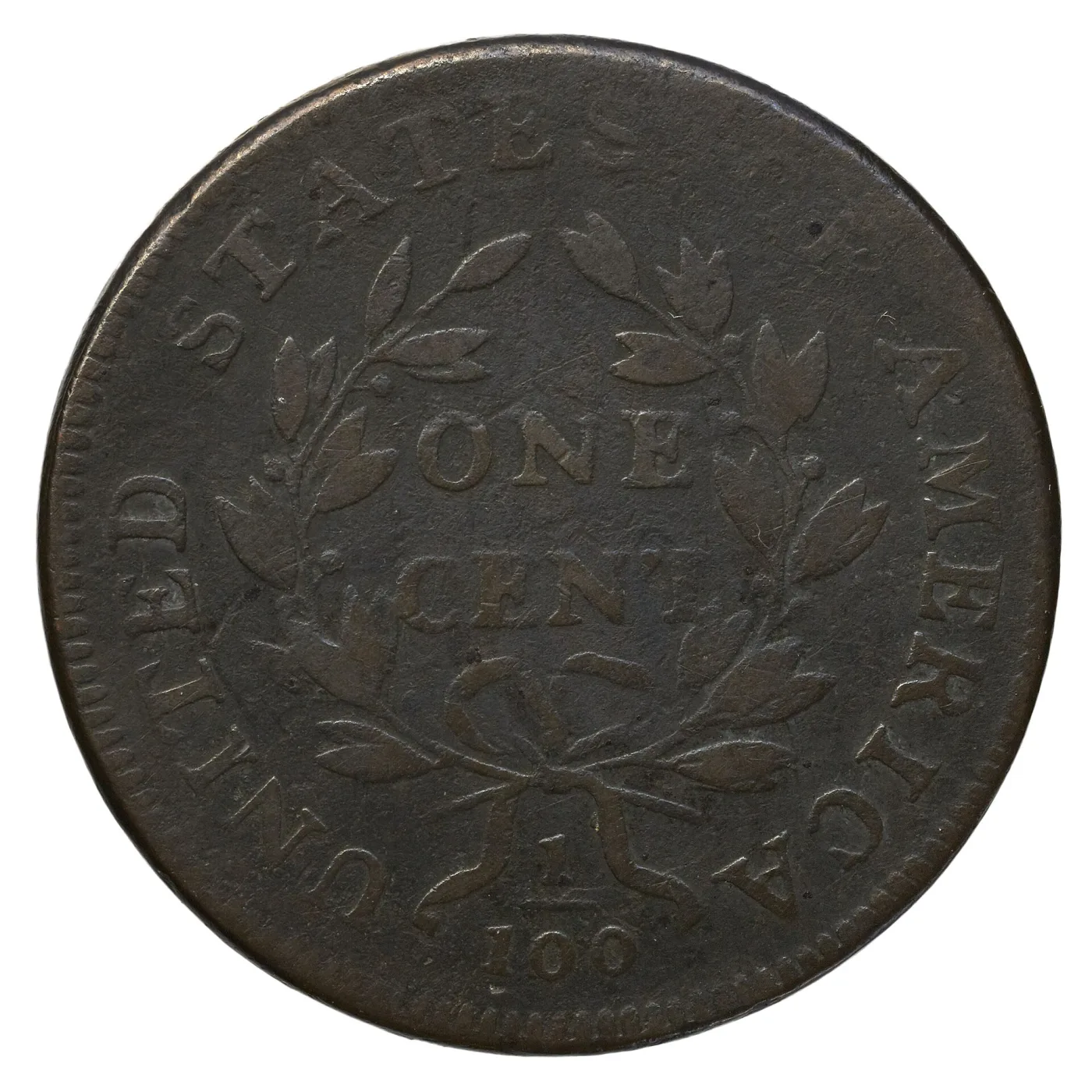
By Robert Scot. Obverse: Liberty facing right with flowing hair partly tied behind and a piece of drapery at the bust line. Reverse: open wreath with “ONE CENT” inside and “1/100” beneath. Used on multiple denominations of the era. Includes the legendary 1799 key date.
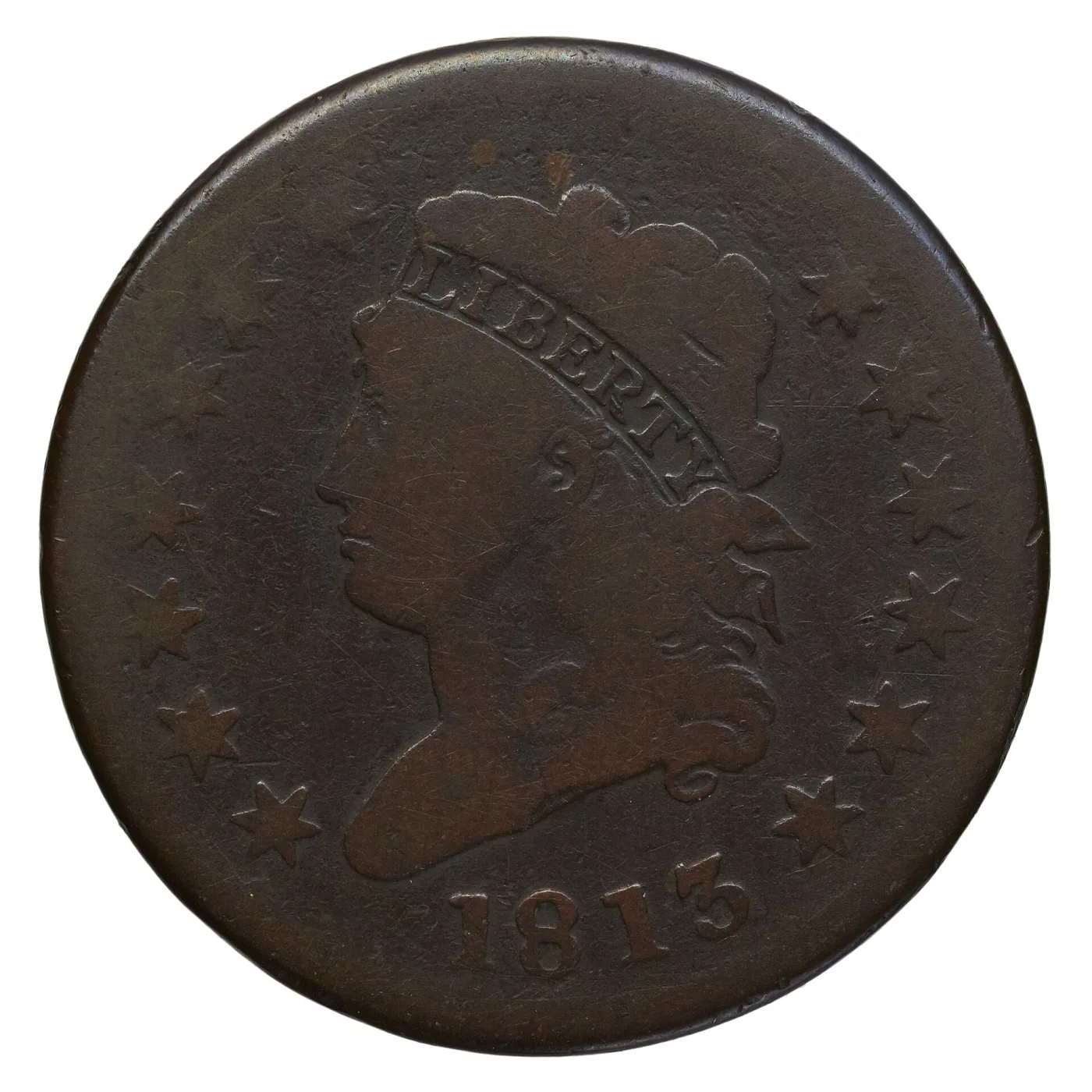
Classic Head (1808-1814)
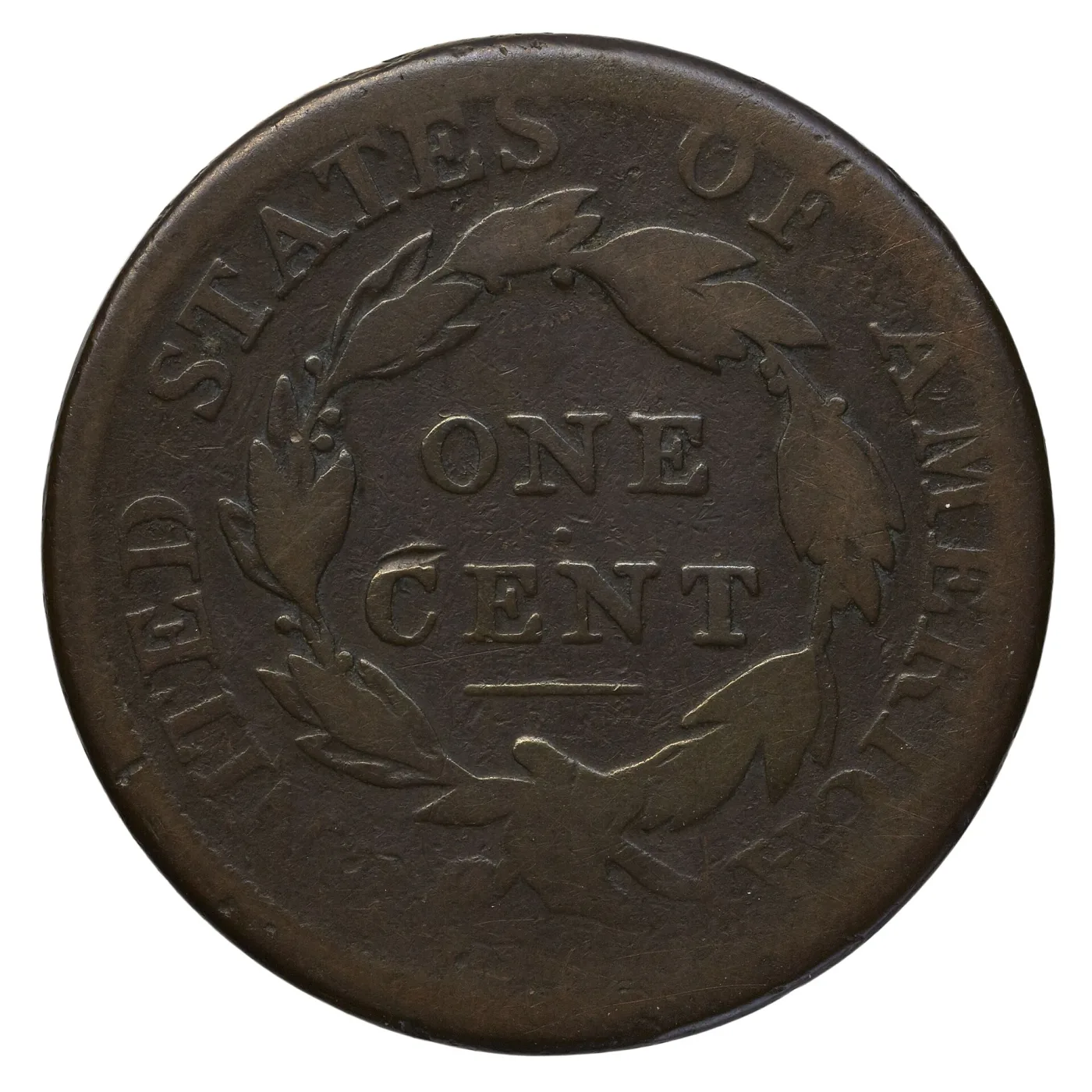
By John Reich. Obverse: Liberty facing left wearing a band inscribed “LIBERTY” — the Greek-revival “classic” style. Reverse: open wreath with “ONE CENT” inside (no fraction). Struck only seven years; production halted in 1815 due to a wartime copper shortage.
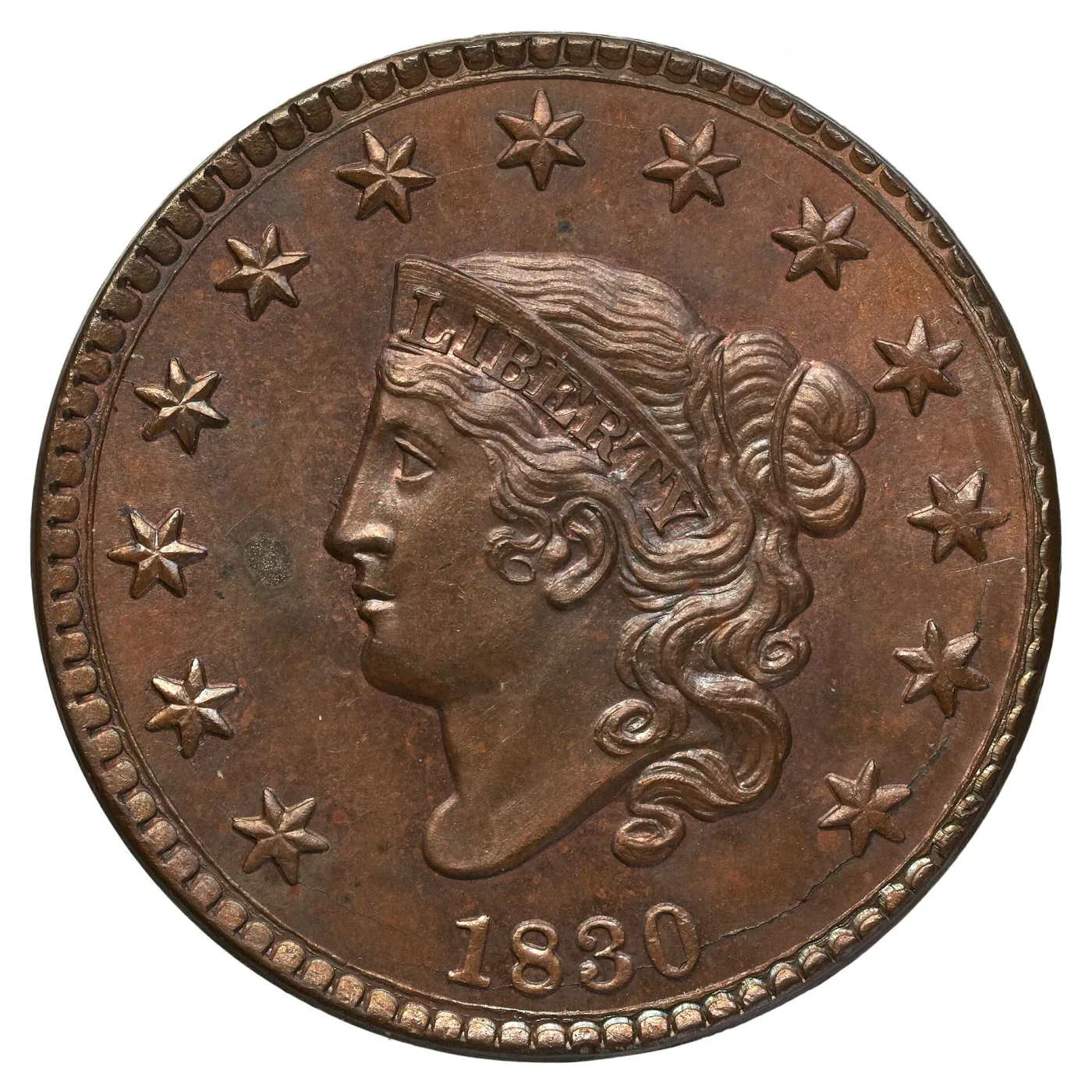
Coronet/Matron Head (1816-1839)
By Robert Scot, modified through the period. Obverse: Liberty facing left wearing a coronet inscribed “LIBERTY.” Multiple sub-types within this period are distinguished by collectors as “Matron Head” (1816-1835), “Matron Head Modified” (1835-1839), and the various “Head of 1840,” “Petite Head,” and “Booby Head” varieties of the transitional 1839 issues.
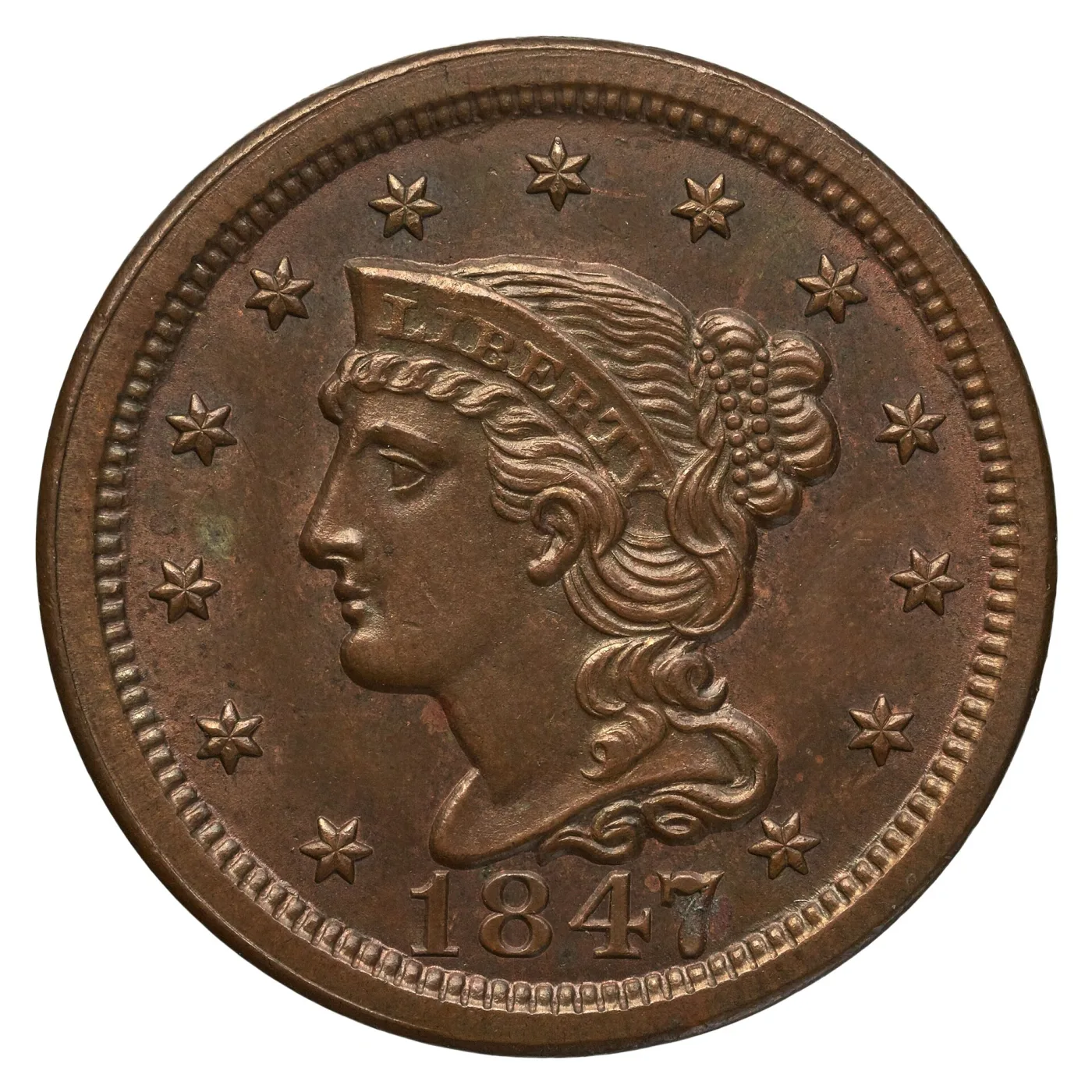
Braided Hair (1839-1857)
By Christian Gobrecht. Obverse: Liberty facing left with hair tied in a tight braided bun behind, secured by a beaded cord — the same “braided hair” style that appears on contemporary Seated Liberty coinage. Reverse: open wreath with “ONE CENT” inside. The final type of the series, retired in 1857.
Chain Cent (1793)
The 1793 Chain Cent is the first coin struck for circulation by the United States Mint and one of the most historically significant pieces in all of American numismatics. Production began on March 1, 1793 and ended approximately six weeks later when the design was condemned and replaced by the Wreath Cent.
Sub-Varieties
Four major Chain Cent varieties are recognized: AMERI. (with abbreviated “AMERICA” on reverse), AMERICA (full spelling), Periods (with periods after LIBERTY and the date), and the No Periods variety. The AMERI. variety is the rarest and most desirable. All four are scarce in absolute terms.
Mintage and Survival
Total Chain Cent mintage: approximately 36,103. Modern survival is estimated at fewer than 1,500 examples across all varieties combined, with most in heavily circulated grades.
Values
Chain AMERICA: Good $12,000, Fine $30,000, EF $90,000, AU $200,000+, MS-63 $700,000+. Chain AMERI.: Good $25,000, Fine $60,000, EF $180,000+, AU $400,000+. The 1793 Chain Cent in any grade is a major numismatic acquisition, and high-grade examples regularly bring auction results in the seven figures.
Diagnostic Features
Liberty’s hair on the obverse is wild and disheveled, with a startled expression that earned contemporary criticism. The chain reverse has fifteen links representing the states (Vermont and Kentucky had been admitted by 1793). The fraction “1/100” sits beneath the chain. The coin’s appearance is unmistakable; counterfeits are common but typically detectable by weight, surface, and detail mismatches.
Wreath Cent (1793)
The 1793 Wreath Cent replaced the Chain Cent in mid-1793. The chain reverse had been criticized as suggestive of slavery and as poorly executed; the wreath was a more conventional and aesthetically pleasing alternative.
Sub-Varieties
Major Wreath Cent varieties include Vine and Bars Edge (the most common), Lettered Edge (“ONE HUNDRED FOR A DOLLAR”), and Strawberry Leaf (an extreme rarity with only four known examples). The Strawberry Leaf is one of the most valuable American coins; the most recent sale was in the multiple millions.
Mintage and Survival
Total Wreath Cent mintage: approximately 63,353. Modern survival is somewhat better than the Chain Cent because production lasted longer, but high-grade examples remain scarce.
Values
Wreath Cent (Vine and Bars): Good $3,500, Fine $7,500, EF $20,000, AU $40,000, MS-63 $130,000+. Lettered Edge variety: 30%-50% premium. Strawberry Leaf: $500,000 to several million depending on grade.
Liberty Cap Large Cent (1793-1796)
The Liberty Cap design was the third Large Cent type of 1793 and the first that lasted more than a few months. The type continued through 1796.
1793 Liberty Cap
The 1793 Liberty Cap is the rarest year of the type, with mintage of approximately 11,056 — the entire production was crammed into the final months of 1793 after the Wreath Cent was discontinued. Values: Good $5,500, Fine $14,000, EF $45,000, AU $100,000+, MS-63 $300,000+.
1794 Liberty Cap — Specialist’s Year
1794 is a famous year among Sheldon variety specialists, with over fifty distinct die marriages catalogued. Total mintage 918,521. Values for common varieties: Good $400, Fine $900, EF $3,000, AU $7,500, MS-63 $25,000+. Rare die marriages can reach five-figure premiums even in modest grades. The “Starred Reverse” (S-48) is a famous variety with 94 tiny stars hidden in the dentils.
1795 Liberty Cap
Mintage approximately 501,500. Two major varieties: Lettered Edge (“ONE HUNDRED FOR A DOLLAR”) and Plain Edge — the transition reflects the Mint’s reduction of cent weight from 13.48g to 10.89g. The Plain Edge is more common. Values: Good $300, Fine $700, EF $2,500, AU $6,500, MS-63 $20,000+. The “Reeded Edge” 1795 is a major rarity with only nine known.
1796 Liberty Cap
Mintage 109,825 — the final year of the type, before the Draped Bust took over within the same calendar year. Values: Good $400, Fine $1,000, EF $3,500, AU $9,000, MS-63 $30,000+.
Draped Bust Large Cent (1796-1807)
The Draped Bust type was used from late 1796 through 1807 and contains the most famous key date of the entire Large Cent series — the 1799. The portrait is Robert Scot’s Draped Bust of Liberty, first introduced on the silver Draped Bust Dollar in 1795 and then propagated across nearly every US denomination of the late 1790s and early 1800s, including the tiny Draped Bust Half Cent. For a deeper look at the Sheldon die marriages, reverse styles, and date-by-date rarities of this type, see our dedicated Draped Bust Large Cent guide.
Date Run and Mintages
1796: 363,375. 1797: 897,510. 1798: 1,841,745. 1799: 42,540 (the famous key). 1800: 2,822,175. 1801: 1,362,837. 1802: 3,435,100. 1803: 3,131,691. 1804: 96,500. 1805: 941,116. 1806: 348,000. 1807: 829,221.
1799 — The Great Key Date
The 1799 Large Cent is the most famous key in the series. With reported mintage of 42,540 (and some specialists believing the actual struck quantity was lower), the 1799 is rare in any grade and a true rarity in higher condition. Two varieties exist: 1799 Normal Date and 1799/8 overdate. Values: 1799 Normal Date Good $4,000, Fine $10,000, EF $35,000+, AU $80,000+, MS-63 $250,000+. 1799/8 commands a similar but slightly lower premium. The 1799 is the date that aspiring Large Cent collectors save for last.
1804 — Smaller Mintage Key
Mintage 96,500. While not as rare as the 1799, the 1804 is significantly scarcer than other Draped Bust dates. The 1804 has a “Restrike” variety made in the 1860s using rusted dies, which is plentiful and trades at a small fraction of the original. Original 1804: Good $1,800, Fine $4,000, EF $14,000, AU $30,000, MS-63 $80,000+. 1804 Restrike: $400-$2,500 depending on condition.
1798/7 Overdate
The 1798/7 overdate is a recognized variety with significant premium. Two sub-varieties (Style 1 and Style 2 Hair) further distinguish the year. Premium ranges from 50% to 200% over normal 1798.
Common Dates
1797, 1798, 1800-1803, 1805-1807 are all reasonably available in circulated grades. Values for these dates: Good $80, Fine $200, EF $800, AU $2,200, MS-63 $6,000.
Classic Head Large Cent (1808-1814)
The Classic Head type is short — just seven years — and ended abruptly when wartime copper supply problems halted Mint copper production in 1815. The type is uniformly scarce in high grade because the copper used was poor quality and tended to corrode. The same John Reich design continued in use on the parallel Classic Head Half Cent for two decades after the large cent moved on to the Coronet/Matron Head style in 1816. For a date-by-date breakdown of all seven years, the overdates, and the planchet-quality problem that defines the series, see the dedicated Classic Head Large Cent guide.
Date Run and Mintages
1808: 1,109,000. 1809: 222,867 — a key date. 1810: 1,458,500. 1811: 218,025 — another key. 1812: 1,075,500. 1813: 418,000. 1814: 357,830.
1809 — Lowest Mintage
The 1809 has the lowest business-strike mintage of the type at 222,867 and is a key date. Values: Good $300, Fine $750, EF $3,000, AU $7,500, MS-63 $20,000+.
1811 — Second Key
1811 mintage 218,025 includes both Wide Date and Close Date varieties. Values: Good $250, Fine $600, EF $2,500, AU $6,000, MS-63 $18,000+. The 1811/0 overdate is a recognized variety.
Common Dates
1808, 1810, 1812-1814 are all available in circulated grades but tougher in high grade than equivalent Draped Bust dates due to the poor copper alloy. Values: Good $150, Fine $400, EF $1,800, AU $4,500, MS-63 $12,000.
Strike Quality and Color
Classic Head Large Cents are notorious for poor strikes, planchet defects, and unstable copper that tends to develop pitting, corrosion spots, and uneven toning. Original-color Mint State examples are genuinely rare. Most surviving high-grade examples show some degree of surface compromise and trade at significant discounts to the equivalent grade in earlier or later types.
Coronet/Matron Head Large Cent (1816-1839)
After a one-year gap in 1815 (no cents struck), production resumed in 1816 with a new Coronet design that lasted, with various modifications, through 1839. This is the longest-running Large Cent type and contains numerous sub-varieties that collectors track. For a full date-by-date breakdown, the 1823 key date, and every 1839 head variety, see the dedicated Coronet Head Large Cent identification guide.
Matron Head (1816-1835)
The original Coronet design, known to collectors as the “Matron Head” because of Liberty’s somewhat heavy-set appearance. Mintages were generally large (often 1-3 million per year). Common dates trade in circulated grades for $25-$100. Better dates include 1821 (389,000 mintage; Good $80, EF $400, MS-63 $3,500) and 1823 (which is overdate-only as 1823/2 with mintage shared with 1824; Good $250, EF $2,500, MS-63 $12,000+).
Matron Head Modified (1835-1839)
In 1835 the design was modified slightly: Liberty’s head was made smaller and more refined. The transition produced “Head of 1836,” “Head of 1838,” and other sub-types that collectors track. Mintages remained large. Values for common varieties: Good $25, Fine $60, EF $250, AU $600, MS-63 $1,800.
1839 Transitional Varieties
1839 is one of the most studied years in the entire Large Cent series because it contains six distinct head varieties marking the transition from Coronet to Braided Hair: 1839/6 (overdate, Good $400), Type of 1838 (Head of 1838), Silly Head (an unflattering portrait), Booby Head (an even more unflattering portrait), Petite Head, and Head of 1840 (the new Braided Hair design adopted late in the year). Each is a distinct variety with its own population and market.
Newcomb Variety System
Coronet Large Cent varieties are catalogued by Newcomb numbers (N-1, N-2, etc., from Howard Newcomb’s United States Copper Cents 1816-1857, 1944). For some years over thirty Newcomb varieties are recognized; specialist collectors pursue complete or partial Newcomb sets within particular years.
Braided Hair Large Cent (1839-1857)
The final type of the Large Cent series was introduced late in 1839 and continued through the abolition of the denomination in 1857. The design is by Christian Gobrecht and shares its visual vocabulary with the contemporary Seated Liberty silver coinage. For a date-by-date breakdown of the whole run, the 1857 final-year key, and the 1855 Knob on Ear, see the dedicated Braided Hair large cent guide.
Date Run and Mintages
1839 (Head of 1840): part of the 3.1 million 1839 mintage. 1840: 2,462,700. 1841: 1,597,367. 1842: 2,383,390. 1843: 2,425,342. 1844: 2,398,752. 1845: 3,894,804. 1846: 4,120,800. 1847: 6,183,669. 1848: 6,415,799. 1849: 4,178,500. 1850: 4,426,844. 1851: 9,889,707 (highest mintage of the series). 1852: 5,063,094. 1853: 6,641,131. 1854: 4,236,156. 1855: 1,574,829. 1856: 2,690,463. 1857: 333,456 (final year, lowest mintage of the type).
1857 — Final Year
The 1857 has the lowest mintage of the type at 333,456 and is widely collected as the final-year issue. Two varieties: Large Date and Small Date. Values: 1857 Large Date Good $80, Fine $130, EF $300, AU $600, MS-63 $1,500, MS-65 RD $5,000+. Small Date adds 20%-40% premium. The 1857 is one of the most popular date selections for U.S. type-set collectors.
1855 Knob on Ear and Slanted 5s
1855 contains several recognized varieties: Upright 5s, Slanted 5s, and the famous “Knob on Ear” — a die break that creates a distinctive bump on Liberty’s earlobe. Knob on Ear premium: 50%-200% over common 1855.
Common Dates
1840-1854 are all reasonably available in any grade. Values: Good $25, Fine $50, EF $200, AU $450, MS-63 $1,200, MS-63 RD $2,500-$4,000.
Color Designations
For Mint State Braided Hair Large Cents, the same Brown (BN), Red Brown (RB), and Red (RD) designations apply as on the contemporary Braided Hair Half Cent. Original red on these later coppers is uncommon but not impossible: Mint hoards saved for collectors and “old time” collections occasionally yield examples. Red examples command 2x to 5x the Brown premium.
Composition and Physical Specifications
Large Cent specifications shifted significantly across the seven types as the Mint refined copper supply, weight standards, and rolling technology.
1793 Specifications
Chain, Wreath, and early Liberty Cap (1793-1795 early): 13.48 grams, 26-27mm diameter, lettered edge (“ONE HUNDRED FOR A DOLLAR”) on most varieties, plain or vine-and-bars edge on others. Composition: 100% copper.
1795-1796 Weight Reduction
Mid-1795 the weight was reduced to 10.89 grams (168 grains), the standard that would persist for the rest of the series. Diameter standardized at approximately 29mm. Edge changed to plain (no lettering) for most issues.
Stable Specifications 1796-1857
For the entire Draped Bust through Braided Hair period: 10.89 grams, ~29mm diameter, plain edge, 100% copper. Slight diameter variations occur (28-29.5mm) due to planchet preparation differences.
Color and Surface
All Large Cents are pure copper and follow the standard copper toning progression: original Mint Red, then Red-Brown, then chocolate Brown, and finally deep blackish-brown or “ebony” patina. Original red is essentially impossible on circulation Large Cents because the coins entered commerce immediately. Mint State examples that retain red are restricted to coins saved by collectors or recovered from original Mint storage hoards (notably the famous “Randall Hoard” of 1820s cents discovered in the 1860s).
How to Identify a Large Cent
Large Cents are easy to recognize once you understand their key diagnostic features. The big size, copper color, and “ONE CENT” denomination distinguish them from every other U.S. coin.
Step 1: Check the Size
Large Cents are approximately 28-29mm in diameter — bigger than a modern U.S. quarter (24.3mm) and roughly the size of a half dollar (30.6mm). Weight is approximately 10.89 grams (later issues) or 13.48 grams (1793 to mid-1795). If your “penny” is significantly smaller than a quarter, it is not a Large Cent — it is likely a small cent (Flying Eagle, Indian Head, or Lincoln) or a foreign coin.
Step 2: Check the Color
Large Cents are brown, red-brown, or near-black copper. They are never silver, never silver-clad, and never copper-nickel. The color may be patchy, spotted, or uneven — this is normal for copper of this age.
Step 3: Read the Reverse
The reverse must say “ONE CENT” within a wreath (or for the 1793 Chain, within a chain). If the reverse says “HALF CENT,” you have a Half Cent, not a Large Cent. If the reverse shows a different design (oak wreath, shield, columns), you have a different coin entirely. The “1/100” fraction beneath the wreath (Chain, Wreath, Liberty Cap, Draped Bust types) confirms the early date range.
Step 4: Identify the Type by the Obverse
Chain (1793 only): chain reverse. Wreath (1793 only): flowing-hair Liberty + wreath reverse + no Liberty cap. Liberty Cap (1793-1796): cap on a pole behind Liberty. Draped Bust (1796-1807): Liberty with drapery at bust. Classic Head (1808-1814): band inscribed LIBERTY. Coronet/Matron Head (1816-1839): coronet inscribed LIBERTY, Liberty facing left. Braided Hair (1839-1857): hair in tight bun behind, coronet inscribed LIBERTY.
Step 5: Confirm the Date
Large Cent dates run from 1793 to 1857 with a single gap year of 1815 (no cents struck due to wartime copper shortage). Any date outside this range or in 1815 is impossible and indicates a counterfeit, altered date, or misread date. For broader context on identifying any U.S. copper, see our complete coin identification guide.

Sheldon and Newcomb Variety Attribution
Large Cent specialists use two principal reference systems to identify die varieties: Sheldon numbers (for 1793-1814) and Newcomb numbers (for 1816-1857). These systems govern serious specialist collecting and are essential for accurate pricing of varieties beyond the date level.
Sheldon Numbers (1793-1814)
William Sheldon’s Penny Whimsy (1958, revised from earlier Early American Cents, 1949) catalogues every known die marriage from 1793 through 1814. Sheldon numbers are written as S-1, S-2, etc. The 1794 alone has over 50 Sheldon varieties; 1793 has approximately 16. Sheldon also introduced the 70-point grading scale that has since become the universal standard for coin grading. Common varieties trade at par with the date; rare die marriages (NC for “Non-Collectible,” meaning very few examples known) command extreme premiums.
Newcomb Numbers (1816-1857)
Howard Newcomb’s United States Copper Cents 1816-1857 (1944) catalogues die marriages for the later types. Newcomb numbers are written as N-1, N-2, etc. Some years have over forty distinct Newcomb varieties. As with Sheldon, common varieties match date prices while rare varieties carry significant premiums.
Why Variety Attribution Matters
For most circulated common-date Large Cents, variety attribution is academic. But for rare die marriages, the variety is the difference between a $50 coin and a $5,000 coin. Famous examples include the 1793 S-NC-1 (an extreme Chain Cent rarity), the 1794 Starred Reverse (S-48), the 1817 N-16 “15 Stars,” the 1839/6 N-1, and the 1855 N-9 Knob on Ear. EAC members regularly cherrypick dealer stocks for unattributed rare varieties.
Resources for Attribution
The Early American Coppers (EAC) club is the principal organization for Large Cent specialists. EAC’s quarterly journal Penny-Wise publishes attribution updates and population data. Reference photographs are available in PCGS and NGC online attribution guides, in Penny-Wise, and in Bill Noyes’s two-volume United States Large Cents 1793-1814 (which substantially supplements Sheldon with high-resolution photography of every known die state).
Grading Large Cents
Large Cent grading is the founding application of the 70-point Sheldon scale and remains the most rigorously practiced grading discipline in American numismatics. EAC members hold strong opinions about grade accuracy, and the divergence between EAC and commercial grading is significant.
Wear Points by Type
Chain, Wreath, Liberty Cap: Liberty’s hair, cheek, and the high points of the head wear first. Reverse wear shows on the chain links or wreath leaves.
Draped Bust: Wear shows on the curl above the forehead, the drapery folds, and the hair detail. Reverse wear on wreath leaves and “ONE CENT” lettering.
Classic Head: The “LIBERTY” band is the principal wear indicator — fully bold LIBERTY is required for Fine or better. The hair detail above the forehead is secondary.
Coronet/Matron Head: The hair behind the coronet, the LIBERTY on the band, and the cheek wear first.
Braided Hair: The hair braid behind Liberty’s head, the LIBERTY on the coronet, and the cheek detail. The braid should show distinct strands in Fine or finer.
Grade Descriptions
Good (G-4 to G-6): Date and main devices clear; most internal detail worn smooth. LIBERTY mostly worn off on Classic Head and later types.
Very Good (VG-8 to VG-10): Some internal detail visible. LIBERTY partially readable.
Fine (F-12 to F-15): About half of design detail visible. LIBERTY fully readable. Hair detail begins to emerge.
Very Fine (VF-20 to VF-35): Most design detail sharp. Hair shows distinct strands. All design elements clearly defined.
Extremely Fine (EF-40 to EF-45): All details sharp with only slight wear on the highest points.
About Uncirculated (AU-50 to AU-58): Traces of wear only on the highest points. AU-58 examples appear nearly uncirculated to the casual eye.
Mint State (MS-60 to MS-70): No wear. Color designation (BN, RB, RD) is recorded alongside the numerical grade. Surface preservation, strike sharpness, and originality of color drive premium for high-end Mint State examples. The same approach applies to other early small cents like the Flying Eagle Cent and Indian Head Penny that succeeded the Large Cent.
EAC Grading vs Slab Grading
EAC grading is generally 4-10 points stricter than commercial third-party grading, particularly for early dates and for coins with surface problems. EAC emphasizes original surface, strike sharpness, absence of cleaning, and absence of corrosion or environmental damage. A coin slabbed PCGS VF-30 may grade EAC F-15 due to a faint old cleaning or weak strike. Both standards are valid; collectors should understand which standard governs the price they are quoted.
Counterfeit Detection and Authentication
Large Cents are heavily counterfeited at the high-end, particularly the 1793 Chain, the 1799, the 1804, and the 1839 transitional varieties.
Cast Counterfeits
Cast counterfeits have been produced since the 19th century. Diagnostic features include slightly fuzzy detail, incorrect weight (usually too light), pitted or grainy surfaces under magnification, and visible mold seams on the edge. Color often appears subtly wrong — too uniform, too red, or oddly mottled. A 0.01-gram digital scale and a 10x loupe are essential equipment.
Altered Dates
The most common alteration is changing a common 1798 to read 1799, or altering a common 1803 to a scarce 1804. Examination at 10x magnification typically reveals tooling marks, residual original numerals, or wrong proportions on the altered digits. Any “1799” or “1804” coin requires careful date authentication before purchase at significant retail.
Restruck Coins
Mint employees in the 1860s used original dies (many of them rusted) to produce “restrike” Large Cents for sale to collectors. The most famous restrike is the 1804, but 1823 and other dates also have restrike populations. Restrikes are not counterfeits — they are genuine Mint products — but they trade at a small fraction of original strikes and require expert attribution to distinguish.
Modern Replicas
Modern replica Large Cents are widely sold by hobby retailers and museum gift shops. Most are clearly marked “COPY” as required by the Hobby Protection Act of 1973, but unmarked older replicas circulate. Any Large Cent that looks too clean or has oddly perfect detail should be regarded with suspicion.
Professional Authentication
For any Large Cent with retail value above $200-$300, professional authentication and grading by PCGS or NGC is strongly recommended. Holders provide authentication, an objective grade, color designation, and tamper-evident encapsulation. Variety attribution by EAC-credentialed dealers or by PCGS/NGC variety services adds further assurance for specialist purchases. The same authentication approach applies to all early American copper, including the Two Cent Piece and Shield Nickel that followed the small cent transition.
Current Market Values by Date and Grade
Large Cent values vary enormously by type, date, variety, and grade. The following are representative 2026 retail ranges for properly graded common-variety coins.
1793 Type Values
Chain AMERICA: Good $12,000, Fine $30,000, EF $90,000, AU $200,000+. Chain AMERI.: Good $25,000, Fine $60,000, EF $180,000+. Wreath (Vine and Bars): Good $3,500, Fine $7,500, EF $20,000, AU $40,000, MS-63 $130,000+. Liberty Cap 1793: Good $5,500, Fine $14,000, EF $45,000, AU $100,000+, MS-63 $300,000+.
Liberty Cap (1794-1796) Values
1794: Good $400, Fine $900, EF $3,000, AU $7,500, MS-63 $25,000+. 1795: Good $300, Fine $700, EF $2,500, AU $6,500, MS-63 $20,000+. 1796 Liberty Cap: Good $400, Fine $1,000, EF $3,500, AU $9,000, MS-63 $30,000+.
Draped Bust Values
1796-1798 common: Good $80, Fine $200, EF $800, AU $2,200, MS-63 $6,000. 1799: Good $4,000, Fine $10,000, EF $35,000+, AU $80,000+, MS-63 $250,000+. 1800-1803 common: Good $80, Fine $200, EF $700, AU $2,000, MS-63 $5,500. 1804: Good $1,800, Fine $4,000, EF $14,000, AU $30,000, MS-63 $80,000+. 1805-1807: Good $80, Fine $200, EF $750, AU $2,200, MS-63 $6,000.
Classic Head Values
1808: Good $150, Fine $400, EF $1,800, AU $4,500, MS-63 $12,000. 1809: Good $300, Fine $750, EF $3,000, AU $7,500, MS-63 $20,000+. 1810: Good $150, Fine $400, EF $1,800, AU $4,500, MS-63 $13,000. 1811: Good $250, Fine $600, EF $2,500, AU $6,000, MS-63 $18,000+. 1812-1814: Good $150, Fine $400, EF $1,800, AU $4,500, MS-63 $12,000.
Coronet/Matron Head Values
Common dates 1816-1820, 1822, 1824-1839 in mid-grade: Good $25, Fine $60, EF $250, AU $600, MS-63 $1,800. 1821: Good $80, EF $400, MS-63 $3,500. 1823/2: Good $250, EF $2,500, MS-63 $12,000+. 1839 transitional varieties: Silly Head Good $80, EF $500, MS-63 $4,000; Booby Head Good $50, EF $300, MS-63 $2,500.
Braided Hair Values
Common dates 1840-1854: Good $25, Fine $50, EF $200, AU $450, MS-63 $1,200, MS-63 RD $2,500-$4,000. 1855 (common varieties): Good $30, Fine $60, EF $250, AU $500, MS-63 $1,400. 1855 Knob on Ear adds 50%-200% premium. 1856: Good $30, Fine $60, EF $250, AU $500, MS-63 $1,300. 1857 Large Date: Good $80, Fine $130, EF $300, AU $600, MS-63 $1,500, MS-65 RD $5,000+. 1857 Small Date adds 20%-40%.
Type Coin Pricing
For type-set buyers, the most affordable Liberty Cap Large Cent is a 1795 or 1796 in low circulated grade ($300-$1,000); the most affordable Draped Bust is a 1798, 1800-1803, or 1807 in EF ($700-$900); the most affordable Classic Head is a 1810 or 1814 in EF ($1,800); the most affordable Coronet is a common 1817-1830 in EF ($250); and the most affordable Braided Hair is a 1851 or 1853 in EF ($200). A complete seven-coin Large Cent type set in EF (excluding the 1793 Chain and Wreath, which are separate budgets) can be assembled for approximately $5,000-$8,000.
Collecting Strategies and Tips
Large Cents support a remarkable range of collecting approaches at every budget level, from a five-coin type set under $5,000 to specialist Sheldon variety sets exceeding $1 million.
Five-Coin Type Set
The most accessible approach is a single example of each major late type: Liberty Cap, Draped Bust, Classic Head, Coronet, and Braided Hair. Budget $4,000-$8,000 for EF-AU examples. This five-coin set fits comfortably in a U.S. type album and represents the bulk of the design history.
Seven-Coin Type Set
Adding the 1793 Chain and Wreath types brings the set to seven coins. The 1793 types alone require a $20,000-$60,000 budget for circulated examples, making the full seven-coin set substantially more expensive than the five-coin version.
Complete Date Set
A complete date set of Large Cents includes 60+ distinct dates plus type variations. Excluding the 1793 types and the 1799, a complete date set in mixed circulated grades is achievable for $15,000-$30,000. Adding the 1799 in any grade adds $4,000-$80,000 depending on grade. A complete set with 1793 types in similar grades is a substantial collection worth $50,000-$250,000.
Sheldon Variety Set
Specialists pursue every known Sheldon die marriage 1793-1814 (over 250 distinct varieties). This is the EAC member’s typical pursuit and requires deep knowledge of attribution diagnostics. The set is rarely completed; partial sets focused on a single year (e.g., complete 1794 Sheldon set) are more achievable but still represent multi-year and five- to six-figure projects.
Newcomb Variety Set
The Newcomb varieties 1816-1857 number over 600 across the period. Most collectors pursue Newcomb attribution by year rather than overall, and complete-year Newcomb sets are common goals.
Cherrypicking
Large Cents in dealer stocks are frequently unattributed at the variety level. Patient cherrypicking with a 10x loupe and Sheldon/Newcomb references can yield finds of $100-$5,000 die varieties for the cost of common-date material. EAC meetings, regional shows, and specialist auctions are the best venues. Cherrypicking is genuinely profitable for serious students of the series — the body of knowledge required to do it well is one of the joys of Large Cent specialization.
Proper Storage and Preservation
Large Cents are pure copper, the most reactive metal in U.S. coinage, and require careful storage. Improper handling can convert an attractive original-color coin to a problem coin in months.
Avoid PVC and Sulfur
Never store Large Cents in PVC-containing flips or albums. PVC releases hydrochloric acid that creates green slime on copper surfaces — permanent damage that destroys eye appeal and value. Use Mylar flips, inert hard plastic capsules, or third-party grading service holders. Avoid older paper envelopes containing sulfur, which causes uneven gray-black toning and can permanently destroy original red and red-brown surfaces.
Humidity Control
Copper is highly hygroscopic and prone to spotting in humid environments. Store coins in a cool, dry location with stable humidity below 45%. Silica gel packets in your storage area help absorb moisture. Avoid attics, basements, garages, and rooms with temperature swings. Sudden humidity changes can cause condensation that leads to copper spots (“carbon spots”) which are permanent and disfiguring.
Avoid Touching Copper Surfaces
Skin oils contain salts and acids that immediately begin to etch copper. Always hold Large Cents by their edges. For Mint State or proof examples, use clean cotton or nitrile gloves. Even brief contact with bare fingers can leave fingerprints that develop into permanent marks within months.
Never Clean Copper
Cleaning copper destroys both natural patina and microscopic surface detail. Cleaned copper coins are described in dealer parlance as “harshly cleaned,” “lightly cleaned,” or “polished,” all of which receive details grades from third-party services and trade at 30%-70% discounts to original-surface examples. Even unattractive original copper is worth more than cleaned copper of the same technical grade. Specialists particularly value coins with original “EAC color” — natural medium-to-dark brown patina with no evidence of intervention.
Long-Term Storage
For long-term storage of valuable copper, consider third-party grading service holders, which provide an inert sealed environment. Coins in raw (unholdered) form should be kept in inert paper envelopes (acid-free, sulfur-free) inside Mylar flips, or in inert hard plastic capsules. Check stored coins annually for signs of new spotting or color change, and address any problems immediately by relocating the coin to a drier or more inert environment.
Frequently Asked Questions
What is a Large Cent worth in 2026?
Common-date Coronet and Braided Hair Large Cents in well-circulated grades typically retail for $25-$100. Better dates and Mint State examples range from $300 to $5,000+. Earlier types (Liberty Cap, Draped Bust, Classic Head) start at $80-$400 in Good and rise quickly with grade. Major rarities (1793 Chain, 1799, 1804) range from $4,000 to several million depending on grade. Always identify the type, date, variety, and grade before estimating value.
Why is the 1793 Chain Cent so valuable?
The 1793 Chain Cent is the first coin struck for circulation by the United States Mint, with a tiny six-week production run and combined surviving population under 1,500 examples. Its historical significance, scarcity, and iconic design make it one of the most coveted American coins. Even Good-grade examples bring five-figure prices.
What's the rarest Large Cent?
The 1793 Strawberry Leaf Wreath Cent, with only four known examples, is the absolute rarest regular variety. The 1799 Normal Date and 1804 are the most famous keys at the date level. Specific rare die marriages (1794 NC varieties, 1795 Reeded Edge with 9 known) are rarer still in absolute terms but less famous.
Why was there no Large Cent struck in 1815?
The War of 1812 disrupted American copper supply, particularly imported English copper that the Mint had relied on. Stocks ran out in 1814 and could not be replenished until 1815-1816. The Mint produced no cents in 1815, resuming with a new design (Coronet) in 1816 once copper supplies were restored.
What's the difference between a Large Cent and a Half Cent?
The Large Cent has "ONE CENT" on the reverse and is approximately 28-29mm in diameter with weight of 10.89-13.48 grams. The Half Cent has "HALF CENT" on the reverse and is approximately 22-24mm in diameter with weight of 5.44-6.74 grams. Both are pure copper and share design vocabulary, but the size and denomination distinguish them clearly.
Are Large Cents made of pure copper?
Yes. All U.S. Large Cents from 1793 through 1857 are 100% copper. There are no silver, gold, or alloyed Large Cents.
How do I know which Large Cent type I have?
Look at the obverse design and reverse. Chain (1793): chain on reverse. Wreath (1793): wreath reverse, flowing-hair Liberty, no cap. Liberty Cap (1793-1796): cap on a pole. Draped Bust (1796-1807): drapery at the bust. Classic Head (1808-1814): band inscribed LIBERTY across forehead, Liberty facing left. Coronet/Matron Head (1816-1839): coronet inscribed LIBERTY, Liberty facing left, "matronly" appearance. Braided Hair (1839-1857): hair tied in tight braided bun behind, coronet inscribed LIBERTY.
Should I clean my dirty Large Cent?
Never. Cleaning copper destroys original patina and microscopic surface detail, removing 30%-70% of the coin's value. Cleaned coins receive details grades from PCGS and NGC. Even an unattractive original-color coin is worth more than a cleaned coin of the same technical grade.
Can I find Large Cents in circulation today?
No. Large Cents have been out of circulation for well over a century. They are found only through coin dealers, auctions, estate sales, and inherited collections. They are not legal tender for current transactions.
What replaced the Large Cent?
The Flying Eagle Cent, introduced in 1857. The Mint Act of 1857 abolished both the Large Cent and the Half Cent and replaced them with the smaller, lighter copper-nickel small cent. The Flying Eagle Cent ran from 1856 (pattern) through 1858, when it was replaced by the long-running Indian Head Cent.