Jefferson Nickel Identification Guide: Key Dates, Mint Marks, War Nickels, and Values
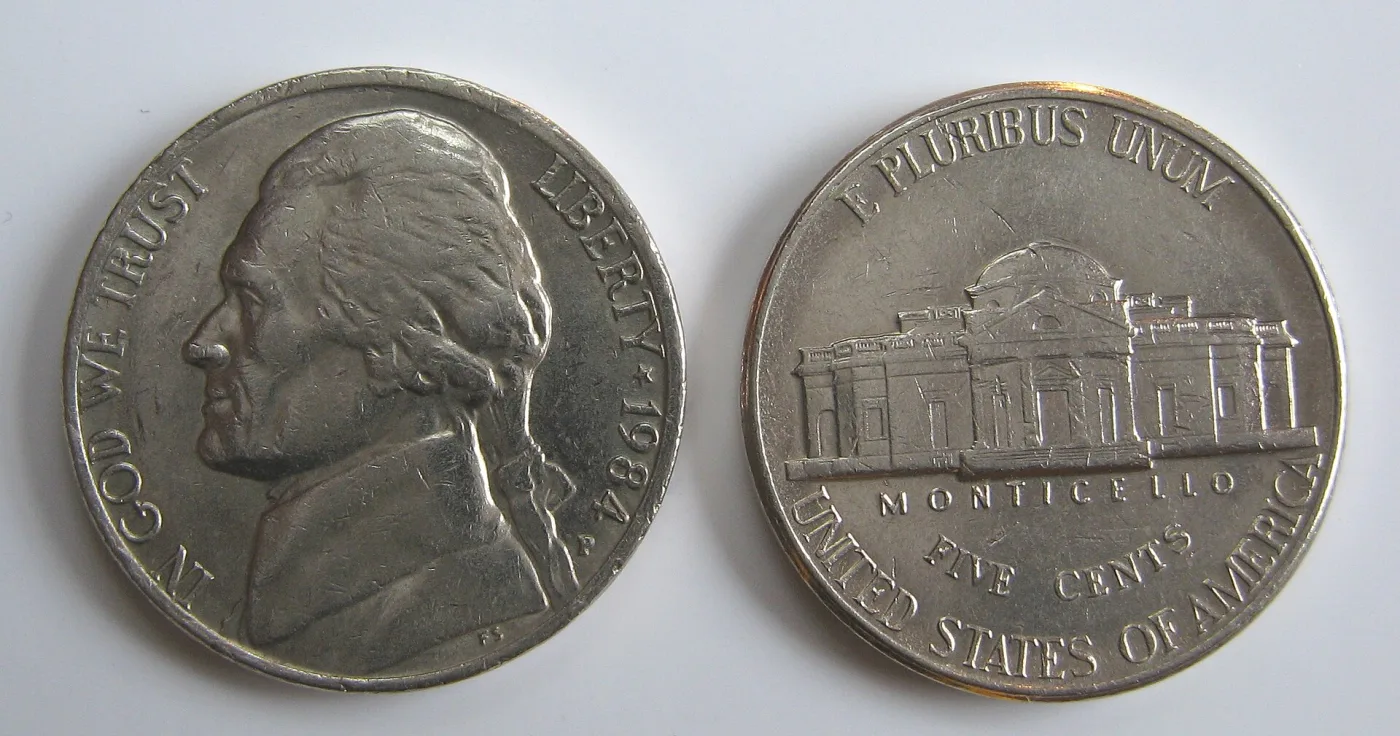
The Jefferson Nickel is the longest-running five-cent design in United States history and one of the most approachable series for both new and experienced collectors. Introduced in 1938 to replace the Buffalo Nickel — itself a successor to the earlier Liberty Head V Nickel and the original Shield Nickel of 1866 — the Jefferson Nickel has been struck continuously for more than eight decades, making a complete date-and-mintmark set one of the most affordable “lifetime” collecting goals in American numismatics. Yet despite its reputation as pocket change, the series hides genuine rarities, a famous wartime silver alloy, and a Full Steps grading designation that can turn an ordinary coin into a four-figure prize.
Jefferson Nickels reward careful looking. The series contains key dates like the 1939 Doubled Monticello, the low-mintage 1950-D, the 1942-P silver “war nickel” with its huge reverse mint mark, and a long tail of condition rarities where Full Steps examples are almost impossible to find. Modern issues from 2004 through 2006 feature special designs commemorating the Lewis and Clark Expedition and the Louisiana Purchase, and a redesigned Jefferson portrait that debuted in 2006 continues to this day. Whether you are digging through a jar of nickels from grandma’s attic or chasing a registry set, the coin you pull could be worth anywhere from five cents to five figures.
This guide walks you through everything you need to confidently identify, grade, authenticate, and value Jefferson Nickels. You will learn how to spot war-era silver composition, locate mint marks across three different design phases, understand the Full Steps designation on Monticello’s staircase, and price coins at any grade level. If you are brand new to identifying U.S. coins, start with our general coin identification guide and then return here to dive deeper into this remarkable long-running series.
History and Origins of the Jefferson Nickel
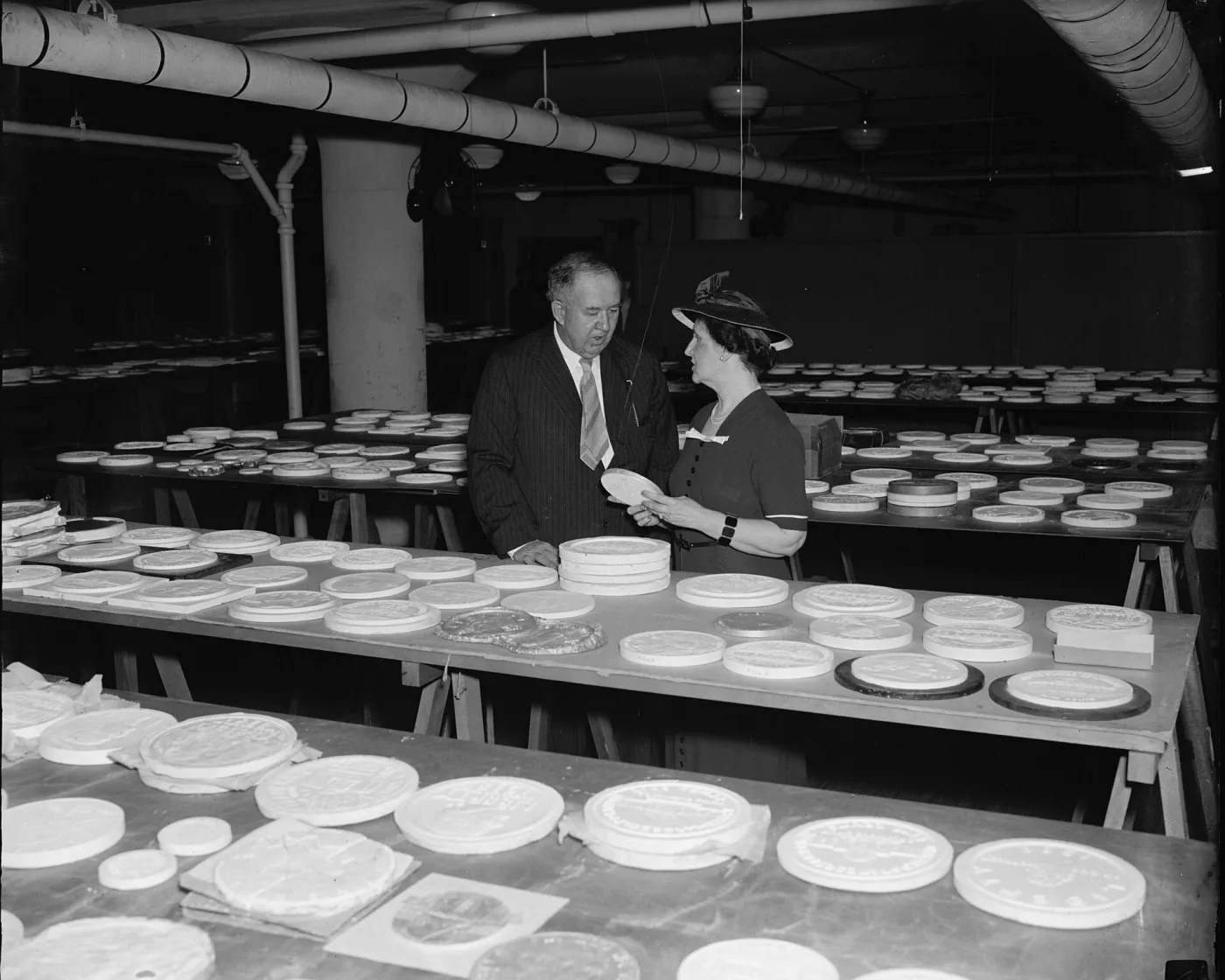
The Jefferson Nickel was born out of routine turnover. By 1938, the Buffalo Nickel designed by James Earle Fraser had been in circulation for 25 years — the minimum period after which the Treasury could change a coin’s design without an act of Congress. The Mint seized the opportunity and announced an open competition for a new nickel featuring Thomas Jefferson on the obverse and his Virginia home Monticello on the reverse, with a prize of $1,000 awarded to the winning designer.
More than 390 artists entered. The winner was Felix Schlag, a German-born sculptor working in Chicago who had immigrated to the United States in 1929. Schlag’s obverse portrait of Jefferson was based on a 1789 marble bust by Jean-Antoine Houdon — the same sculptor whose Franklin bust would later inspire the Franklin Half Dollar. His original reverse, however, depicted Monticello from a three-quarter perspective angle. Mint officials rejected that rendering and asked for a straight-on view of the east front of the building. Schlag redrew the reverse, but in the rush to production his initials were omitted. They would not appear on the coin until 1966, nearly thirty years after his design entered circulation.
A Coin Designed for Everyday Use
From the beginning, the Jefferson Nickel was conceived as a workhorse circulating coin rather than a showpiece. The design is simple, the relief is low, and the fields are broad — all features that allowed dies to last longer and coins to stack and handle well in commercial use. This pragmatism is partly why the series has survived so long without major redesigns: it does its job well, it is recognizable at a glance, and it is cheap to produce.
Production Timeline and Key Phases
The Jefferson Nickel series breaks naturally into four phases. Phase one (1938-1941) is the pre-war original design in standard cupronickel. Phase two (1942-1945) is the wartime silver-manganese alloy introduced to free nickel metal for the war effort. Phase three (1946-2003) returns to cupronickel with Schlag’s original design, later gaining the designer’s initials in 1966. Phase four begins in 2004 with the Westward Journey commemorative reverses, continues with a fully redesigned obverse portrait by Jamie Franki in 2006, and remains in production today.
Relationship to Other 20th-Century Series
The Jefferson Nickel shares its production era with several other modern U.S. series. It overlaps with the tail end of the Mercury Dime, the entire run of the Walking Liberty Half Dollar, the full Franklin and Kennedy Half Dollar runs, the Standing Liberty Quarter’s final years, and the full silver run of the Washington Quarter. Because Jefferson Nickels were struck every year from 1938 onward, they serve as a useful reference point for dating other coins found alongside them in hoards and accumulations.
Design Elements and How to Identify a Jefferson Nickel
Jefferson Nickels are easy to identify once you know what to look for. The design stayed remarkably consistent from 1938 until the modern redesigns beginning in 2004, and most coins you will encounter come from the classic Schlag design era.
Obverse (Front) Design — Classic (1938-2003)
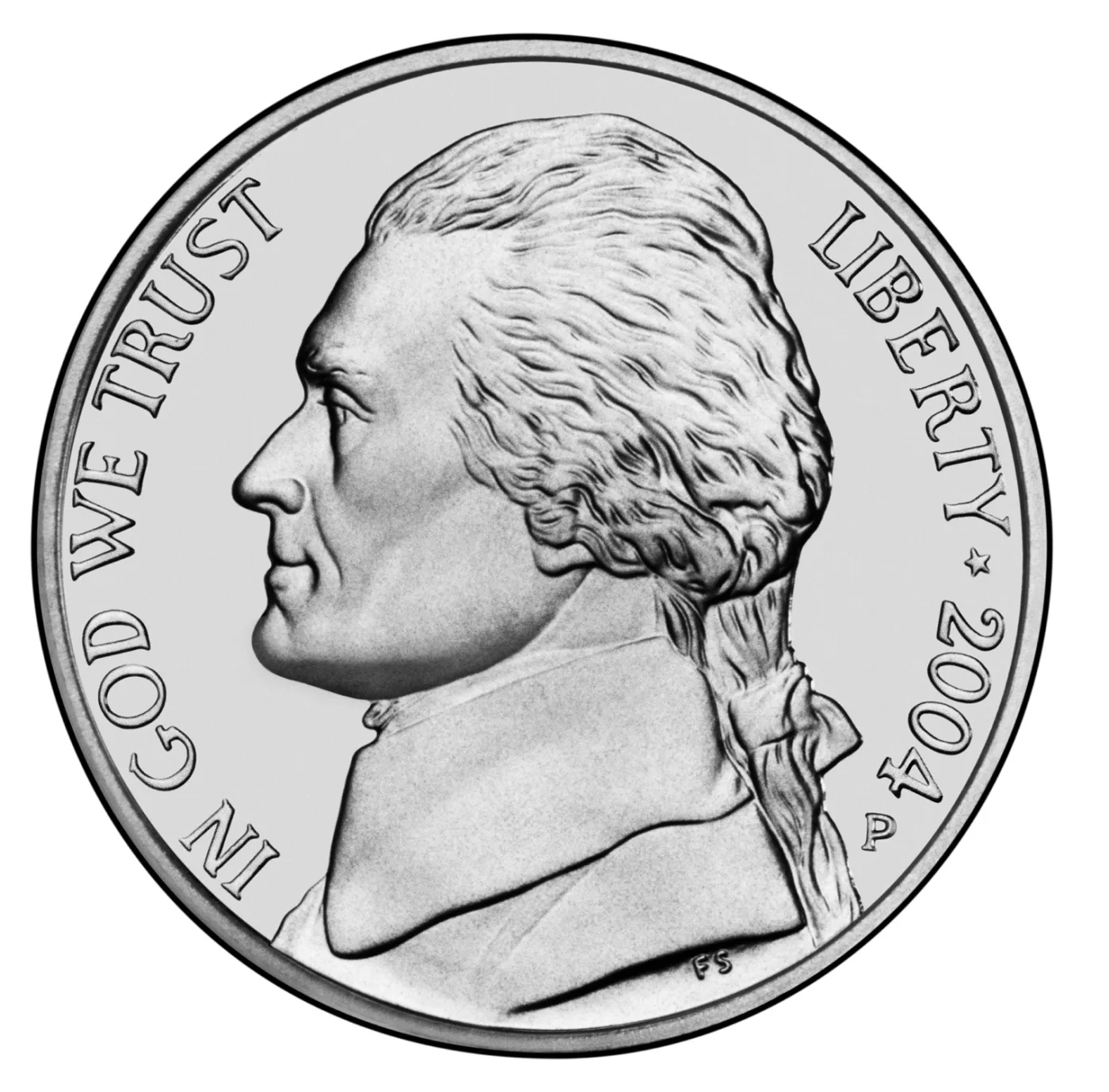
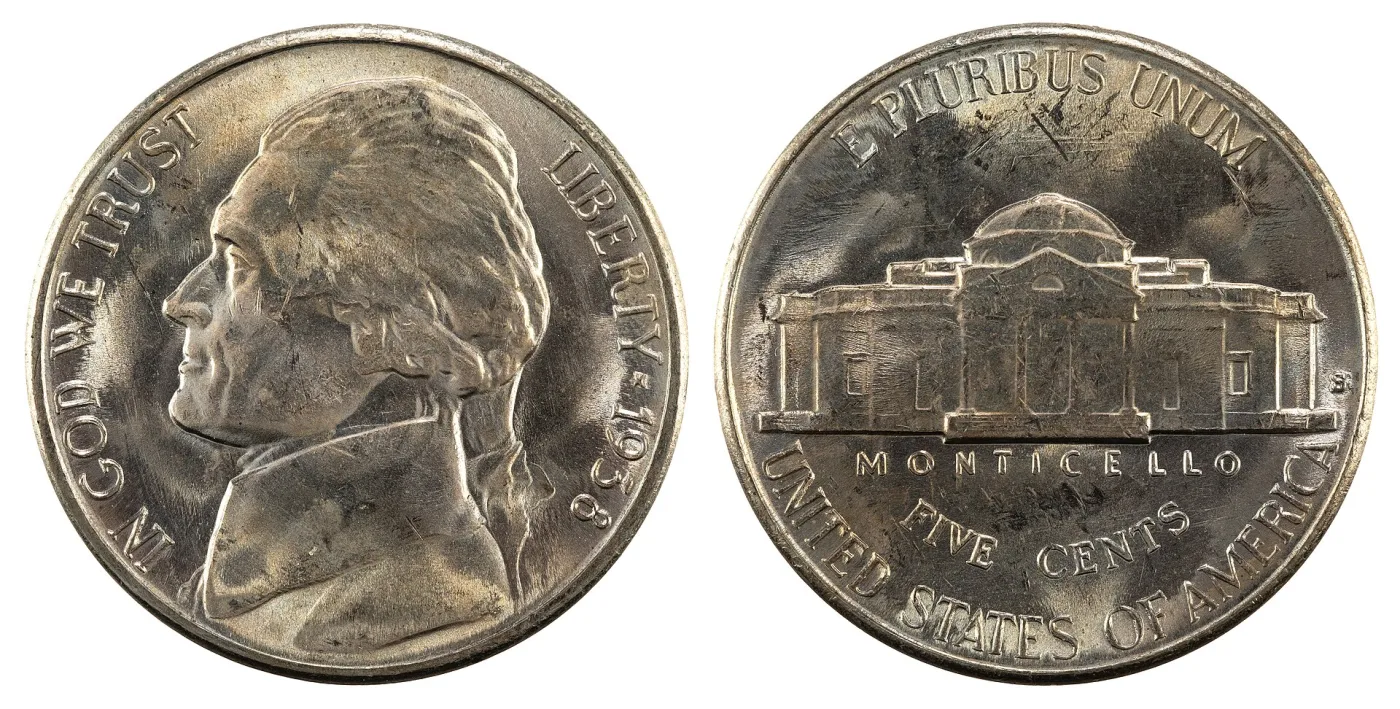
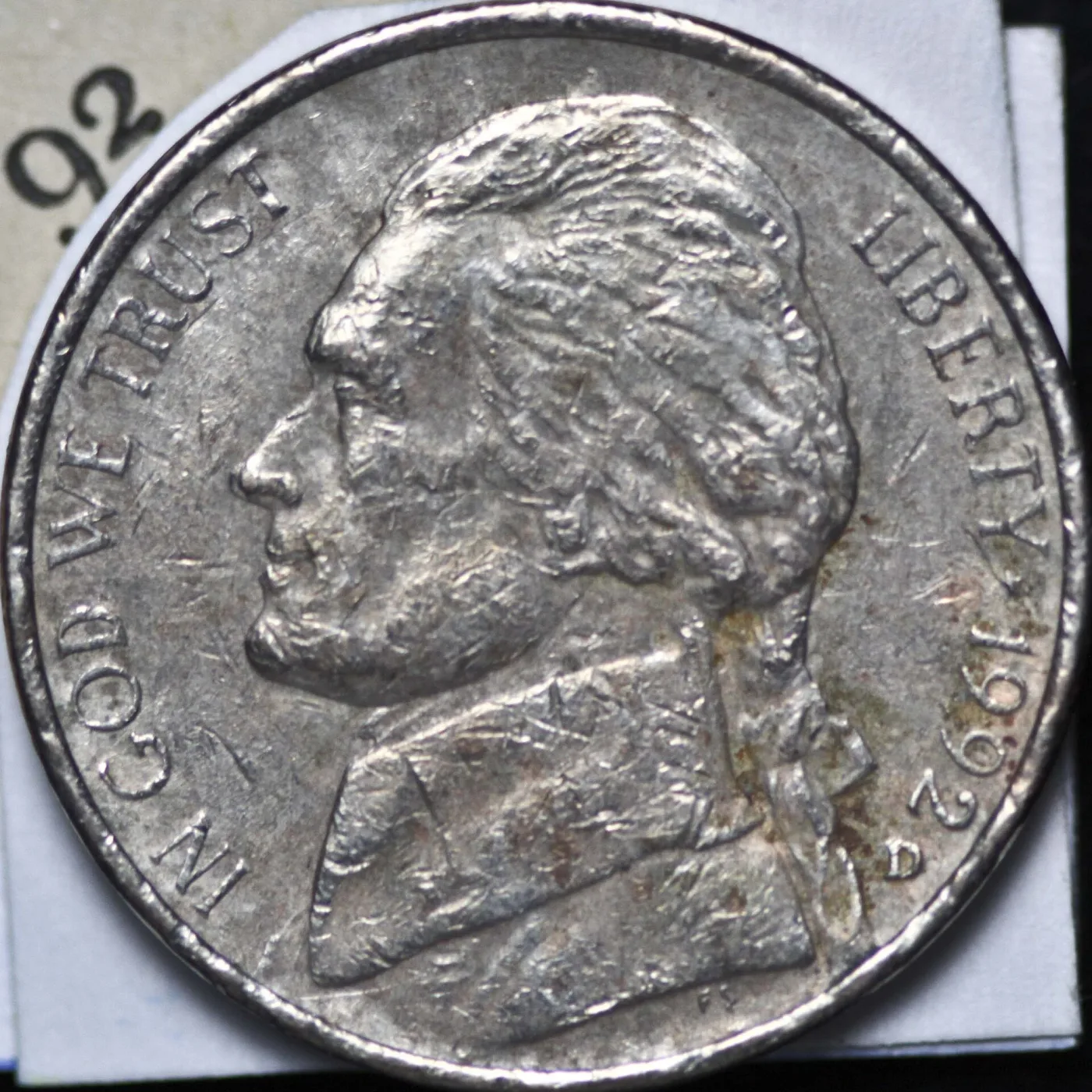
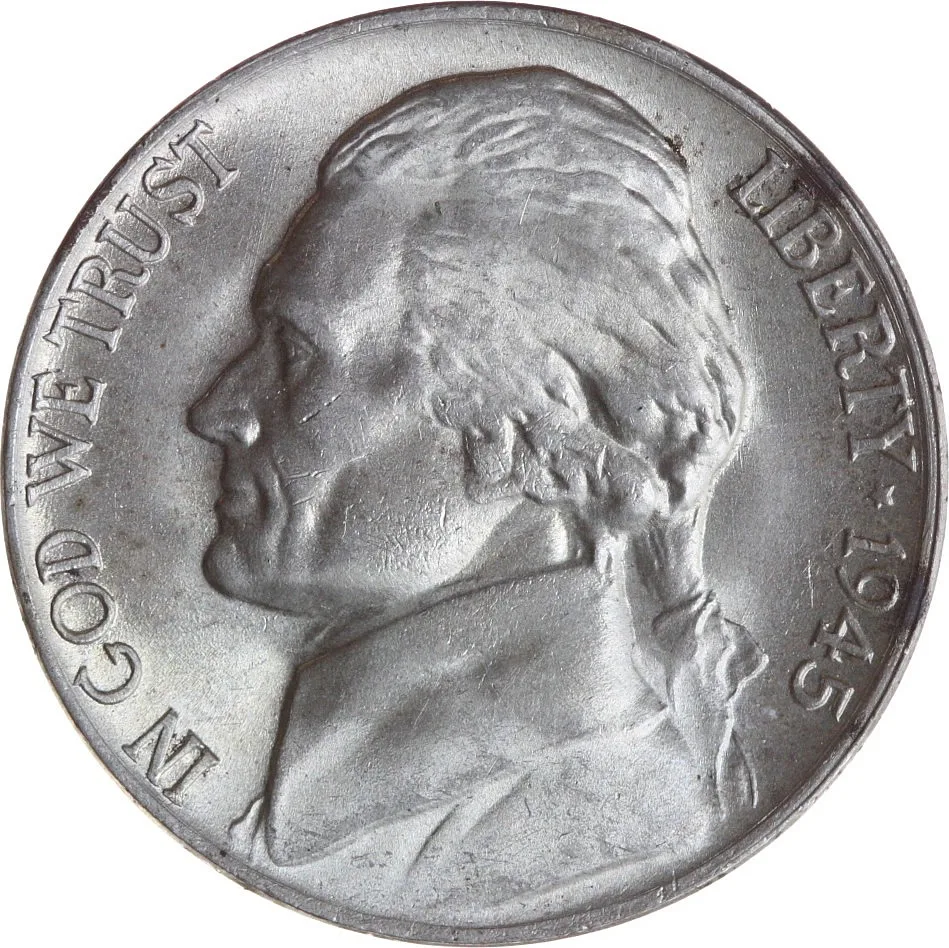
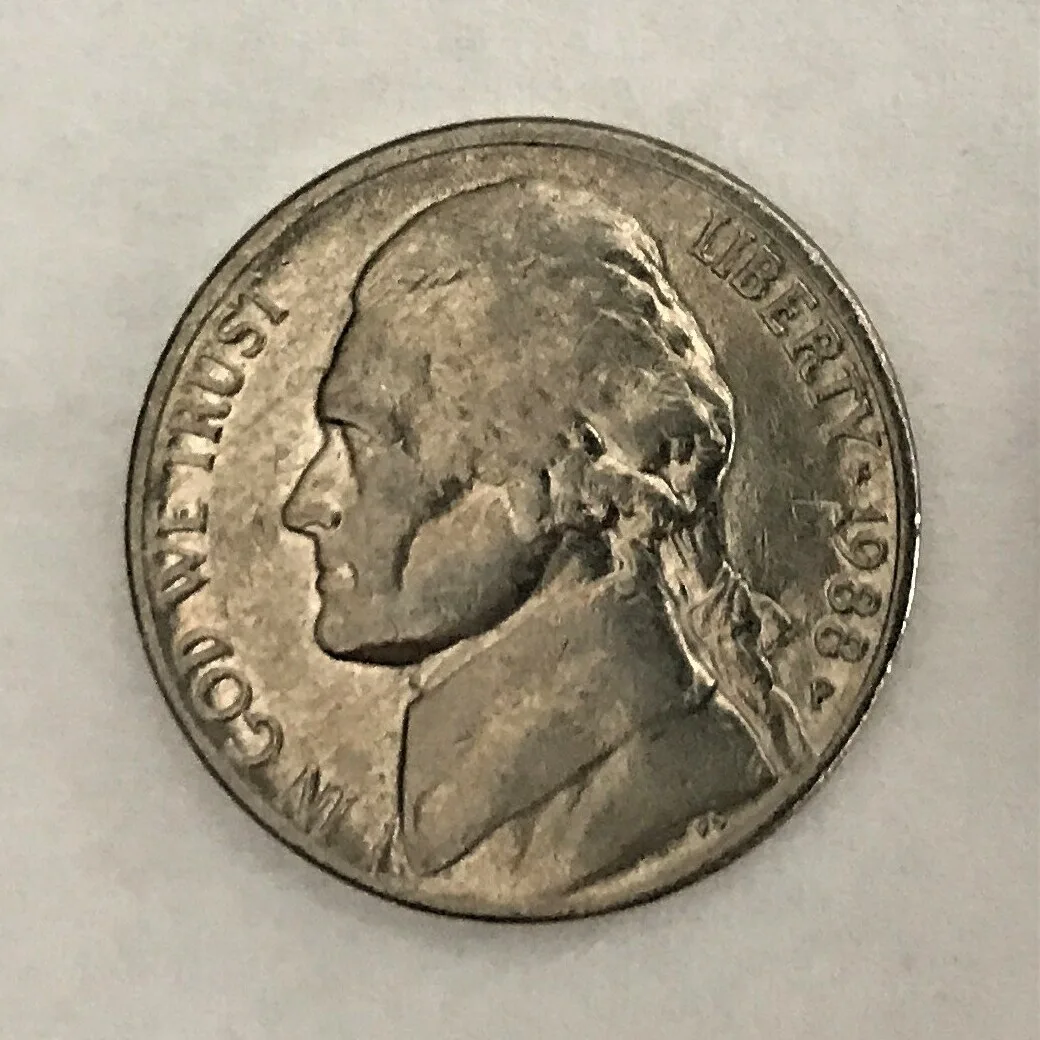
The classic obverse features a left-facing bust of Thomas Jefferson, based on Houdon’s sculpture. “IN GOD WE TRUST” arcs down the left side of the coin, and “LIBERTY” and the date appear to the right of Jefferson’s portrait, separated by a small star. Jefferson’s queue — the ribbon-tied ponytail typical of late 18th-century gentlemen — is visible at the back of his neck, and the collar of his coat is clearly defined at the shoulder. Starting in 1966, Schlag’s initials “FS” appear in small letters below Jefferson’s shoulder truncation.
Reverse (Back) Design — Classic (1938-2003, 2006-Present)
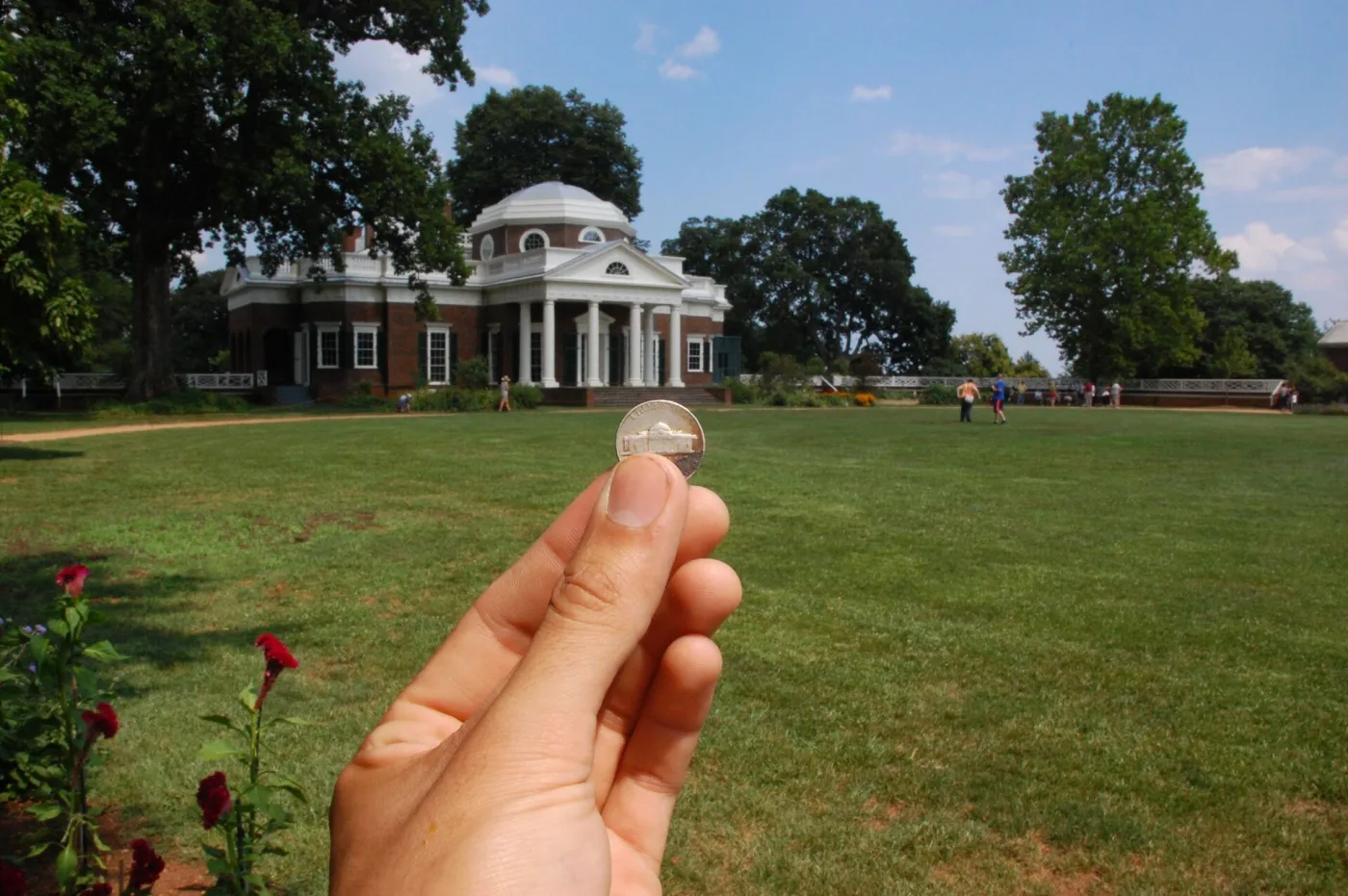
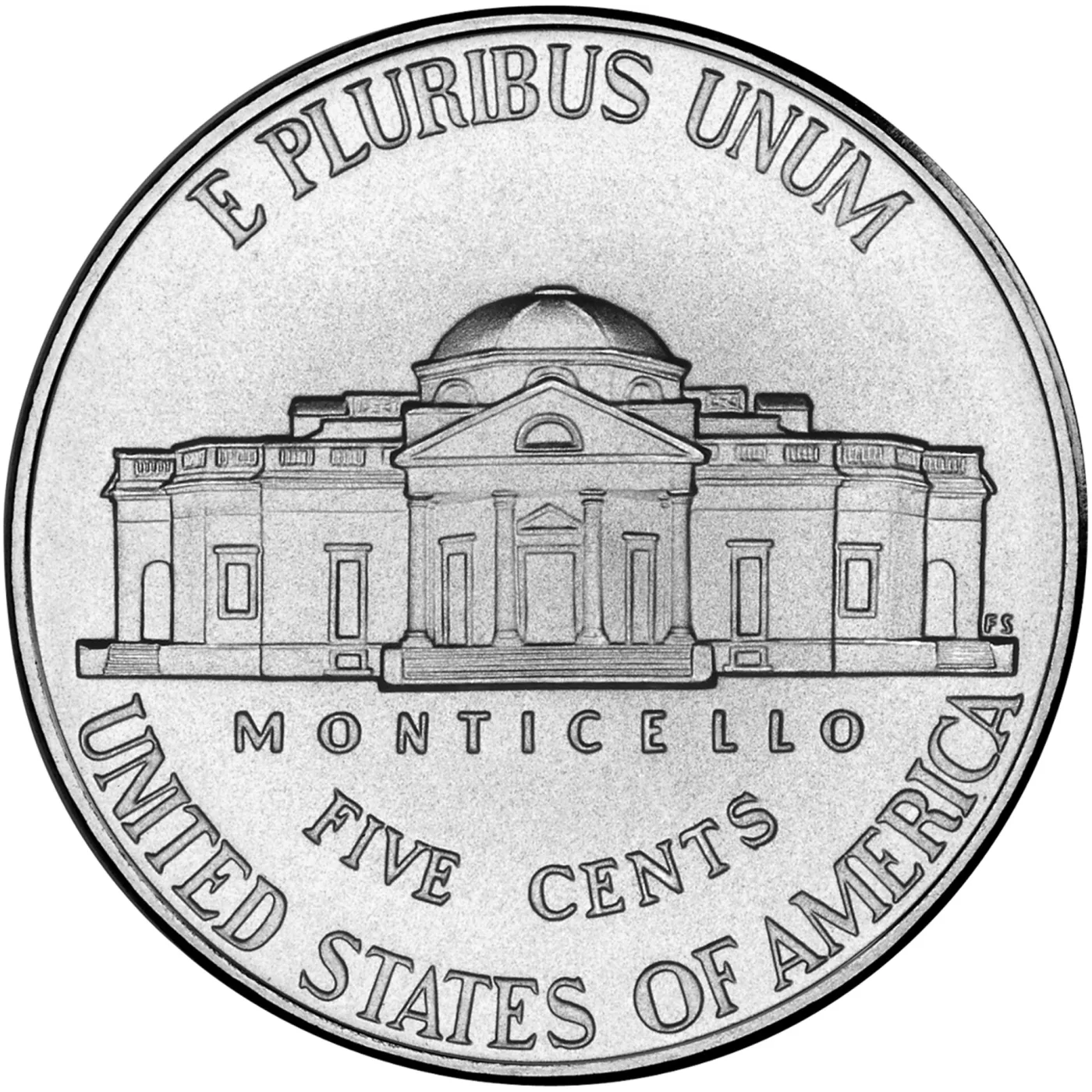
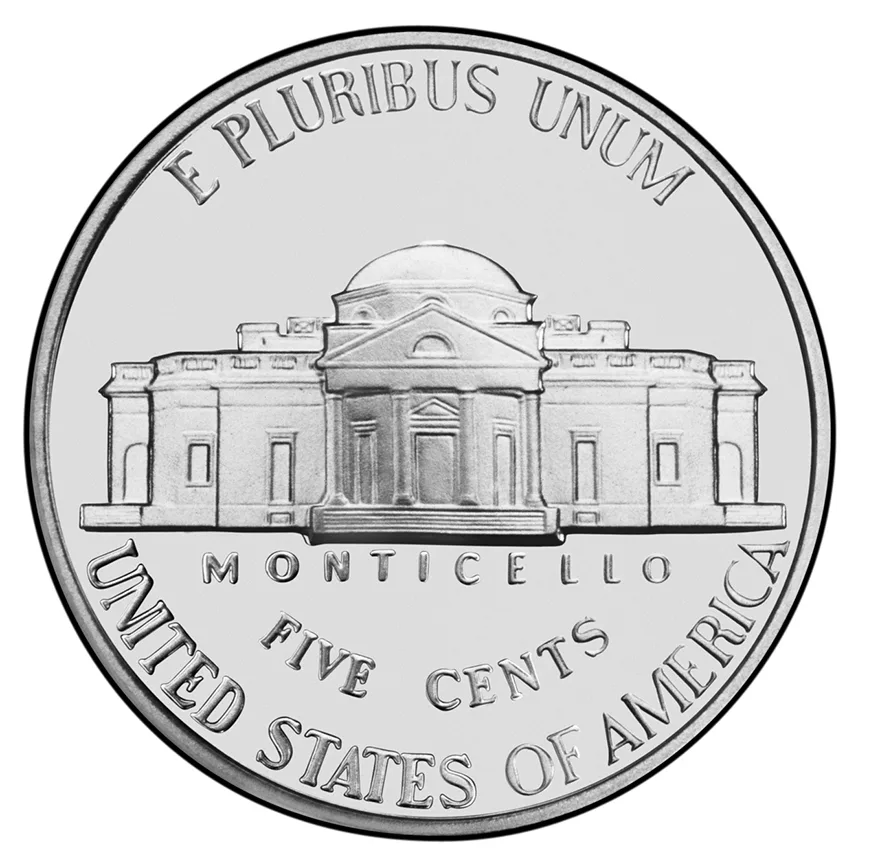
The classic reverse shows a straight-on view of the east front of Monticello, Jefferson’s iconic Virginia estate. “E PLURIBUS UNUM” arcs across the top above the dome, “MONTICELLO” runs directly below the building, “FIVE CENTS” appears below that, and “UNITED STATES OF AMERICA” curves along the bottom rim. The reverse is where Full Steps grading takes place — the staircase at the front entrance of Monticello has five to six distinct horizontal steps that must be completely separated and unbroken for the coin to earn the FS designation.
Modern Redesign (2006-Present)
In 2006, sculptor Jamie Franki introduced a new obverse featuring a forward-facing Jefferson portrait based on a painting by Rembrandt Peale. The bust is larger, the expression more lively, and “Liberty” now appears in Jefferson’s own handwriting, copied from the Declaration of Independence draft. The Monticello reverse returned in 2006 with enhanced detail compared to the original Schlag design, though the grading fundamentals (steps and overall strike) remain the same.
Physical Specifications
Most Jefferson Nickels are composed of 75% copper and 25% nickel (cupronickel), weigh 5.00 grams, have a diameter of 21.2 millimeters, and feature a plain (non-reeded) edge. The wartime silver alloy coins (1942-1945) are the only exception: they weigh 5.00 grams but consist of 56% copper, 35% silver, and 9% manganese. Every Jefferson Nickel shares the 21.2 mm diameter and plain edge, so size and edge alone cannot distinguish a war nickel from a regular issue — you must look at the mint mark and date.
Mint Marks and Where to Find Them
Mint mark placement on Jefferson Nickels changed multiple times across the series. Knowing where to look for a given year is essential because the location itself can tell you whether a coin is a war nickel, a modern issue, or a transitional piece.
Pre-War Placement (1938-1942 Early)
From 1938 through the early part of 1942, the mint mark appears on the reverse, to the right of Monticello, between the building and the rim. The letter is small — typically about 1 millimeter tall — and sits out in the open field beside the building’s lower storey, well above the “MONTICELLO” and “FIVE CENTS” legends that run across the bottom. Philadelphia coins have no mint mark; Denver shows a small “D”; San Francisco shows a small “S.”
War Nickel Placement (1942-1945)
When the wartime silver alloy was introduced in late 1942, the Mint made a dramatic change to help the public and banks identify the new composition: the mint mark was enlarged substantially and moved to the reverse directly above the dome of Monticello. This large mint mark — much bigger than any used before or since on a Jefferson Nickel — is the single most reliable visual indicator of a war nickel. Notably, this is the first time the Philadelphia Mint ever placed a “P” mint mark on any U.S. coin.
Post-War Placement (1946-1964)
After the war, mint marks returned to their pre-war position on the reverse, to the right of Monticello. They also reverted to the smaller pre-war size. Philadelphia remained unmarked (the “P” would not return until 1980).
No Mint Marks (1965-1967)
During the coin shortage and transition away from silver coinage, Congress temporarily banned mint marks on all U.S. coins from 1965 through 1967 to discourage hoarding by date. All Jefferson Nickels from these three years lack mint marks entirely, regardless of where they were struck.
Modern Placement (1968-Present)
Beginning in 1968, the mint mark moved to the obverse, near the date. On classic-design coins (1968-2003), the mint mark appears below the date at the lower right. On the 2006-present redesign, it is again near the date but positioned slightly differently to accommodate the new portrait layout. Philadelphia began marking coins with “P” in 1980.
The Three Mints
Philadelphia: No mint mark from 1938-1979 (except on 1942-1945 war nickels, which show a large “P” above Monticello). Small “P” from 1980 onward.
Denver (D): Produced Jefferson Nickels in most years from 1938 onward, with small “D” mint marks. Denver struck the low-mintage 1950-D, the key date of the series.
San Francisco (S): Struck business-strike Jefferson Nickels from 1938-1954, then resumed only as a proof-only mint from 1968 onward. S-mint coins after 1968 are generally proof strikes intended for collectors, not circulation.
War Nickels (1942-1945): The Silver Jefferson
No discussion of Jefferson Nickels is complete without covering the war nickels. These wartime issues are the only Jefferson Nickels that contain silver, and they occupy a unique place in both American numismatics and American industrial history.
Why War Nickels Exist
Nickel metal is a critical strategic material used in armor plating, stainless steel, and other wartime applications. In late 1942, with World War II consuming national metal stocks, Congress authorized the Treasury to remove nickel from the five-cent coin for the duration of the war. The Mint’s metallurgists needed a replacement alloy that would still work in existing vending machines — which identify coins by size, weight, and electrical conductivity. After testing dozens of combinations, they settled on 56% copper, 35% silver, and 9% manganese. The manganese matched the electrical properties of nickel closely enough that most vending machines could accept the new coins without modification.
How to Identify a War Nickel
War nickels are among the easiest U.S. coins to identify. Three features set them apart from regular Jefferson Nickels:
1. Date range: War nickels exist only for dates 1942, 1943, 1944, and 1945. A 1941 or 1946 nickel is never silver.
2. Large mint mark above Monticello: War nickels carry an oversized “P,” “D,” or “S” mint mark directly above the dome of Monticello on the reverse. This placement is unique to the war-nickel period.
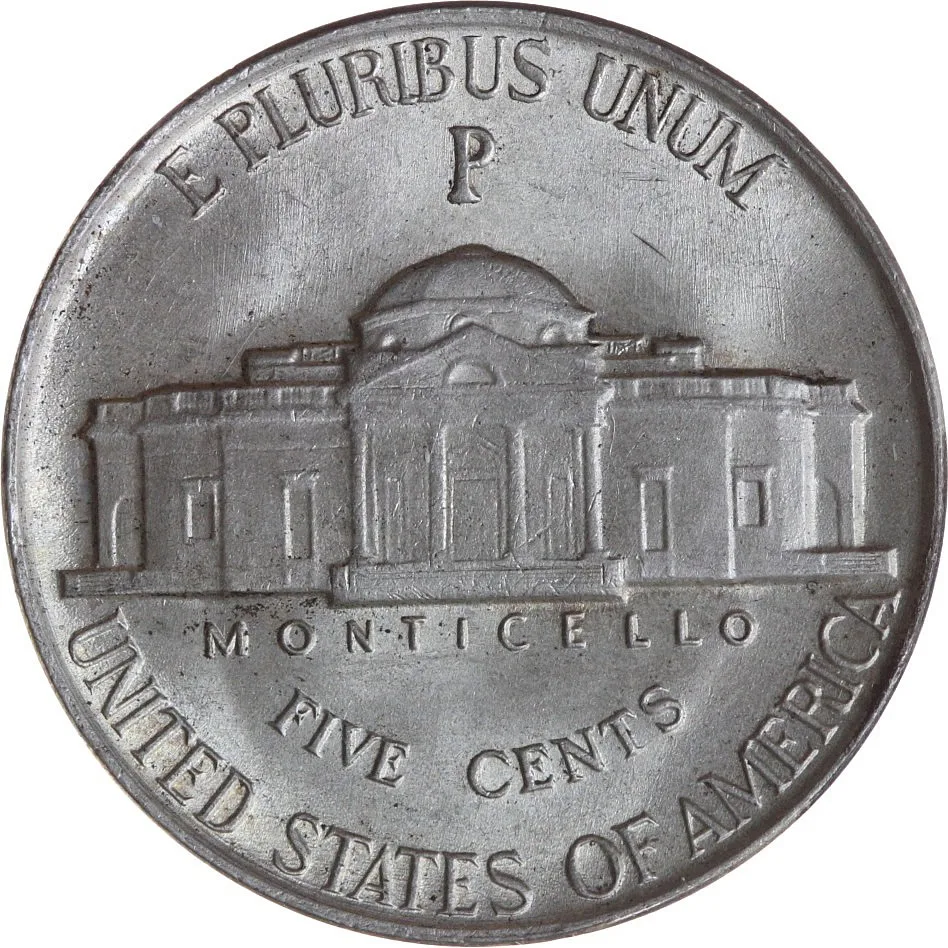
3. The 1942 exception: Both alloys were struck in 1942. A 1942 with no mint mark or a small mint mark to the right of Monticello is a regular cupronickel nickel. A 1942 with a large “P” or “S” above the dome is a silver war nickel. (Denver did not strike war nickels in 1942 — 1942-D coins are all regular alloy.)
Silver Content and Melt Value
Each war nickel contains 0.05626 troy ounces of pure silver. At current silver prices, the melt value fluctuates between $1.25 and $1.75 per coin — many times the five-cent face value. War nickels from circulation and low-grade hoards are routinely sold by weight as junk silver alongside pre-1965 dimes, quarters, and halves.
War Nickel Preservation Issues
The silver-manganese alloy is chemically active and prone to dark, streaky toning that many collectors find unattractive. Heavily toned examples can appear almost black. While some toning is unavoidable and even desirable in certain patterns, war nickels are generally harder to find with original bright surfaces than their cupronickel counterparts. Well-struck, brightly toned, fully original war nickels in MS-65 or better are genuinely sought-after by specialists.
Full Steps (FS): The Grading Designation That Changes Everything
Like Full Bell Lines on Franklin Halves, Full Bands on Mercury Dimes, and Full Head on Standing Liberty Quarters, Full Steps is a strike designation that can multiply a coin’s value several times over. Understanding what it is and which dates are hard to find with it is one of the most important skills in collecting Jefferson Nickels.
What Are the Steps?
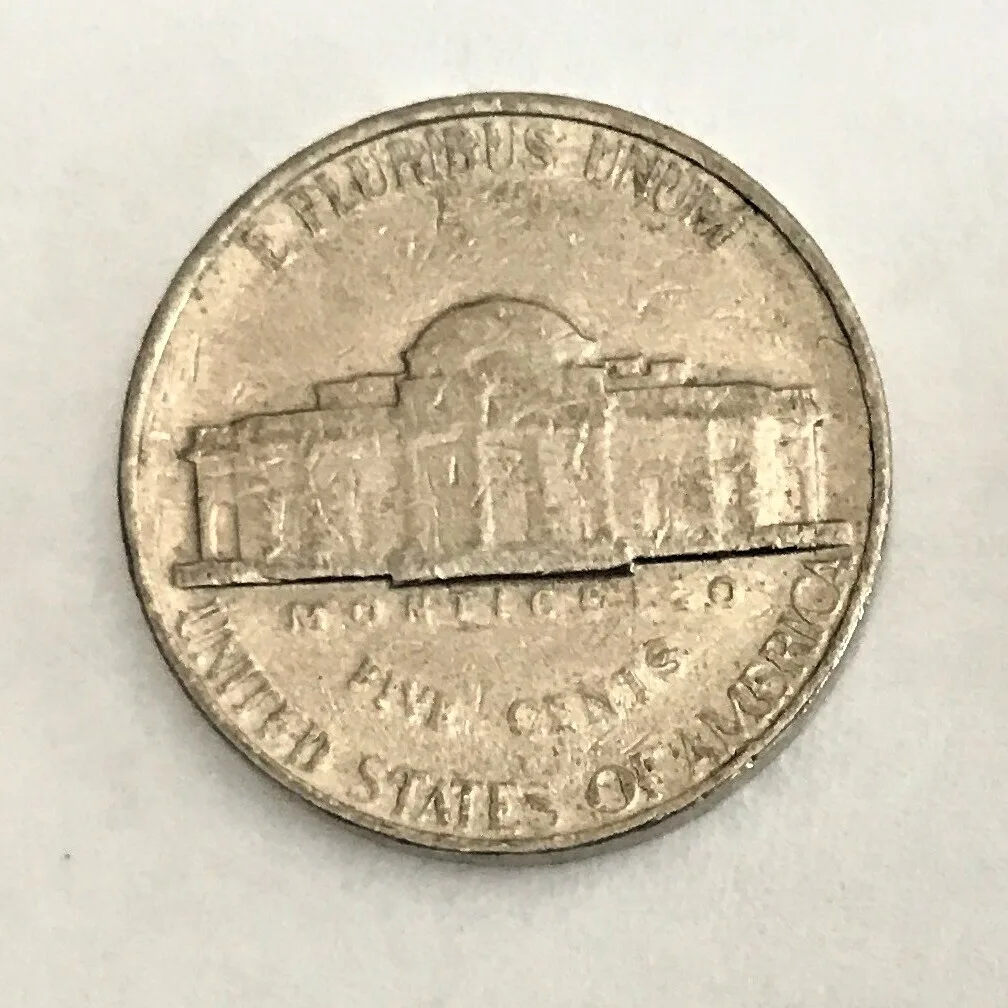
Look at the reverse of a Jefferson Nickel. Directly beneath the columns of Monticello, you will see a set of horizontal lines representing the staircase leading up to the east front of the building. A fully detailed strike shows five or six distinct, unbroken steps running across the base of the structure. A weak strike — caused by insufficient die pressure, worn dies, or both — leaves the steps blurred, merged, or entirely missing.
The 5FS and 6FS Designations
PCGS and NGC recognize two tiers of the designation. “5FS” requires five complete, clean, unbroken steps. “6FS” is stricter — all six steps must be fully separated with no interruptions, nicks, or planchet roughness. Most dates are scarce in 5FS and much scarcer in 6FS. PCGS primarily uses “FS” as an umbrella designation with a population split between coins meeting the five-step and six-step standards. NGC uses “5FS” and “6FS” as separate designations.
Why Full Steps Is So Elusive
The steps sit at the lowest point of the relief on the reverse, which is the highest point of the die. Metal must flow into that deep recess to strike the steps fully. Several dates — notably the 1953-S, 1954-S, 1955-D, and various 1960s Denver issues — are notoriously weakly struck and almost impossible to find in Full Steps even in gem Mint State. A common 1954-S in MS-65 might sell for $20, while the same coin in MS-65 FS (if it exists at all in PCGS population reports) can command $10,000 or more.
Condition-Rarity Hot Spots
The most famous Jefferson condition rarities revolve around Full Steps: 1939-D Reverse of 1940 FS, 1949-S FS, 1951-S FS, 1953-S FS, 1954-S FS, 1955-D FS, and 1960-D FS are all dates where Full Steps examples routinely trade for $1,000 to $20,000. For many of these, PCGS has graded fewer than five examples in MS-65 FS or higher across its entire history.

Key Dates and Semi-Keys
Jefferson Nickels do not include any ultra-low-mintage rarities on the order of the 1916-D Mercury Dime or 1909-S VDB Lincoln Cent. The “keys” of the series are driven by modest mintages combined with heavy circulation or by extreme condition rarity. Here are the dates every Jefferson collector should know by heart.
1950-D: The Mintage King
Mintage: 2,630,030. The 1950-D is the lowest-mintage business-strike Jefferson Nickel and the undisputed date key of the series. Unlike most key dates, however, the 1950-D was widely saved at the time of issue — hoarders and dealers pulled rolls from circulation knowing a low-mintage issue would be collectible. As a result, Mint State examples are relatively plentiful. Circulated 1950-Ds sell for $10 to $15, MS-63 examples for $15 to $25, and MS-65 for $30 to $50. MS-66 FS examples move into the $100 to $300 range.
1939-D: Low Mintage and Scarce in FS
Mintage: 3,514,000. The 1939-D is the second-lowest-mintage Jefferson issue. Circulated examples sell for $5 to $10, MS-65 for $60 to $120, and MS-65 FS for $400 to $1,200. The 1939-D “Reverse of 1940” variety (see the varieties section) is even scarcer in Full Steps.
1939-S: Harder Than It Looks
Mintage: 6,630,000. The 1939-S is not as flashy as the 1950-D but is genuinely difficult to find in high grades with Full Steps. MS-65 runs $50 to $100; MS-65 FS commands $500 to $1,500.
1942-D Horizontal D (D/Horizontal D)
The 1942-D shows a well-known variety where the “D” mint mark was initially punched into the die on its side (horizontally) and then corrected by repunching over it upright. The resulting coin shows a ghostly horizontal “D” beneath the main upright “D.” Premiums are substantial: a common 1942-D in MS-65 sells for $25 to $40, but a 1942-D Horizontal D in MS-65 can bring $1,500 to $5,000 depending on how strong the underlying horizontal mint mark appears.
1943/2-P: The Wartime Overdate
A famous overdate variety exists on the 1943-P war nickel, where the “3” in the date was punched over an earlier “2.” Under magnification, remnants of the “2” are visible inside the loops of the “3.” Circulated examples sell for $50 to $150, and MS-65 FS coins can exceed $3,000.
Other Semi-Keys
Several additional Jefferson Nickels are tougher than their mintages suggest, particularly in Full Steps: 1938-D, 1938-S, 1949-S, 1951-S, 1953-S, 1954-S, 1955-D, and 1960-D. For registry-set collectors, these condition rarities are the budget bottleneck, not the 1950-D.
Notable Varieties: Doubled Monticello, Doubled Dies, and Overmintmarks
Jefferson Nickels offer a deep well of varieties for collectors who enjoy the detective work of cherry-picking. Some are subtle, others dramatic. The following are the most collected and most valuable.
1939 Doubled Monticello
The 1939 Doubled Monticello shows strong, unmistakable doubling in “MONTICELLO” and “FIVE CENTS” on the reverse. This is one of the most visually dramatic doubled dies in 20th-century U.S. coinage and is collectible at every grade level. Circulated examples sell for $50 to $150, AU-55 for $200 to $400, MS-63 for $400 to $900, and MS-65 FS for $5,000 or more.
1939 Reverse of 1938 vs Reverse of 1940
In 1939, the Mint modified the reverse design slightly — “MONTICELLO” and “FIVE CENTS” were sharpened and the steps redrawn for better definition. The “Reverse of 1938” (the original Schlag reverse, used through early 1939) shows wavy, indistinct steps and slightly mushy lettering. The “Reverse of 1940” (used from mid-1939 onward) shows crisper lettering and clearer steps. The 1939-D and 1939-S coins exist with both reverses, and the Reverse of 1940 versions of those mint marks are significantly scarcer, particularly in Full Steps.
1945-P Doubled Die Reverse
The 1945-P Doubled Die Reverse is a popular war-nickel variety showing strong doubling in “MONTICELLO” and the reverse devices. MS-65 examples sell for $400 to $1,000, and FS examples can reach $3,000 or more.
1946-D/D Repunched Mint Mark
The 1946-D shows a well-known repunched mint mark where the “D” was punched multiple times into the die, creating overlapping impressions. Several distinct varieties exist, with the most dramatic (known as D/D North) carrying premiums of $50 to $500 depending on grade.
1949-D D/S Overmintmark
The 1949-D D/S is one of the most famous overmintmarks in U.S. coinage. A die originally punched with an “S” mint mark was later repunched with a “D” — likely because the die was reallocated from San Francisco to Denver. The ghostly “S” is visible underneath the primary “D.” Circulated examples sell for $50 to $150, MS-65 for $500 to $1,500, and MS-65 FS for $3,000 or more.
1954-S S/D Overmintmark
The 1954-S S/D is the mirror image of the 1949-D D/S: an “S” punched over a previously stamped “D.” It is similarly valuable, with MS-65 examples commanding $400 to $1,200.
1971 No-S Proof
The 1971 No-S Proof is a rare error where a small number of proof dies were prepared without the “S” mint mark. These coins are significantly rarer than regular 1971-S proofs and sell for $1,500 to $5,000 in PR-65 and up.
Proof Jefferson Nickels and Cameo Designations
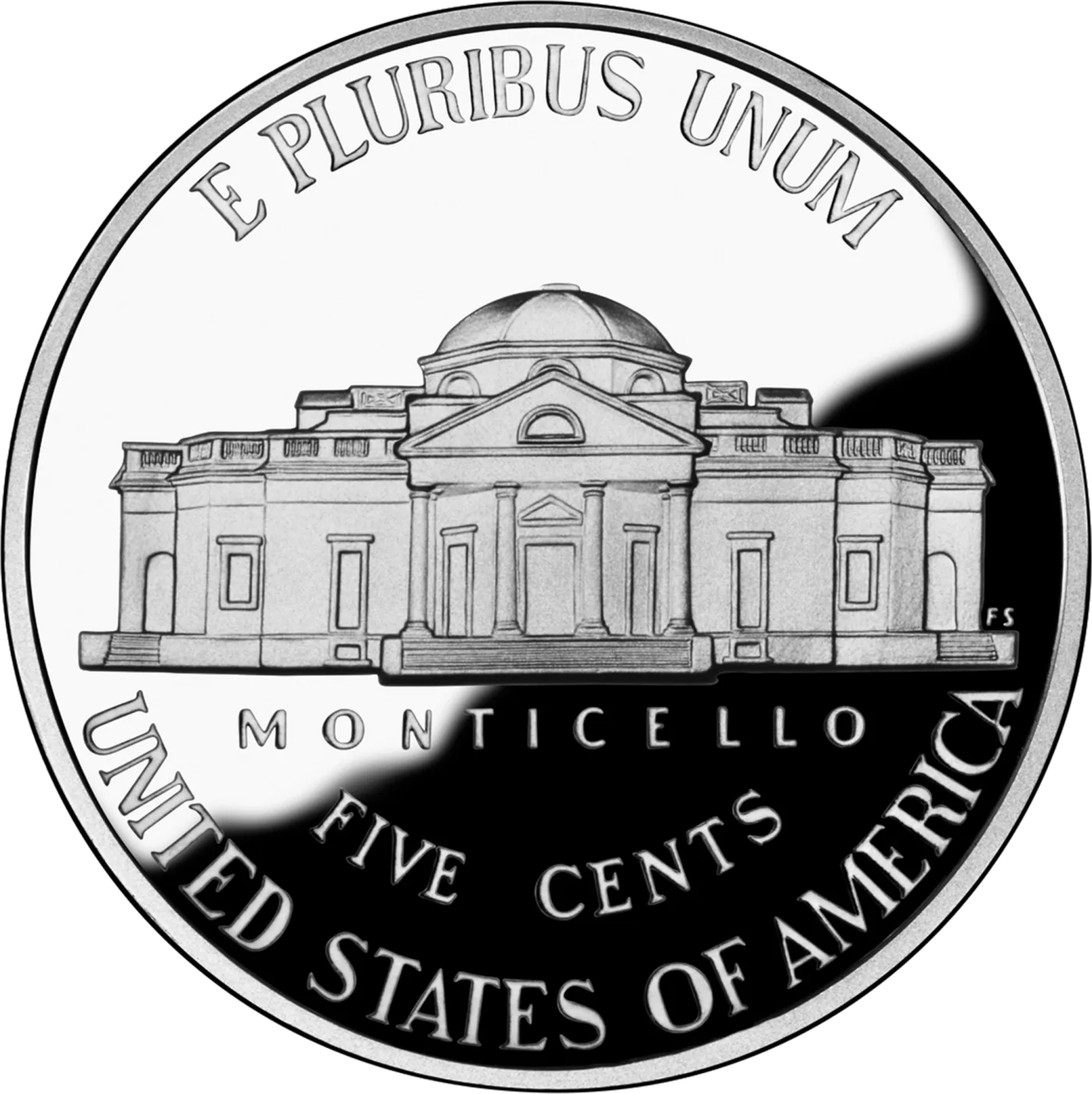
Proof Jefferson Nickels have been struck continuously since 1938 (with a brief pause during the war years) and offer collectors an enormous range of affordable and semi-affordable targets. Early proofs are scarce in top grades, and modern proofs offer beautiful Deep Cameo surfaces at reasonable prices.
Early Proofs (1938-1942)
The earliest Jefferson proofs, struck at Philadelphia from 1938 through 1942, have low mintages — under 30,000 for most years. The 1938 proof in PR-65 sells for $100 to $200, and PR-67 Cameo examples can exceed $2,000. The 1939 and 1940 proofs follow similar patterns. These early proofs are genuinely scarce in cameo grades and command strong premiums for eye appeal.
Modern Proof Era (1950-Present)
Proof production resumed in 1950 after a wartime pause and has continued at San Francisco ever since (with minor exceptions). Modern proofs are plentiful in base proof grades — PR-65 common dates sell for $5 to $15 — but top-grade cameo and Deep Cameo examples are still collected enthusiastically. PR-70 Deep Cameo examples of many modern dates sell for $50 to $200 each.
Key Proof Issues
Beyond the 1971 No-S mentioned above, other key proofs include the 1942-P Type 2 silver-alloy proof (the first U.S. coin proof struck in the wartime silver-manganese alloy), which sells for $250 to $600 in PR-65. The 1994-P and 1997-P matte-finish proofs, issued only in special sets, are scarcer than their proof counterparts and sell for $100 to $250 each.
Error Coins and Mint Mistakes
Because they have been produced in enormous quantities for decades, Jefferson Nickels are a fertile source of mint errors. Values range widely based on the type and severity of the error.
Off-Center Strikes
An off-center Jefferson Nickel sells for $15 to $50 for minor examples (5-10% off-center) and $200 to $500 for dramatic strikes (25%+ off-center with a full date visible). Off-center war nickels command higher premiums because of their silver content and shorter production window.
Broadstrikes and Collar Errors
A broadstrike occurs when a coin is struck without the retaining collar, producing an oversized, irregularly edged coin. Jefferson broadstrikes typically sell for $20 to $80 depending on how dramatically the coin spread.
Struck on Wrong Planchet
Jefferson Nickels struck on dime planchets (smaller, silver or cupronickel-clad) sell for $200 to $800. Nickels struck on cent planchets (copper-plated zinc after 1982, or solid bronze before) are less common and command $500 to $1,500. Extremely rare wrong-planchet errors can exceed $5,000.
Clipped Planchets
Clipped-planchet errors — where the blank was cut improperly, leaving a curved or straight missing edge — are relatively common on Jefferson Nickels. Minor clips sell for $5 to $20; dramatic or multiple clips bring $50 to $200.
Die Cracks, Cuds, and Die Breaks
Large die cracks, cuds (where a piece of the die has broken away), and prominent die breaks are collected as attribution varieties. Premiums range from $10 to $200 depending on the drama and known rarity of the specific die state.
1999 Wide AM and Close AM Varieties
Certain 1999 Jefferson Nickels show slight spacing differences in “AMERICA” on the reverse. These are subtle and require magnification, but attributed examples carry modest premiums of $10 to $50.
How to Grade Jefferson Nickels
Jefferson Nickels are graded on the standard Sheldon 70-point scale. Because the design has been in production for so long and the coins have circulated so heavily, accurate grading requires attention to several specific wear points.
Key Wear Points on the Obverse (Classic Design)
The first areas to show wear are the high points of Jefferson’s hair — especially just above the ear and at the temple — and his cheekbone. In Good (G-4), these areas are completely smooth. By Very Fine (VF-20 to VF-35), individual hair strands become visible again and the cheek shows definition but still has minor flattening.
Key Wear Points on the Reverse
The reverse high points are the steps of Monticello (the focus of FS grading), the triangular pediment above the columns, and the dome. The columns themselves wear relatively slowly because they sit in lower relief. Lettering around the perimeter shows wear early in the “MONTICELLO” and “FIVE CENTS” legends.
Grading Circulated Jeffersons
Good (G-4 to G-6): Jefferson’s portrait is fully outlined, but hair detail is largely smooth. Date and “LIBERTY” are readable. The Monticello building is visible in outline but steps are completely flat.
Fine (F-12 to F-15): Major hair detail returns. Some steps on Monticello become visible but remain partially blurred. Pillars of Monticello are clearly separated.
Very Fine (VF-20 to VF-35): Most hair detail is present. Monticello’s steps show partial definition. “MONTICELLO” lettering is sharp.
Extremely Fine (EF-40 to EF-45): All hair detail is sharp with only trace wear on the highest points. Steps are mostly complete though usually not sharp enough for FS.
About Uncirculated (AU-50 to AU-58): Only slight friction on the highest points. Most original luster remains, especially in protected areas around the date and lettering.
Grading Mint State Jeffersons
Mint State Jefferson Nickels are graded on luster, strike quality, surface preservation, and eye appeal. MS-60 shows heavy bag marks; MS-63 is a typical “brilliant uncirculated” with some marks; MS-65 is a true gem with minimal marks and strong luster; and MS-66+ is exceptional. Remember that the MS grade and the Full Steps designation are separate: a coin can be MS-66 without FS, or MS-63 with FS. Both affect value independently, though high grade plus FS is where the money concentrates.
Authentication: Detecting Counterfeits and Alterations
Jefferson Nickels are not frequently counterfeited outright because most are low-value. The greater risk is altered coins — adjusted dates, added mint marks, or fake varieties. Here is what to watch for.
Weight and Dimensions
Genuine Jefferson Nickels weigh 5.00 grams with a tolerance of about 0.05 gram, and measure 21.2 mm in diameter. War nickels weigh the same 5.00 grams but have a different composition. Any coin significantly outside these specifications warrants further investigation.
Altered Dates and Mint Marks
The most common alterations on Jefferson Nickels involve creating fake key dates: adding a “D” to a 1950 Philadelphia to create a fake 1950-D, or altering a 1938 or 1939 Philadelphia into a fake S-mint. Under high magnification (10x or greater), altered mint marks show tool marks, inconsistent surface texture, incorrect font, or misalignment with the mint mark position used in that year.
War Nickel Authentication
Because war nickels are visually identified by the large mint mark above Monticello, counterfeiters sometimes try to enlarge or reposition a small mint mark to fake a war nickel. A genuine large war-nickel mint mark has a specific shape, size, and font that does not match modern or older mint marks. A specific-gravity test can also confirm the silver-manganese alloy (around 9.25) versus cupronickel (around 8.90).
Counterfeit Full Steps
In the high-grade market, some coins have been “doctored” by carefully tooling between the steps to create the appearance of Full Steps. Professional authentication at PCGS or NGC routinely catches this with high magnification and surface analysis. Any expensive FS coin should be in a third-party holder.
Professional Authentication
For any Jefferson Nickel valued over $200 — including key dates in high grades, FS examples, major varieties, and wartime overdates — professional authentication through PCGS or NGC is strongly recommended. The cost is modest relative to the protection it provides.
Current Market Values by Date and Mint
Jefferson Nickel values are dominated by three factors: date rarity, condition (MS grade), and strike (FS designation). For most common dates, the coin is worth face value in circulated grades and only modest premiums in MS-65 or below.
Common Dates (1938-Present, Circulated)
The vast majority of circulated Jefferson Nickels sell for face value (five cents) or a small premium up to $0.25. This includes nearly all post-1946 Philadelphia issues and most Denver and San Francisco coins from the 1950s and later in circulated grades.
War Nickels (1942-1945)
War nickels sell for their silver melt value in circulated grades — currently $1.25 to $1.75 depending on silver spot price. MS-63 war nickels bring $5 to $15, MS-65 runs $20 to $50, and MS-66 FS examples of some dates can exceed $500.
Key-Date Values
The 1950-D in MS-65 sells for $30 to $50 and in MS-66 FS for $100 to $300. The 1939-D Reverse of 1940 in MS-65 FS sells for $1,500 to $4,000. The 1954-S in MS-65 FS is a legitimate condition rarity at $5,000 to $15,000 or more. The 1955-D and 1953-S in MS-65 FS approach similar levels.
Variety Values
The 1939 Doubled Monticello in MS-65 sells for $1,000 to $3,000. The 1942-D Horizontal D in MS-65 runs $1,500 to $5,000. The 1949-D D/S in MS-65 sells for $500 to $1,500. The 1943/2-P overdate in MS-65 FS can reach $3,000 to $8,000.
Factors Affecting Value
Beyond date and grade, eye appeal matters enormously for Jefferson Nickels. Original luster (versus dipped or cleaned surfaces), attractive original toning, sharp strike, and minimal contact marks all drive premium prices. Conversely, environmental damage, cleaning, artificial toning, and heavy bag marks depress value regardless of technical grade.
Modern Issues: Westward Journey and the New Portrait
The Jefferson Nickel has seen more design change in the 21st century than in its first 65 years. These modern issues are inexpensive and readily available, making them a great starting point for new collectors.
2004 Westward Journey: Peace Medal and Keelboat
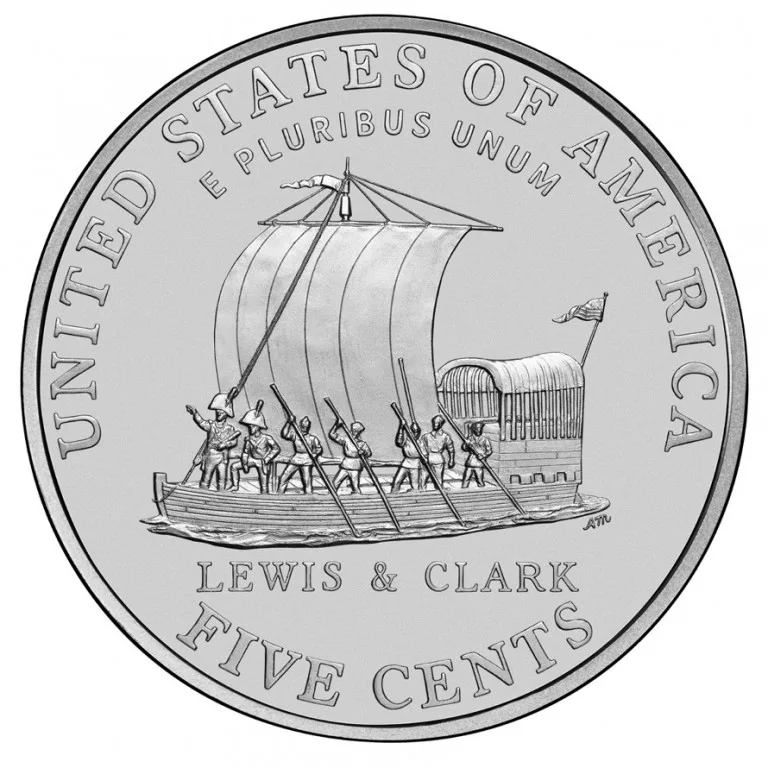
To commemorate the bicentennial of the Louisiana Purchase and the Lewis and Clark Expedition, the Mint issued two 2004 reverse designs. The first, released in the spring, depicts a Peace Medal — a clasped-hands design based on the medals Jefferson presented to Native American leaders during the expedition. The second, released later that year, shows the keelboat used by the Corps of Discovery on the Missouri River. Both retain the classic Schlag obverse.
2005 Westward Journey: Bison and Ocean in View
Two 2005 reverses followed. The first shows an American bison, a nod both to the wildlife encountered by Lewis and Clark and to Fraser’s Buffalo Nickel. The second depicts an ocean shoreline with the legend “Ocean in view! O! the joy!” — a quote from William Clark’s journal at the Pacific. The 2005 coins also introduced a new, enlarged Jefferson portrait on the obverse by Joe Fitzgerald, creating a transitional year.
2006-Present: The Return of Monticello
Beginning in 2006, the reverse returned to a revised Monticello design with sharper detail than the original Schlag reverse. The obverse adopted Jamie Franki’s new forward-facing Jefferson portrait, which remains in use today. These modern Jeffersons are readily available in MS-65 or higher and are excellent teaching coins for new collectors learning to evaluate strike and surface quality.
Collecting Modern Issues
Modern Jefferson Nickels offer minimal date rarity — all are high-mintage — but the 2004 and 2005 designs are particularly popular as single-year type coins. A complete set of four Westward Journey reverses plus the 2006-present revised Monticello can be assembled in MS-66 FS for $50 to $150 from original mint rolls and bags.
Storage, Handling, and Preservation
Jefferson Nickels are cupronickel or silver-manganese alloy coins, both of which respond to environmental exposure over time. Proper storage prevents damage and preserves value.
Handling Guidelines
Always hold coins by the edges. Never touch the obverse or reverse surfaces with bare fingers — skin oils leave fingerprints visible under magnification and can cause long-term toning spots. Use clean cotton or nitrile gloves for any extended handling. Work over a soft surface such as a velvet pad to prevent damage from accidental drops.
Storage Options
For circulated and low-grade Mint State Jeffersons, 2x2 cardboard flips with Mylar windows are inexpensive and sufficient. For MS-65 and higher examples — especially FS coins and war nickels — airtight capsules (in the 21.2 mm or “nickel” size) provide better protection against environmental damage. For high-value coins, PCGS or NGC third-party holders offer the best combination of protection, authentication, and liquidity. Never use PVC-based soft flips for long-term storage; the plasticizers leach out and cause permanent green residue.
Environmental Considerations
Humidity is the primary enemy of Jefferson Nickels, particularly war nickels with their reactive manganese alloy. Store coins in a cool, dry, stable environment. Use silica gel packets or a small desiccant container in your storage area. Avoid basements, attics, and garages where temperature and humidity fluctuate dramatically.
Cleaning: Don’t
Never clean a Jefferson Nickel. Even heavily tarnished or toned coins should be left alone. Cleaning removes original surfaces, introduces microscopic scratches, and can reduce a coin’s value by 50% to 90%. The same advice applies to every other U.S. series, whether you are preserving a Lincoln Wheat Penny, a Morgan Silver Dollar, or a Jefferson Nickel. If a coin has severe environmental damage, consult a professional conservation service rather than attempting home remedies.
Building a Jefferson Nickel Collection
Jefferson Nickels offer one of the most flexible collecting paths in American numismatics. With over 200 distinct date-and-mintmark combinations, multiple variety subsets, and a wide price range, you can build a collection at almost any budget.
Complete Date Set (Circulated)
A complete date-and-mintmark set from 1938 to the present in circulated grades can be assembled for roughly $50 to $150, excluding varieties. The 1950-D is the only date requiring more than a few dollars, and even that is typically under $20 in circulated grades. This is an outstanding entry-level goal for new collectors.
Complete Date Set (Mint State)
In MS-63 to MS-65, the complete set runs roughly $400 to $1,500. Most dates are common in mid-Mint State grades, and only a handful of condition rarities push the budget.
Full Steps Registry Set
A complete MS-65 FS set is where the Jefferson Nickel series becomes genuinely difficult and expensive. Budget $15,000 to $50,000 for MS-65 FS, and six figures for MS-66 FS or higher. The 1953-S, 1954-S, 1955-D, and 1960-D are the main bottlenecks.
War Nickel Set
A complete war nickel set (eleven coins: 1942-P, 1942-S, 1943-P, 1943-D, 1943-S, 1944-P, 1944-D, 1944-S, 1945-P, 1945-D, 1945-S) can be assembled in MS-65 for $300 to $800. Add the 1943/2-P overdate and the 1945-P DDR for a semi-advanced wartime set.
Variety Collection
For collectors who enjoy the hunt, a Jefferson variety set covering the 1939 Doubled Monticello, 1942-D Horizontal D, 1943/2-P, 1945-P DDR, 1949-D D/S, and 1954-S S/D is a manageable and visually interesting subset. Budget $2,000 to $10,000 depending on grade.
Proof Set
A complete proof Jefferson set (1938-present, excluding war years) in PR-65 can be built for $500 to $1,500. Cameo and Deep Cameo sets push that to $3,000 to $10,000, with early-date cameos driving the cost.
Budget Tips
Start with circulated common dates from pocket change or coin rolls — bank rolls of nickels still occasionally yield silver war nickels and interesting varieties. Add the 1950-D early to anchor your set. Consider certified coins for anything MS-65 FS and above, where the designation is the value driver. Attend coin shows where dealers discount bulk Jefferson Nickel bags and rolls.
Frequently Asked Questions
How much is a Jefferson Nickel worth?
Most circulated Jefferson Nickels are worth face value (five cents). War nickels from 1942-1945 are worth their silver melt value, currently $1.25 to $1.75 each. Key dates like the 1950-D sell for $10 to $30 in circulated grades, and high-grade Full Steps examples of scarce dates can reach thousands of dollars.
What is the rarest Jefferson Nickel?
In terms of condition rarity, the 1954-S in MS-65 FS is among the most elusive business-strike Jefferson Nickels — examples routinely sell for $10,000 or more. For proofs, the 1971 No-S is the most famous rarity, with PR-65 examples selling for $1,500 to $5,000.
What are war nickels and how do I identify them?
War nickels are Jefferson Nickels struck from 1942 to 1945 in a special silver-copper-manganese alloy (35% silver). Identify them by the large mint mark ("P," "D," or "S") placed directly above the dome of Monticello on the reverse. A 1942 with no mint mark or a small mint mark is not a war nickel.
What does Full Steps mean on a Jefferson Nickel?
Full Steps (FS) is a strike designation applied by PCGS and NGC to Jefferson Nickels showing five or six complete, unbroken horizontal steps on Monticello's front staircase on the reverse. FS coins command significant premiums — sometimes several multiples of non-FS prices in the same Mint State grade — because the steps are at the deepest recess of the reverse design and require a very strong strike.
Where is the mint mark on a Jefferson Nickel?
Mint mark location has changed three times during the series: 1938 to early 1942, the mint mark appears to the right of Monticello on the reverse; 1942-1945 war nickels show a large mint mark above Monticello's dome; 1946-1964 returns to the small reverse position; 1965-1967 has no mint mark at all; 1968 to the present, the mint mark appears on the obverse near the date.
Are Jefferson Nickels made of silver?
Only the war nickels from 1942 to 1945 contain silver (35% silver, 56% copper, 9% manganese). All other Jefferson Nickels are 75% copper and 25% nickel with no silver content.
What is the 1950-D Jefferson Nickel worth?
The 1950-D is the lowest-mintage Jefferson Nickel at just 2,630,030. However, because collectors hoarded rolls when it was released, it is relatively available in Mint State. Circulated 1950-Ds sell for $10 to $15, MS-65 for $30 to $50, and MS-66 FS for $100 to $300.
Should I clean my Jefferson Nickel?
No. Cleaning removes the natural patina, introduces microscopic scratches, and can destroy most of a coin's collector value. Even heavily toned war nickels should be left untouched. If a coin has severe environmental damage, consult a professional conservation service.
What is the 1939 Doubled Monticello?
The 1939 Doubled Monticello is a dramatic doubled-die reverse variety showing strong doubling in "MONTICELLO" and "FIVE CENTS." It is one of the most popular Jefferson varieties, with circulated examples selling for $50 to $150 and MS-65 coins bringing $1,000 to $3,000 or more.