Washington Quarter Identification Guide: Key Dates, Mint Marks, and Values
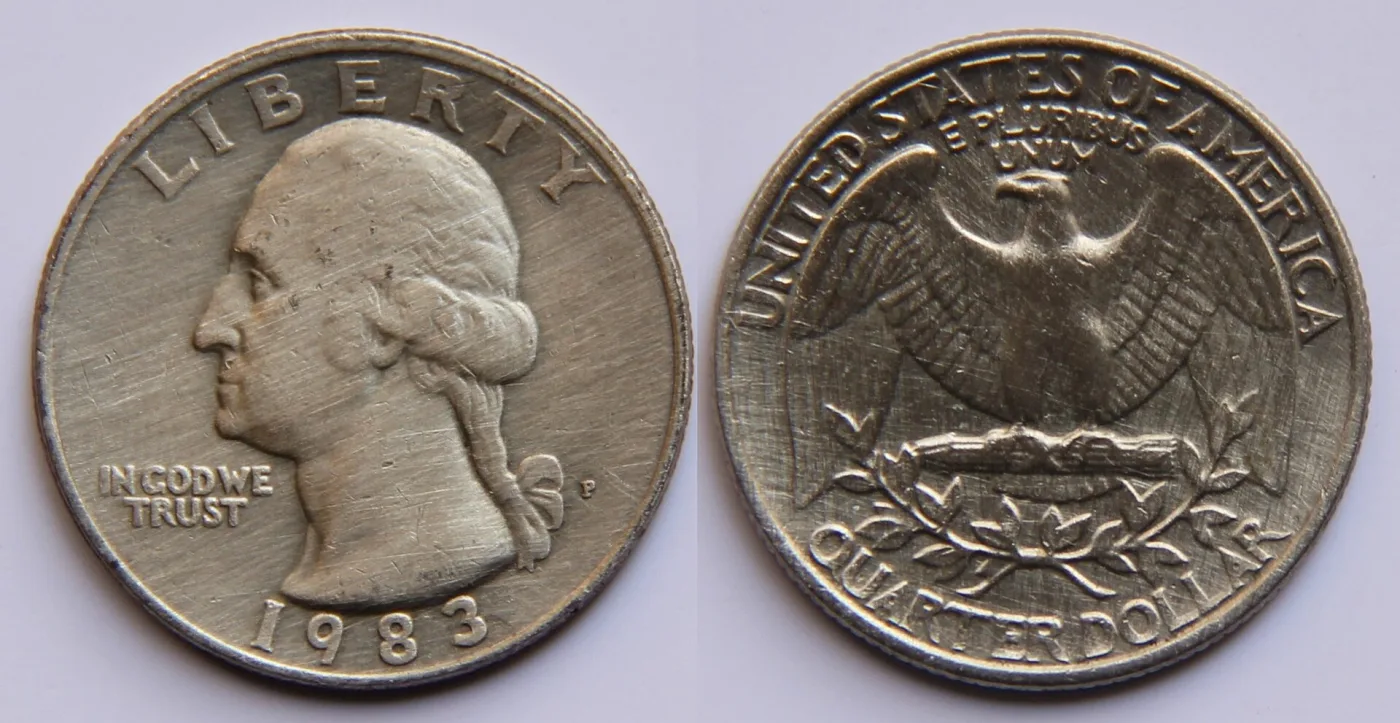
The Washington Quarter has been in continuous production since 1932, making it one of the longest-running designs in U.S. coinage history. It began as a one-year commemorative honoring the bicentennial of George Washington’s birth, became a permanent design the following year, transitioned from 90% silver to copper-nickel clad in 1965, and has since hosted three major reverse redesigns: the 50 State Quarters (1999-2008), the America the Beautiful series (2010-2021), and the American Women Quarters (2022-2025). Few coins pack this much history into a denomination you still pull out of your pocket every day.
For collectors, the Washington Quarter is a series of series. Silver Washington Quarters from 1932 through 1964 form the classic collecting focus, anchored by three legitimately scarce first-year dates — the 1932-D, 1932-S, and to a lesser extent the 1937 Doubled Die. Post-1965 clad quarters are mostly face-value coins, but proof issues, special mint sets, and modern die varieties still offer affordable collecting. And the 50 State Quarters, launched in 1999, introduced millions of new collectors to the hobby and carry a surprising number of error varieties worth real money — the same rotating-design formula that later inspired the Presidential Dollar series.
This guide covers the full Washington Quarter story: how to identify the design, where mint marks appear (they moved in 1968), which dates are worth saving, how to grade silver quarters, how to spot the famous errors, and how modern series fit into the picture. If you are new to U.S. coins, start with our general coin identification guide, then return to dive into this cornerstone American series.
History and Origins of the Washington Quarter
The Washington Quarter was born from a celebration that almost never happened. In 1932, the United States marked the 200th anniversary of George Washington’s birth, and Congress originally planned a commemorative half dollar for the occasion. Sculptor Laura Gardin Fraser — wife of James Earle Fraser, who had designed the Buffalo Nickel — submitted a portrait that the Commission of Fine Arts repeatedly recommended. But Treasury Secretary Andrew Mellon overruled the commission and selected John Flanagan’s design instead, and the denomination was shifted from a half dollar commemorative to a circulating quarter replacing the Standing Liberty Quarter.
What was intended as a one-year commemorative turned out to be a permanent change. The Treasury simply kept striking Flanagan’s design in 1934, and it has continued uninterrupted ever since. The decision to make the quarter a circulating tribute rather than a commemorative half dollar inadvertently gave the United States one of its most ubiquitous coin designs — more than 100 billion Washington Quarters have been struck across the series.
John Flanagan: The Designer
John Flanagan (1865-1952) was a well-regarded sculptor and medalist working in New York. He was not a Mint employee like Charles Barber — designer of the earlier Barber Quarter — had been; he was an outside artist commissioned for this specific project. Flanagan based his Washington portrait on Jean-Antoine Houdon’s 1786 bust of Washington — a life study sculpted when Washington was 53 years old. Flanagan’s initials “JF” appear on the obverse at the base of the neck, partially hidden in the truncation line. His work on the quarter was his most prominent numismatic contribution.
Production Timeline
Silver Washington Quarters were struck from 1932 through 1964 (with no production in 1933 and no Denver or San Francisco issues in 1938). Starting in 1965, the composition changed to copper-nickel clad, and mint marks were temporarily removed from all coinage through 1967. From 1968 onward the modern clad Washington Quarter has been struck continuously, with the reverse redesigned for the 1976 Bicentennial, the 50 State Quarters program (1999-2008), the District of Columbia and U.S. Territories set (2009), America the Beautiful (2010-2021), and American Women Quarters (2022-2025). A new Semiquincentennial (250th anniversary) reverse design began in 2026.
Historical Context
Washington Quarters circulated through the Great Depression, World War II, the postwar boom, the Silver Crisis of the early 1960s, the Vietnam War, and every American event since. A silver Washington Quarter from the 1940s could buy a gallon of gas; today it is worth roughly $4 to $6 in silver melt alone. The 1964 final silver date is heavily hoarded and readily available in high grade because Americans pulled them from circulation en masse as silver prices rose.
Design Elements and How to Identify the Coin
The Washington Quarter’s obverse has stayed remarkably consistent for 90+ years, while the reverse has changed dramatically. Learning to recognize Flanagan’s Washington head is the core identification skill.
Obverse (Front) Design
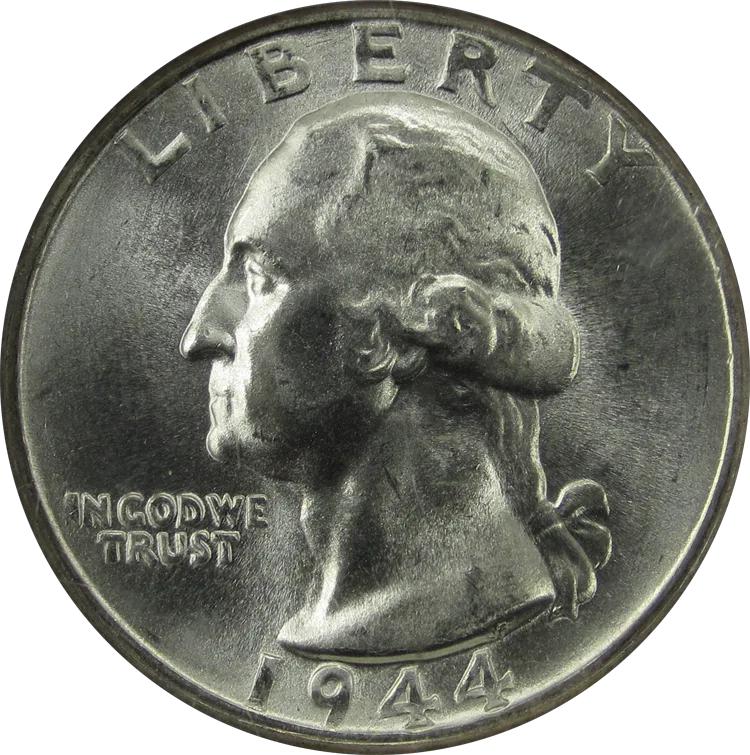
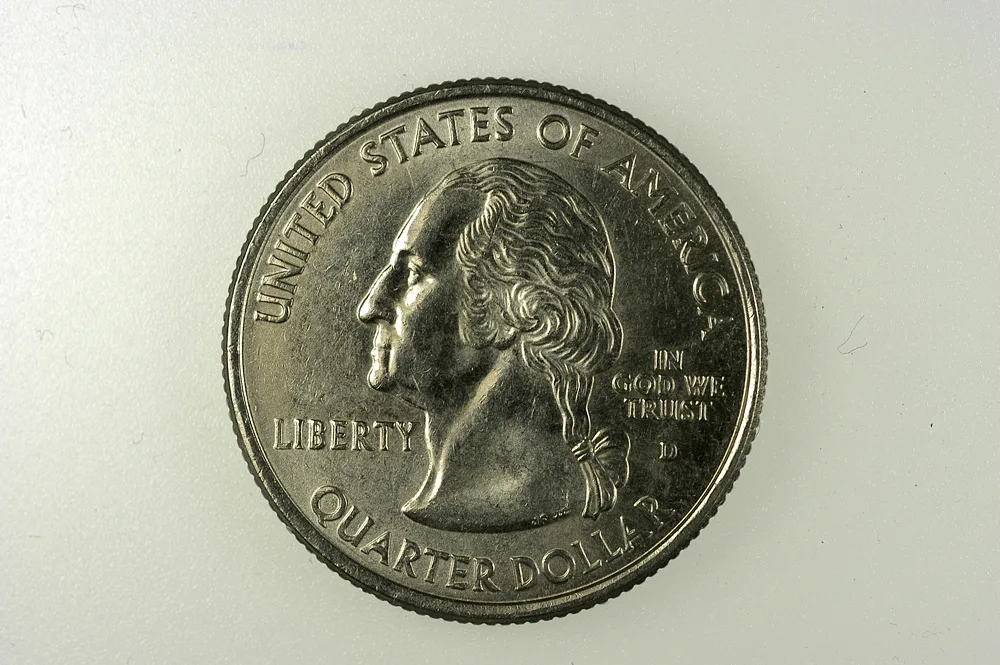
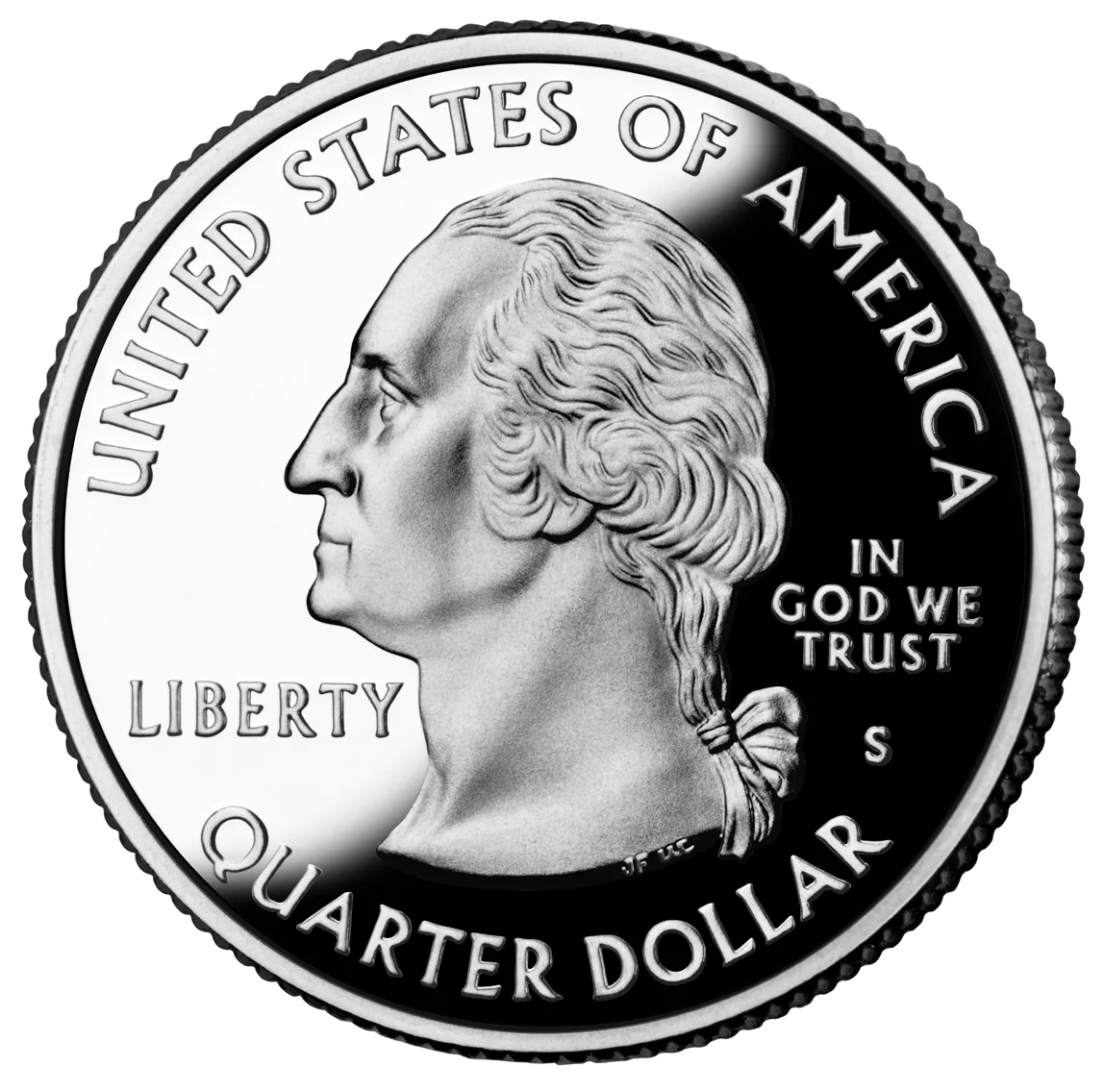
The obverse features a left-facing bust of George Washington. Above the portrait is the word “LIBERTY” in capital letters, and below is the date. To the left of the neck is the motto “IN GOD WE TRUST” (added in 1932 as required by law for silver coinage). Flanagan’s initials “JF” appear at the base of the neck, where the shoulder meets the truncation line. On modern quarters (1999 onward), the obverse has been slightly modified — Washington’s portrait was redrawn by William Cousins in 1999 (note the “WC” initials added to Flanagan’s “JF”) to accommodate the 50 State Quarters reverse program, and again slightly revised in 2022 by Laura Gardin Fraser’s original unused design for the American Women Quarters obverse.
Reverse (Back) Design — Classic (1932-1998)
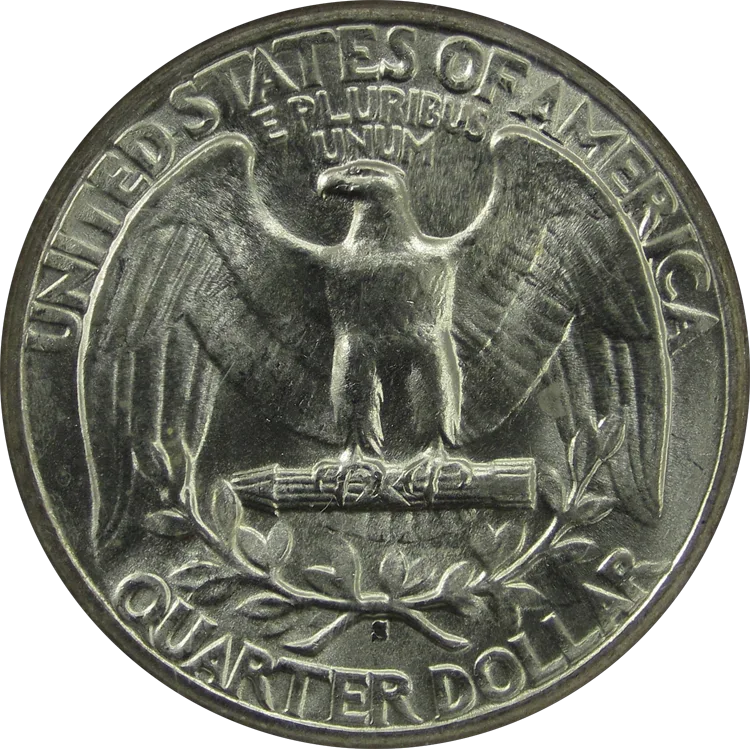
The classic Washington Quarter reverse shows a heraldic eagle with wings spread, perched on a bundle of arrows, with olive branches below. Above the eagle is “UNITED STATES OF AMERICA”; below the arrows is “QUARTER DOLLAR.” The motto “E PLURIBUS UNUM” appears above the eagle’s head. This reverse was used from 1932 through 1998 (except 1976). On Bicentennial quarters, the eagle was replaced with a Colonial drummer boy.
Physical Specifications
Silver Washington Quarters (1932-1964) are composed of 90% silver and 10% copper, weigh 6.25 grams, and have a diameter of 24.3 millimeters. Clad Washington Quarters (1965-present) are composed of outer layers of 75% copper / 25% nickel bonded to a pure copper core, weigh 5.67 grams, and have the same 24.3 mm diameter. Both versions feature a reeded edge with 119 reeds. The weight difference is significant and is the easiest way to distinguish silver from clad without looking at the edge.
Silver vs Clad: The Edge Test
Look at the edge of the coin. A silver Washington Quarter shows a solid silvery-white edge all the way around. A clad quarter shows a distinctive copper-colored stripe sandwiched between two thinner silver-colored layers — the classic “sandwich” edge. This is the fastest visual test. The date is the slower test: 1964 and earlier is silver, 1965 and later is clad (with a handful of transitional error exceptions).
How to Quickly Distinguish a Washington Quarter
If the obverse shows a left-facing Washington bust with “LIBERTY” above and “IN GOD WE TRUST” to the left, it is a Washington Quarter. If the reverse shows a seated eagle, a Colonial drummer, a state design, a national park, or a portrait of an American woman — it is a Washington Quarter with one of the six major reverse designs used across the series.
Mint Marks and Where to Find Them
Mint mark location on Washington Quarters moved in 1968, which is one of the more confusing aspects of the series for new collectors.
1932-1964 (Silver Era): Reverse Placement
On silver Washington Quarters, the mint mark appears on the reverse, below the wreath at the bottom of the coin, just above the word “QUARTER.” The mint mark is small — about 1 mm — and can be weakly struck or partially obscured on circulated coins. Expect to use a magnifier for reliable identification below VF condition.
1965-1967: No Mint Marks
During the silver-to-clad transition years of 1965, 1966, and 1967, the Mint removed all mint marks from circulating coinage to discourage collector hoarding and speed up production. Quarters from these three years bear no mint mark regardless of which facility actually struck them. Most were struck at Philadelphia, but Denver and San Francisco also contributed without distinction on the coins.
1968-Present: Obverse Placement
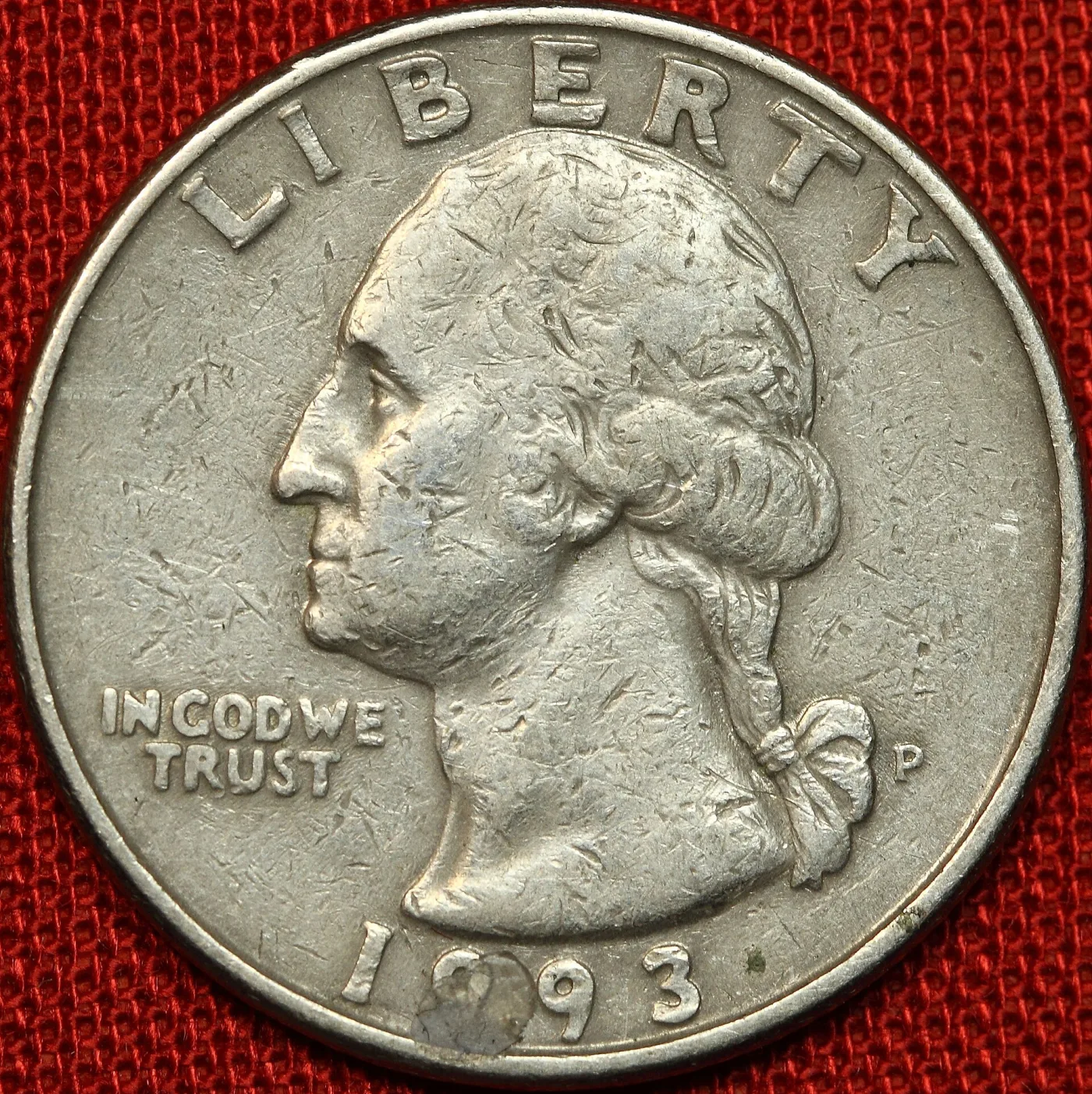
Beginning in 1968, the mint mark moved to the obverse, just to the right of Washington’s queue (the ribbon tying his hair at the back), roughly at the 3 o’clock position on the coin. This is where you will find the mint mark on every Washington Quarter struck from 1968 to today, including all 50 State Quarters and America the Beautiful issues.
Mint Facilities and Their Marks
- Philadelphia (no mint mark 1932-1979, “P” 1980-present): The Mother Mint struck Washington Quarters every year except 1938. Philadelphia coins bore no mint mark at all until 1980, when the “P” began appearing on all denominations except the cent.
- Denver (“D”): Denver has struck Washington Quarters since 1932 (with gaps in 1933 and 1938). The 1932-D is a major key date.
- San Francisco (“S”): San Francisco struck circulating Washington Quarters from 1932 through 1954 (with gaps), and has struck proof-only issues since 1968. The 1932-S is a major key date.
- West Point (“W”): West Point struck special-issue silver proof quarters starting in 2019 for collector products. Regular circulating quarters do not come from West Point.
Silver vs Clad: The 1965 Transition
The 1965 transition from 90% silver to copper-nickel clad is the single most important dividing line in Washington Quarter collecting. Understanding it protects your collection and your wallet.
Why the Composition Changed
By the early 1960s, the world price of silver had risen to the point where silver coins were worth more as metal than as money. Americans began hoarding silver coinage from circulation, creating coin shortages that threatened commerce. The Coinage Act of 1965 eliminated silver from quarters and dimes entirely (the Kennedy Half Dollar was reduced to 40% silver through 1970 before also going clad) and authorized the copper-nickel clad composition still in use today.
Transition Year Anomalies
The 1965 transition produced a small number of legitimate errors where silver planchets were accidentally struck with 1965 dies, or clad planchets struck with 1964 dies. These “wrong-metal” errors are rare and genuinely valuable: a 1965 silver-planchet quarter can sell for $5,000 to $10,000. Any suspected transitional error should be professionally authenticated — most claimed examples are cleaned common coins, not genuine errors.
Spotting Silver Quarters in Change
Silver quarters are still occasionally found in circulation, especially in rolls obtained directly from banks. Check the edge first (solid silver color, no copper stripe), then the date (1964 or earlier); these common-date silver coins are the backbone of junk silver stacking, valued for their metal content rather than rarity. A silver quarter has a distinctive higher-pitched ring when dropped on a hard surface compared to the duller sound of clad. The silver content gives each coin approximately $4 to $6 in melt value at current spot prices, providing a floor value regardless of date or condition.
Junk Silver vs Collector Silver
Worn, common-date silver Washington Quarters (especially 1946-1964) are typically sold as “junk silver” — bought and sold based on silver content rather than collector value. They trade at a small premium to melt. Higher-grade silver Washington Quarters (VF and above) and the key dates command genuine collector premiums. The jump from melt-value junk silver to collector pricing happens around XF-40 for common dates and much earlier for semi-keys and keys.
Key Dates and Semi-Keys (1932-1964)
The silver Washington Quarter series has a clear hierarchy of scarcity. Three dates stand above the rest, with a handful of semi-keys filling in the middle tier.
1932-D: The Primary Key
With a mintage of just 436,800, the 1932-D is the rarest regular-issue Washington Quarter and one of the key coins of 20th-century U.S. numismatics. Values range from $150 in Good, $275 in Fine, $600 in VF, $1,200 in EF, $2,500 in AU, and $4,500 to $10,000+ in MS-63 to MS-65. Because the 1932-D is heavily counterfeited and frequently altered from common 1932-P coins (by adding a “D” mint mark), any 1932-D purchase above the $200 range should be in a PCGS or NGC holder.
1932-S: The Secondary Key
With 408,000 struck — slightly lower than the 1932-D — the 1932-S is the lowest-mintage coin in the series but commands slightly lower prices due to generally higher average quality of surviving examples. Values: $125 in Good, $225 in Fine, $400 in VF, $700 in EF, $1,500 in AU, $3,000 in MS-63, and $6,500+ in MS-65. Altered mint marks (“S” added to common 1932-P) are a known issue; certification is essential.
1937 Doubled Die Obverse (DDO)
The 1937 DDO shows strong doubling on “LIBERTY” and the date. It is a true variety (not a date error) and is listed as FS-101 in the Cherrypickers’ Guide. Values run $75 in G, $250 in F, $800 in EF, $2,000 in AU, and $5,000 to $15,000 in MS-63 to MS-65. Because 1937 is a common date without the DDO, always compare suspected DDOs to published variety photographs before paying a premium.
Semi-Keys
Several additional dates carry modest premiums over common silver Washington Quarters:
- 1936-D — mintage 5.4 million but scarce in high grade; $15 in F, $75 in EF, $400 in MS-63, $1,500+ in MS-65.
- 1940-D — $12 in F, $50 in EF, $200 in MS-63.
- 1942-D DDO — doubled die obverse variety; $35 in F, $400 in MS-63.
- 1943-S Doubled Die — another variety, $40 in F, $550 in MS-63.
- 1950-D/S and 1950-S/D — repunched mint marks, both valuable varieties; $50 in F, $400 in MS-63.
Common Dates
All other silver Washington Quarters (1934-1964, excluding varieties) are common. Their values in circulated grades are driven almost entirely by silver melt. In Mint State, common-date silver quarters run $10 to $40 in MS-63, $75 to $200 in MS-65, and $500 to $2,000 in MS-67 where graded that high.
Notable Varieties and Doubled Dies
The Washington Quarter series rewards variety collectors. Beyond the 1937 DDO, several other doubled dies and repunched mint marks carry significant premiums.
1934 Doubled Die Obverse
The 1934 comes with “Light Motto” and “Heavy Motto” variations in “IN GOD WE TRUST.” The Heavy Motto is the normal variety; the Light Motto is a die state, not a true variety. A separate 1934 DDO exists with doubling on “IN GOD WE TRUST” and commands $40 in F, $300 in MS-63.
1942-D Doubled Die Obverse
FS-101 shows strong doubling on “IN GOD WE TRUST” and “LIBERTY.” Values: $35 in F, $150 in EF, $400 in MS-63, $1,500+ in MS-65. One of the most collected Washington Quarter varieties.
1943-S Doubled Die Obverse
Shows clear doubling on “LIBERTY” and “IN GOD WE TRUST.” Values: $40 in F, $600 in MS-63. A popular cherrypick because it can still be found in uncertified dealer stock.
1950-D/S and 1950-S/D Overmintmarks
Two distinct overmintmark varieties exist for 1950: a D punched over an S, and an S punched over a D. Both are visible under 10x magnification near the mint mark area on the reverse (this is still during the silver era, so mint mark is on reverse). Values run $30 to $50 in circulated grades and $400 to $800 in MS-63 for each variety.
1972 Type 1, 2, and 3 Reverses (Clad)
Clad-era varieties include three slightly different reverse hubs used in 1972. Most collectors do not chase these, but specialists can distinguish them by subtle differences in the eagle’s tail feathers and the placement of “E PLURIBUS UNUM.” Values are modest — $5 to $20 premium over common 1972 quarters.
State Quarter Errors
The 50 State Quarters series produced several well-known errors worth pursuing. These include the 2004-D Wisconsin “Extra Leaf” varieties (high and low), the 2005-P Minnesota “Extra Tree” varieties, and the 2005-P Kansas “In God We Rust” grease-filled die variety. We cover these in the 50 State Quarters section below.

The 1976 Bicentennial Quarter
For the 200th anniversary of American independence, the Mint struck a special reverse design on quarters, half dollars, and dollars. The Bicentennial Quarter is dated “1776-1976” on the obverse — no quarter is dated 1975 or 1976 alone.
The Drummer Boy Reverse
Designer Jack L. Ahr replaced Flanagan’s heraldic eagle with a Colonial drummer boy holding a drum and accompanied by a victory torch encircled by 13 stars. The design was chosen through a national competition that also selected reverse designs for the Bicentennial half dollar (Seth Huntington’s Independence Hall) and dollar (Dennis Williams’s Liberty Bell superimposed on the moon).
Circulation vs Silver Clad
The Bicentennial Quarter was struck in two compositions. The circulation version was standard copper-nickel clad, struck at Philadelphia (no mint mark) and Denver (“D”) in enormous quantities — over 1.6 billion circulation coins. San Francisco (“S”) struck both proofs and a special 40% silver clad version sold only in collector sets. Silver Bicentennial Quarters were never released into circulation, so any 1776-1976 quarter you find in change is the copper-nickel version regardless of mint mark.
Values
Circulation 1776-1976 quarters are worth face value in worn condition, $1 to $5 in MS-63, and $20 to $100 in MS-67. Silver 40% Bicentennial Quarters sell for $5 to $10 in BU and $40 to $100 in PR-69 DCAM. No Bicentennial Quarter is significantly rare, though MS-68 examples of the circulation version can bring $1,000+ as “condition rarities.”
50 State Quarters (1999-2008)
The 50 State Quarters program ran from 1999 through 2008, with five new reverse designs released each year in the order the states ratified the Constitution or were admitted to the Union. The program was wildly popular — the Mint estimates over 140 million Americans collected state quarters — and it introduced a generation of new collectors to the hobby.
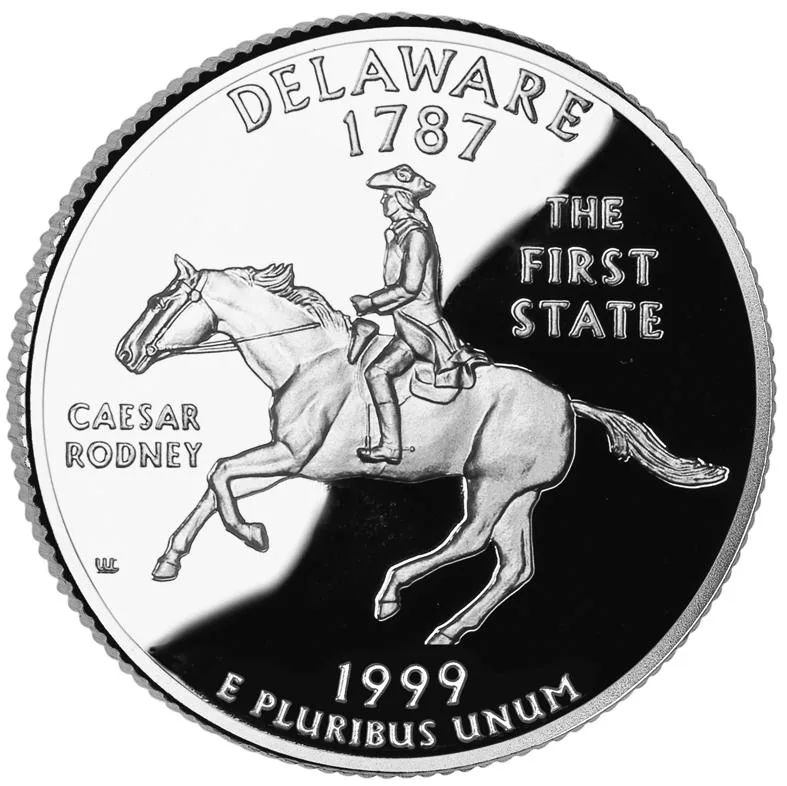
Program Structure
Five states per year over ten years. Each design was struck at Philadelphia (“P”) and Denver (“D”) for circulation and at San Francisco (“S”) for proofs (in both copper-nickel clad and 90% silver versions). The obverse was slightly modified from the traditional Flanagan design to free up space, with “UNITED STATES OF AMERICA” and “QUARTER DOLLAR” moved to the obverse and each state’s unique reverse design taking the full reverse.
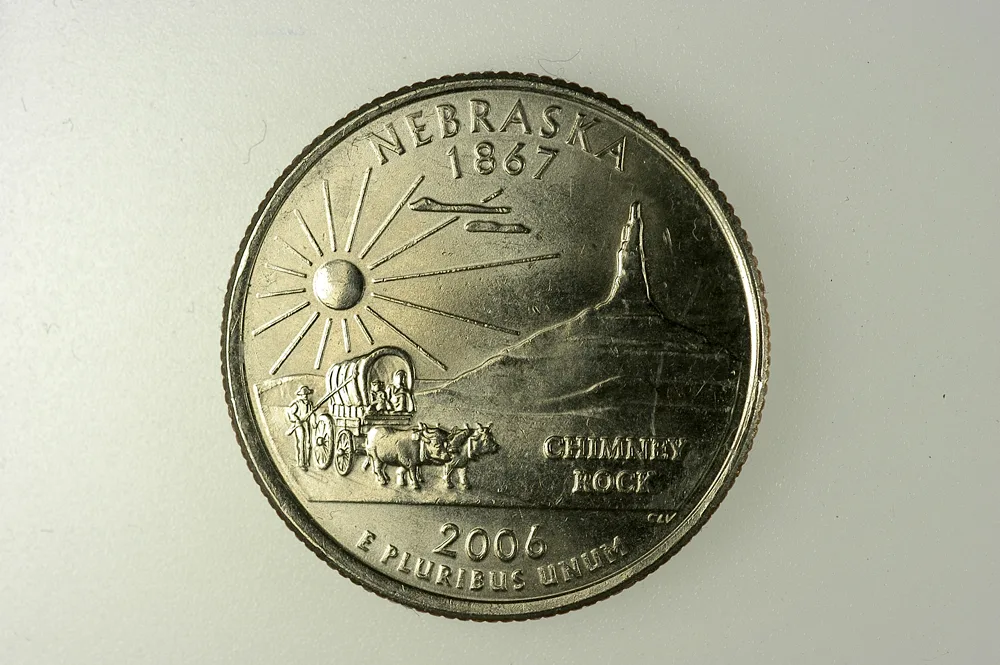
Collectible Errors and Varieties
- 2004-D Wisconsin Extra Leaf (High and Low): Two variants showing an extra corn leaf on the state design. High Leaf values $150 in MS-63, $300 in MS-65. Low Leaf values $100 in MS-63, $200 in MS-65.
- 2005-P Minnesota Extra Tree: Multiple die states show additional trees in the forest scene. Values $10 to $100 depending on variety and grade.
- 2005-P Kansas “In God We Rust”: Grease-filled die obliterates the “T” in TRUST. Values $50 to $150.
- 2004-P Wisconsin and 2005-P Kansas “Humpback Bison”: Die chip creating a hump on the bison’s back. Modest premiums.
- Off-center strikes, clipped planchets, and wrong-planchet errors: Various values from $20 to $2,000+ depending on severity.
Complete Set Values
A complete 50 State Quarters set in BU from rolls (100 coins, P and D of each state) is worth $40 to $80 in average uncirculated condition. In album-quality MS-65, $150 to $250. The 90% silver proof set of all 50 designs runs $500 to $800 depending on year completeness. No single non-error state quarter is truly rare; collector interest is in complete sets and the error varieties.
The DC and Territories Quarters (2009)
A six-coin continuation in 2009 honored the District of Columbia and five U.S. territories (Puerto Rico, Guam, American Samoa, U.S. Virgin Islands, and Northern Mariana Islands). These are often included with state quarter collections. Values parallel the state quarter series.
America the Beautiful and American Women Quarters
The quarter has remained the Mint’s primary vehicle for rotating reverse designs since 2010, with two additional multi-year programs following the state quarters.
America the Beautiful (2010-2021)
Also called the ATB Quarters or National Park Quarters, this program honored 56 national parks, forests, monuments, and historic sites — one per state, DC, and five territories. Five designs were released each year over 11 years plus a final 2021 “Tuskegee Airmen” coin. The obverse features a restored, more detailed Flanagan portrait. Reverse designs depict iconic park scenes: Yosemite’s Half Dome, Yellowstone’s geyser, the Statue of Liberty, etc.
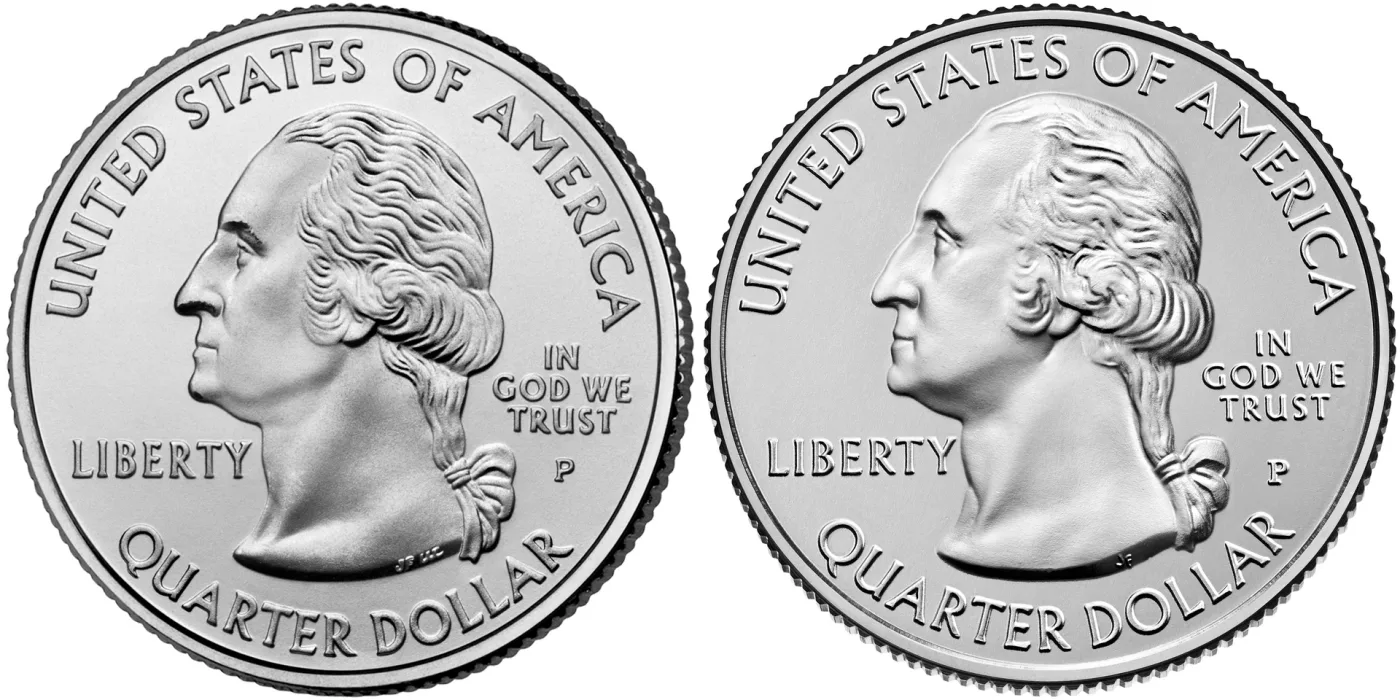
Circulation values are modest — $1 to $5 in BU, $10 to $40 in MS-67. The 5-ounce silver ATB bullion versions (3-inch diameter coins, not circulating) trade at melt plus 20-50% premium based on silver spot. A complete 56-coin circulation P-D set in BU costs $60 to $120.
American Women Quarters (2022-2025)
The American Women Quarters (AWQ) program ran 2022 through 2025, honoring five notable American women each year with reverse designs. Honorees included Maya Angelou (2022), Sally Ride (2022), Wilma Mankiller (2022), Nina Otero-Warren (2022), Anna May Wong (2022), and many others through 2025. The obverse uses Laura Gardin Fraser’s originally rejected 1932 Washington design — a historical full-circle moment, since Fraser’s design had been passed over for Flanagan’s at the series’ beginning.
Semiquincentennial and Beyond (2026+)
In 2026, quarter production shifted to a new Semiquincentennial (250th anniversary) design program marking the United States’ bicentennial-plus-50 celebration. New obverse and reverse designs are in use. Collectors should watch current Mint announcements for specifications.
How to Grade Washington Quarters
Washington Quarters grade on different wear points than many earlier U.S. designs. The key reference points are Washington’s hair above the ear, the eagle’s breast feathers (classic reverse), and any high points on post-1999 reverses.
Obverse Wear Points
- Good (G-4): Design outlined, major features flat. “LIBERTY” readable but worn; date clear.
- Very Good (VG-8): Some hair detail visible above ear; “IN GOD WE TRUST” fully readable.
- Fine (F-12): Hair above ear shows some separation; major details crisp.
- Very Fine (VF-20): Most hair detail visible; slight wear on cheek and hair crown.
- Extremely Fine (EF-40): Full hair detail with only minor wear on high points.
- About Uncirculated (AU-50): Only slight friction on the highest points; most luster intact.
- Mint State (MS-60+): No wear; graded by contact marks, luster, and strike.
Reverse Wear Points (Classic Eagle)
The eagle’s breast feathers are the primary reverse wear point. On VF-20 some breast detail shows; on EF-40 nearly all feather detail is present; on AU-50 only the highest breast feathers show friction; on MS, no wear at all. The arrow tips and olive branch leaves also wear early.
Mint State Grading
For silver Washington Quarters, MS-63 represents a coin with several noticeable contact marks but full luster; MS-65 is a gem with only minor marks; MS-67 is a superb example with only minute imperfections under magnification. Early dates (1932-1940) are noticeably scarcer in MS-65+ than later dates because of rougher handling during the Depression era.
Strike Quality
Washington Quarters from Denver in the late 1930s and early 1940s can show weak strikes, particularly on the eagle’s breast feathers and the top of Washington’s hair. Philadelphia strikes tend to be strongest. A well-struck coin commands a premium over a technically equivalent weakly-struck coin. This parallels strike variation seen in other series like the Mercury Dime with its Full Bands designation.
No Strike Designation
Unlike the Mercury Dime (Full Bands) or Standing Liberty Quarter (Full Head), Washington Quarters do not have a formal third-party strike designation. Collectors and graders do note strike quality informally, and fully struck examples command premiums, but there is no “FS” or “FH” equivalent on the Washington Quarter slab label.
Proof Washington Quarters
Proof Washington Quarters have been struck since the series began, with production periods at Philadelphia (1936-1942, 1950-1964) and San Francisco (1968-present).
Silver-Era Proofs (1936-1964)
Philadelphia struck proof Washington Quarters from 1936 through 1942 (suspended during WWII) and again from 1950 through 1964. Silver-era proofs are characterized by mirror fields, sharp strikes, and on some years significant cameo contrast. Mintages ranged from 3,837 (1936) to over 3 million (1963-1964). Key proofs to watch for:
- 1936 Proof — mintage 3,837; $800-$1,500 in PR-64, $3,000+ in PR-65 CAM.
- 1937 Proof — mintage 5,542; $400-$800 in PR-64.
- 1950 Proof — mintage 51,386; $100-$250 in PR-65.
- Other silver proofs 1951-1964 — generally $30-$100 in PR-65, higher with CAM or DCAM designations.
Clad-Era Proofs (1968-present)
San Francisco has struck proof Washington Quarters in clad since 1968 and in 90% silver (for collector sets) starting in 1992. Modern proofs typically show Deep Cameo contrast and are readily available in PR-69 DCAM and PR-70 DCAM grades. Values are modest — $5 to $25 for typical years, with some early clad proofs (1968-1972) bringing slight premiums in PR-70.
Special Collector Issues
Since 1999, the Mint has produced numerous special collector formats: silver proofs, reverse proofs, enhanced proofs, and burnished uncirculated coins. These are sold in Mint sets and bring varied premiums. Reverse proof quarters and enhanced proof quarters from annual sets can range from $10 to $100 depending on format and year.
Authentication and Counterfeit Detection
The Washington Quarter is counterfeited less often than high-value 19th-century coins, but the key dates (1932-D and 1932-S) attract altered-coin fraud, and even modern state quarter errors have spawned fake examples.
Altered Mint Marks on 1932 Keys
The most common Washington Quarter deception is adding a “D” or “S” mint mark to a common 1932 Philadelphia quarter to create a fake 1932-D or 1932-S. Genuine mint marks were punched into the working die before striking, so they are integral to the coin’s surface. Added mint marks sit on top of the surface and usually show a slight color or texture difference under 10x magnification. Under a stereo microscope, added mint marks show tooling marks and disturbed surface metal at their base. Any 1932-D or 1932-S priced above $200 should be in a PCGS or NGC holder.
Counterfeit Silver Quarters
Chinese counterfeit Washington Quarters exist and have become more sophisticated in the past decade. Most are struck rather than cast, but they commonly show small weight discrepancies (a genuine silver quarter weighs 6.25 g ±0.05 g), soft details, or slightly incorrect letter spacing. The ring test — dropping the coin on a hard surface and listening for the characteristic high-pitched silver ring — can flag obvious fakes but is not definitive.
Fake State Quarter Errors
The 2004-D Wisconsin Extra Leaf varieties have inspired crude fakes made by engraving an extra leaf onto normal quarters. Under magnification, fake extra leaves show tooling marks, disturbed metal, and an incorrect leaf profile compared to genuine die-produced examples. Use published variety photographs for side-by-side comparison before paying the extra-leaf premium.
Cleaned and Polished Coins
Many circulated Washington Quarters have been cleaned at some point. Cleaned silver quarters show hairlines, unnatural brightness, or a slightly “off” color. PCGS and NGC “Details” holders identify cleaned coins that are genuine but uncertifiable. Cleaned silver Washington Quarters typically sell at 30-50% of problem-free examples in the same grade.
Counterfeit Detection Equipment
For serious Washington Quarter collectors, a calibrated scale (0.01 g resolution), digital calipers, and a 10x jeweler’s loupe are essential. The same tools that serve Morgan Silver Dollar and Peace Dollar authentication work perfectly for quarters — weight and diameter checks rule out most fakes within seconds.
Current Market Values by Era
Washington Quarter values vary dramatically by era, date, and grade. The values below are approximate retail prices as of 2026.
Silver Common Dates (1934-1964)
Most silver Washington Quarters sell for $5 to $7 in circulated condition (driven by silver melt), $15 to $30 in MS-63, $50 to $150 in MS-65, and $300 to $1,000 in MS-67. Better dates and weak-strike conditions shift these ranges upward.
1932 Issues
The 1932-P (common) sells for $7 to $10 in F, $30 in MS-63, $200 in MS-65. The 1932-D runs $150-$200 in G, $600 in VF, $2,500 in AU, $4,500 in MS-63, $10,000+ in MS-65. The 1932-S runs $125 in G, $400 in VF, $1,500 in AU, $3,000 in MS-63, $6,500+ in MS-65.
Clad Era Common Dates (1965-1998)
Face value in circulated condition. $2-$5 in MS-65, $20-$50 in MS-67, and occasional MS-68 examples bring $200-$1,000+ as condition rarities.
50 State Quarters (1999-2008)
Face value in circulated condition; $2-$10 in MS-65 from rolls; $20-$100 in MS-67. Errors like the Wisconsin Extra Leaf can bring $100-$300 in uncirculated grades.
America the Beautiful (2010-2021)
Face value in circulated condition; $2-$5 in MS-65; $15-$75 in MS-67. The 5 oz silver ATB bullion coins trade at silver spot plus 25-50% premium.
Proofs
Silver-era proofs: $50 to $3,000+ depending on date and CAM/DCAM designation. Modern clad proofs: $5 to $25. Modern silver proofs: $15 to $75. Special formats (reverse proof, enhanced): $20 to $150.
Factors Affecting Value
Beyond date and grade, Washington Quarter values are driven by strike quality, original surfaces (versus dipped/cleaned), attractive toning, and eye appeal. An MS-65 silver quarter with weak strike and bright-dipped surfaces may sell below guide, while an MS-65 with a sharp strike and original peripheral toning can bring MS-66 money.
Storage, Handling, and Preservation
Washington Quarters span nearly a century of U.S. coinage, and proper storage matters as much for modern clad issues as for silver classics.
Handling
Always hold Washington Quarters by the edges. For examination, work over a soft cloth to prevent damage from drops. Use cotton or nitrile gloves for high-value coins; fingerprints on proof surfaces are nearly impossible to remove without damaging the coin. Silver quarters are particularly vulnerable to environmental toning, so quick handling is better than prolonged exposure to skin oils.
Holders and Albums
For circulated silver quarters, 2x2 cardboard flips are fine. For Fine and better, use Air-Tite capsules sized 24 mm or quarter size. For coins worth $100+, use PCGS or NGC slabs. Dansco and Whitman albums are popular for complete date sets — the 50 State Quarters folder is a classic first-collection product. Avoid PVC-based soft flips at all costs; plasticizer migration causes permanent green corrosion that ruins silver coins within a few years.
Environmental Controls
Store coins in a cool, dry location. Silica gel packets absorb humidity; rotate them every 6 to 12 months. Avoid basements, attics, and areas with temperature swings. Sulfur sources (newspaper, some cardboard, rubber bands, certain paints and adhesives) accelerate silver tarnish dramatically. The preservation principles that apply to Franklin Half Dollars, Walking Liberty Half Dollars, and any other 20th-century silver coinage apply identically to Washington Quarters.
Cleaning: Don’t
Never clean a Washington Quarter. Toning on silver quarters is a natural protective patina; removing it exposes fresh metal, introduces hairlines, and reduces value by 30-70%. Even heavily tarnished silver quarters should be left alone. Modern clad quarters can develop spots and surface disturbances, but the same rule applies — cleaning makes things worse. If a coin shows active corrosion, consult a professional conservation service (NCS) rather than attempting home remedies.
Building a Washington Quarter Collection
Washington Quarters are one of the most versatile U.S. series for collectors at every budget level. Multiple collecting paths suit different goals.
Type Collection
A single example of each major Washington Quarter type (silver 1932-1964, Bicentennial 1976, classic clad 1965-1998, 50 State, America the Beautiful, American Women, and Semiquincentennial) makes a compact type set — seven coins representing 90+ years of the series. Budget $50 to $200 for a good type set in BU.
Silver Short Set (1941-1964)
A popular introduction is the silver “short set” from 1941 through 1964 — 65 coins in a Dansco album, skipping the scarce early dates. In AU, $200 to $400. In BU, $500 to $1,000. This avoids the expensive 1932 keys and focuses on the more affordable wartime and postwar silver issues.
Complete Silver Set (1932-1964)
A complete 83-coin silver date-and-mintmark set in G-VG, including the three keys, runs $2,500 to $5,000. In F-VF, $4,000 to $8,000. In BU, $12,000 to $30,000+ depending on grade consistency and key-date grades. This is the classic Washington Quarter collecting goal.
50 State Quarters Set
A complete 50 State Quarters collection (100 coins, P and D) in BU from rolls: $40 to $80. In PCGS MS-66, $300 to $500. Add the 2009 DC and Territories issues (12 coins) for another $20 to $50. Include the 90% silver proof set for $500 to $800.
America the Beautiful Complete
A complete 56-coin P-D ATB set in BU runs $60 to $120. In MS-67, $500 to $1,500. The 5 oz silver ATB bullion set (56 coins at 5 oz each) is a major bullion position — track silver spot prices carefully.
Error and Variety Focus
A targeted variety set including the 1937 DDO, 1942-D DDO, 1943-S DDO, 1950-D/S, 1950-S/D, 2004-D Wisconsin Extra Leaf (both varieties), 2005-P Minnesota Extra Tree, and 2005-P Kansas “In God We Rust” costs $800 to $2,500 depending on grades and variety selections.
Budget Tips
Start with a Dansco album and fill it with circulated silver quarters obtained from coin dealers or bank rolls. Prioritize original surfaces over higher grade in problem coins. Buy the key dates certified from the start — uncertified 1932-D and 1932-S are a minefield of altered mint marks. Modern clad quarters are essentially free — pull them from change and bank rolls.
Frequently Asked Questions
How much is a Washington Quarter worth?
Clad Washington Quarters (1965-present) are worth face value in circulated condition, with some errors and condition-rarity MS-67+ examples bringing $20 to $1,000+. Silver Washington Quarters (1932-1964) are worth about $5 in silver melt value at minimum, rising to hundreds of dollars for the key dates (1932-D, 1932-S) and thousands in Mint State for the keys.
Which Washington Quarters are silver?
All Washington Quarters dated 1932 through 1964 are 90% silver. Starting in 1965, quarters switched to copper-nickel clad. Silver proof quarters have been produced since 1992 for collector sets, but these are not circulating coins.
How do I tell if my Washington Quarter is silver?
Look at the date (1964 or earlier means silver) and check the edge (solid silvery-white means silver; a copper stripe sandwiched between two silver layers means clad). A silver quarter also weighs 6.25 grams; a clad quarter weighs 5.67 grams. Silver quarters have a distinctive high-pitched ring when dropped on a hard surface.
What are the rarest Washington Quarters?
The 1932-D is the rarest regular-issue Washington Quarter, with a mintage of 436,800. The 1932-S is second, with 408,000 struck (slightly lower mintage but generally found in higher average condition, so values are slightly lower). The 1937 Doubled Die Obverse is the third major rarity. Among proof issues, the 1936 Proof (mintage 3,837) is the lowest-mintage key.
Where is the mint mark on a Washington Quarter?
On silver Washington Quarters (1932-1964), the mint mark is on the reverse, below the wreath at the bottom of the coin. On quarters dated 1965, 1966, and 1967, there is no mint mark at all. On Washington Quarters from 1968 to present, the mint mark is on the obverse, just to the right of Washington's hair ribbon at approximately the 3 o'clock position.
Who designed the Washington Quarter?
Sculptor John Flanagan designed the original Washington Quarter obverse and reverse, first struck in 1932. His portrait of Washington was based on Jean-Antoine Houdon's 1786 bust. The obverse has been slightly modified over the years (by William Cousins in 1999 for the 50 State Quarters), and the reverse has been redesigned multiple times for the Bicentennial, 50 State Quarters, America the Beautiful, American Women, and Semiquincentennial programs.
Are state quarters worth anything?
Most 50 State Quarters are worth face value in circulated condition and $2 to $10 in BU from rolls. Error varieties like the 2004-D Wisconsin Extra Leaf can bring $100 to $300 in uncirculated grades. A complete 50-state BU collection is worth $40 to $80. Silver proof state quarters in original mint packaging are worth $15 to $50 each.
What is a Bicentennial Quarter?
A Bicentennial Quarter is a 1976 quarter struck with a special "1776-1976" dual date and a Colonial drummer boy reverse by Jack L. Ahr. They were struck for circulation in copper-nickel clad (Philadelphia and Denver) and in 40% silver (San Francisco, sold only in collector sets). Over 1.6 billion circulation Bicentennial Quarters were struck, so circulated examples are worth face value.
Should I clean my Washington Quarter?
No. Cleaning any coin, including a common Washington Quarter, reduces its value. Silver quarters in particular lose 30-70% of their value when cleaned because original surfaces and natural toning are lost. Even heavily tarnished coins should be left alone. If a coin shows active corrosion, consult a professional conservation service.
How can I tell a 1932-D from a fake?
Genuine 1932-D mint marks are integral to the coin's surface, with natural metal flow around their base. Fake "D" mint marks (added to common 1932-P coins) sit on top of the surface and show tooling marks, slight color differences, or disturbed metal under 10x magnification. Any 1932-D worth more than $200 should be certified by PCGS, NGC, ANACS, or ICG. Never buy a raw (uncertified) 1932-D from an unknown source.
What years were Washington Quarters not made?
Washington Quarters were not struck in 1933 (production was suspended due to the Depression and ongoing silver policy debates). Denver and San Francisco did not strike quarters in 1938. Every other year from 1932 to the present has seen at least some Washington Quarter production at one or more mints.