Classic Head Half Cent Identification Guide: John Reich Design, Key Dates 1811 and 1831, Cohen Varieties, Grading, and Values
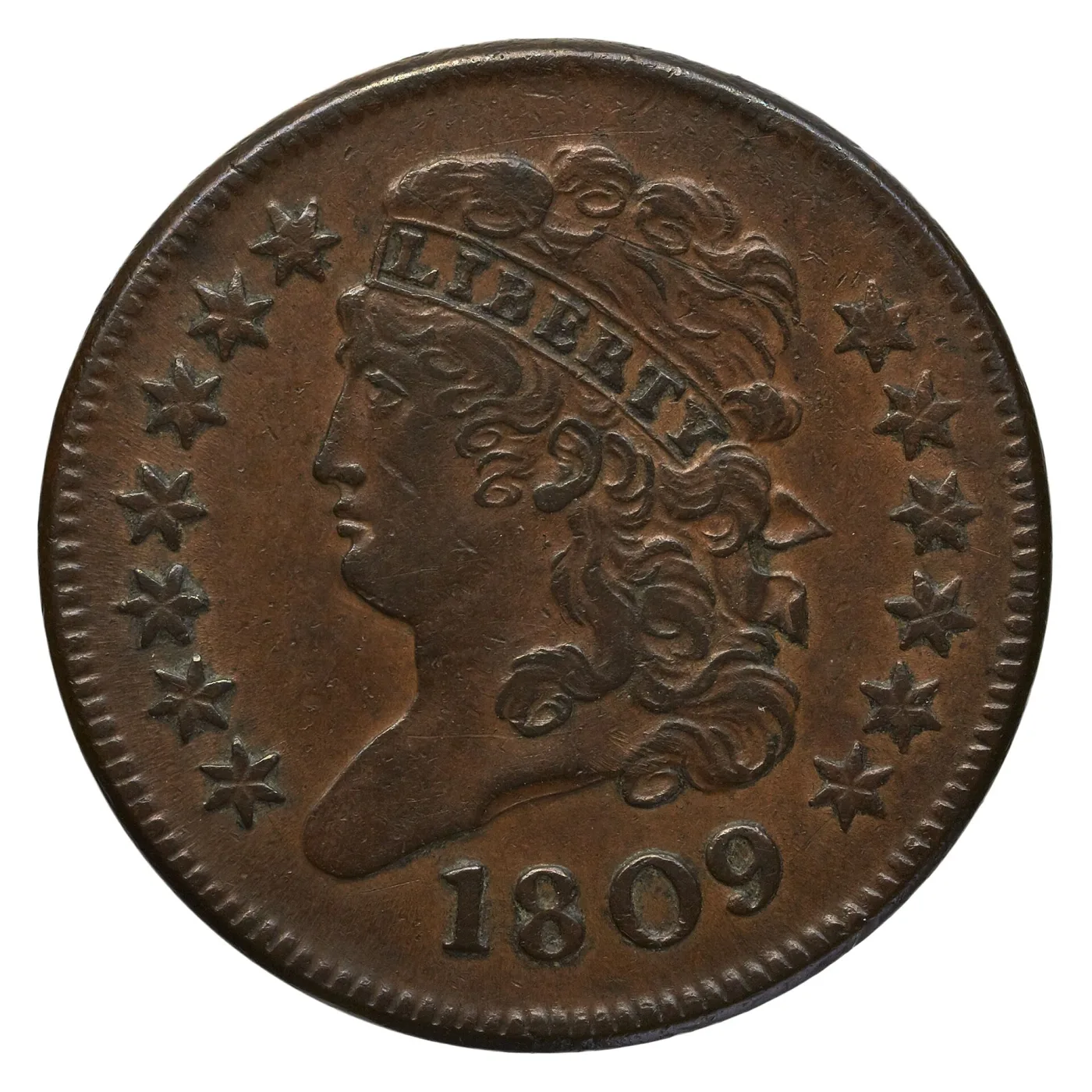
The Classic Head Half Cent is the third major design type of the United States half cent denomination, struck intermittently from 1809 through 1836 in pure copper. Designed by John Reich — the German-born engraver whose work also defined the Capped Bust era of American silver coinage — the Classic Head replaced the Draped Bust style and introduced a Greek-revival portrait of Liberty wearing a band inscribed “LIBERTY” across her forehead. The result is one of the most aesthetically refined small-denomination coins of the early federal period, and one of the most fascinating to attribute and collect.
Yet the Classic Head series is also one of the strangest in American numismatics. Production was wildly irregular: half cents were struck in 1809, 1810, and 1811, then the Mint produced none from 1812 through 1824 — a thirteen-year gap with no business strikes. Coinage resumed in 1825 but skipped 1827, 1830, 1837, 1838, and 1839. The 1831 and 1836 dates are notoriously proof-only or restrike-only, with original mintages of just a few dozen pieces each. Together these quirks create a 27-year nominal type that contains only fifteen actual dates, several of them legitimate rarities and several others available only as later 1850s-era restrikes from the original dies.
This guide is the comprehensive 2026 reference for identifying, attributing, grading, authenticating, and valuing Classic Head Half Cents. You will learn the diagnostic features that separate Classic Head from the earlier Draped Bust and Liberty Cap half cents, how to recognize the 1809/6, 1811 wide-and-close-date varieties, the 12-stars-versus-13-stars distinction, the original-versus-restrike controversies of 1831 and 1836, the Cohen die variety attribution system, EAC grading standards for copper, counterfeit detection, and current retail market values across every known date. Whether you are pulling a mystery copper from an inherited collection, completing a four-coin half cent type set, or chasing the 1811 as the great business-strike key, this guide will give you a working specialist’s command of the series.
History and Background
The Classic Head Half Cent was introduced in 1809 as part of a broader Mint redesign initiative led by John Reich, who had been hired by the Philadelphia Mint in 1807 specifically to modernize the appearance of American coinage. Reich had already replaced Robert Scot’s Draped Bust design on the half dollar in 1807 with the Capped Bust style that would dominate American silver coinage for the next three decades. The half cent and large cent received the next round of Reich’s attention: the Classic Head design replaced the earlier Draped Bust half cent on both denominations beginning in 1808 (for the large cent) and 1809 (for the half cent).
The name “Classic Head” refers to the Greek and Roman classical revival in early-nineteenth-century American art and architecture, of which Reich’s portrait is a small but characteristic example. The Liberty depicted on the obverse wears a band inscribed “LIBERTY” across her forehead — a stylistic flourish meant to evoke ancient laurel wreaths and victory crowns — with her hair tied in a knot at the back of her head. This visual vocabulary deliberately distinguishes the federal coinage from the British, French, and Spanish issues still circulating in 1810s America by signaling an independent republican tradition rooted in classical antiquity rather than monarchical iconography.
The series was plagued by Mint priorities and economic disruption. Half cent production was suspended in 1812 as the War of 1812 stretched federal resources and the Mint focused its limited copper supply on the more commercially useful large cent. The suspension stretched on long after the war ended in 1815: no half cents were struck in 1813, 1814, 1815, 1816, 1817, 1818, 1819, 1820, 1821, 1822, 1823, or 1824 — a full thirteen-year hiatus. When production resumed in 1825, the Mint operated in fits and starts, with no production at all in 1827, 1830, or after 1836 in the Classic Head style. The resulting shortage of small change during the Panic of 1837 was so acute that privately made Hard Times Tokens circulated as unofficial cents in these very years. The denomination would not see consistent annual production again until the Braided Hair type began regular business strikes in 1849.
Reich’s Departure and Continuation of the Design
John Reich left the Philadelphia Mint in 1817 after a frustrating decade of underpayment and limited recognition. His Classic Head design, however, continued in use for the half cent for two decades after his departure. The dies for later years (1825-1836) were prepared by William Kneass, who served as chief engraver from 1824 to 1840. Kneass made minor modifications to the head and to lettering details over the years, but the overall Reich design remained intact through the end of the series in 1836.
Companion to the Classic Head Large Cent
The Classic Head was also used on the large cent from 1808 through 1814, where it replaced the earlier Draped Bust large cent of 1796-1807. The large cent abandoned the Classic Head for the Coronet/Matron Head design in 1816, but the half cent retained the Classic Head through 1836 — making the half cent series one of the longest-running uses of any Reich design in U.S. coinage history. Collectors who pursue Classic Head half cents almost always look at Classic Head large cents as a complementary specialty.
Design and Diagnostic Features
Identifying a Classic Head half cent at a glance requires only a handful of features, but distinguishing dates and varieties within the series requires careful attention to lettering, stars, dentils, and date placement.
Obverse
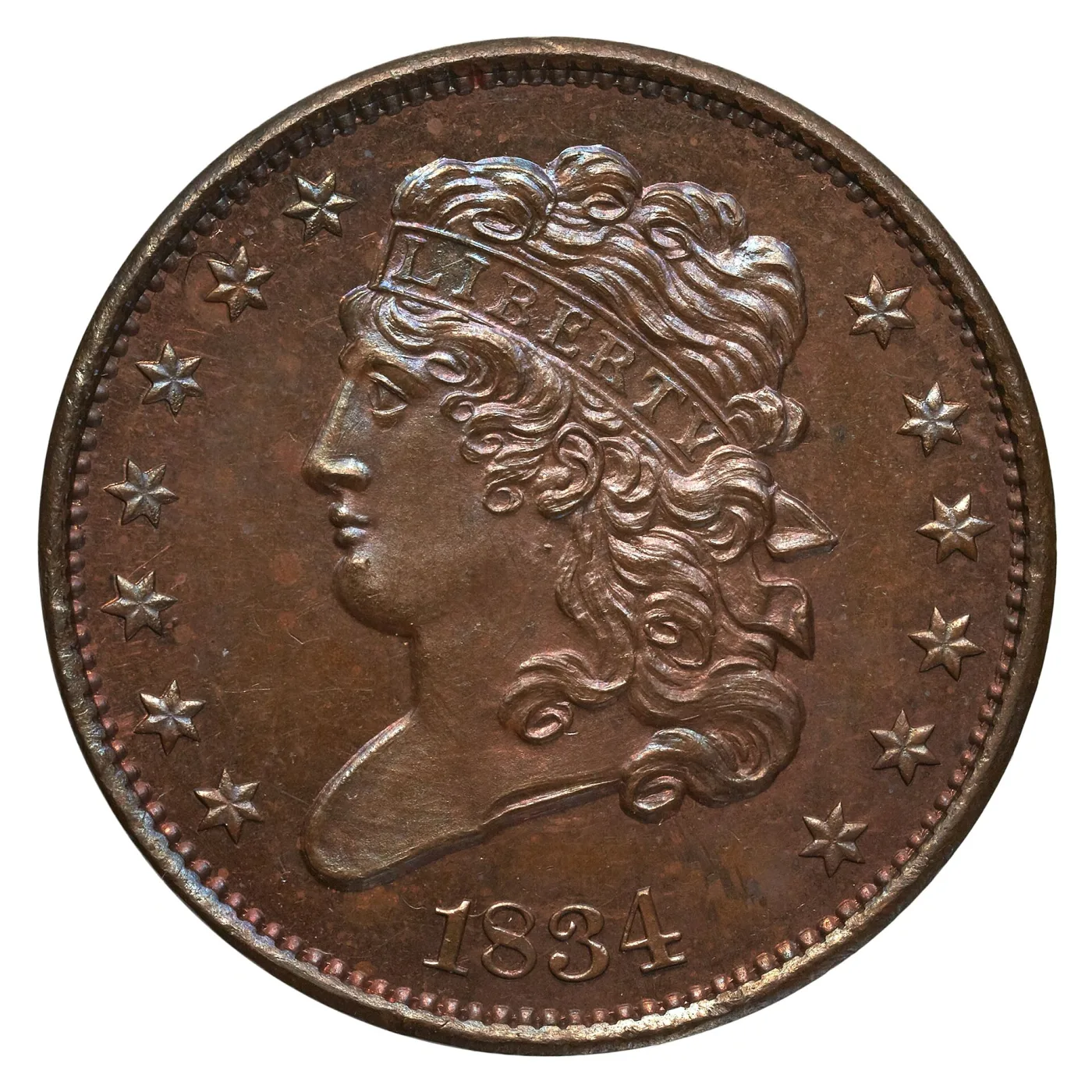
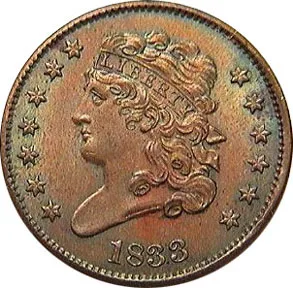
Liberty faces left, with her hair tied in a knot at the back of her head and a band inscribed “LIBERTY” running across her forehead. Thirteen stars surround the portrait — seven to the left, six to the right, in the standard arrangement — with one notable exception. The 1828 issue exists in two varieties: 13 Stars (standard) and 12 Stars (one star missing on the left). The date appears below the portrait at the base of the coin. There is no mint mark on any Classic Head half cent because the entire series was struck at the Philadelphia Mint; branch mints did not exist for copper coinage until the late 1830s.
Reverse
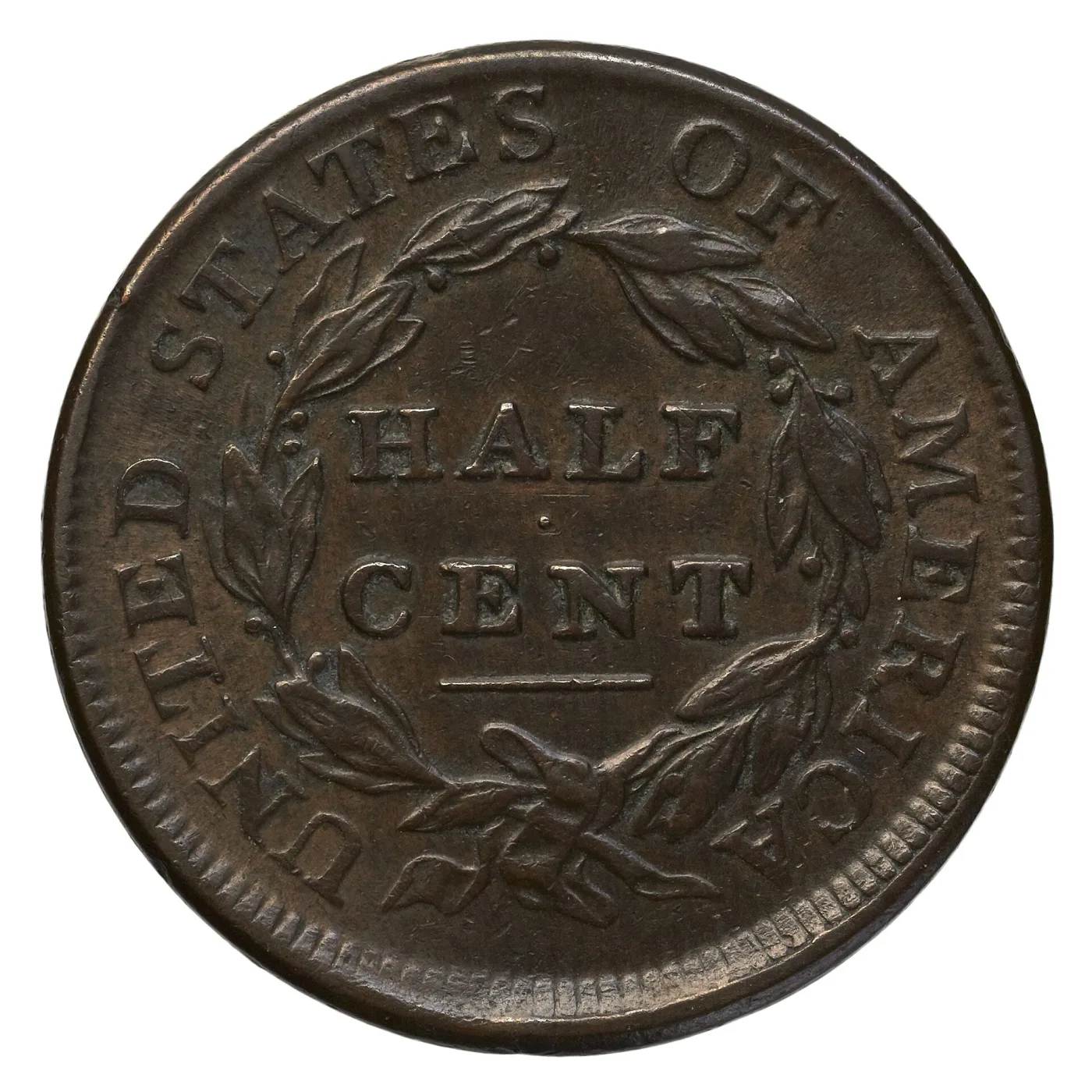
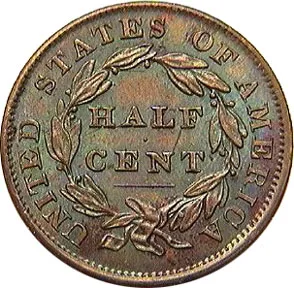
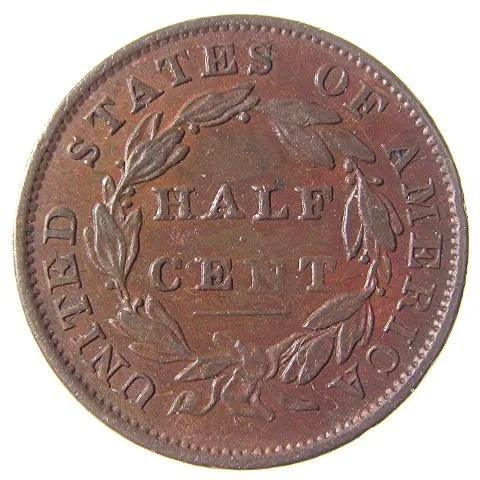
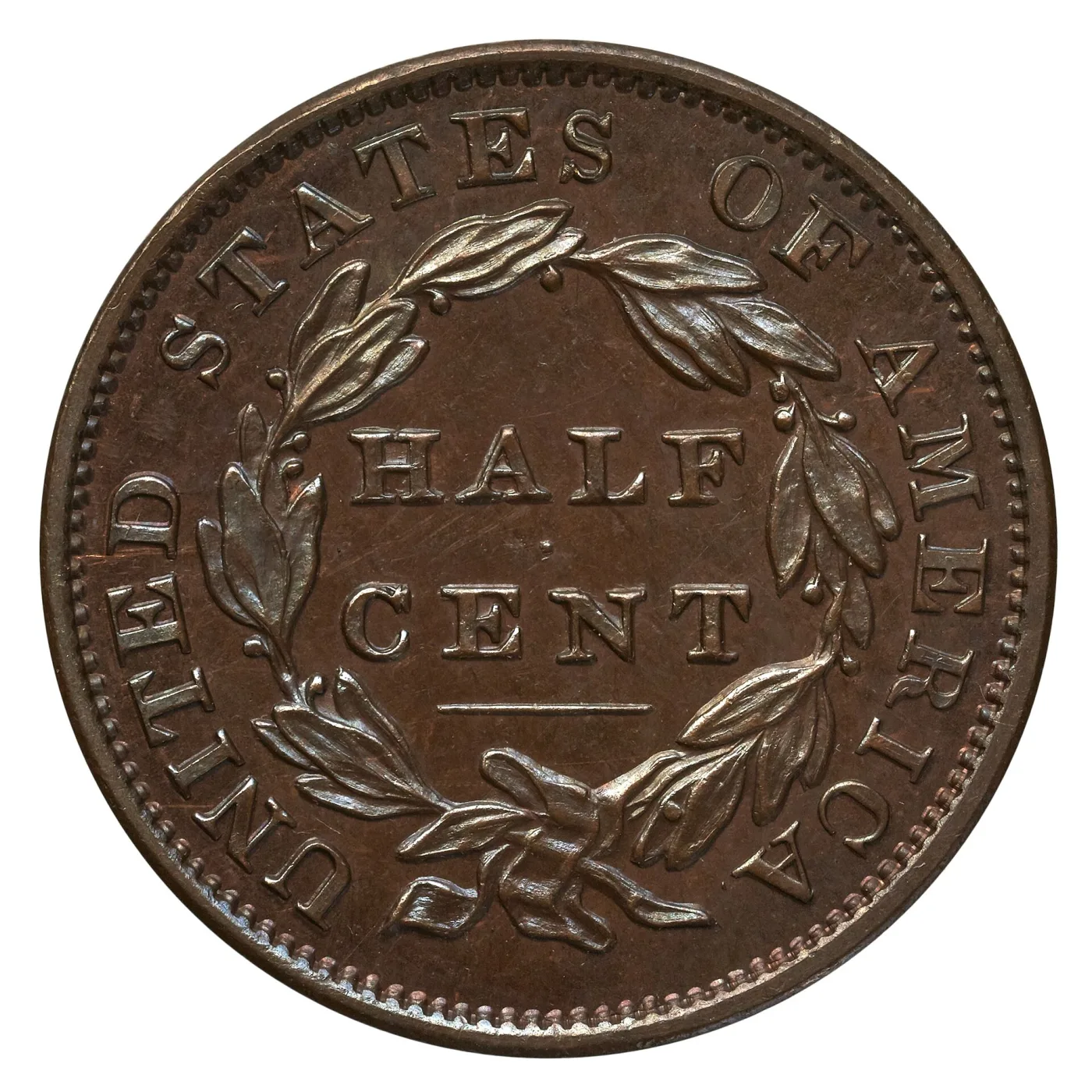
The reverse shows “HALF CENT” inscribed within a wreath of leaves and berries, with “UNITED STATES OF AMERICA” arching around the outside. The fraction “1/200” that appeared on Liberty Cap and Draped Bust half cent reverses has been eliminated — a deliberate simplification by Reich that places the denomination in plain English rather than as a fraction of a dollar. The wreath is open at the top, tied at the bottom with a ribbon bow.
Edge
The edge is plain (not lettered, not reeded). This is a useful diagnostic: any half cent with a lettered or reeded edge is not a Classic Head — earlier Liberty Cap issues sometimes have lettered edges, but Classic Head and later Braided Hair issues all have plain edges.
Diagnostic Quick Identification
To confirm Classic Head versus the predecessor Draped Bust style: look for the headband. Classic Head has a wide band across the forehead reading “LIBERTY”; Draped Bust shows Liberty with her hair flowing loose under a ribbon at the back, with “LIBERTY” arching above the head as separate letters. The classical band is the single most reliable visual cue for the Classic Head type.
Composition and Physical Specifications
The Classic Head Half Cent specifications match the half cent denomination throughout its 1793-1857 life and are essential for authentication.
Standard Specifications (1809-1836)
- Composition: 100% copper (pure)
- Weight: 5.44 grams (84 grains)
- Diameter: 23.5 mm
- Edge: Plain
- Mint: Philadelphia only (no mint mark)
- Designer: John Reich (obverse and reverse)
- Years struck: 1809, 1810, 1811, 1825, 1826, 1828, 1829, 1831, 1832, 1833, 1834, 1835, 1836
Any coin claimed to be a Classic Head half cent that weighs significantly outside the 5.0-5.8 gram range, has a diameter outside 23.0-24.0 mm, or has a non-plain edge should be examined for authenticity. Many counterfeits and museum-shop replicas are produced in modern brass or zinc-based alloys and will weigh differently and have a different copper-versus-brass color under bright light.
Date-by-Date Analysis (1809-1836)
The Classic Head Half Cent spans 1809-1836 nominally, but contains only thirteen issued dates with significant gaps and irregularities.
1809 — First Year of Type
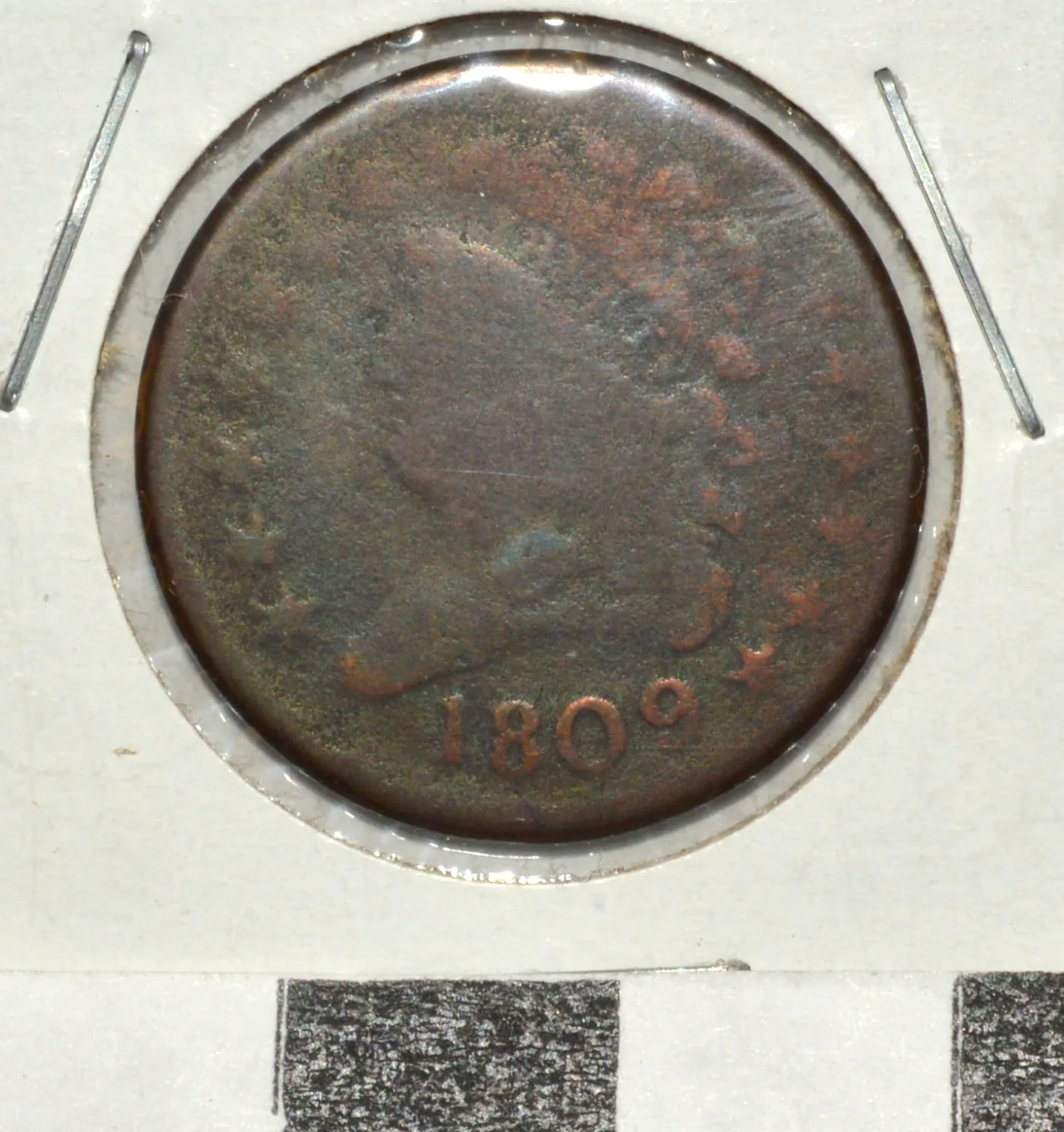
Mintage: 1,154,572. The first year of the Classic Head series and the highest-mintage year of the entire half cent denomination during the Classic Head era. Common in circulated grades, scarce in Mint State, very rare in Gem MS-65+. Notable variety: 1809/6 overdate, showing remnants of a 6 beneath the final 9 in the date. The 1809 over inverted 9 (sometimes called “1809/9”) is also collected. Common date values: G-4 $55, F-12 $90, EF-40 $200, AU-50 $450, MS-63 $1,800, MS-65RB $7,500.
1810 — Second Year
Mintage: 215,000. Significantly scarcer than 1809 in all grades, and notably difficult in higher Mint State. Only one major Cohen variety. Values: G-4 $65, F-12 $130, EF-40 $375, AU-50 $850, MS-63 $3,200, MS-65RB $14,000.
1811 — Great Business-Strike Key
Mintage: 63,140. The 1811 is the lowest-mintage business-strike year of the Classic Head series and the great key date of the type for collectors who do not pursue the 1831 and 1836 proof-only issues. Two die varieties exist: Wide Date (the more common) and Close Date (the scarcer). Most surviving examples grade Good to Fine; pieces above EF are quite scarce. Values: G-4 $400, F-12 $850, EF-40 $2,800, AU-50 $6,500, MS-63 $30,000+, MS-65RB extreme rarity at six figures. The 1811 is the date most likely to make a Classic Head set difficult to complete.
1812-1824 — No Production
The Mint produced no half cents for thirteen consecutive years. Any half cent dated within this range is either a contemporary counterfeit or an altered date. This is a useful authentication test: a “1818” or “1820” half cent does not exist genuinely.
1825 — Resumption
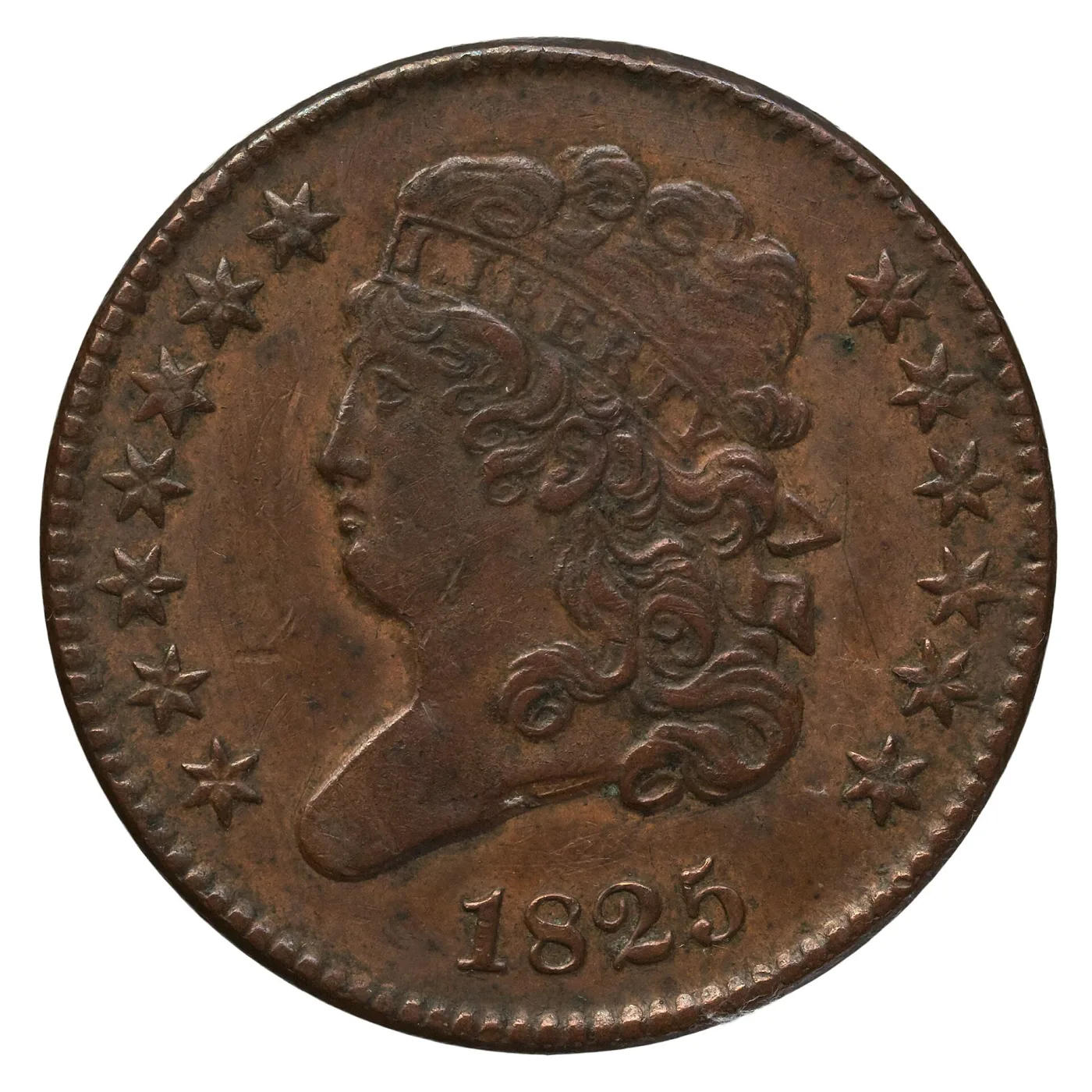
Mintage: 63,000. Same mintage as 1811 but considerably more available in upper grades because the coins were saved at the time as a return-to-production novelty. Two Cohen varieties exist. Values: G-4 $60, F-12 $110, EF-40 $300, AU-50 $700, MS-63 $2,400, MS-65RB $10,500.
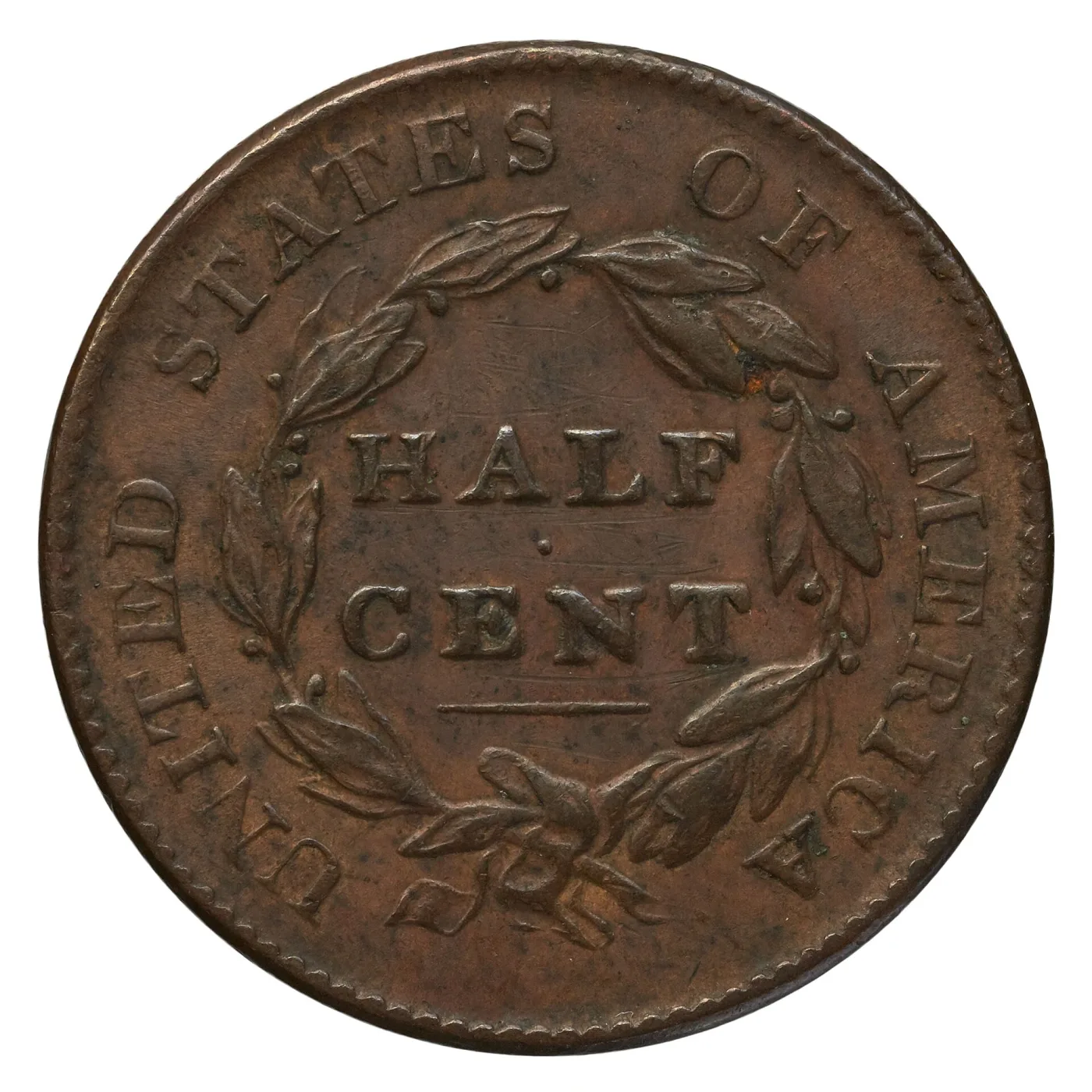
1826 — Second Year of Resumption
Mintage: 234,000. More common than 1825 in circulated grades but similar pricing in Mint State. Two Cohen varieties. Values: G-4 $50, F-12 $90, EF-40 $250, AU-50 $550, MS-63 $1,900, MS-65RB $8,500.
1828 — 13 Stars and 12 Stars
Mintage: 606,000. The 1828 issue is famous for two co-existing varieties: 13 Stars (the standard arrangement) and 12 Stars (one star missing from the left side, caused by a defective hub). The 12 Stars variety carries a roughly 3x-5x premium over the 13 Stars. There is no 1827 half cent. Values: 13 Stars G-4 $50, F-12 $80, EF-40 $200, AU-50 $400, MS-63 $1,500, MS-65RB $6,000. 12 Stars G-4 $90, F-12 $200, EF-40 $700, AU-50 $1,400, MS-63 $5,500, MS-65RB $22,000.
1829 — Common Date
Mintage: 487,000. A common date with one major Cohen variety. Values: G-4 $50, F-12 $80, EF-40 $200, AU-50 $400, MS-63 $1,400, MS-65RB $5,500.
1830 — No Production
No business strike half cents were produced in 1830.
1831 — Proof-Only Original / Restrike
Mintage: 2,200 nominal — but virtually all known examples are restrikes from the 1850s rather than originals. True 1831 Originals exist in extreme rarity (perhaps a dozen genuine examples) and command six-figure prices. Restrikes from worn dies were struck during the Mint’s “back-room” period in the late 1850s to satisfy collector demand. Restrike values: PR-63 $7,500, PR-65 $25,000. Original values: PR-63 $50,000+, PR-65 $150,000+.
1832 — Common Date
Mintage: 154,000. Available in most grades. Three Cohen varieties. Values: G-4 $55, F-12 $90, EF-40 $200, AU-50 $400, MS-63 $1,500, MS-65RB $6,000.
1833 — Most Common Mint State Date
Mintage: 120,000. The 1833 is by far the most commonly encountered Classic Head half cent in Mint State grades, because a large hoard was preserved by Mint employees and dealers and slowly dispersed through the late nineteenth and twentieth centuries. Values: G-4 $55, F-12 $90, EF-40 $200, AU-50 $400, MS-63 $1,300, MS-65RB $4,500.
1834 — Common Date
Mintage: 141,000. Similar to 1832 in availability and pricing. Values: G-4 $55, F-12 $90, EF-40 $200, AU-50 $400, MS-63 $1,400, MS-65RB $5,500.
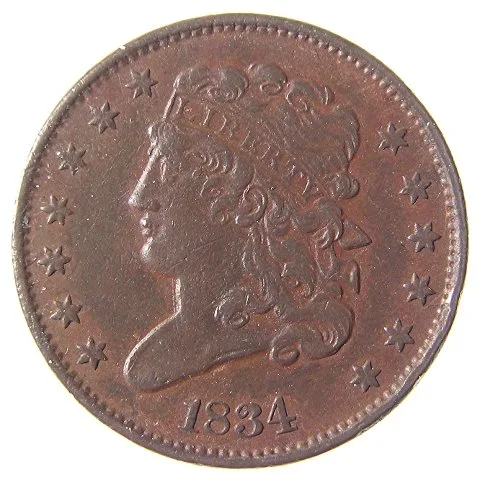
1835 — Common Date
Mintage: 398,000. The highest-mintage year of the 1825-1836 resumption period. Two Cohen varieties. Values: G-4 $50, F-12 $80, EF-40 $200, AU-50 $400, MS-63 $1,300, MS-65RB $5,000.
1836 — Proof-Only Original / Restrike
The 1836 issue has no recorded business-strike mintage. All known 1836 Classic Head half cents are proof-only originals or later restrikes. Originals are extremely rare and command six figures; restrikes from rusted dies were produced in the late 1850s. Restrike values: PR-63 $9,000, PR-65 $28,000. Original values: PR-63 $80,000+, PR-65 $200,000+.
Key Dates, Rarities, and Condition Rarities
Several Classic Head half cent dates and varieties stand out as either absolute rarities or as condition rarities — coins that are common in lower grades but disappear in higher grades.
Absolute Rarities
- 1811 (any variety): Lowest business-strike mintage of the type. The great key for date collectors.
- 1831 Original: Perhaps a dozen genuine originals known. Six-figure coin.
- 1836 Original: Similar extreme rarity to 1831 Original.
- 1828 12 Stars: Significantly scarcer than 13 Stars at all grade levels.
- 1809/6 Overdate: Major variety with strong specialist following.
Condition Rarities
Several common dates are condition rarities — easy in Good but legendary in MS-65 or MS-66. The 1810, 1811, and 1825 are nearly impossible to find in full red Mint State; even MS-63RB pieces represent the top tier for surviving examples. Conversely, the 1833 hoard makes that date readily available even in MS-65RB, while a comparable 1810 in MS-65RB is a five-figure coin.

Major Varieties and Overdates
The Classic Head Half Cent contains a handful of named varieties that significantly affect value and are essential to identify before pricing a coin.
1809/6 Overdate
The 1809/6 overdate shows traces of a 6 beneath the final 9 of the date, indicating that an unused 1806 die was repunched with the 1809 date. The overdate is visible under a 5x or 10x loupe as horizontal die-cut marks within the loop of the 9. Premium over standard 1809: roughly 2x in lower grades, larger in higher grades.
1809/9 (“Inverted 9”)
A second 1809 variety shows the last digit punched, recut, and possibly inverted. Less universally recognized than the 1809/6 but collected by Classic Head specialists.
1811 Wide Date vs Close Date
Both varieties are scarce. Wide Date is the more common; Close Date carries a modest premium and is more commonly mis-attributed than Wide Date.
1828 13 Stars vs 12 Stars
The major variety of the entire Classic Head series. The 12 Stars version shows one fewer star on the left side and is produced by a defective hub. Easily distinguishable by counting the stars on the left of the portrait: standard 1828s have seven stars to the left of the head; the 12 Stars variety has six.
Date and Lettering Repunches
Many Classic Head dates show minor repunched dates (RPDs) and repunched letters, which were corrections made to the working dies during preparation. These minor varieties are catalogued by specialists but rarely command meaningful premiums outside the EAC (Early American Coppers) collector community.
Cohen Variety Attribution
Classic Head Half Cent varieties are catalogued under the Cohen numbering system established by Roger S. Cohen Jr. in his 1971 reference American Half Cents — The “Little Half Sisters”. Cohen numbers (typically “C-1,” “C-2,” etc., for each date) identify die marriages — specific obverse die paired with specific reverse die — and are the primary attribution language for half cent collectors.
How Cohen Numbers Work
Each Cohen variety represents a unique combination of an obverse die and a reverse die. Diagnostic features used to attribute Cohen varieties include date placement (high, low, left, right), star positions, lettering spacing on the reverse, leaf positions in the wreath, and die cracks or rust marks that develop over the life of a die. For Classic Head half cents, most dates have between one and five Cohen varieties, except 1809 which has five and 1828 which has two major varieties (the 13 Stars and 12 Stars hub differences).
Breen Encyclopedia
Walter Breen’s 1983 Encyclopedia of United States Half Cents provides expanded variety analysis including die states, emission sequences, and detailed historical context. Breen’s book is the definitive specialist reference and is regularly cited alongside Cohen in auction catalog descriptions.
Why Cohen Numbers Matter
Some Cohen die marriages are dramatically rarer than others. A common-date 1832 in C-1 may be a $200 coin while the same date in C-3 — the rarest die marriage — can fetch $2,000+ even in identical grade. Always check the Cohen number before assigning value to a Classic Head half cent in EF or better grade.
Originals vs Restrikes (1831 and 1836)
The 1831 and 1836 dates are the most notoriously difficult Classic Head half cents to attribute correctly. Both dates exist as Originals — struck in the year of date for inclusion in proof sets — and as Restrikes, struck during the 1850s and 1860s from the original dies after the dies had developed identifiable rust, cracks, and other die-state changes.
Why Restrikes Exist
During the 1850s and 1860s, the Philadelphia Mint operated an informal “back room” trade in restruck rarities, producing pieces from original dies to satisfy collector and dealer demand. Mint employees, most notably Theodore Eckfeldt, were involved in this trade, which produced restrikes of many rare dates and pattern issues. The 1831 and 1836 half cents were among the most heavily restruck.
Diagnostic Differences
Originals were struck from fresh, smooth dies and show full, sharp design detail with no die cracks or rust pits. Restrikes from the 1850s show diagnostic die degradation: rust pits on Liberty’s portrait, fine cracks across the obverse fields, and characteristic die-state changes on the reverse wreath. The die state diagnostics are well-documented in Cohen, Breen, and the United States Half Cent Society’s reference literature.
Value Implications
The value difference is dramatic. A genuine 1831 Original PR-63 trades for $50,000+. A restrike of the same date and grade trades for $7,500. Misattribution in either direction can cost or gain tens of thousands of dollars. For high-value Classic Head proofs, always work with PCGS, NGC, or CAC certified examples where the original-versus-restrike question has been resolved by professional graders.
Proof Classic Head Half Cents
Proofs are special-strike presentation pieces made with polished dies and planchets, struck with extra pressure to produce mirrored fields and frosted devices. The Classic Head era predates regular proof set sales (which began in 1858), so all Classic Head proofs are individually struck rarities.
Years with Documented Proofs
Proof Classic Head half cents are documented for 1825, 1826, 1828, 1829, 1831 (mostly restrikes), 1832, 1833, 1834, 1835, and 1836 (mostly restrikes). Genuine proofs from any of these years are rare — proof populations are typically measured in single or low double digits for each date.
Identifying a Proof
A proof Classic Head half cent will show full mirror fields visible at low magnification, sharper rim definition than business strikes, and crisp full strike on every star and lettering element. The most reliable identification is professional certification, since proof attribution requires direct comparison to known proof reference coins.
Proof Values
Common-date proofs (1832, 1833, 1835) trade at $3,000-$7,000 in PR-63, $10,000-$25,000 in PR-65. Rare proofs (1825, 1826, 1828) trade at $10,000-$50,000 across grades. The 1831 and 1836 proofs — when authenticated as Originals — sit in the $50,000-$200,000+ range and represent some of the most prestigious copper proof issues in American numismatics.
Grading Classic Head Half Cents
Grading copper coins requires assessment of both technical wear (Sheldon Scale 1-70) and surface condition (color, planchet quality, eye appeal). The EAC (Early American Coppers) grading standards used by half cent specialists are more conservative than third-party service grading and are essential reading for serious collectors.
Key Wear Points
The first areas to show wear on a Classic Head half cent are the high points of the portrait: Liberty’s hair above the ear and her cheek. The “LIBERTY” headband should be fully legible in Fine and better. On the reverse, the highest points of the wreath leaves and the centers of the berries wear first. By Very Fine grade, all letters in “LIBERTY” should still be clear and the wreath leaves should retain partial detail.
Color Designations
Mint State copper is graded in three color categories:
- BN (Brown): Less than 5% original mint red. Most surviving Mint State Classic Head half cents fall here.
- RB (Red-Brown): 5%-95% original mint red. Substantial premium over BN.
- RD (Red): 95%+ original mint red. Extremely rare for Classic Head; carries enormous premium.
EAC vs PCGS/NGC Grading
EAC grades are typically 5-15 points lower than PCGS/NGC grades for the same coin. An EAC “VF-20” might receive a PCGS “EF-40” or higher. EAC graders also deduct heavily for cleaning, environmental damage, and any non-original surface — issues that PCGS and NGC may grade as “details” but EAC will simply assign a much lower numeric grade. When buying from an EAC dealer, expect lower numerical grades but more conservative coins; when buying PCGS/NGC, expect higher numerical grades but apply your own assessment of surface quality.
Strike Quality
Strike quality varies considerably across Classic Head dates. The 1809-1811 issues are often weakly struck, with mushy hair and weak stars. The 1828-1836 issues are generally sharper. A fully struck 1811 in any grade commands a premium because most surviving examples have weak central detail.
Counterfeit Detection and Authentication
Classic Head Half Cents have been counterfeited and altered for over a century, particularly the rare 1811 date and the proof-only 1831 and 1836 issues.
Altered Dates
The most common deception is alteration of common dates to read as rare dates. A genuine 1833 can be altered to read 1831 by recutting the last digit; a 1829 can be altered to 1828 12 Stars by tooling. Examine the date digits under 10x magnification for irregular spacing, raised tool marks, or color differences between digits and surrounding field. Compare suspect dates against known-genuine reference coins.
Cast Counterfeits
Casting counterfeits show characteristic surface pitting (the casting “orange peel”), softened detail, and seams along the edge. They typically weigh slightly less than genuine pieces because cast copper has lower density than struck copper. The edge of a struck coin is sharp and crisp; a cast counterfeit edge often shows file marks where the seam was removed.
Modern Replicas
Many “1811 Half Cent” replicas are sold as novelty items, museum reproductions, or magicians’ coins. These are typically struck in brass or plated zinc, weigh incorrectly, and may bear “COPY” stamped somewhere on the coin (required by U.S. law since 1973). Always check weight on a digital scale before believing a too-good-to-be-true find.
Third-Party Certification
For any Classic Head half cent worth more than $500, certification by PCGS, NGC, or ANACS is strongly recommended. For pieces worth more than $5,000 (the 1811, 1828 12 Stars, 1831, and 1836), certification is essentially required for resale. Collectors should also be aware of the EAC (Early American Coppers) net-grading tradition, which applies sharper deductions for problems than third-party services.
Current Market Values
Classic Head Half Cent values vary dramatically by date, variety, grade, and color designation. The figures below are 2026 retail estimates for problem-free, original-surface examples; auction results for premium examples can exceed retail by 20%-100% in strong markets.
Common Dates (1809, 1826, 1828 13 Stars, 1829, 1832, 1833, 1834, 1835)
- G-4: $50-$60
- F-12: $80-$110
- EF-40: $200-$300
- AU-50: $400-$550
- MS-63 BN: $1,300-$1,800
- MS-65 RB: $4,500-$8,500
- MS-65 RD: $15,000-$40,000 (extreme rarity)
Better Dates (1810, 1825)
- G-4: $60-$80
- F-12: $110-$150
- EF-40: $300-$450
- AU-50: $700-$1,000
- MS-63 BN: $2,400-$3,500
- MS-65 RB: $10,000-$15,000
Key Date — 1811
- G-4: $400
- F-12: $850
- EF-40: $2,800
- AU-50: $6,500
- MS-63 BN: $30,000+
- MS-65 RB: $90,000+
1828 12 Stars Variety
- G-4: $90
- F-12: $200
- EF-40: $700
- AU-50: $1,400
- MS-63 BN: $5,500
- MS-65 RB: $22,000
Proof-Only Restrikes (1831, 1836)
- PR-60: $4,500
- PR-63: $7,500-$9,000
- PR-64: $14,000-$17,000
- PR-65: $25,000-$28,000
Proof-Only Originals (1831, 1836)
- PR-63: $50,000-$80,000
- PR-65: $150,000-$200,000
- PR-66+: $300,000+
Collecting Strategies
The Classic Head Half Cent supports several different collecting approaches, ranging from beginner type collecting to advanced specialty pursuits.
Type Set
The simplest approach is a single Classic Head half cent as part of a four-coin half cent type set (Liberty Cap, Draped Bust, Classic Head, Braided Hair). Choose a common date such as 1833, 1835, or 1828 13 Stars in EF-40 or better. Budget: $200-$500 for a circulated example, $1,500-$5,000 for Mint State. The 1833 is the most popular type coin choice because the original hoard makes Mint State examples relatively affordable.
Date Set (Excluding 1831 and 1836)
A complete date set excluding the proof-only 1831 and 1836 includes 1809, 1810, 1811, 1825, 1826, 1828, 1829, 1832, 1833, 1834, and 1835 — eleven business-strike dates. The 1811 is the only meaningful challenge; the rest are routinely available. Budget for a Fine-grade set: $2,500-$3,500. For an EF set: $7,000-$10,000. For an MS-63 set: $40,000-$60,000.
Complete Date Set (Including Restrike Proofs)
Adding restrike 1831 and 1836 proofs brings the count to thirteen dates and the budget significantly higher. PR-63 restrikes of 1831 and 1836 add roughly $17,000 to the set cost. This level of set is the most popular complete approach because Original 1831 and 1836 are simply too expensive for almost any collector.
Cohen Variety Set
Specialist collectors pursue all major Cohen varieties for each date. This is an open-ended pursuit involving roughly 30-40 die marriages depending on which sub-varieties one includes. Membership in the U.S. Half Cent Society or Early American Coppers (EAC) is essentially required for serious variety collecting.
Where Classic Head Fits in a Broader Collection
Many collectors approach Classic Head half cents alongside the contemporary Classic Head large cent and the larger silver Capped Bust series by the same designer, such as the Capped Bust half dollar, the Capped Bust quarter, and the Capped Bust dime. A John Reich type collection across all denominations is a popular and historically coherent approach to early American coinage.
Storage and Preservation
Copper is the most chemically reactive of the precious and semi-precious coinage metals, and Classic Head half cents require careful handling to preserve their value.
Never Clean Copper
Cleaning copper destroys both natural patina and microscopic surface detail. Cleaned copper coins are described as “harshly cleaned,” “lightly cleaned,” or “polished” and receive details grades from PCGS and NGC, trading at 30%-70% discounts to original-surface examples. Even unattractive original-color coins are worth more than cleaned coins of the same technical grade. Specialists particularly value coins with original “EAC color” — natural medium-to-dark brown patina with no evidence of intervention.
Avoid PVC and Plasticizers
PVC (“polyvinyl chloride”) flips and pages leach plasticizers that react with copper to form a green slime on the coin’s surface. This is one of the most common preservation disasters for half cent collections inherited from earlier generations. Move any coin out of PVC flips immediately and store in inert Mylar, paper envelopes, or hard plastic capsules.
Humidity Control
High humidity accelerates copper corrosion and spotting. Store copper coins in an environment with relative humidity below 50%, ideally 30%-40%. Silica gel packets in the storage container help. Avoid basements, attics, and garages, where humidity fluctuates dramatically with the seasons.
Long-Term Storage
For long-term storage of valuable copper, certified PCGS or NGC holders provide an inert sealed environment. Raw coins should be kept in inert paper envelopes (acid-free, sulfur-free) inside Mylar flips, or in inert hard plastic capsules. Check stored coins annually for signs of new spotting or color change, and address any problems immediately.
Frequently Asked Questions
What is a Classic Head Half Cent worth in 2026?
Common-date Classic Head half cents in well-circulated grades retail for $50-$200. Better dates and Mint State examples range from $400 to $5,000+. The 1811 key date starts at $400 in Good and reaches $30,000+ in Mint State. Proof-only 1831 and 1836 restrikes trade in the $4,500-$28,000 range, while genuine Originals of those dates are six-figure coins.
What's the key date in the Classic Head Half Cent series?
For business strikes, the 1811 (mintage 63,140) is the great key. For proof-only issues, the 1831 Original and 1836 Original are extraordinary rarities measured in single-digit known populations.
Why was there no 1827 or 1830 Half Cent?
The Philadelphia Mint did not strike half cents in 1827 or 1830 because of low commercial demand for the denomination, limited copper supply, and competing demand for large cents. Half cents were never popular in commerce, and the Mint produced them only when Treasury specifically requested new supply.
What's the difference between an Original and a Restrike?
Originals were struck in the year of date (typically for collectors and presentations). Restrikes were struck in the 1850s and 1860s using the same dies after they had developed rust pits, cracks, and other diagnostic die-state changes. Originals are dramatically scarcer and more valuable. The distinction is made by die-state analysis and is best confirmed by professional certification (PCGS or NGC).
Is the 1828 12 Stars rarer than the 13 Stars?
Yes, considerably. The 12 Stars variety was produced by a defective hub and exists in much smaller numbers than the standard 13 Stars 1828. The premium is roughly 2x in lower grades and grows to 4x or more in higher grades.
Are Classic Head Half Cents made of pure copper?
Yes. All Classic Head half cents from 1809-1836 are 100% copper. There are no silver, gold, or alloyed Classic Head half cents. Any "Classic Head Half Cent" in brass or a non-copper alloy is a counterfeit or a modern replica.
Should I clean my dirty Classic Head Half Cent?
Never. Cleaning copper destroys original patina and microscopic surface detail, removing 30%-70% of the coin's value. Cleaned coins receive details grades. Even an unattractive original-color coin is worth more than a cleaned coin of the same technical grade.
Why do experts use "EAC grading" instead of PCGS/NGC grades?
The Early American Coppers (EAC) collector community developed a more conservative grading standard than PCGS/NGC, with sharper deductions for cleaning, environmental damage, and any non-original surface. EAC grades are typically 5-15 points lower than PCGS/NGC grades for the same coin. Many half cent specialists buy on EAC standards because they better reflect true rarity and quality.
What replaced the Classic Head Half Cent?
The Braided Hair Half Cent by Christian Gobrecht replaced the Classic Head beginning with proof-only originals in 1840 and business strikes in 1849. The Braided Hair design also appears on contemporary Coronet large cents and the silver Seated Liberty series.
Can I find Classic Head Half Cents in circulation today?
No. Half cents have been out of circulation for well over 165 years. They are found only through coin dealers, auctions, estate sales, and inherited collections. They are not legal tender for current transactions.