Capped Bust Dime Identification Guide: Large Size, Small Size, JR Varieties, Key Dates, and Values
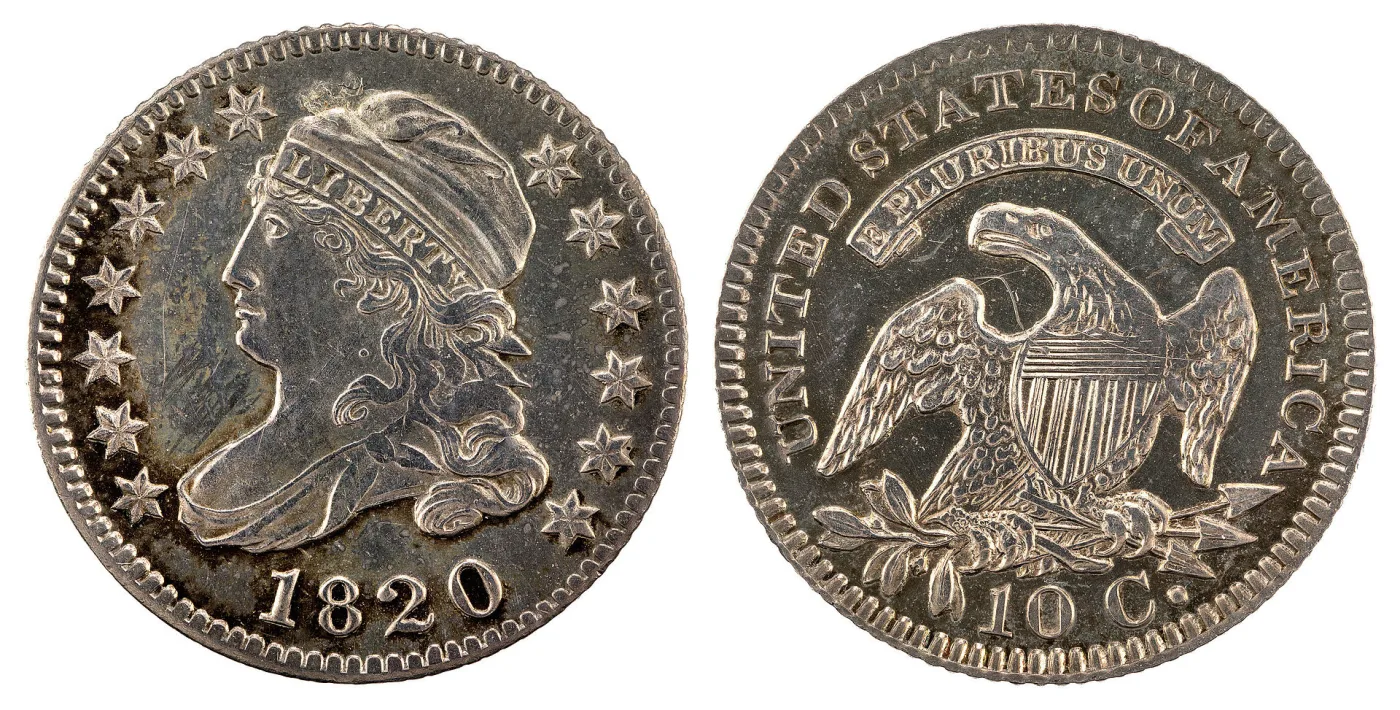
The Capped Bust Dime ran from 1809 to 1837 — a 29-year series that defined the second generation of US dime coinage and bridged the early federal era to the Seated Liberty period. Designed by John Reich, the German-born assistant engraver of the US Mint who also produced the matching Capped Bust Quarter and the contemporary copper Classic Head Half Cent, the series is famous among specialists for its two distinct sizes (Large Size 1809-1828 and Small Size 1828-1837), its rich population of “JR” die varieties catalogued by John Reich Society researchers, and a handful of legendary rarities including the 1822, the 1811/9 overdate, and the elusive 1804-style emissions of the earliest years.
This guide walks through every aspect of identifying, attributing, grading, and valuing Capped Bust Dimes. You’ll learn how to distinguish Large Size from Small Size at a glance, navigate the JR variety system, recognize every key date, weigh and authenticate suspect coins, grade with the Sheldon scale, and price your dimes accurately at today’s market. The series rewards patient study: while common dates remain genuinely affordable, the rarities and high-grade pieces are among the most exciting collectibles in the entire 19th-century US silver landscape.
Whether you have a single inherited coin or are pursuing a complete date set or JR-by-JR specialist run, this guide will give you the working knowledge to identify any Capped Bust Dime with confidence.
History: Reich’s New Dime in the Federal Era
Before 1809, the US dime had carried two early designs: the Draped Bust Dime (1796-1807) and a brief continuation of the same Draped Bust hub. By 1808 those dies were exhausted, and Mint Director Robert Patterson invited John Reich to redesign the silver coinage. Reich, an immigrant German engraver hired as Assistant Engraver in 1807, produced a unified family of designs: the Capped Bust Half Dollar (1807), the Capped Bust Half Eagle (1807), and — in 1809 — the Capped Bust Dime. The same allegorical bust appeared on the quarter (1815) and would eventually be reduced in scale for the Capped Bust Half Dime (1829).
The dime entered Reich’s new family two years after the half dollar because dime production at the Philadelphia Mint was sporadic in the early federal era. The Mint frequently skipped years when bullion was scarce or when other denominations were prioritized. Capped Bust Dimes were struck in 1809, 1811, 1814, 1820, 1821, 1822 (very few), 1823 through 1825, 1827 through 1837. The gaps create a series of perfectly understandable “no-issue” years rather than rarities.
The series ended in 1837 when Chief Engraver Christian Gobrecht replaced Reich’s bust with the new Seated Liberty figure that would dominate US silver for the next 55 years. The transition was abrupt: 1837 saw both Capped Bust Dimes (early in the year, using leftover Small Size dies) and the first Seated Liberty Dimes (later in the year, No Stars sub-type). This makes 1837 a year of overlap that collectors find particularly interesting.
The Designer: John Reich
John Reich (1768-1833) was born Johann Matthäus Reich in Bavaria and arrived in Philadelphia around 1800 as an indentured servant — his passage purchased by Mint Director Henry William DeSaussure as part of a labor contract. He worked for years as an unpaid die-sinker before being formally hired by the Mint as Assistant Engraver in 1807 at a meager salary. Despite his importance to American coinage — he designed the entire second-generation federal silver family and the gold half eagle and quarter eagle — Reich was poorly paid and resigned in 1817 in frustration. Many of his original master hubs continued in use long after his departure, including on the Capped Bust Dime, which kept Reich’s basic obverse until 1837.
Reich’s design philosophy was distinctly different from Robert Scot’s earlier work. Where Scot’s Draped Bust Liberty (modeled after Gilbert Stuart’s portrait of Ann Willing Bingham) was delicate and feminine, Reich’s Capped Bust Liberty is sturdier, with a softer cloth cap (sometimes called a “mob cap” or “turban”) and a more confident, classical bearing. For the broader context of Reich’s design family, see the Capped Bust Half Dollar guide.
Design: John Reich’s Capped Bust Liberty
Understanding every design element is essential for accurate sub-type identification, JR variety attribution, and authentication.
Obverse (Heads Side)
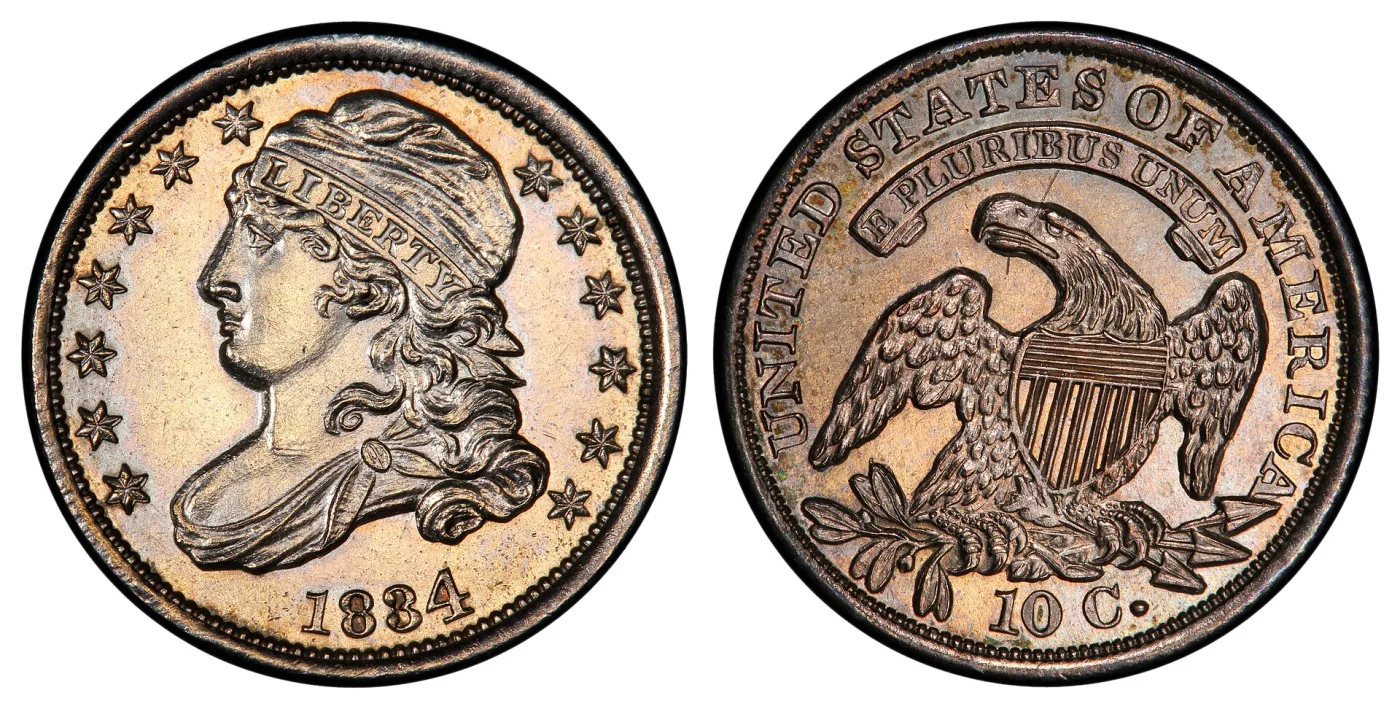
The obverse depicts Liberty facing left, her hair tied up in a soft cloth cap (a “mob cap”) with a band across the front inscribed LIBERTY. Hair curls flow down her neck behind the cap. Seven six-pointed stars appear to the left of Liberty and six stars to the right, totaling thirteen for the original colonies. The date appears in the exergue beneath the bust truncation. The general portrait derived from Reich’s larger half dollar bust, scaled down for the dime field. Star arrangement (7 left, 6 right) is the standard configuration; the rare 1828 variants would later introduce additional star-position modifications, but the basic count of 13 stars never changes.
Reverse (Tails Side)
The reverse shows a heraldic-style eagle with a Union shield on its breast, three arrows in the right talon and an olive branch in the left talon. The eagle’s beak holds a scroll inscribed E PLURIBUS UNUM. Around the eagle is the legend UNITED STATES OF AMERICA. The denomination 10 C. appears below the eagle, beneath the arrows and olive branch. Note the use of “C.” for “cents” — this is one of the abbreviated denomination styles of the early federal era. The dime is the only Capped Bust silver denomination to spell the denomination with “C.” rather than spell out “DIME” or “TEN CENTS.” This is a useful diagnostic for spotting altered or fantasy pieces.
Edge
All Capped Bust Dimes have a reeded edge, struck by either the open collar (Large Size, 1809-1828) or close collar (Small Size, 1828-1837). The transition from open collar to close collar in 1828 is one of the defining technological shifts in the series and is discussed in detail later in this guide.
Designer Initials
Unlike the half dollar of 1807, which carries Reich’s tiny “JR” initial under the bust, the Capped Bust Dime is unsigned. Reich did not place his initial on the dime, possibly because the field was too small. This sometimes confuses new collectors looking for designer marks — there are none.
Large Size vs Small Size: The Critical Sub-Type Split
The single most important identification step for any Capped Bust Dime is determining whether it is Large Size (1809-1828) or Small Size (1828-1837). The two sub-types are distinct enough that most type collectors pursue one of each. Misidentifying the size is one of the most common beginner mistakes — and one of the easiest to fix once you know what to look for.
Large Size Diagnostics (1809-1828)
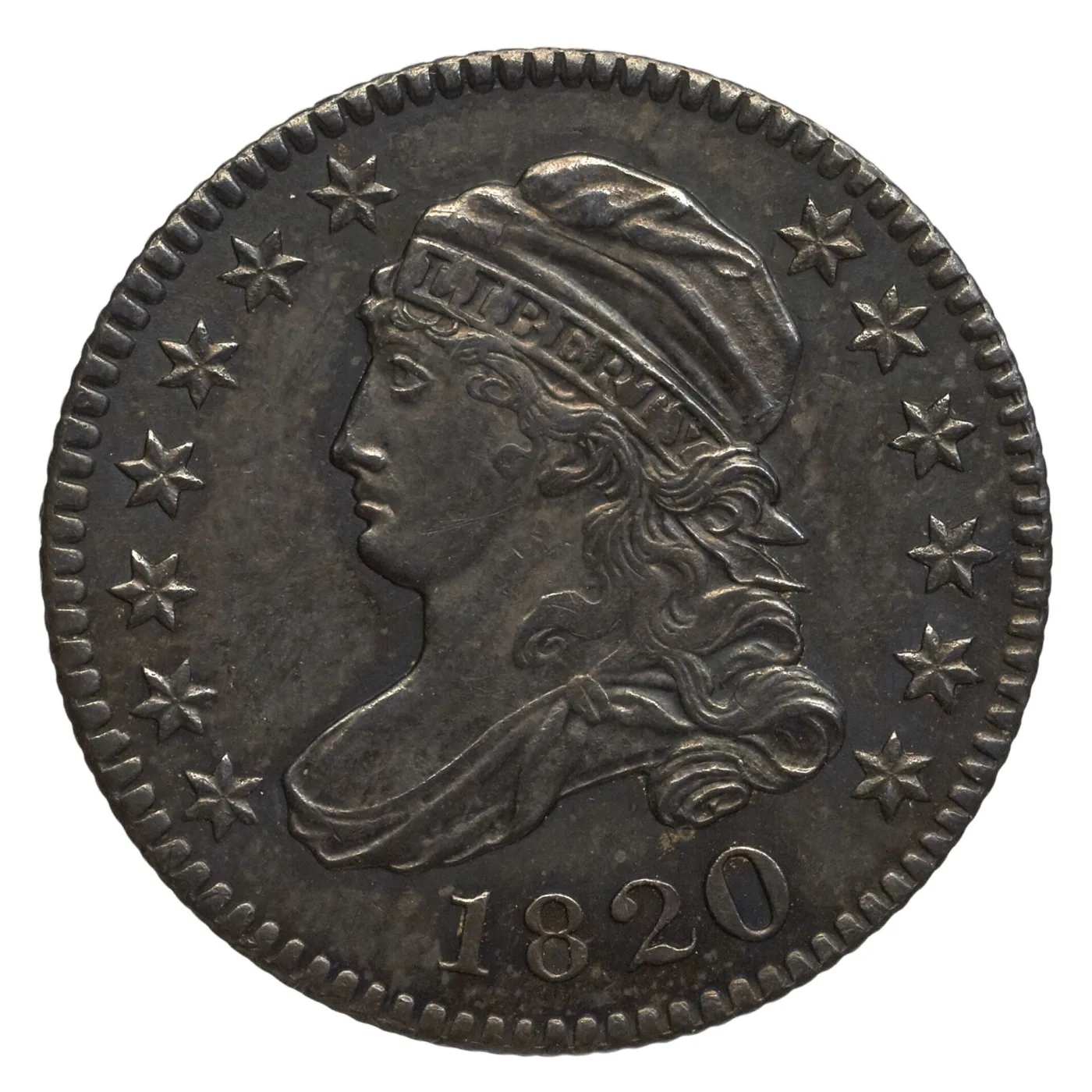
Large Size dimes are struck on planchets nominally 18.8 mm in diameter, with an open collar that produces slightly irregular edges and inconsistent rim shape from coin to coin. The design fills more of the planchet, with stars and lettering closer to the rim. The eagle on the reverse is larger and more spread; the wings reach further toward the legend. The denomination “10 C.” appears further from the eagle’s tail. Open-collar planchets often have slightly off-center strikes and uneven thickness around the rim. Production-quality control was looser. Visual impression: the design looks more “spread out,” with airier fields.
Small Size Diagnostics (1828-1837)
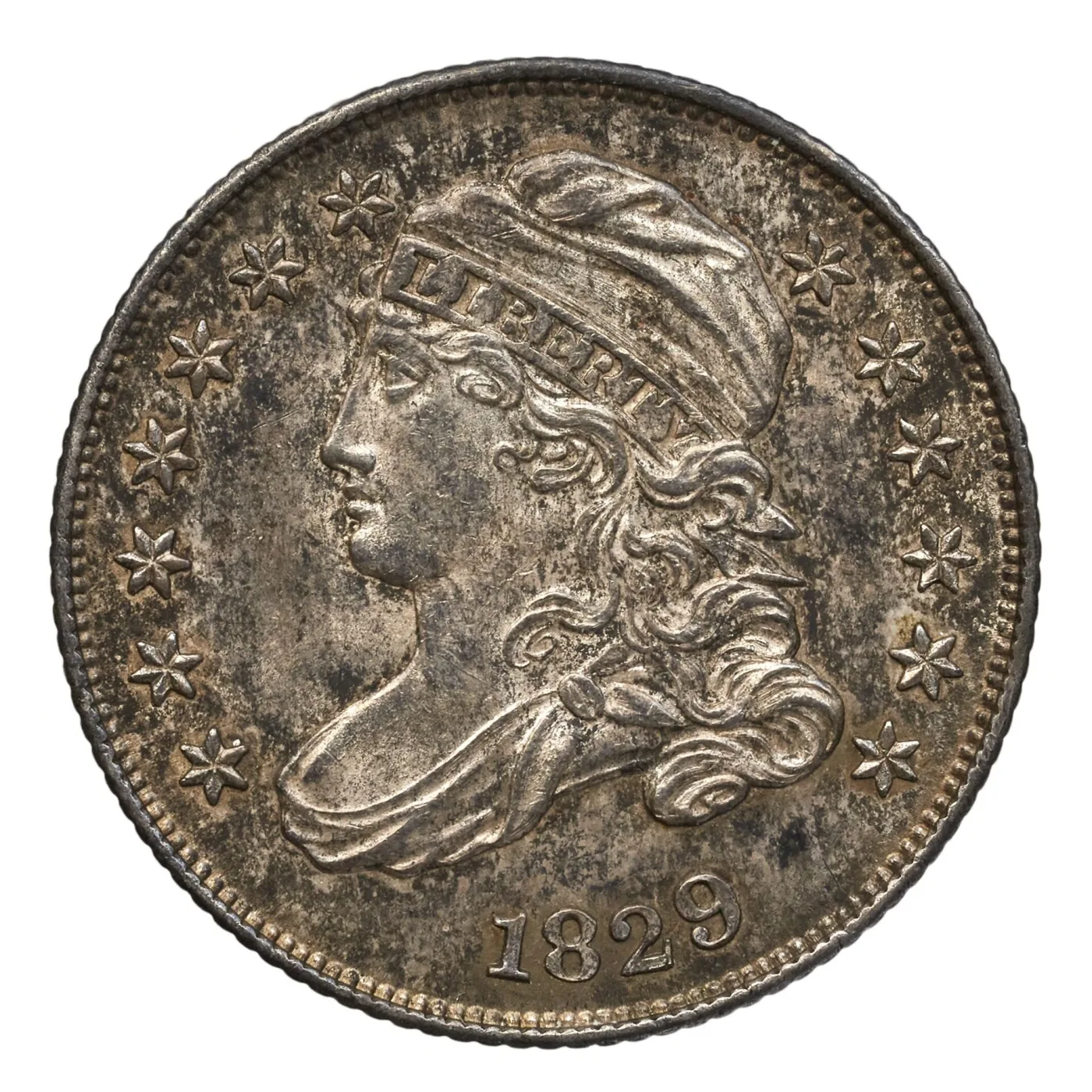
Small Size dimes are struck on planchets nominally 18.5 mm in diameter, in a close collar (steel restraining ring) that produces consistent edges and a sharp, uniform rim. The design is slightly compressed and pulled in from the rim. The eagle is smaller and more compact; the wings are tighter. The denomination “10 C.” is positioned closer to the eagle. Stars are smaller and may show new “scalloped” or “knob-tipped” punches on later dies. The close collar also makes reeded edges more uniform and the planchets visibly more circular. Visual impression: the design looks “tighter,” with crisp uniform rims and a more refined appearance.
The Overlap Year of 1828
1828 saw both Large Size and Small Size production. Early 1828 dies were Large Size (continuing open collar); later in the year, the Mint switched to Small Size (close collar). Both 1828 sub-types exist and are collected separately. The Large Size 1828 is rarer than the Small Size 1828, particularly in higher grades. Distinguishing them requires careful comparison of rim sharpness, design compression, and the position of “10 C.” on the reverse. The 1828 Large Date and Small Date varieties (both within Small Size) add another layer of attribution to this transition year.
Why the Mint Made the Change
The 1828 transition reflects the Mint’s adoption of the close-collar steam press technology pioneered by Mint Director Samuel Moore. The new close collar produced more uniform coins with consistent diameter and edge reeding, reduced planchet waste, and increased production speeds. Every US silver denomination converted to close-collar production between 1828 and 1836. The dime led the conversion in 1828; the quarter followed in 1831; the half dollar converted in 1836 (introducing the rare “Reeded Edge” Capped Bust Half — see the Capped Bust Half Dollar guide for the parallel story).
Composition and Specifications
Knowing the metal content and weight is essential for both authentication and bullion-floor valuation. Capped Bust Dime specifications are unusual in that the silver fineness changed slightly mid-series.
Weight and Fineness
- Large Size (1809-1828): 2.70 g, 18.8 mm diameter (nominal), 0.8924 silver / 0.1076 copper (89.24% silver, an inheritance from the 1792 Mint Act’s “standard silver” specification).
- Small Size (1828-1837): 2.70 g, 18.5 mm diameter, 0.8924 silver / 0.1076 copper. Same composition, slightly smaller diameter due to the close-collar adoption.
Silver Content
A Capped Bust Dime contains approximately 0.0774 troy ounces of pure silver. At a silver spot of $30/oz the bullion floor is about $2.32. No problem-free Capped Bust Dime should ever sell for less than melt, even as a heavily-worn cull, because numismatic premium for the series is significantly higher than melt for every date.
Weight as Authentication Tool
Use a jeweler’s scale accurate to 0.01 grams. Tolerance for genuine coins is roughly ± 0.07 g. Cast counterfeits often weigh significantly under standard (commonly 2.30-2.50 g) because the contemporary casting alloys were lower density. Modern struck counterfeits made of base metal can be detected by weighing and by specific-gravity testing. The same authentication discipline applies to the broader early federal silver family — for the parallel diagnostic on dollars, see the Draped Bust Dollar guide.
Mint Marks: A Philadelphia-Only Series
Every Capped Bust Dime was struck at the Philadelphia Mint. There are no branch-mint Capped Bust Dimes — the first branch-mint dime is the 1838-O Seated Liberty Dime from New Orleans, which began operations after the close of the Capped Bust series.
What This Means for Identification
No Capped Bust Dime carries a mint mark. Any “Capped Bust” dime offered with an “O,” “S,” “CC,” or “D” mint mark is either a counterfeit or an altered modern fantasy. This is one of the simplest authentication tests in early American silver: if it has a mint mark, it isn’t real.
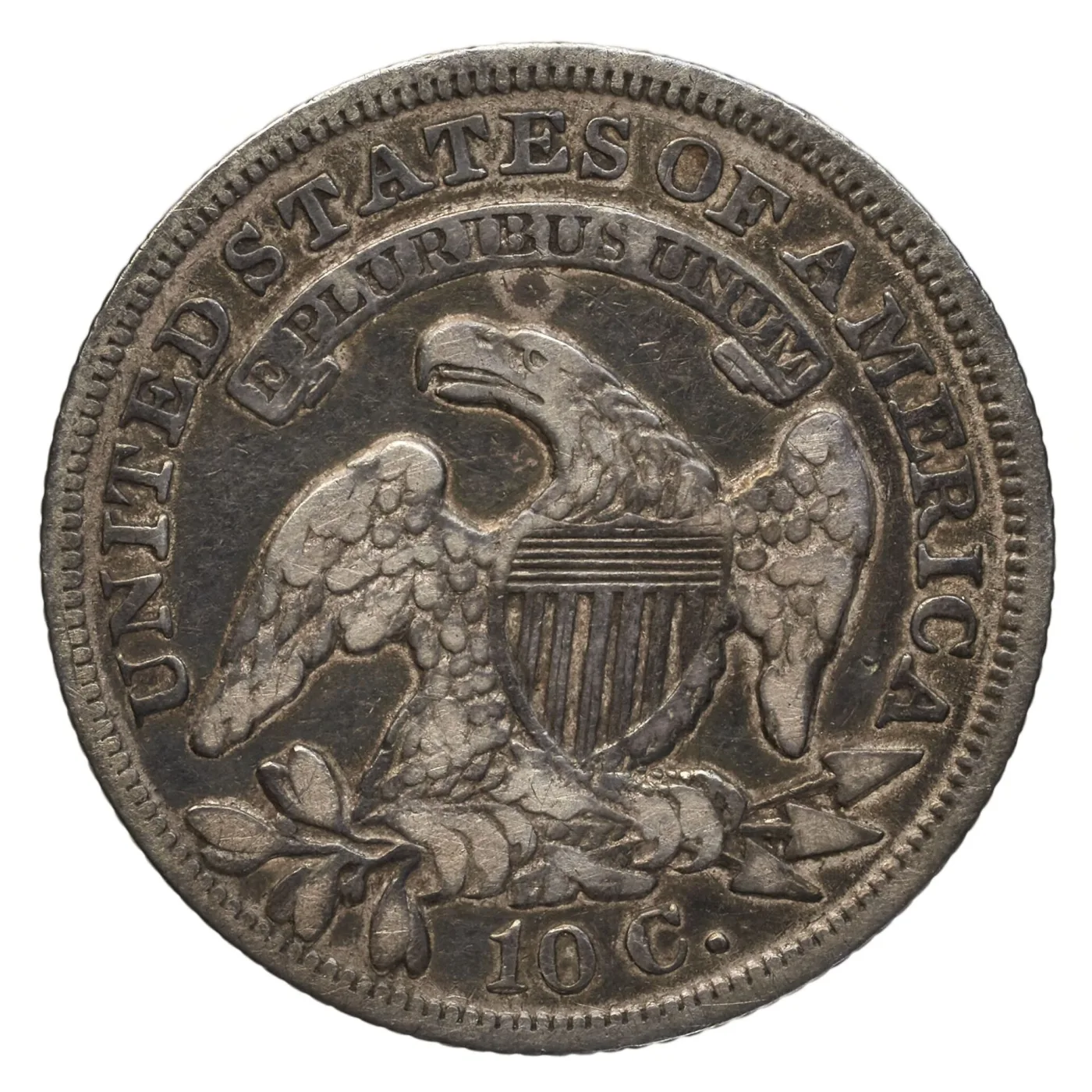
The Implication for Series Difficulty
Because the series is Philadelphia-only, the only attribution variables are date, sub-type (Large vs Small), and die variety (JR-number). This makes the series approachable for a date set (24 attainable dates) while still offering enormous specialist depth via JR varieties. By contrast, a date-and-mint-mark set of Seated Liberty Dimes requires far more entries.

The JR Variety System and Die Marriages
The Capped Bust Dime has one of the deepest die-variety scenes in all of US numismatics. Because each die was hand-engraved at the Philadelphia Mint with individually positioned stars, dates, and denomination punches, every die produces distinct micro-diagnostics. Across 29 years of production, more than 130 obverse-reverse die marriages are catalogued. The standard reference is the John Reich Society’s JR numbering system, originally compiled by Davis, Logan, Lovejoy, McCloskey, and Subjack in the multi-volume “Early United States Dimes 1796-1837” (1984).
How JR Numbers Work
Each unique obverse-reverse die pairing receives a “JR” number — for example, 1820 JR-1, 1820 JR-2, 1820 JR-3, etc. The numbers are assigned in approximate order of rarity (low numbers = more common, high numbers = scarcer). A given date can have anywhere from one JR variety (some years had only one die marriage) to a dozen or more (1820 has 13 JR varieties). Attribution requires matching specific obverse die diagnostics (star position, date placement, die cracks) with reverse die diagnostics (eagle wing position, “10 C.” placement, denticle alignment).
Why It Matters
JR variety attribution can multiply the value of an otherwise common-date coin by 10x or more. For example, an 1820 Large 0 (JR-3) might bring $80 in F-12, while an 1820 Small 0 (JR-7) in the same grade brings $400+. Similarly, the 1828 Small Date and Large Date are dramatically different in scarcity. Specialist collectors building “JR sets” pursue every die marriage; type collectors are happy with any JR variety of each date. The reference guide is the only practical tool for serious attribution.
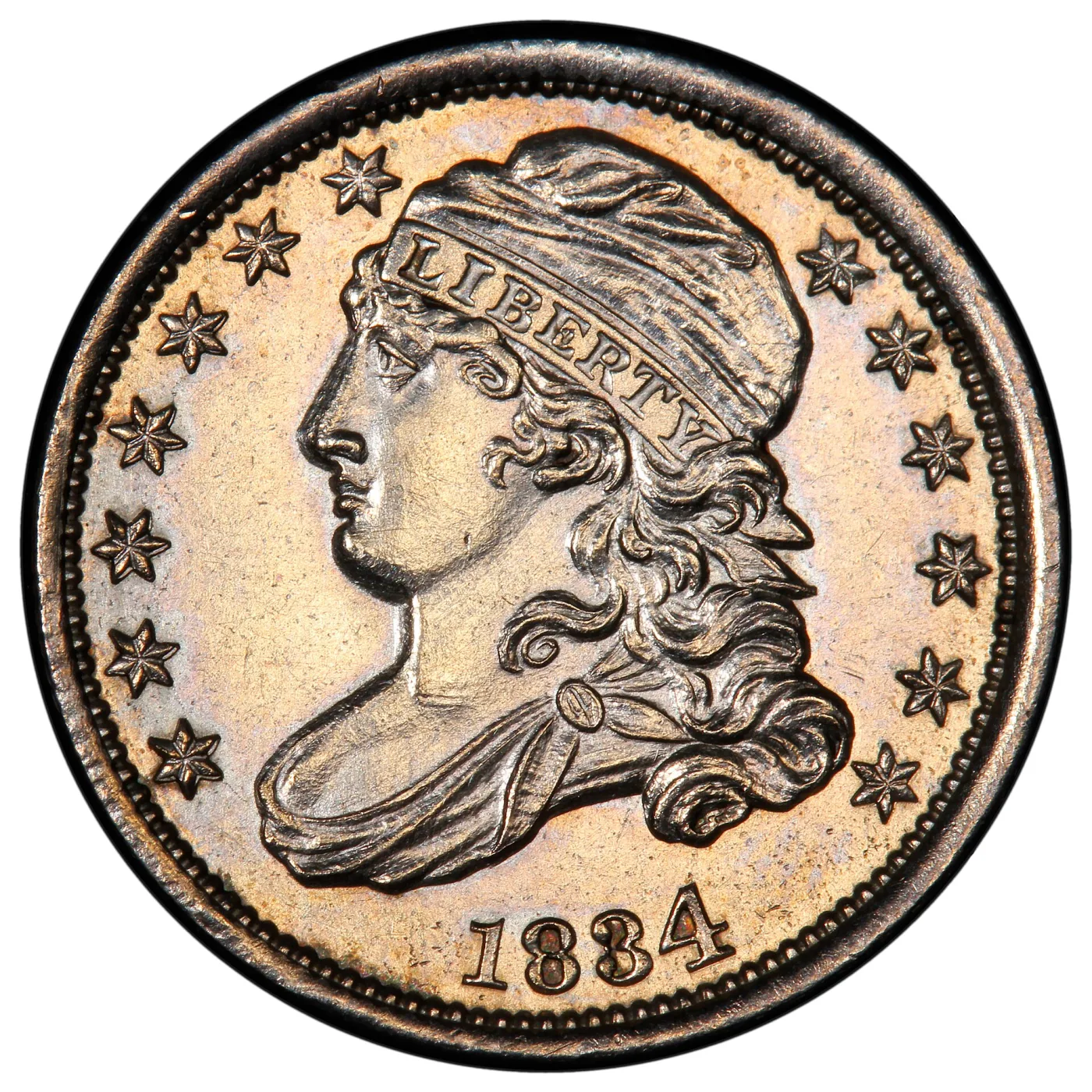
Notable JR Varieties
- 1809 JR-1: The only die marriage for 1809. All 1809 dimes are this variety.
- 1811/9 JR-1: The famous 1811/9 overdate, one of the most popular early dime varieties.
- 1820 JR-1 through JR-13: Thirteen die marriages for a single year — the most of any Capped Bust Dime date.
- 1822 JR-1: The only die marriage for the legendary 1822 (mintage just 100,000), the series key.
- 1823/2 JR-1, JR-2, JR-3: Three varieties of the 1823 overdate.
- 1824/2 JR-1, JR-2: Two varieties of the 1824 overdate.
- 1828 Large Date (JR-1): The Large Size half of the 1828 transition.
- 1828 Small Date (JR-2): The Small Size half of the 1828 transition.
- 1829 Curl Base 2 (JR-10): The rare “Curl Base 2” variety where the 2 in the date has a distinctive curl at its base. R-6 rarity.
- 1830/29 (JR-1): The famous 1830 over 1829 overdate.
- 1830 Large 10 C. / Small 10 C.: Two distinct reverse denomination sizes.
The JR system is the most rewarding aspect of the series for specialists — every coin pulled from a junk box could be a rare die marriage hiding in plain sight. The same kind of variety depth exists in the parallel Capped Bust Half Dollar series via the Overton numbering system.
Key Dates and Major Rarities
Across 29 years of production, Capped Bust Dimes include several dates and varieties whose values vastly exceed common dates. Memorize these — they define the series economy and they are where most counterfeits and altered coins are concentrated.
The Series Keys
- 1822: Mintage 100,000 — the lowest of any Capped Bust Dime date. The series king. F-12 ~$1,800, XF $7,500+, AU $15,000+. Frequently faked by date alteration of 1823 or 1828.
- 1809: Mintage 51,065 — the first year and very rare in all grades. F-12 ~$900, XF $3,500+, AU $9,000+.
- 1811/9: Mintage 65,180 (entire year). The famous overdate, one of the most popular varieties. F-12 ~$700, XF $2,200+, AU $5,500+.
- 1814 STATESOFAMERICA: The variety with no space between “STATES” and “OF” and “OF” and “AMERICA” on the reverse. Scarce. F-12 ~$200, XF $700+.
- 1820 STATESOFAMERICA: Another no-space variety. F-12 ~$200, XF $700+.
- 1824/2: The 1824 over 1822 overdate. F-12 ~$200, XF $900+.
- 1828 Large Date (Large Size): The rarer half of the 1828 transition. F-12 ~$250, XF $1,200+.
- 1829 Curl Base 2: Distinctive curl at base of 2. R-6 rarity, F-12 ~$1,500, XF $5,000+.
Other Notable Dates
- 1830/29: The 1830 over 1829 overdate. F-12 ~$120, XF $400+.
- 1830 Small 10 C.: Scarcer reverse variety. F-12 ~$200, XF $700+.
- 1833 Last 3 High: Variety with the final 3 in date punched too high. F-12 ~$80, XF $250+.
- 1834 Small 4 / Large 4: Two distinct date-punch varieties.
- 1837: The final Capped Bust year. Common but historically interesting as the last of the series.
Condition Rarities
Even among common dates, high-grade examples (MS-63 and above) command large premiums because few collectors saved Capped Bust Dimes in the 19th century — most circulated heavily for decades. A common-date 1835 that brings $50 in F-12 might bring $2,500 in MS-64 and $8,000+ in MS-66. Mint State Capped Bust Dimes from any date are scarce, and gems (MS-65 and finer) are genuinely rare. The series rewards condition-set collectors as much as date-set collectors.
Overdates and Repunched Dates
Because each die was hand-engraved and dies were sometimes carried over from year to year, overdates and repunched dates appear throughout the series. These are some of the most collectible varieties.
1811/9 (Eleven Over Nine)
The Mint reused an 1809 die in 1811 by punching new “1” digits over the “0” and “9” of the original date. Under magnification, the underlying “9” is clearly visible inside the second “1” of the new date. All 1811 Capped Bust Dimes are 1811/9. The variety is collectible as a single popular issue with no non-overdate 1811 alternative.
1823/2 (Twenty-Three Over Twenty-Two)
An 1822 die was carried over and the final “2” repunched with a “3” for 1823 production. Under magnification, the underlying “2” is visible inside the “3.” All 1823 dimes are 1823/2 to some degree, though the strength of the underlying digit varies. There are three JR sub-varieties (JR-1, JR-2, JR-3) distinguished by the small “E” / large “E” in “STATES” on the reverse.
1824/2 (Twenty-Four Over Twenty-Two)
The 1822 die was carried over again two years later and the final “2” repunched with a “4.” All 1824 dimes are 1824/2. The variety is less dramatic visually than 1823/2 because the “4” obliterates more of the underlying “2,” but careful magnification reveals the underdigit.
1830/29 (Thirty Over Twenty-Nine)
An 1829 die was repunched for 1830 use. The final “0” sits over the original “9.” Less dramatic than 1811/9 but still clearly visible under 10x magnification. Not all 1830 dimes are overdates — most 1830 issues are non-overdate Small Size pieces.
1828 / 1828 Curl Base Knob 2
Within the Small Size 1828 issues, two distinctly different “2” punches were used. The “Curl Base 2” (also called “Knob 2”) shows a small curl at the base of the 2 digit, while the “Square Base 2” has a flat-bottomed 2. The Curl Base is part of the Large Date sub-variety; the Square Base is Small Date. Distinguishing them is one of the trickier 1828 attributions.
The 1828 Large-to-Small Transition
The 1828 transition from Large Size (open collar) to Small Size (close collar) is the single most important production event in the Capped Bust Dime series. Understanding it is essential for both attribution and authentication.
The Mechanical Change
Through 1827, US silver dimes were struck without a restraining collar — the planchet sat loose between the dies, and edge reeding was applied by a separate hand-cranked tool before striking. This produced slightly variable diameters (some coins are 18.7 mm, others 18.9 mm) and somewhat uneven reeding. Mint Director Samuel Moore introduced the “close collar” — a steel restraining ring around the planchet at the moment of striking — which produced uniform diameter and crisp reeding simultaneously with the strike. The close collar was first applied to dime production in mid-1828.
How to Tell Them Apart
The most reliable visual diagnostic is the relationship between the design and the rim. On Large Size coins, the design extends very close to the rim, sometimes touching the denticles. On Small Size coins, the design pulls in from the rim, leaving a visible gap. The rim itself is uneven and rounded on Large Size (open-collar) coins, but uniform, sharp, and perfectly circular on Small Size (close-collar) coins. Both types should have reeded edges, but Small Size reeding is much more uniform.
A second diagnostic is the position of “10 C.” on the reverse. On Large Size, “10 C.” sits further from the eagle’s tail and arrows; on Small Size, it sits very close to the tail. A third is the relative size of the stars and lettering — Small Size pieces have slightly smaller punches.
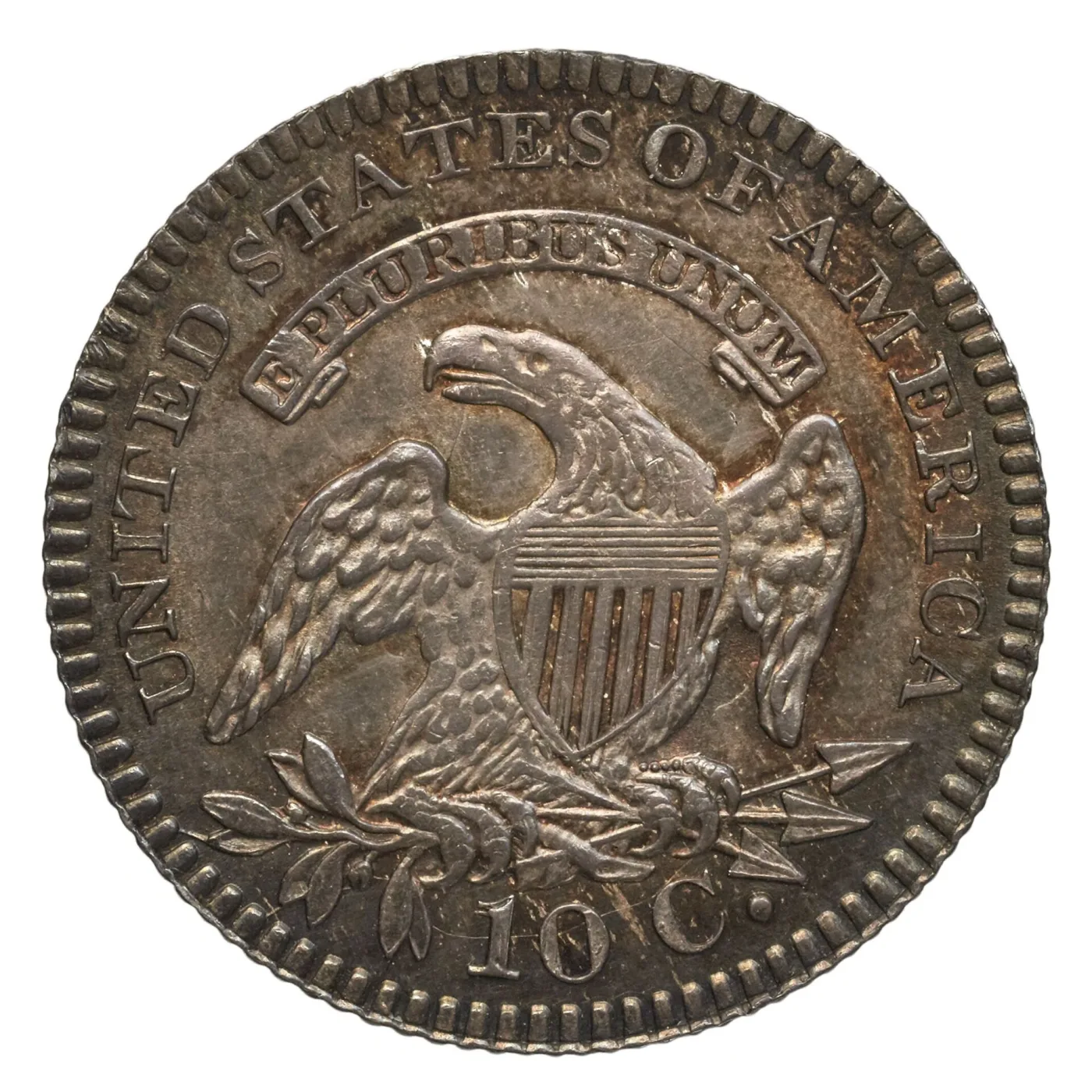
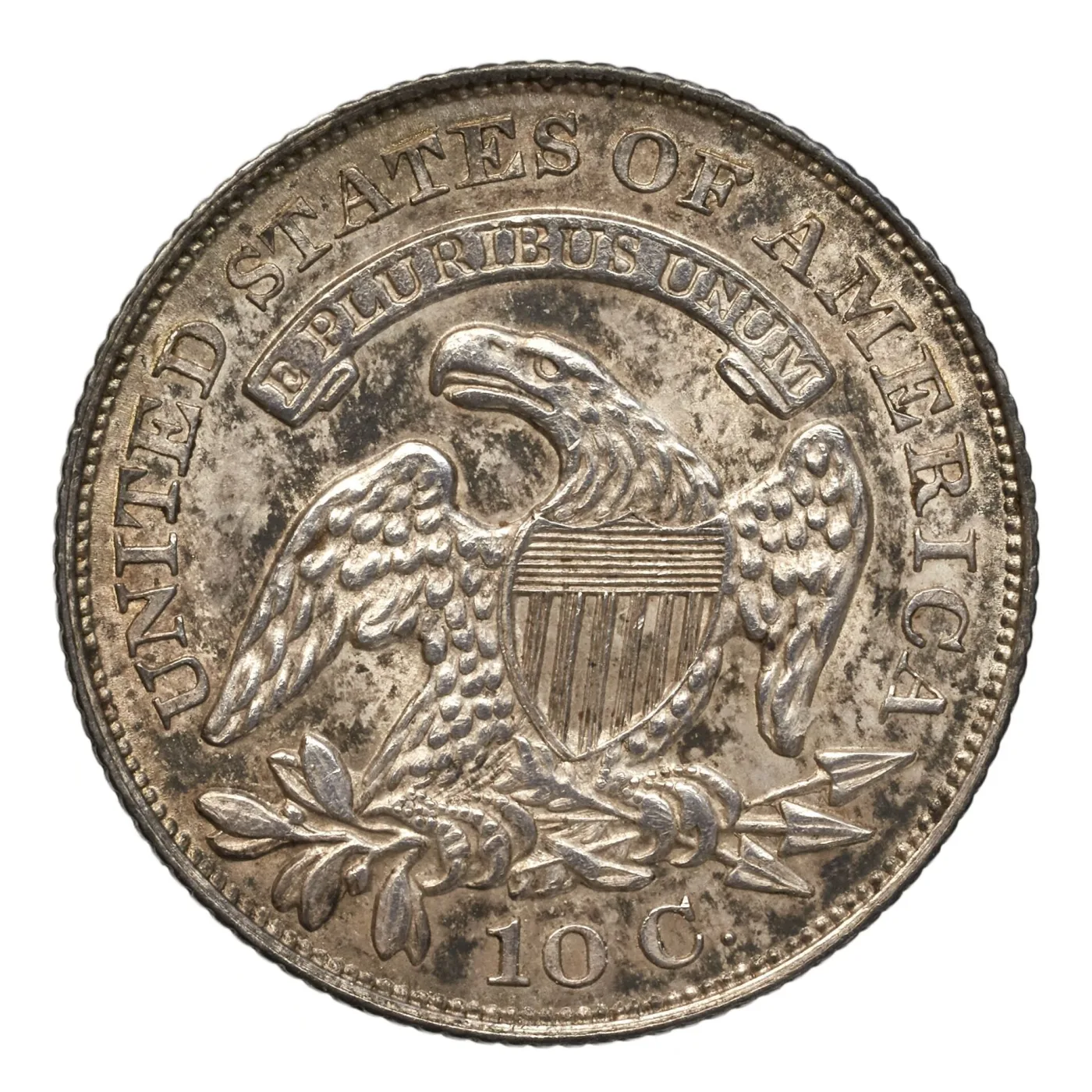
Why Collectors Care
Most type collectors want one Large Size and one Small Size example. The Large Size 1828 is the only year where you can choose between two sub-types within a single calendar year. The Large Size 1828 is also rarer than the Small Size 1828 by approximately 4:1 in surviving population. Mint State Large Size 1828 dimes are particularly rare.
Grading Capped Bust Dimes
Capped Bust Dime grading follows the Sheldon 70-point scale, with several diagnostic wear points particular to the series. Accurate grading is essential because price-grade curves are steep on this series — the difference between F-12 and VF-20 on a common date can mean a 2x value jump.
Key Wear Points
The earliest wear shows on Liberty’s hair curls above her ear and on the high points of the cap. Next, the eagle’s wing feathers and breast feathers show smoothing. The shield lines on the eagle’s breast lose definition. The word LIBERTY on Liberty’s headband should be fully readable down to about F-12; in lower grades, individual letters wear away.
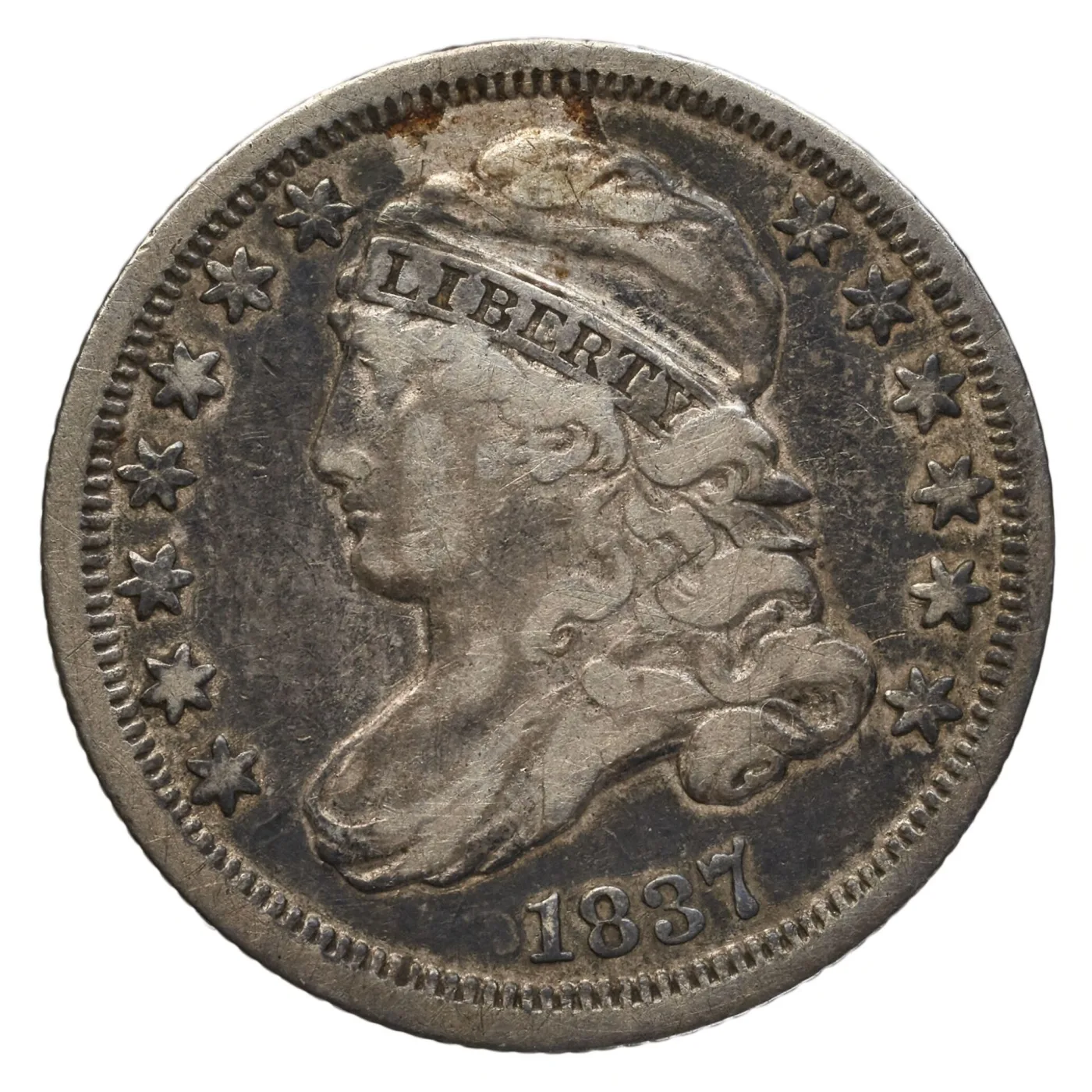
Grade Definitions
- About Good (AG-3): Date legible, outlines of bust and eagle visible. LIBERTY mostly worn off. Most details flat.
- Good (G-4 to G-6): Full date, rim mostly visible. LIBERTY partly readable. Bust outline complete.
- Very Good (VG-8 to VG-10): All major design features visible. LIBERTY readable but may be weak. Most hair detail flat.
- Fine (F-12 to F-15): LIBERTY clear. Hair shows some detail. Eagle wings show feather separation in protected areas.
- Very Fine (VF-20 to VF-35): LIBERTY sharp and bold. Most hair curls distinct. Eagle wings show clear feather separation.
- Extremely Fine (XF-40 to XF-45): Light wear on highest points only. All design details sharp. Some mint luster may remain in protected areas.
- About Uncirculated (AU-50 to AU-58): Trace wear on highest points only. Significant mint luster.
- Mint State (MS-60 to MS-70): No wear. Graded by strike quality, surface preservation, and luster.
Strike Quality
Capped Bust Dimes are notorious for striking weakness, particularly on the obverse stars above Liberty’s cap and on the eagle’s right (viewer’s left) wing tip. A weakly-struck XF coin may look like a worn AU at first glance. Always distinguish between honest wear and original strike weakness when grading. The JR variety reference notes typical striking characteristics for each die marriage, which can help identify whether softness is wear or strike.
Authentication and Spotting Counterfeits
Capped Bust Dimes have been counterfeited in three eras: contemporary 19th-century circulation counterfeits (often cast in lead-tin alloy), 20th-century coin-show fakes (struck or cast), and 21st-century Chinese-origin struck counterfeits. The 1822 key date is by far the most-faked issue.
Weight and Specific Gravity
Standard weight is 2.70 g ± 0.07 g. Specific gravity for the 89.24% silver alloy is approximately 10.34. Cast lead-tin counterfeits are typically 9.5 or below, and modern copper-core silver-plated fakes are around 8.5-9.0. A jeweler’s scale and a precision specific-gravity tester are the most reliable starting authentication tools.
Date Alteration
The most common alteration is converting a common date (1823, 1825, 1828) to the rare 1822 by re-engraving the final digit. Look for tooling marks around the altered digit and disturbed metal in the surrounding field. Genuine 1822 dies have specific JR-1 diagnostics including a die crack from the rim through the 1 of the date — these die-crack markers are extremely difficult to replicate convincingly.
Mint Mark Additions
Any Capped Bust Dime with a mint mark is fake. Period. The Philadelphia Mint did not strike mint-marked dimes until 1838-O. A “Capped Bust” dime with an “O” mint mark is either a contemporary forgery, a modern fantasy strike, or an altered Seated dime with a recut design.
Surface Diagnostics
Genuine Capped Bust Dimes show the characteristic adjustment marks (faint parallel file marks on the planchet, applied at the Mint to bring overweight planchets to standard) and the slightly granular fields from open-collar production. Cast counterfeits show pebbly surfaces, soft details, and tool marks at the rim where seams were filed. Struck modern counterfeits are smoother than genuine pieces and often have suspiciously sharp denticles or mushy lettering. The same authentication discipline applies more broadly across early federal silver — see the Trade Dollar guide for related counterfeit-detection methods.
Third-Party Grading
For any Capped Bust Dime worth more than $300 — and certainly for any 1822, 1809, 1811/9, or Mint State example — third-party authentication through PCGS or NGC is strongly recommended. The cost of certification is small relative to the price of being wrong. JR variety attribution is also offered as an add-on service on PCGS slabs and is required for accurate valuation of scarce die marriages.
Current Market Values and Price Guide
Values below are approximate retail for problem-free, original coins as of 2026. Auction results, cleaned coins, problem coins, and exceptional specimens vary widely. JR variety attribution can multiply these numbers significantly.
Common Date Range (Most 1820s and 1830s Dates)
- G-4: $50-$80
- F-12: $80-$130
- VF-20: $150-$250
- XF-40: $400-$650
- AU-50: $750-$1,100
- MS-63: $2,000-$3,500
- MS-65: $7,500-$12,000
Better Dates and Scarce Years
- 1814: F-12 $90, XF $500, MS-63 $4,000.
- 1820: F-12 $80, XF $400, MS-63 $3,000.
- 1821: F-12 $80, XF $450, MS-63 $3,500.
- 1825: F-12 $80, XF $400, MS-63 $3,500.
- 1827: F-12 $80, XF $400, MS-63 $3,000.
- 1834: F-12 $60, XF $350, MS-63 $2,500.
- 1835: F-12 $60, XF $300, MS-63 $2,500.
Major Rarities
- 1809: F-12 $900, XF $3,500, MS-63 $25,000+.
- 1811/9: F-12 $700, XF $2,200, MS-63 $18,000+.
- 1822: F-12 $1,800, XF $7,500, MS-63 $60,000+.
- 1823/2: F-12 $80, XF $400, MS-63 $3,500.
- 1824/2: F-12 $200, XF $900, MS-63 $5,500.
- 1828 Large Date (Large Size): F-12 $250, XF $1,200, MS-63 $6,500.
- 1829 Curl Base 2: F-12 $1,500, XF $5,000, AU $15,000+.
Pricing Resources
For current market data, consult the PCGS Price Guide, NGC Price Guide, and recent auction archives at Heritage Auctions, Stack’s Bowers, and Great Collections. The “Greysheet” (Coin Dealer Newsletter) provides wholesale bid/ask pricing updated weekly. For JR-variety-specific pricing, the John Reich Journal publishes specialist auction results not captured in general price guides.
Building a Capped Bust Dime Collection
Capped Bust Dimes can be collected at many different levels of depth and budget. Here are the most popular collection strategies.
Type Set (2 Coins)
The simplest approach: one Large Size and one Small Size. Total budget for VF examples of common dates: $400-$700. This gets you both major sub-types and serves as a permanent placeholder in any 19th-century US silver type set.
Date Set (24 Dates)
One example of each issued year: 1809, 1811, 1814, 1820, 1821, 1822, 1823, 1824, 1825, 1827, 1828, 1829, 1830, 1831, 1832, 1833, 1834, 1835, 1836, 1837. (Some sources count slightly different dates depending on overdate handling.) Total budget for an F-12 set with the 1822 included: approximately $4,000-$6,000. Without 1822: approximately $2,500-$3,500.
JR Set (Specialist)
A complete JR-by-JR die marriage set is the ultimate specialist collection. More than 130 die marriages across the series, several of which are R-6 or R-7 (only a handful of known examples). Cost: $50,000+ for a high-grade set, decades to assemble. The John Reich Society membership is essential for serious JR collectors. The same depth of specialist collecting exists in the parallel Large Cent series via the Sheldon and Newcomb numbering systems.
Condition Set
Pursue every date in MS-63 or finer. Approximately 24 coins. Budget: $50,000-$150,000+ depending on grade target. Mint State Capped Bust Dimes are scarce in any date and rare in grades above MS-65.
Overdate Set
Focus on the major overdates: 1811/9, 1823/2, 1824/2, 1830/29. Four coins, total budget around $2,000-$3,500 in F-12. A pleasing thematic collection that captures the heart of the series’ die-variety drama.
Cleaning, Toning, and Preservation
Capped Bust Dimes are 200 years old. Most have circulated extensively, and many have been cleaned, polished, or tampered with at some point in their history. Knowing what to look for protects your investment.
Original Surfaces
An original Capped Bust Dime shows soft cartwheel luster (on Mint State pieces), natural toning (typically gray, gold, or russet from album storage), and unbroken patina across protected areas. Tooling marks under the high points are normal artifacts of striking. The fields should never look brilliantly bright on a circulated coin — bright fields signal cleaning.
Signs of Cleaning
Look for: unnaturally bright fields, hairline scratches in concentric circles (wheel polishing), hairlines in random directions (rag wiping), pitted or “frosty” surfaces (acid dip), and “milky” residue in protected areas (incomplete rinsing). Cleaned Capped Bust Dimes are worth approximately 30-50% of problem-free pricing.
Storage Recommendations
Store Capped Bust Dimes in inert holders: PCGS / NGC slabs (for certified coins), Mylar 2x2 flips, or Saflips. Avoid PVC-containing soft flips, which leach acids and damage silver surfaces over time. Keep storage areas cool and dry (under 50% relative humidity). Never clean a Capped Bust Dime, no matter how dirty it looks — cleaning destroys value irreversibly. If a coin truly needs conservation, send it to NCS (NGC’s conservation service) or PCGS Restoration rather than attempting home methods. The same preservation principles apply to all early federal silver — see the broader Complete Coin Identification Guide for general preservation advice.
Frequently Asked Questions
What is the rarest Capped Bust Dime?
The 1822 is the series king, with a mintage of just 100,000 and a survival rate that puts it well below 1,000 known examples in all grades combined. The 1809 (first year) and 1811/9 are also major rarities. Among die varieties, the 1829 Curl Base 2 is R-6 (only 12-30 known) and several JR varieties of other dates are similarly scarce.
How can I tell Large Size from Small Size?
Check the relationship between the design and the rim. Large Size (open collar, 1809-1828) has the design extending nearly to the rim with uneven, rounded edges. Small Size (close collar, 1828-1837) has the design pulled in from the rim with sharp, uniform edges. The "10 C." position on the reverse also differs — on Large Size it sits further from the eagle's tail.
Are there mint marks on Capped Bust Dimes?
No. Every Capped Bust Dime was struck at Philadelphia, which used no mint mark. Any Capped Bust Dime with a mint mark is fake. The first branch-mint US dime is the 1838-O Seated Liberty Dime.
What is a JR number?
JR numbers identify specific obverse-reverse die marriages, catalogued by the John Reich Society. Each unique die pairing receives a sequential JR number per date. JR attribution can significantly affect value — some JR varieties are 10x to 50x more valuable than common varieties of the same date.
How much is a typical Capped Bust Dime worth?
Common-date Capped Bust Dimes (most 1820s and 1830s issues) bring approximately $50-$80 in G-4, $80-$130 in F-12, $400-$650 in XF-40, and $2,000-$3,500 in MS-63. Keys like the 1822 bring $1,800 in F-12 and $60,000+ in MS-63. Always check both the date AND the JR variety before pricing.
Should I clean my Capped Bust Dime?
Absolutely not. Cleaning destroys 30-70% of value irreversibly. Even "gentle" methods like distilled water rinses can disturb original surfaces enough to be detectable by graders. If a coin truly needs conservation, send it to NCS or PCGS Restoration — never attempt home cleaning.
Where can I sell my Capped Bust Dime?
For coins worth under $300, local coin dealers or eBay (with PCGS/NGC certification) are practical. For coins worth $500+, consign to Heritage Auctions, Stack's Bowers, or Great Collections — the larger buyer base and competitive bidding will usually outperform private sale. Always get coins worth more than $300 authenticated and graded before selling.
How does the Capped Bust Dime compare to the Seated Liberty Dime?
The Capped Bust Dime (1809-1837) is the earlier series, with John Reich's bust design and a smaller production. The Seated Liberty Dime (1837-1891) is the longer-running successor with Christian Gobrecht's allegorical figure. Both are 89.24% silver in their earliest issues; the Seated dime later dropped to 90% silver. Capped Bust Dimes are generally rarer and more variety-driven; Seated dimes have a much deeper date-and-mint-mark scene including the famous Carson City keys.