Coronet Head Large Cent Identification Guide: Matron Head, Coronet Head, 1823 Key Date, 1839 Head Varieties, Newcomb Attribution, Grading, and Values
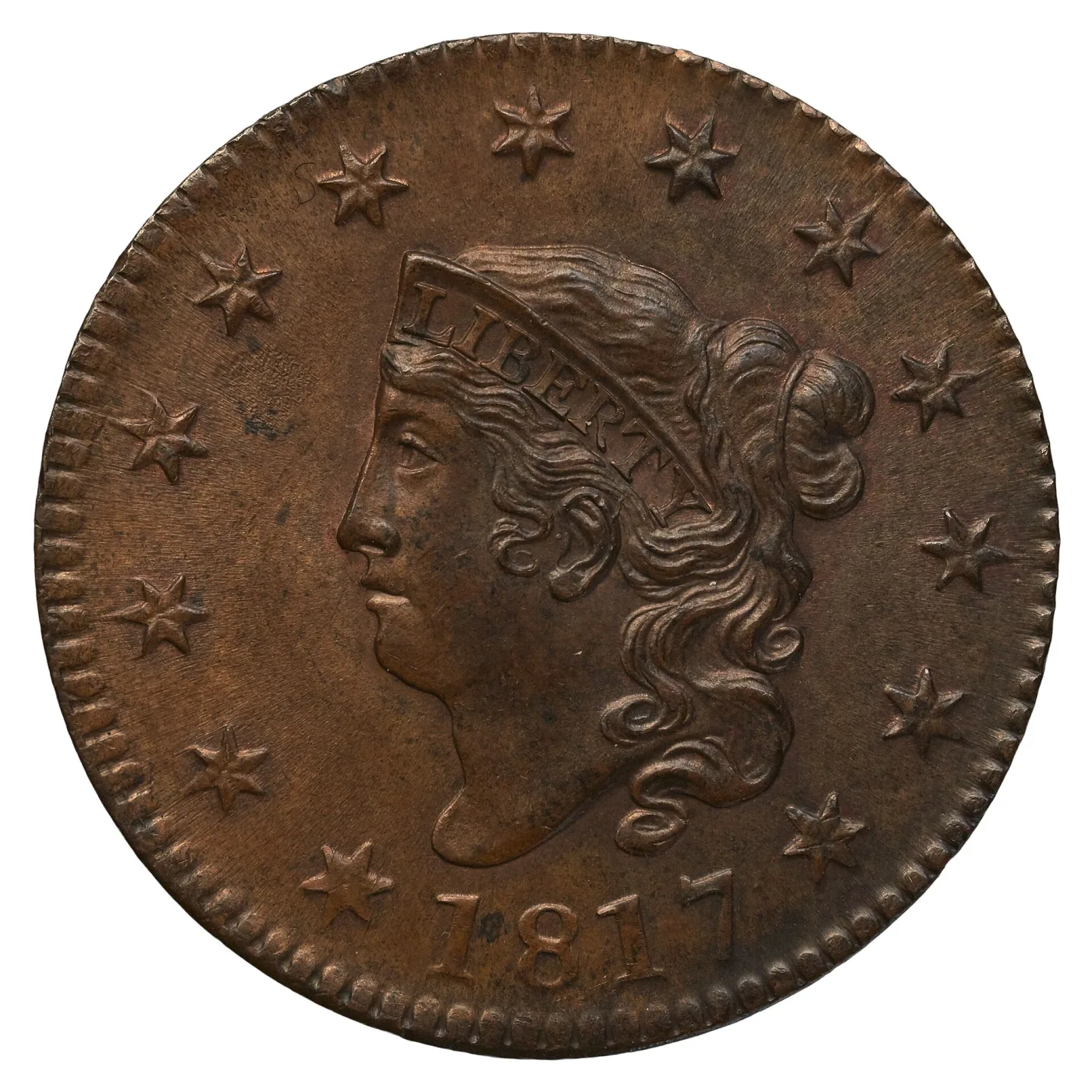
The Coronet Head Large Cent is the long-running, middle-period type of the United States large cent — the big copper coin that Americans carried in their pockets for the better part of a generation. Struck at the Philadelphia Mint from 1816 through 1839, it bridges the early, crude, hand-engraved coppers of the 1790s and the refined Braided Hair cents that closed the series in 1857. Collectors and catalogers split this twenty-three-year run into two closely related sub-styles: the Matron Head of 1816-1835, with its mature, full-faced Liberty, and the modified Coronet Head (sometimes called the “Young Head” or “Matron Head Modified”) of 1835-1839. Both share the defining feature that gives the type its name: a plain coronet — a tiara-like band — worn across Liberty’s brow and inscribed “LIBERTY.”
For the collector, the Coronet Head cent is one of the most rewarding fields in all of American numismatics. It is affordable enough that a complete date set is within reach of almost any budget, yet deep enough that specialists spend lifetimes chasing its die varieties. It contains a single famous key date — the 1823 — and one of the most entertaining clusters of varieties in the entire series: the 1839 “head” varieties, with their irresistible nicknames of Silly Head, Booby Head, Petite Head, and Head of 1838. It also holds the legendary Randall Hoard, a keg of uncirculated cents from the 1820s discovered after the Civil War that explains why certain “rare” early dates are surprisingly available in Mint State today.
This guide is the complete 2026 reference for identifying, attributing, grading, authenticating, and valuing Coronet Head Large Cents. You will learn how to separate this type from the earlier Draped Bust large cent and the intervening Classic Head cent, how to tell the Matron Head from the modified Coronet Head, how to navigate the 1816-1820 dates and the critical 1823 key date, how to identify every one of the 1839 head varieties, how the Newcomb die-variety system organizes the series, how EAC copper grading works, how to spot counterfeits and “problem” coins, and what every date is worth today. Whether you are filling a single type slot, building a date set from an inherited box of coppers, or attributing Newcomb varieties under a loupe, this guide will give you a specialist’s command of America’s everyday coin of the 1820s and 1830s.
History and Background
The Coronet Head Large Cent was born out of a crisis at the Philadelphia Mint. In January 1816 a fire destroyed the Mint’s rolling and milling machinery, halting cent production entirely. No large cents are dated 1815 — a unique gap in the series — and when production resumed later in 1816, the Mint introduced an entirely new design. The worn-out Classic Head cent of John Reich (1808-1814), which had been struck on soft, impure copper and tended to wear and corrode badly, was retired. In its place came a fresh portrait of Liberty wearing a coronet, generally attributed to Robert Scot with later refinement traditionally credited to John Reich, and ultimately modified again under Christian Gobrecht.
The new cent was struck on far better copper, purchased increasingly from English sources, and the coins of this era survive in much better condition than the earlier coppers as a result. For more than two decades the Coronet Head cent was the workhorse of American small change. There were no nickels, no small cents, and no widely circulating low-value silver in everyday hands; the big copper cent — roughly the diameter of a modern half dollar — was the coin of daily commerce, the coin that bought a newspaper or a loaf of bread. When the Panic of 1837 made even these cents scarce, privately struck Hard Times Tokens of nearly the same size circulated as substitutes.
By the late 1830s, rising copper prices and changing tastes prompted a redesign. Christian Gobrecht, who became chief engraver in 1840, reworked Liberty’s portrait into the slimmer, more youthful Braided Hair style that he had already applied to the half cent. The transition happened in 1839, which is exactly why that single year produced such a remarkable spread of portrait varieties as the Mint experimented its way from the old Matron Head toward the new Braided Hair design. The Coronet Head type therefore ends in 1839, handing off directly to the Braided Hair cent of 1839-1857.
Where It Sits in the Large Cent Story
The full large cent series runs from 1793 to 1857 and is conventionally divided into six design types: Flowing Hair Chain, Flowing Hair Wreath, Liberty Cap, Draped Bust, Classic Head, and finally the Coronet/Braided Hair group. The Coronet Head (Matron Head) is the fifth of these, immediately preceding the Braided Hair finale. For an overview of all six types and how they fit together, see the broader large cent identification guide; this article focuses specifically on the 1816-1839 Coronet/Matron Head issues.
A Beginner-Friendly Series
Because so many were made and survive, and because the copper of this era holds up well, the Coronet Head cent is one of the easiest pre-1840 U.S. types to collect. A worn but fully identifiable example of a common date can be had for the price of a restaurant meal, and even uncirculated examples of several dates are within reach thanks to old hoards. This accessibility makes it a favorite entry point for collectors moving from modern coins into early American copper.
Design and Diagnostic Features
Identifying the Coronet Head type is straightforward once you know what to look for. The coronet band across Liberty’s forehead is the single most reliable diagnostic, and it cleanly separates this type from every earlier large cent design.
Obverse
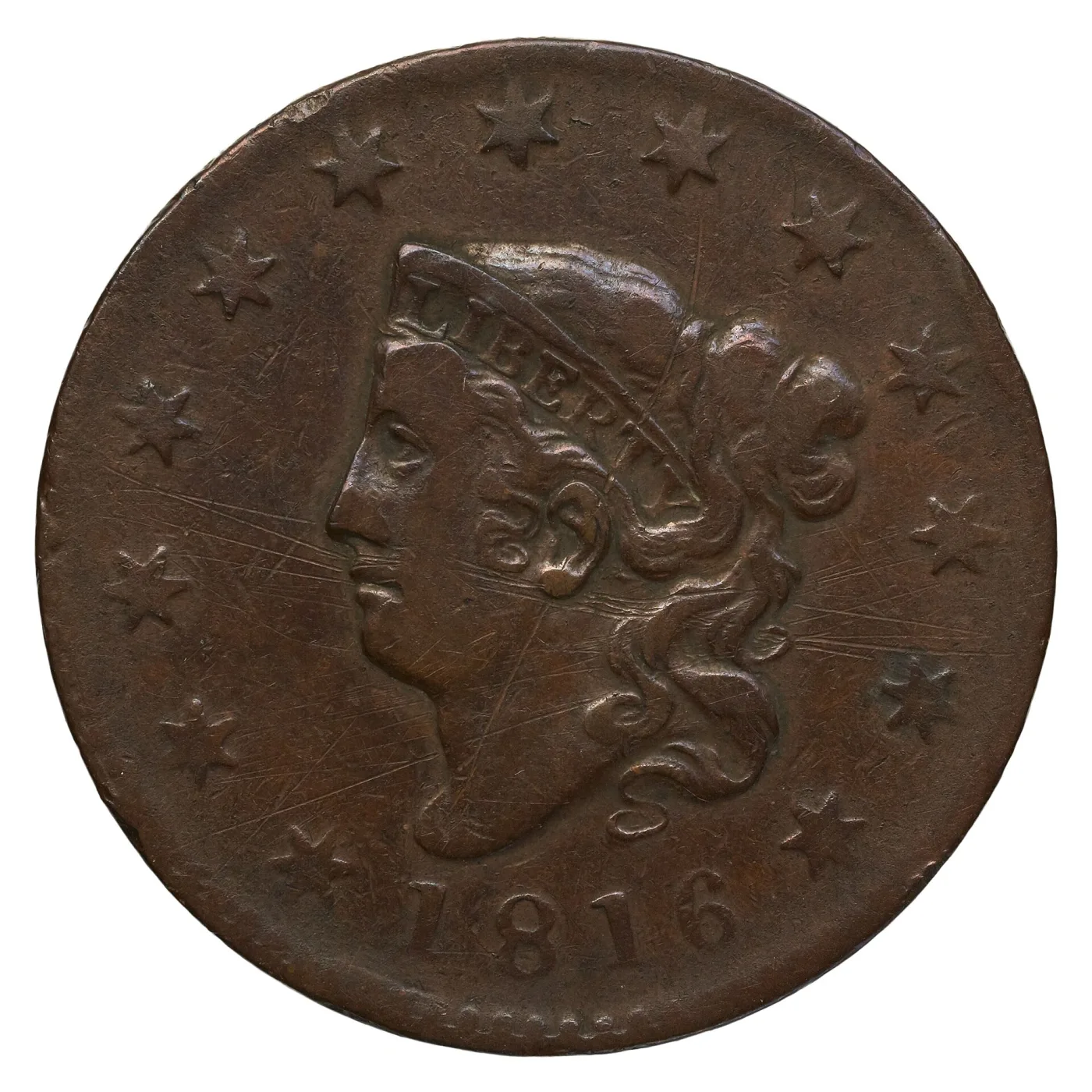
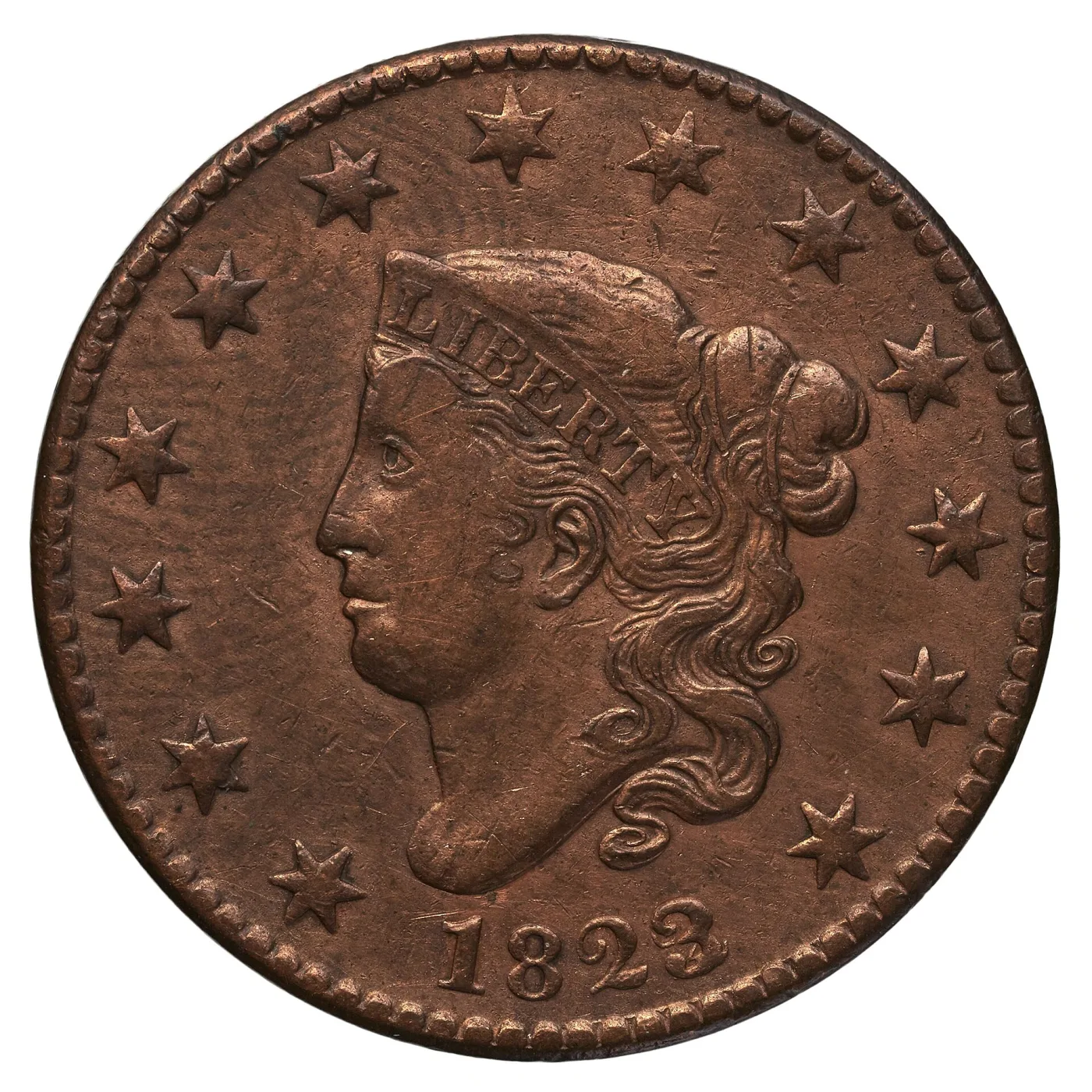
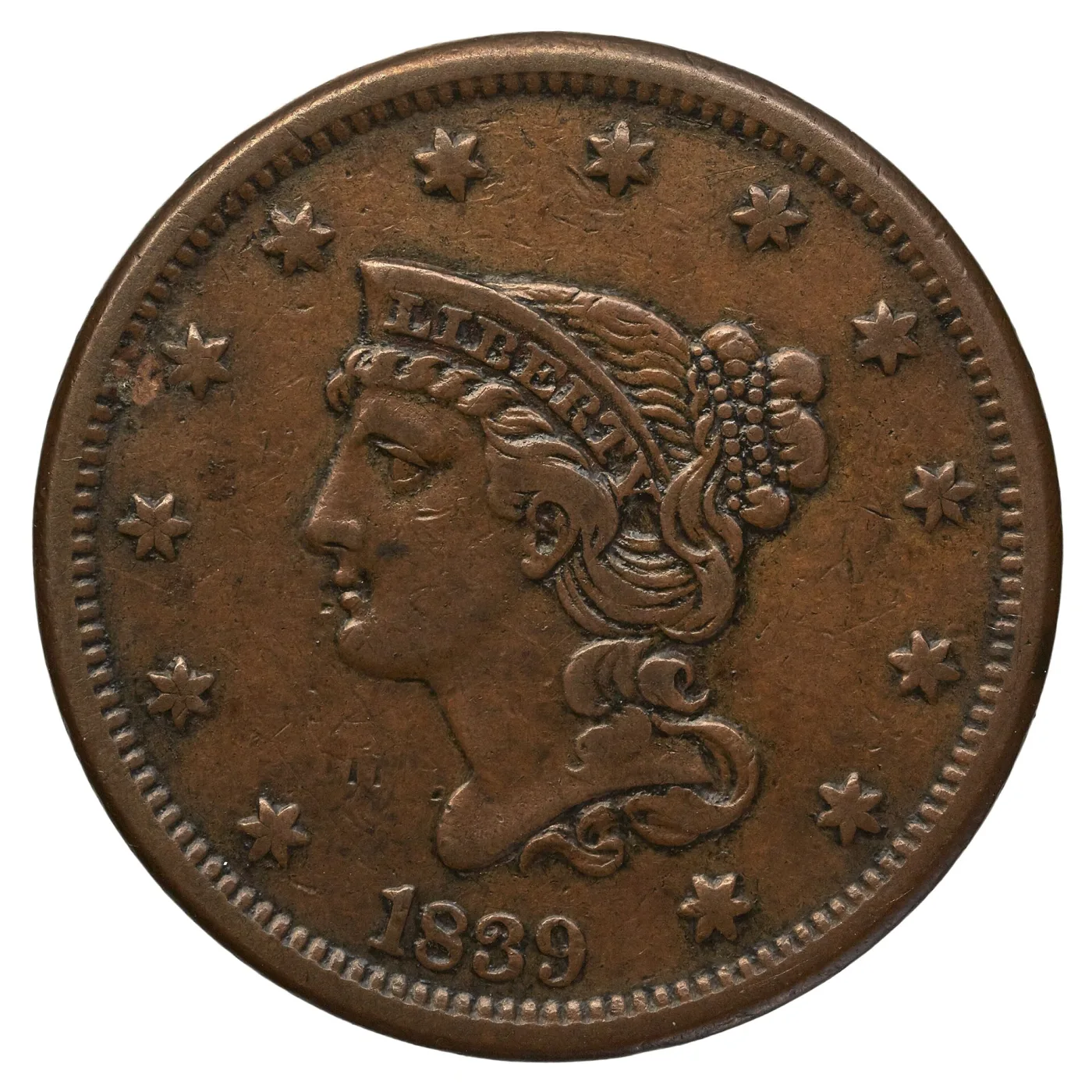
Liberty faces left, wearing a plain coronet (a flat band, like a tiara without ornament) across her forehead, inscribed with the word “LIBERTY” in raised letters. Her hair is gathered up and back, falling in waves and gathered into a bun or coil behind the head; on most dates the hair is secured with a beaded cord. Thirteen stars surround the portrait — seven to the left and six to the right — and the date appears below at the base of the coin. There is no mint mark on any Coronet Head large cent; every example was struck at the Philadelphia Mint, since branch mints did not yet exist when the type was produced.
Reverse
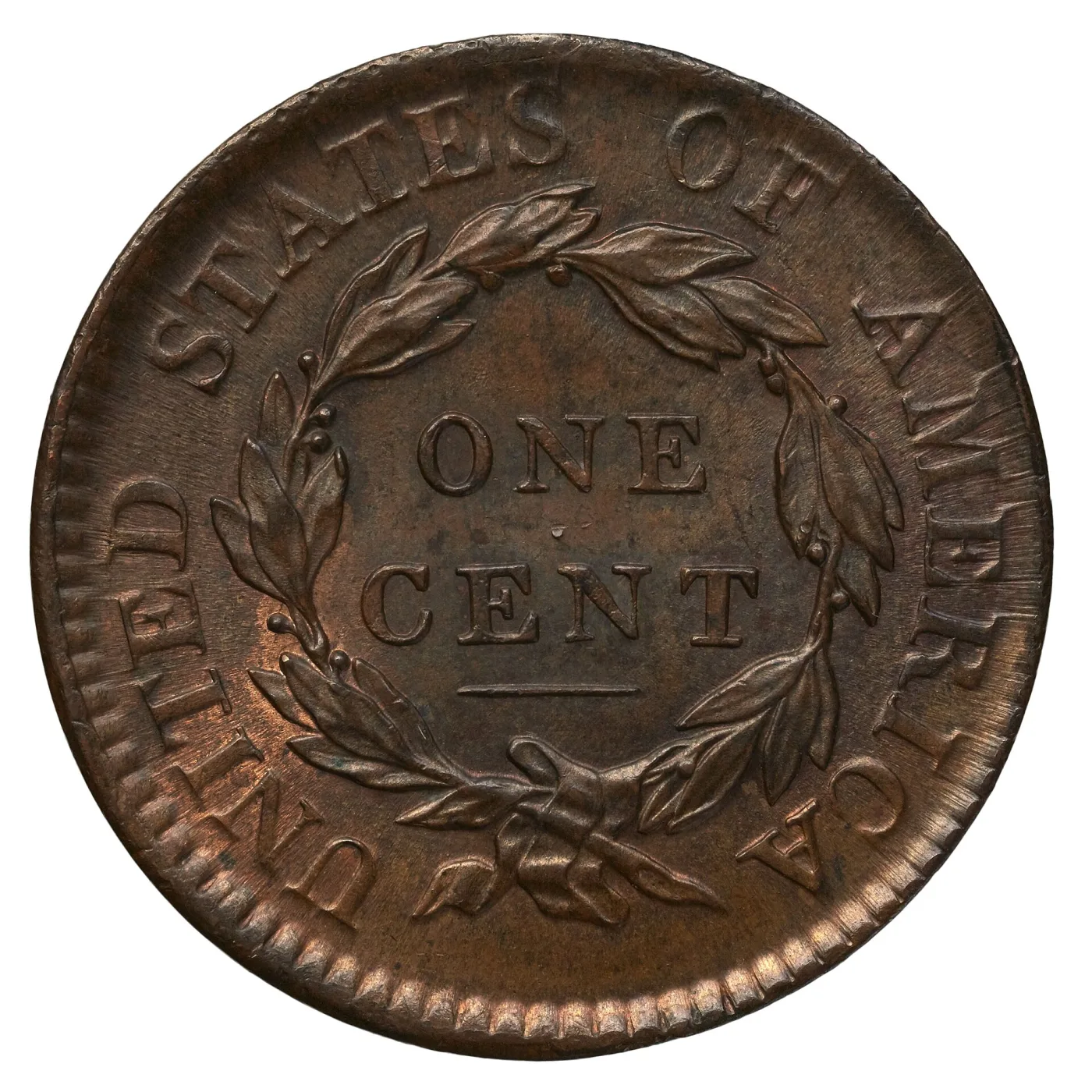
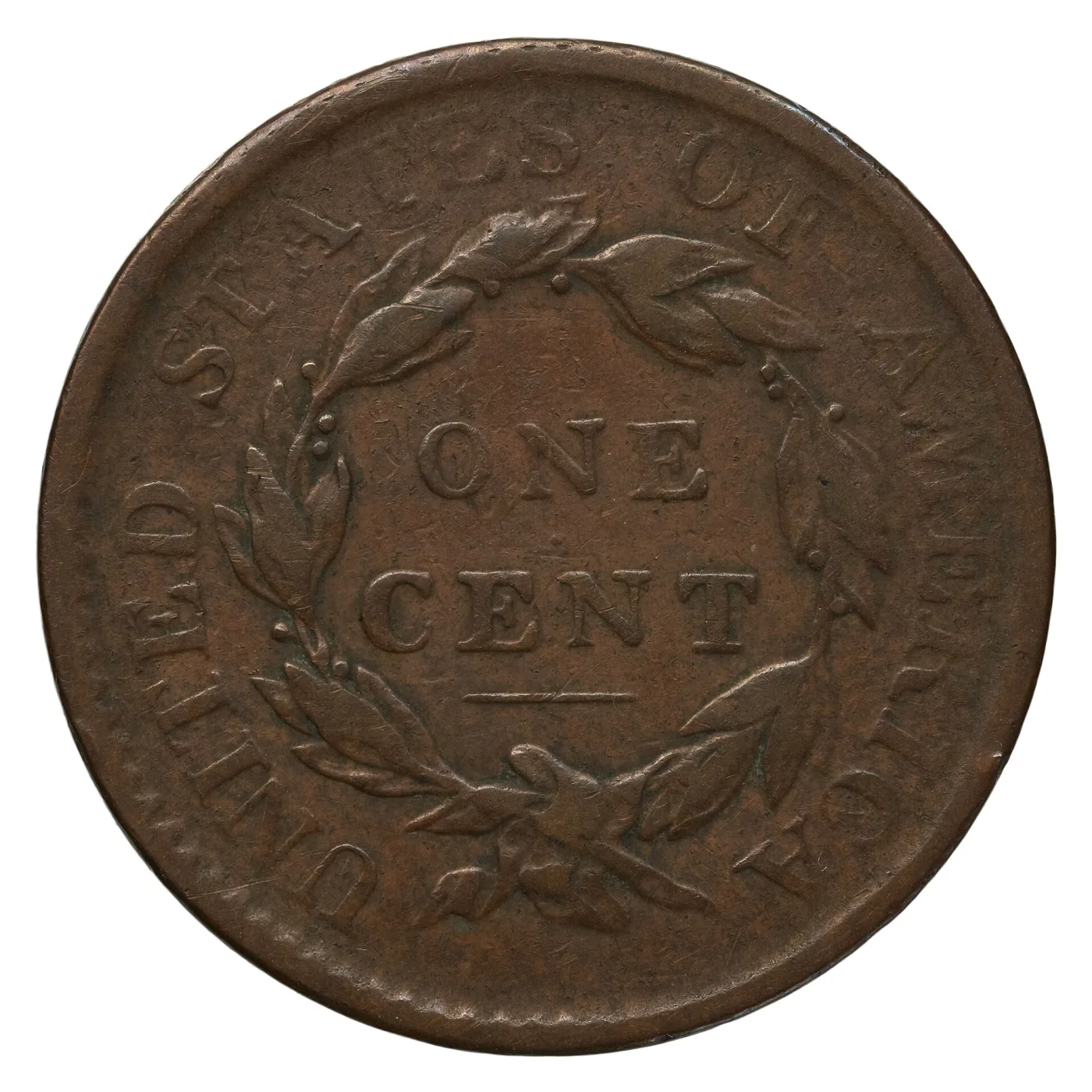
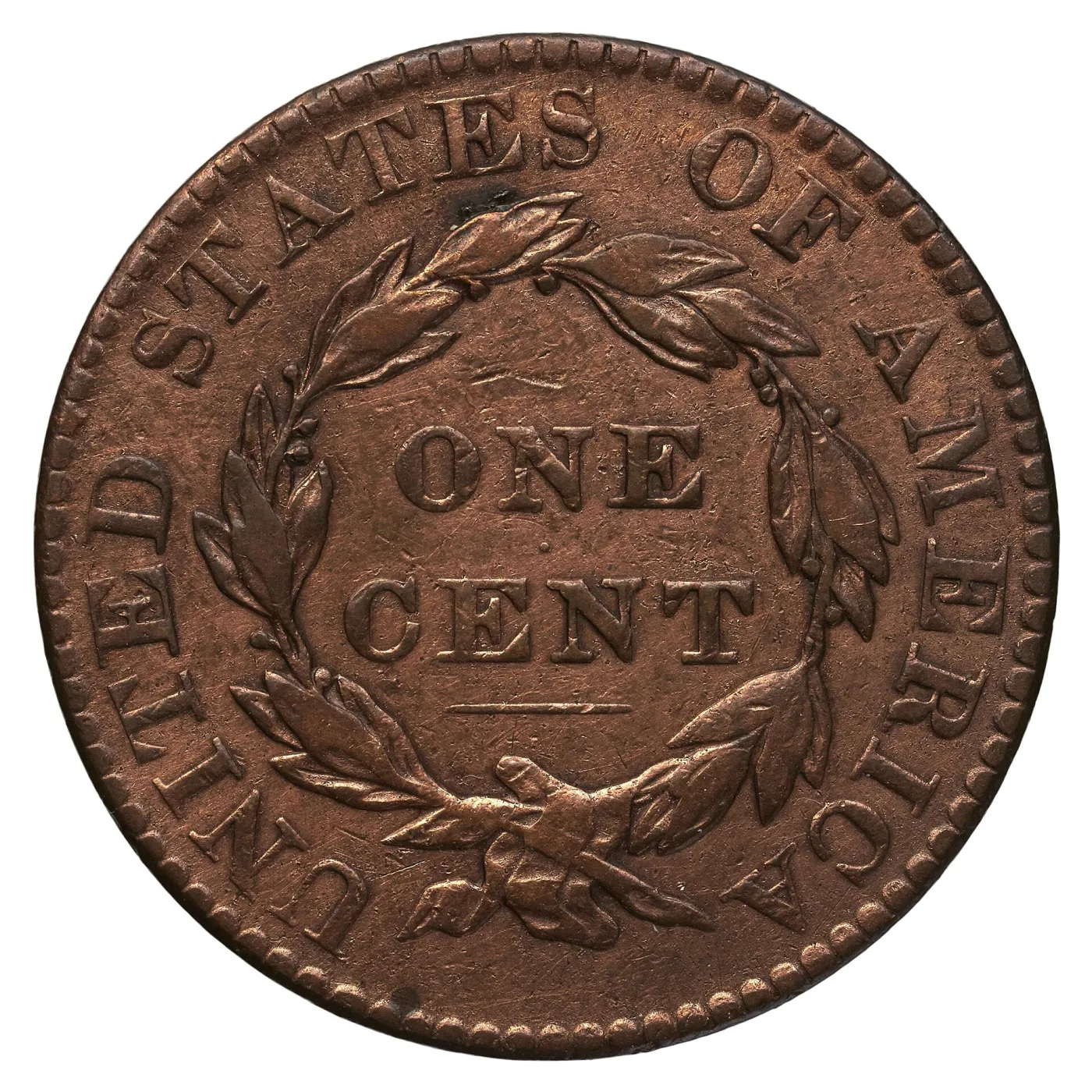
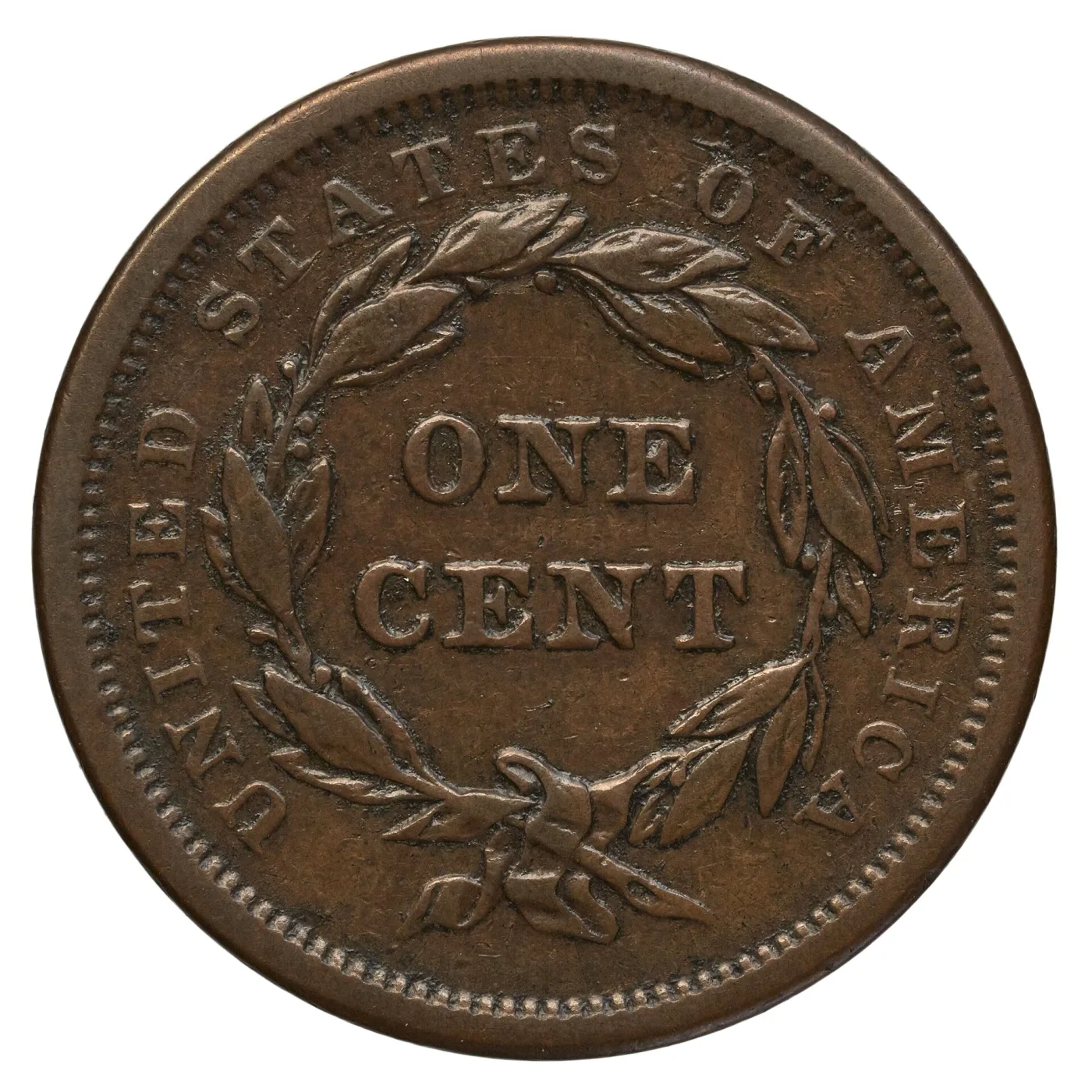
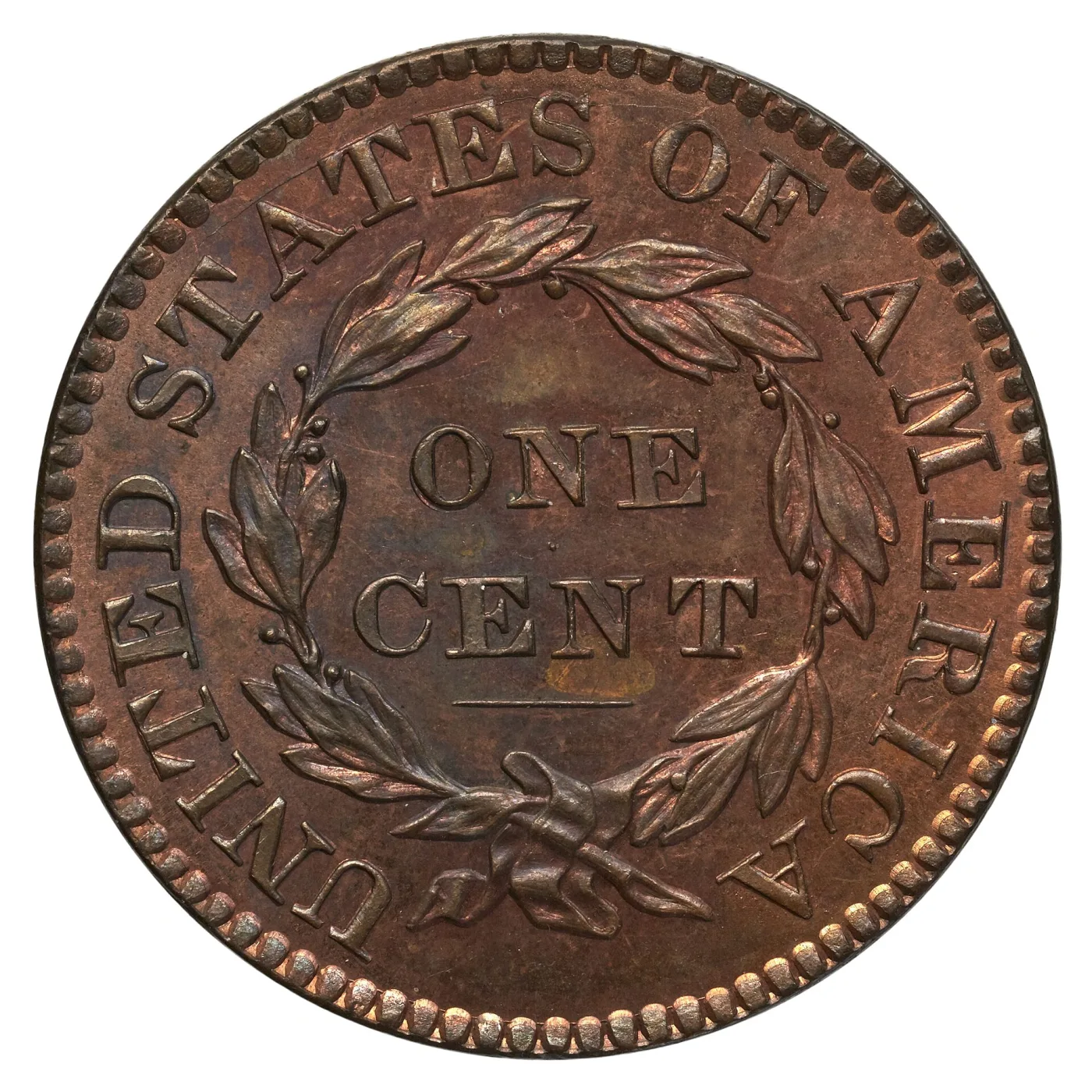
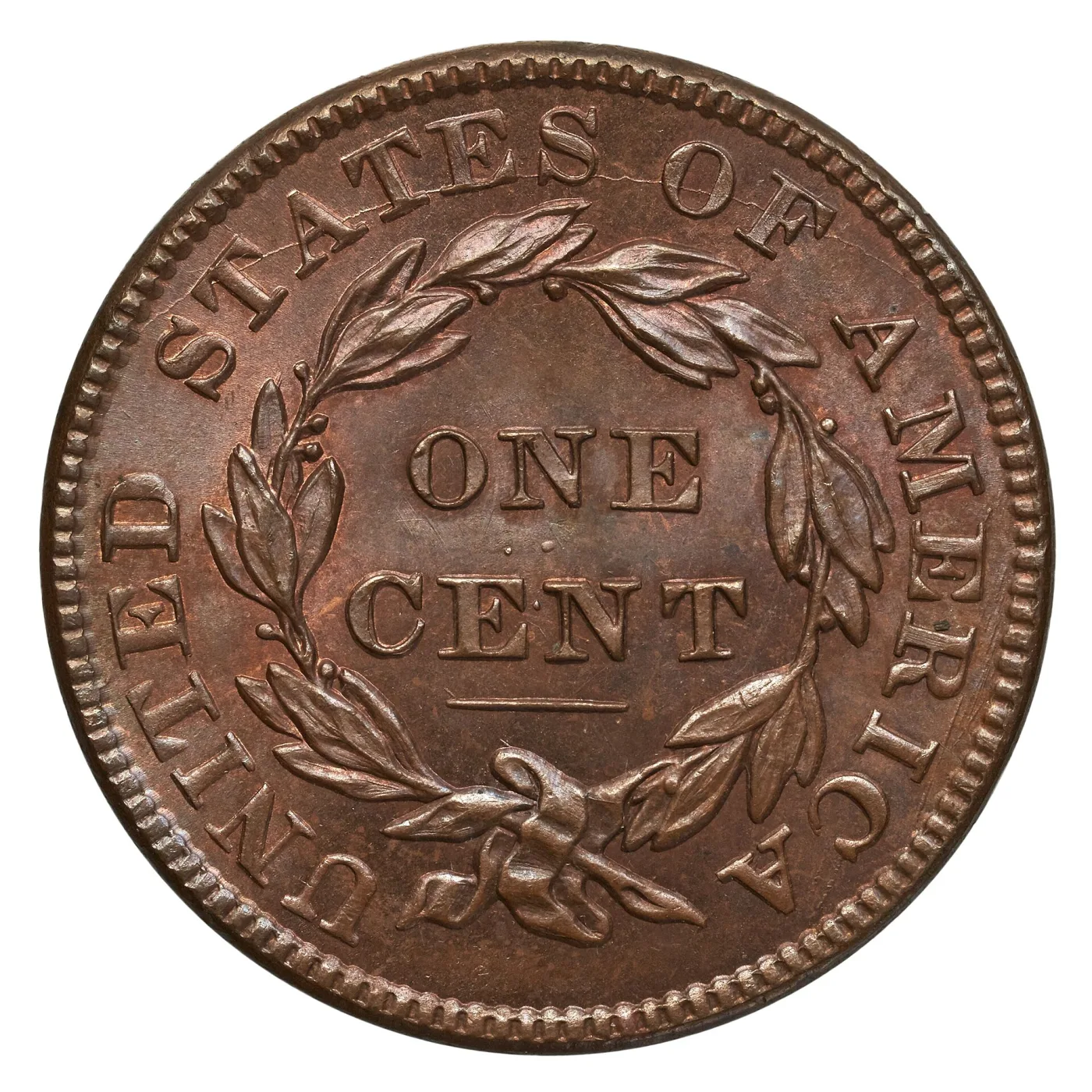
The reverse shows “ONE CENT” inside a continuous wreath tied at the bottom with a ribbon bow, with “UNITED STATES OF AMERICA” arching around the outside. Unlike the very earliest large cents, there is no “1/100” fraction beneath the wreath on this type. The shape of the wreath, the position and size of the letters, and tiny details of the bow and leaves are what variety specialists use to distinguish one die marriage from another.
Edge
The edge is plain (not reeded and not lettered). Earlier large cents of the 1790s sometimes had lettered or decorated edges, but every Coronet Head cent has a plain edge — any large cent of this style with a reeded or lettered edge is either an earlier type or a problem coin.
Diagnostic Quick Identification
To confirm the Coronet Head type versus its neighbors: look for the coronet band reading “LIBERTY” across the brow, combined with the date 1816-1839. The earlier Draped Bust cent (1796-1807) has no coronet — Liberty’s hair is loose and tied with a ribbon, and she faces right. The Classic Head cent (1808-1814) shows Liberty in a headband reading “LIBERTY” but with a distinctly different, broad-faced classical-revival portrait and the date 1808-1814. The later Braided Hair cent (1839-1857) shows a slimmer, younger Liberty with her hair in a tight braid rather than the fuller matron coiffure. The combination of the coronet band, the left-facing matron portrait, and a date between 1816 and 1839 is decisive.
Matron Head vs Modified Coronet Head
Within the 1816-1839 type, catalogers recognize two principal portrait styles. Knowing the difference helps you describe and price coins accurately, though both are universally accepted as the same overarching “Coronet” type.
Matron Head (1816-1835)
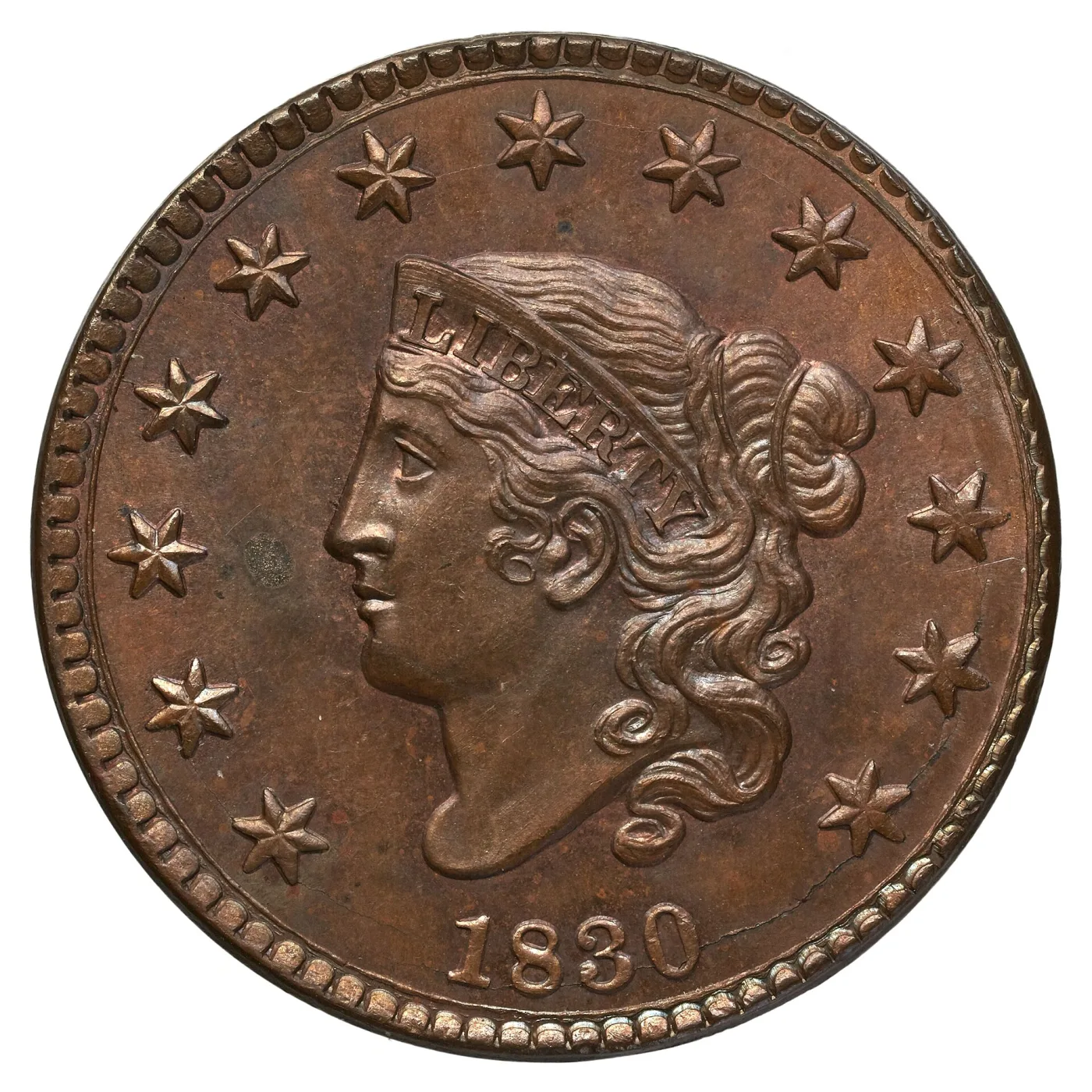
The original portrait, used from 1816 through about 1835, shows a mature, full-faced Liberty — hence the nickname “Matron Head.” The features are heavier and more rounded, the coronet is relatively large, and the overall impression is of an older woman. This is the style most people picture when they think of the 1820s copper cent. The Matron Head era includes all the classic date-collecting dates: the 1816-1820 issues, the famous 1823, and the abundant late-1820s and early-1830s dates.
Modified Coronet Head / “Young Head” (1835-1839)
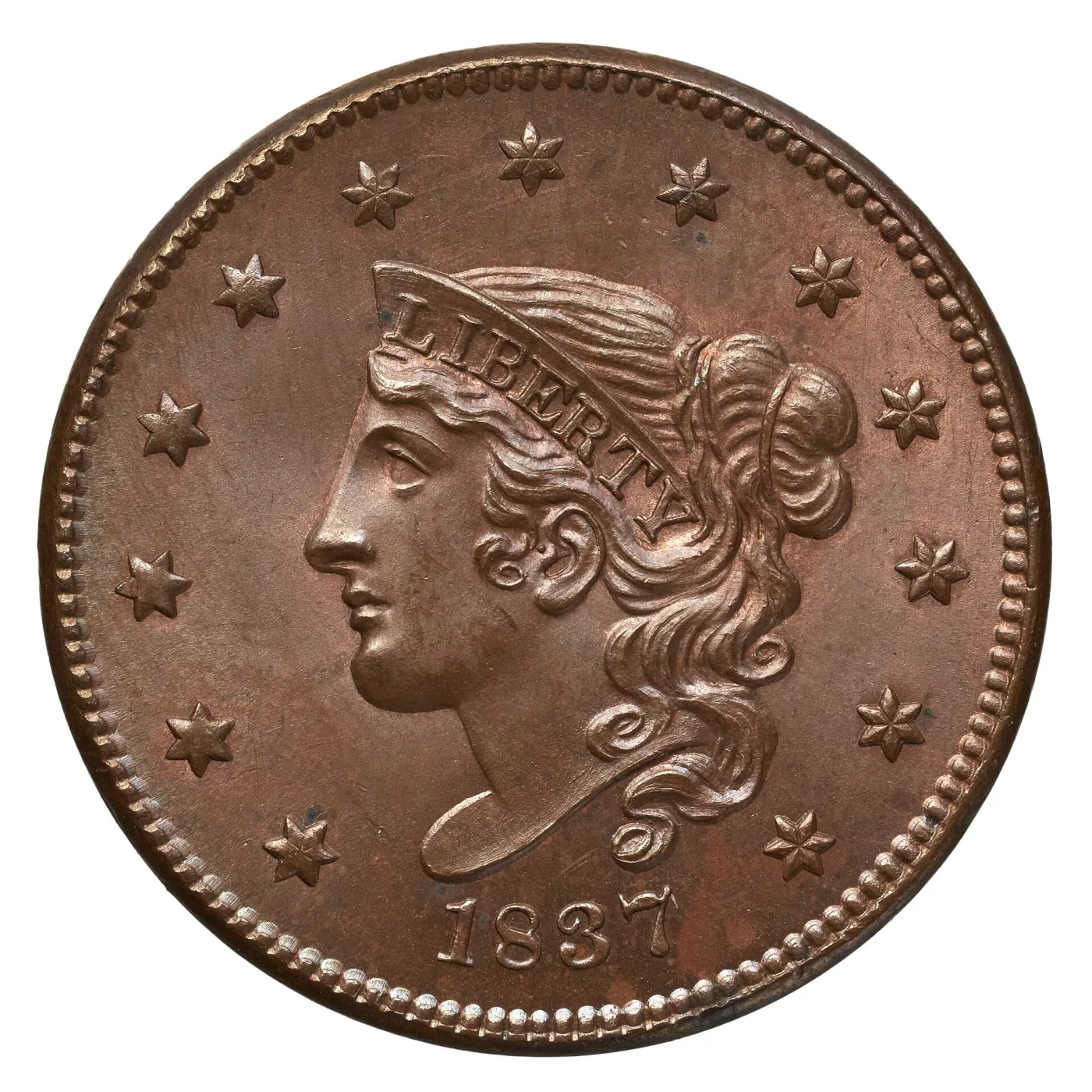
Beginning around 1835, the portrait was reworked into a slimmer, more youthful Liberty, often called the “Modified Matron Head,” “Young Head,” or simply the later “Coronet Head.” The face is less full, the coronet is slightly smaller, and the hair arrangement is tidier. This modification was a stepping-stone toward the fully redesigned Braided Hair portrait of 1839 and later. The 1835-1838 dates are mostly this modified style, and 1839 contains the dramatic transitional varieties discussed below.
How Catalogers Use the Distinction
In day-to-day collecting, both styles are simply “Coronet Head large cents” and fill the same slot in a type set. The Matron-versus-modified distinction matters mainly when attributing Newcomb varieties and when describing the 1835-1839 transition. If you are building a basic date set, you do not need to worry about which portrait sub-style a given date uses; if you are attributing varieties, the portrait style is one of the first things you note.
Composition and Physical Specifications
The Coronet Head Large Cent carries the standard large cent specifications of its era. These figures are essential for authentication, because the coin’s size and weight are difficult for casual counterfeiters to reproduce in the correct metal.
Standard Specifications (1816-1839)
- Composition: ~100% copper (pure copper planchets)
- Weight: 10.89 grams (168 grains)
- Diameter: 28-29 mm (roughly the size of a modern half dollar)
- Edge: Plain
- Mint: Philadelphia only (no mint mark)
- Designers: Robert Scot / John Reich (Matron Head); Christian Gobrecht (modified Coronet and 1839 varieties)
- Years struck: 1816-1839 continuously (no 1815-dated cents exist due to the 1816 Mint fire)
Any coin claimed to be a Coronet Head large cent that weighs significantly outside the roughly 10.0-11.5 gram range, has a diameter far from 28-29 mm, or shows a non-plain edge should be examined for authenticity. The large cent is a big, heavy coin; lightweight brass or zinc replicas feel wrong in the hand and ring differently. Because copper of this era was relatively pure, genuine coins also develop the characteristic mellow brown and chocolate patinas that brass and bronze fakes cannot quite imitate.
Date-by-Date Analysis (1816-1839)
The Coronet Head series was struck every year from 1816 through 1839. Most dates are common, a few are condition rarities, and only the 1823 stands out as a genuine key date. Values below are 2026 retail estimates for problem-free, original-surface examples; cleaned, corroded, or “details” coins trade for substantial discounts.
1816 — First Year
Mintage: 2,820,982. The first Coronet Head cent and a popular first-year type coin. Common in circulated grades and obtainable in Mint State thanks in part to early hoards. Values: G-4 $35, F-12 $60, EF-40 $150, AU-50 $300, MS-63 BN $700.
1817 — 13 Stars and 15 Stars
Mintage: 3,948,400. The 1817 comes in two major varieties: the normal 13 Stars (common) and the scarcer 15 Stars, an engraving error that added two extra stars. The 15 Stars is a popular variety carrying a strong premium. Values (13 Stars): G-4 $30, F-12 $50, EF-40 $130, MS-63 BN $600. The 15 Stars: F-12 $200, EF-40 $700, AU-50 $2,000+.
1818 — Common Date
Mintage: 3,167,000. A common, affordable date well represented by the Randall Hoard, which makes Mint State examples unusually available. Values: G-4 $28, F-12 $48, EF-40 $120, MS-63 BN $450 (Randall Hoard coins keep this date affordable in MS).
1819 — Large Date and Small Date
Mintage: 2,671,000. Comes in Large Date and Small Date varieties, both common. Another date well supplied by the Randall Hoard in high grade. Values: G-4 $28, F-12 $48, EF-40 $120, MS-63 BN $450.
1820 — Large Date and Small Date
Mintage: 4,407,550. Like 1818 and 1819, a Randall Hoard date that is genuinely available in Mint State with original red-brown color. Comes in Large Date and Small Date (with a notable 1820/19 overdate among the Large Dates). Values: G-4 $28, F-12 $48, EF-40 $115, MS-63 BN $400, MS-64 RB $750.
1821 — Scarcer Date
Mintage: 389,000. A genuinely scarcer date with a low mintage; tougher than its neighbors in every grade and quite difficult in Mint State. Values: G-4 $50, F-12 $130, EF-40 $600, AU-50 $1,400, MS-63 BN $4,000+.
1822 — Common Date
Mintage: 2,072,339. A common date available in all circulated grades. Values: G-4 $28, F-12 $50, EF-40 $130, AU-50 $350, MS-63 BN $700.
1823 — The Key Date
Mintage: included in 1824 figures; struck in small numbers. The 1823 is the key date of the series, scarce in all grades and rare in high grade. It exists as a normal date and as the 1823/2 overdate, and both are keys. See the dedicated section below. Values (normal 1823): G-4 $150, F-12 $450, EF-40 $2,500, AU-50 $6,000+, with Mint State examples extremely rare and expensive.
1824 — 1824/2 Overdate and Normal
Mintage: 1,262,000. A moderately scarce date that includes the 1824/2 overdate. Tougher than the common late-1820s dates. Values: G-4 $35, F-12 $80, EF-40 $400, AU-50 $1,000, MS-63 BN $3,500.
1825 — Moderately Scarce
Mintage: 1,461,100. Slightly scarcer than the common dates, particularly in higher grades. Values: G-4 $32, F-12 $70, EF-40 $300, AU-50 $750, MS-63 BN $2,500.
1826 — 1826/5 Overdate and Normal
Mintage: 1,517,425. Includes the 1826/5 overdate. The normal date is moderately common. Values: G-4 $30, F-12 $60, EF-40 $200, AU-50 $500, MS-63 BN $1,500.
1827 — Common Date
Mintage: 2,357,732. A common date available in all grades. Values: G-4 $28, F-12 $50, EF-40 $150, AU-50 $400, MS-63 BN $900.
1828 — Large Date and Small Date
Mintage: 2,260,624. Comes in Large Narrow Date and Small Wide Date varieties, both reasonably available. Values: G-4 $28, F-12 $50, EF-40 $150, AU-50 $425, MS-63 BN $1,000.
1829 — Large Letters and Medium Letters
Mintage: 1,414,500. Reverse letter-size varieties exist. A moderately common date. Values: G-4 $30, F-12 $55, EF-40 $175, AU-50 $475, MS-63 BN $1,200.
1830 — Large Letters and Medium Letters
Mintage: 1,711,500. Common in circulated grades; the Large Letters is the standard variety. Values: G-4 $28, F-12 $50, EF-40 $150, AU-50 $400, MS-63 BN $900.
1831 — Large Letters and Medium Letters
Mintage: 3,359,260. A common, high-mintage date; an excellent choice for an affordable circulated type coin. Values: G-4 $26, F-12 $45, EF-40 $130, AU-50 $350, MS-63 BN $700.
1832 — Large Letters and Medium Letters
Mintage: 2,362,000. Common and affordable in all circulated grades. Values: G-4 $26, F-12 $45, EF-40 $130, AU-50 $350, MS-63 BN $750.
1833 — Common Date
Mintage: 2,739,000. A common date and a popular high-grade type choice. Values: G-4 $26, F-12 $45, EF-40 $130, AU-50 $350, MS-63 BN $700.
1834 — Multiple Star/Date Varieties
Mintage: 1,855,100. Comes with several combinations of large and small stars, dates, and letters that variety collectors pursue. Generally common in circulated grades. Values: G-4 $28, F-12 $48, EF-40 $140, AU-50 $375, MS-63 BN $800.
1835 — Matron and Modified Head
Mintage: 3,878,400. The transition year between the original Matron Head and the modified “Young Head” portrait; both styles exist for 1835. A common, high-mintage date. Values: G-4 $26, F-12 $45, EF-40 $130, AU-50 $350, MS-63 BN $700.
1836 — Modified Coronet Head
Mintage: 2,111,000. Now firmly in the modified “Young Head” style. Common in circulated grades. Values: G-4 $26, F-12 $45, EF-40 $130, AU-50 $350, MS-63 BN $750.
1837 — Plain and Beaded Cords
Mintage: 5,558,300. The highest-mintage date of the series and exceptionally common, with both “Plain Cords” and “Beaded Cords” hair varieties. An ideal affordable type coin in any grade. Values: G-4 $24, F-12 $42, EF-40 $120, AU-50 $325, MS-63 BN $650.
1838 — Common Date
Mintage: 6,370,200. Another very high mintage and one of the most common dates in the series. Values: G-4 $24, F-12 $42, EF-40 $120, AU-50 $325, MS-63 BN $650.
1839 — The Variety Year
Mintage: 3,128,661. The final year of the type and the most fascinating, containing the famous head varieties — Head of 1838, Silly Head, Booby Head, Petite Head, and the 1839/6 overdate — as the Mint transitioned to the Braided Hair design. Values vary widely by variety (see the dedicated section below); the common 1839 styles run G-4 $30, F-12 $55, EF-40 $160, MS-63 BN $800.
The 1823 Key Date and the 1823/2 Overdate
No single date defines Coronet Head collecting like the 1823. It is the one genuine key the series offers, the coin that stands between a collector and a complete date set, and the date most likely to be faked or “restruck.”
Why the 1823 Is Scarce
Very few 1823 cents were struck, and the dies used were prone to failure, so survivors are uncommon in every grade and downright rare in higher grades. Unlike the abundant late-1820s dates, the 1823 simply does not turn up in quantity. Most surviving examples are well worn, and many show the heavy die cracks and “buckled die” appearance characteristic of the failing dies of that year. A problem-free 1823 in Fine or better is a prize in any large cent collection.
The 1823/2 Overdate
The series also includes a famous 1823/2 overdate, in which an 1823 die was punched over a previously dated 1822 die, leaving traces of the underlying “2” beneath the final “3.” Both the normal 1823 and the 1823/2 are scarce keys, and both command strong prices. Attributing whether a given 1823 is the normal date or the overdate requires examining the digits under magnification for the telltale remnants of the underlying numeral.
The 1823 Restrikes
One quirk every collector must know: there are 1823 “restrikes.” In the 1860s, someone (using discarded Mint dies) struck new 1823-dated cents from a rusted obverse die paired with an 1813 Classic Head reverse die. These restrikes are not original Mint products and are easily identified by the heavily rusted, pitted die surface and the mismatched reverse. They are collectible as curiosities but are worth a fraction of a genuine 1823 and must never be confused with the real key date. Any “uncirculated 1823” with a strangely rough, pitted surface should be suspected as a restrike.
Buying an 1823 Safely
Because the 1823 is valuable and frequently altered (commonly by re-engraving the last digit of an 1822 or 1828 to read “1823”), it is one of the dates where third-party certification is strongly recommended. PCGS, NGC, and ANACS will confirm both the date and whether the coin is a genuine business strike, a restrike, or an altered date. For a key-date copper like this, the cost of certification is small insurance against an expensive mistake.

The 1839 Head Varieties: Silly Head, Booby Head & More
The 1839 large cent is the most entertaining single date in American copper, because that year the Mint cycled through several distinct portraits while transitioning from the old Matron/Coronet Head to Gobrecht’s new Braided Hair design. Collectors have given these portraits memorable nicknames, and assembling all of them is a popular sub-collection in its own right. Telling them apart depends almost entirely on the shape of Liberty’s head, the position of the curls, and small details around the truncation of the bust.
Head of 1838 (1839)
The earliest 1839 cents use the same modified Coronet (“Young Head”) portrait carried over from 1838. This is the “Head of 1838” variety — essentially the old style in its final appearance. It is common and serves as the baseline against which the other 1839 heads are compared. Value: similar to a common date, roughly F-12 $55, EF-40 $160, MS-63 BN $800.
Silly Head (1839)
The “Silly Head” gets its nickname from an odd lock of hair and a curious facial expression that struck nineteenth-century collectors as faintly ridiculous. Diagnostically, it shows a distinctive extra curl near the forehead and a slightly altered coronet. It is more sought-after than the common heads and carries a premium. Value: F-12 $120, EF-40 $400, AU-50 $900, MS-63 BN $2,500.
Booby Head (1839)
The “Booby Head” is perhaps the most famous of the group, named for its ungainly, slightly comical portrait in which the shoulder/truncation line is positioned differently and the lowest curl points awkwardly. A key diagnostic is the reverse: the Booby Head is typically paired with a reverse lacking a line under “CENT.” It is a perennial favorite and trades at a premium. Value: F-12 $110, EF-40 $375, AU-50 $850, MS-63 BN $2,200.
Petite Head (1839)
The “Petite Head” (sometimes considered the first appearance of the new, smaller Braided Hair-style portrait, also called the “Type of 1840”) shows a noticeably smaller, slimmer, more youthful Liberty — the design that would carry forward into the 1840-1857 Braided Hair series. It bridges the Coronet Head and Braided Hair types. Value: F-12 $60, EF-40 $180, MS-63 BN $850.
1839/6 Overdate — The Rarity of the Group
The most valuable 1839 variety is the 1839/6 overdate, struck using a leftover 1836-dated die over which an 1839 date was punched (in the Head of 1836/Plain Hair Cords style). It is a major rarity, especially in higher grades, and is one of the most prized varieties in the entire large cent series. Genuine examples in any grade are expensive, and Mint State pieces are extreme rarities. Value: G-4 $1,200, F-12 $3,500, EF-40 $12,000+, with high-grade examples reaching well into five and six figures.
Collecting the 1839 Heads
Many collectors assemble a “set within the set” of all the 1839 head varieties — Head of 1838, Silly Head, Booby Head, and Petite Head — as an affordable and fun project (the 1839/6 overdate being the optional expensive capstone). Because the differences are subtle, a good reference photo or attribution guide is invaluable, and certified examples remove the guesswork. This cluster of varieties is one of the main reasons the Coronet Head series is so beloved by specialists.
The Randall Hoard
One of the most important facts in Coronet Head collecting is the existence of the Randall Hoard — and understanding it explains an apparent paradox: why several scarce-mintage early dates are surprisingly available in Mint State.
What the Hoard Was
The Randall Hoard was a keg of uncirculated large cents, almost all from the early-to-mid 1820s, that surfaced after the Civil War. The story, attached to a dealer named John Swan Randall, holds that a wooden keg of bright new cents was discovered (reportedly under a railroad platform or in a store’s stock) and dispersed into the market in the 1860s and 1870s. The hoard consisted primarily of dates 1816-1820 and 1825-1826, in Mint State condition.
Why It Matters Today
Because of the Randall Hoard, dates like 1818, 1819, 1820, and 1825 are far more available in Mint State than their mintages alone would predict. Many of the uncirculated examples of these dates in collections today trace directly to the hoard. A characteristic feature of Randall Hoard coins is that they were stored in a way that left them with significant spotting and often a streaky red-brown or partially corroded surface — they are uncirculated but not always pretty. A “Randall Hoard cent” is typically an Uncirculated 1818-1820 with telltale dark spots.
Practical Implications for Collectors
The lesson is that mintage figures alone do not predict availability for this series. When budgeting for a high-grade date set, expect the Randall Hoard dates to be relatively affordable in Mint State, while genuinely scarce dates without a hoard — like 1821 and especially 1823 — are far more expensive in equivalent grades. When evaluating an “Uncirculated” early date, the presence of characteristic hoard spotting is a clue to its origin and to fair pricing.
Newcomb Attribution and Major Varieties
Like all early large cents, the Coronet Head series is collected by die variety as well as by date. The standard attribution system is the Newcomb numbering scheme, and learning its basics opens up the deepest and most rewarding level of the series.
Newcomb Numbers
Middle-date large cents (1816-1839) are catalogued under the Newcomb system, from Howard R. Newcomb’s reference United States Copper Cents 1816-1857. Each Newcomb number (N-1, N-2, and so on, per date) identifies a specific die marriage — a particular obverse die paired with a particular reverse die. Some dates have only a handful of Newcomb varieties; others, like 1820 and 1828, have a couple dozen. The Newcomb system is the middle-date counterpart to the Sheldon numbers used for early-date large cents (1793-1814).
How Attribution Works
To attribute a Coronet Head cent to its Newcomb variety, specialists examine the exact placement of the date digits relative to the bust and rim, the position of the stars, any repunching or recutting of the date, the size and style of the reverse letters, the shape of the wreath, and the position of the berries and leaves. Diagnostic die cracks, clash marks, and the die state (early vs late) help pin down not just the marriage but the sequence in which coins were struck. A loupe (7x-10x) and a good reference book or online plate are essential.
The Most Collectible Varieties
- 1817 15 Stars: The famous two-extra-stars engraving variety — the most popular non-overdate variety of the series.
- 1823/2 overdate: A scarce key overdate (covered above).
- 1824/2, 1826/5, 1820/19, 1839/6 overdates: Collectible overdates of varying scarcity, the 1839/6 being a major rarity.
- 1839 head varieties: Silly Head, Booby Head, Petite Head, Head of 1838 (covered above).
- Large/Small Date and Large/Medium Letters varieties: Found on 1819, 1820, 1828, 1829, 1830, 1831, 1832 and others; modest premiums but fun to collect.
EAC and the Specialist Community
The Early American Coppers (EAC) club is the home of large cent variety specialists, and its conventions for grading and attribution differ from the third-party services. EAC collectors typically use Newcomb numbers as a matter of course, grade conservatively (see the grading section), and place a premium on original, uncleaned “EAC color.” For anyone who wants to go deep on the Coronet Head series, the Newcomb reference and the EAC community are the two essential resources.
Grading Coronet Head Large Cents
Grading copper requires assessing both technical wear (Sheldon Scale 1-70) and surface condition (color, planchet quality, eye appeal). For large cents in particular, the EAC grading tradition is notably more conservative than third-party service grading, and originality is prized above raw sharpness.
Key Wear Points
On a Coronet Head cent, the first areas to show wear are the high points of Liberty’s hair above the ear and the curls over the coronet, along with the cheek and the tips of the coronet band. The word “LIBERTY” on the coronet should remain fully legible through Very Fine and better; when “LIBERTY” begins to fade, the coin is dropping into the Fine and Very Good range. On the reverse, the bow knot and the tops of the wreath leaves wear first. The date should remain clear and full down to About Good before the lowest grades.
Color Designations
Mint State copper is graded in three color categories, exactly as with the half cents:
- BN (Brown): Less than 5% original mint red. The most common Mint State color for circulated-era coppers.
- RB (Red-Brown): 5%-95% original mint red. A meaningful premium over BN.
- RD (Red): 95%+ original mint red. Scarce on this series and carrying a large premium; genuine full-red Coronet Head cents are uncommon outside of hoards.
Planchet and Strike Quality
Copper of the 1816-1839 era is generally good, but planchet flaws, laminations, and striking weakness still occur and affect grade and price. Many early dates show some softness at the centers. When grading, weigh the planchet quality and strike alongside wear; a sharply struck coin on a clean planchet is worth a premium over a weakly struck or flawed example of the same technical grade.
EAC vs PCGS/NGC Grading
EAC grades typically run several points — often 5 to 15 points — lower than PCGS/NGC grades for the same coin, because EAC graders deduct heavily for cleaning, corrosion, porosity, and any non-original surface. An EAC “VF-20” may correspond to a PCGS “EF-40.” When buying from EAC dealers, expect conservative numbers but more original coins; when buying certified PCGS/NGC coins, expect higher numbers but always apply your own judgment of surface quality, color, and originality. For a series where cleaned and “improved” coins are everywhere, learning to see original surfaces is the single most valuable grading skill.
Counterfeit Detection and Authentication
The Coronet Head series faces three main authenticity threats: altered dates (especially the 1823 key), the 1823 restrikes, and outright cast or modern struck fakes. Knowing the specifications and the look of original copper is your best defense.
Altered Dates
The classic deception is altering a common date into the rare 1823 — for example, re-engraving the last digit of an 1822, 1828, or 1829 to read “1823,” or tooling an overdate to appear or disappear. Examine the date digits under 10x magnification for irregular spacing, raised tool marks, differences in digit style, or color differences between the digits and the surrounding field. Because the genuine 1823 is so valuable, any 1823 should be authenticated before purchase.
The 1823 Restrikes
As described above, genuine-looking but non-original 1823 “restrikes” were made in the 1860s from a rusted die paired with an 1813 reverse. They show a distinctively rough, pitted, heavily rusted surface and a mismatched reverse. They are not counterfeits in the criminal sense — they are collectible curiosities — but they are worth far less than an original 1823 and must be identified as restrikes, not sold as genuine business strikes.
Cast and Modern Counterfeits
Cast counterfeits show surface pitting (the casting “orange peel” texture), softened detail, and often a seam along the edge, and they tend to weigh light because cast copper is less dense than struck copper. Modern struck replicas are frequently made in brass or plated base metal, weigh incorrectly, and may bear “COPY” as required by U.S. law since 1973. Always check weight on a digital scale (target ~10.89 g) and inspect the edge and surface texture before believing a too-good-to-be-true find. The big, heavy, mellow-brown look of a genuine large cent is hard to fake convincingly.
Third-Party Certification
For any Coronet Head large cent worth more than a few hundred dollars — and especially for the 1823, the 1839/6 overdate, the 1817 15 Stars, and any high-grade red example — certification by PCGS, NGC, or ANACS is strongly recommended. For the rarities, certification is effectively required for resale, both to confirm authenticity and to settle the original/restrike and date-attribution questions. Keep the conservative EAC net-grading tradition in mind when evaluating problem coins, since a “details” coin trades at a steep discount.
Current Market Values
Coronet Head Large Cent values depend on date, variety, grade, color, and — above all — originality of surface. The figures below are 2026 retail estimates for problem-free, original-surface coins; cleaned, corroded, or “details” coins trade at 30%-70% discounts, while exceptional examples can bring strong premiums at auction.
Common Dates (1816, 1818-1820, 1827-1838)
- G-4: $24-$35
- F-12: $42-$60
- EF-40: $115-$160
- AU-50: $325-$425
- MS-63 BN: $650-$1,000
- MS-64 RB: $1,200-$2,000 (scarcer with color)
Scarcer Dates (1821, 1824, 1825, 1826)
- G-4: $30-$50
- F-12: $60-$130
- EF-40: $200-$600
- AU-50: $500-$1,400
- MS-63 BN: $1,500-$4,000+
Key Date (1823 and 1823/2)
- G-4: $150-$200
- F-12: $400-$500
- EF-40: $2,200-$3,000
- AU-50: $5,000-$7,000
- Mint State: extremely rare, five to six figures
Premium Varieties
- 1817 15 Stars: F-12 $200, EF-40 $700, AU-50 $2,000+
- 1839 Silly Head / Booby Head: F-12 $110-$120, EF-40 $375-$400, MS-63 BN $2,200-$2,500
- 1839/6 Overdate: G-4 $1,200, F-12 $3,500, EF-40 $12,000+, high grades far higher
Note: full-red (RD) Mint State examples of any date are scarce on this series and command large premiums over the red-brown and brown figures above. The Randall Hoard dates (1818-1820, 1825) are the exception that remains relatively affordable in Mint State.
Collecting Strategies
The Coronet Head Large Cent supports a wide range of approaches, from a single affordable type coin to an advanced Newcomb-variety specialty. It is one of the best “scalable” series in U.S. numismatics.
Type Set
The simplest goal is a single Coronet Head large cent to represent the type in a large cent type set or a broader U.S. type collection. The high-mintage common dates — 1837, 1838, 1831-1833 — are the standard choices because they are abundant and inexpensive in every grade. Budget: $25-$160 for a circulated example, $650-$2,000 for Mint State depending on color. A single coin from this type pairs naturally with one each of the Chain, Wreath, Liberty Cap, Draped Bust, Classic Head, and Braided Hair types for a complete large cent type set.
Date Set (1816-1839)
A complete date set of the Coronet Head series — one coin for each year from 1816 through 1839 — is one of the most popular and achievable goals in early American copper. Every date except the 1823 is readily available, so the project is mostly a matter of patience and budget, with the 1823 as the one real hurdle. Budget for a circulated (Good-to-Fine) date set: roughly $1,200-$2,500, the bulk of which is the 1823. For an EF-grade set, plan on $6,000-$10,000+. This is a classic “first complete series” for a collector graduating from modern coins.
Variety Set (Newcomb)
For specialists, attributing and collecting Newcomb varieties turns the series into a lifetime pursuit. Some collect all varieties of a single favorite date; others chase the named varieties (15 Stars, the overdates, the 1839 heads); the most advanced attempt a complete Newcomb set. This is where the Coronet Head series reveals its full depth — and where membership in the EAC community pays dividends.
The 1839 Head Set
A focused and fun mini-project is collecting all the 1839 head varieties: Head of 1838, Silly Head, Booby Head, and Petite Head (with the 1839/6 overdate as an optional capstone). It is affordable, visually interesting, and a great introduction to variety attribution.
Where Coronet Head Fits in a Broader Collection
Many collectors pursue the Coronet Head cent alongside the contemporary copper half cents — the Classic Head and Braided Hair half cents — and the broader copper series, building a complete “type table” of U.S. coppers. Because Christian Gobrecht’s hand shaped the late portraits here and across the silver coinage, some collectors connect the Coronet Head cent to the broader Gobrecht-era federal series, from the Seated Liberty dime and Seated Liberty quarter to the Coronet gold issues. Beginners often start with the general coin identification guide before specializing in early copper, then narrow into the large cent series as a whole.
Storage and Preservation
Copper is the most chemically reactive of the common coinage metals, and large cents — particularly the higher-grade and red-brown examples — require careful handling to preserve their value. The principles here apply to all early copper.
Never Clean Copper
Cleaning copper destroys natural patina and microscopic surface detail, and it is the single most common way collectors destroy value. Cleaned coins are described as “harshly cleaned,” “lightly cleaned,” or “polished” and receive “details” grades from PCGS and NGC, trading at 30%-70% discounts to original-surface examples. Specialists prize natural “EAC color” — the mellow brown and chocolate tones original copper develops over time. Even an unattractive original-color coin is worth more than a bright, cleaned coin of the same technical grade.
Avoid PVC and Plasticizers
PVC (“polyvinyl chloride”) flips and album pages leach plasticizers that react with copper to form a green slime on the surface — one of the most common disasters for copper collections inherited from earlier generations. Move any coin out of PVC flips immediately and store it in inert Mylar, acid-free paper envelopes, or hard plastic capsules.
Humidity Control
High humidity accelerates copper corrosion and spotting (the very fate that befell many Randall Hoard coins). Store copper coins at relative humidity below 50%, ideally 30%-40%, and keep silica gel packets in the storage container. Avoid basements, attics, and garages, where humidity swings dramatically with the seasons and where copper “disease” can take hold.
Long-Term Storage
For valuable copper, certified PCGS or NGC holders provide an inert sealed environment and are strongly recommended for high-grade and red-brown examples and for all key dates. Raw coins should be kept in acid-free, sulfur-free paper envelopes inside Mylar flips, or in inert hard plastic capsules. Inspect stored coins annually for new spotting or color change, and address any active problem immediately — early copper that has begun to “bleed” green needs prompt attention.
Frequently Asked Questions
What is a Coronet Head Large Cent worth in 2026?
Common dates (1816, 1818-1820, 1827-1838) retail for about $24-$60 in circulated grades and $650-$2,000 in Mint State depending on color. Scarcer dates like 1821, 1824, and 1825 run higher. The 1823 key date is worth $150-$500 even well worn and several thousand dollars in EF or better. Premium varieties — the 1817 15 Stars, the 1839 Silly Head and Booby Head, and especially the 1839/6 overdate — carry significant premiums.
What is the difference between the Matron Head and the Coronet Head?
They are two sub-styles of the same 1816-1839 type. The Matron Head (1816-1835) shows a mature, full-faced Liberty; the modified Coronet or "Young Head" (1835-1839) shows a slimmer, more youthful Liberty as the design moved toward the Braided Hair style. Both wear the coronet band reading "LIBERTY" and fill the same slot in a type set. The distinction matters mainly for variety attribution and for describing the 1835-1839 transition.
Why is the 1823 cent the key date?
Very few 1823 cents were struck, and the dies failed quickly, so survivors are scarce in all grades and rare in high grade. Both the normal 1823 and the 1823/2 overdate are keys. Beware of altered dates (common dates re-engraved to read "1823") and the 1860s "restrikes" struck from a rusted die with a mismatched 1813 reverse — neither is a genuine original. Certification is strongly recommended for any 1823.
What are the 1839 Silly Head and Booby Head?
They are nicknamed portrait varieties produced in 1839 as the Mint transitioned from the Coronet Head to the Braided Hair design. The Silly Head has an odd extra curl and expression; the Booby Head has an ungainly portrait and is usually paired with a reverse lacking a line under "CENT." Both carry premiums over common 1839 cents. The 1839 also includes the Head of 1838, the Petite Head, and the rare 1839/6 overdate.
What is the Randall Hoard?
The Randall Hoard was a keg of uncirculated large cents — mostly dates 1816-1820 and 1825-1826 — that surfaced after the Civil War and was dispersed in the 1860s-1870s. It is the reason several early dates are surprisingly available in Mint State today, though hoard coins often show characteristic spotting. Mintage figures alone do not predict availability for this series because of the hoard.
Are Coronet Head Large Cents made of pure copper?
Yes. Every Coronet Head large cent from 1816-1839 is essentially 100% copper, weighing about 10.89 grams and measuring 28-29 mm across — roughly the size of a modern half dollar. There are no silver, gold, or clad large cents. Any "large cent" in brass or a non-copper alloy, or one that weighs far from 10.89 g, is a counterfeit or modern replica.
Why are there no 1815 large cents?
A fire at the Philadelphia Mint in early 1816 destroyed the machinery used to make planchets, and the leftover Classic Head dies and the new Coronet dies bridged the gap such that no cents bear the date 1815. The 1815 gap is a well-known quirk of the large cent series and marks the transition from the Classic Head to the Coronet Head type.
How are Coronet Head cents attributed by variety?
Middle-date large cents (1816-1839) are attributed using the Newcomb numbering system (N-1, N-2, etc., per date) from Howard Newcomb's reference. Specialists examine the date placement, star positions, repunching, reverse letter sizes, wreath details, and die cracks under magnification. This is the middle-date counterpart to the Sheldon numbers used for the earlier Draped Bust and Classic Head cents.
Should I clean my dirty Coronet Head cent?
Never. Cleaning copper destroys original patina and surface detail and removes 30%-70% of the coin's value, earning it a "details" grade. Collectors prize natural "EAC color." Even an unattractive original-color coin outvalues a bright, cleaned coin of the same technical grade. If a coin has active green corrosion, consult a specialist rather than attempting to clean it yourself.
How does the Coronet Head cent relate to the other large cent types?
It is the fifth of the six large cent design types, following the Flowing Hair (Chain and Wreath), Liberty Cap, Draped Bust, and Classic Head designs, and preceding the final Braided Hair type of 1839-1857. A complete large cent type set requires one coin of each design. For an overview of the whole series, see the large cent identification guide.
Can I find Coronet Head Large Cents in circulation today?
No. Large cents were discontinued in 1857 and have been out of circulation for well over 165 years. They are found only through coin dealers, auctions, estate sales, and inherited collections, and are not legal tender for current transactions.