Draped Bust Large Cent Identification Guide: Sheldon Varieties, 1799 & 1804 Key Dates, Reverse Styles, EAC Grading & Values
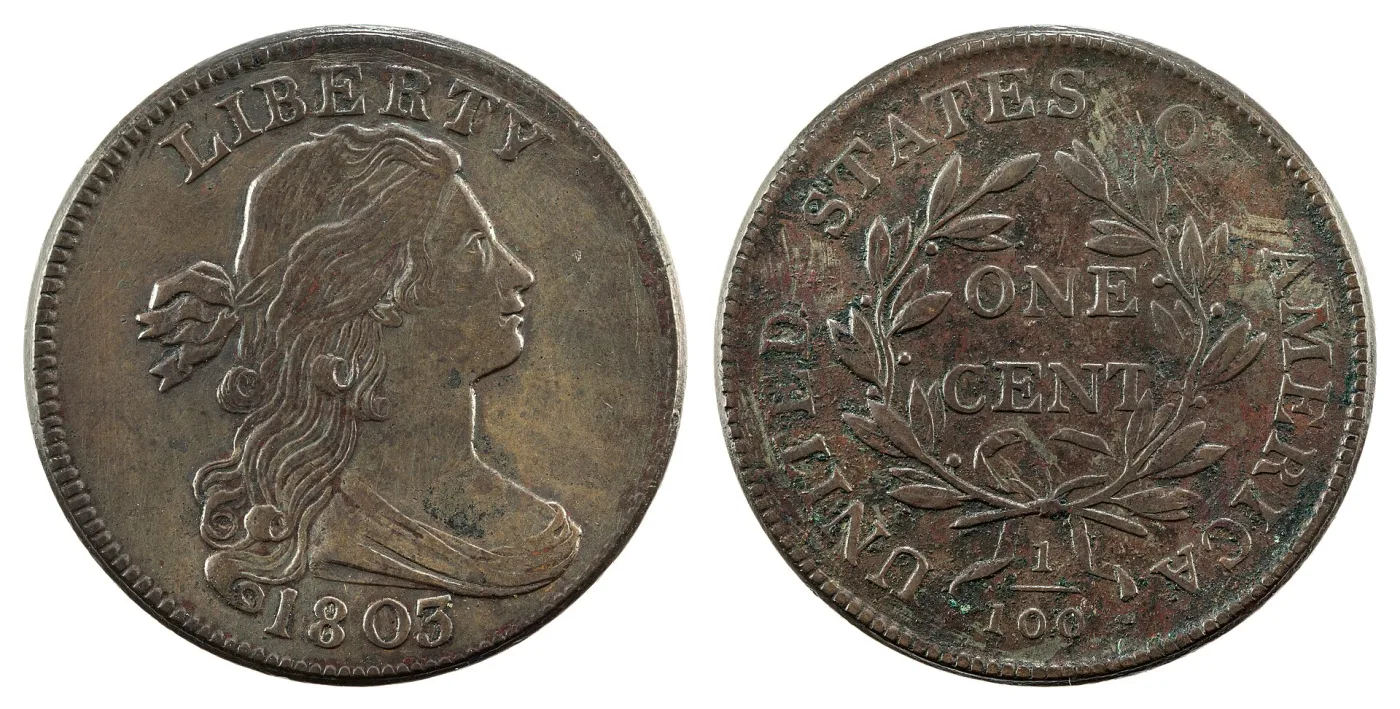
The Draped Bust Large Cent is the third major design type of America’s first one-cent coin, struck at the Philadelphia Mint from 1796 through 1807. Larger than a modern quarter at nearly 29 mm of pure copper, it carries the graceful Draped Bust portrait of Liberty that Robert Scot adapted from a Gilbert Stuart drawing — the same Liberty that appears, scaled down, on the contemporary half cent, dime, quarter, half dollar, and silver dollar. For collectors of early American copper, the Draped Bust cent sits at the very heart of the hobby: abundant enough to be collectible, yet riddled with rare die varieties, overdates, and famous blunders that reward a sharp eye.
These coins were struck during the Mint’s chaotic infancy, when planchets were rolled and cut by hand, dies were engraved one at a time, and economy demanded that every working die be used until it shattered. The result is a series that early-copper specialists describe as endlessly deep: more than a hundred distinct die marriages, a celebrated rarity in the 1799, and the iconic 1804 with its broken obverse and reverse dies. Almost every Draped Bust cent tells a story about how money was made before machinery took over, and learning to read those stories is what draws so many collectors into “EAC” collecting.
This guide is your complete 2026 reference for identifying, attributing, grading, authenticating, and valuing Draped Bust Large Cents. You will learn how to separate this type from the earlier large cent sub-types that came before it and the Classic Head cent that followed, how to read the different reverse wreath styles, why 1799 and 1804 are the great key dates, how the Sheldon numbering system works, how copper specialists grade and color-evaluate these coins, and what every date is worth today.
Overview & Historical Background
The cent was authorized by the Coinage Act of 1792 as the workhorse of the new United States monetary system. The Mint struck its first cents — the famous Chain and Wreath cents — in 1793, quickly followed by the Liberty Cap type. By 1796, the Mint retired the Liberty Cap motif on both the cent and the half cent and adopted the Draped Bust portrait, which had debuted on the silver dollar in 1795 and was gradually spreading across the entire denomination lineup to create a unified national coinage.
The Draped Bust Large Cent therefore belongs to a coherent design era. The same Liberty appears on the contemporary Draped Bust dollar, on the Draped Bust dime and quarter, and on the tiny Draped Bust half cent. Collectors who admire the Draped Bust aesthetic on the silver coins often find the big copper cent the most affordable and characterful way to own the design in substantial size.
Why Production Was So Irregular
Unlike the half cent, the large cent was genuinely needed in commerce — but copper supply, planchet quality, and Mint capacity were all unreliable in the 1790s and early 1800s. Mintages swung from a few tens of thousands to over a million depending on the year. A disastrous 1799 saw almost no cents struck for circulation, creating the series’ most famous date rarity. Many coins were struck on defective planchets imported from Boulton & Watt in England, and dies were pushed far past their useful life, producing the dramatic die cracks and “die states” that variety collectors prize.
Robert Scot, John Smith Gardner, and the Draped Bust Portrait
Robert Scot, the Mint’s first chief engraver, executed the Draped Bust design based on a drawing attributed to portraitist Gilbert Stuart. His assistant John Smith Gardner is credited with engraving several of the early Draped Bust cent dies. The motif shows Liberty facing right, her hair flowing loosely and tied back with a ribbon, with drapery across the bust — the feature that gives the type its name. This is the key point of distinction from the Classic Head type that followed in 1808, where Liberty wears a beaded headband across her forehead.
Design Features & Diagnostics
Confident type identification starts with knowing exactly what to look for on both faces of the coin. The Draped Bust Large Cent has a distinctive look that, once learned, is unmistakable even on a heavily worn example.
Obverse (Front)
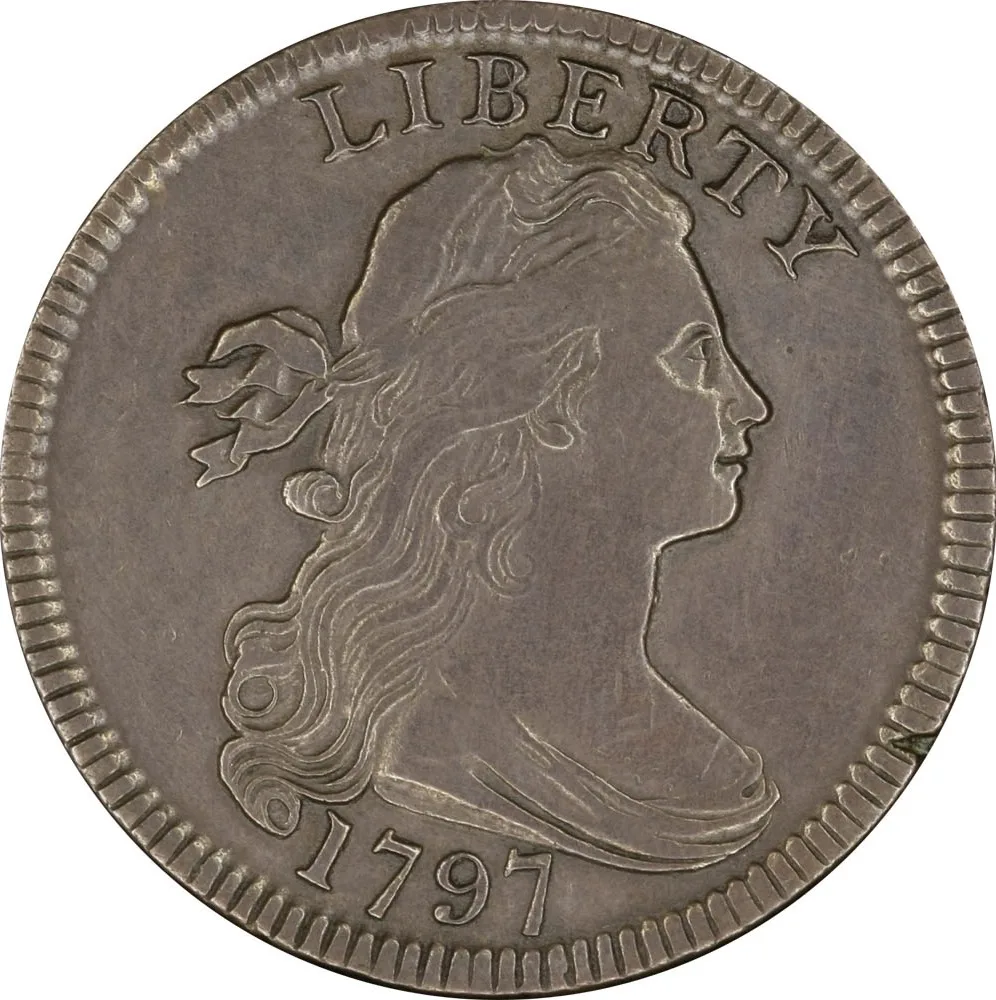
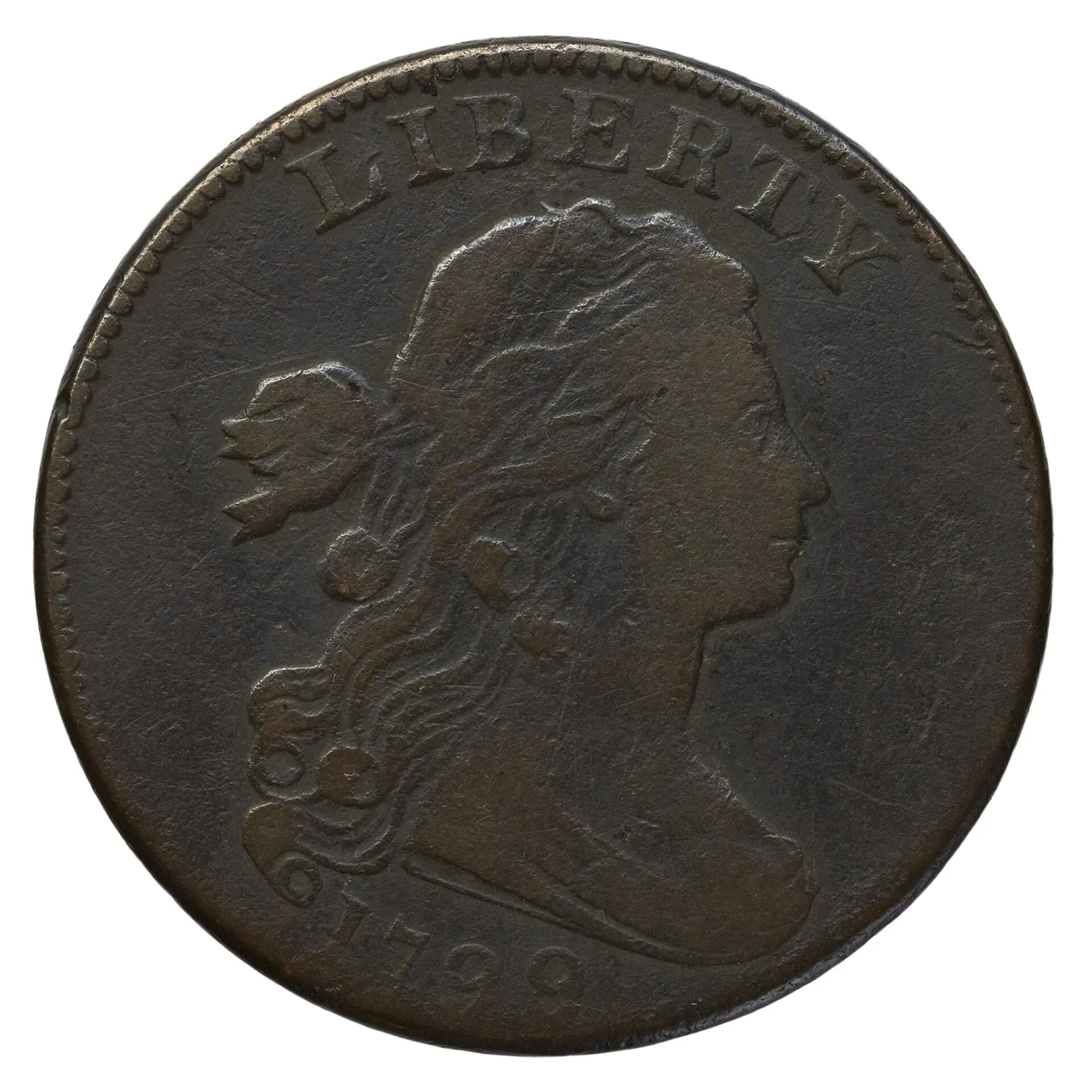
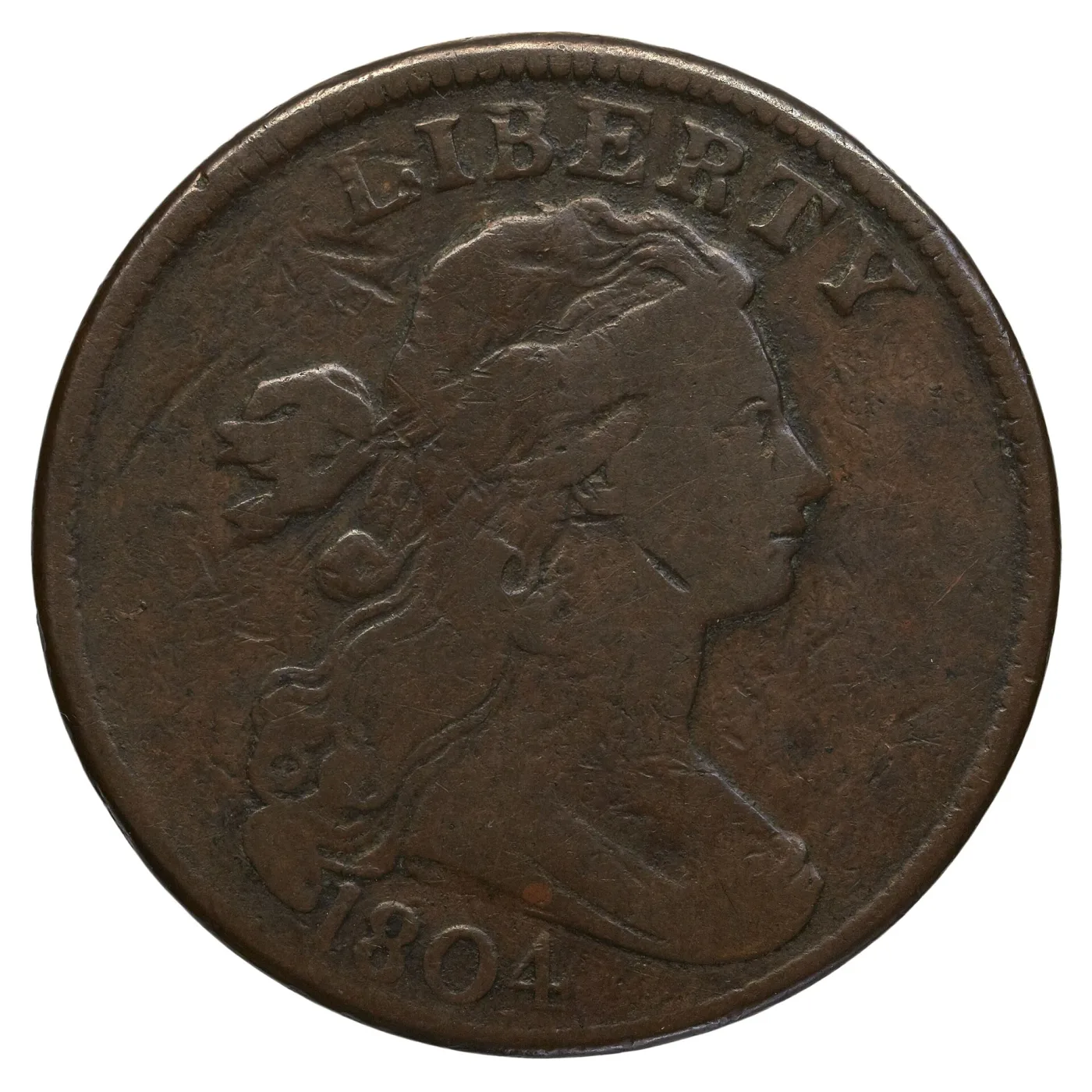
The obverse shows Liberty facing right with flowing hair tied back by a ribbon and drapery draped across the truncation of the bust. The word “LIBERTY” arches above the head in raised letters, and the date appears below the bust. There are no stars on the Draped Bust cent obverse — a useful quick check, since the later Classic Head and Coronet cents are also star-free, but the earlier Liberty Cap cent and the silver coins of the era handle stars and devices differently. Unlike the Liberty Cap type, there is no cap on a pole; unlike the Classic Head type, there is no inscribed headband.
Reverse (Back)
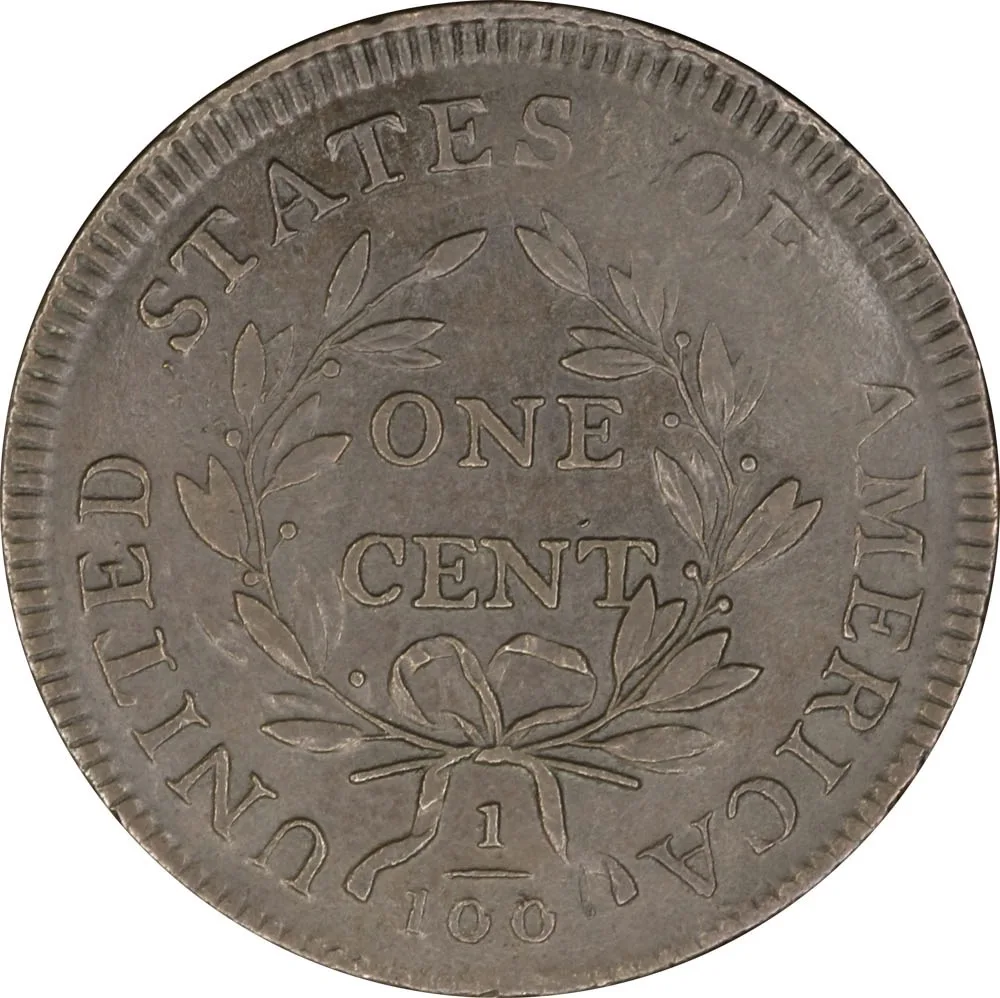
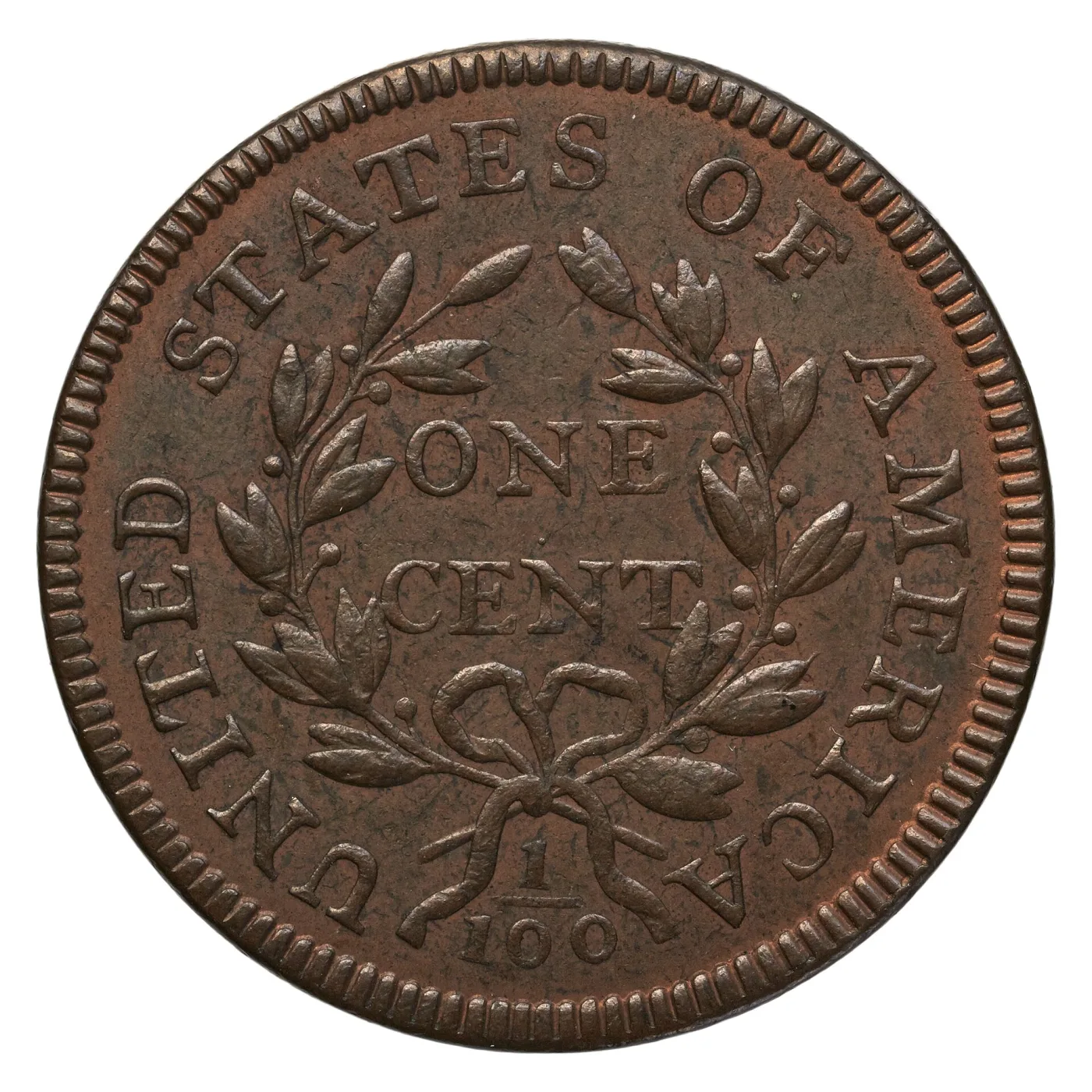
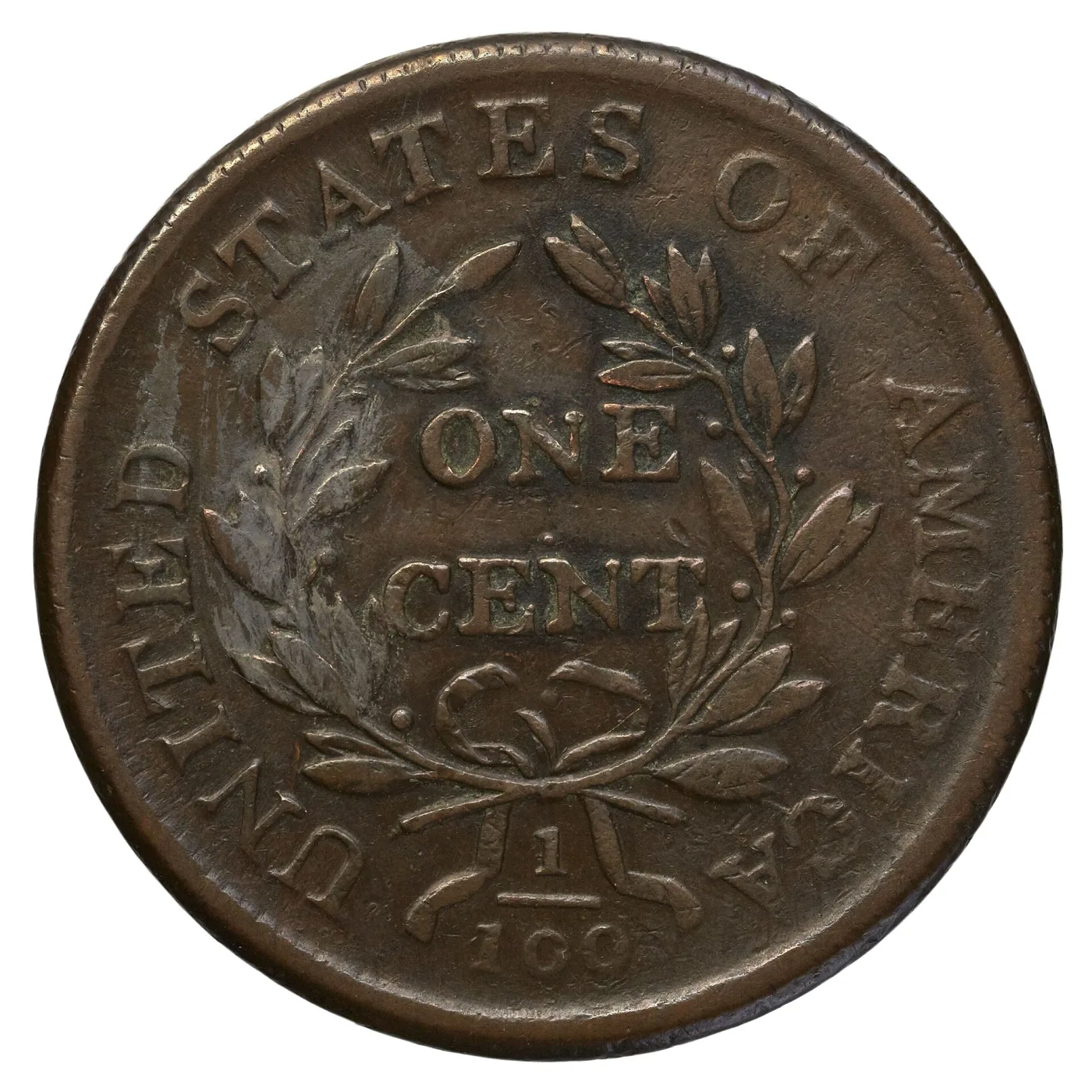
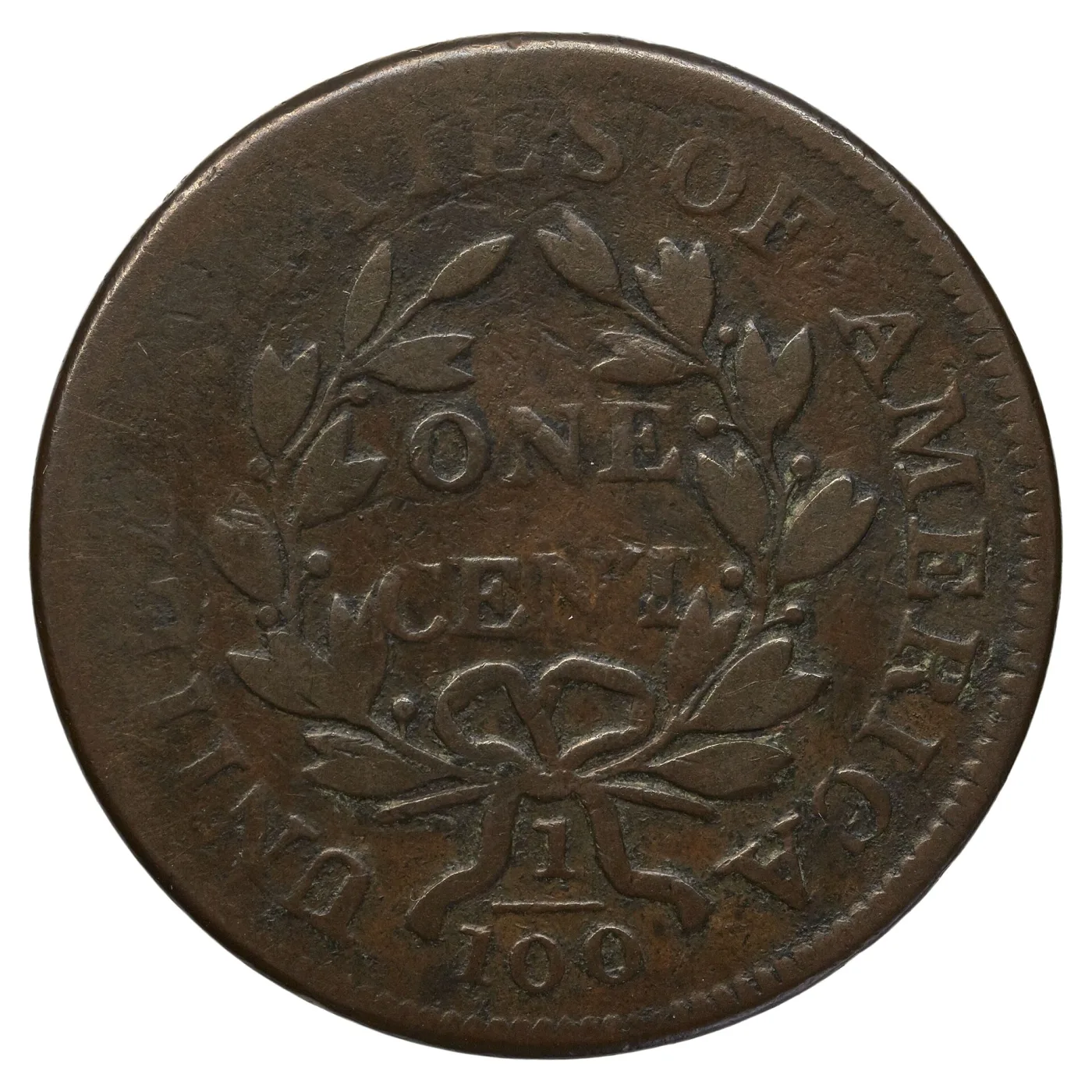
The reverse displays the words “ONE CENT” inside an open wreath tied with a ribbon bow at the bottom, with “UNITED STATES OF AMERICA” arching around the rim. Below the wreath bow appears the fraction “1/100,” indicating the coin’s value as one one-hundredth of a dollar. The edge is lettered on most issues, reading “ONE HUNDRED FOR A DOLLAR.” The exact style of the wreath, the leaves, and the fraction changed several times during the type and forms the basis of the major reverse varieties discussed below.
Both faces of a single 1797 cent, sharp enough to check every feature named above without a loupe.
Quick Type Confirmation
To confirm you have a Draped Bust Large Cent rather than a neighboring type: check the portrait first. Flowing hair with a ribbon and bust drapery, plus “LIBERTY” as arched letters and no headband, equals Draped Bust. A Phrygian liberty cap on a pole means you have the earlier Liberty Cap cent. A wide beaded forehead band means the later Classic Head. Then confirm the date falls in the 1796-1807 window and that the reverse reads “ONE CENT” with a “1/100” fraction.
Specifications & Composition
The physical specifications of the Draped Bust Large Cent are essential for authentication, because counterfeits and altered coins frequently miss the correct weight or diameter.
Standard Specifications
Composition: 100% copper (pure copper, no alloy). Weight: 168 grains, approximately 10.89 grams. Diameter: approximately 29 mm (varies slightly, roughly 27-29 mm across the type). Edge: lettered, “ONE HUNDRED FOR A DOLLAR” (a small number of late issues approach the plain edge of the next era). Designer: Robert Scot, with John Smith Gardner. Mint: Philadelphia (no mint mark). Years struck: 1796, 1797, 1798, 1799, 1800, 1801, 1802, 1803, 1804, 1805, 1806, 1807.
Planchet Quality
Early Mint planchets were rolled and cut from copper of variable quality, including imported English planchets later in the period. Expect to see frequent lamination cracks, planchet voids, dark spots, and “adjustment marks” — file lines added before striking to bring an overweight planchet down to legal weight. These are normal for the type and do not necessarily indicate damage, though heavy roughness or porosity lowers eye appeal and value.
Color matters enormously for copper. Original mint-red coins are extremely rare for this early period; the overwhelming majority of survivors are brown, with the occasional glossy red-brown example commanding a strong premium. Recognizing original surfaces versus recolored, cleaned, or corroded copper is a skill we cover in the grading and authentication sections below — the same skills that apply across all large cent sub-types of the era.

Date-by-Date Guide (1796-1807)
The Draped Bust Large Cent series spans twelve consecutive years. Understanding each year’s character helps you set expectations for availability, variety richness, and price.
1796
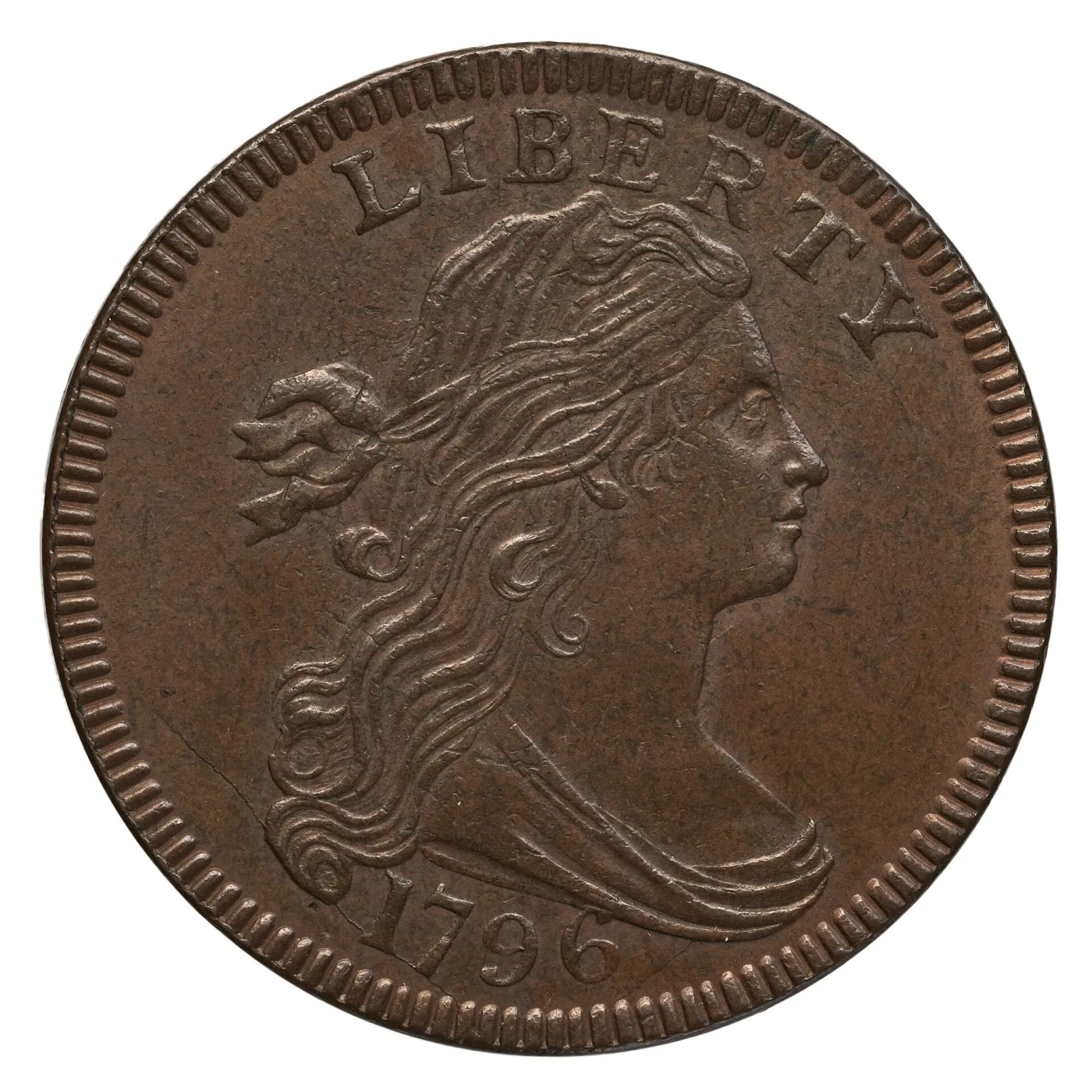
The first year of the type and a transitional one. The Mint struck both the Liberty Cap cent and the new Draped Bust cent in 1796, so a 1796 Draped Bust cent is a genuine first-year issue with extra historical appeal. It comes in two reverse styles — the “Reverse of 1794” and the “Reverse of 1797” — and several die marriages. The 1796 is scarcer and more sought after than the more common dates that follow, especially in higher grades.
A 1796 with the date fully struck up, which is how the type opens.
1797
A more available date with significant reverse variety. The 1797 reverses include the older “Stems” style and the newer “Stems” and “Stemless” wreath configurations, along with the gripped-edge and plain-edge distinctions of the period. Several 1797 die marriages are common, making this a popular and affordable early date.
1798
One of the more plentiful early dates, with a long roster of die varieties. The 1798 includes a notable 1798/7 overdate, along with both the “Style 1 hair” and “Style 2 hair” portrait variations that variety collectors track. The sheer number of 1798 marriages makes it a happy hunting ground for cherry-pickers.
1799 — The Great Key
The 1799 is the undisputed key date of the entire large cent series, not just the Draped Bust type. Almost no cents were struck for circulation that year, and the date includes both the normal 1799 and a famous 1799/8 overdate. Every genuine 1799 is rare and valuable in any grade, and the date is so coveted that it has been a prime target for counterfeiters and date-alterers for more than a century. A 1799 is the coin that defines — and often gates — a complete Draped Bust cent collection.
1800
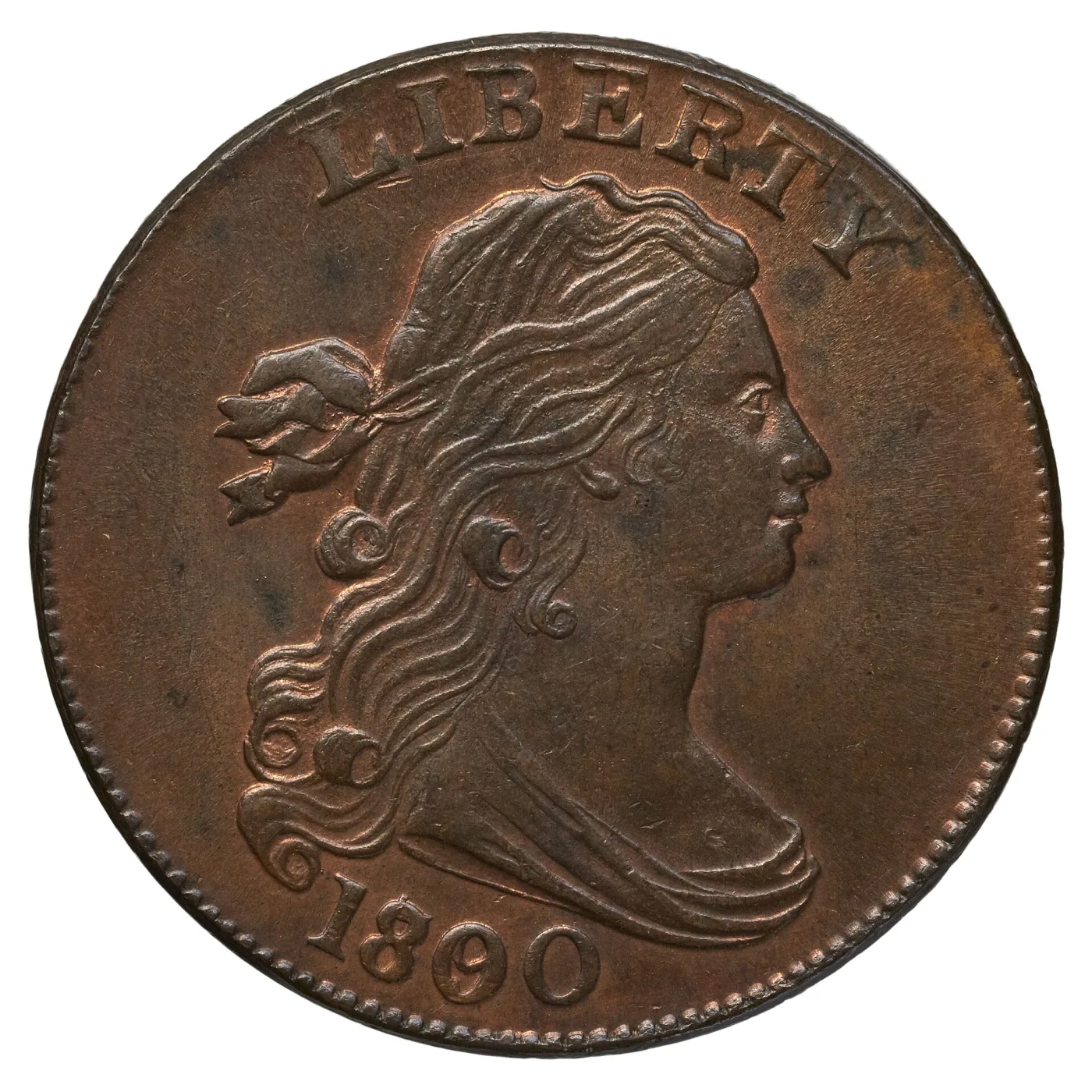
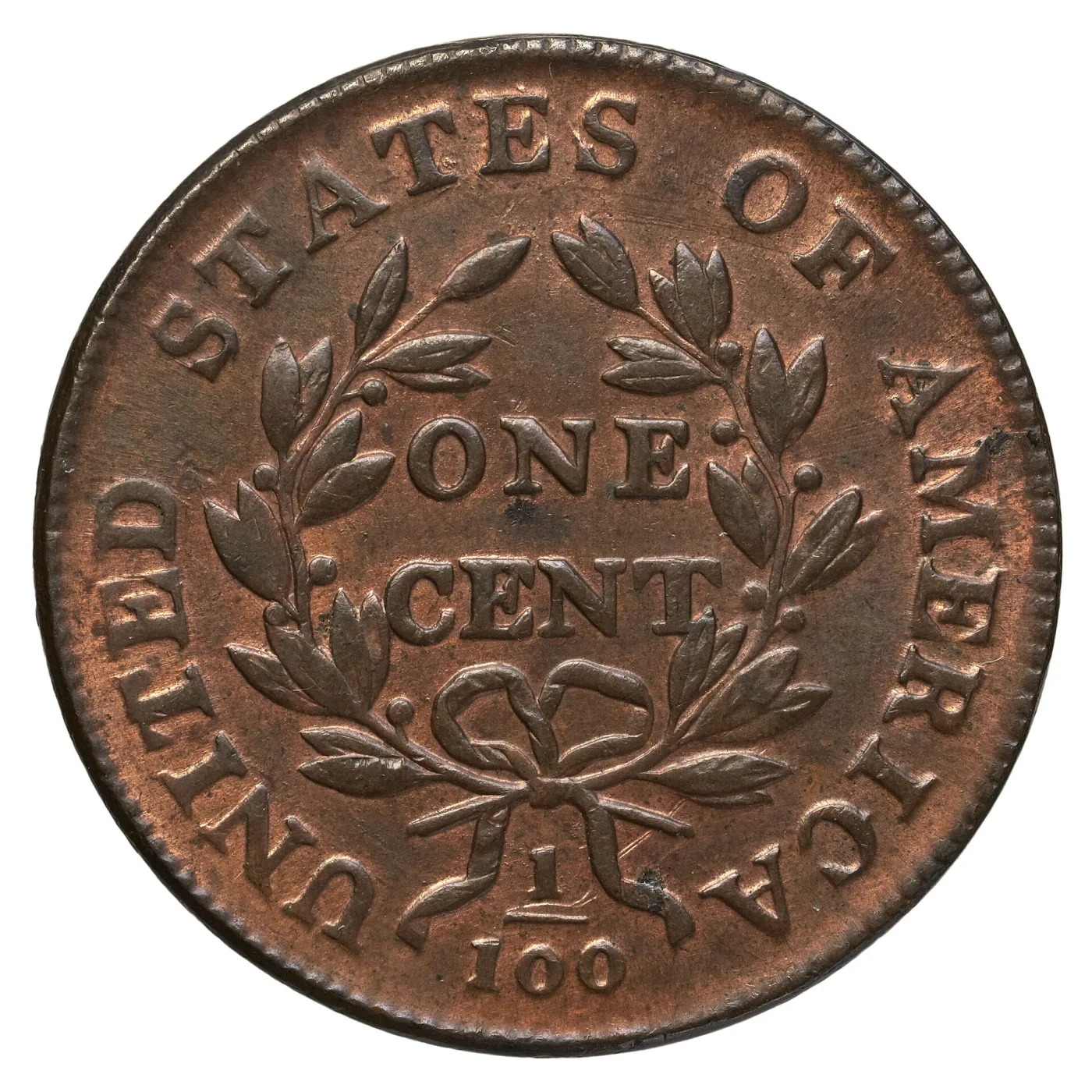
Production resumed strongly in 1800, making it a common date with abundant varieties, including overdates such as the 1800/79 and 1800/798. The 1800 is an excellent affordable choice for collectors who want an early-date Draped Bust cent without 1799 money.
An 1800 with enough original surface left to show both what the date is hiding and what a fully struck reverse looks like.
1801, 1802, 1803
These are the most plentiful and variety-rich dates of the entire type, struck in large numbers. The 1801 includes celebrated blunder reverses — the “3 Errors” reverse (with a fraction reading 1/000, a missing stem, and a broken “UNITED”) and the “1/000” fraction variety. The 1802 and 1803 each offer “Stems” versus “Stemless” wreaths and Small Fraction versus Large Fraction distinctions. For most collectors, a common 1801, 1802, or 1803 is the default, affordable way to own a representative Draped Bust cent.
1804 — The Iconic Rarity
The 1804 is the second great key of the series and one of the most famous of all early American coins. Only a small number were struck, all from a single obverse die and a single broken reverse die, and survivors are typically found heavily worn with the characteristic die breaks at the rims. Because it is so well known and so eagerly collected, the 1804 has been counterfeited and faked extensively — including coins assembled from altered 1800-era cents — so authentication is essential.
1805, 1806, 1807
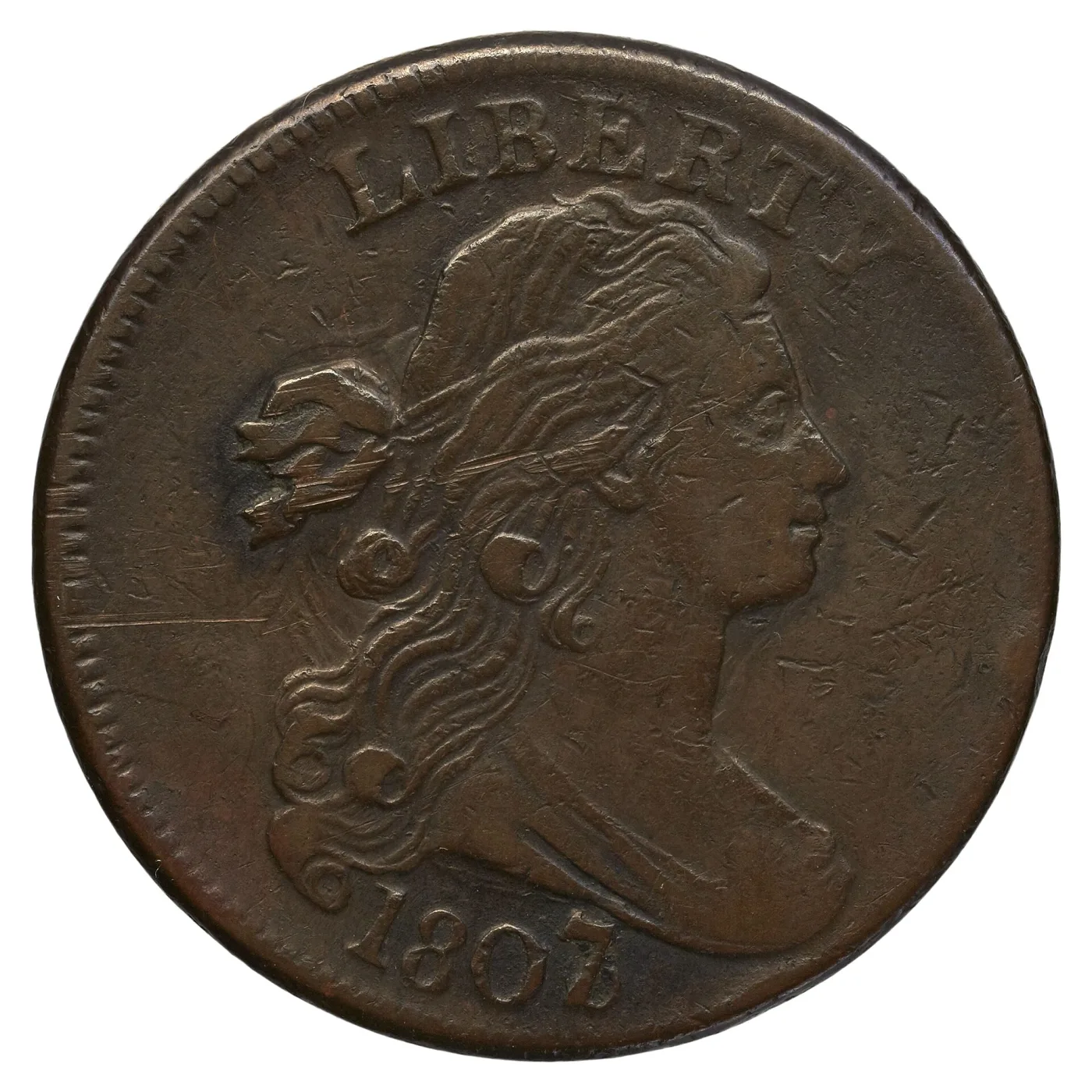
These final dates are again common, with the 1806 being slightly scarcer than its neighbors. The 1807 includes a striking 1807/6 overdate (with both a “Large 7” and a “Small 7” version) and the famous “Comet” variety, named for a raised die-break streak behind Liberty’s head. After 1807, the design gave way to John Reich’s Classic Head, beginning the next chapter of the large cent story covered in our broader large cent guide.
The last year of the type, paired with its own reverse.
Reverse Styles & Wreath Varieties
Variety attribution on the Draped Bust cent leans heavily on the reverse, where the wreath, leaves, and fraction changed repeatedly. A handful of repeatable diagnostics let you classify almost any example.
Reverse of 1794, 1795, and 1797
Early Draped Bust cents reused or echoed reverse styles carried over from the Liberty Cap era. Specialists describe the 1796 reverses as the “Reverse of 1794” (with distinctive leaf and lettering arrangements) and the “Reverse of 1797.” Matching the reverse style is the first step in attributing a 1796 or 1797 cent, and it can swing the value substantially because some style/die combinations are far scarcer than others.
Stems vs. Stemless Wreath
Look at the bottom of the reverse wreath, just below the ribbon bow. On “Stems” varieties, two stems extend downward past the bow toward the rim. On “Stemless” (or “Stems to Wreath”) varieties, those projecting stems are absent. Stemless reverses appear on certain 1797, 1800, 1802, and 1803 issues, and on some dates the stemless variety is markedly scarcer than the stems version, so this single feature can change a coin’s price meaningfully — exactly as it does on the contemporary Draped Bust half cent.
Small Fraction vs. Large Fraction
On many 1802 and 1803 cents, examine the size of the “1/100” fraction beneath the wreath bow. The Mint cut new reverse dies with a noticeably larger fraction partway through the period, producing collectible “Small Fraction” and “Large Fraction” sub-varieties. These distinctions matter for accurate cataloging even when the price difference is modest.
Blunder Reverses
The series is famous for its mistakes. The 1801 “3 Errors” reverse combines a fraction reading “1/000,” a missing wreath stem, and a broken “UNITED” into one celebrated blunder die. The plain “1/000” fraction reverse appears on its own as well. These engraving and die errors are eagerly collected and command strong premiums, and they make the 1801 one of the most entertaining dates to attribute.
Overdates and Die Breaks
Prominent overdates — dates punched over an earlier numeral — appear throughout the type: the 1798/7, 1799/8, 1800/79, 1800/798, and 1807/6 are the headline examples. The 1807 “Comet” variety and the broken dies of the 1804 are die-break diagnostics rather than overdates, but they are attributed the same way: with a loupe, by matching the exact crack and clash pattern to a published die marriage.
Key Dates & Rarities
Knowing where the value concentrates helps you prioritize and avoid overpaying for common material.
1799 — The Crown Jewel
The 1799 (both the normal date and the 1799/8 overdate) is the undisputed king of the series and the most important single date in the entire U.S. large cent set. Almost none were struck for circulation, and survivors are rare in every grade. Most are found in low grades — About Good to Good — and even a heavily worn, problem-free 1799 commands four figures, with higher grades climbing into the tens of thousands. This is the date that defines a complete collection and the one most worth authenticating before purchase.
1804 — The Famous Broken-Die Rarity
The 1804 is the second great key. Struck from a single obverse and a single broken reverse die, genuine examples almost always show the telltale rim breaks, and they are typically well worn. The 1804 is one of the most counterfeited early cents — beware altered dates and “added” or tooled features — so certification by a major service is strongly recommended for any 1804.
An 1804 shown with its own reverse, which is the only way to test what the date claims.
1796 First-Year and Scarce Reverses
The 1796, as the first year of the type, is scarcer and more desirable than the common 1801-1803 dates, particularly in higher grades and with the scarcer reverse styles. Certain 1797 stemless and reverse-style combinations are also notably scarce.
Rare Varieties Within Common Dates
Beyond the key dates, certain die marriages within otherwise common years are genuine rarities — the so-called “NC” (Non-Collectible, i.e., extremely rare) marriages cataloged by Sheldon. A coin that looks like an ordinary 1801 or 1803 might be a much scarcer die marriage worth a large multiple of the common price. This is exactly why precise attribution pays.
Sheldon & NC Attribution System
Serious large cent collectors attribute coins by die variety, not just by date. For the early dates, one reference system dominates above all others.
The Sheldon Numbers (S-#)
Dr. William Sheldon’s landmark reference, Penny Whimsy (and its predecessor Early American Cents), assigns each known die marriage of the 1793-1814 large cents a single continuous “S” number — for example, S-179 or S-250. The Sheldon system is the everyday standard for attributing Draped Bust cents and is the numbering you will most often see in auction listings, dealer inventories, and the EAC community. Sheldon also introduced the famous 70-point grading scale that the entire hobby later adopted.
The NC Designations
Die marriages discovered to be so rare that Sheldon considered them effectively uncollectible were given “NC” numbers (NC-1, NC-2, and so on) rather than S-numbers. Many NC marriages are known from only a handful of examples — sometimes just one or two — and they represent the ultimate prizes for advanced specialists. New marriages and reclassifications continue to be documented by the Early American Coppers (EAC) club.
How to Attribute a Coin
Attribution proceeds by matching diagnostic features: the date style and position, the hair style (Style 1 vs. Style 2), the reverse wreath and fraction, the lettering arrangement, die cracks, clash marks, and the relationship between obverse and reverse dies (the “die marriage”). A good light, a 5x-10x loupe, and a Sheldon attribution guide are the standard tools. The same disciplined eye serves you across all early copper, from the half cent series to the later small cents.
Grading Draped Bust Large Cents
Grading early copper is its own discipline, and the standards used by the Early American Coppers (EAC) club are often stricter than those of the third-party grading services. Understanding both perspectives protects you as a buyer.
Wear Progression
In About Good (AG-3) and Good (G-4), the design is heavily worn; LIBERTY may be partly gone and the date must still be legible. In Very Good (VG-8) to Fine (F-12), more hair detail and drapery returns and LIBERTY is complete. Very Fine (VF-20 to VF-35) shows substantial hair and drapery detail. Extremely Fine (EF-40 to EF-45) retains most detail with light wear on the high points of the hair and drapery. About Uncirculated (AU) and Mint State (MS) coins show minimal to no wear, and any original mint color is a major value driver.
EAC Grading vs. Slab Grading
EAC grading explicitly nets down for problems — corrosion, cleaning, scratches, environmental damage, and porosity — so an EAC grade is frequently several points lower than the number on a third-party slab. When buying, ask whether a quoted grade is “EAC net” or “slab,” because for early copper the difference can be substantial in both grade and price. Two coins in identical slab grades can be worth very different amounts depending on their EAC net quality.
Color and Surface
For copper, originality of surface is paramount. Brown coins with smooth, glossy, undisturbed surfaces are prized. Watch for recoloring (artificial toning applied to hide cleaning), “porosity” from corrosion, granular or pitted surfaces, and the dull, washed-out look of a coin that has been dipped or wiped. These same surface-evaluation skills apply directly to grading later copper such as Indian Head cents and the early small-cent issues.
Authentication & Counterfeit Detection
Genuine Draped Bust Large Cents — especially the 1799 and 1804 key dates — are valuable enough to attract counterfeits and alterations, and they have been faked for well over a century.
Weight and Diameter Checks
Start with the basics. A genuine coin weighs about 10.89 grams (168 grains) and measures roughly 29 mm. Cast counterfeits often miss the weight, show a seam on the edge, lack the correct lettered edge, or display a pebbly, granular surface from the casting process. A precision scale and a caliper are inexpensive insurance against the most common fakes.
Altered Dates
Because 1799 and 1804 are so valuable, unscrupulous sellers have altered common dates (often a 1798, 1800, or 1803) into a fake 1799 or 1804. Examine the date under magnification for tooling, reshaped or re-engraved digits, solder traces, and surfaces or color that do not match between the date area and the surrounding field. A genuine 1799 or 1804 will also match a known Sheldon die marriage; an altered coin will not.
Diagnostic Matching
The most reliable authentication is die-marriage matching. Every genuine Draped Bust cent corresponds to a documented die pairing with known die cracks, clash marks, and lettering positions. The genuine 1804, for instance, is known only with its specific broken obverse and reverse dies. If a coin’s claimed date and variety cannot be matched to a published Sheldon marriage, treat it with great suspicion. For any high-value piece, certification by a major grading service is strongly recommended.
Current Market Values
The following ranges are general 2026 retail guidance for problem-free, accurately graded coins. Actual prices vary enormously with eye appeal, color, variety, die state, and certification. Always confirm against recent auction results before buying or selling, since the early-copper market rewards quality steeply.
Common Dates (1798, 1800, 1801, 1802, 1803, 1805, 1807)
In About Good to Good, expect roughly $30-$90. Very Good to Fine generally runs $120-$400. Attractive Very Fine to Extremely Fine examples reach $500-$2,000, and original About Uncirculated to Mint State coins climb well into the four and five figures, with glossy red-brown survivors commanding the highest premiums.
Better Dates and Varieties (1796, 1797 scarce reverses, 1806, overdates, blunders)
The first-year 1796, scarce 1797 reverse combinations, the slightly scarcer 1806, and popular varieties like the 1801 “3 Errors,” the 1807/6 overdate, and the 1807 “Comet” carry meaningful premiums over common dates in matching grades — often several multiples for the desirable die marriages.
The 1799 and 1804 Key Dates
Even a well-worn, problem-free 1799 commonly brings several thousand dollars, and higher grades reach into the tens of thousands; the 1799/8 overdate is similarly rare. The 1804 is also a four-to-five-figure coin in collectible grades. Because condition and authenticity swing the price so dramatically, both keys should always be certified by a major grading service before purchase.
The NC and Rare-Marriage Premium
The truly rare Sheldon marriages and the NC die pairings can be worth many multiples of a common coin of the same date and grade. This is why careful attribution can turn a routine-looking purchase into a significant find.
Collecting Strategies
There are several rewarding ways to approach the Draped Bust Large Cent, depending on your budget and temperament.
Type Coin Approach
Many collectors simply want one nice Draped Bust Large Cent to represent the type in a U.S. type set, or to fill a slot in a large cent type set alongside the Chain, Wreath, Liberty Cap, Classic Head, Coronet Head, and Braided Hair cents. A common, attractive 1798, 1800, 1801, 1802, or 1803 is the ideal choice for the Draped Bust slot — affordable, abundant, and historically significant. Aim for a problem-free Fine to Very Fine example with smooth, original brown surfaces.
Date Set
A date set of 1796 through 1807 is a classic goal. The set is entirely achievable except for the 1799 and 1804, which are the expensive gatekeepers. Building toward those two keys last lets you assemble the remaining ten dates affordably while saving for the rarities — a strategy many collectors also apply to silver series like the Draped Bust dollar.
Variety Set (The Deep End)
The Sheldon variety set is the specialist’s pursuit — collecting every documented die marriage of the type. This is a lifetime project that combines cherry-picking, attribution skill, and patience, and it is the path that defines the Early American Coppers community. Chasing the rare marriages and NC pairings is the most intellectually engaging way to collect the series and a natural gateway into the broader world of early copper, including the two-cent piece and other obsolete denominations.
Storage and Handling
Copper is reactive. Store large cents in inert, archival-quality holders away from PVC flips, handle them only by the edges, and keep them in a stable, low-humidity environment with a desiccant. Never clean a copper coin — cleaning destroys the original surface and color and devastates value far more than honest wear ever could.
Frequently Asked Questions
How do I tell a Draped Bust Large Cent from a half cent?
Size, weight, and denomination. The large cent is about 29 mm and 10.89 grams; the contemporary half cent is smaller (about 23.5 mm) and lighter (about 5.44 grams). The reverse also differs: the large cent reads "ONE CENT" with a "1/100" fraction, while the half cent reads "HALF CENT" with "1/200."
Why is the 1799 cent so valuable?
Almost no cents were struck for circulation in 1799, so very few survive in any grade. Combined with intense collector demand for a complete set, that scarcity makes the 1799 the great key of the entire large cent series — valuable even when heavily worn.
Is my worn common-date Draped Bust cent worth anything?
Yes. Even a heavily worn, problem-free 1798, 1800, 1801, 1802, or 1803 typically retails for several tens of dollars, and a scarce die marriage or popular blunder variety can be worth considerably more. Originality and surface quality matter as much as the grade number.
Should I clean my dirty old large cent?
No. Never clean a copper coin. Cleaning strips the original surface and color, immediately and permanently reducing the coin's value. Collectors strongly prefer original, undisturbed surfaces — even with dirt or honest wear — over any cleaned coin.
What is a "Sheldon number" and do I need one?
A Sheldon number (such as S-179) identifies the exact die marriage of an early large cent. You don't need to attribute a coin to enjoy it, but learning the Sheldon system lets you spot scarce marriages, avoid altered fakes, and participate fully in the Early American Coppers community.