Braided Hair Half Cent Identification Guide: Christian Gobrecht Design, 1849 Small Date and Large Date, Proof-Only Dates, Restrikes, Grading, and Values
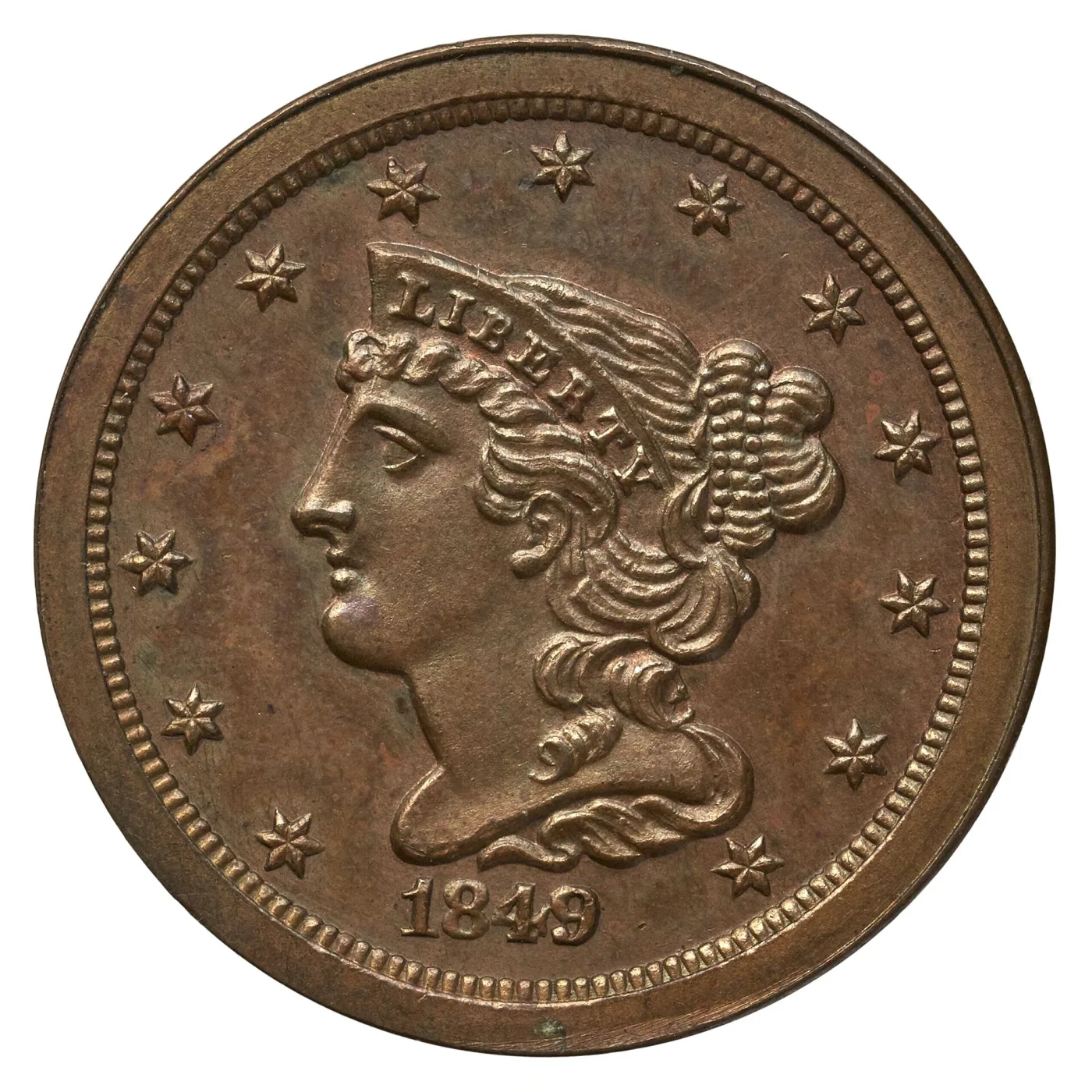
The Braided Hair Half Cent is the fourth and final design type of the United States half cent denomination, struck from 1840 through 1857 in pure copper. Designed by Christian Gobrecht — the prolific engraver whose work also created the Seated Liberty silver coinage and the famous Gobrecht dollar — the Braided Hair half cent replaced the John Reich Classic Head style with a refined, neoclassical portrait of Liberty wearing a coronet inscribed “LIBERTY,” her hair gathered into a tight braided bun behind her head. It is the most elegant and most consistently well-struck of all four half cent types, and for many collectors it is the gateway into the entire half cent series.
But the Braided Hair series is also one of the most misunderstood in American numismatics, because of a peculiar split personality across its eighteen-year run. For the first nine years — 1840, 1841, 1842, 1843, 1844, 1845, 1846, 1847, and 1848 — the Philadelphia Mint struck no half cents for circulation at all. The only coins of these dates are proof-only presentation pieces, and almost all of those are later restrikes produced in the 1850s and 1860s rather than original-year strikings. Regular business-strike production did not begin until 1849, and even then the Mint skipped 1852 (another proof-only date). The result is a nominal eighteen-year type that contains only a handful of dates available as ordinary circulated coins, and a long roster of proof-only rarities that have confused collectors for over a century.
This guide is the comprehensive 2026 reference for identifying, attributing, grading, authenticating, and valuing Braided Hair Half Cents. You will learn how to separate the Braided Hair type from the earlier Classic Head half cent, how to distinguish the critical 1849 Small Date (proof-only restrike) from the 1849 Large Date (the first business strike), how to navigate the original-versus-restrike controversies of the 1840-1849 proof issues, how the “First Restrike” and “Second Restrike” reverses are diagnosed, the Cohen die variety system for the series, EAC grading standards for copper, counterfeit detection, and current retail values across every date. Whether you are completing a four-coin half cent type set, chasing the proof-only rarities, or simply identifying a worn copper coin from an inherited box, this guide will give you a specialist’s command of the last half cent ever struck.
History and Background
The Braided Hair Half Cent was introduced in 1840 as part of Christian Gobrecht’s sweeping modernization of American coinage. Gobrecht, who joined the Philadelphia Mint as second engraver in 1835 and became chief engraver in 1840, had already designed the seated figure of Liberty that defined the silver coinage of the era. His coronet-and-braid portrait of Liberty was first applied to the large cent in 1839 (where it is usually called the “Coronet” or “Braided Hair” cent, superseding the older Coronet/Matron Head large cent of 1816-1839) and then adapted, in miniature, to the half cent beginning in 1840. The half cent thereby received its fourth and last redesign, replacing the Classic Head half cent of John Reich.
The most striking fact about the early Braided Hair half cent is that, for nine years, it was never made for commerce. From 1840 through 1848 the Treasury held enormous stocks of older, undistributed half cents and large cents, and there was simply no demand for new half cents in the channels of trade. The Mint nonetheless produced tiny quantities of proof half cents in these years as presentation pieces for dignitaries, government officials, and the small but growing community of coin collectors. These proof-only issues — combined with the later restrikes made to satisfy collector demand — are the foundation of the series’ reputation for complexity.
Regular business-strike coinage finally resumed in 1849, and continued every year through 1857 with the single exception of 1852, which remained a proof-only date. By the mid-1850s, however, the half cent had become almost useless as a unit of commerce. Rising copper prices, the impracticality of such a tiny denomination, and the introduction of the small Flying Eagle cent in 1857 all sealed its fate. The Coinage Act of February 21, 1857 formally abolished both the half cent and the old copper large cent, ending a denomination that had run since 1793.
Gobrecht’s Broader Legacy
Christian Gobrecht’s braided-hair Liberty is one of the most widely reproduced portraits in American numismatics. The same essential design appears on the Coronet large cent (1839-1857), the gold Liberty Head half eagle and other Coronet gold issues by Gobrecht, and — in seated form — across the entire silver series of the period, from the Seated Liberty dime to the Seated Liberty half dollar. Collectors who appreciate the Braided Hair half cent frequently build broader Gobrecht-era type sets that span copper, silver, and gold.
The End of an Era
The 1857 half cent is therefore not just the last Braided Hair half cent — it is the last half cent of any kind. After sixty-four years the denomination disappeared from American pockets, never to return. This terminal status gives the 1857 a special place in collections, and makes a complete four-type half cent set (Liberty Cap, Draped Bust, Classic Head, Braided Hair) a satisfying and historically coherent goal.
Design and Diagnostic Features
The Braided Hair half cent is generally the easiest of the four half cent types to identify, because Gobrecht’s portrait is so distinct from the earlier designs. Distinguishing dates and varieties within the series, however, requires careful attention to the date size, the wreath berries, and the lettering on the reverse.
Obverse
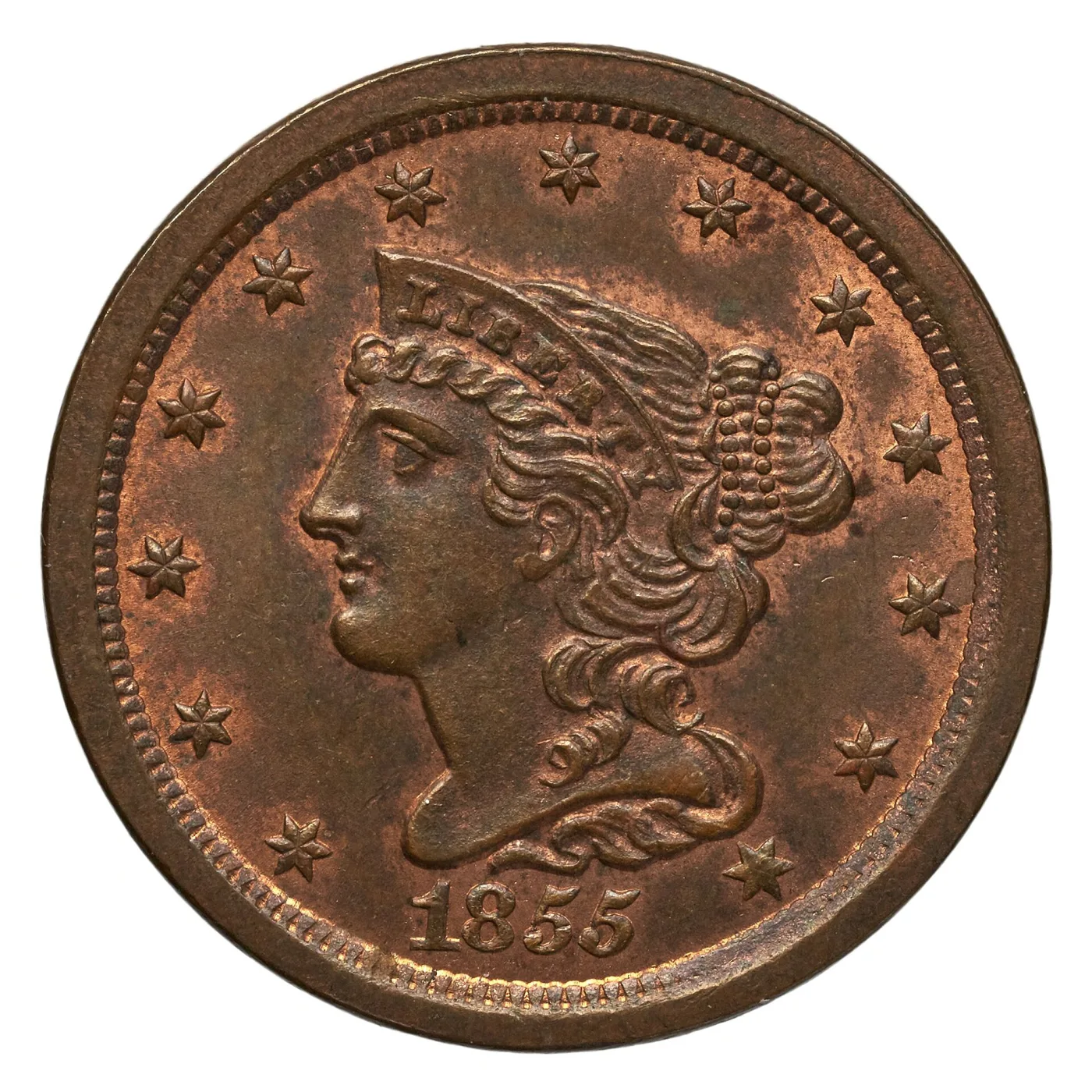
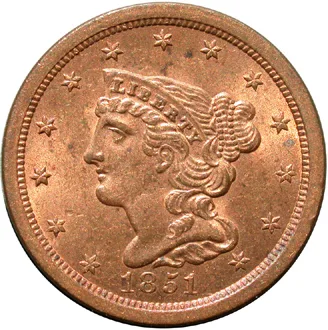
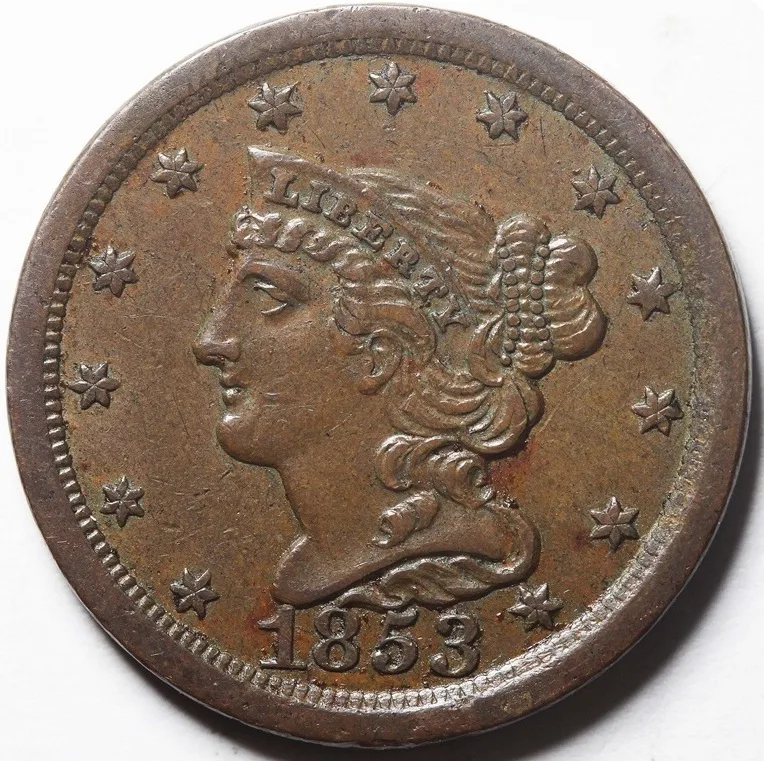
Liberty faces left, wearing a coronet (a band) inscribed “LIBERTY” across the front of her head, with her hair pulled back and gathered into a tight braided bun secured behind the neck. Thirteen stars surround the portrait — seven to the left and six to the right — with the date below at the base of the coin. There is no mint mark on any Braided Hair half cent; the entire series was struck at the Philadelphia Mint, as branch mints never produced the denomination.
Reverse
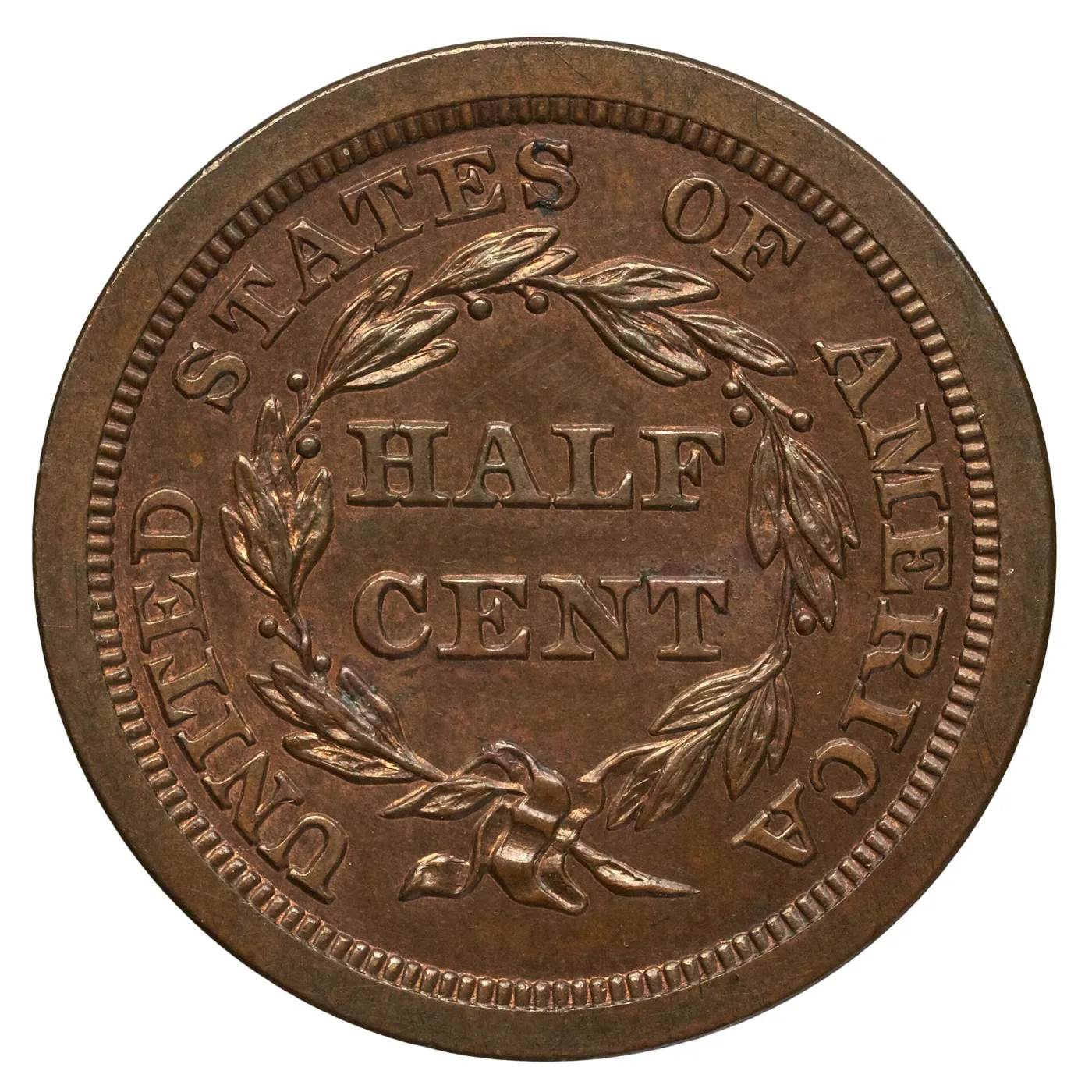
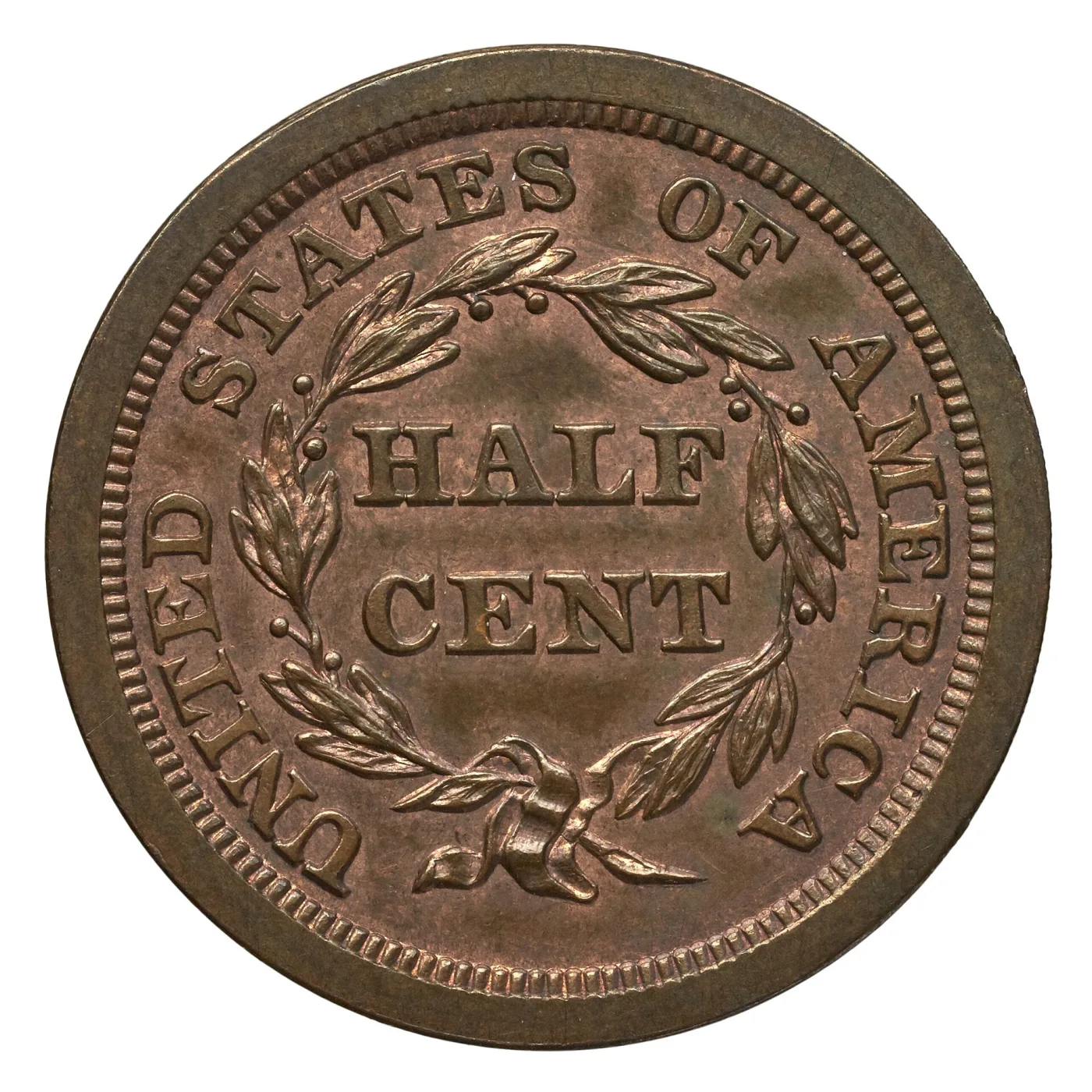
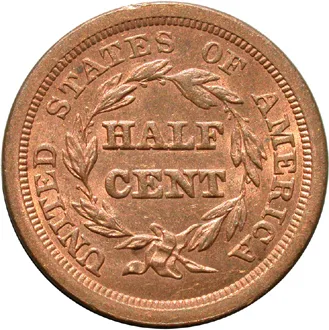
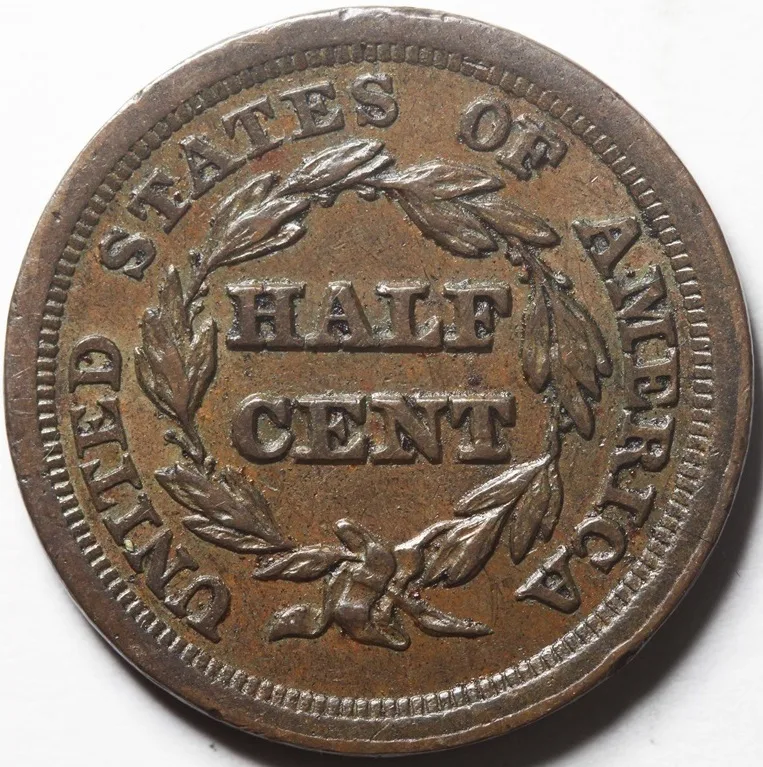
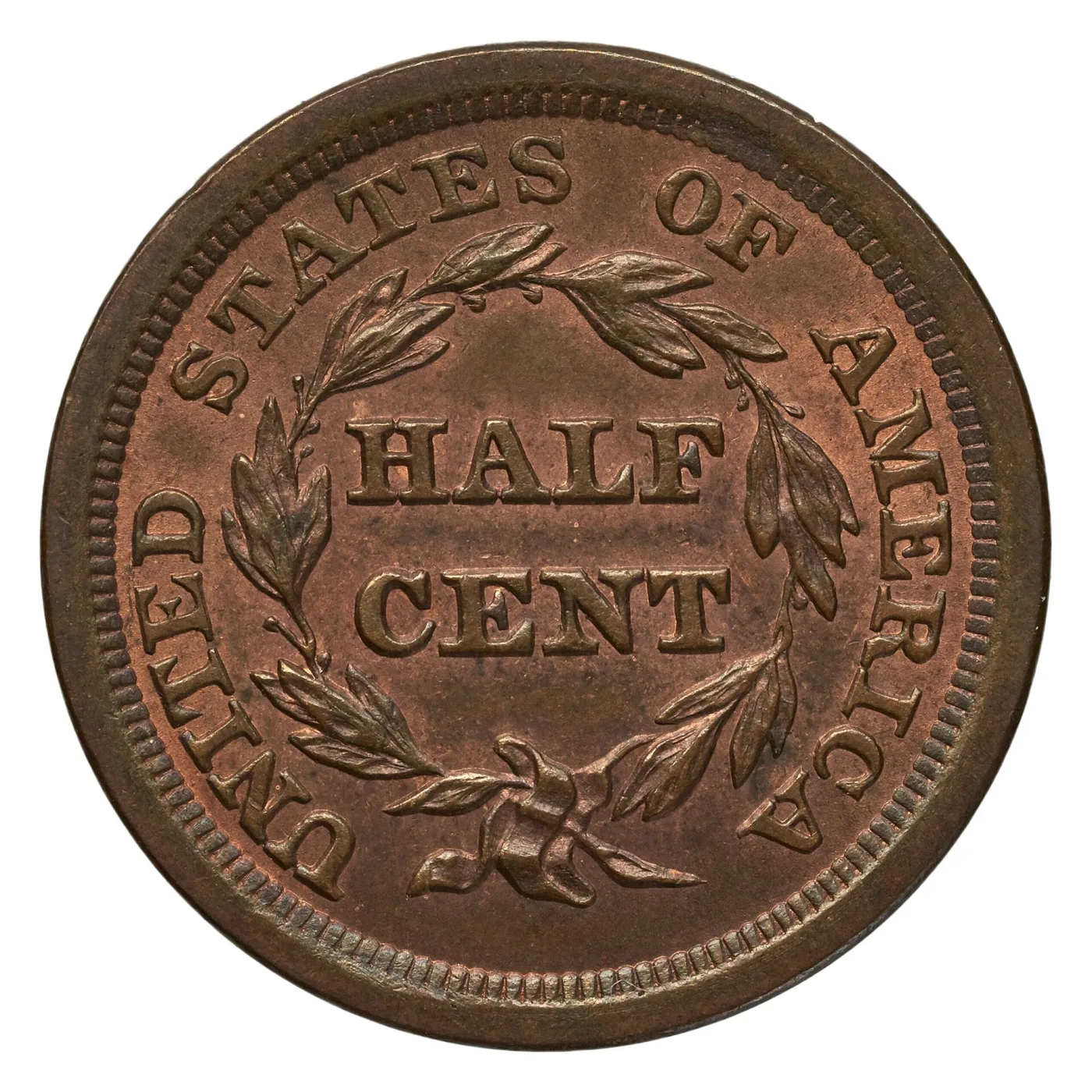
The reverse shows “HALF CENT” inside a wreath of leaves and berries, with “UNITED STATES OF AMERICA” arching around the outside. The wreath is tied at the bottom with a ribbon bow. Unlike the earliest half cents, there is no “1/200” fraction. The size of the berries in the wreath and the recutting of the letters N and T in “CENT” are the principal diagnostics used to separate originals from restrikes and to distinguish the two restrike reverses (discussed in detail below).
Edge
The edge is plain (not reeded, not lettered). Like the Classic Head type that preceded it, every Braided Hair half cent has a plain edge — any half cent with a reeded or lettered edge is not a Braided Hair coin.
Diagnostic Quick Identification
To confirm the Braided Hair type versus the Classic Head: look at how the hair is arranged. The Classic Head shows loose curls and a “LIBERTY” band high on the forehead in a Greek-revival style; the Braided Hair shows the hair drawn tightly back into a visible braided bun, with a neat coronet band lower across the head. The braid is the single most reliable visual cue. The two types also differ in date placement and overall portrait sharpness — Braided Hair coins are generally crisper and more uniform.
Composition and Physical Specifications
The Braided Hair Half Cent shares the standard half cent specifications of the post-1835 period and matches the Classic Head in size and metal. These figures are essential for authentication.
Standard Specifications (1840-1857)
- Composition: 100% copper (pure)
- Weight: 5.44 grams (84 grains)
- Diameter: 23.0 mm
- Edge: Plain
- Mint: Philadelphia only (no mint mark)
- Designer: Christian Gobrecht (obverse and reverse)
- Business-strike years: 1849, 1850, 1851, 1853, 1854, 1855, 1856, 1857
- Proof-only years: 1840, 1841, 1842, 1843, 1844, 1845, 1846, 1847, 1848, 1852 (plus proof versions of business-strike dates)
Any coin claimed to be a Braided Hair half cent that weighs significantly outside the 5.0-5.8 gram range, has a diameter outside about 22.5-23.5 mm, or has a non-plain edge should be examined for authenticity. Many counterfeits and museum-shop replicas are produced in modern brass or zinc-based alloys and will weigh differently and show a different copper-versus-brass tone under bright light.
Date-by-Date Analysis (1840-1857)
The Braided Hair Half Cent spans 1840-1857 nominally, but only eight dates were struck for circulation. The remaining dates exist solely as proofs, the great majority of them later restrikes. Values below are 2026 retail estimates for problem-free, original-surface examples.
1840-1848 — Proof-Only Dates
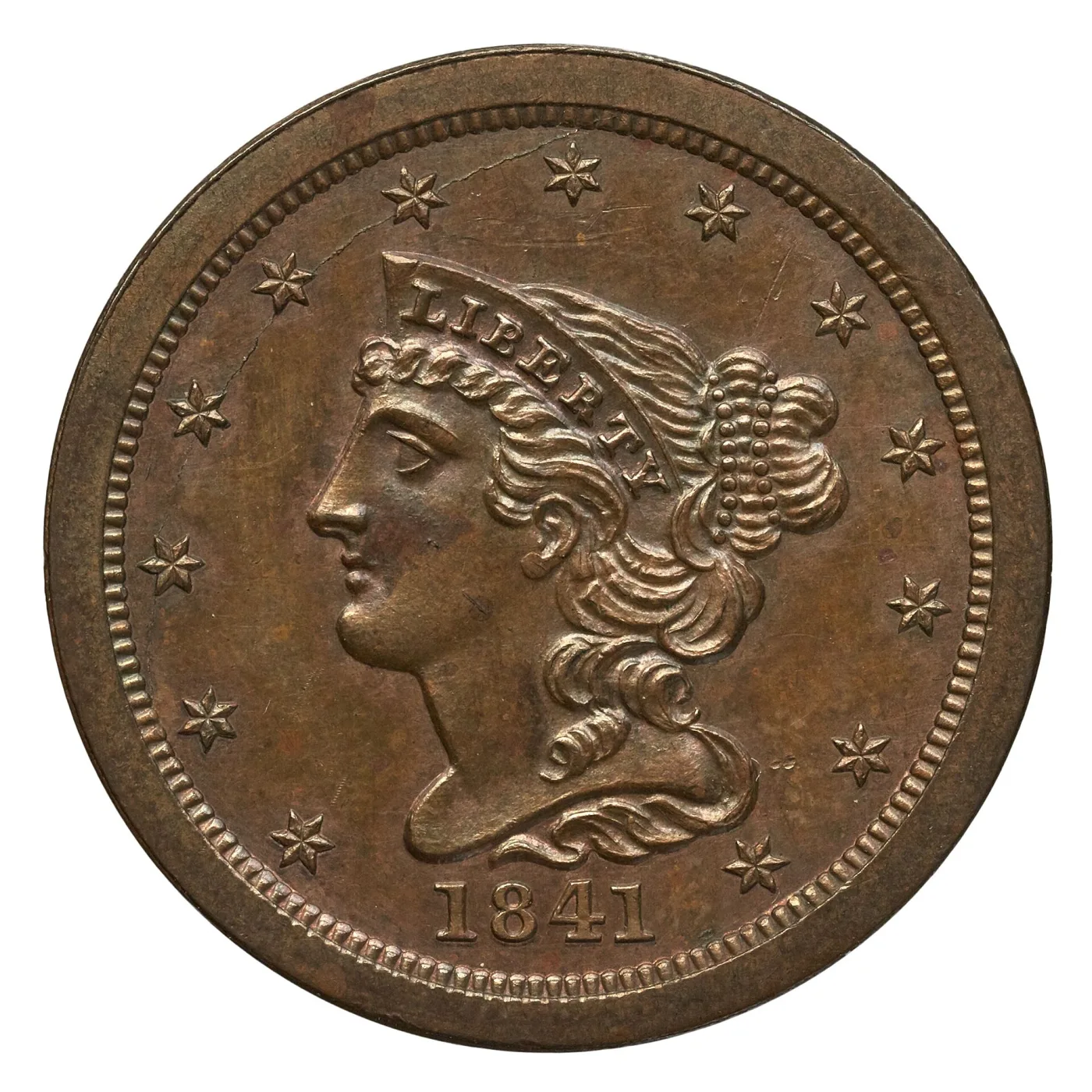
No half cents were struck for circulation in any of these nine years. Each date exists only as a proof, and almost every surviving example is a restrike from the 1850s or 1860s rather than an original. Originals are extreme rarities (often fewer than a dozen genuine examples per date) and command five- to six-figure prices; restrikes are far more available but still scarce and expensive. Typical restrike values: PR-63 BN $4,000-$6,000, PR-65 RB $12,000-$25,000. Original values: PR-63 $25,000-$60,000+, PR-65 $60,000-$150,000+ depending on the date and how many originals are known.
1849 Small Date — Proof-Only Restrike
All 1849 Small Date half cents are proof-only restrikes. The Small Date uses the same reverse as the 1840-1848 “First Restrikes” (the so-called “Reverse of 1856”). Walter Breen estimated roughly fifteen examples were struck; about ten distinct survivors have been identified. Values: PR-63 BN $5,000, PR-65 RB $20,000-$25,000. Do not confuse this rare proof restrike with the common 1849 Large Date business strike below.
1849 Large Date — First Business Strike
Mintage: 39,864. The 1849 Large Date is the first business-strike Braided Hair half cent and the date that began regular production after the long proof-only interval. It is genuinely available in circulated grades and obtainable in Mint State. Values: G-4 $60, F-12 $90, EF-40 $180, AU-50 $300, MS-63 BN $700, MS-64 RB $1,200, MS-65 RD $4,000+.
1850 — Business Strike
Mintage: 39,812. A scarcer date in higher grades than its mintage suggests; choice Mint State examples are not common. Values: G-4 $65, F-12 $100, EF-40 $220, AU-50 $400, MS-63 BN $850, MS-65 RB $3,500.
1851 — Most Common Date
Mintage: 147,672. The highest business-strike mintage of the series and the most readily available Braided Hair half cent in all grades, including Mint State. The 1851 is the standard “type coin” choice for the Braided Hair slot in a half cent type set. Values: G-4 $55, F-12 $80, EF-40 $150, AU-50 $250, MS-63 BN $500, MS-64 RB $900, MS-65 RD $2,500.
1852 — Proof-Only Date
No business strikes were made in 1852. Like the 1840-1849 Small Date issues, the 1852 exists only as a proof, and essentially all examples are restrikes. Two restrike reverses are known (the First Restrike “Reverse of 1856” and the Second Restrike “Reverse of 1840”). Originals are of legendary rarity. Restrike values: PR-63 BN $5,000-$7,000, PR-65 RB $20,000-$30,000.
1853 — Common Date
Mintage: 129,694. A common, affordable date available in all circulated grades and in Mint State. Values: G-4 $55, F-12 $80, EF-40 $150, AU-50 $250, MS-63 BN $500, MS-65 RB $2,500.
1854 — Common Date
Mintage: 55,358. Slightly scarcer than 1853 but still readily available. Values: G-4 $55, F-12 $85, EF-40 $160, AU-50 $275, MS-63 BN $550, MS-65 RB $2,800.
1855 — Common Date
Mintage: 56,500. A common date that is among the easier Braided Hair half cents to find with original red color in Mint State. Values: G-4 $55, F-12 $80, EF-40 $150, AU-50 $250, MS-63 BN $500, MS-65 RD $2,800.
1856 — Common Date
Mintage: 40,430. Available in all grades; a popular choice for a high-grade type coin. Values: G-4 $55, F-12 $85, EF-40 $160, AU-50 $275, MS-63 BN $550, MS-65 RB $2,800.
1857 — Last Half Cent
Mintage: 35,180. The final half cent ever struck, and a date with strong demand precisely because of its terminal status. Because it was the last year, many were saved, so Mint State examples are obtainable despite the relatively low mintage. Values: G-4 $70, F-12 $110, EF-40 $200, AU-50 $325, MS-63 BN $700, MS-65 RD $3,500. Expect a premium over comparable common dates due to its “last year of issue” appeal.
The 1849 Small Date vs Large Date
No single distinction matters more in the Braided Hair series than the difference between the 1849 Small Date and the 1849 Large Date. They share a year but could not be more different in nature, rarity, and value, and confusing them is the most common and most costly error a new collector makes.
1849 Large Date — Common Business Strike
The Large Date is a normal circulating coin with a mintage near 40,000. It exists in worn grades, it turns up in dealer junk boxes and inherited collections, and it is the date most people actually have when they own “an 1849 half cent.” A circulated Large Date is a $60-$300 coin.
1849 Small Date — Rare Proof Restrike
The Small Date is a proof-only restrike with perhaps a dozen examples known. It was never made for circulation; it is a presentation/collector piece struck in the 1850s. A Small Date is a $5,000-$25,000 coin. Because the digits are physically smaller and more tightly spaced, the date occupies less horizontal space at the base of the coin.
How to Tell Them Apart
The fastest way to distinguish them is the date size and spacing: the Large Date digits are noticeably bigger and wider-spaced, filling more of the lower field; the Small Date digits are compact and dainty. Equally decisive is the surface — the Small Date is always a proof, with full mirror fields and razor-sharp design, while the Large Date is a business strike with frosty or worn surfaces. If you have a worn, circulated 1849 half cent, it is by definition a Large Date business strike, because the Small Date exists only as a pristine proof.
Why It Matters
A misidentified 1849 can swing value by a factor of fifty or more. Any 1849 half cent that appears to be a proof — mirrored fields, sharp squared rims, no circulation wear — should be examined carefully and, if it shows the small compact date, submitted for professional certification, because it may be the rare Small Date restrike rather than a cleaned business strike.

Proof-Only Dates and the End of the Denomination
Ten of the eighteen nominal years of the Braided Hair series are proof-only: 1840 through 1848, the 1849 Small Date, and 1852. Understanding why so many dates exist only as proofs is essential to understanding the whole series.
Why So Many Proof-Only Dates?
The Treasury entered the 1840s holding large stocks of older half cents that had never circulated, so it had no reason to order new ones for commerce. But the Mint still produced a small number of proof half cents each year to fill proof sets and presentation pieces for collectors, officials, and visiting dignitaries. With no accompanying business strikes, these proofs became the only coins of their dates — a situation almost unique in U.S. coinage.
The Long Suspension (1840-1848)
For nine years the half cent existed only as a tiny proof issue. Original proofs of these dates are exceedingly rare; many dates have fewer than a dozen genuine originals known. Most of the “1840s” half cents on the market today are restrikes made years or decades later, which is why the original-versus-restrike question dominates pricing for this part of the series (see the next section).
Resumption and the Final Years (1849-1857)
Business strikes resumed in 1849 and ran through 1857, skipping only 1852. The denomination’s days were numbered, however: copper prices rose, the coin was too small to be useful, and the Mint was preparing the small-diameter cent. The Act of February 21, 1857 abolished the half cent and the large copper cent together, replacing them with the copper-nickel Flying Eagle cent. The 1857 half cent is therefore the last of its kind, and the Braided Hair type closes out a denomination that had begun under the Liberty Cap design in 1793.
Originals, First Restrikes, and Second Restrikes
The single most specialized topic in the Braided Hair series is the distinction between Originals, First Restrikes, and Second Restrikes among the proof-only dates. This terminology comes from the work of Roger Cohen and Walter Breen and is the language used in every serious auction description.
Originals
Originals are proofs struck in (or very close to) the year of date, with a reverse that shows large berries in the wreath. They are the rarest and most valuable category, with populations measured in single digits for many dates. The large-berry reverse is the key diagnostic for an original.
First Restrikes (“Reverse of 1856”)
First Restrikes were produced in the late 1850s using a reverse die with small berries, in which the letters N and T in “CENT” and portions of the wreath ribbon are recut. This reverse is called the “Reverse of 1856.” The 1840-1848 First Restrikes and the 1849 Small Date all share this same small-berry, recut-lettering reverse. First Restrikes are far more available than originals but are still genuine rarities.
Second Restrikes (“Reverse of 1840”)
Second Restrikes were produced later still, using yet another reverse die (the “Reverse of 1840”), and are known for some — but not all — of the proof-only dates. Notably, no Second Restrikes are known for the 1849 Small Date, though Breen speculated they might exist. Second Restrikes are the scarcest of the restrike categories where they occur.
How to Use This in Practice
For a high-value 1840s proof half cent, the price depends almost entirely on which category it belongs to. The large-berry reverse signals an original (most valuable); the small-berry reverse with recut N and T signals a First Restrike; the third reverse signals a Second Restrike. Because the value difference can run into tens of thousands of dollars, these attributions should always be confirmed by PCGS, NGC, or CAC rather than guessed at from photographs.
Key Dates, Rarities, and Condition Rarities
The Braided Hair series contains both absolute rarities (the proof-only dates) and condition rarities (common business strikes that vanish in top grades).
Absolute Rarities
- 1840-1848 Originals: Each is a single- to low-double-digit rarity; among the most prestigious copper proofs in U.S. numismatics.
- 1849 Small Date: Proof-only restrike, roughly a dozen known. Not to be confused with the common 1849 Large Date.
- 1852 Original: Extraordinary rarity; even restrikes are scarce and expensive.
- 1840-1852 Second Restrikes: Where they exist, the scarcest restrike category.
Condition Rarities
Among the business strikes, full red (RD) Mint State examples are the real challenge. Dates such as 1849 Large Date, 1850, and 1856 are easy in circulated grades but genuinely scarce and expensive in MS-65 RD. The 1851 and 1855 are the easiest to locate with original red color, which is exactly why they are the preferred dates for collectors building a high-grade type set. The 1857, while not rare, carries a persistent premium for its last-year status across all grades.
Major Varieties and Cohen Attribution
The Braided Hair series has fewer dramatic die varieties than the earlier copper types, but it still has a structured attribution system and a handful of collectible varieties beyond the famous 1849 date sizes.
Cohen Numbers
Braided Hair half cent varieties are catalogued under the Cohen numbering system from Roger S. Cohen Jr.’s reference American Half Cents — The “Little Half Sisters”. Each Cohen number (C-1, C-2, and so on, per date) identifies a die marriage — a specific obverse die paired with a specific reverse die. Most Braided Hair business-strike dates have only one or two Cohen varieties, making the series far simpler to attribute than the multi-variety Draped Bust half cents.
Breen Encyclopedia
Walter Breen’s Encyclopedia of United States Half Cents remains the definitive specialist reference, providing die-state analysis, emission sequences, and the original/restrike distinctions that govern the proof-only dates. Breen and Cohen are the two names you will see cited in every serious Braided Hair auction lot.
Collectible Varieties
- 1849 Small Date vs Large Date: The headline variety of the series (covered above).
- Reverse types on proof-only dates: Large-berry (Original), small-berry/recut (First Restrike), and the Second Restrike reverse — each a meaningful value driver.
- Minor repunched dates and die cracks: Catalogued by EAC specialists but generally carrying small premiums on business strikes.
Why Attribution Matters
On business strikes, Cohen attribution rarely changes value dramatically because most dates have only one or two marriages. On the proof-only dates, however, the reverse attribution is everything — it determines whether a coin is a five-figure original or a four-figure restrike. Always identify the reverse before pricing a Braided Hair proof.
Grading Braided Hair Half Cents
Grading copper requires assessing both technical wear (Sheldon Scale 1-70) and surface condition (color, planchet quality, eye appeal). The EAC (Early American Coppers) grading tradition used by half cent specialists is more conservative than third-party service grading.
Key Wear Points
The first areas to show wear on a Braided Hair half cent are the high points of Liberty’s hair above the ear and the strands of the braided bun, along with the cheek. The “LIBERTY” coronet should remain fully legible through Very Fine and better. On the reverse, the tops of the wreath leaves and the centers of the berries wear first. By Very Fine, all coronet letters should be sharp and the wreath should retain most of its leaf detail.
Color Designations
Mint State copper is graded in three color categories:
- BN (Brown): Less than 5% original mint red. The most common Mint State color for the series.
- RB (Red-Brown): 5%-95% original mint red. A substantial premium over BN.
- RD (Red): 95%+ original mint red. Scarce and carrying a large premium, especially for low-mintage dates.
Strike Quality
Braided Hair half cents are generally well struck — better and more uniform than the Classic Head issues — so weak strikes are less of a grading concern than on the earlier series. The proofs, by definition, show full, sharp strikes with mirrored fields. For business strikes, the main grading drivers are wear, color, and the absence of cleaning or environmental damage.
EAC vs PCGS/NGC Grading
EAC grades typically run 5-15 points lower than PCGS/NGC grades for the same coin, because EAC graders deduct heavily for cleaning, environmental damage, and any non-original surface. An EAC “VF-30” may correspond to a PCGS “AU-50.” When buying from EAC dealers, expect more conservative numbers but more original coins; when buying certified PCGS/NGC coins, expect higher numbers but apply your own judgment of surface quality and originality.
Counterfeit Detection and Authentication
The Braided Hair series is targeted by counterfeiters chiefly through alteration of common business strikes into rare proof-only dates and through outright cast or modern struck fakes.
Altered Dates
The classic deception is altering a common business-strike date into a proof-only date — for example, recutting an 1853 or 1855 into an “1852,” or tooling an 1849 Large Date to mimic the look of something rarer. Examine the date digits under 10x magnification for irregular spacing, raised tool marks, or color differences between the digits and the surrounding field. Remember that any 1840-1848 or 1852 half cent must be a proof; a circulated, frosty-surfaced coin with one of those dates is a red flag for alteration.
False Proofs
Because the proof-only dates are so valuable, business strikes are sometimes polished or “improved” to imitate proof surfaces. Genuine proofs show squared, knife-sharp rims, fully reflective fields right up to the devices, and complete striking detail. Artificially polished business strikes show rounded rims, hairlined fields, and softness in the design. When in doubt, a genuine proof attribution requires professional certification.
Cast and Modern Counterfeits
Cast counterfeits show surface pitting (the casting “orange peel”), softened detail, and a seam along the edge, and they often weigh slightly light because cast copper is less dense than struck copper. Modern struck replicas are frequently made in brass or plated zinc, weigh incorrectly, and may bear “COPY” as required by U.S. law since 1973. Always check weight on a digital scale and inspect the edge before believing a too-good-to-be-true find.
Third-Party Certification
For any Braided Hair half cent worth more than $300-$500, certification by PCGS, NGC, or ANACS is strongly recommended. For the proof-only dates and any high-grade red business strike, certification is effectively required for resale, because the original/restrike and proof/business-strike questions carry such large value swings. Collectors should also keep the conservative EAC net-grading tradition in mind when evaluating problem coins.
Current Market Values
Braided Hair Half Cent values vary enormously by date, by status (business strike vs proof-only restrike vs original), by grade, and by color. The figures below are 2026 retail estimates for problem-free, original-surface coins; strong auctions can exceed retail by 20%-100% for premium examples.
Common Business-Strike Dates (1849 Large Date, 1851, 1853, 1854, 1855, 1856)
- G-4: $55-$65
- F-12: $80-$100
- EF-40: $150-$220
- AU-50: $250-$400
- MS-63 BN: $500-$850
- MS-64 RB: $900-$1,400
- MS-65 RD: $2,500-$4,000 (scarce)
Better Business-Strike Date (1850)
- G-4: $65
- F-12: $100
- EF-40: $220
- AU-50: $400
- MS-63 BN: $850
- MS-65 RB: $3,500
Last-Year Date (1857)
- G-4: $70
- F-12: $110
- EF-40: $200
- AU-50: $325
- MS-63 BN: $700
- MS-65 RD: $3,500
Proof-Only Restrikes (1840-1848 First Restrikes, 1849 Small Date, 1852)
- PR-60 BN: $3,500-$4,500
- PR-63 BN: $5,000-$7,000
- PR-64 RB: $9,000-$14,000
- PR-65 RB: $18,000-$30,000
Proof-Only Originals (1840-1848, 1852)
- PR-63: $25,000-$60,000
- PR-65: $60,000-$150,000
- PR-66+: $150,000-$300,000+ (date-dependent)
Collecting Strategies
The Braided Hair Half Cent supports approaches ranging from a single affordable type coin to an advanced proof specialty.
Type Set
The simplest goal is a single Braided Hair half cent for the fourth slot in a four-coin half cent type set (Liberty Cap, Draped Bust, Classic Head, Braided Hair). The 1851 is the standard choice because it is the most available date in every grade; the 1855 is a popular alternative for collectors who want full red color. Budget: $150-$400 for a circulated example, $500-$2,800 for Mint State depending on color.
Business-Strike Date Set
A complete set of the eight business-strike dates — 1849 Large Date, 1850, 1851, 1853, 1854, 1855, 1856, and 1857 — is one of the most achievable date sets in all of early American copper, since none of the eight is rare. Budget for a Fine-grade set: $700-$900. For an EF set: $1,300-$1,800. For an MS-63 BN set: $4,500-$6,500. This is an excellent first “complete series” project for a new copper collector.
Complete Set with Proof-Only Dates
Adding the proof-only dates (1840-1848, 1849 Small Date, and 1852) transforms the project into a major undertaking. Even using restrikes rather than originals, each proof-only date adds several thousand dollars, and a complete restrike set runs well into six figures. A complete set using originals is one of the most ambitious goals in U.S. copper and is attempted by only a handful of advanced collectors.
Where Braided Hair Fits in a Broader Collection
Many collectors pursue the Braided Hair half cent alongside the contemporary Coronet/Braided Hair large cent and the broader Gobrecht-era silver coinage, such as the Seated Liberty dime and Seated Liberty quarter. A Gobrecht type collection spanning copper and silver is a historically coherent and visually elegant way to assemble the mid-nineteenth-century federal series. Beginners often start with the general coin identification guide before specializing in copper.
Storage and Preservation
Copper is the most chemically reactive of the common coinage metals, and Braided Hair half cents — particularly the full-red business strikes and the proofs — require careful handling to preserve their value.
Never Clean Copper
Cleaning copper destroys natural patina and microscopic surface detail. Cleaned coins are described as “harshly cleaned,” “lightly cleaned,” or “polished” and receive details grades from PCGS and NGC, trading at 30%-70% discounts to original-surface examples. This is especially damaging for proofs, where a single cleaning can erase the mirror surface entirely. Even an unattractive original-color coin is worth more than a cleaned coin of the same technical grade; specialists prize natural “EAC color.”
Avoid PVC and Plasticizers
PVC (“polyvinyl chloride”) flips and pages leach plasticizers that react with copper to form a green slime on the surface — one of the most common disasters for half cent collections inherited from earlier generations. Move any coin out of PVC flips immediately and store it in inert Mylar, acid-free paper, or hard plastic capsules.
Humidity Control
High humidity accelerates copper corrosion and spotting. Store copper coins at relative humidity below 50%, ideally 30%-40%, and keep silica gel packets in the storage container. Avoid basements, attics, and garages, where humidity swings dramatically with the seasons.
Long-Term Storage
For valuable copper, certified PCGS or NGC holders provide an inert sealed environment and are strongly recommended for full-red business strikes and all proofs. Raw coins should be kept in acid-free, sulfur-free paper envelopes inside Mylar flips, or in inert hard plastic capsules. Inspect stored coins annually for new spotting or color change, and address any problem immediately.
Frequently Asked Questions
What is a Braided Hair Half Cent worth in 2026?
Common business-strike dates (1849 Large Date, 1851, 1853-1856) retail for $55-$220 in circulated grades and $500-$4,000 in Mint State depending on color. The 1857 last-year date carries a small premium. Proof-only dates are far more valuable: restrikes trade for roughly $4,000-$30,000, while genuine originals of the 1840-1848 and 1852 dates are five- to six-figure coins.
What's the difference between the 1849 Small Date and Large Date?
The 1849 Large Date is a common business strike (mintage about 40,000) worth $60-$300 in circulated grades. The 1849 Small Date is a proof-only restrike with roughly a dozen examples known, worth $5,000-$25,000. The Large Date has bigger, wider-spaced digits and frosty/worn surfaces; the Small Date has compact digits and full proof mirror fields. A worn, circulated 1849 is always the Large Date.
Why were no Braided Hair half cents struck for circulation from 1840 to 1848?
The Treasury was holding large stocks of older, undistributed half cents, so there was no commercial demand for new ones. The Mint produced only tiny numbers of proof half cents in those years as presentation pieces, which is why every date from 1840 to 1848 exists solely as a proof — and almost always as a later restrike.
What are "First Restrikes" and "Second Restrikes"?
Originals are proofs struck near the year of date with a large-berry reverse. First Restrikes were made in the late 1850s using a small-berry reverse (the "Reverse of 1856") with recut N and T in "CENT." Second Restrikes were made later using a different reverse (the "Reverse of 1840") and exist for some dates but not all (none are confirmed for the 1849 Small Date). The reverse type determines whether a proof is a valuable original or a more affordable restrike.
Why is the 1857 Half Cent special?
The 1857 is the last half cent ever struck. The Coinage Act of February 21, 1857 abolished both the half cent and the old copper large cent, replacing them with the small Flying Eagle cent. Because it was the final year, many 1857s were saved, so Mint State examples are obtainable despite the relatively low mintage — and the date carries a persistent "last year of issue" premium.
Are Braided Hair Half Cents made of pure copper?
Yes. Every Braided Hair half cent from 1840-1857 is 100% copper, weighing 5.44 grams. There are no silver, gold, or alloyed Braided Hair half cents. Any "Braided Hair Half Cent" in brass or a non-copper alloy is a counterfeit or modern replica.
Who designed the Braided Hair Half Cent?
Christian Gobrecht, who became chief engraver of the Philadelphia Mint in 1840. His coronet-and-braid Liberty also appears on the Coronet large cent, on Coronet gold coinage, and — in seated form — across the Seated Liberty silver series of the same era.
Should I clean my dirty Braided Hair Half Cent?
Never. Cleaning copper destroys original patina and surface detail and removes 30%-70% of the coin's value. Cleaned coins receive details grades. This is especially true for proofs, where cleaning can permanently ruin the mirror surface. Even an unattractive original-color coin outvalues a cleaned coin of the same technical grade.
How does the Braided Hair Half Cent relate to the other half cent types?
It is the fourth and final type, following the Liberty Cap, Draped Bust, and Classic Head designs. A complete half cent type set requires one coin of each design; the Braided Hair is usually the easiest and most affordable of the four to obtain in high grade. For an overview of all four types, see the half cent identification guide.
Can I find Braided Hair Half Cents in circulation today?
No. Half cents were abolished in 1857 and have been out of circulation for well over 165 years. They are found only through coin dealers, auctions, estate sales, and inherited collections, and are not legal tender for current transactions.