1793 Chain Cent Identification Guide: America's First Federal Coin, AMERI and AMERICA Reverses, Sheldon Varieties, Grading, Authentication, and Values
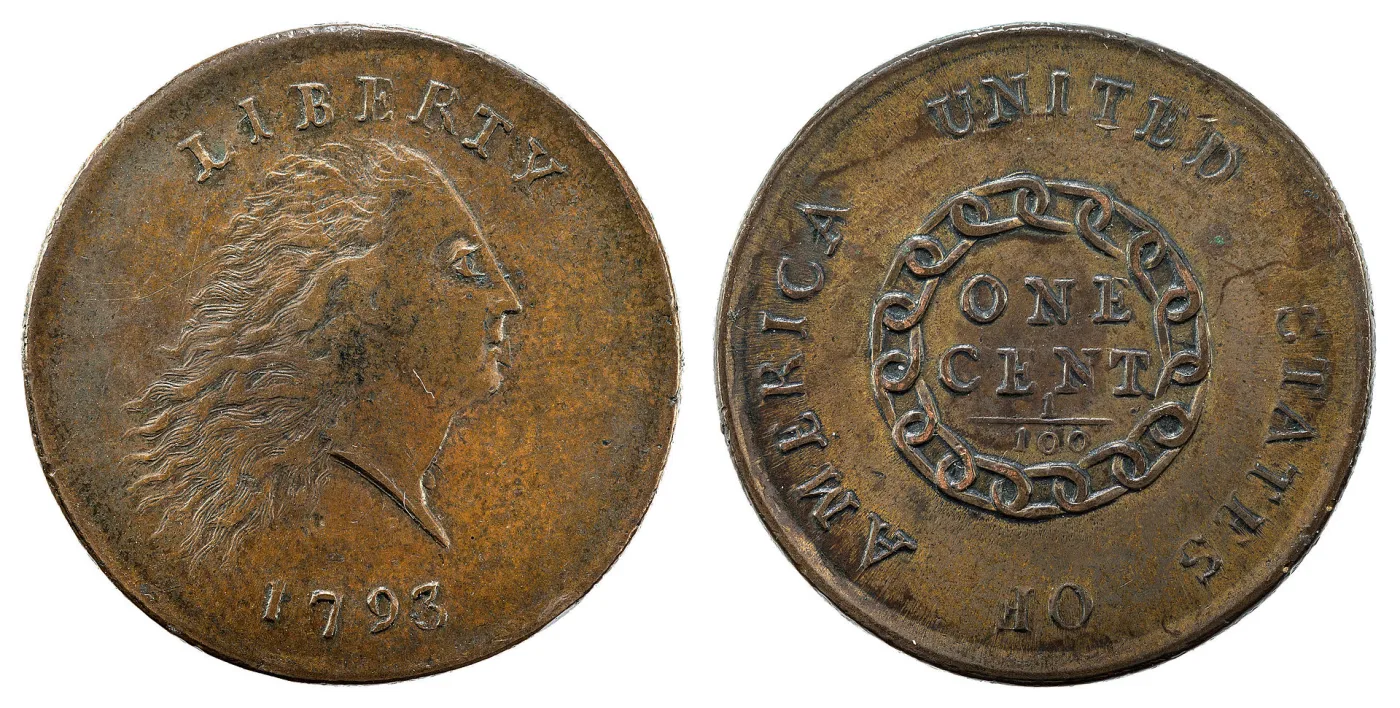
The 1793 Chain Cent is the first circulating coin struck by the United States Mint under the Coinage Act of 1792 — the very first federal coin produced for the American people, and the opening chapter of the entire large cent denomination. Struck in pure copper at the newly built Philadelphia Mint in the earliest weeks of March 1793, it takes its name from the distinctive reverse: a circle of fifteen interlinked chain links, one for each state then in the Union, enclosing the legend “ONE CENT.” No other regular-issue U.S. coin ever used this design again, and the Chain Cent was retired within a matter of weeks, making it one of the most storied and coveted single-year types in all of American numismatics.
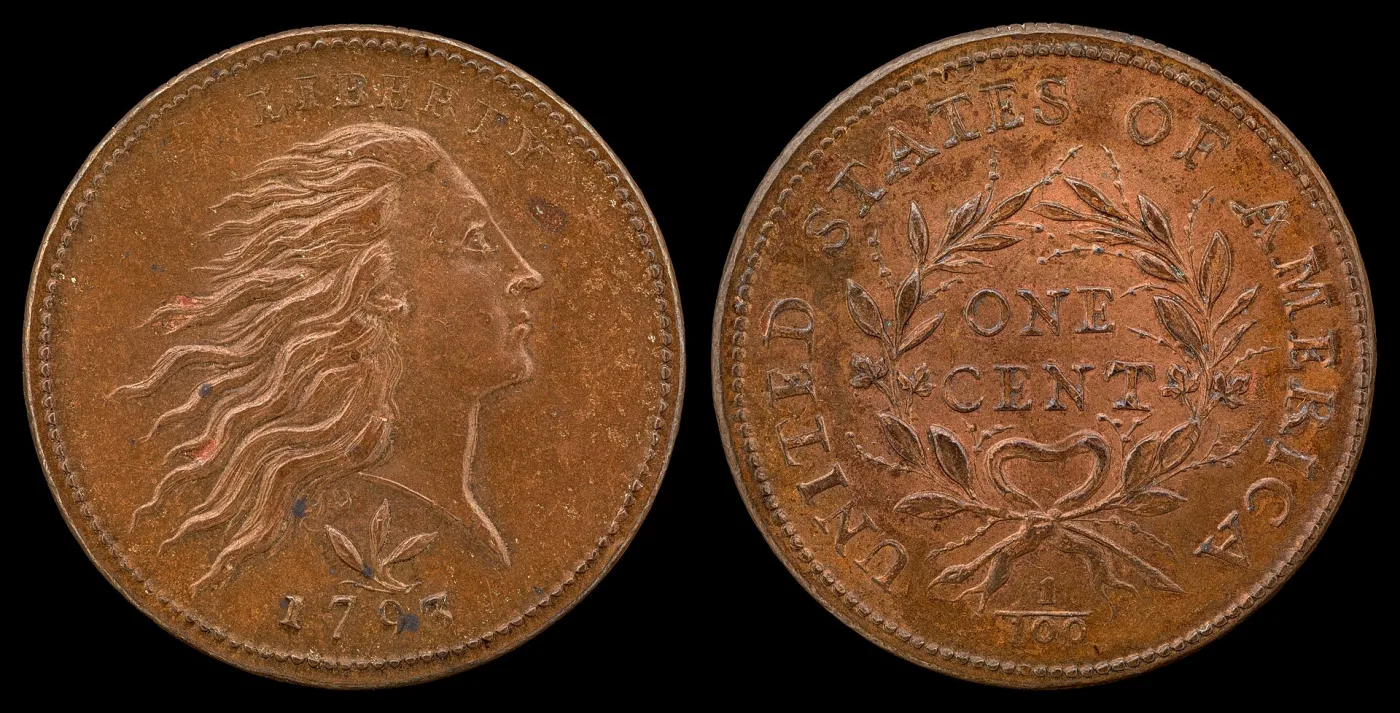
The coin was also an instant public-relations problem. The chain motif, intended to symbolize the strength and unity of the states, was widely read by a young republic as a symbol of bondage and slavery — the opposite of the liberty the new nation meant to celebrate. Contemporary newspapers criticized both the chain and the wild, frightened-looking rendering of Liberty on the obverse. The Mint responded almost immediately, replacing the chain with a wreath (the 1793 Wreath Cent, and shortly after the Liberty Cap cent) before the spring of 1793 was out. Total Chain Cent mintage was only 36,103 coins, and the survivors — most of them dark, porous, and heavily worn — are among the great prizes of early American copper.
This guide is the comprehensive 2026 reference for identifying, attributing, grading, authenticating, and valuing the 1793 Chain Cent. You will learn the diagnostic features of the Flowing Hair obverse and the chain reverse, the crucial difference between the “AMERI.” abbreviated reverse and the full “AMERICA” reverse, the “Periods” versus “no periods” obverse distinction, the four collectible Sheldon die marriages (S-1 through S-4) plus the legendary NC varieties, how to grade porous copper, how to detect the many counterfeits and altered coins that plague this type, and current market values from low-grade fillers to six- and seven-figure condition rarities. Whether you have found a mysterious early copper in an inherited collection or are a specialist chasing a Sheldon die marriage, this guide will give you a working command of America’s first coin.
History and Background
The Coinage Act of April 2, 1792 established the United States Mint and authorized a decimal system of coinage, with the copper cent as its foundational unit. After a year of building the Philadelphia Mint, acquiring equipment, and securing copper, the Mint struck its first coins for circulation in March 1793. Those coins were the Chain Cents — making them, by universal agreement, the first coins produced by the United States Mint for public circulation. (Silver half dimes were struck in 1792 as well, but as patterns or a tiny pre-Mint issue, not regular circulating coinage.) Every American cent since — from the Draped Bust and Coronet large cents to the modern Lincoln cent — descends from this first copper piece.
The dies were engraved by the Mint’s first chief coiner, Henry Voigt, working from the young institution’s limited artistic resources. The result was crude by later standards: the obverse Liberty has wild, streaming hair and a startled expression, while the reverse chain of fifteen links was meant to invoke the interlinked strength of the fifteen states (the original thirteen plus Vermont and Kentucky). The same linked-chain motif had appeared six years earlier on the 1787 Fugio Cent, the first coin authorized by the United States, where thirteen rings encircled the motto “WE ARE ONE.” The imagery backfired. A March 1793 commentary in a Philadelphia newspaper complained that “the chain on the reverse is but a bad omen for liberty, and liberty herself appears to be in a fright.” Faced with public disapproval, the Mint abandoned the chain design within weeks.
The Shortest-Lived Large Cent Type
Chain Cent production ran only from roughly March 1 to March 12, 1793, yielding 36,103 pieces before the design was replaced by the 1793 Wreath Cent, which substituted a wreath for the chain and softened Liberty’s hair. The Wreath Cent in turn gave way to the Liberty Cap large cent later in 1793. Thus 1793 alone saw three distinct large cent designs — Chain, Wreath, and Liberty Cap — a sequence unique in U.S. coinage history and a favorite challenge for type collectors. The Chain, as the first and rarest of the three, is the crown jewel.
Why the Chain Cent Matters
Beyond its rarity, the Chain Cent carries immense historical weight as the tangible beginning of federal coinage. It is a cornerstone of any early American copper collection, a blue-chip rarity in the auction market, and one of the most recognizable and symbolically loaded coins the United States ever made. For collectors of the broader large cent series, the 1793 Chain is the first coin in the album and, almost always, the most expensive.
Design and Diagnostic Features
The Chain Cent is unmistakable once you know what to look for. Its two design elements — the Flowing Hair obverse and the chain reverse — appear on no other regular-issue U.S. coin in this exact combination.
Obverse (Flowing Hair Liberty)
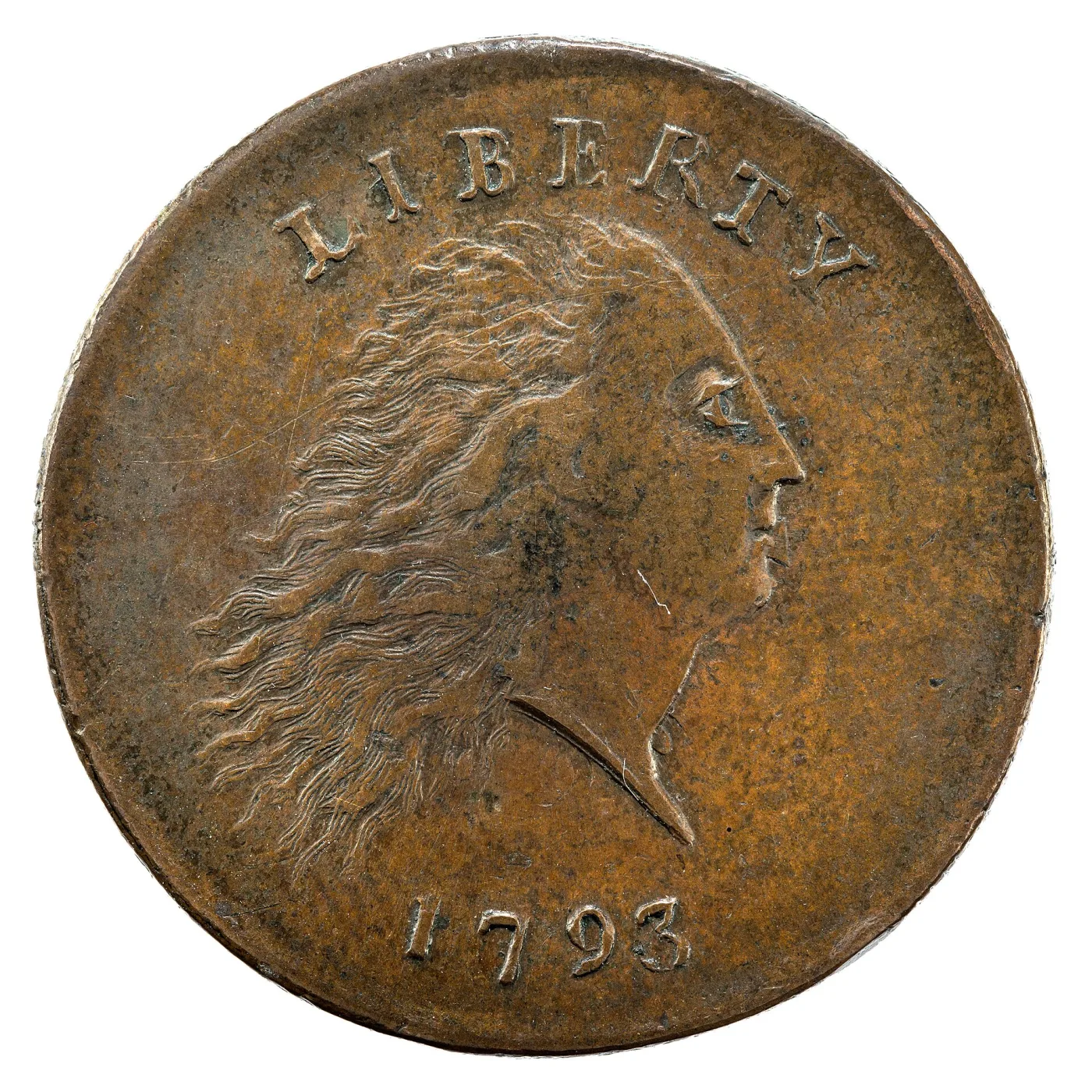
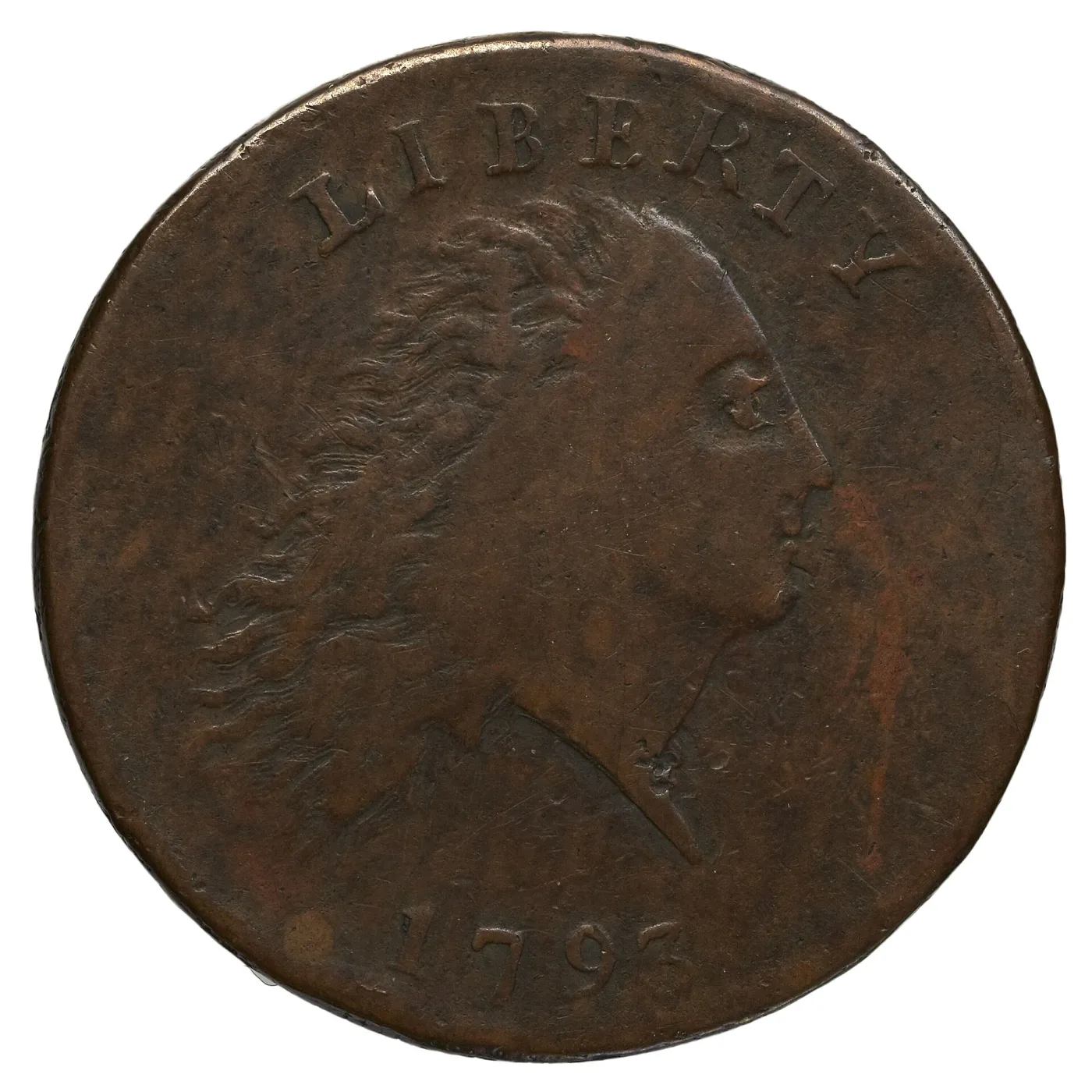
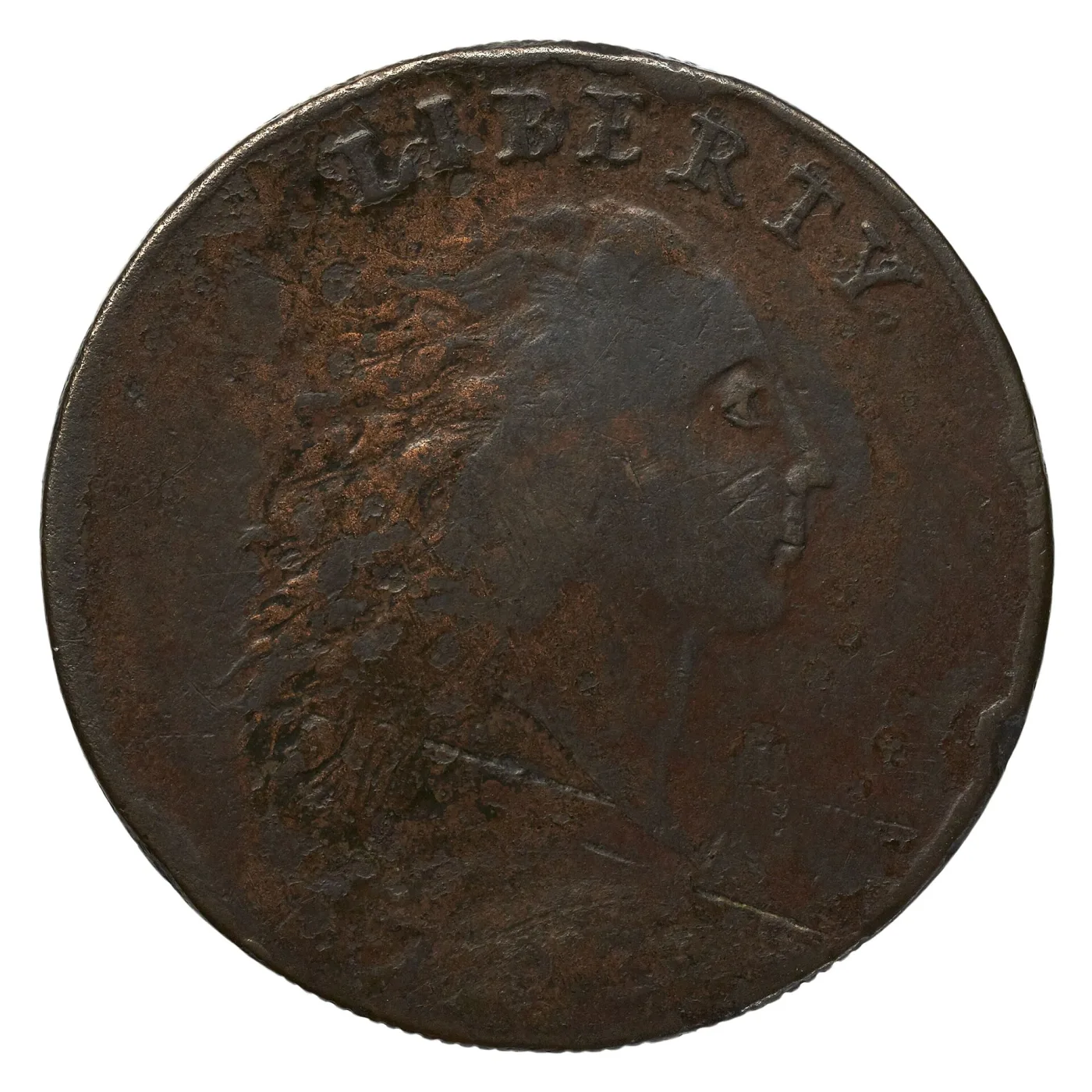
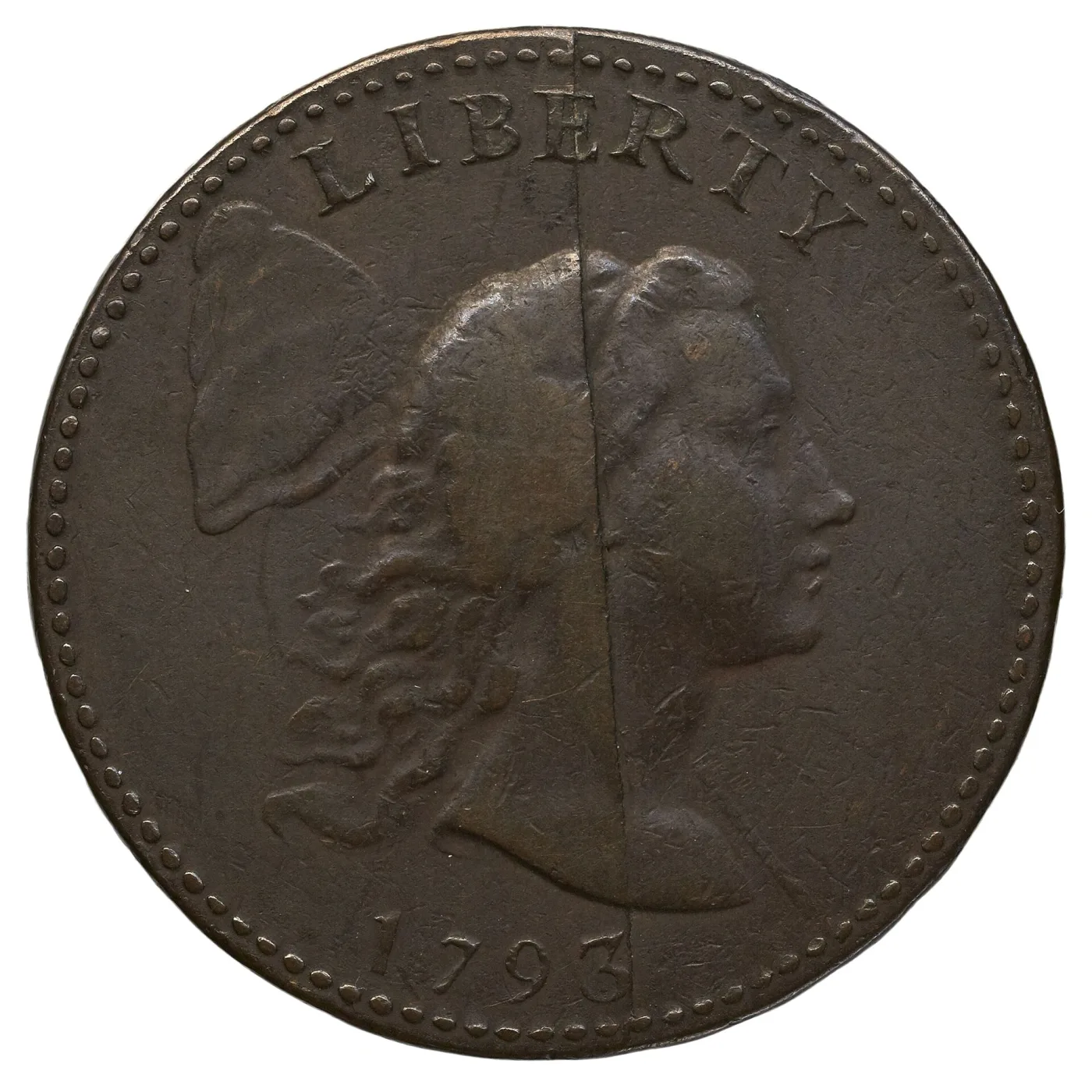
Liberty faces right, her hair streaming loosely and wildly behind and above her head with no cap, band, or coronet. The word “LIBERTY” appears above her head and the date “1793” below. There are no stars on the obverse. The rendering is deliberately simple and, to modern eyes, unrefined — the “frightened” look that contemporaries criticized. This same untamed Flowing Hair concept links the Chain Cent stylistically to the later Flowing Hair dollar and Flowing Hair half dime of 1794–1795, though each coin used a different engraver’s hand.
Reverse (The Chain)
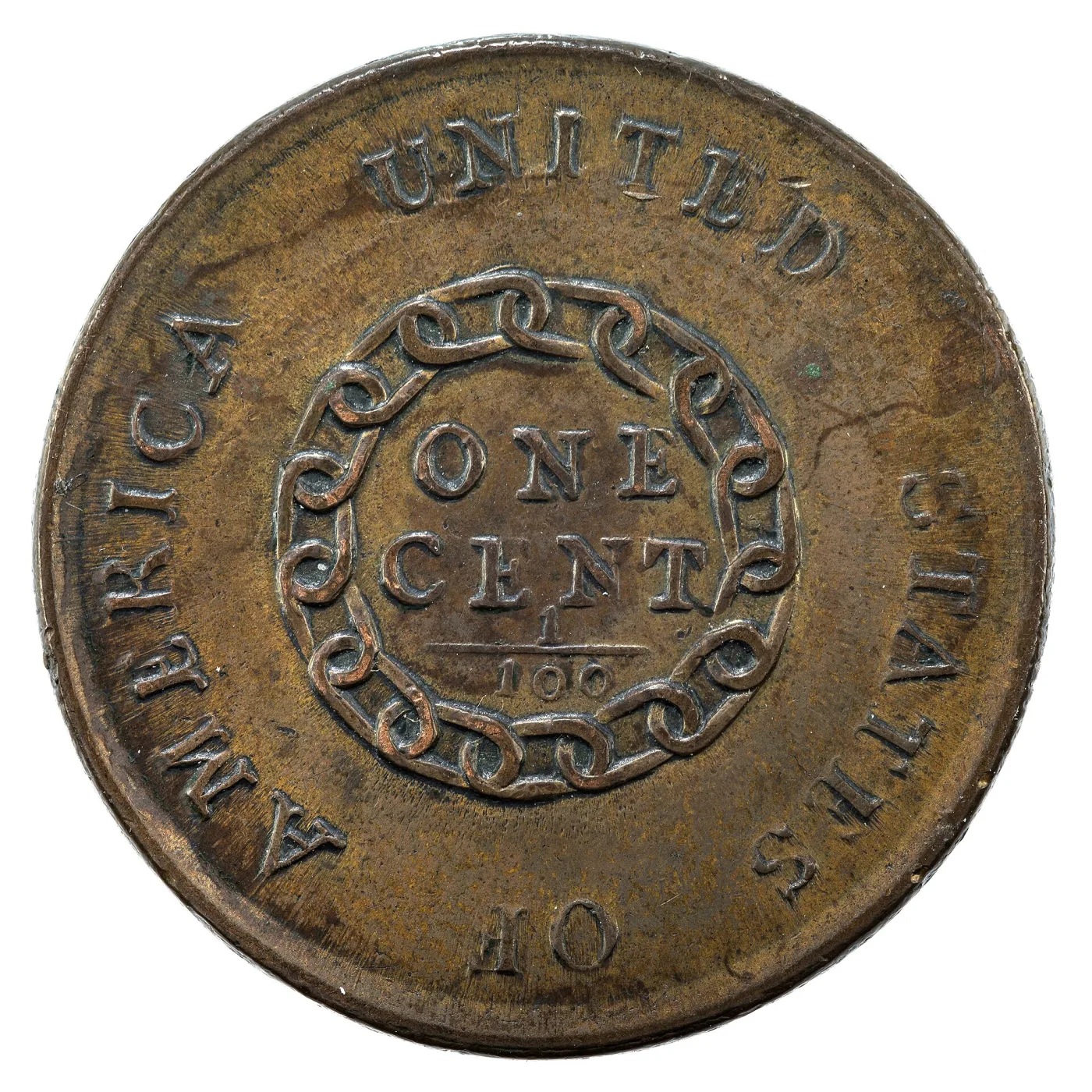
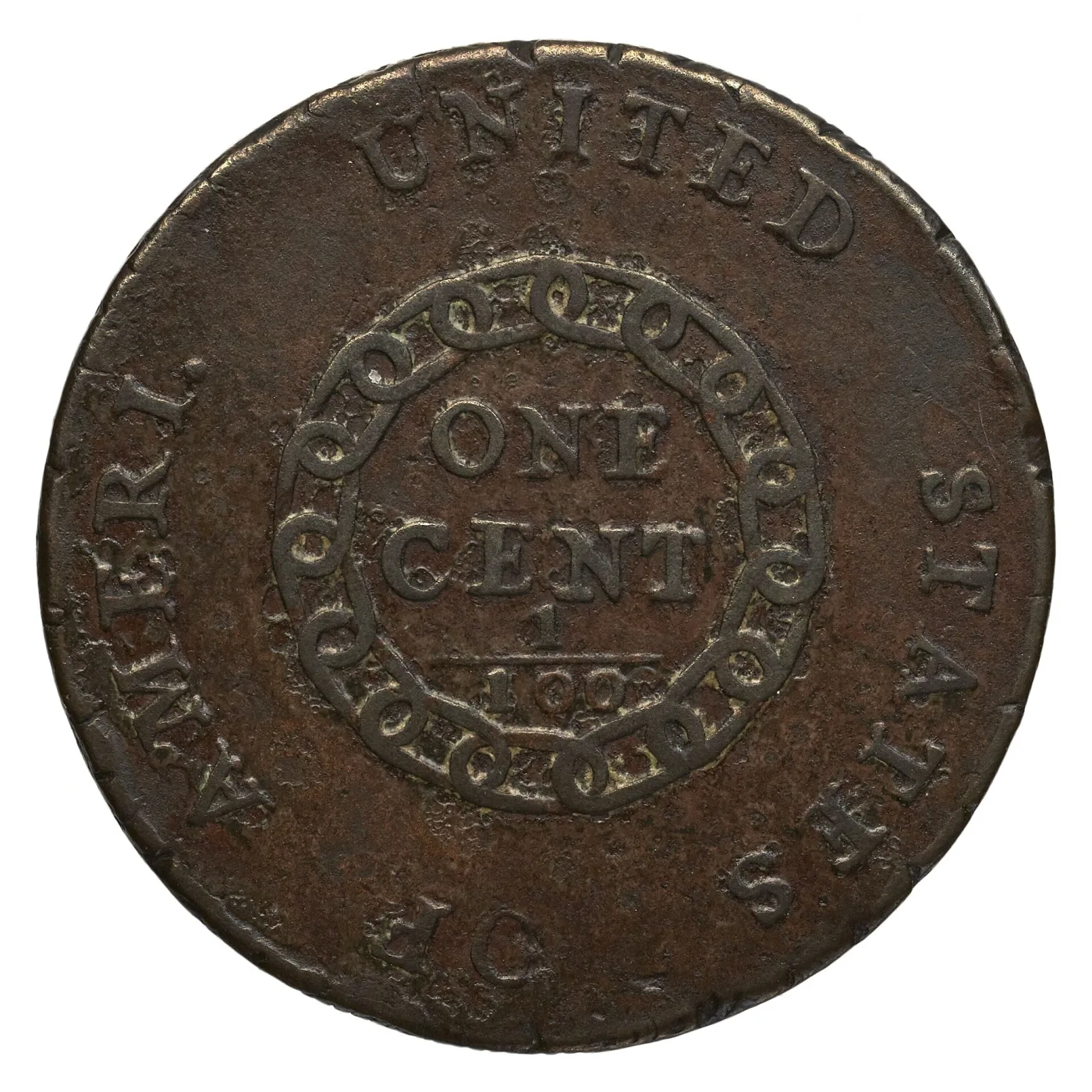
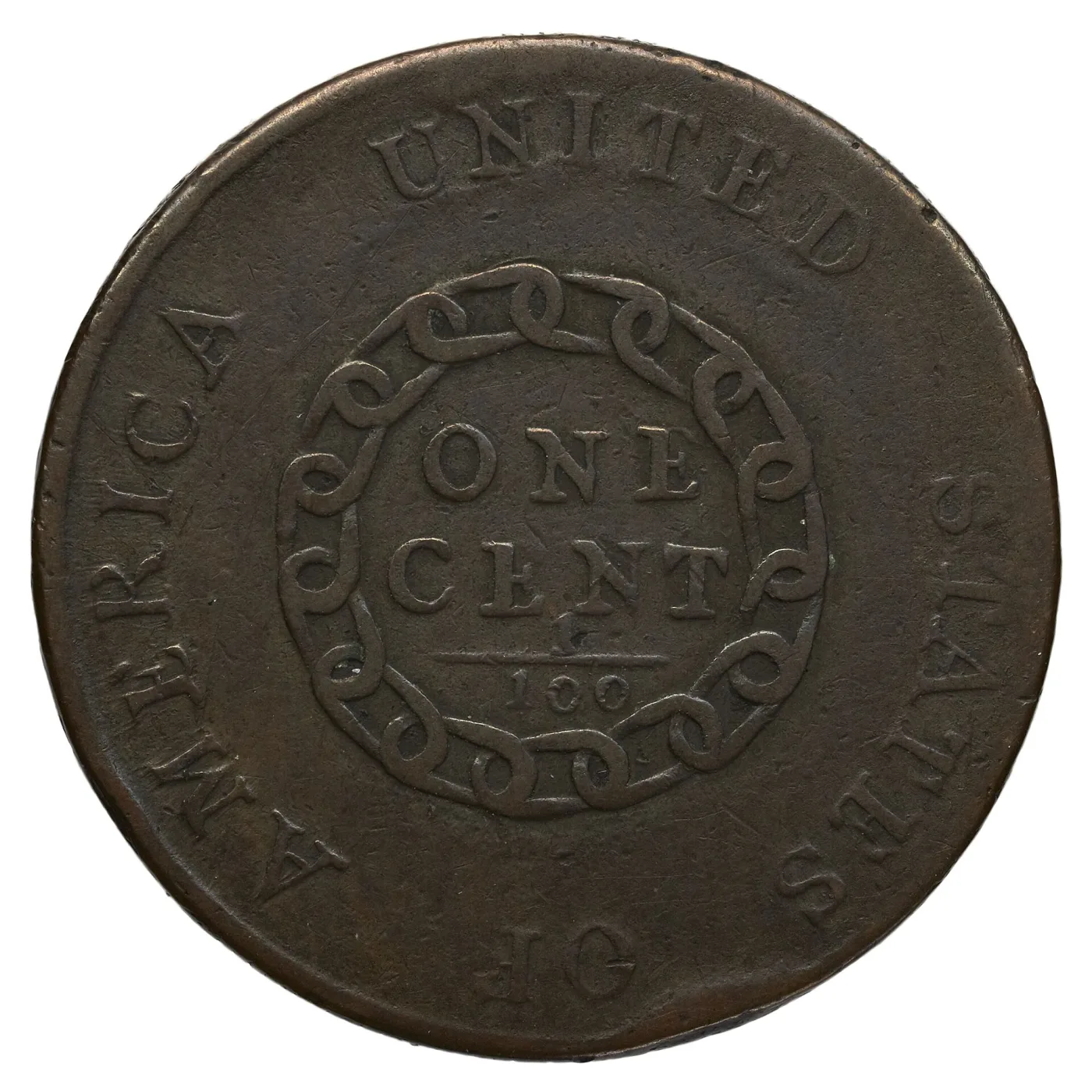
The reverse shows a continuous circle of fifteen oval chain links, enclosing the words “ONE CENT” in the center with the fraction “1/100” beneath. Around the outer edge, between the chain and the rim, runs the legend “UNITED STATES OF AMERICA” — or, on the very first dies, the abbreviated “UNITED STATES OF AMERI.” (discussed in detail below). The chain is the single most important identifier of the type: if a 1793 cent has a chain on the reverse, it is a Chain Cent and nothing else.
Edge
The edge is decorated with a raised design of vines and bars — the same protective edge treatment used on the Wreath Cent. The edge is not plain, not reeded, and not lettered with words. A genuine Chain Cent shows the vine-and-bars edge; a plain or reeded edge on a “1793 chain cent” is a major warning sign of a counterfeit or replica.
Quick Identification Summary
- Date: 1793 only. No other year exists.
- Obverse: Flowing Hair Liberty facing right, “LIBERTY” above, “1793” below, no stars.
- Reverse: Circle of 15 chain links around “ONE CENT” and “1/100,” with “UNITED STATES OF AMERI.” or “…AMERICA” around the edge.
- Edge: Vine-and-bars design (raised).
- Metal: Pure copper, roughly 26–27 mm, about 13.5 grams (Mint standard for 1793).
AMERI. vs AMERICA Reverse
The most famous and valuable distinction within the Chain Cent series is the wording of the reverse legend. This single feature separates the very first American cent variety from the rest and dramatically affects value.
The “AMERI.” Reverse
On the earliest reverse die, the engraver misjudged the available space and was forced to abbreviate the final word, so the legend reads “UNITED STATES OF AMERI.” — with “AMERICA” truncated to “AMERI.” followed by a period. This is the reverse used on the very first cents struck, and it is cataloged as Sheldon-1 (S-1). Because it was the first die and was used only briefly, the “AMERI.” Chain Cent is the rarest and most desirable of the four collectible varieties, and it holds a special place as the first distinct variety of the first U.S. coin.
The “AMERICA” Reverse
Recognizing the cramped abbreviation, the Mint quickly cut new reverse dies that spelled out the full word: “UNITED STATES OF AMERICA.” These “AMERICA” reverses appear on Sheldon-2, Sheldon-3, and Sheldon-4, which together account for the majority of surviving Chain Cents. While still rare in absolute terms, the AMERICA varieties are more available than the S-1 AMERI. and trade at lower (though still substantial) prices.
Why the Difference Matters
The AMERI. abbreviation is the headline collectible feature of the type. An “AMERI.” Chain Cent commands a strong premium over an “AMERICA” example in the same grade, and the distinction is the first thing a specialist checks. To attribute the reverse, simply read the last word of the legend under good light and, if worn, a loupe: if it reads “AMERI.” with the truncated ending, you have the S-1; if it spells out “AMERICA,” you have one of S-2, S-3, or S-4. This is the easiest and most consequential attribution you can make on the coin.
Periods vs No Periods Obverse
A second collectible distinction concerns punctuation on the obverse. On one variety, the engraver added small periods (dots) after the date and after “LIBERTY,” producing the so-called “Periods” obverse: “LIBERTY.” and “1793.” each followed by a period. This obverse is paired with an AMERICA reverse and is cataloged as Sheldon-3.
The other AMERICA varieties (S-2 and S-4) have no periods after the date or LIBERTY. The “Periods” versus “no periods” distinction is a standard attribution point among the AMERICA reverses and, together with subtle differences in the chain, lettering, and die state, allows specialists to separate S-2, S-3, and S-4. For most collectors, the practical hierarchy is simple: first determine AMERI. versus AMERICA, then, among AMERICA coins, look for the periods after LIBERTY and the date to help pin down the specific Sheldon marriage.
Attribution Order
- Read the reverse legend. “AMERI.” = S-1. “AMERICA” = S-2, S-3, or S-4.
- Check the obverse punctuation. Periods after LIBERTY and 1793 point to S-3.
- Compare die diagnostics. Chain-link shape, lettering position, and die cracks distinguish S-2 from S-4, best confirmed against a specialist reference such as Sheldon’s Penny Whimsy or William Noyes’s photographic studies.
Composition and Physical Specifications
The 1793 Chain Cent follows the large cent standard set by the Coinage Act of 1792 and the Mint’s earliest production. These specifications are essential for authentication.
Standard Specifications (1793 Chain Cent)
- Composition: 100% copper (pure)
- Weight: approximately 13.48 grams (208 grains), the 1793 large cent standard
- Diameter: approximately 26–27 mm (early cents vary; often cited as ~27 mm)
- Edge: Vine-and-bars (raised decorative design)
- Mint: Philadelphia only (no mint mark)
- Designer/Engraver: Henry Voigt (attributed)
- Year struck: 1793 only
- Total mintage: 36,103
Note that the earliest 1793 cents are slightly heavier and larger than the later large cents of the 1800s, reflecting the original higher copper standard before weight reductions. A coin claimed to be a Chain Cent that weighs dramatically off from ~13.5 grams, shows the wrong diameter, or lacks the vine-and-bars edge should be treated as suspect until authenticated. Because genuine survivors are often corroded, weight can run slightly low from metal loss — so weight is one data point, not proof by itself.
The Four Die Marriages (S-1 to S-4) and NC Varieties
The entire Chain Cent type is produced from just a handful of die marriages. Four are considered collectible and obtainable (S-1 through S-4); additional ultra-rarities carry “NC” (Non-Collectible) designations. Attribute the die marriage before pricing any Chain Cent, because the variety can swing the value dramatically.
Sheldon-1 (S-1): AMERI. Reverse
The first die marriage and the rarest of the four collectible varieties. Distinguished by the abbreviated “UNITED STATES OF AMERI.” reverse. As the very first variety of the very first U.S. coin, the S-1 AMERI. carries enormous historical cachet and the highest premium of the type. Survivors are few, and high-grade examples are extraordinary rarities.
Sheldon-2 (S-2): AMERICA, No Periods
An AMERICA-reverse marriage without the obverse periods. One of the more available Chain Cent varieties, though “available” is relative for a coin with total mintage near 36,000. A workhorse variety for collectors seeking a representative AMERICA Chain Cent.
Sheldon-3 (S-3): AMERICA, Periods (Periods Obverse)
The “Periods” variety, with small periods after “LIBERTY” and after the date “1793.” Paired with an AMERICA reverse. The periods make S-3 the most straightforward AMERICA marriage to attribute at a glance, and it is a popular target for variety collectors specifically because of the distinctive punctuation.
Sheldon-4 (S-4): AMERICA, No Periods
Another AMERICA-reverse marriage without periods, distinguished from S-2 by die diagnostics in the chain, lettering, and die state. Completes the four-coin set of collectible Chain Cent die marriages.
NC (Non-Collectible) Varieties
Beyond the four standard marriages, the Chain Cent has famous NC rarities — die combinations known from only a tiny number of surviving specimens, sometimes just one or two. The most celebrated is NC-1, an AMERI.-reverse rarity of legendary status among large cent specialists. These NC coins are essentially unobtainable for the typical collector and appear at auction only at long intervals, commanding prices that place them among the most valuable large cents in existence. Their designation as “Non-Collectible” reflects that no ordinary collector can realistically hope to assemble a set including them — not that they are undesirable; quite the opposite.

Sheldon Variety Attribution
Chain Cent varieties are cataloged under the Sheldon numbering system, the standard attribution language for U.S. large cents of 1793–1814. Large cents use Sheldon (S-) numbers, while half cents use Cohen (C-) numbers — do not confuse the two systems.
How Sheldon Numbers Work
Dr. William H. Sheldon assigned a unique number to each die marriage — a specific obverse die paired with a specific reverse die — in his landmark reference Early American Cents (1949), later revised as Penny Whimsy (1958). For 1793 he numbered the Chain Cents first: S-1 (AMERI.), S-2, S-3, and S-4 (all AMERICA), with the Wreath Cents continuing from S-5 onward. This is why the Chain Cent occupies the very front of the Sheldon catalog and of any comprehensive large cent collection.
NC Numbers
Die marriages too rare for Sheldon to include in the regular collectible sequence received “NC” (“Non-Collectible”) numbers. The Chain Cent’s NC varieties — NC-1 foremost among them — are among the most famous rarities in the entire large cent series, known from a mere handful of coins.
Why Sheldon Numbers Matter
The specific die marriage can multiply a Chain Cent’s value: an S-1 AMERI. is worth substantially more than an S-2 or S-4 AMERICA in the same grade, and an NC rarity is in a category of its own. Auction catalogs and certified-coin labels routinely cite the Sheldon number, and serious buyers purchase by variety as much as by grade. For most collectors, recording the Sheldon attribution from a reputable certification label or auction description is sufficient; advanced specialists rely on Penny Whimsy, the EAC community, and Noyes’s die-state photography for precise attribution.
Grading the Chain Cent
Grading the 1793 Chain Cent is among the most demanding tasks in U.S. numismatics. A grader must assess both technical wear (the Sheldon Scale, 1–70) and surface condition (porosity, color, planchet quality, eye appeal), and for this type — as for most early copper — the surface assessment often matters as much as the wear grade. The overwhelming majority of survivors are heavily circulated and problem-affected, so a large share of Chain Cents trade in the Good-to-Fine range and lower.
Key Wear Points
On the obverse, the highest points — Liberty’s cheek and the flowing locks of hair — wear first, and the strands of hair merge as wear progresses. The “LIBERTY” and date lettering should remain legible in Good and better. On the reverse, the raised chain links and the central “ONE CENT” are the high points; in low grades the links flatten and merge, while “ONE CENT” and “1/100” stay readable longer. Because many Chain Cents are also weakly struck or struck from worn dies, distinguishing genuine wear from strike softness takes practice and reference comparison.
Color Designations
Mint State copper is graded in three color categories, though full original color is essentially unknown on this type:
- BN (Brown): Less than 5% original mint red. Virtually all Mint State Chain Cents are brown.
- RB (Red-Brown): 5%–95% original mint red. Extraordinarily rare and enormously valuable for a Chain Cent.
- RD (Red): 95%+ original red. Effectively nonexistent for the 1793 Chain Cent given its age and the copper of the era.
The Surface (Porosity) Factor
As with the Classic Head large cent and other early copper, surface quality is a pricing axis as important as grade. A Chain Cent may grade Fine by wear but have rough, granular, porous surfaces or corrosion, dropping its market value below a smoother, lower-graded coin. Third-party services assign “details” grades (e.g., “VF Details, Corrosion” or “Environmental Damage”) to problem coins, while EAC graders apply sharp net deductions. Always assess the surface first: smooth and glossy is premium, lightly porous is average, and heavily corroded is a discount coin — even at the same technical grade.
EAC vs PCGS/NGC Grading
EAC (Early American Coppers) grades are typically several points more conservative than PCGS/NGC grades for the same coin, and the gap widens for problem-plagued types like the Chain Cent. An EAC “Fine-12” might receive a PCGS “VF-20.” EAC graders deduct heavily for porosity, cleaning, tooling, and any non-original surface — exactly the problems that plague this type. When buying from an EAC dealer, expect lower numerical grades but coins whose grade better reflects true quality; when buying certified coins, read the surface yourself and never assume a high number means a smooth, original coin.
Counterfeit Detection and Authentication
Because the 1793 Chain Cent is so valuable and so famous, it is among the most frequently counterfeited and faked U.S. coins. Deceptions range from crude souvenir replicas to sophisticated altered and cast pieces. Authentication by a major grading service is essential for any coin claimed to be genuine.
Cast and Struck Counterfeits
Cast counterfeits show characteristic surface pitting (a fine “orange-peel” texture), softened detail, mushy rims, and seams along the edge where a casting mold joined. They often weigh incorrectly and lack the crisp, sharp devices of a struck coin. Struck counterfeits from false dies can be more deceptive but usually fail on precise die diagnostics, lettering shape, and edge treatment. The genuine vine-and-bars edge is difficult to fake convincingly; a wrong, plain, or blurry edge is a strong red flag.
Altered and “Manufactured” Coins
Some fakes begin with a genuine but heavily worn or damaged 1793 cent (even a Wreath Cent) that has been tooled, re-engraved, or otherwise manipulated to imitate a Chain Cent or a rarer variety. Others are entirely modern products. Examine the fields and devices under 10x magnification for tool marks, re-engraving, smoothing, or added detail, and be suspicious of any coin whose surfaces look “worked.”
Replicas and Souvenirs
Replica Chain Cents are sold openly as museum-shop souvenirs and history-set pieces, typically in the wrong metal or size and often (as U.S. law has required since 1973) stamped “COPY.” Any piece marked “COPY,” struck in brass or a plated base metal, or showing the wrong weight and color is a replica, not a genuine coin. These have no numismatic value as Chain Cents.
Weight, Diameter, and Edge Checks
Three quick physical checks screen out many fakes: the coin should weigh roughly 13.5 grams (allowing for corrosion loss), measure around 26–27 mm, and show the raised vine-and-bars edge. A coin that fails any of these — especially the edge — should be presumed inauthentic until proven otherwise.
Third-Party Certification
For any coin represented as a genuine 1793 Chain Cent, certification by PCGS, NGC, or ANACS is effectively mandatory. Given the values involved and the prevalence of fakes, no significant Chain Cent should be bought raw unless you have the expertise to authenticate it yourself and accept the risk. Certification resolves authenticity, variety attribution, and the critical surface/porosity question in one step. Many advanced buyers also value the EAC net-grading perspective for problem coins.
Current Market Values
The 1793 Chain Cent is a five-figure coin even in low grades and reaches six and seven figures at the top of the market. Values vary enormously by variety (AMERI. vs AMERICA), grade, and — critically — surface quality. The figures below are 2026 retail estimates for genuine, problem-free examples with average (lightly porous) surfaces; smooth, glossy coins bring strong premiums, while corroded or damaged coins trade at steep discounts, and “details”-graded problem coins sell well below the numbers shown. Auction results for premium and finest-known pieces regularly exceed these estimates.
AMERICA Reverse (S-2, S-3, S-4) — More Available
- AG-3: $6,000–$9,000
- G-4: $10,000–$14,000
- VG-8: $16,000–$22,000
- F-12: $28,000–$38,000
- VF-20: $55,000–$80,000
- EF-40: $120,000–$180,000
- AU and Mint State: $250,000 to well over $1,000,000
AMERI. Reverse (S-1) — The Rarest Variety
- AG-3: $12,000–$18,000
- G-4: $18,000–$28,000
- VG-8: $30,000–$45,000
- F-12: $55,000–$80,000
- VF-20: $110,000–$170,000
- EF-40 and finer: $250,000 to seven figures
NC Varieties (NC-1 and other die marriages)
The NC rarities are essentially priceless in the practical sense — they appear at auction only rarely, and when they do, they can realize sums placing them among the most valuable large cents ever sold, often into the high six or seven figures depending on the specimen and grade.
Factors That Move the Price
- Variety: AMERI. (S-1) over AMERICA (S-2/3/4); NC in a class of its own.
- Surface: Smooth, glossy original surfaces command large premiums; porosity, corrosion, tooling, and cleaning drop values sharply.
- Grade: Even one point of grade can mean tens of thousands of dollars at the higher levels.
- Eye appeal and pedigree: Attractive coins with distinguished provenance bring premiums at auction.
Because values are so high and so sensitive to authenticity and surface, always rely on current certified auction records and a trusted specialist dealer when buying or selling — the estimates above are a starting framework, not a substitute for coin-in-hand evaluation.
Collecting Strategies
Few collectors will ever own more than one 1793 Chain Cent, so strategy centers on how to acquire a single meaningful example — or, for the well-resourced specialist, how to pursue the varieties.
The Single Type Coin
The most common goal is one Chain Cent to represent the type in a large cent type set (Chain, Wreath, Liberty Cap, Draped Bust, Classic Head, Coronet, Braided Hair) or a “first year of issue” set. Most collectors target an AMERICA-reverse coin (S-2, S-3, or S-4) in a grade they can afford — often AG-3 to G-4 — prioritizing a genuine, honestly graded coin with the most pleasing surfaces available in budget. A problem-free G-4 is a far better long-term hold than a “details” VF.
Surface Over Grade
For this type especially, choose surface quality over raw grade. A smooth, evenly worn Good-4 with original color and no corrosion is more desirable — and more liquid — than a higher-graded coin with rough, porous, or tooled surfaces. Experienced early-copper collectors would rather own a “nice” low-grade Chain Cent than a “problem” higher-grade one.
The Variety Set (S-1 through S-4)
The advanced pursuit is a set of the four collectible die marriages: the S-1 AMERI. plus the three AMERICA varieties (S-2, S-3, S-4). This is a major undertaking — the S-1 alone is a formidable and expensive acquisition — but it is the definitive way to collect the type short of the unobtainable NC rarities. Assembling all four is a lifetime achievement for a large cent specialist.
Where the Chain Cent Fits
The Chain Cent anchors the front of an early American coppers collection and the very first page of a date-run large cent set. Collectors often build outward from it through the 1793 Wreath and Liberty Cap cents, then into the Draped Bust and later types. Understanding how early copper is graded is essential before spending five figures on any single coin.
Storage and Preservation
Copper is the most chemically reactive of the coinage metals, and a 230-year-old cent — often already porous — demands careful handling to prevent further deterioration.
Never Clean the Coin
Cleaning copper destroys natural patina and microscopic surface detail and is irreversible. Cleaned Chain Cents are described as “harshly cleaned,” “lightly cleaned,” or “recolored” and receive details grades, trading at heavy discounts. On a coin this valuable, a cleaning can erase tens of thousands of dollars of value. Never attempt to “improve” a dark or porous Chain Cent — the porosity is in the metal and cannot be removed, and any attempt only adds a cleaning problem on top of it. If a coin is uncertified and you believe it may be genuine, submit it for authentication rather than touching the surfaces.
Avoid PVC and Plasticizers
PVC (“polyvinyl chloride”) flips and album pages leach plasticizers that react with copper to form a corrosive green slime — a common disaster for inherited copper. Move any raw Chain Cent out of PVC immediately and store it in inert Mylar, acid-free paper, or a hard inert capsule.
Humidity Control
High humidity accelerates copper corrosion and spotting, a particular danger for an already-porous planchet. Store copper below 50% relative humidity, ideally 30%–40%, with silica gel in the container. Avoid basements, attics, and garages where humidity swings seasonally.
Long-Term Storage
For a coin of this value, a certified PCGS or NGC holder provides an inert, sealed, tamper-evident environment and is the standard way to store and trade a genuine Chain Cent. Inspect any stored copper periodically for new spotting or color change, and address active corrosion immediately, since it can progress quickly on a porous surface.
Frequently Asked Questions
What is a 1793 Chain Cent worth in 2026?
Genuine, problem-free AMERICA-reverse Chain Cents (S-2, S-3, S-4) retail from roughly $6,000–$9,000 in About Good up to $120,000–$180,000 in EF-40, with AU and Mint State coins reaching $250,000 to over $1,000,000. The rarer AMERI. reverse (S-1) commands a strong premium at every grade. Surface quality matters enormously: corroded, cleaned, or "details"-graded coins sell well below these figures.
Why is it called a "Chain" Cent?
The reverse features a circle of fifteen interlinked chain links — one for each state then in the Union — enclosing "ONE CENT." The chain was meant to symbolize the strength and unity of the states, but the public read it as a symbol of bondage, and the Mint replaced the design within weeks.
What is the difference between the AMERI. and AMERICA Chain Cents?
On the first reverse die (Sheldon-1), the engraver ran out of room and abbreviated the legend to "UNITED STATES OF AMERI." The Mint then cut new dies spelling out "UNITED STATES OF AMERICA" (Sheldon-2, 3, and 4). The AMERI. variety is the rarest and most valuable; read the last word of the reverse legend to tell them apart.
Was the Chain Cent really the first U.S. coin?
The 1793 Chain Cent is regarded as the first circulating coin struck by the United States Mint under the Coinage Act of 1792. A small number of 1792 half dimes exist, but they are considered patterns or a pre-Mint issue rather than regular circulating coinage. The Chain Cent is therefore the first federal coin made for public circulation.
How many 1793 Chain Cents were made and how many survive?
Total mintage was 36,103 across all die marriages. The number of survivors is much smaller — most were heavily used and many were lost or destroyed — with estimates commonly in the low thousands across all grades, and only a tiny fraction in high grade or with clean surfaces.
Do Chain Cents use Sheldon or Cohen numbers?
Sheldon (S-) numbers. Large cents of 1793–1814 are attributed by the Sheldon system; half cents use the Cohen (C-) system. The Chain Cents are S-1 (AMERI.), S-2, S-3, and S-4 (all AMERICA), plus NC rarities such as NC-1. Do not confuse the two attribution systems.
How can I tell if my 1793 Chain Cent is genuine?
Check three physical features first: the coin should weigh about 13.5 grams, measure roughly 26–27 mm, and show a raised vine-and-bars edge (not plain or reeded). Examine the surfaces under magnification for casting pits, seams, tool marks, or a "COPY" stamp. Given how often this coin is faked, any piece believed to be genuine should be authenticated by PCGS, NGC, or ANACS before purchase or sale.
What came after the Chain Cent in 1793?
The Mint replaced the chain reverse with a wreath (the 1793 Wreath Cent) within weeks, then introduced the Liberty Cap large cent later the same year. So 1793 alone produced three large cent designs — Chain, Wreath, and Liberty Cap — a sequence found in no other year. For the full arc of the denomination, see the large cent overview guide.
Can I find a Chain Cent in circulation or in a coin roll today?
No. Large cents were discontinued in 1857 and the Chain Cent has not circulated for well over two centuries. Genuine examples are found only through specialist dealers, major auctions, and long-held collections, and are not legal tender for current transactions. Any "Chain Cent" found loose or in a roll is a replica or novelty piece.