Liberty Cap Large Cent Identification Guide: 1793 Chain Cent, Wreath Cent, Liberty Cap, AMERI. and LIHERTY Varieties, Sheldon Attribution, Grading, and Values
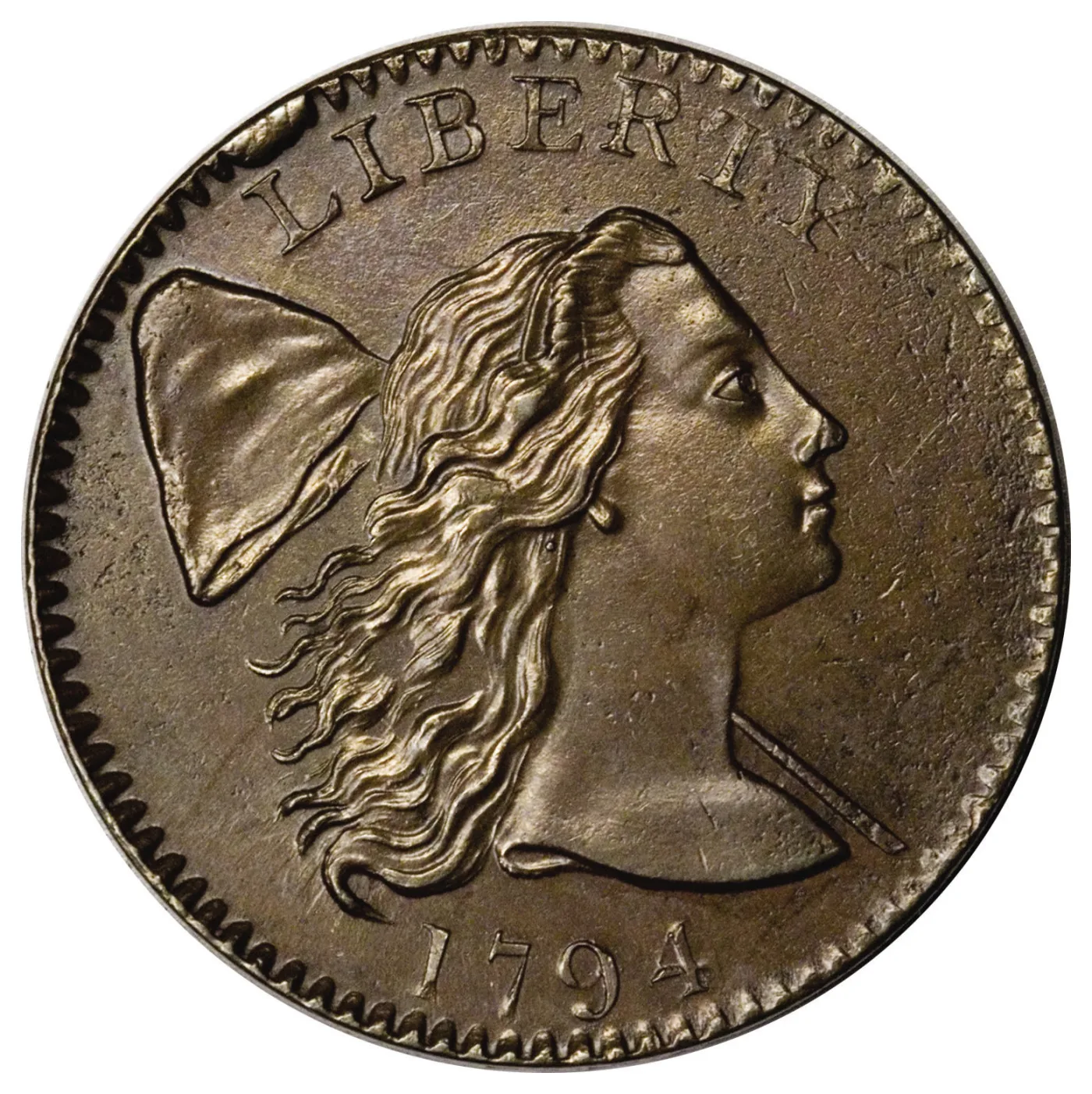
The Liberty Cap Large Cent era covers the very first cents struck by the United States Mint — the foundational copper coinage of 1793 through 1796. Within these four years the Mint produced three completely different one-cent designs in rapid succession: the legendary Chain cent and Wreath cent of early 1793 (both with the wild, windblown “Flowing Hair” Liberty), followed by the Liberty Cap cent introduced in mid-1793 and carried through 1796. These are the cornerstone coins of American numismatics — the coins that launched the entire large cent denomination that would run until 1857 — and they include some of the most famous, most valuable, and most heavily collected early coppers in existence.
No other short stretch of U.S. coinage packs in this much history and rarity. The 1793 Chain cent was the first circulating coin struck under federal authority at the brand-new Philadelphia Mint, produced for just twelve days before public criticism forced a redesign. The Wreath cent that replaced it lasted only a few months before the Liberty Cap design took over. The 1793 Liberty Cap is one of the rarest regular-issue large cents of all, and the series is studded with celebrated rarities: the Chain “AMERI.” abbreviation, the 1793 “Strawberry Leaf” cent, the 1794 “Starred Reverse,” the 1795 “Jefferson Head,” and the famous 1796 “LIHERTY” misspelling.
This guide is the comprehensive 2026 reference for identifying, attributing, grading, authenticating, and valuing the 1793-1796 large cents. You will learn how to tell the three 1793 designs apart at a glance, how to recognize the Chain, Wreath, and Liberty Cap subtypes, how to read the Sheldon die-variety system that governs these coins, how to spot the headline rarities, how to grade heavily worn and frequently damaged copper using EAC standards, and how to detect the alterations and cast counterfeits that plague this high-value series. Whether you have pulled a mysterious crude copper from an inherited box, you are assembling a four-coin large cent type set, or you are chasing the 1793 issues that anchor any serious early-copper collection, this guide will give you a working specialist’s command of the first United States cents.
History and Background
The large cent denomination was authorized by the Coinage Act of April 2, 1792, which established the United States Mint in Philadelphia and defined the cent as a copper coin worth one-hundredth of a dollar. The first cents reached circulation in 1793, making them — alongside the half cent — the very first coins struck for circulation by the federal government. (A handful of 1792 patterns, such as the silver-center cent and the Birch cent, preceded them, but those were experimental pieces, not regular coinage.) The 1793 cent is therefore the true starting point of United States circulating coinage, and that historical primacy is a large part of why these coins are so avidly collected.
The young Mint was improvising. It lacked reliable equipment, skilled engravers, and a steady supply of good copper, and it was working out basic questions of design and production in real time. The result was three different cent designs in a single year — an unmatched rate of change driven by mechanical trouble, public criticism, and the Mint’s own learning curve. Each redesign tells part of the story of an institution finding its feet.
Three Designs in One Year
Production began in late February 1793 with the Chain cent, whose reverse showed a chain of fifteen interlocking links (one for each state). The public reportedly read the chain as a symbol of slavery rather than union, and the crude, frightened-looking Liberty on the obverse drew ridicule. The Mint quickly replaced the chain reverse with a graceful wreath — the Wreath cent — in the spring. By mid-1793 the obverse Liberty was also redesigned, gaining a liberty cap on a pole behind her head, producing the Liberty Cap cent that would continue through 1794, 1795, and 1796.
The End of the Liberty Cap and the Transition to Draped Bust
In 1796 the Mint replaced the Liberty Cap design with Robert Scot’s Draped Bust large cent, which had already debuted on the silver dollar. Because the change occurred during 1796, both the Liberty Cap and the Draped Bust cent were struck that year, making 1796 a two-design transition date. The Draped Bust type then ran through 1807, followed by the Classic Head (1808-1814) and the Coronet and Braided Hair types (1816-1857). The 1793-1796 issues thus form the opening chapter of the long large cent story told in our large cent overview guide.
Companion to the First Half Cent
The cent did not arrive alone. The Liberty Cap half cent also debuted in 1793, sharing the same liberty-cap-on-a-pole motif (though the half cent’s Liberty faced left in 1793 and right thereafter, the reverse of the cent’s progression). The two denominations are natural companions, and the same crude charm, poor copper, and great rarities define both. Collectors of early American copper frequently pursue the 1793 cent and the 1793 half cent together as the twin firstborn of the U.S. Mint.
The Three 1793 Designs at a Glance
The single most important identification skill for this era is telling the three 1793 cent designs apart. All three share the same denomination, diameter, and pure-copper composition, but their obverses and reverses are distinct. Use this quick decision tree before anything else.
Step 1: Look at the Reverse
- Chain of links? It is a Chain cent (early 1793 only). Fifteen interlocking oval links encircle “ONE CENT” and “1/100,” with “UNITED STATES OF AMERICA” (or the abbreviated “AMERI.”) around the outside.
- Open wreath with a bow? It is either a Wreath cent (1793) or a Liberty Cap cent (1793-1796). Proceed to Step 2 to separate them by the obverse.
Step 2: Look at the Obverse (for wreath-reverse coins)
- Flowing, windblown hair and NO cap? It is a Wreath cent (1793). Liberty’s hair streams wildly with no cap and no pole.
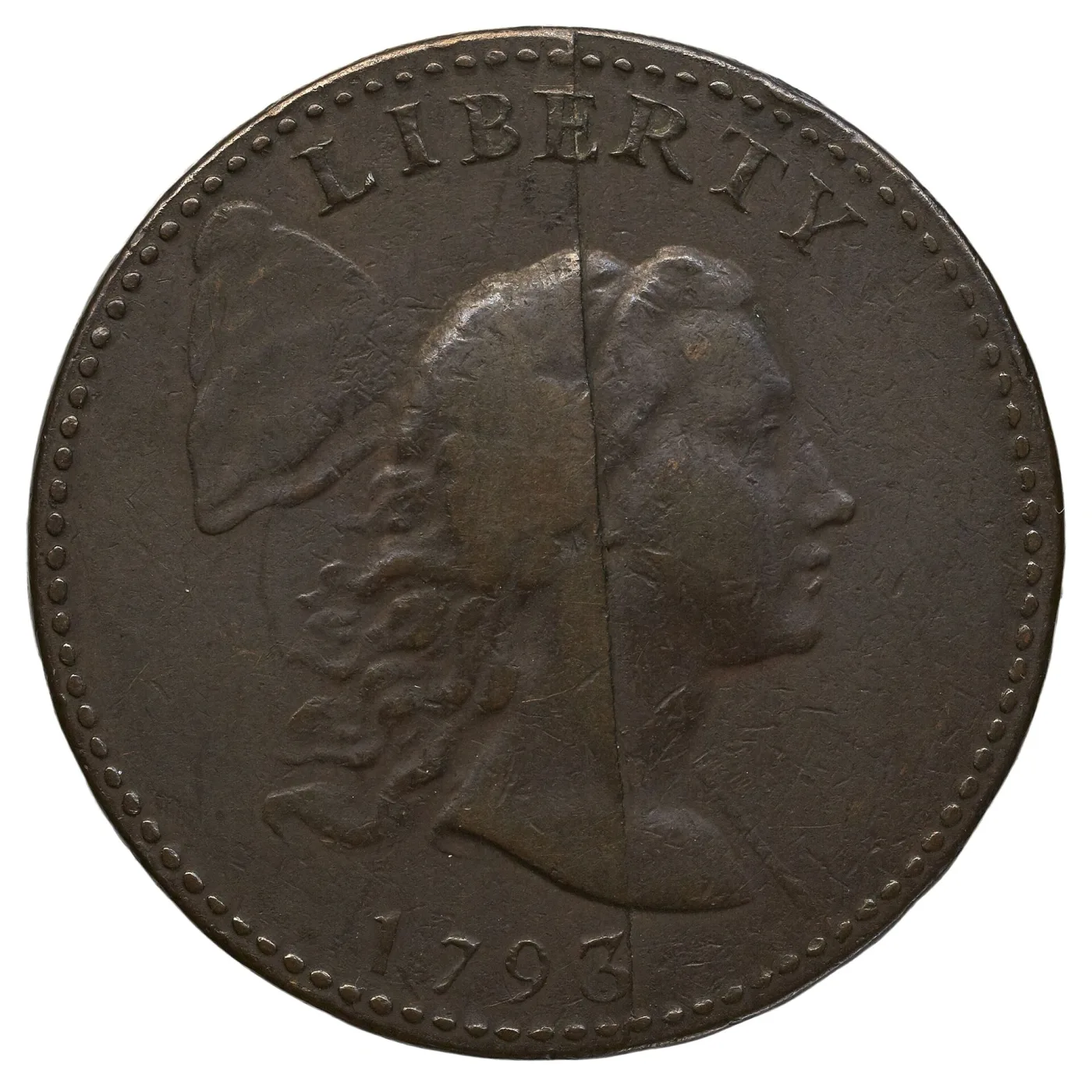
- A liberty cap on a pole behind the head? It is a Liberty Cap cent (1793-1796). A soft “Phrygian” cap sits atop a pole that rests against the back of Liberty’s neck and shoulder.
The Flowing Hair Connection
Both the Chain and Wreath cents wear the same “Flowing Hair” portrait of Liberty — the same general style used on the 1794-1795 Flowing Hair dollar and Flowing Hair half dollar. The Chain and Wreath cents are therefore sometimes grouped as the “Flowing Hair” large cents, while the Liberty Cap is treated as a separate type. For collecting and cataloging purposes, however, the three are usually counted as three distinct subtypes within the 1793-1796 large cent era.
The 1793 Chain Cent
The 1793 Chain cent is the most historically significant U.S. large cent and one of the most coveted coins in all of American numismatics. It was the first circulating coin struck under the authority of the new federal Mint, and its entire production run lasted only about twelve days in late February and early March 1793. The total mintage was just 36,103 pieces, and survivors in any grade are scarce and expensive.
Design
The obverse shows Liberty facing right with long, loose, flowing hair and the inscription “LIBERTY” above and the date “1793” below. The portrait was widely criticized at the time as crude and wild-eyed. The reverse displays a chain of fifteen interlocking oval links — one for each of the fifteen states then in the Union — surrounding “ONE CENT” with the fraction “1/100” at the center, and the legend running around the rim outside the chain. The chain was intended as a symbol of the strength of the united states, but the public read it as an emblem of bondage, and the design was abandoned almost immediately.
The AMERI. Variety (Sheldon-1)
The most famous Chain cent variety is the “AMERI.”, cataloged as Sheldon-1. On this first reverse the engraver, apparently worried about fitting the legend into the available space, abbreviated “AMERICA” as “AMERI.” — so the legend reads “UNITED STATES OF AMERI.” This is the rarest readily collectible Chain variety and one of the most desirable U.S. coins of any type. The remaining Chain varieties (Sheldon-2, Sheldon-3, and Sheldon-4) spell “AMERICA” in full.
Chain Cent Sheldon Varieties
- S-1 (AMERI.): The abbreviated-legend variety, the most famous and among the most valuable of all large cents.
- S-2 (AMERICA): Pairs the AMERI. obverse with a full-AMERICA reverse; the scarcest of the four collectible Chain varieties, with only an estimated 125-150 survivors in all grades.
- S-3 (AMERICA): A new obverse with the full-AMERICA reverse; the most available Chain variety, with perhaps 600-700 survivors.
- S-4 (AMERICA): The “periods” variety, with a period after both LIBERTY and the date; full AMERICA reverse.
- NC-1: A non-collectible rarity known from only a handful of pieces, reserved for advanced specialists.
Identifying a Genuine Chain Cent
A genuine Chain cent has a plain edge with a fine raised line (a “beaded” or “vine” treatment is found on the Wreath cent, not the Chain). The chain links are clearly raised and three-dimensional. Because Chain cents are so valuable — even a heavily worn, problem example can be worth five figures — any suspected Chain cent should be authenticated by a major grading service before purchase. Cast copies and crude electrotypes of the Chain cent have circulated among unsuspecting buyers for over a century.
The 1793 Wreath Cent
After the Chain reverse was abandoned, the Mint introduced the 1793 Wreath cent in the spring of 1793. With a mintage of roughly 63,353 pieces, it is more available than the Chain cent but still genuinely scarce, and it is far more attractive — the open wreath and refined Flowing Hair portrait represent a clear artistic improvement over the rushed Chain design.
Design
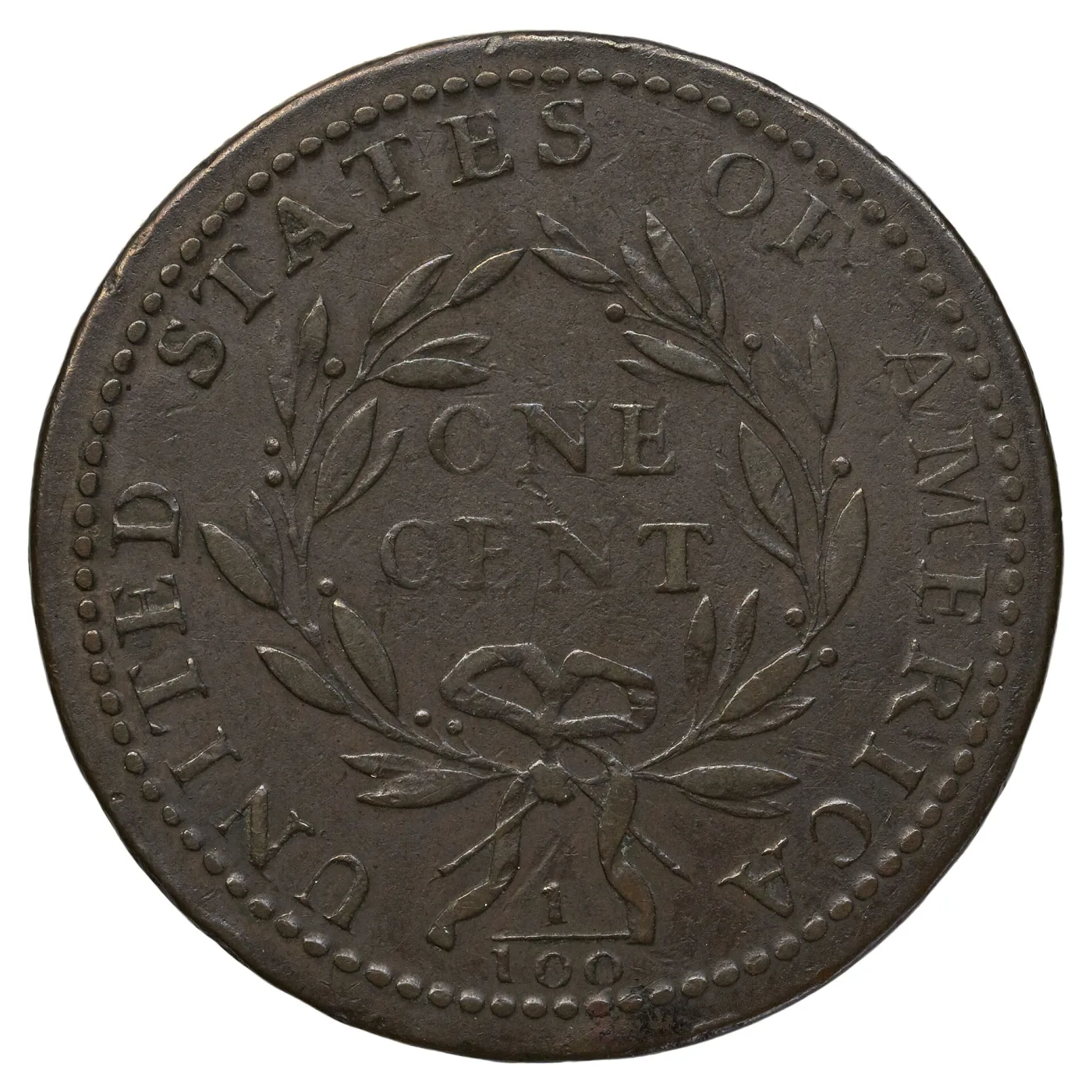
The obverse retains a Flowing Hair Liberty facing right, but the portrait is more carefully executed, and a sprig of leaves (often called the “cotton” or “leaf” sprig) appears below the bust, between Liberty and the date. The reverse shows a graceful open wreath tied with a bow at the bottom, enclosing “ONE CENT” with “1/100” below, and “UNITED STATES OF AMERICA” around the rim. The wreath reverse would, in modified form, carry through the Liberty Cap and Draped Bust series for years to come.
Edge Varieties: Vine and Bars vs. Lettered Edge
The Wreath cent is found with two distinct edge treatments, an important identification and value point:
- Vine and Bars edge: A decorative edge showing a vine with leaves alternating with bars. This is the more common Wreath cent edge.
- Lettered edge: The edge is inscribed “ONE HUNDRED FOR A DOLLAR” followed by a decorative leaf. This edge variety is scarcer and generally commands a premium.
Always examine the edge of a Wreath cent — the edge type is part of the coin’s attribution and affects its value.
The Strawberry Leaf Cent
The single most famous Wreath cent rarity is the 1793 “Strawberry Leaf” cent, one of the most celebrated rarities in the entire U.S. series. On this variety the sprig below the bust resembles a three-leaf strawberry plant with a blossom, instead of the normal cotton/leaf sprig. Only four examples are known to exist, none in high grade, and the variety is essentially unobtainable for ordinary collectors — when one appears at auction it brings a price in the high six or seven figures. The Strawberry Leaf is mentioned here for identification awareness: if you ever encounter a 1793 Wreath cent whose under-bust sprig looks unusual, it warrants expert examination, though genuine examples are vanishingly rare and altered or misidentified pieces far outnumber the real ones.
The Liberty Cap Cent (1793-1796)
The Liberty Cap design, introduced in mid-1793, is the longest-lived of the early cent types, running through 1796. It is the design most collectors mean when they refer to a “Liberty Cap large cent,” and it forms the bridge between the experimental 1793 Flowing Hair coppers and the more settled Draped Bust coinage that followed.
Design
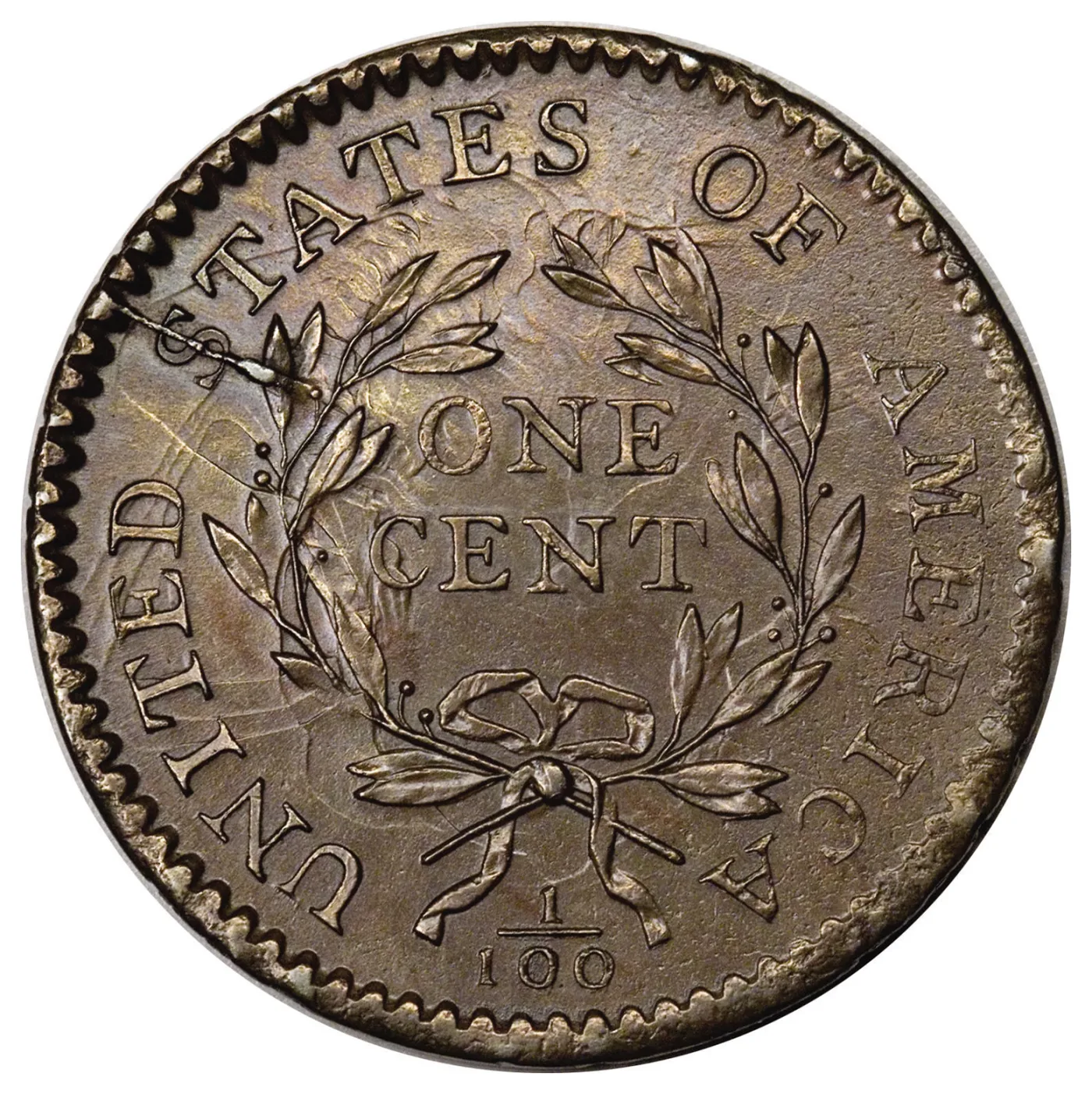
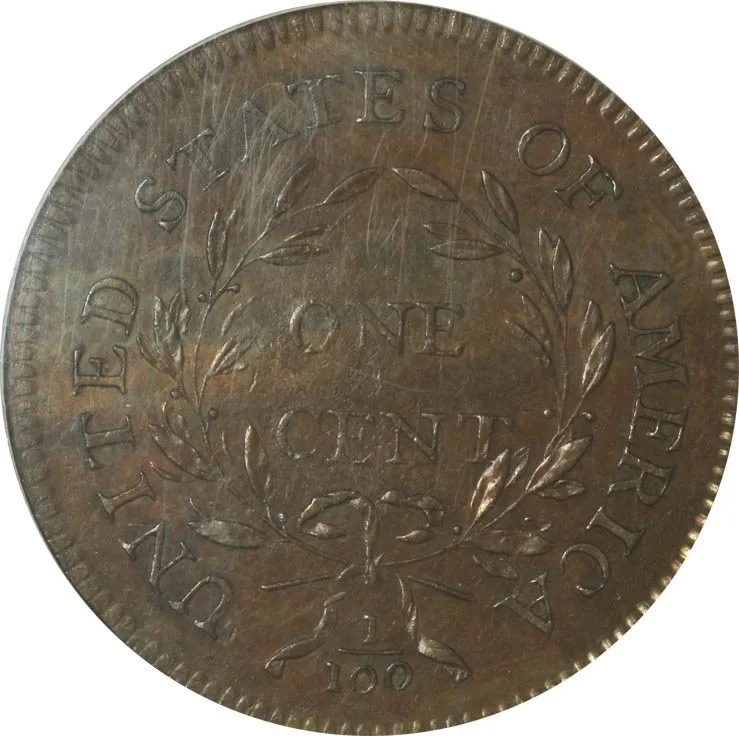
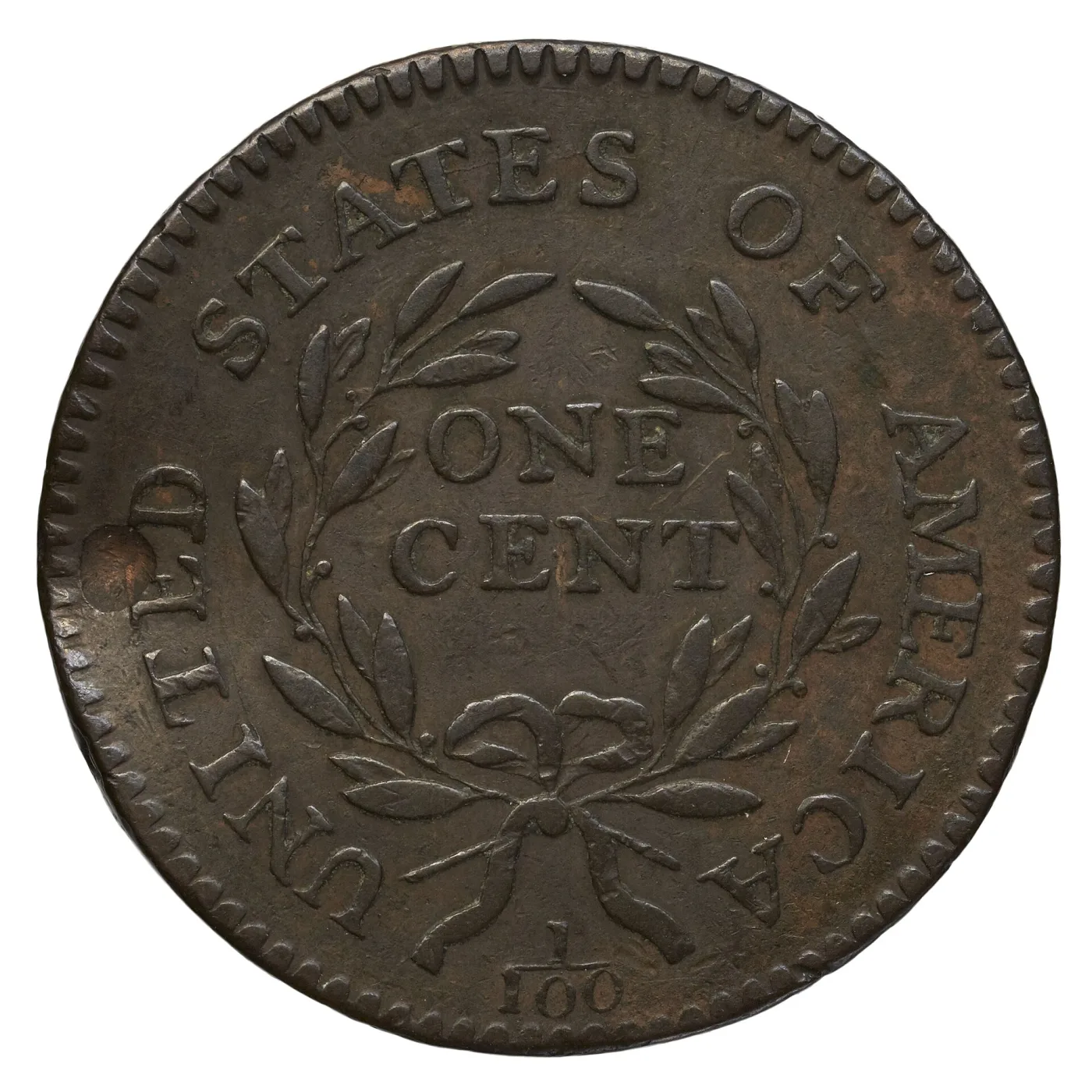
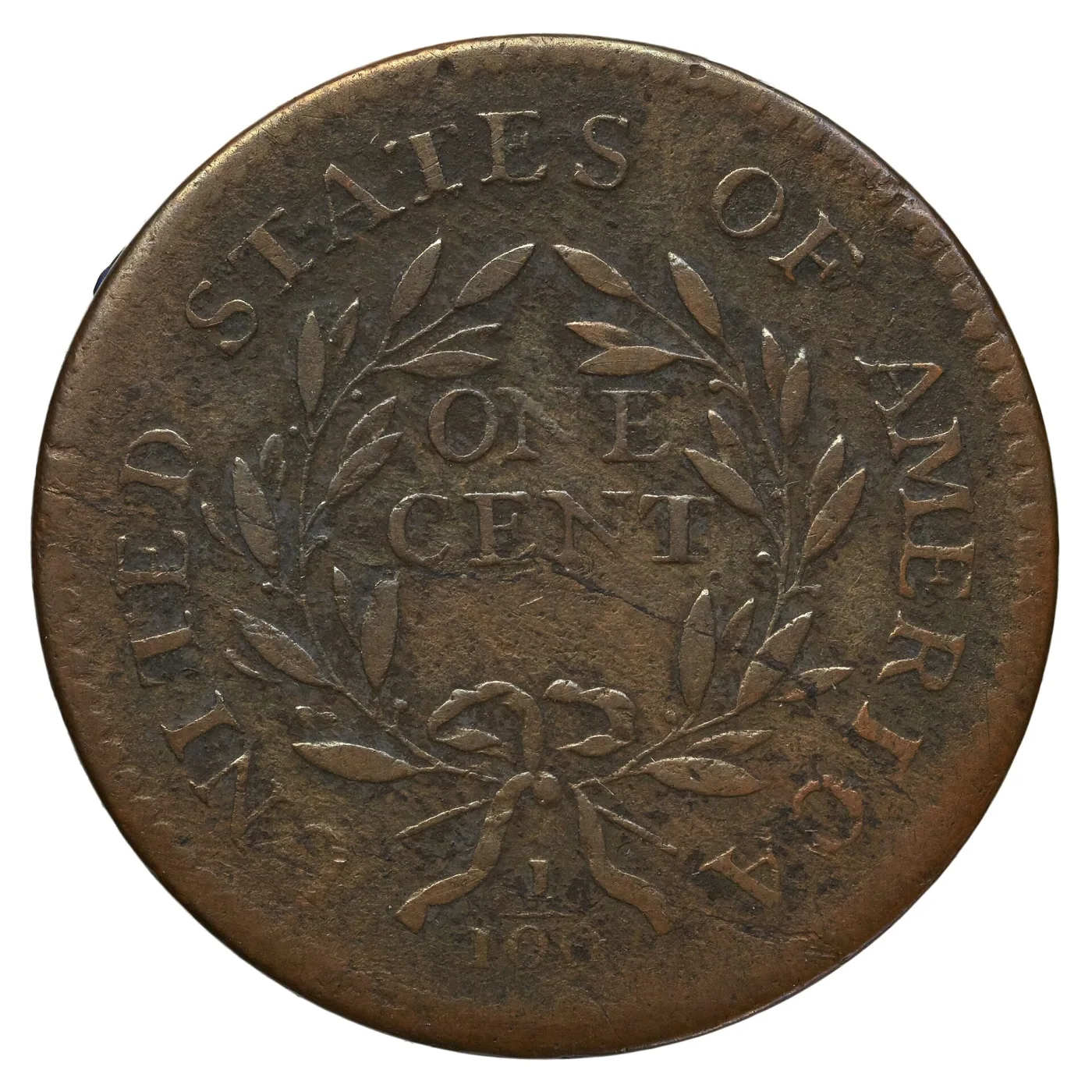
The obverse shows Liberty facing right with a soft “Phrygian” liberty cap perched on a pole that rests against the back of her neck and shoulder. The liberty cap and pole were a classical symbol of freedom dating to ancient Rome, where freed slaves wore such caps. “LIBERTY” appears above and the date below. The reverse continues the open wreath enclosing “ONE CENT” and “1/100,” with “UNITED STATES OF AMERICA” around the rim, much like the Wreath cent reverse.
The “Head” Subtypes
Across its four years the Liberty Cap obverse was re-engraved several times, producing distinct portrait styles that collectors track as “head” subtypes:
- Head of 1793 (the “Liberty Cap of 1793”): The original, crude, large-headed Liberty introduced in mid-1793 and continued into early 1794. The 1793 Liberty Cap is a major rarity (see below); the Head of 1793 also appears on some early 1794 cents.
- Head of 1794: The most common 1794 portrait, with a more refined and better-proportioned Liberty.
- Head of 1795 (the “Head of ’95”): A flatter, smoother portrait introduced late in 1794 and used through 1795 and 1796.
The 1794 cent in particular is famous for displaying all three head styles within a single year, which is why 1794 is the most variety-rich date of the Liberty Cap series and a favorite of die-variety specialists.
Edge and Weight Changes
Early Liberty Cap cents (1793 and most of 1794-1795) were struck on the original heavier standard with a lettered edge reading “ONE HUNDRED FOR A DOLLAR.” In 1795, a weight reduction (under the Mint Act adjustments of that year) lowered the cent’s weight and the Mint switched to a plain edge. As a result, 1795 and 1796 cents are found with a plain edge, while earlier issues carry the lettered edge — an important diagnostic for dating and attribution. A small number of 1795 “Reeded Edge” cents exist as an extreme rarity.

Composition and Physical Specifications
The 1793-1796 large cents were struck in pure copper, but the weight standard changed partway through the period — a key authentication detail.
Heavy Standard (1793 - mid-1795)
- Composition: 100% copper (pure)
- Weight: 13.48 grams (208 grains)
- Diameter: approximately 26-28 mm (varies; planchets were not perfectly uniform)
- Edge: Chain cent — plain; Wreath cent — Vine and Bars or Lettered; Liberty Cap (heavy) — Lettered (“ONE HUNDRED FOR A DOLLAR”)
Reduced Standard (late 1795 - 1796)
- Composition: 100% copper (pure)
- Weight: 10.89 grams (168 grains)
- Diameter: approximately 29 mm
- Edge: Plain (the lettered edge was discontinued with the weight reduction)
Other constants: all coins were struck at the Philadelphia Mint only, so there are no mint marks; the designers across the period include Henry Voigt, Adam Eckfeldt, Joseph Wright, and Robert Scot, depending on the type and head. Because early planchets varied and two centuries of wear and corrosion remove metal, weight alone is never conclusive — but a coin claimed to be an early heavy-standard cent that weighs near 10.9 grams, or a 1796 that weighs near 13.5 grams, deserves close scrutiny. Combine weight with edge type and design to confirm an attribution.
Date-by-Date Analysis (1793-1796)
The values below are 2026 retail estimates for genuine, problem-free examples. Early copper is very frequently encountered with porosity, corrosion, smoothing, or damage, and such problem coins trade at steep discounts to the figures shown. Conversely, smooth, original, well-struck examples command strong premiums.
1793 Chain Cent
Mintage: 36,103. The first U.S. cent and a blue-chip rarity in every grade. Even well-worn, problem examples command five figures, and the AMERI. (S-1) variety brings substantial premiums over the AMERICA varieties. Approximate values (AMERICA, S-3): G-4 $9,000, VG-8 $14,000, F-12 $25,000, VF-20 $55,000, EF-40 $125,000+. The AMERI. (S-1) runs roughly 1.5x-3x these figures, and finest-known examples have sold for well over $1 million.
1793 Wreath Cent
Mintage: 63,353. More available than the Chain cent and more attractive, but still a scarce and expensive first-year type coin. Approximate values (Vine and Bars edge): G-4 $2,500, VG-8 $4,000, F-12 $7,000, VF-20 $14,000, EF-40 $30,000, AU-50 $55,000+. The Lettered Edge variety carries a premium. The Strawberry Leaf variety is essentially priceless (four known).
1793 Liberty Cap Cent
Mintage: 11,056 — the lowest of the entire period and one of the great large cent rarities. The 1793 Liberty Cap (Head of 1793) is far rarer than either the Chain or Wreath cent by survivors and is a key target for advanced collectors. Approximate values: G-4 $9,000, VG-8 $16,000, F-12 $30,000, VF-20 $65,000, EF-40 $150,000+. High-grade examples are extraordinary and bring six and seven figures.
1794 Liberty Cap Cent
Mintage: 918,521 — by far the most available date of the Liberty Cap series and the easiest year to obtain as a type coin. The 1794 is the great “variety year,” with the Head of 1793, Head of 1794, and Head of 1795 all represented, plus dozens of Sheldon die marriages and famous rarities like the Starred Reverse and the “No Fraction Bar.” Approximate values (common varieties): G-4 $300, VG-8 $600, F-12 $1,200, VF-20 $2,800, EF-40 $6,500, AU-50 $13,000, MS-63 BN $40,000+. Rare die varieties multiply these figures dramatically.
1795 Liberty Cap Cent
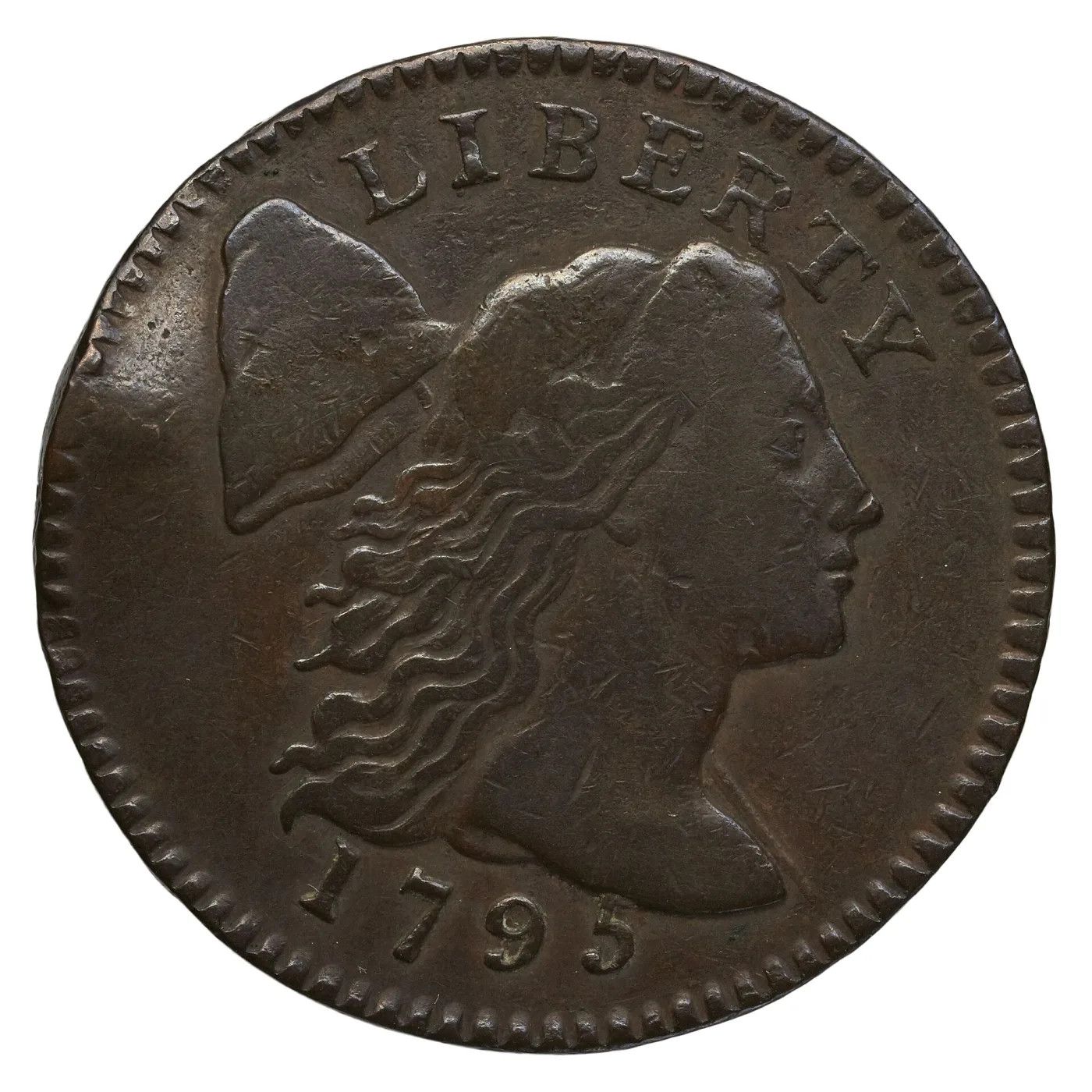
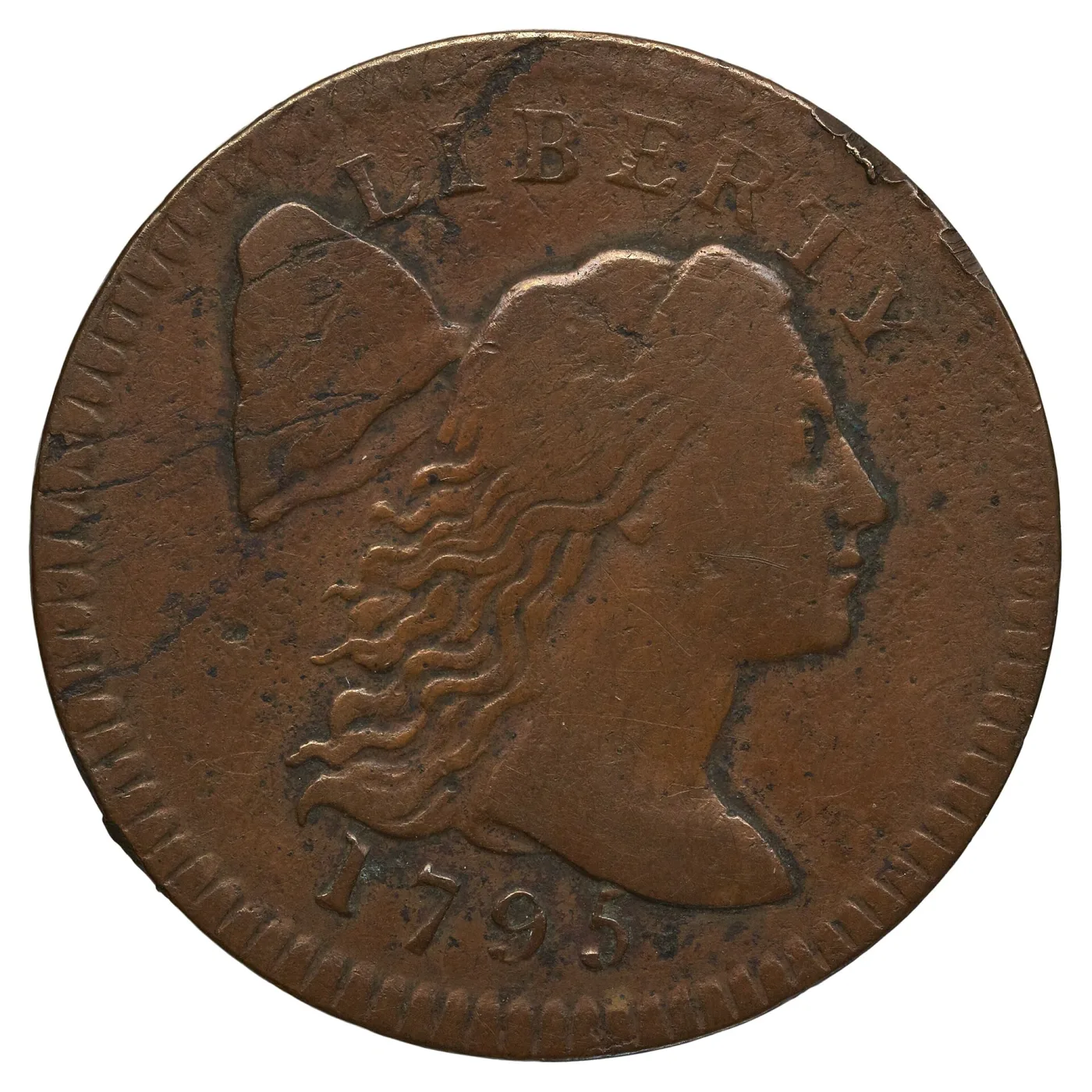
Mintage: 538,500 (Plain Edge and Lettered Edge combined). The 1795 spans the weight reduction: early-1795 Lettered Edge cents are on the heavy standard, while later Plain Edge cents are on the reduced standard. The Plain Edge is the more common of the two. The 1795 also includes the famous “Jefferson Head” — actually a contemporary private piece, not a regular Mint product (see below). Approximate values (Plain Edge): G-4 $300, VG-8 $550, F-12 $1,100, VF-20 $2,400, EF-40 $5,500, AU-50 $11,000, MS-63 BN $35,000+. The Lettered Edge and “Reeded Edge” varieties carry strong premiums.
1796 Liberty Cap Cent
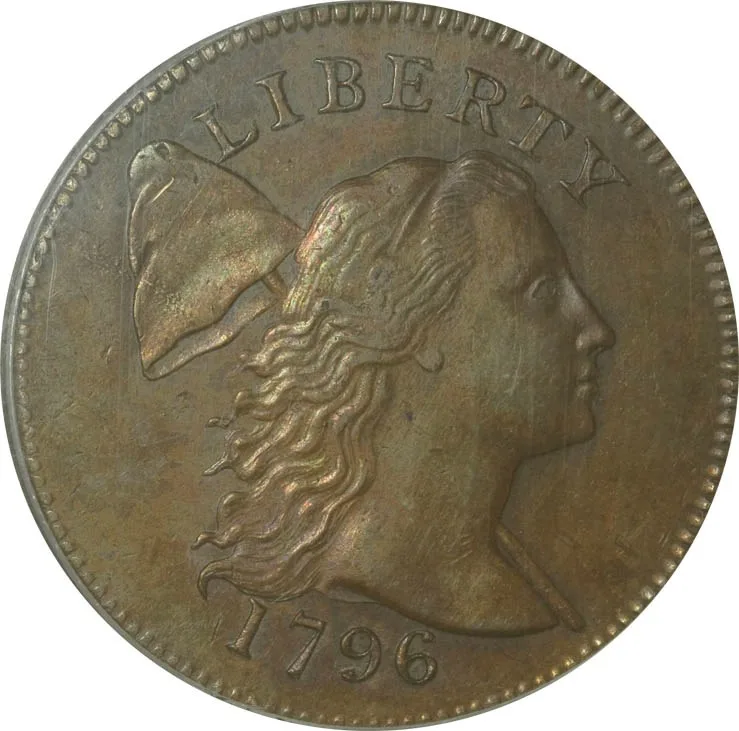
Mintage: 109,825 — the final and scarcest year of regular Liberty Cap production (excluding the 1793 rarities). Because 1796 is a transition year, both the Liberty Cap and the new Draped Bust cent were struck; this guide covers the Liberty Cap portion. The 1796 Liberty Cap includes the celebrated “LIHERTY” error (see below). Approximate values: G-4 $450, VG-8 $850, F-12 $1,800, VF-20 $4,000, EF-40 $9,000, AU-50 $18,000, MS-63 BN $55,000+.
Both sides of a 1796 Liberty Cap with the design still crisp enough to check the details that matter on this date:
Key Dates, Rarities, and Famous Varieties
The 1793-1796 large cents contain a remarkable concentration of celebrated rarities. Understanding them is essential both for valuing a coin correctly and for recognizing when an ordinary piece is being misrepresented as a rarity.
The Three 1793 Designs
- 1793 Liberty Cap (11,056): The rarest by survivors and the ultimate key of the period. The Head of 1793 portrait on a 1793-dated coin is a major-rarity target.
- 1793 Chain (36,103): The first U.S. cent; a blue-chip rarity, especially the AMERI. (S-1) variety.
- 1793 Wreath (63,353): The most “obtainable” 1793 cent, though still scarce and four-figure-plus in any grade.
Famous Named Varieties
- Chain AMERI. (S-1, 1793): The abbreviated-legend Chain cent; one of the most famous and valuable large cents in existence.
- Strawberry Leaf (1793 Wreath): Only four known; the under-bust sprig resembles a strawberry plant. Essentially priceless and almost never genuinely encountered.
- Starred Reverse (1794): A 1794 cent (Sheldon-48) with 94 tiny five-pointed stars hidden in the dentils around the reverse rim — a great early-copper rarity, discovered only decades after it was struck.
- Jefferson Head (1795): A crude piece long associated with the date 1795 but now understood to be a contemporary private production (likely a maker seeking a Mint contract), not an official Mint coin. It exists in plain-edge and lettered-edge forms and is a rare and curious collectible.
- LIHERTY error (1796): A 1796 Liberty Cap cent on which “LIBERTY” is misspelled “LIHERTY,” the B appearing as an H because of a defective or re-cut punch. A popular and collectible blunder variety.
- 1795 Reeded Edge: An extreme rarity (only a few known) with a reeded rather than plain or lettered edge.
- 1794 “No Fraction Bar” and other die blunders: The chaotic 1794 dies produced several collectible oddities, including missing or misplaced fraction bars and assorted lettering errors.
Condition Rarity
Beyond the named rarities, the entire period behaves as a condition rarity. Early copper saw hard use, poor storage, and aggressive cleaning over two centuries, so the overwhelming majority of survivors are low-grade, porous, corroded, or otherwise impaired. A genuinely smooth, original, problem-free example of any date — even the “common” 1794 — is far scarcer than the mintage suggests and commands a substantial premium. For these coins, originality and surface quality matter as much as the date.

Sheldon Variety Attribution
The 1793-1796 large cents are attributed by the Sheldon numbering system, the standard reference language for U.S. large cents of 1793-1814. A crucial point for newcomers: large cents use Sheldon (S-) numbers, while half cents of the same era use Cohen (C-) numbers. Do not mix the two systems — a “C-1” is a half cent attribution, while these cents are “S-” numbers.
How Sheldon Numbers Work
Dr. William H. Sheldon’s landmark 1949 reference Early American Cents (later revised as Penny Whimsy in 1958) assigned a unique number to each die marriage — a specific obverse die paired with a specific reverse die. The 1793-1796 cents run from Sheldon-1 (the Chain AMERI.) upward through the Wreath and Liberty Cap marriages. The 1793 issues occupy the lowest Sheldon numbers, which is why “S-1” is shorthand for the Chain AMERI. and carries such cachet among collectors.
NC Numbers
Die marriages too rare for Sheldon to confirm with enough specimens received “NC” (“Non-Collectible”) designations. Several NC varieties exist in this period — including Chain NC-1 — and they are prized by advanced specialists, though most collectors will never handle one.
Why Sheldon Numbers Matter So Much Here
For the 1793-1796 cents, the specific die variety can dwarf the date in importance. A common date in a rare die marriage can be worth many times an ordinary example, and the named rarities — Chain AMERI. (S-1), Starred Reverse (S-48), and others — are defined by their Sheldon attribution. Auction catalogs and certified holders almost always cite the Sheldon number, and serious early-copper collectors buy by variety first. Membership in the Early American Coppers (EAC) club and access to the standard references — Sheldon’s Penny Whimsy, Walter Breen’s Encyclopedia, and William Noyes’s photographic die-state studies — are essential for confident attribution. For most collectors, recording the Sheldon number from the certification label or auction description is sufficient.
Grading Liberty Cap and 1793 Large Cents
Grading these early coppers is among the most demanding tasks in U.S. numismatics. Because so many survivors are worn, weakly struck, porous, corroded, or altered, a grader must assess technical wear, strike, and — critically — surface quality and originality, and the surface assessment often matters more than the wear grade.
Key Wear Points
On the obverse, the highest points are Liberty’s hair detail and, on the Liberty Cap type, the cap and the hair above the forehead. On the reverse, the wreath leaves and bow (or, on the Chain cent, the chain links) wear first. Many early cents are also weakly struck, with soft centers from the moment of minting, so a grader must distinguish honest wear (smooth, flattened high points) from strike weakness (soft detail present at striking) — a distinction that takes practice and reference comparison.
Two 1795 cents, same date and same design, separated by nothing but the years they spent in circulation:
Low-Grade Reality and “Sharpness” vs. “Net” Grade
A large share of 1793-1796 cents grade below Fine, and many are valued in Good or even About Good. For these coins, every grade point matters enormously to value. EAC graders use a “sharpness grade” (what the wear alone would suggest) and then apply deductions for problems to arrive at a “net grade.” A coin with EF sharpness but heavy porosity might net only VF or even Fine. This net-grading discipline is central to how experienced collectors value early copper.
The reverses of those same two coins tell the story again, and carry one detail worth finding before you grade anything:
Color Designations
Mint State copper is graded in three color categories — BN (Brown), RB (Red-Brown), and RD (Red) — but for the 1793-1796 cents, original red is almost unheard of. Virtually all Mint State survivors are Brown, and even those are great rarities. Any early cent offered as “Red” should be examined with extreme skepticism.
EAC vs. PCGS/NGC Grading
EAC (Early American Coppers) grades are typically several points more conservative than PCGS/NGC grades for the same coin, and the gap widens for problem coins. An EAC “VF-20” might receive a PCGS “EF-40.” EAC graders deduct sharply for porosity, cleaning, smoothing, and any non-original surface — exactly the problems that plague this era. When buying from an EAC dealer, expect lower numerical grades but coins whose grade better reflects true quality; when buying certified PCGS/NGC coins, read the surface yourself and never assume a high number means an original, problem-free coin.
Counterfeit Detection and Authentication
Because 1793-1796 cents are so valuable, they are among the most heavily counterfeited and altered U.S. coins. The 1793 issues in particular have attracted forgers for over 150 years.
Cast and Electrotype Copies
The oldest deceptions are cast copies and electrotypes of the Chain, Wreath, and 1793 Liberty Cap cents. Cast counterfeits show characteristic surface pitting (the casting “orange peel”), softened detail, and seams along the edge; they often weigh incorrectly and lack the crisp rims of a struck coin. Electrotypes are made by depositing copper into a mold and joining two shells, leaving a faint seam around the edge and often a hollow or filled core that affects weight and “ring.” Examine the edge and weigh the coin precisely; a struck early cent has a sharp, naturally irregular edge, while copies show file marks, seams, or unnatural smoothness.
Altered Dates and Added Features
Forgers alter common coins to imitate rarities: tooling a 1794 to read 1793, re-cutting letters to fake the AMERI. abbreviation or the LIHERTY error, or adding tiny “stars” to a 1794 reverse to imitate the Starred Reverse. Examine date digits and key letters under 10x magnification for irregular spacing, raised tool marks, smoothing in the surrounding fields, or color differences. Because each major rarity corresponds to a specific Sheldon die marriage with known diagnostics, any genuine example must match that variety’s documented die characteristics — a quick way to expose an alteration.
“Re-engraved” and Tooled Coins
A common problem with worn early copper is re-engraving: a forger or “improver” re-cuts hair lines, the date, or other detail on a genuine but worn coin to make it appear higher grade. Tooled coins show sharp, fresh detail that is inconsistent with the surrounding wear and surface. This is one of the most common impairments in the early-copper market and a major reason certification matters.
Modern Replicas
Replica and souvenir 1793 cents exist, often struck in brass or plated base metal and frequently bearing “COPY” stamped on the coin (required by U.S. law since 1973). They weigh incorrectly and show the wrong color and surface under bright light. Always check weight, edge, and color before believing a too-good-to-be-true find.
Third-Party Certification
For any 1793-1796 large cent, certification by PCGS, NGC, or ANACS is strongly recommended, and for the 1793 issues and any rarity it is essentially required for resale. Certification resolves authenticity, the surface/problem question, and the Sheldon attribution all at once — each of which materially affects value in this series. Collectors should also weigh the EAC net-grading tradition, which applies sharper deductions for problems than the third-party services and is the dominant value language among early-copper specialists.
Current Market Values
Values for 1793-1796 large cents vary enormously by type, date, die variety, grade, and surface quality. The figures below are 2026 retail estimates for genuine, problem-free examples. Problem coins (porous, corroded, cleaned, tooled, or damaged) trade at steep discounts, while smooth original coins and rare die varieties bring strong premiums. Auction results for the great rarities can reach six and seven figures.
1793 Chain Cent (AMERICA, S-3)
- G-4: $9,000
- VG-8: $14,000
- F-12: $25,000
- VF-20: $55,000
- EF-40: $125,000+
- AMERI. (S-1): roughly 1.5x-3x the above; finest known $1,000,000+
1793 Wreath Cent (Vine and Bars edge)
- G-4: $2,500
- VG-8: $4,000
- F-12: $7,000
- VF-20: $14,000
- EF-40: $30,000
- AU-50: $55,000+
- Lettered Edge: premium over Vine and Bars; Strawberry Leaf: essentially priceless
1793 Liberty Cap Cent
- G-4: $9,000
- VG-8: $16,000
- F-12: $30,000
- VF-20: $65,000
- EF-40: $150,000+
1794 Liberty Cap (common varieties)
- G-4: $300
- VG-8: $600
- F-12: $1,200
- VF-20: $2,800
- EF-40: $6,500
- AU-50: $13,000
- MS-63 BN: $40,000+
- Starred Reverse (S-48) and other rare marriages: many multiples of the above
1795 Liberty Cap (Plain Edge)
- G-4: $300
- VG-8: $550
- F-12: $1,100
- VF-20: $2,400
- EF-40: $5,500
- AU-50: $11,000
- MS-63 BN: $35,000+
- Lettered Edge, Reeded Edge, Jefferson Head: strong premiums
1796 Liberty Cap
- G-4: $450
- VG-8: $850
- F-12: $1,800
- VF-20: $4,000
- EF-40: $9,000
- AU-50: $18,000
- MS-63 BN: $55,000+
- LIHERTY error: collectible premium
Collecting Strategies
The 1793-1796 large cents support collecting approaches at every budget level, from a single affordable type coin to the most ambitious rarity pursuits in American numismatics.
Type Coin
The most popular goal is a single Liberty Cap large cent as part of a four-coin large cent type set (Liberty Cap, Draped Bust, Classic Head, and Coronet/Braided Hair). The 1794 or 1795 in Good to Fine is the affordable choice, typically $300-$1,200 for a presentable problem-free example. Prioritize surfaces and originality — a smooth, evenly worn Good is a far better type coin than a porous or tooled Fine at the same price.
Three-Type 1793 Set
An advanced and historically meaningful goal is one example each of the three 1793 designs — Chain, Wreath, and Liberty Cap. This is a major financial undertaking (the Chain and 1793 Liberty Cap alone run well into five and six figures), but it captures the entire dramatic first year of U.S. cent coinage in three coins. Many collectors build it slowly over years, starting with the more attainable Wreath cent.
Date Set (1793-1796)
A by-date set of the period requires a 1793 (any of the three types satisfies the year for some collectors, or all three for a complete-type approach), plus 1794, 1795, and 1796. The 1794 and 1795 are obtainable; the 1796 is scarcer; and the 1793 entry is the great challenge. This is a classic intermediate-to-advanced pursuit.
Variety Set
Many specialists collect by Sheldon die marriage, pursuing the famous named varieties — Chain AMERI. (S-1), the 1793 Wreath edge varieties, the three 1794 head styles, the 1796 LIHERTY, and beyond. A complete Sheldon set of the period is an open-ended, lifetime specialty requiring EAC membership, deep references, and patience, since many marriages appear infrequently. It is the deepest way to collect these coins and the natural endpoint for a dedicated early-copper specialist.
Surface-Quality and “Choice for the Grade” Collecting
A uniquely early-copper approach is to prioritize originality and eye appeal over technical grade — building a set of smooth, glossy, problem-free coins even at modest grades. A set of original VG and Fine cents is more difficult, and often more rewarding, than a set of higher-graded problem coins, and it reflects a sophisticated understanding of what makes this series special. EAC collectors call this buying coins that are “choice for the grade.”
Where the Liberty Cap Fits in a Broader Collection
Collectors often pursue the 1793-1796 cents alongside the companion Liberty Cap half cent and the contemporary Flowing Hair silver coinage of 1794-1795. A “first year of issue” collection spanning the 1793 cent, the 1793 half cent, and the 1794 silver dollar and half dollar is a coherent and prestigious way to assemble the founding coins of the United States Mint.
Storage and Preservation
Copper is the most chemically reactive of the coinage metals, and the irreplaceable, often-impaired surfaces of these 230-year-old cents make careful handling especially important.
Never Clean Copper
Cleaning copper destroys natural patina and microscopic surface detail and is irreversible. Cleaned coins are described as “harshly cleaned,” “lightly cleaned,” or “recolored” and receive details grades, trading at 30%-70% discounts. For early copper this is doubly important: collectors prize original surfaces above almost everything, and an unattractive original-color coin is worth more than a cleaned one of the same technical grade. Never attempt to “improve” a dark, porous, or corroded 1793-1796 cent — there is no safe way to do it, and any attempt only adds a problem.
Avoid PVC and Plasticizers
PVC (“polyvinyl chloride”) flips and album pages leach plasticizers that react with copper to form a green slime — one of the most common preservation disasters for inherited copper. Move any coin out of PVC flips immediately and store it in inert Mylar, acid-free paper envelopes, or hard plastic capsules.
Humidity Control
High humidity accelerates copper corrosion and spotting, a particular danger for already-porous early planchets. Store copper below 50% relative humidity, ideally 30%-40%, with silica gel packets in the storage container. Avoid basements, attics, and garages where humidity swings with the seasons.
Long-Term Storage
For valuable coins, certified PCGS or NGC holders provide an inert, sealed environment — and for five- and six-figure 1793 issues, certification is essential for both preservation and resale. Raw coins should be kept in acid-free, sulfur-free paper envelopes inside Mylar flips, or in inert hard plastic capsules. Inspect stored copper annually for new spotting or color change and address any problem immediately, since active corrosion on a porous planchet can progress quickly.
Frequently Asked Questions
What is the first United States cent?
The 1793 Chain cent is the first cent struck for circulation by the United States Mint. Its production ran for only about twelve days in early 1793, with a total mintage of 36,103 pieces. The most famous variety, the Chain "AMERI." (Sheldon-1), abbreviates "AMERICA" as "AMERI." on the reverse and is among the most valuable large cents in existence.
How do I tell a Chain cent from a Wreath cent from a Liberty Cap cent?
Look at the reverse first. A chain of fifteen links means a Chain cent. An open wreath means either a Wreath cent or a Liberty Cap cent — so then look at the obverse: wild flowing hair with no cap is a Wreath cent, while a soft cap on a pole behind Liberty's head is a Liberty Cap cent. The Chain and Wreath are both 1793 only; the Liberty Cap runs 1793-1796.
What is the rarest 1793 cent?
By survivors, the 1793 Liberty Cap (mintage 11,056) is the rarest of the three 1793 designs and one of the great large cent rarities overall. The Chain cent is more famous and the Wreath cent more available, but the 1793 Liberty Cap is the toughest of the three to find. Among individual varieties, the 1793 "Strawberry Leaf" Wreath cent (only four known) is essentially unobtainable.
What is the LIHERTY error?
The LIHERTY error is a 1796 Liberty Cap cent on which "LIBERTY" is misspelled "LIHERTY" — the B appears as an H because of a defective or re-cut letter punch. It is a popular and collectible blunder variety and commands a premium over a normal 1796 cent.
Do these cents use Sheldon or Cohen numbers?
Sheldon (S-) numbers. Large cents of 1793-1814 are attributed by the Sheldon system; half cents use the Cohen (C-) system. The Chain AMERI. is Sheldon-1 and the Starred Reverse is Sheldon-48, for example. Do not confuse the two attribution systems.
What is a Liberty Cap large cent worth in 2026?
It depends heavily on the type and date. Common-date Liberty Cap cents (1794 and 1795) in well-circulated grades retail for roughly $300-$2,800, rising into five figures in high grade. The 1796 is scarcer. The 1793 issues are blue-chip rarities: a Wreath cent runs from about $2,500 in Good, while the Chain cent and 1793 Liberty Cap start around $9,000 in Good and reach six and seven figures in high grade. Surface quality and die variety can multiply any of these figures.
Why did the Mint change the cent design three times in 1793?
The Chain reverse was abandoned after the public read the chain as a symbol of bondage rather than union, and the crude obverse Liberty drew criticism. The Mint replaced it with the Wreath cent, then redesigned the obverse again to add the classical liberty cap, producing the Liberty Cap cent by mid-1793. The rapid changes reflect a brand-new institution learning to design and strike coins under public scrutiny.
What came before and after the Liberty Cap large cent?
Within 1793, the Chain and Wreath cents preceded the Liberty Cap. After 1796, the Draped Bust large cent (1796-1807) replaced it, followed by the Classic Head (1808-1814) and the Coronet/Matron and Braided Hair types through 1857. For the full sweep of the denomination, see the large cent overview guide.
Should I clean my dark or corroded 1793 cent?
Never. Cleaning copper removes 30%-70% of the value and produces a details grade, and the corrosion on early copper cannot be safely removed. An original dark or porous coin is always worth more than a cleaned one of the same grade. If the coin is valuable, send it to PCGS, NGC, or ANACS for authentication and grading rather than attempting any conservation yourself.
Can I find 1793-1796 large cents in circulation today?
No. Large cents were discontinued in 1857 and have not circulated for well over 165 years. These coins are found only through coin dealers, auctions, estate sales, and inherited collections, and are not legal tender for current transactions.