1793 Wreath Cent Identification Guide: America's Second Cent, Vine and Bars vs Lettered Edge, Sprig Above Date, Strawberry Leaf, Sheldon Varieties, Grading, and Values
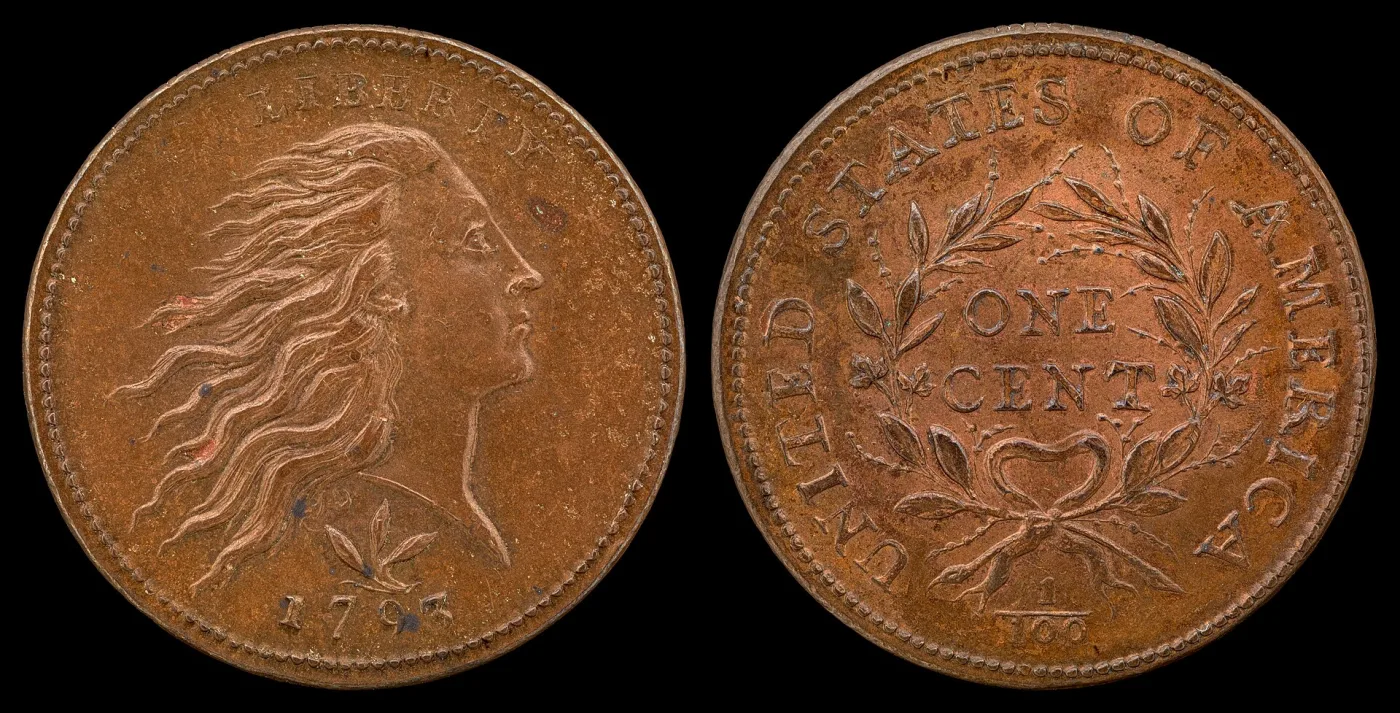
The 1793 Wreath Cent is the second design of the United States large cent and the second circulating coin type ever struck by the U.S. Mint — the coin the Mint produced to replace the ill-fated 1793 Chain Cent after only a few weeks of production. Struck in pure copper at the Philadelphia Mint from roughly mid-April 1793, it takes its name from the graceful reverse wreath that encloses the words “ONE CENT,” replacing the chain of interlinked rings that a young republic had read as a symbol of bondage. In its brief life the Wreath Cent gave the new nation a far more agreeable emblem — and gave collectors a coin that ranks among the most beautiful and most affordable of all the 1793 large cents.
The Wreath Cent is defined by a set of small but crucial features that every early copper collector must learn to read: the sprig of leaves above the date on the obverse, the open wreath tied with a bow on the reverse, and — most important of all — the two distinct edge treatments (the Vine and Bars edge and the far scarcer Lettered edge) that separate the common varieties from the rare ones. It is also home to one of the single most famous rarities in American numismatics, the legendary Strawberry Leaf cent, a variety so rare that only four examples are known to exist.
This guide is the comprehensive 2026 reference for identifying, attributing, grading, authenticating, and valuing the 1793 Wreath Cent. You will learn the diagnostic features of the Flowing Hair obverse and the wreath reverse, the all-important difference between the Vine and Bars edge and the Lettered edge, the Sprig, Vine, and Strawberry Leaf sub-types, the collectible Sheldon die marriages (S-5 through S-11c) and their NC rarities, how to grade porous early copper, how to detect counterfeits and altered coins, and current market values from low-grade fillers to six- and seven-figure condition rarities. Whether you have found a mysterious early copper in an inherited box or are a specialist chasing a Sheldon marriage, this guide will give you a working command of America’s second coin.
History and Background
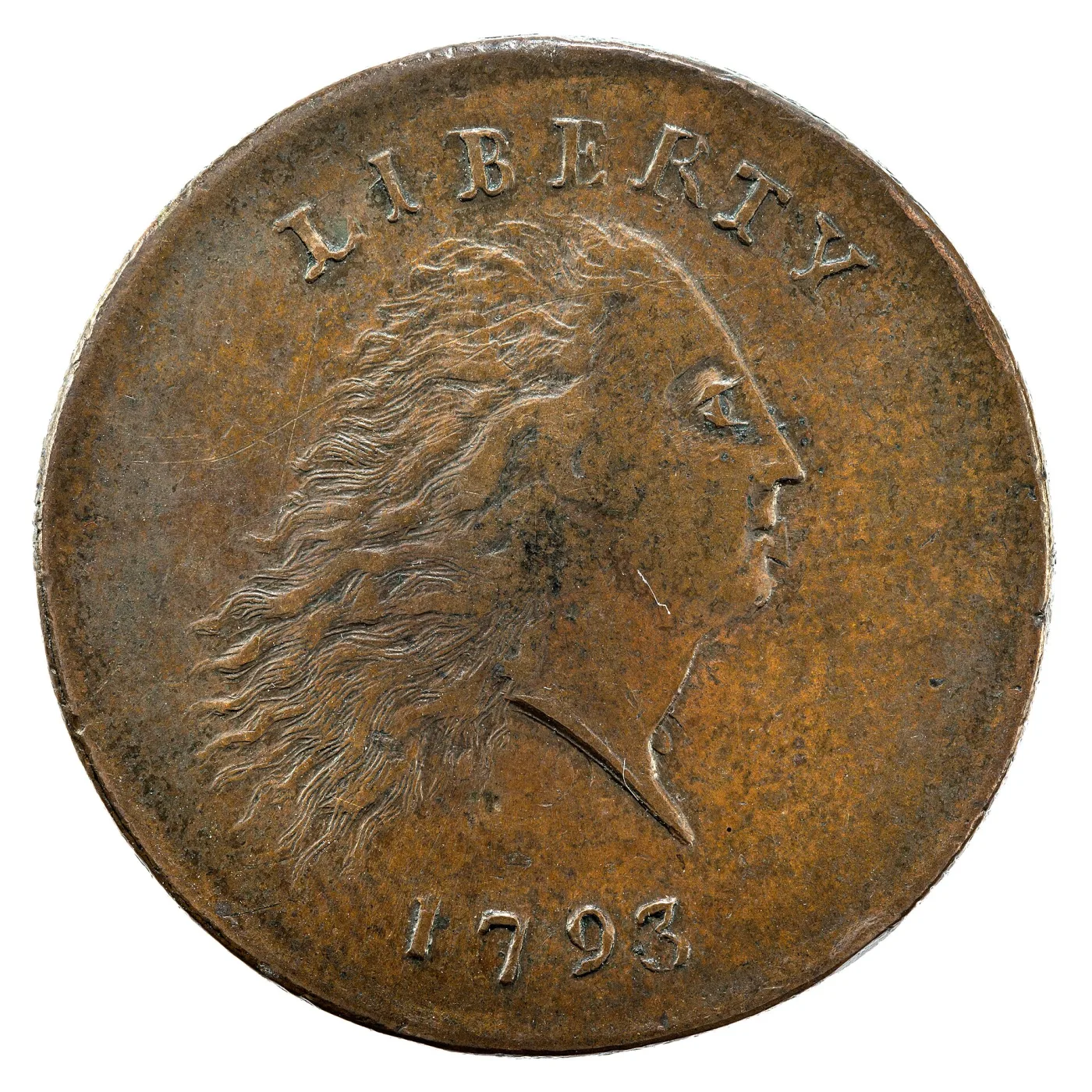
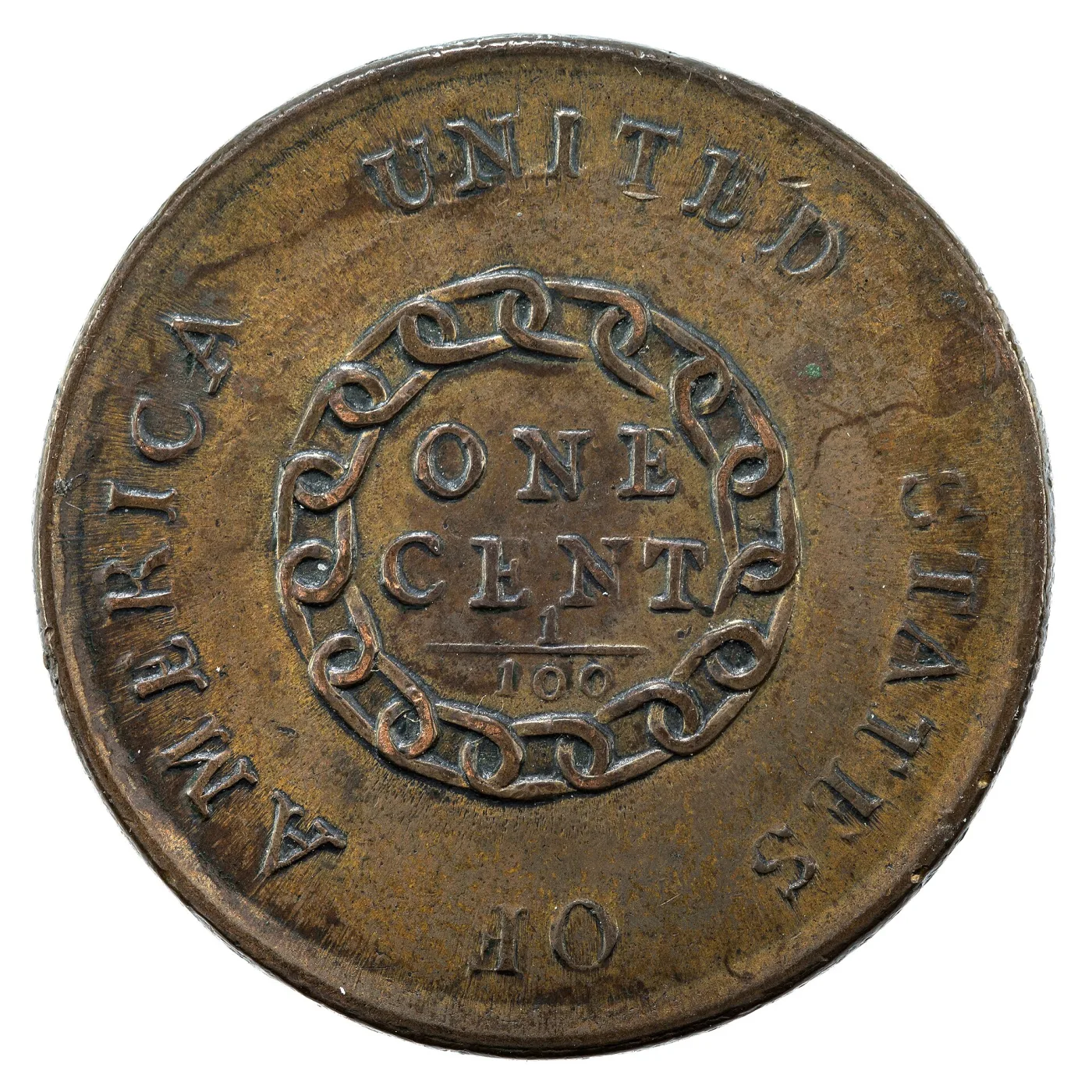
The Coinage Act of April 2, 1792 established the United States Mint and made the copper cent the foundational unit of the new decimal system. The Mint’s first circulating coins, the Chain Cents, were struck in March 1793 — but their reverse design of fifteen interlinked chain rings drew immediate public criticism as a symbol of slavery rather than the unity it was meant to convey. Contemporary newspapers also mocked the frightened look of Liberty on the obverse. Faced with this early public-relations disaster, the Mint moved quickly to redesign the cent.
The result was the Wreath Cent, introduced in April 1793. The threatening chain was replaced by an open, decorative wreath — a far more traditional and reassuring emblem — and Liberty’s hair, while still flowing, was rendered more softly and naturally. A small sprig of leaves was added above the date on the obverse, a graceful touch that gives the type one of its nicknames, the “Sprig” cent. The redesign is generally credited to the Mint’s early engraving talent, with Adam Eckfeldt often associated with the more refined dies that followed Henry Voigt’s crude Chain work. The Wreath Cent was struck in far greater numbers than the Chain Cent — roughly 63,000 pieces — making it appreciably more available today, though still a genuine 18th-century rarity.
The Middle Child of 1793
The Wreath Cent occupies a remarkable position in U.S. coinage: it is the middle of three distinct large cent designs struck in the single year 1793. First came the Chain, then the Wreath, and finally the Liberty Cap cent, which arrived later in 1793 and continued into 1796. No other year in American numismatics produced three different designs of the same denomination. For type collectors, assembling all three 1793 cents — Chain, Wreath, and Liberty Cap — is one of the classic and most coveted challenges in the hobby, and the Wreath is the essential center panel of that triptych.
Both faces of the type the Wreath cent replaced, so you can see exactly what the Mint changed in April 1793:
Why the Wreath Cent Matters
The Wreath Cent is significant both as a design and as history. It represents the Mint’s swift, self-correcting response to public opinion in the earliest days of the republic — the government literally changing its coinage to reflect the will of the people. It is also, by broad agreement, the most attractive of the 1793 cents, with a balanced, classical reverse that later engravers echoed. As the second coin in the large cent series and the second circulating coin the United States ever made, it anchors the front of any serious early American copper collection, right behind the Chain Cent itself.
Design and Diagnostic Features
The Wreath Cent is identified by the combination of its Flowing Hair obverse with a sprig above the date and its distinctive open wreath reverse. Once you know these features, the type is unmistakable and cannot be confused with the Chain Cent that preceded it or the Liberty Cap cent that followed.
Obverse (Flowing Hair Liberty with Sprig)
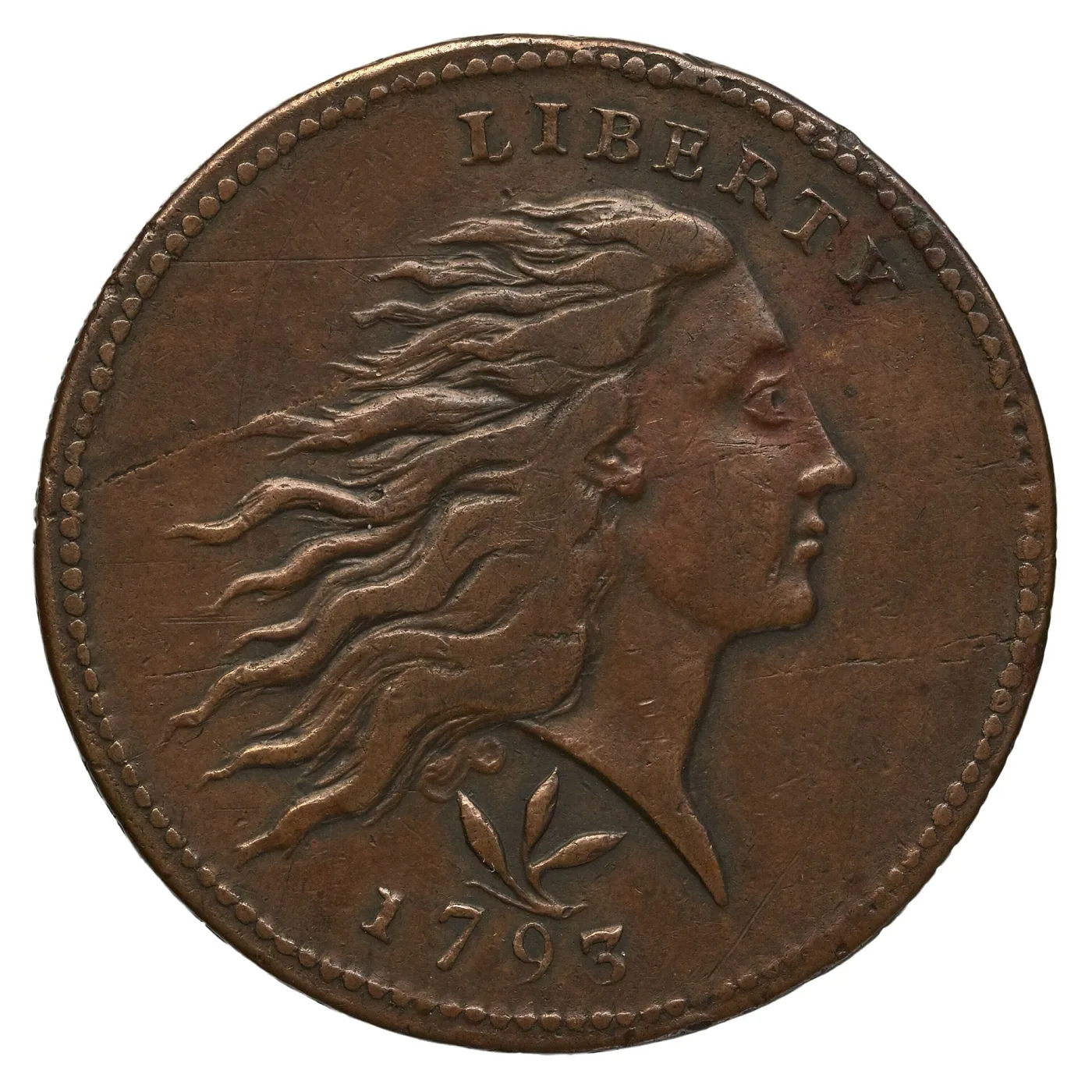
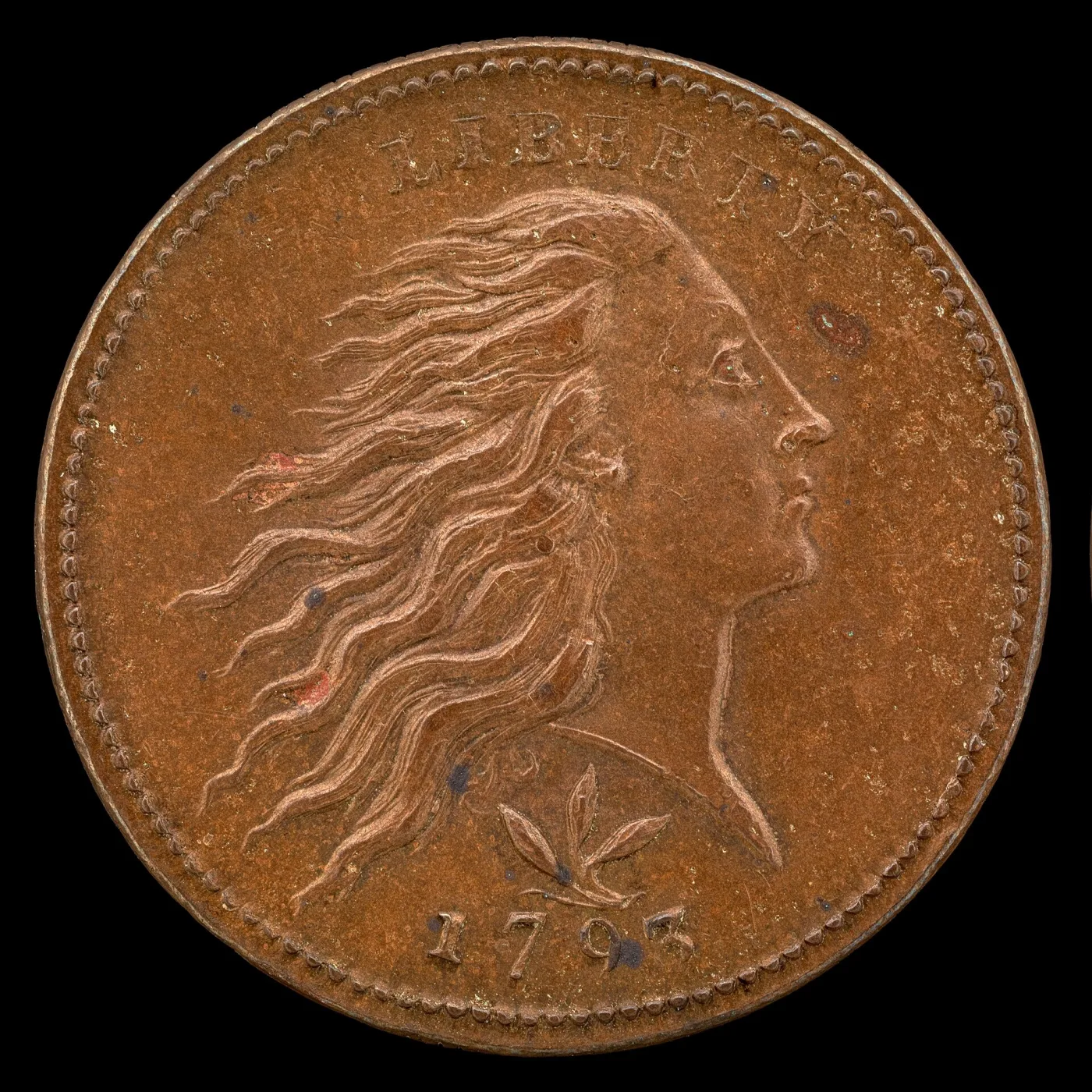
Liberty faces right, her hair flowing loosely behind her, but rendered more gracefully and naturally than the wild, “frightened” hair of the Chain Cent. The word “LIBERTY” appears above her head and the date “1793” below. The single most useful obverse diagnostic is the sprig of leaves directly above the date — a small cluster of foliage between Liberty’s hair and the “1793,” present on the Wreath Cent and absent from both the Chain Cent and the later Liberty Cap. There are no stars on the obverse. This same untamed Flowing Hair concept links the Wreath Cent stylistically to the 1794–1795 Flowing Hair dollar and Flowing Hair half dime, though each coin used a different engraver’s hand.
Reverse (The Wreath)
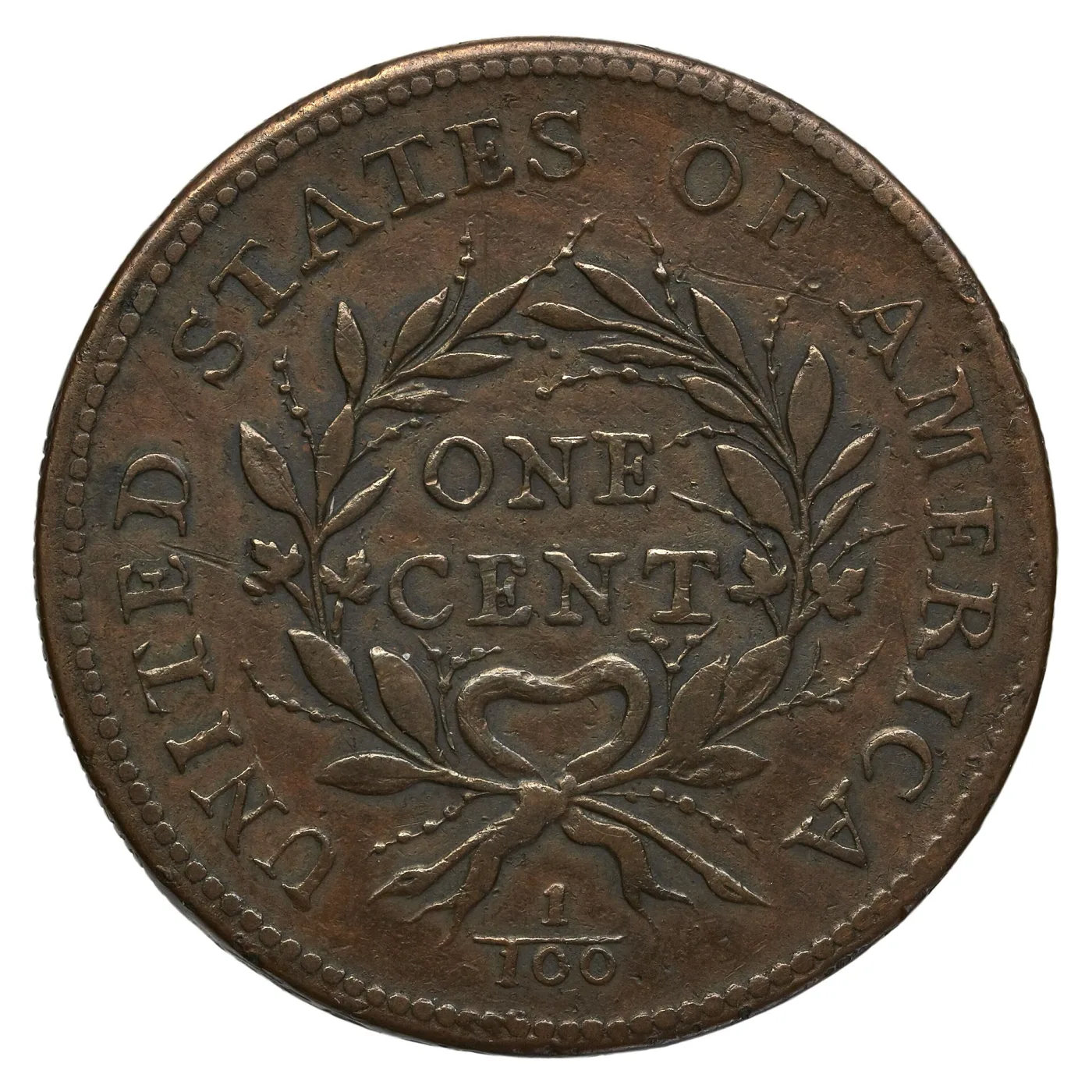
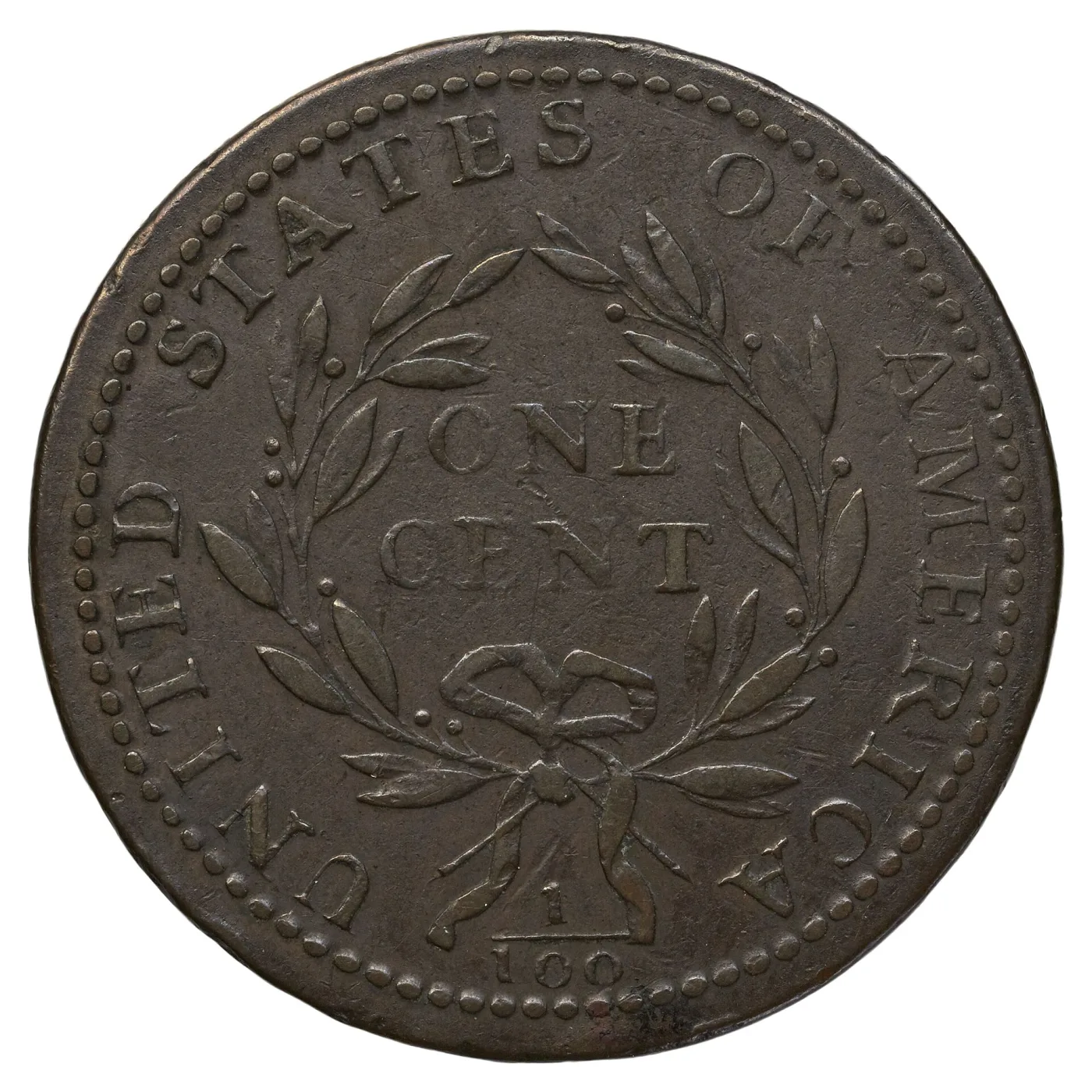
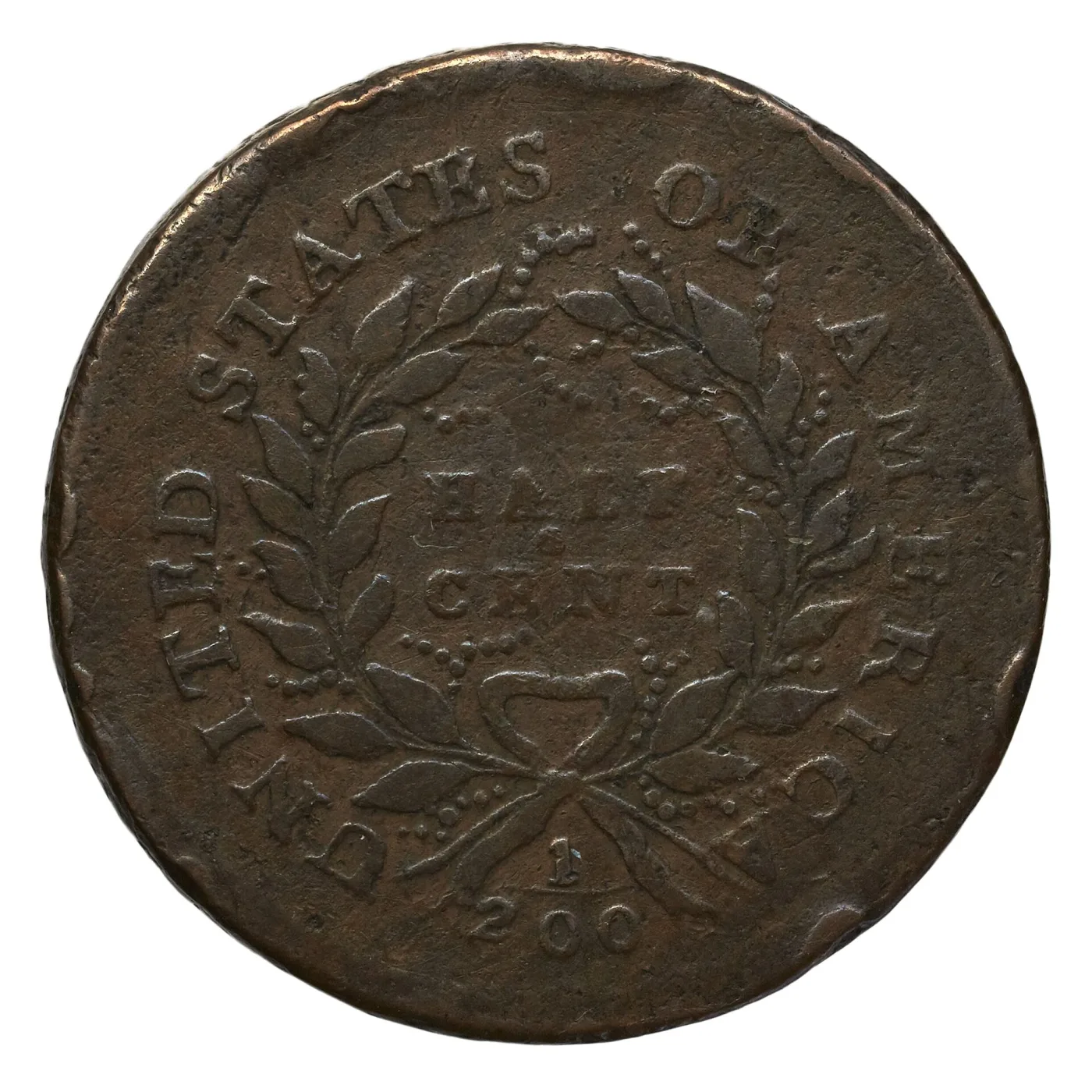
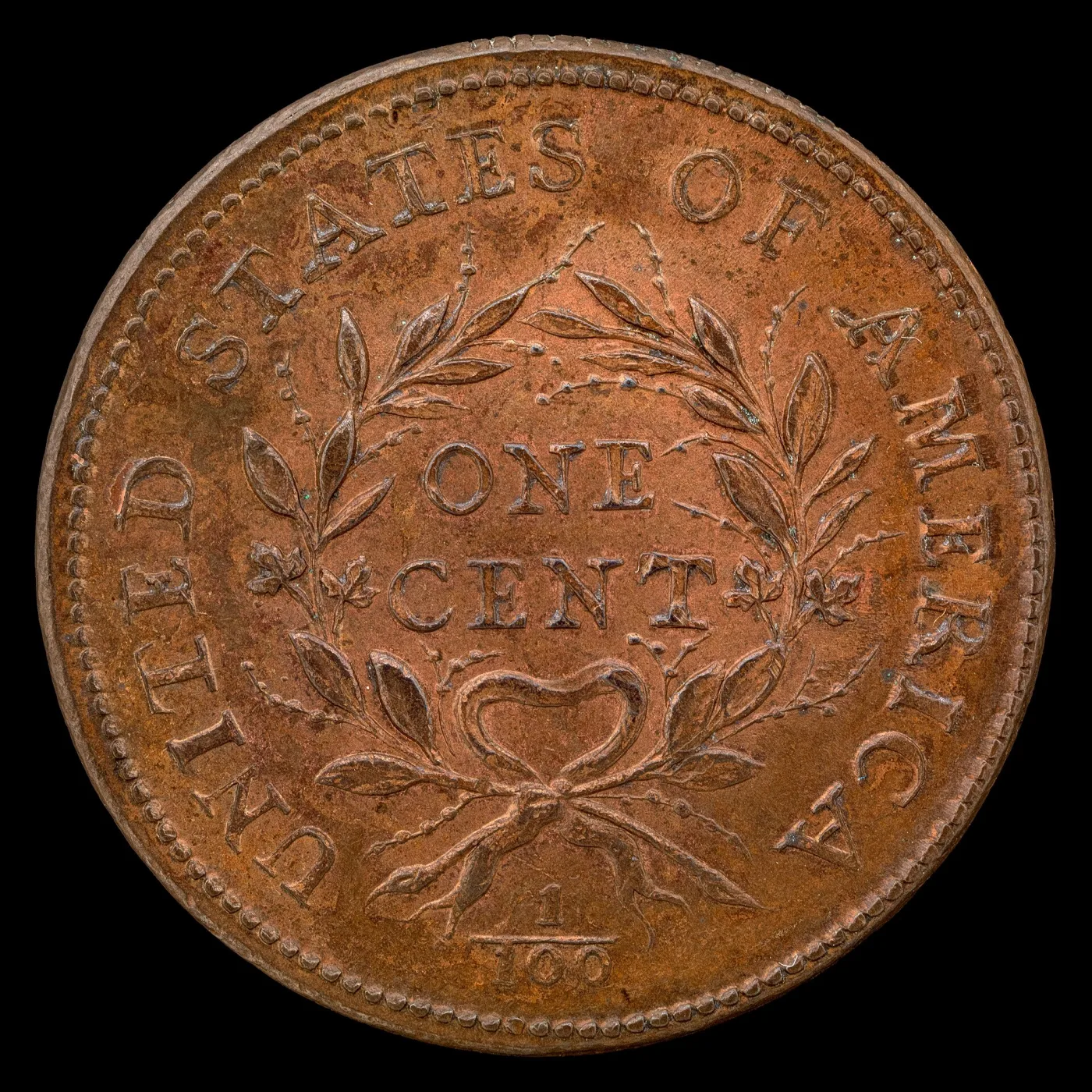
The reverse shows a graceful open wreath — two curved branches of leaves and berries rising from a bow at the bottom and nearly meeting at the top — enclosing the words “ONE CENT” in the center, with the fraction “1/100” beneath. Around the outer edge, between the wreath and the rim, runs the legend “UNITED STATES OF AMERICA.” The wreath is the single most important identifier of the type: if a 1793 cent has a wreath (rather than a chain) on the reverse and a sprig above the date on the obverse, it is a Wreath Cent. The bow at the base of the wreath and the arrangement of leaves and berries also provide fine diagnostics used to separate individual Sheldon die marriages.
The reverse is the weaker half of the identification, and setting a Wreath cent beside its successor shows why:
Edge (The Critical Feature)
Unlike most coins, the Wreath Cent’s edge carries decisive identifying information, because the type exists with two entirely different edge treatments. The common edge is the Vine and Bars design — a raised pattern of vine and bars, the same protective edge used on the Chain Cent. The scarcer edge is a Lettered edge reading “ONE HUNDRED FOR A DOLLAR” followed by a decorative leaf or bar. Because the edge determines both the variety and much of the value, examining it is a mandatory step in identifying any Wreath Cent — a point covered in full in its own section below.
Quick Identification Summary
- Date: 1793 only. No other year exists.
- Obverse: Flowing Hair Liberty facing right, “LIBERTY” above, “1793” below, with a sprig of leaves above the date, no stars.
- Reverse: Open wreath tied with a bow around “ONE CENT” and “1/100,” with “UNITED STATES OF AMERICA” around the edge.
- Edge: Vine and Bars (common) OR Lettered “ONE HUNDRED FOR A DOLLAR” (scarce).
- Metal: Pure copper, roughly 26–28 mm, about 13.5 grams (Mint standard for 1793).
Vine and Bars vs Lettered Edge
The most consequential distinction within the Wreath Cent series is the edge. Because the coin exists with two different edge treatments produced from different collars, the edge is not a cosmetic detail — it defines the variety, separates common coins from scarce ones, and must be checked on every example before attribution or pricing.
The Vine and Bars Edge
The great majority of Wreath Cents have the Vine and Bars edge: a raised, ornamental pattern of a leafy vine alternating with small bars, running continuously around the edge. This is the same style of decorative edge used on the 1793 Chain Cent, applied by rolling the planchet through an edge device (the Castaing machine) before striking. A Wreath Cent with the Vine and Bars edge is the “type coin” most collectors acquire, and it is the more available and more affordable of the two edges.
The Lettered Edge
A minority of Wreath Cents carry a Lettered edge reading “ONE HUNDRED FOR A DOLLAR”, followed by a decorative device (a leaf and/or bars). This edge states the coin’s value relationship to the dollar — one hundred cents to a dollar — directly on the edge, a charming early-Mint practice also seen on the Liberty Cap cents. Lettered-edge Wreath Cents are considerably scarcer than their Vine and Bars counterparts and command a premium at every grade. Because the lettering wears and can be difficult to read on a circulated coin, examine the edge carefully under raking light and magnification.
Why the Edge Matters
The edge is the first thing a specialist checks on a Wreath Cent, for three reasons. First, it determines the variety: certain Sheldon die marriages exist only with one edge or the other, so the edge is part of the attribution. Second, it affects value: a Lettered-edge coin is worth a premium over a Vine and Bars coin in the same grade. Third, it is a powerful authentication tool: a genuine Wreath Cent must show one of these two specific raised edge treatments, and a plain, reeded, or blurry edge is a strong warning sign of a cast counterfeit or replica. To read the edge, hold the coin by its faces and rotate it slowly under a good light, using a loupe if the design or lettering is worn.
The Sprig Above the Date
Beyond the edge, the obverse sprig is the Wreath Cent’s most characteristic feature and the source of its “Sprig” nickname. Understanding the sprig is essential both for identifying the type at a glance and for recognizing the coin’s most famous rarity.
The Normal Sprig
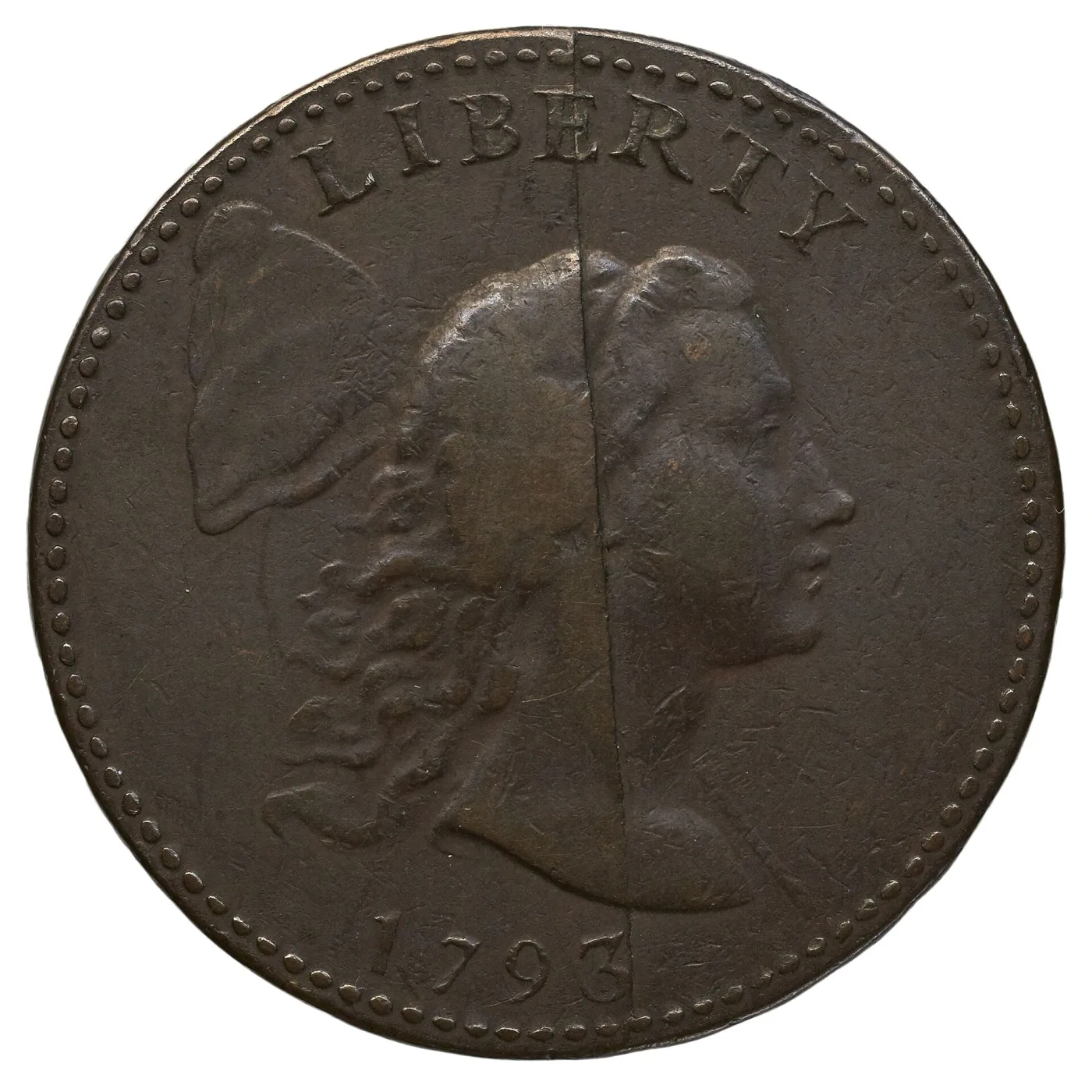
On the standard Wreath Cent, a small sprig of leaves sits directly above the date “1793,” between the date and the lower edge of Liberty’s flowing hair. This foliage — a little cluster of leaves on a short stem — is present on all Wreath Cents and immediately distinguishes the obverse from the Chain Cent (which has no sprig) and from the Liberty Cap cent (which replaced the flowing hair and cap arrangement). On most die marriages the sprig resembles a simple leafy branch, and its exact shape and position help specialists separate individual dies.
1793 produced three cent designs, and one look at the space above the date sorts them:
The Strawberry Leaf Sprig
On a tiny handful of dies, the sprig above the date is rendered not as the usual leaves but as a distinctive trefoil resembling a strawberry plant — a cluster with a small blossom or berry that early numismatists thought looked like a strawberry (some describe it as a cotton or clover leaf). This “Strawberry Leaf” sprig is the defining feature of the rarest and most storied Wreath Cent variety, discussed in the next section. In practical terms, when you examine any Wreath Cent, look closely at the sprig above the date: if it shows the ordinary leafy branch, you have a normal Wreath Cent; if it shows the unusual trefoil “strawberry” form, you may — extraordinarily rarely — be looking at one of the great rarities of American numismatics.
Reading the Sprig
Because the sprig is small and often the highest-relief detail on the lower obverse, it is frequently worn on circulated coins. Use magnification and good lighting to study its form. On a normal coin the distinction hardly matters for value, but confirming the sprig type is a standard part of Wreath Cent attribution and the only way to recognize a Strawberry Leaf should you ever encounter one.
The Strawberry Leaf Rarity
No discussion of the Wreath Cent is complete without the Strawberry Leaf cent, one of the most celebrated rarities in all of United States numismatics and, for many collectors, the ultimate prize of the 1793 copper coinage.
What the Strawberry Leaf Is
The Strawberry Leaf variety is a Wreath Cent on which the sprig above the date takes the unusual trefoil, “strawberry-plant” form rather than the normal leafy branch. It is cataloged among the Sheldon NC (“Non-Collectible”) numbers — the die marriages so rare that Dr. William Sheldon placed them outside the regular collectible sequence. The Strawberry Leaf coins are known in two die marriages (traditionally cited as NC-2 and NC-3), and together only about four examples are known to exist, none of them in high grade. Every known specimen is well worn and, in most cases, environmentally damaged, which only adds to the variety’s mystique.
Why It Is So Famous
The Strawberry Leaf is famous for the combination of extreme rarity, historical importance, and the drama of its market appearances. When a Strawberry Leaf cent comes to auction — an event that happens perhaps once in many years — it commands headlines and prices well into the six or seven figures despite grading only in the low circulated range. It is routinely listed among the most valuable large cents in existence and among the “holy grail” rarities that even advanced early-copper specialists may never own. Its status is a reminder that in early American copper, a tiny die difference — here, the shape of a sprig — can separate a modestly priced coin from a legendary one.
What This Means for You
For the ordinary collector, the practical lesson is simple: always look at the sprig, but understand that the odds of finding a genuine Strawberry Leaf are vanishingly small, and that any coin claimed to be one must be authenticated by a top grading service without exception. Far more common are misidentifications and outright fakes — worn normal Wreath Cents mistaken for Strawberry Leaves, or altered coins manufactured to imitate the trefoil sprig. If you believe you have found a Strawberry Leaf, do not clean it, do not sell it quickly, and submit it to PCGS or NGC for authentication; the difference between hope and reality here is measured in hundreds of thousands of dollars.

Composition and Physical Specifications
The 1793 Wreath Cent follows the large cent standard set by the Coinage Act of 1792 and the Mint’s earliest production. These specifications are essential for authentication and match those of its Chain Cent predecessor.
Standard Specifications (1793 Wreath Cent)
- Composition: 100% copper (pure)
- Weight: approximately 13.48 grams (208 grains), the 1793 large cent standard
- Diameter: approximately 26–28 mm (early cents vary in size)
- Edge: Vine and Bars (raised decorative design) or Lettered “ONE HUNDRED FOR A DOLLAR”
- Mint: Philadelphia only (no mint mark)
- Designer/Engraver: attributed to the early Mint staff (Adam Eckfeldt often associated with the wreath dies)
- Year struck: 1793 only
- Total mintage: approximately 63,353
As with the Chain Cent, the earliest 1793 cents are slightly heavier and larger than the later large cents of the 1800s, reflecting the original higher copper standard before subsequent weight reductions. A coin claimed to be a Wreath Cent that weighs dramatically off from about 13.5 grams, shows the wrong diameter, or lacks a proper raised edge treatment should be treated as suspect until authenticated. Because genuine survivors are frequently corroded or porous, weight can run slightly low from metal loss — so weight is one data point, not proof by itself.
Die Marriages (S-5 to S-11c) and NC Varieties
The Wreath Cent type is produced from a modest number of die marriages, cataloged in the Sheldon system immediately after the four Chain Cent marriages. Attribute the die marriage before pricing any Wreath Cent, because edge type, sub-variety, and rarity all bear on value.
The Collectible Sheldon Marriages (S-5 through S-11c)
The regular, collectible Wreath Cents run from Sheldon-5 through Sheldon-11c, continuing the numbering directly from the Chain Cents (which occupy S-1 through S-4). These marriages encompass the Vine and Bars edge coins and the Lettered edge coins, along with finer distinctions in the sprig, wreath, bow, and lettering. Some marriages are relatively obtainable, while others are genuinely scarce, but all are considered part of the standard collectible sequence that a variety specialist can realistically pursue.
Vine and Bars vs Lettered Edge Marriages
Among the collectible marriages, the edge type is a primary sorting factor. Most die marriages are Vine and Bars, while a smaller number are Lettered edge; a few specific marriages are known only with one edge. Because the edge is part of the attribution, a complete description of a Wreath Cent always states both the Sheldon number and the edge — for example, “S-9, Vine and Bars edge” or a Lettered-edge marriage. This is why examining the edge is inseparable from attributing the coin.
The Strawberry Leaf NC Varieties
Beyond the collectible marriages lie the famous NC (Non-Collectible) rarities, foremost among them the Strawberry Leaf coins (traditionally NC-2 and NC-3). These are die combinations known from only a tiny number of surviving specimens — in the Strawberry Leaf’s case, roughly four coins in total across both marriages. As with the Chain Cent’s NC rarities, the “Non-Collectible” label reflects that no ordinary collector can realistically assemble a set including them, not that they are undesirable; in fact they are among the most desirable of all large cents. They appear at auction only at long intervals and command extraordinary prices.
Comparison With Adjacent Types
The Wreath Cent’s die marriages sit between the Chain Cent’s S-1 through S-4 and the Liberty Cap cent’s later Sheldon numbers, so the three 1793 types form a continuous run at the very front of the Sheldon catalog. Collectors moving through early copper often study all three together, then continue into the Draped Bust and Classic Head large cents that follow. Understanding where the Wreath Cent falls in this sequence helps place any individual coin in the broader story of the denomination.
Sheldon Variety Attribution
Wreath Cent varieties are cataloged under the Sheldon numbering system, the standard attribution language for U.S. large cents of 1793–1814. Large cents use Sheldon (S-) numbers, while half cents use Cohen (C-) numbers — do not confuse the two systems when working with early copper.
How Sheldon Numbers Work
Dr. William H. Sheldon assigned a unique number to each die marriage — a specific obverse die paired with a specific reverse die — in his landmark reference Early American Cents (1949), later revised as Penny Whimsy (1958). He numbered the 1793 cents in order of type: the Chain Cents first (S-1 through S-4), then the Wreath Cents (S-5 onward), then the Liberty Cap cents. This is why the Wreath Cents occupy the numbers immediately after the Chain Cents at the very front of the Sheldon catalog, and why any comprehensive large cent collection encounters them near its beginning.
NC Numbers
Die marriages too rare for Sheldon to include in the regular collectible sequence received “NC” (“Non-Collectible”) numbers. The Wreath Cent’s NC varieties — the Strawberry Leaf coins chief among them — are among the most famous rarities in the entire large cent series, known from a mere handful of coins and treasured accordingly.
Why Sheldon Numbers Matter
The specific die marriage, together with the edge type, can significantly affect a Wreath Cent’s value. A Lettered-edge marriage is worth a premium over a common Vine and Bars marriage in the same grade, and an NC rarity is in a category of its own. Auction catalogs and certified-coin labels routinely cite the Sheldon number and the edge, and serious buyers purchase by variety as much as by grade. For most collectors, recording the Sheldon attribution and edge from a reputable certification label or auction description is sufficient; advanced specialists rely on Penny Whimsy, the EAC community, and William Noyes’s die-state photography for precise attribution.
Grading the Wreath Cent
Grading the 1793 Wreath Cent is among the more demanding tasks in U.S. numismatics. A grader must assess both technical wear (the Sheldon Scale, 1–70) and surface condition (porosity, color, planchet quality, eye appeal), and for this type — as for most early copper — the surface assessment often matters as much as the wear grade. Most survivors are heavily circulated and many are problem-affected, so a large share of Wreath Cents trade in the Good-to-Fine range and lower, though the type is appreciably more available in higher grades than the rarer Chain Cent.
Key Wear Points
On the obverse, the highest points — Liberty’s cheek and the flowing locks of hair — wear first, and the strands of hair merge as wear progresses; the sprig above the date is also high relief and softens early. The “LIBERTY” and date lettering should remain legible in Good and better. On the reverse, the raised wreath leaves, the bow, and the central “ONE CENT” are the high points; in low grades the leaves flatten and merge, while “ONE CENT” and “1/100” stay readable longer. Because many early cents are also weakly struck or struck from worn dies, distinguishing genuine wear from strike softness takes practice and reference comparison.
Color Designations
Mint State copper is graded in three color categories, though full original color is essentially unknown on this type:
- BN (Brown): Less than 5% original mint red. Virtually all Mint State Wreath Cents are brown.
- RB (Red-Brown): 5%–95% original mint red. Extraordinarily rare and enormously valuable for a Wreath Cent.
- RD (Red): 95%+ original red. Effectively nonexistent for the 1793 Wreath Cent given its age and the copper of the era.
The Surface (Porosity) Factor
As with the Classic Head large cent and other early copper, surface quality is a pricing axis as important as grade. A Wreath Cent may grade Fine by wear but have rough, granular, porous surfaces or corrosion, dropping its market value below a smoother, lower-graded coin. Third-party services assign “details” grades (for example, “VF Details, Corrosion” or “Environmental Damage”) to problem coins, while EAC graders apply sharp net deductions. Always assess the surface first: smooth and glossy is premium, lightly porous is average, and heavily corroded is a discount coin — even at the same technical grade.
EAC vs PCGS/NGC Grading
EAC (Early American Coppers) grades are typically several points more conservative than PCGS/NGC grades for the same coin, and the gap widens for problem-plagued types like the 1793 cents. An EAC “Fine-12” might receive a PCGS “VF-20.” EAC graders deduct heavily for porosity, cleaning, tooling, and any non-original surface — exactly the problems that plague this type. When buying from an EAC dealer, expect lower numerical grades but coins whose grade better reflects true quality; when buying certified coins, read the surface yourself and never assume a high number means a smooth, original coin. For a broader primer, see the coin grading guide.
Counterfeit Detection and Authentication
Because the 1793 Wreath Cent is valuable and historically important — and because the Strawberry Leaf is worth a fortune — the type is frequently counterfeited and faked. Deceptions range from crude souvenir replicas to sophisticated altered and cast pieces. Authentication by a major grading service is essential for any coin claimed to be genuine, and absolutely mandatory for any purported Strawberry Leaf.
Cast and Struck Counterfeits
Cast counterfeits show characteristic surface pitting (a fine “orange-peel” texture), softened detail, mushy rims, and seams along the edge where a casting mold joined. They often weigh incorrectly and lack the crisp, sharp devices of a struck coin. Struck counterfeits from false dies can be more deceptive but usually fail on precise die diagnostics, lettering shape, and — crucially — the edge treatment. The genuine Vine and Bars or Lettered edge is difficult to fake convincingly; a wrong, plain, reeded, or blurry edge is a strong red flag.
Altered and “Manufactured” Coins
Some fakes begin with a genuine but heavily worn or damaged 1793 cent (even a Chain Cent or a common Wreath) that has been tooled, re-engraved, or otherwise manipulated — most dangerously, to add or reshape the sprig into a false Strawberry Leaf. Others are entirely modern products. Examine the fields and devices under 10x magnification for tool marks, re-engraving, smoothing, or added detail, and be especially suspicious of any coin whose sprig or surfaces look “worked.” The very high value of the Strawberry Leaf makes it a prime target for exactly this kind of alteration.
Replicas and Souvenirs
Replica 1793 cents are sold openly as museum-shop souvenirs and history-set pieces, typically in the wrong metal or size and often (as U.S. law has required since 1973) stamped “COPY.” Any piece marked “COPY,” struck in brass or a plated base metal, or showing the wrong weight and color is a replica, not a genuine coin. These have no numismatic value as Wreath Cents.
Weight, Diameter, and Edge Checks
Three quick physical checks screen out many fakes: the coin should weigh roughly 13.5 grams (allowing for corrosion loss), measure around 26–28 mm, and show a genuine raised edge treatment (Vine and Bars, or Lettered “ONE HUNDRED FOR A DOLLAR”). A coin that fails any of these — especially the edge — should be presumed inauthentic until proven otherwise. For a systematic approach that applies across the series, consult the counterfeit coin detection guide.
Third-Party Certification
For any coin represented as a genuine 1793 Wreath Cent, certification by PCGS, NGC, or ANACS is strongly advised, and for a Lettered-edge coin or a purported Strawberry Leaf it is effectively mandatory. Given the values involved and the prevalence of fakes and alterations, no significant Wreath Cent should be bought raw unless you have the expertise to authenticate it yourself and accept the risk. Certification resolves authenticity, variety and edge attribution, and the critical surface/porosity question in one step. Many advanced buyers also value the EAC net-grading perspective for problem coins.
Current Market Values
The 1793 Wreath Cent is a four- to five-figure coin in most grades and reaches six and seven figures for the finest examples and the great rarities. Values vary by edge type (Vine and Bars vs Lettered), variety, grade, and — critically — surface quality. The figures below are 2026 retail estimates for genuine, problem-free Vine and Bars examples with average (lightly porous) surfaces; Lettered-edge coins bring premiums, smooth glossy coins bring strong premiums, and corroded or damaged coins trade at steep discounts, with “details”-graded problem coins selling well below the numbers shown. Auction results for premium and finest-known pieces regularly exceed these estimates.
Vine and Bars Edge (Common Type) — Retail Estimates
- AG-3: $1,500–$2,500
- G-4: $2,800–$4,500
- VG-8: $5,000–$8,000
- F-12: $9,000–$14,000
- VF-20: $18,000–$28,000
- EF-40: $40,000–$65,000
- AU and Mint State: $90,000 to well over $500,000
Lettered Edge — Add a Premium
Lettered-edge Wreath Cents (“ONE HUNDRED FOR A DOLLAR”) are scarcer than the Vine and Bars coins and typically command a meaningful premium over the figures above in the same grade, with the exact premium depending on the specific die marriage and eye appeal. Always confirm the edge before pricing, and price a Lettered-edge coin against Lettered-edge auction records rather than against common Vine and Bars results.
Strawberry Leaf and Other NC Rarities
The Strawberry Leaf cents and other NC rarities are essentially priceless in the practical sense — they appear at auction only rarely, and when they do, they can realize sums placing them among the most valuable large cents ever sold, commonly into the high six or seven figures even in low, damaged grades, purely on the strength of their extreme rarity and fame.
Factors That Move the Price
- Edge and variety: Lettered edge over Vine and Bars; NC rarities (Strawberry Leaf) in a class of their own.
- Surface: Smooth, glossy original surfaces command large premiums; porosity, corrosion, tooling, and cleaning drop values sharply.
- Grade: Even one point of grade can mean thousands or tens of thousands of dollars at the higher levels.
- Eye appeal and pedigree: Attractive coins with distinguished provenance bring premiums at auction.
Because values are high and sensitive to authenticity, edge, and surface, always rely on current certified auction records and a trusted specialist dealer when buying or selling — the estimates above are a starting framework, not a substitute for coin-in-hand evaluation.
Collecting Strategies
The Wreath Cent is more available and more affordable than the Chain Cent, which makes it a realistic acquisition for a wider range of collectors — but it still demands the same discipline around surface quality, edge, and authenticity that governs all early copper.
The Single Type Coin
The most common goal is one Wreath Cent to represent the type in a large cent type set (Chain, Wreath, Liberty Cap, Draped Bust, Classic Head, Coronet, Braided Hair) or a “first year of issue” set. Most collectors target a Vine and Bars example in a grade they can afford — often G-4 to F-12 — prioritizing a genuine, honestly graded coin with the most pleasing surfaces available in budget. A problem-free G-4 is a far better long-term hold than a “details” VF, and the Wreath Cent’s relative availability means patient buyers can hold out for a smooth, attractive coin.
Surface Over Grade
For this type especially, choose surface quality over raw grade. A smooth, evenly worn Good-4 with even brown color and no corrosion is more desirable — and more liquid — than a higher-graded coin with rough, porous, or tooled surfaces. Experienced early-copper collectors would rather own a “nice” low-grade Wreath Cent than a “problem” higher-grade one, and the market rewards originality handsomely.
The Edge and Variety Set
The advanced pursuit is to collect the Wreath Cent by edge and by die marriage: a Vine and Bars example, a Lettered-edge example, and, for the dedicated specialist, a run of the collectible Sheldon marriages (S-5 through S-11c). Acquiring a genuine Lettered-edge coin is a satisfying milestone, and assembling multiple marriages is a lifetime project for a large cent specialist. The Strawberry Leaf NC rarities sit beyond the reach of essentially all collectors, but their existence gives the series its legendary “impossible” top end.
Where the Wreath Cent Fits
The Wreath Cent sits second in an early American coppers collection and on the second page of a date-run large cent set, directly after the Chain Cent and directly before the Liberty Cap cent. Collectors often build the three 1793 types together as a set, then continue into the Draped Bust and later designs. Understanding how early copper is graded is essential before spending four or five figures on any single coin.
Storage and Preservation
Copper is the most chemically reactive of the coinage metals, and a 230-year-old cent — often already porous — demands careful handling to prevent further deterioration.
Never Clean the Coin
Cleaning copper destroys natural patina and microscopic surface detail and is irreversible. Cleaned Wreath Cents are described as “harshly cleaned,” “lightly cleaned,” or “recolored” and receive details grades, trading at heavy discounts. On a coin this valuable, a cleaning can erase thousands or tens of thousands of dollars of value. Never attempt to “improve” a dark or porous Wreath Cent — the porosity is in the metal and cannot be removed, and any attempt only adds a cleaning problem on top of it. If a coin is uncertified and you believe it may be genuine (or a rare edge or Strawberry Leaf), submit it for authentication rather than touching the surfaces.
Avoid PVC and Plasticizers
PVC (“polyvinyl chloride”) flips and album pages leach plasticizers that react with copper to form a corrosive green slime — a common disaster for inherited copper. Move any raw Wreath Cent out of PVC immediately and store it in inert Mylar, acid-free paper, or a hard inert capsule.
Humidity Control
High humidity accelerates copper corrosion and spotting, a particular danger for an already-porous planchet. Store copper below 50% relative humidity, ideally 30%–40%, with silica gel in the container. Avoid basements, attics, and garages where humidity swings seasonally.
Long-Term Storage
For a coin of this value, a certified PCGS or NGC holder provides an inert, sealed, tamper-evident environment and is the standard way to store and trade a genuine Wreath Cent. Inspect any stored copper periodically for new spotting or color change, and address active corrosion immediately, since it can progress quickly on a porous surface.
Frequently Asked Questions
What is a 1793 Wreath Cent worth in 2026?
Genuine, problem-free Vine and Bars Wreath Cents retail from roughly $1,500–$2,500 in About Good up to $40,000–$65,000 in EF-40, with AU and Mint State coins reaching $90,000 to well over $500,000. Lettered-edge coins command a premium at every grade, and the Strawberry Leaf NC rarities sell for high six or seven figures. Surface quality matters enormously: corroded, cleaned, or "details"-graded coins sell well below these figures.
Why is it called a "Wreath" Cent?
The reverse features an open wreath — two curved leafy branches tied with a bow — enclosing "ONE CENT," replacing the interlinked chain of the earlier Chain Cent. The Mint introduced the wreath in April 1793 after the public criticized the chain design as a symbol of bondage rather than unity.
What is the difference between the Vine and Bars edge and the Lettered edge?
The Vine and Bars edge is a raised ornamental pattern of vine and bars, found on most Wreath Cents. The Lettered edge reads "ONE HUNDRED FOR A DOLLAR" followed by a decorative device and is considerably scarcer, commanding a premium. Always check the edge by rotating the coin under good light, because it determines both the variety and much of the value.
What is the Strawberry Leaf cent?
The Strawberry Leaf is an extremely rare Wreath Cent variety on which the sprig above the date takes an unusual trefoil, "strawberry-plant" form instead of the normal leafy branch. Only about four examples are known across two die marriages (NC-2 and NC-3), all in low, worn grades, and it ranks among the most valuable and famous large cents in existence. Any coin claimed to be a Strawberry Leaf must be authenticated by PCGS or NGC.
How is the Wreath Cent different from the Chain Cent?
Both are 1793 Flowing Hair large cents, but the Chain Cent has a circle of chain links on the reverse and no sprig above the date, while the Wreath Cent has an open wreath on the reverse and a sprig of leaves above the date. The Wreath Cent replaced the Chain Cent within weeks and is more available and more affordable today. Together with the later Liberty Cap cent, they form the three 1793 large cent designs.
Do Wreath Cents use Sheldon or Cohen numbers?
Sheldon (S-) numbers. Large cents of 1793–1814 are attributed by the Sheldon system; half cents use the Cohen (C-) system. The Wreath Cents are S-5 through S-11c, continuing directly from the Chain Cents (S-1 through S-4), plus NC rarities such as the Strawberry Leaf marriages. Do not confuse the two attribution systems.
How can I tell if my 1793 Wreath Cent is genuine?
Check three physical features first: the coin should weigh about 13.5 grams, measure roughly 26–28 mm, and show a genuine raised edge (Vine and Bars, or Lettered "ONE HUNDRED FOR A DOLLAR" — not plain or reeded). Examine the surfaces and the sprig under magnification for casting pits, seams, tool marks, re-engraving, or a "COPY" stamp. Given how often this coin is faked and altered, any piece believed to be genuine should be authenticated by PCGS, NGC, or ANACS before purchase or sale.
What came before and after the Wreath Cent in 1793?
The Chain Cent came first, in March 1793, and was replaced by the Wreath Cent in April after public criticism. Later in 1793 the Wreath Cent gave way to the Liberty Cap large cent. So 1793 alone produced three large cent designs — Chain, Wreath, and Liberty Cap — a sequence found in no other year. For the full arc of the denomination, see the large cent overview guide.
Can I find a Wreath Cent in circulation or in a coin roll today?
No. Large cents were discontinued in 1857 and the Wreath Cent has not circulated for well over two centuries. Genuine examples are found only through specialist dealers, major auctions, and long-held collections, and are not legal tender for current transactions. Any "Wreath Cent" found loose or in a roll is a replica or novelty piece.