Fugio Cent Identification Guide: The 1787 First U.S. Coin, Franklin's Design, Varieties, and Values
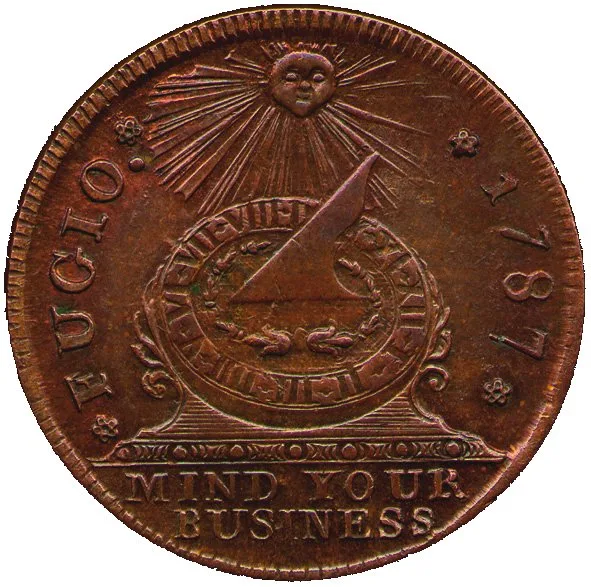
The 1787 Fugio Cent holds a place no other American coin can claim: it is the first coin struck under the authority of the United States government. Authorized by the Congress of the Confederation, designed with input attributed to Benjamin Franklin, and produced under a federal contract, the Fugio Cent bridges the world of the colonial coppers and the federal coinage that would begin at the Philadelphia Mint in 1793. For collectors it is a genuine founding artifact — a coin that was jingling in American pockets while the Constitution was being debated in that same year.
The Fugio Cent is also one of the most charming coins ever made. Its obverse shows a sundial beneath a radiant sun with the Latin word “FUGIO” — “I fly” or “I flee” — and the blunt English admonition “MIND YOUR BUSINESS.” Its reverse joins thirteen linked rings into a chain of states around the motto “WE ARE ONE.” Together the designs deliver a small sermon in copper: time flies, so mind your business, and remember that the states are united. These are the mottos and images that later reappeared on the 1793 Chain Cent, the nation’s first regular-issue federal coin.
This guide explains everything you need to identify, attribute, grade, authenticate, and value a Fugio Cent. You will learn who really made these coins and why, how to read the design, how to tell the major Newman die varieties apart, how to spot the famous 1859 “New Haven restrikes,” and how to distinguish a genuine 18th-century copper from the many copies and counterfeits in the market. Whether you have inherited an old copper or are hunting for a founding-era type coin, the Fugio Cent rewards careful study.
History: The First Coin of the United States
In the 1780s the new United States had no national mint and no national coinage. Everyday commerce ran on a chaotic mixture of foreign silver — above all the Spanish milled dollar — worn British and Irish coppers, state-issued coppers from Connecticut, New Jersey, Massachusetts, and Vermont, and a flood of lightweight counterfeit halfpence. The Congress of the Confederation, operating under the Articles of Confederation, recognized that a reliable copper coinage would serve both commerce and national dignity.
On April 21, 1787, Congress passed a resolution authorizing a federal copper coinage and contracted for its production. This makes the resulting Fugio Cent the first coin issued under the authority of the United States — a distinction that separates it from the state coppers and private tokens of the colonial and post-colonial era, which were struck by individual states, the Crown, or private speculators rather than by the national government.
The Congressional Resolution and the Mottos
The congressional resolution was unusually specific about the design. It directed that the coin bear “on one side the following device, viz. thirteen circles linked together, a small circle in the middle, with the words ‘United States’ round it; and in the center, the words ‘We are one’; on the other side of the same piece the following device, viz. a dial with the hours expressed on the face of it; a meridian sun above on one side of which is the word ‘Fugio,’ and on the other the year in figures ‘1787,’ below the dial, the words ‘Mind your business.’” This is the design of the Fugio Cent almost exactly as struck, which is why the coin’s imagery is sometimes described as the first “official” American iconography.
A Coin Born in a Pivotal Year
1787 was the year the Constitutional Convention met in Philadelphia and drafted the Constitution. The Fugio Cent was therefore produced during the final months of government under the Articles of Confederation, and it circulated as the founders were literally rewriting the framework of the nation. Few coins are so precisely tied to a hinge point in a country’s history, and that context is a large part of the Fugio’s enduring appeal.
Who Made the Fugio Cent
Understanding who actually produced the Fugio Cent — and how the project fell apart — is essential to understanding the coin’s varieties and its scarcity.
The Jarvis Contract
Congress awarded the coinage contract to a businessman named James Jarvis, who had gained control of the Company for Coining Coppers. The contract called for Jarvis to strike a large quantity of copper cents on the federal standard, using government-supplied copper where possible. Much of the actual coinage was produced at a mint in New Haven, Connecticut, which was already equipped for striking the Connecticut state coppers. The dies are generally attributed to Abel Buell, a talented and colorful New Haven engraver and entrepreneur.
The Contract Collapses
The Jarvis venture was a financial and political failure. Jarvis diverted government copper, fell far short of his contractual obligations, produced coins that were often underweight, and ultimately fled to Europe to escape his creditors and the authorities. Only a fraction of the contracted coinage was ever delivered to the government, and the enterprise ended in scandal. As a result, genuine 1787-dated Fugio Cents from the original coinage are far scarcer than the enormous authorized mintage might suggest, and no further federal contract coppers were struck.
Why This Matters for Collectors
Because the original coinage was produced by a private contractor using multiple dies over a compressed and troubled production run, the Fugio Cent exists in dozens of die combinations with meaningful differences in legends, punctuation, and the arrangement of the rays around the sun. These die varieties — catalogued by Eric P. Newman — are the heart of specialized Fugio collecting and the key to accurate identification.
Design and Symbolism
The Fugio Cent packs an extraordinary amount of meaning into a small copper coin. Both sides were designed to be read, not merely admired, and the imagery is deliberately didactic.
Obverse: The Sundial and the Sun
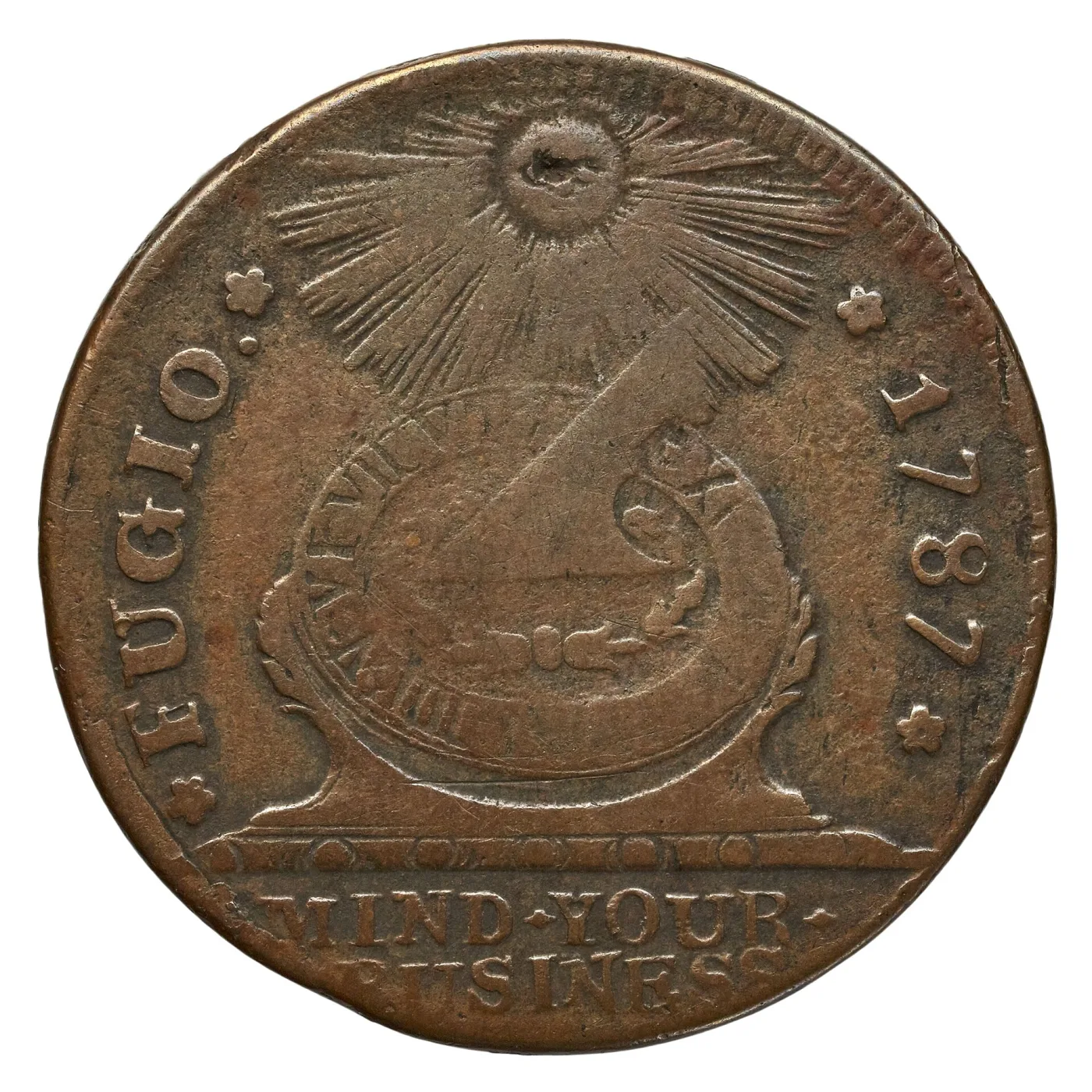
The obverse depicts a sundial with the hours marked on its face, illuminated by a radiant “meridian” sun above. To the left of the dial is the Latin word “FUGIO”; to the right is the date “1787.” Beneath the dial runs the motto “MIND YOUR BUSINESS.” The sundial and the word FUGIO together form a rebus about the passage of time: the sun and dial measure the hours, and “Fugio” (“I fly”) tells you that time itself is fleeing. The combined message — time flies, so attend to your affairs — is a piece of practical Enlightenment wisdom.
Reverse: Thirteen Linked Rings
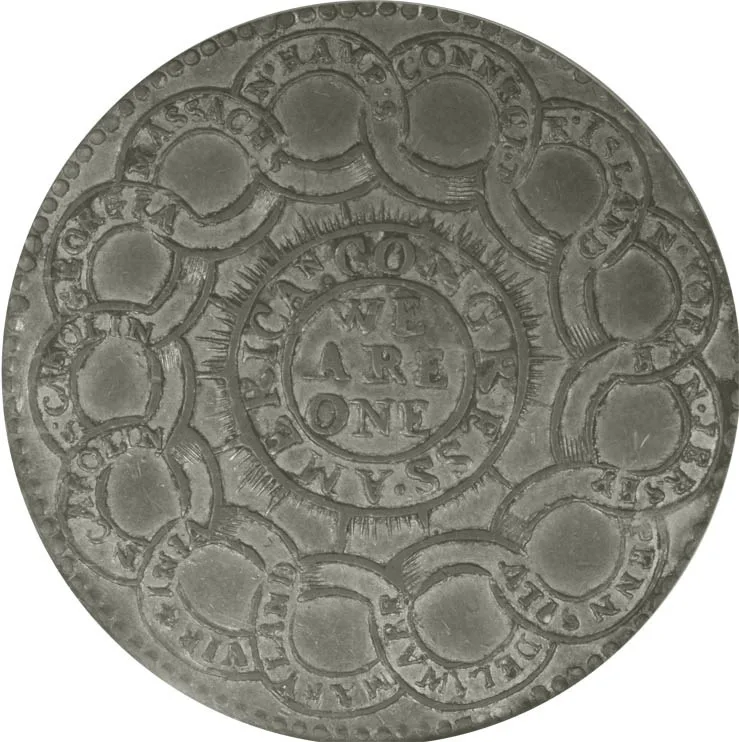
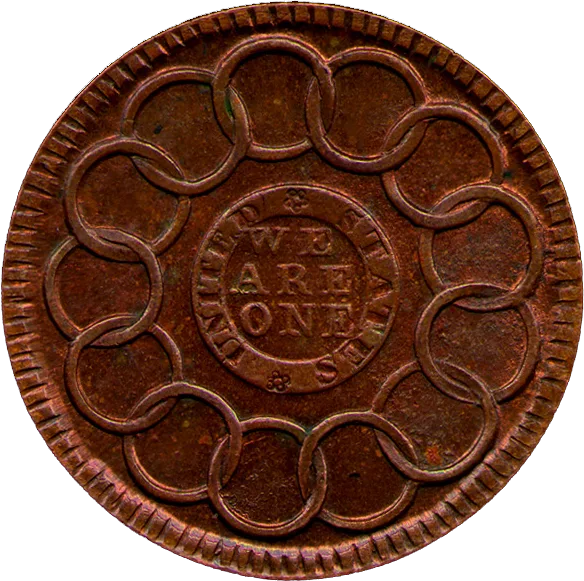
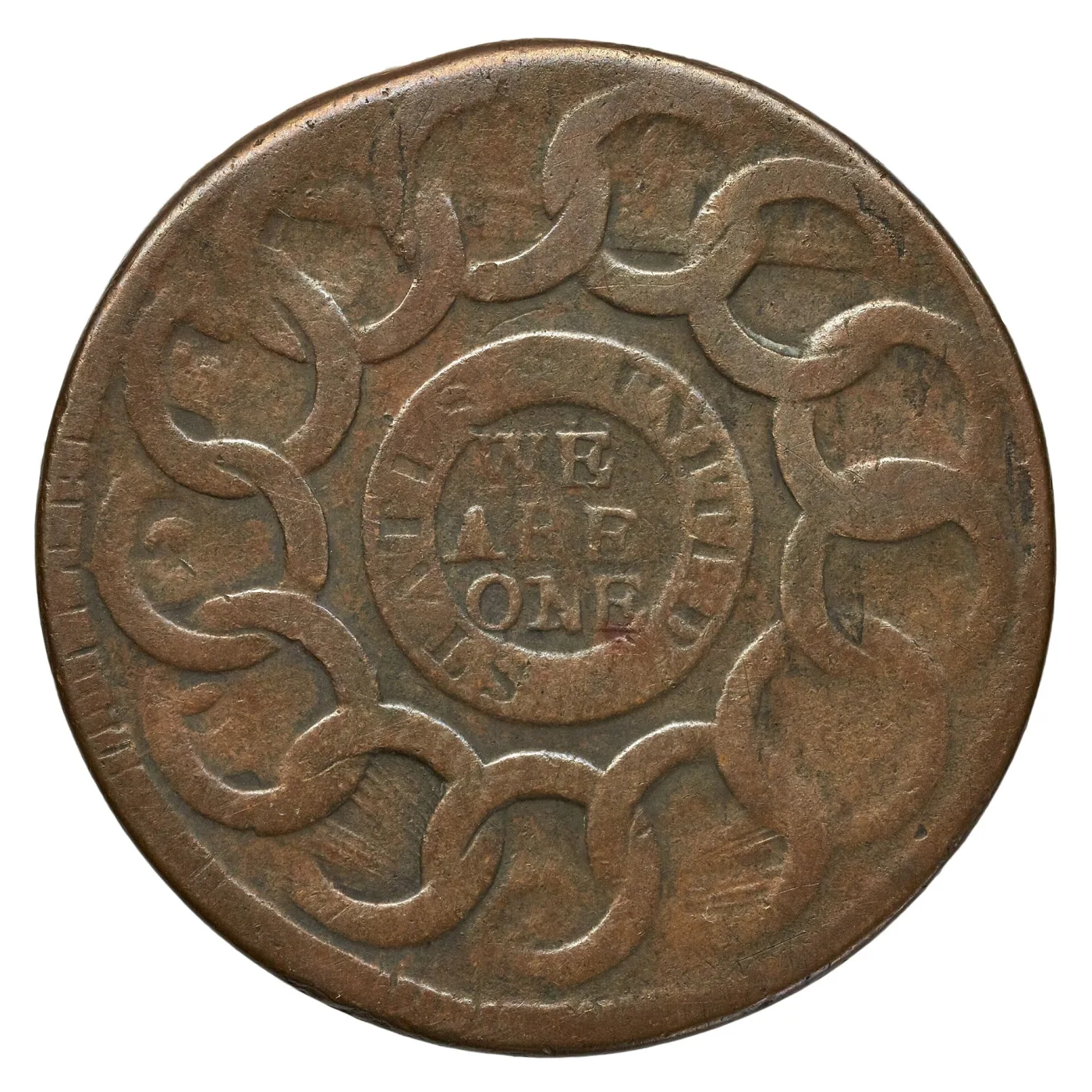
The reverse shows thirteen small rings, each representing one of the original states, linked together in an endless chain around the circumference. At the center is a small circle containing the words “WE ARE ONE,” with “UNITED STATES” (or, on some dies, “STATES UNITED”) arranged around it. The chain of linked rings is one of the earliest expressions of American federal union in coinage, symbolizing thirteen distinct states bound into a single nation. This exact motif — a ring of linked chain-links standing for the united states — was revived six years later on the reverse of the 1793 Chain Cent.
An American Design Language
The Fugio’s imagery established a visual vocabulary that echoes through early federal coinage. The linked chain reappeared on the first federal cent; the emphasis on mottos and allegory shaped the early large cents and half cents; and the didactic spirit — a coin that teaches a lesson — remained an American habit through the Two Cent Piece of 1864, the first coin to carry “In God We Trust.”
Franklin, “Fugio,” and “Mind Your Business”
The Fugio Cent is popularly called the “Franklin Cent,” and the design is traditionally attributed to Benjamin Franklin. The attribution is well founded, though it deserves a careful explanation.
The Franklin Connection
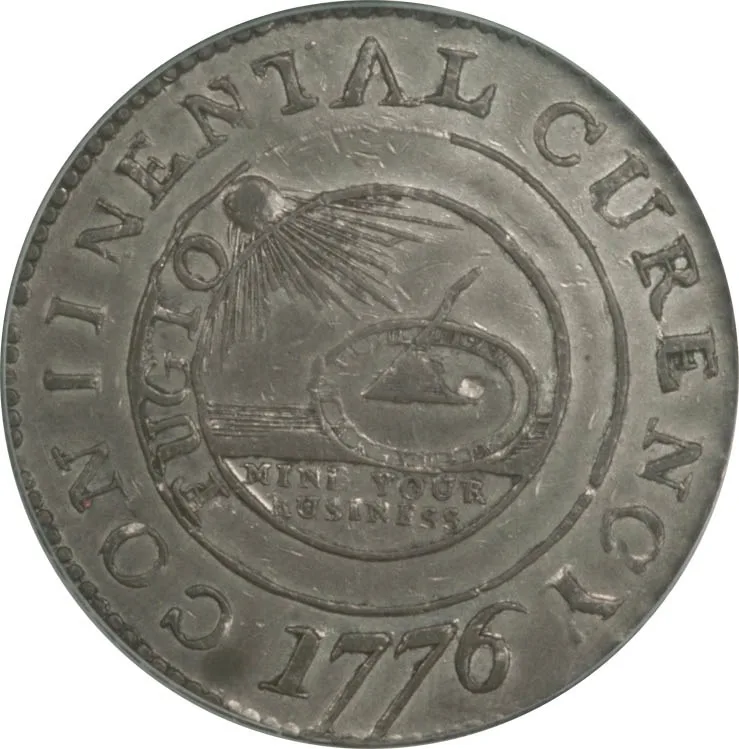
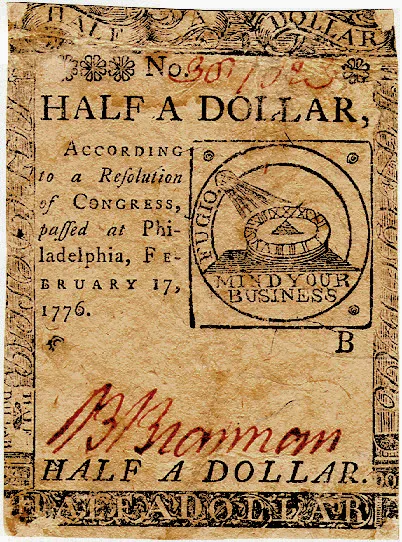
The pairing of “FUGIO” with a sundial and the motto “MIND YOUR BUSINESS” appears earlier on the paper currency Franklin helped design — the Continental currency notes and, before that, some colonial paper money. Franklin had a lifelong fondness for pithy maxims (he was, after all, the author of Poor Richard’s Almanack), and the combination of a sundial, the word “Fugio,” and a call to industriousness is thoroughly Franklinian in spirit. Numismatists therefore credit Franklin with originating the device, even though the coin itself was produced years later under the Jarvis contract.
What “Fugio” Means
“Fugio” is Latin for “I flee” or “I fly.” Paired with the sun and sundial, it is understood to complete the thought “time flies” — the sun crosses the sky, the dial marks the hours, and time is always fleeing. It is essentially a visual version of the Latin phrase “tempus fugit.”
“Mind Your Business” — Money, Not Manners
Modern readers often misread “MIND YOUR BUSINESS” as a rude “mind your own business.” In the 18th century the phrase was a straightforward exhortation to industry and diligence: attend to your affairs, work hard, do not waste the fleeting hours. On a coin — an instrument of commerce — the double meaning is deliberate: mind your business in the sense of tending to your trade and your money. This blend of thrift, time-consciousness, and commerce is exactly the sort of practical moralizing Franklin was famous for.
Composition and Physical Specifications
The Fugio Cent was struck in copper on the general standard intended for the federal coppers, though the troubled Jarvis coinage produced considerable variation in weight and quality.
Metal and Specifications
Composition: copper. Diameter: approximately 28 to 29 mm, roughly the size of a modern U.S. quarter to half-dollar. Weight: nominally around 157 grains (about 10.2 grams) on the intended standard, though surviving genuine examples vary considerably, and many are noticeably underweight because of Jarvis’s diversion of government copper. Edge: plain on the standard business strikes. These coppers are similar in scale to the contemporary large cents that would begin at the federal Mint in 1793.
Color and Surfaces
As copper coins that circulated in the 18th century and have aged for well over two centuries, Fugio Cents are normally found in shades of brown, chocolate, and olive, often with roughness, porosity, or corrosion from long burial or environmental exposure. Fully “red” original-color Fugios essentially do not exist among circulated pieces; the rare high-grade examples with original surfaces are almost always brown or lightly toned. Surface quality — smoothness versus granularity — is one of the biggest drivers of value in this series.
Striking Character
Because the coins were struck on relatively crude equipment from hand-made dies, strike quality varies enormously. Weakness, off-center striking, clashed dies, and die cracks are common and are part of the coin’s character rather than defects that disqualify a piece. Learning to distinguish honest circulation wear and striking softness from damage and alteration is a core identification skill for this series and for early copper generally.
How to Identify a Fugio Cent
A genuine Fugio Cent is unmistakable once you know what to look for. Work through these checks to confirm you have one and to begin narrowing down the variety.
Step 1: Confirm the Obverse Device
Look for the sundial with the radiant sun above it, the word “FUGIO” to the left of the dial, the date “1787” to the right, and “MIND YOUR BUSINESS” below. If your copper shows a sundial and the word FUGIO, you are almost certainly holding a Fugio Cent (or a copy of one). No other American coin uses this device.
Step 2: Confirm the Reverse Device
Turn the coin over and look for thirteen small linked rings forming a chain around the rim, a central circle reading “WE ARE ONE,” and the legend “UNITED STATES” or “STATES UNITED” around that center. Count the rings if you can — thirteen linked rings for the thirteen original states is the signature of the reverse.
Step 3: Read the Central Legend
Examine whether the legend around the central “WE ARE ONE” reads “UNITED STATES” or “STATES UNITED.” This single detail is the first fork in Fugio variety attribution and immediately places your coin into one of two broad groups (discussed below).
Step 4: Study the Rays Around the Sun
Look closely at the rays emanating from the sun on the obverse. On some varieties the rays are pointed and slender; on the scarce “Club Rays” varieties the rays are broad, blunt, and club-shaped. The form of the rays is a major variety determinant and a favorite diagnostic among specialists.
Confirm the coin is copper, roughly 28 to 29 mm in diameter, and shows the brown, aged surfaces expected of an 18th-century copper. Be alert to unnaturally sharp detail combined with lightweight, “soapy” surfaces, which can indicate a modern struck copy or a cast. When in doubt, compare against the fundamentals covered in our complete coin identification guide, and remember that any high-value attribution should be confirmed by a professional grading service.
Major Varieties: STATES UNITED, Pointed Rays, and Club Rays
Fugio Cents are collected by die variety, but three broad groupings capture the varieties most collectors care about and most affect value. These are the categories you will see on grading-service labels and in auction descriptions.
Pointed Rays vs. Club Rays
The single most important obverse distinction is the shape of the sun’s rays. Pointed Rays varieties, in which the rays taper to points, make up the large majority of Fugio Cents and are the type most collectors acquire. Club Rays varieties, in which the rays are broad and blunt like clubs, are considerably scarcer and command substantial premiums. Within Club Rays there are further sub-distinctions (such as rounded versus concave endings) that specialists track.
UNITED STATES vs. STATES UNITED
On the reverse, the legend circling “WE ARE ONE” reads either “UNITED STATES” or “STATES UNITED.” Both exist across various die combinations. The “STATES UNITED” arrangement and certain rare label pairings can be significant to variety collectors and to value, so this legend should always be read carefully and recorded when describing a coin.
Cinquefoils and Label Ornaments
Fugio reverses are punctuated with small ornaments. The most common are “cinquefoils” — five-petaled, flower-like devices — that separate the words in the legend. A few dies use crosses or other ornaments instead. The style of these small punctuation marks is one of the details Newman used to distinguish die marriages, and noticing them is part of careful attribution.
The “8 Pointed Star” and Other Notable Types
Certain Fugio varieties carry special nicknames and premiums, including dies with distinctive star ornaments on the label, particular rare legend arrangements, and specific scarce die states. These are the coins advanced collectors pursue, and correct identification can mean the difference between a common copper worth a few hundred dollars and a rarity worth many thousands.

Newman Numbers and Die Attribution
Serious Fugio collecting is organized around the die-variety system published by Eric P. Newman, the foremost scholar of the series. Understanding this framework helps you communicate about the coins and pin down exactly what you have.
The Newman Reference
Newman assigned numbers to the individual obverse and reverse dies and catalogued the combinations (die marriages) in which they are found. A Fugio variety is typically cited by a Newman number that identifies the specific pairing of obverse and reverse dies. Grading services and auction houses reference these numbers, and a coin attributed to a rare Newman marriage can be worth far more than a common one in the same grade.
How Attribution Works
Attribution proceeds by matching the details of your coin against reference photographs and descriptions: the shape of the rays, the exact wording and arrangement of the legends, the style and placement of the cinquefoils and other ornaments, the positions of the date digits, and any die cracks or clash marks. Because the differences can be subtle, high-value attributions are usually confirmed by specialists or by third-party grading services that note the variety on the holder.
Do You Need to Attribute Your Coin?
For a common Pointed Rays Fugio in circulated grade, precise Newman attribution has modest impact on value, and simply identifying the coin as a genuine 1787 Fugio Cent is enough for most owners. For scarcer types — Club Rays, unusual legends, rare die states — attribution is essential, because it can multiply the coin’s value. When in doubt about whether your coin is a common or a rare marriage, professional grading is the safest path.
The 1859 New Haven Restrikes
No discussion of the Fugio Cent is complete without the famous “New Haven restrikes,” a set of pieces that are technically not 18th-century coins at all but that occupy a permanent place in the series.
The Story of the Restrikes
According to the traditional account, in 1858 a young man named C. Wyllys Betts recovered original Fugio dies (or the site of the New Haven mint) and, around 1859 to 1860, dies were used — or new dies were made — to strike additional Fugio Cents for sale to collectors. These pieces, produced roughly seventy years after the originals, became known as the “New Haven restrikes.” They were struck in copper, brass, silver, and even gold for the collector market.
How to Recognize a Restrike
The New Haven restrikes come from a specific die combination and have their own diagnostic look, generally with sharper, fresher detail and smoother, more “modern” surfaces than a genuinely circulated 1787 original. Off-metal restrikes in brass, silver, or gold are obviously not original copper business strikes. Because restrikes are a well-known and collectible part of the Fugio story, they carry value in their own right, but they must never be confused with — or sold as — original 1787 coinage.
Why It Matters for Identification
If you encounter a very sharp, almost uncirculated-looking “Fugio Cent” with clean surfaces, or one struck in a metal other than copper, the New Haven restrike is a strong possibility and the piece should be evaluated accordingly. The distinction between an original and a restrike is exactly the kind of judgment where professional authentication earns its fee.
Grading Fugio Cents
Grading early copper like the Fugio Cent differs from grading modern coins. Surface quality, color, and the absence of damage matter as much as the technical amount of wear, and “net grading” is the norm.
Focal Points for Wear
On the obverse, the high points that wear first are the sundial’s gnomon and dial face and the details of the sun. On the reverse, the linked rings and the central “WE ARE ONE” show wear early. Because strike quality varies so much, graders distinguish honest wear from weak striking, just as they do on other crudely struck early types like the 1793 Chain Cent.
Grade Ranges
About Good to Good (AG-3 to G-6): Heavy wear; the sundial and legends are worn but the FUGIO device and thirteen rings are identifiable. Many surviving Fugios fall in this range.
Very Good to Fine (VG-8 to F-15): Moderate wear with the major devices clear; some detail visible in the dial and rings. Legends are readable. This is a common and desirable circulated range for type collectors.
Very Fine (VF-20 to VF-35): Light-to-moderate wear; strong dial and ray detail, sharp legends, pleasing surfaces. Genuinely attractive VF Fugios command solid premiums.
Extremely Fine to About Uncirculated (EF-40 to AU-58): Only slight wear on the highest points, with much original detail. Such coins are scarce and valuable, and surface quality becomes critical to the price.
Mint State (MS-60 and up): No wear. Uncirculated original Fugios are rare and expensive, and even here brown color is the norm; the finest examples with smooth, original surfaces bring the strongest prices. Comparing Fugio surfaces against later coppers such as the early half cents helps calibrate the eye for original color and luster.
Net Grading and Problem Coins
Because so many Fugios have porosity, corrosion, scratches, or old cleaning, grading services frequently assign “details” grades (for example, “VF Details, environmental damage”) rather than a straight numerical grade. A problem-free coin at a given level of wear is worth substantially more than a damaged coin with the same detail. Evaluating surfaces honestly is the single most important grading skill for this series.
Counterfeit Detection and Copies
As the first coin of the United States, the Fugio Cent is widely reproduced. Distinguishing a genuine 1787 copper from copies, counterfeits, and restrikes is the most important protection a buyer has.
Modern Replicas and Souvenir Copies
Countless souvenir Fugio Cents have been produced for museums, gift shops, and educational use. Many are marked “COPY” as required by U.S. law since 1973, but older or foreign-made pieces may not be. Replicas are often the wrong size or weight, struck in the wrong metal, or unnaturally sharp and shiny. Any Fugio with crisp, brand-new detail and bright surfaces deserves suspicion.
Cast Counterfeits
Cast (mold-made) fakes typically show soft, mushy detail, a grainy or pebbled surface under magnification, and sometimes a seam around the edge. The plain edge of a genuine Fugio makes casting seams relatively easy to detect. Cast pieces also frequently fail the weight and diameter checks.
Struck Counterfeits and Altered Pieces
More deceptive fakes are struck from counterfeit dies and can approximate the correct weight and appearance. Diagnostics include lettering and ornament styles that do not match any genuine Newman die, tooling marks, and surfaces that look artificially aged. Comparing a suspect coin’s fine details against verified die photographs is the surest defense, which is why variety knowledge and authentication go hand in hand. The same disciplined, test-based approach used across our counterfeit detection guide — weight, dimensions, surface, and detail analysis — applies directly to the Fugio.
When to Get Professional Authentication
For any Fugio Cent you intend to buy or sell above a modest price, and for any coin that might be a scarce variety or a high grade, certification by PCGS or NGC is strongly advised. A certified holder provides authentication, an objective grade, a variety attribution where applicable, and tamper-evident protection — inexpensive insurance against an expensive mistake.
Current Market Values by Variety and Grade
Fugio Cent values are driven by variety, grade, and — above all — surface quality. The following are typical 2026 retail ranges for genuine, properly attributed coins. Damaged or “details”-graded pieces sell well below these figures.
Common Pointed Rays Varieties
Good to Very Good: roughly $250 to $500. Fine: $500 to $850. Very Fine: $900 to $1,800. Extremely Fine: $2,000 to $4,000. About Uncirculated: $4,500 to $8,000. Mint State brown: $9,000 to $20,000+, with premium-surface and higher-grade examples reaching well beyond that at auction.
Club Rays and Scarce Varieties
Club Rays Fugios command large premiums over Pointed Rays. Circulated Club Rays examples frequently bring several thousand dollars, and higher grades or rare die marriages can reach five figures. Certain very rare Newman marriages and unusual legend combinations are worth many times the common-variety prices and are the province of specialist collectors.
New Haven Restrikes
Copper New Haven restrikes typically sell in the hundreds to low thousands of dollars depending on grade, while off-metal restrikes in brass, silver, or gold are scarcer and priced accordingly. Restrikes are collectible in their own right but are valued separately from — and generally below — comparable original 1787 coins of similar eye appeal.
What Moves the Price
Two Fugios with the same wear grade can differ several-fold in price based on surface quality alone. A smooth, glossy brown coin free of corrosion is worth far more than a granular, porous, or cleaned example. Originality, eye appeal, and a clean surface are prized above sharp detail on a damaged coin. As with all early copper, buy the coin, not the number on the holder.
Collecting Strategies and Tips
The Fugio Cent appeals to several kinds of collectors, from those who simply want one founding-era coin to specialists chasing every die marriage. Here are the common approaches.
The Single Type Coin
Most collectors want exactly one Fugio Cent to represent the first coinage of the United States in a type set. A pleasing, problem-free Pointed Rays example in Very Good to Fine is the classic choice, offering strong eye appeal and historical resonance at a manageable price. Prioritize surfaces and originality over raw sharpness.
The Variety Specialist
Advanced collectors pursue Fugio Cents by Newman variety, seeking the full range of ray types, legend arrangements, and ornament styles. This is a deep, scholarly pursuit rewarded by the intellectual satisfaction of attribution and the thrill of finding a rare marriage misidentified as a common coin — the classic “cherrypick.”
Building Historical Context
Many collectors place the Fugio alongside related founding-era pieces: the colonial and post-colonial coppers that preceded it, and the first federal issues — the 1793 Chain Cent, early large cents, and half cents — that followed. Displayed together, these coins tell the story of how the United States moved from a patchwork of state and foreign money to a national coinage.
Buying Wisely
Buy certified coins from reputable dealers and auction houses when spending real money, learn to read surfaces before you learn to chase grades, and be especially cautious of “bargain” Fugios online, which are disproportionately copies, restrikes sold as originals, or damaged coins photographed flatteringly. Patience and knowledge are the Fugio collector’s best tools.
Storage and Preservation
Copper is a reactive metal, and 18th-century copper is fragile. Proper storage protects both the coin and its value.
Avoid PVC and Moisture
Never store a Fugio Cent in a soft PVC flip. PVC breaks down over time and deposits a corrosive green residue on copper that can permanently damage the surface. Use inert Mylar flips, archival hard-plastic holders, or the sealed holders provided by grading services. Keep coins in a cool, dry place with stable humidity below about 50%.
Never Clean an Original Copper
Cleaning is the fastest way to destroy the value of a Fugio Cent. Any abrasive cleaning, dipping, or “brightening” strips the natural patina, leaves microscopic scratches, and turns an original coin into a “details”-graded problem coin worth a fraction of its former value. Even an unattractive, dark original surface is worth more than a cleaned one. The same rule applies to all early copper, including the large cents and half cents of the same era.
Handling
Always hold the coin by its edges over a soft surface, and use clean cotton or nitrile gloves for higher-grade pieces. Skin oils and acids can etch copper and leave permanent fingerprints that develop over months. Minimizing handling is the simplest form of preservation.
Frequently Asked Questions
Is the Fugio Cent really the first U.S. coin?
Yes. The Fugio Cent, authorized by a resolution of the Congress of the Confederation in 1787 and produced under a federal contract, is the first coin issued under the authority of the United States government. Earlier American coins — Massachusetts silver, state coppers, and various tokens — were made by individual colonies or states, the Crown, or private parties, not by the national government.
What does "Fugio" mean?
"Fugio" is Latin for "I flee" or "I fly." Combined with the sun and sundial on the coin, it conveys the idea that "time flies," similar to the phrase "tempus fugit." It is a reminder to make good use of one's fleeting time.
What does "Mind Your Business" mean on the coin?
In 18th-century usage it meant "attend to your affairs" — a call to industry and diligence rather than the modern rebuke "mind your own business." On a coin used in commerce, it also carries the sense of tending to your trade and your money.
Did Benjamin Franklin design the Fugio Cent?
The design is traditionally and credibly attributed to Franklin, who used the same sundial, "Fugio," and "Mind Your Business" motifs on paper currency he helped create. The coin is often called the "Franklin Cent," although it was actually struck under the Jarvis contract, partly at New Haven, with dies attributed to Abel Buell.
Why are genuine Fugio Cents relatively scarce if so many were authorized?
The Jarvis coinage contract failed. Jarvis diverted government copper, struck far fewer coins than required, produced many underweight pieces, and fled abroad. Only a fraction of the authorized coinage was delivered, so genuine original 1787 Fugios are much scarcer than the intended mintage would imply.
What are the New Haven restrikes?
They are Fugio Cents struck around 1859 to 1860 — roughly seventy years after the originals — for sale to collectors, reportedly after original dies or the New Haven mint site were rediscovered. They were made in copper and in off-metals like brass, silver, and gold. They are collectible but must not be confused with, or sold as, original 1787 coins.
How much is my Fugio Cent worth?
It depends heavily on variety, grade, and surface quality. A common Pointed Rays example in circulated grade might bring a few hundred to a couple thousand dollars, while Club Rays coins, rare Newman marriages, and high-grade originals can reach five figures. Damaged or cleaned coins sell for much less. Professional authentication and attribution give the most reliable valuation.
Should I clean my Fugio Cent to make it look better?
No. Cleaning a Fugio Cent destroys its natural patina and dramatically reduces its value. Coins identified as cleaned receive "details" grades and sell at steep discounts. Leave the surfaces original, even if the coin looks dark or worn.