Liberty Head V Nickel Identification Guide: Key Dates, Mint Marks, and Values
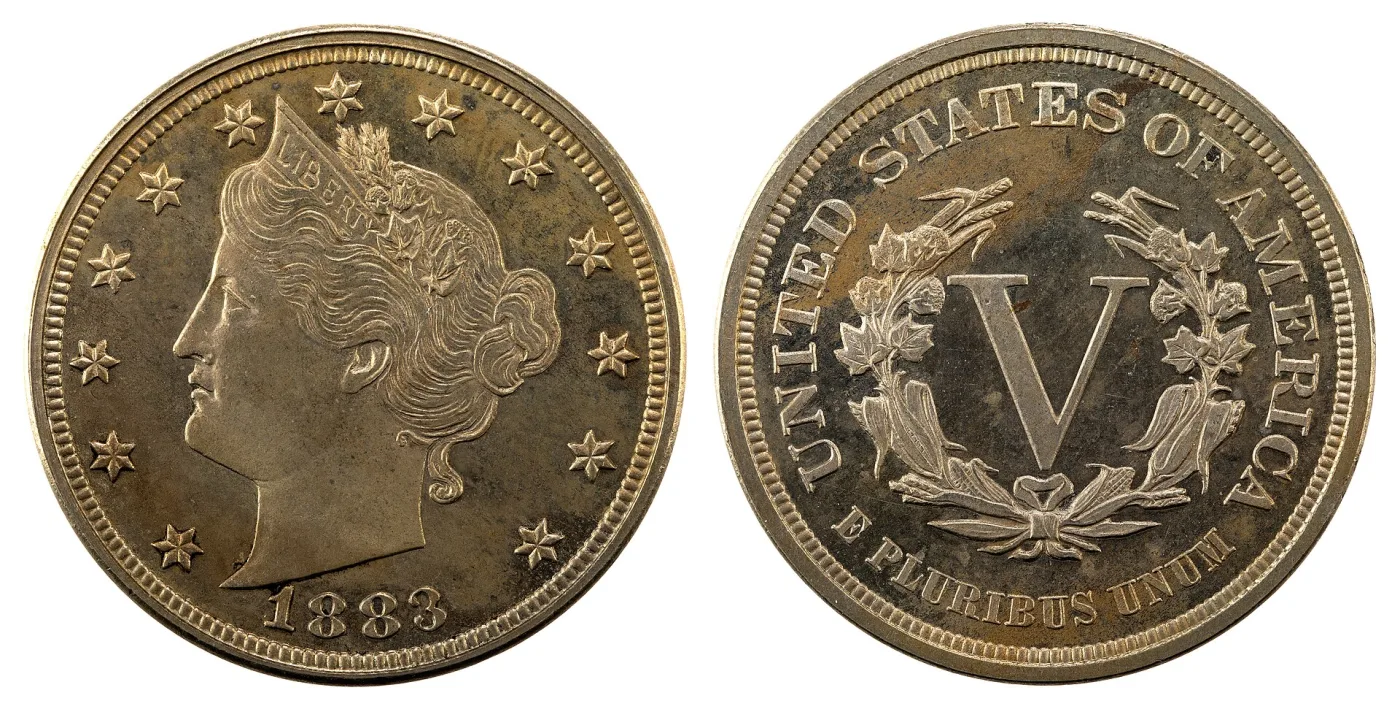
The Liberty Head Nickel — affectionately known to collectors as the “V Nickel” because of the prominent Roman numeral V on its reverse — is one of the most historically interesting five-cent pieces ever produced by the United States Mint. Struck from 1883 through 1912 (with five legendary 1913 specimens famously made under mysterious circumstances), this Charles E. Barber design replaced the older Shield Nickel and preceded the celebrated Buffalo Nickel. Across its three-decade run it witnessed the closing of the American frontier, the Spanish-American War, and the dawn of the automobile age.
For collectors, the V Nickel offers a rare combination: a classic nineteenth-century design, a manageably short series, an iconic first-year scandal involving gold-plated “racketeer nickels,” and one of the most famous rarities in all of numismatics — the 1913 Liberty Head Nickel, of which only five examples are known to exist. Building a complete date set is achievable for collectors of moderate means, and even high-grade examples of common dates remain affordable compared with similar-era coins like the Morgan Silver Dollar.
This guide walks you through everything you need to know to identify, grade, and value Liberty Head V Nickels: the famous Type 1 (No CENTS) and Type 2 (With CENTS) varieties of 1883, the legendary racketeer nickel scam, all key and semi-key dates, mint mark identification, the 1913 rarity, authentication tips for spotting alterations and counterfeits, current market values, and practical advice for assembling a collection. The same analytical approach used here applies broadly across American numismatics — many of these coin identification techniques work across the full spectrum of US coinage.
History and Design: Charles Barber’s V Nickel
By the early 1880s, the Shield Nickel — in service since 1866 — had become a headache for the United States Mint. Its high-relief design clashed with the hard nickel-copper alloy and routinely produced weakly struck coins, broken dies, and quality-control problems — bad enough that the Mint had already simplified the reverse once in 1867, which is why 1867 Shield Nickels exist with and without rays. Mint Director Henry Linderman had begun experimenting with replacement designs as early as 1881, and by 1882 the Mint’s chief engraver, Charles E. Barber, had prepared the patterns that would soon become the Liberty Head Nickel.
Barber, who would later design the Barber Dime and Barber Quarter beginning in 1892, drew on classical motifs that had become a hallmark of late-nineteenth-century American coinage. His Liberty Head obverse depicts a stately, idealized goddess of Liberty wearing a coronet inscribed with LIBERTY, surrounded by thirteen stars representing the original colonies. The reverse features a large Roman numeral V — the denomination — within a wreath of cotton, corn, wheat, and tobacco leaves: the agricultural staples of the United States.
Production began in early 1883, but almost immediately the design provoked controversy. The reverse of the new coin lacked the word CENTS — Barber had assumed that the V was self-explanatory, just as Roman numerals had identified denominations on US gold pieces for decades. He was about to be proven wrong in spectacular fashion, leading to the famous racketeer nickel scandal we will examine in detail later. By mid-1883 the Mint had revised the reverse to add the word CENTS at the bottom, creating two distinct subtypes within a single year.
The Designer: Charles E. Barber
Charles Barber, son of William Barber (designer of the Trade Dollar), served as Chief Engraver of the United States Mint from 1879 until his death in 1917 — a tenure that included the design of half the circulating American coinage of his era. Despite frequent friction with outside artists like Augustus Saint-Gaudens and James Earle Fraser (creator of the Buffalo Nickel that replaced the V Nickel in 1913), Barber was a meticulous craftsman whose designs prized clarity, durability, and ease of striking over artistic flourish. The Liberty Head Nickel exemplifies these priorities: low relief, balanced fields, and a portrait that wears slowly even with heavy circulation.
Barber’s design served well for thirty years. By the time it was retired in early 1913, more than 596 million V Nickels had been struck — an enormous output that ensured the design would remain familiar to American collectors and casual observers for generations.
Design Details: Obverse and Reverse
Understanding every element of the V Nickel design helps you grade it accurately, identify die varieties, and spot altered or counterfeit specimens.
Obverse (Heads Side)
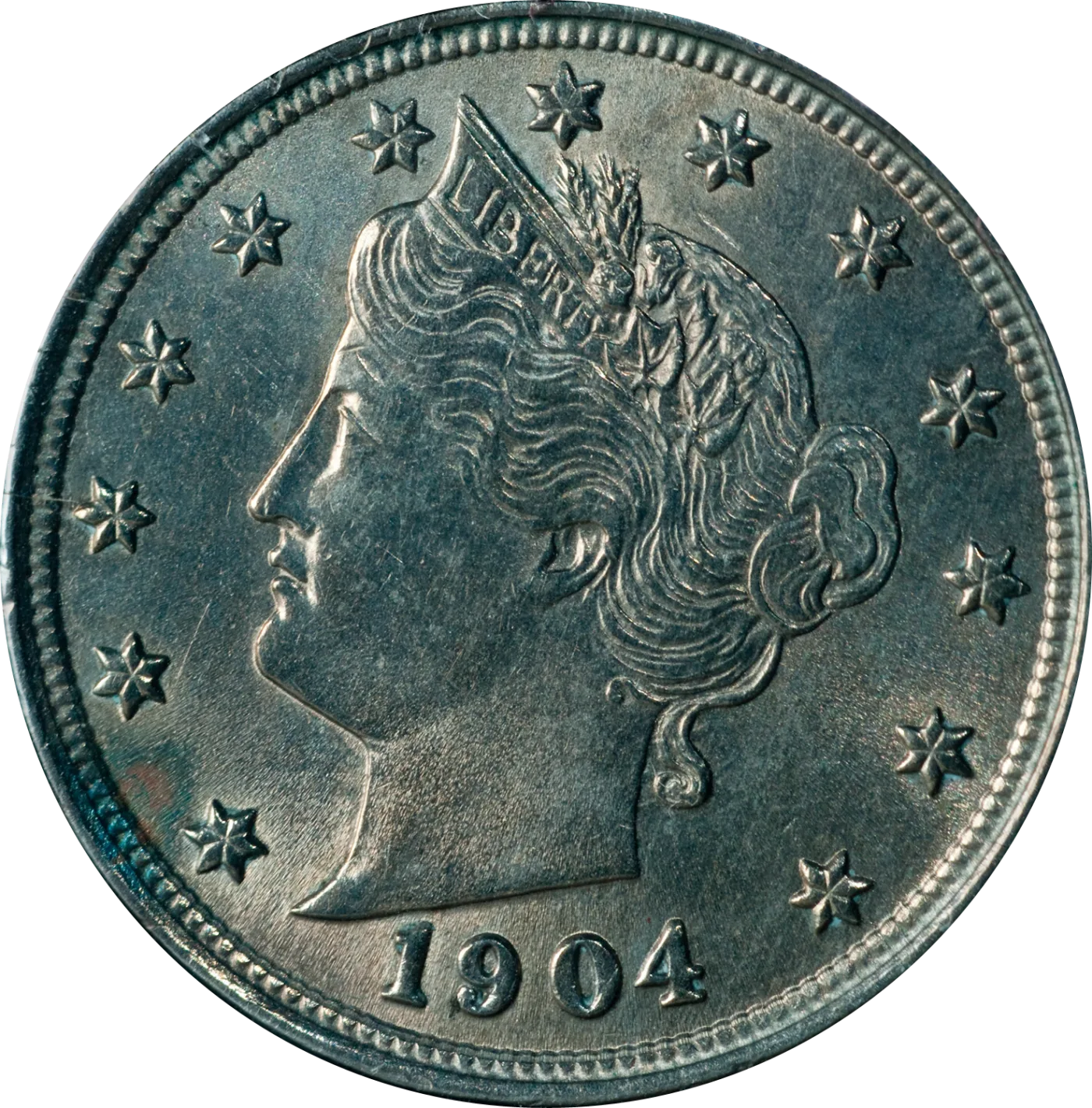
The obverse features a left-facing profile bust of Liberty. She wears a coronet — a band across her hair — inscribed with LIBERTY in raised letters. Her hair is pulled back in classical style, with curls falling behind her neck. Thirteen stars surround the portrait, six on the left and seven on the right, representing the original thirteen colonies. The date appears at the bottom of the coin, below the bust truncation.
The obverse carries no mint mark; mint marks appear only on the reverse and only on coins struck in 1912, when production briefly expanded beyond Philadelphia. There is no designer’s initial visible on the obverse — Barber’s signature B does not appear on this coin (unlike his later Barber Dime, Quarter, and Half Dollar designs, where his B is on the truncation of Liberty’s neck).
Reverse (Tails Side)
The reverse features a large, bold Roman numeral V (representing five cents) at the center of the coin, surrounded by a wreath. The wreath combines four agricultural emblems: cotton at left, corn at right, with wheat and tobacco leaves interwoven. Above the wreath, the legend UNITED STATES OF AMERICA curves along the rim, with the motto E PLURIBUS UNUM just below it in smaller letters.
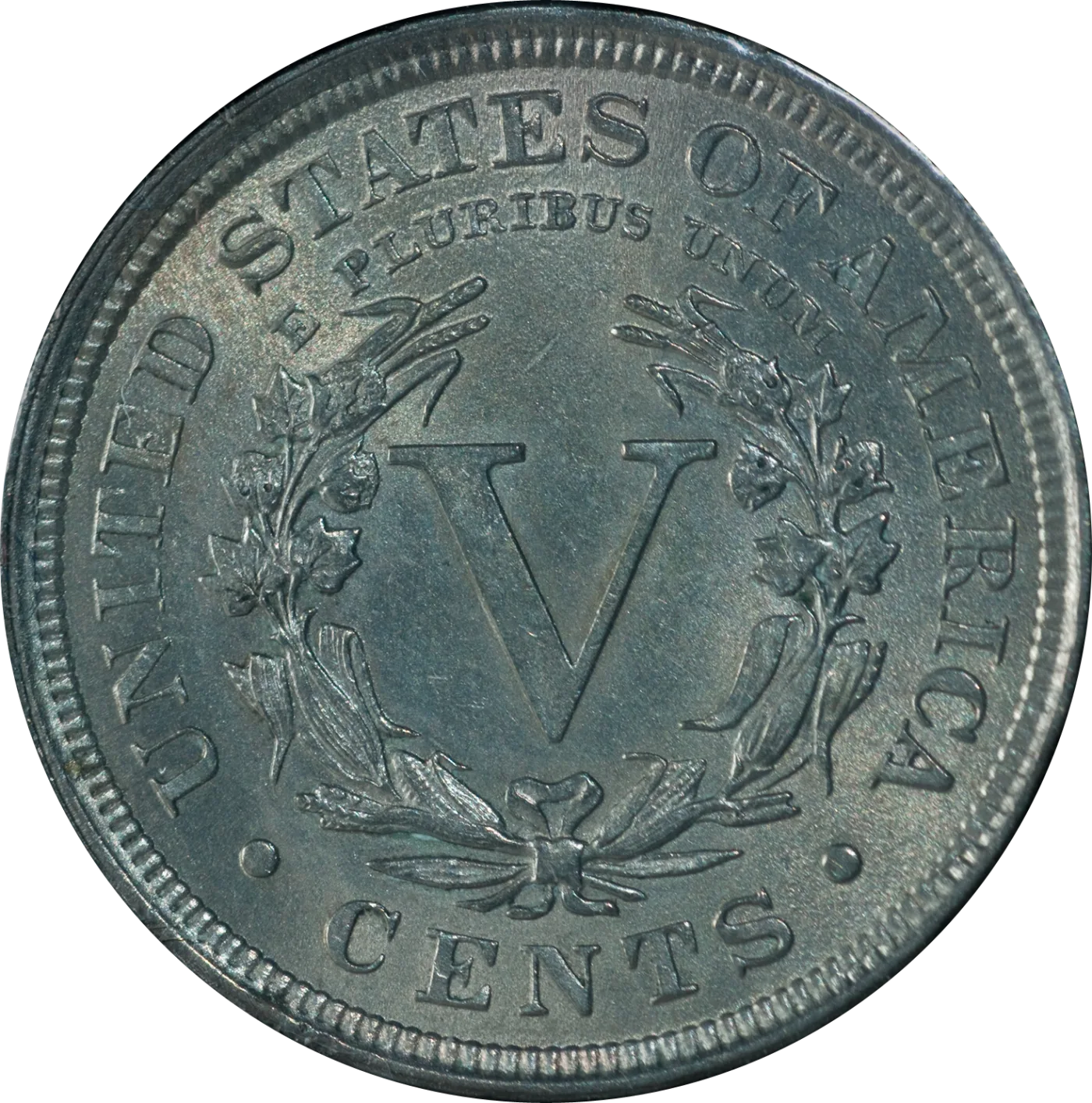
Below the wreath sits the most consequential design element on the entire coin: on Type 1 (1883 only) the area is blank; on Type 2 (mid-1883 onward through 1912) the word CENTS appears in raised letters. The presence or absence of CENTS is the single most important variety distinction in the entire series, and we will examine it in detail in the next section.
Mint marks, when present, appear on the reverse to the left of the word CENTS — visible only on the 1912-D and 1912-S issues, which are the only V Nickels ever struck outside Philadelphia.
Type 1 (No CENTS) vs. Type 2 (With CENTS)
Among all Liberty Head Nickel varieties, the most fundamental distinction is between Type 1 and Type 2 — both produced only in 1883. If you own an 1883 V Nickel, identifying which type it is is the first step toward establishing its value, because the historical context of these two subtypes is unlike any other in American numismatics.
Type 1: No CENTS (Early 1883)
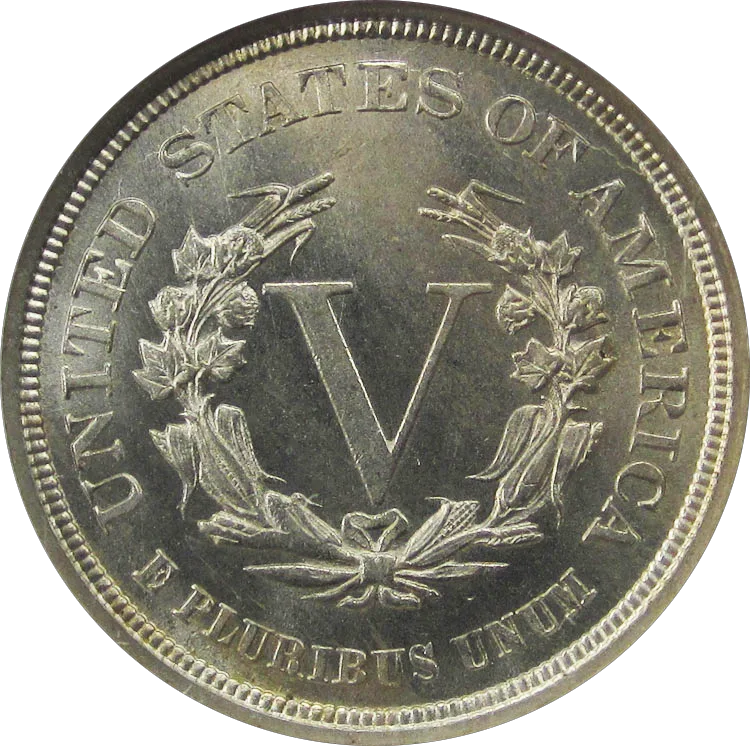
The Type 1 reverse — used from January through approximately June of 1883 — has only the Roman numeral V within the wreath. There is no word CENTS anywhere on the coin. The denomination is communicated entirely by the V, exactly as Charles Barber had intended. Mintage of Type 1 was approximately 5,479,519 pieces, all struck at Philadelphia.
Despite the perception of rarity created by their reputation, Type 1 No CENTS nickels are actually among the most common dates in the entire series in higher grades. Because their notoriety was instant — sparked by the racketeer nickel scandal — they were saved by the millions almost immediately after the design change. Today, finding a problem-free Mint State Type 1 is far easier than finding a Mint State example of most other V Nickel dates.
Type 2: With CENTS (Mid-1883 through 1912)
By summer 1883, public outrage over the racketeer nickel scam had become a national embarrassment. The Mint hurriedly modified the reverse die to add the word CENTS at the bottom of the coin, below the wreath. The denomination was now unmistakable, and the agricultural wreath was slightly compressed to make room for the new lettering. This Type 2 reverse was used for the remainder of 1883 and every subsequent year of the series through 1912.
The 1883 With CENTS coin is significantly scarcer than the No CENTS variety, with a mintage of approximately 16,032,983 pieces — but with far fewer survivors in higher grades because few were saved as souvenirs the way the No CENTS pieces were. In Mint State the With CENTS 1883 typically commands a higher premium than the No CENTS, the reverse of what most collectors initially assume.
Identifying Type 1 vs. Type 2 at a Glance
The quickest way to tell them apart is to look at the area below the wreath on the reverse:
- Type 1 (No CENTS): Plain field below the wreath; only the V indicates denomination
- Type 2 (With CENTS): The word “CENTS” appears below the wreath in raised letters
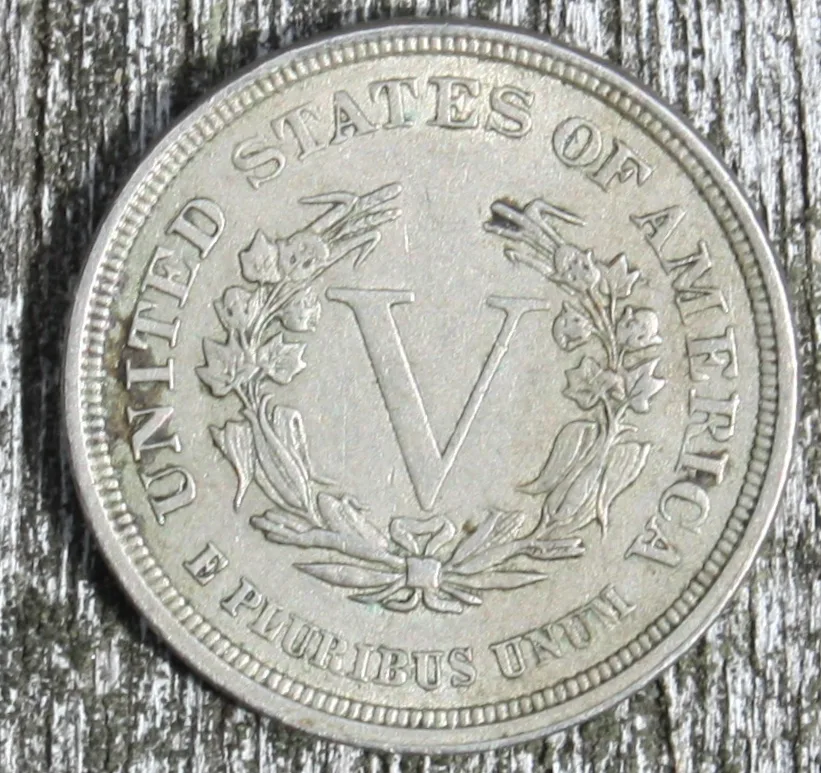
The distinction is unmistakable on any coin where the bottom rim area is legible, even on heavily worn examples. If you have an 1883 V Nickel, this is the first thing to check before doing anything else.
The Racketeer Nickel Scandal
No discussion of the Liberty Head Nickel is complete without the famous racketeer nickel — the scam that gave the Type 2 (With CENTS) reverse its existence. This story is one of the most colorful episodes in American numismatic history and explains why the 1883 No CENTS coin has the reputation it does.
How the Scam Worked
When the new Liberty Head Nickel debuted in early 1883, its reverse showed only the Roman numeral V — without the word CENTS. The new five-cent piece happened to be the same diameter (21.2 mm) as the United States five-dollar gold half eagle, which also displayed a Roman numeral V (for five dollars). To enterprising fraudsters, the resemblance was an opportunity. They began gold-plating the new nickels and passing them off as five-dollar gold coins, often to merchants, immigrants, and others unfamiliar enough with the gold half eagle to be deceived.
The most famous figure associated with the scam was Josh Tatum, a deaf-mute peddler who reportedly traveled the country buying inexpensive items with gold-plated nickels and accepting $4.95 in change. Whether Tatum actually existed or his story was apocryphal is debated — but contemporary newspaper accounts and Mint correspondence from 1883 confirm that the gold-plating fraud was widespread, embarrassing, and politically damaging.
The Mint’s Response
By June 1883, public pressure forced action. The Mint quickly modified the reverse design to include the word CENTS in raised letters at the bottom of the coin, eliminating any possible confusion with gold coinage. Production of the No CENTS variety was halted and the With CENTS variety began. The damage to Barber’s design — aesthetically, the Type 2 is somewhat more cluttered than the elegant Type 1 — was an inevitable cost of preventing further fraud.
Are Gold-Plated V Nickels Still Around?
Yes — and they remain confusing to new collectors. Gold-plated 1883 No CENTS nickels are common, both as genuine survivors of the original 1883 racketeer scheme and as later replicas made for novelty purposes. They are not rare, and the gold plating does not add value. In most cases a gold-plated V Nickel is worth less than an unplated example because the surface alteration disqualifies the coin from a numismatic grade. If you find a gold-plated 1883 No CENTS in an old collection, treat it as a curiosity rather than a windfall.

Key Dates and Semi-Keys
The Liberty Head V Nickel series spans 1883 through 1913 and includes thirty-three date-and-mint-mark combinations (counting Type 1 and Type 2 separately for 1883). Most dates are affordable in circulated grades, but a handful are genuinely scarce and command meaningful premiums. The same careful approach to spotting key dates applies whether you’re looking at V Nickels, the Indian Head Penny series, or the Mercury Dime that came later.
1885
The 1885 is the most consistently scarce non-error date in the series. Philadelphia struck only 1,476,490 V Nickels that year — a sharp drop from the millions struck in 1883 and 1884 — likely the result of weak demand following the bicentennial of Philadelphia’s founding and an oversupply of circulating five-cent pieces from prior years. The 1885 is desirable in every grade and demands real money even in Good condition. In Mint State, examples are genuinely rare and typically reach four to five figures depending on certification and eye appeal.
1886
The 1886 is the second important key date, with a mintage of 3,330,290 — higher than 1885 but still significantly below typical years. The date is challenging to find in Very Fine and higher grades, and Mint State examples are scarce. Pricing falls below 1885 levels but well above common dates, making the 1886 a critical purchase for anyone assembling a complete date set.
1912-S
The 1912-S is the only V Nickel ever struck at the San Francisco Mint, with a tiny mintage of 238,000 — the lowest mintage of any business-strike V Nickel. As the final year of the series and the only branch-mint S issue, it is critical to any collection. In circulated grades the 1912-S commands several hundred dollars; in Mint State, prices climb into the thousands. Authentication is especially important for this date because of its value (more on that below).
1912-D
The 1912-D was the first V Nickel struck at Denver — and the only Denver issue in the series — with a mintage of 8,474,000. While not as scarce as the 1912-S, the 1912-D is harder to find well-struck and in high grades than its mintage suggests, because Denver’s striking quality on its first nickel issue was inconsistent. Mint State examples with strong strikes carry significant premiums.
Other Notable Semi-Keys
Beyond the absolute keys, several other dates deserve attention:
- 1894: Mintage of 5,410,500 — scarcer in higher grades than its mintage suggests
- 1888: Often weakly struck; well-struck examples in Mint State are scarce
- 1896: Lower mintage at 8,841,000 and tougher in high grades
- 1909: Strike quality issues make truly Mint State Full Detail examples scarce
- 1911 Doubled Die Reverse: A minor but collectible variety prized by specialists
The remaining dates — particularly 1900 through 1908 — are quite common in all grades up through About Uncirculated and reasonably available in Mint State, making them excellent starting points for new collectors.
The 1913 Liberty Head Nickel: A Numismatic Legend
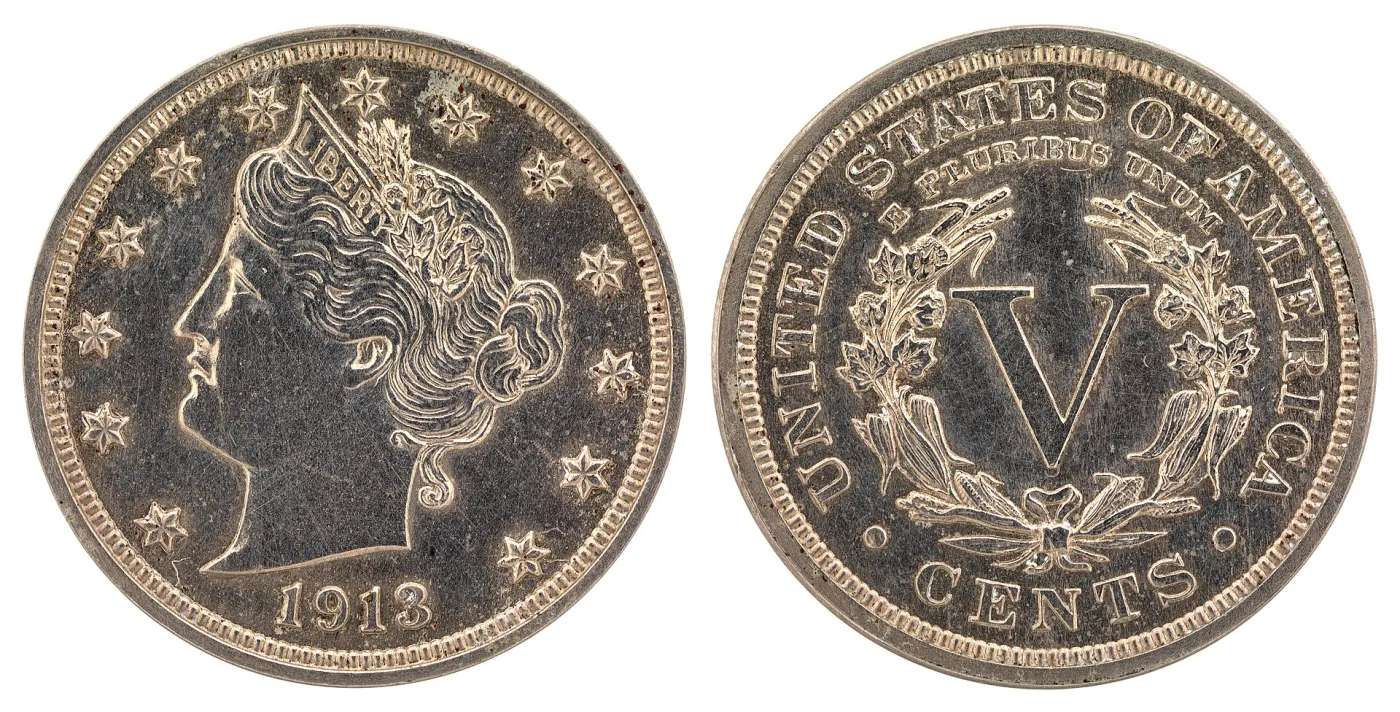
No coin in American numismatics is more famous than the 1913 Liberty Head Nickel — and few stories are as enduringly mysterious. Production of the V Nickel officially ended in late 1912, with the Buffalo Nickel taking its place at all three mints in 1913. Yet five 1913-dated Liberty Head Nickels exist. They were never authorized, never officially recorded by the Mint, and their origin remains debated more than a century later.
The Five Known Specimens
All five known 1913 Liberty Head Nickels first surfaced in the possession of Samuel W. Brown, a former Mint employee who displayed them at the 1920 American Numismatic Association convention. Brown had previously placed advertisements seeking 1913 Liberty Head Nickels at premium prices — a curious pattern that suggested he knew something most collectors did not.
The five specimens are:
- The Eliasberg specimen: The finest known, graded PCGS PR-66; sold for over $4 million in 2018
- The Olsen specimen: Famously appeared on the Hawaii Five-O television series; sold privately for $3.7 million in 2010
- The Norweb specimen: Held by the Smithsonian Institution National Numismatic Collection
- The Walton specimen: Believed lost for decades after a 1962 auto accident; rediscovered in 2003 and sold for $4.56 million in 2022
- The McDermott specimen: The only one with circulation wear; held by the American Numismatic Association Money Museum
How Did They Come to Exist?
The leading theory is that an unauthorized late-night strike was performed at the Philadelphia Mint in late 1912 or early 1913, possibly using working dies that had already been prepared for 1913 V Nickel production before the design change to the Buffalo Nickel was finalized. Samuel Brown — who worked at the Mint during the relevant period — is the most likely figure to have been involved, though he never confessed and the Mint has no surviving records of the strike.
Whatever the truth, the five 1913 Liberty Head Nickels stand as the most famous American rarities in existence. Each appearance at auction generates worldwide attention, and prices have risen steadily for decades. If you ever encounter a coin claimed to be a 1913 Liberty Head Nickel outside the five documented specimens, it is, with absolute certainty, a counterfeit or a misidentified normal date.
Mint Marks and Minting Locations
For most of its run, the Liberty Head V Nickel was a single-mint coin: only Philadelphia struck V Nickels from 1883 through 1911. In 1912, however, production briefly expanded to Denver and San Francisco — an event that produced two of the series’ most desirable issues.
Philadelphia Mint (No Mint Mark)
Philadelphia produced V Nickels every year from 1883 through 1912 — and then, unofficially, the five 1913 specimens. Philadelphia coins bear no mint mark, which was standard for US coinage of the era. Philadelphia mintages varied widely, from the very low 1885 mintage (1.48 million) to the heavy production years like 1903 and 1904 (more than 28 million each).
Denver Mint (D)
Denver struck only one year of V Nickels: 1912. The 1912-D had a mintage of 8,474,000 — modest by Philadelphia standards but the largest single-year output ever for a Denver V Nickel (since it is also the only one). The “D” mint mark appears on the reverse, to the left of the word CENTS.
San Francisco Mint (S)
San Francisco also struck V Nickels only in 1912, with a mintage of just 238,000 — making the 1912-S by far the lowest-mintage business strike of the entire series. The “S” mint mark appears in the same location as the “D,” to the left of CENTS on the reverse. Because the 1912-S is rare and valuable, authentication is especially important: counterfeit S mint marks added to 1912 Philadelphia or Denver coins are well-documented.
Locating the Mint Mark
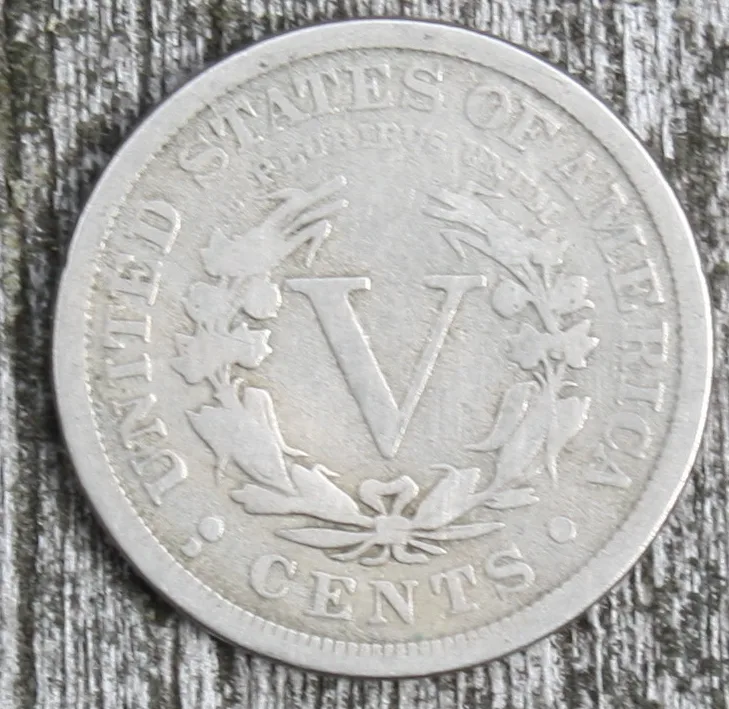
On 1912-D and 1912-S coins, the mint mark sits on the reverse, immediately to the left of the C in CENTS, near the rim. On well-struck coins it is small but clearly visible; on worn coins it can be partially obscured. If you are looking at any V Nickel from 1883 through 1911 and see what appears to be a mint mark, it is either an alteration, a die crack mistaken for a letter, or a foreign substance — there are no genuine branch-mint V Nickels before 1912.
Error Coins and Die Varieties
The V Nickel series produced a smaller catalog of dramatic varieties than later twentieth-century series like the Lincoln Wheat Penny, but several errors and varieties are collectible and worth knowing about.
Doubled Die Varieties
Several dates show modest doubled-die obverse and reverse varieties. The 1888 Doubled Die Reverse and the 1911 Doubled Die Reverse are the best documented and most collectible. Doubling on V Nickels is generally subtle compared with the dramatic doubled dies seen on later series — visible under a 5x or 10x loupe rather than to the naked eye — and premiums are correspondingly modest, generally adding 50% to 200% over the value of a normal example in the same grade.
Repunched Dates
Repunched-date varieties exist for several years in the V Nickel series. The repunching is usually most visible on the final digit — particularly on coins where the die was repunched after slight misalignment. The 1887/6 repunched-date variety is the most dramatic and collectible, with the underlying 6 visible inside the loop of the 7 on well-preserved examples.
1883 Type 2 Over Type 1
A small number of 1883 With CENTS coins were struck from dies that were converted from No CENTS dies — leaving traces of the modification visible under magnification. These are collected as die-state varieties rather than mainstream rarities, but they illustrate the rapid mid-year transition between Types.
Off-Center Strikes and Other Mint Errors
Off-center strikes, broadstrikes, and clipped planchets exist for the V Nickel series, though they are less common than for later issues because Mint quality control was relatively tight by the 1880s. Genuine off-center V Nickels with a visible date and mint mark (or absence thereof) command significant premiums among error specialists.
Grading Liberty Head V Nickels
Accurate grading is essential because price gaps between adjacent grades can be substantial — particularly for the keys and semi-keys. The same foundational grading methods that apply to other US coins work here, with attention to the specific high points unique to this design.
Key Wear Points
V Nickels show wear first in predictable areas. Checking these points is the fastest way to assign an accurate circulated grade:
Obverse:
- LIBERTY on the coronet: The single most important grading element. The letters of LIBERTY wear from left to right and become harder to read as wear progresses. A complete, sharp LIBERTY is a Fine-12 or better; a partial LIBERTY where some letters are missing indicates a lower grade.
- Hair details: The fine hair detail above the ear and behind the coronet wears progressively. Complete hair detail with separation between strands is required for grades of Extremely Fine or better.
- Cheek and jawline: The high points of the cheek and chin smooth out first; check for any remaining contour.
Reverse:
- Wreath details: Individual leaves and grains in the wheat, corn, and tobacco wear first. High-grade coins show every leaf and kernel clearly.
- The V: The Roman numeral itself wears slowly because it is a relatively flat element, but the curves of the V should remain crisp on AU and Mint State coins.
- CENTS lettering: On Type 2 coins, CENTS is positioned near the rim and is among the first things to wear away on heavily circulated examples.
- Bow at the bottom of the wreath: The small bow tie holding the wreath together shows wear quickly; complete bow detail indicates higher grades.
Grading Scale Overview
Good (G-4 to G-6): The design is clearly outlined but flat; LIBERTY is partially missing (typically 3 or fewer letters readable). Date is fully readable. Wreath details are mostly worn smooth.
Very Good (VG-8 to VG-10): LIBERTY shows at least 4 letters readable. Some hair detail visible. Wreath shows partial leaf separation.
Fine (F-12 to F-15): Full LIBERTY is visible, all 7 letters complete though some may be weak. Hair shows moderate detail. Wreath leaves are mostly distinct.
Very Fine (VF-20 to VF-35): LIBERTY is bold and complete. Significant hair detail above the ear. Wreath details are sharp on most leaves. Strong overall design clarity.
Extremely Fine (EF-40 to EF-45): Light wear only on the highest points. LIBERTY is sharp. Hair detail is nearly complete with only minor flatness. Wreath shows full detail. Some original luster may remain in protected areas.
About Uncirculated (AU-50 to AU-58): Only the slightest trace of wear on the high points. Significant original luster remains, particularly in the fields. Hair shows almost full detail.
Mint State (MS-60 to MS-67): No wear. Graded by strike quality, luster, and the number, size, and severity of contact marks. A fully struck MS-65 with strong luster and minimal marks is the gold standard for type collecting.
Strike Quality Considerations
Strike quality varies considerably across V Nickel dates and within individual years. The 1883 No CENTS is generally well-struck because the dies were fresh and demand was modest. Some later Philadelphia issues — particularly 1888, 1909, and 1911 — are notorious for weak central striking, which can flatten LIBERTY or hair detail on coins that are otherwise problem-free. The 1912-D is also frequently encountered with weak striking on its first issue from Denver. Experienced graders learn to distinguish strike weakness from circulation wear, but it remains one of the more challenging aspects of V Nickel evaluation.
Authentication: Spotting Counterfeits and Alterations
Because key date V Nickels can be worth thousands of dollars, counterfeiters and alterers have produced fraudulent examples for as long as there have been collectors paying premium prices. The same principles that apply to authenticating other classic US coins, such as the Walking Liberty Half Dollar, apply here as well.
Altered Dates
The most common fraud in the V Nickel series involves altering common-date coins to resemble the 1885 or 1886 keys. A 1888 might have its second 8 modified to a 5 to create a fake 1885; a 1883 might have its final 3 altered to a 5 or 6. Examine the date digits carefully under magnification:
- Look for tool marks adjacent to or within the digits
- Compare digit shapes against verified images of genuine specimens
- Check whether the spacing between digits matches the spacing on known genuine examples
- Look for unnatural smoothness or roughness near the date area where material may have been added or removed
Added Mint Marks
The 1912-D and especially the 1912-S are frequent targets for added-mint-mark fraud. Counterfeiters take a common 1912 Philadelphia coin (no mint mark) and add a “D” or “S” using engraving or solder techniques. Signs of an added mint mark include:
- The mint mark appears slightly raised or puffy compared to surrounding lettering
- Surface texture inside or around the mint mark differs from adjacent areas
- Under magnification, tool marks, solder lines, or color differences may be visible
- The font, style, or size of the mint mark may not match genuine examples
For the 1912-S in particular, certified coins from PCGS or NGC are essentially required for any meaningful purchase. The premium over a 1912-P is significant enough to make fraud profitable, and the alteration is subtle enough to fool casual buyers.
Cast Counterfeits
Cast counterfeits — made by pressing a genuine coin into a mold and casting fakes from the impression — exist for the highest-value V Nickels. Cast coins typically show a slightly grainy or porous surface, lack the sharp rim definition of a struck coin, and may be very slightly underweight or undersized due to metal shrinkage during cooling. A loupe and a precise scale can identify most cast counterfeits.
The 1913 Specifically
Any coin claimed to be a 1913 Liberty Head Nickel that is not one of the five documented specimens is, with absolute certainty, fraudulent. The five known examples are all carefully tracked in published reference works and have been graded and certified by PCGS or NGC. Period. If you encounter a 1913 V Nickel for sale outside one of these specific provenance chains, walk away immediately.
Using Third-Party Grading Services
For any V Nickel worth more than $100, purchasing a coin already certified by PCGS or NGC is strongly recommended. Both services have examined hundreds of thousands of V Nickels and can detect alterations and counterfeits that elude even experienced collectors. The certification fee is small relative to the protection it provides on key-date and high-grade coins.
Current Market Values and Price Guide
V Nickel values span an enormous range — from a few dollars for a common-date well-circulated coin to seven figures for the legendary 1913. The prices below reflect approximate retail values as of 2026 for problem-free, original-surface coins. Cleaned, damaged, or impaired examples are worth substantially less. Always consult current price guides or recent auction records for definitive figures, as the market fluctuates.
Common Dates (Most Years 1883 With CENTS through 1911)
- Good-4: $3–$6
- Very Fine-20: $15–$25
- Extremely Fine-40: $35–$55
- MS-63: $130–$200
- MS-65: $400–$700
1883 No CENTS (Type 1)
- Good-4: $7–$12
- Very Fine-20: $20–$30
- Extremely Fine-40: $35–$45
- MS-63: $90–$140
- MS-65: $250–$400
1883 With CENTS (Type 2)
- Good-4: $25–$40
- Very Fine-20: $80–$120
- Extremely Fine-40: $150–$220
- MS-63: $300–$450
- MS-65: $700–$1,100
1885 (Key Date)
- Good-4: $700–$900
- Very Fine-20: $1,200–$1,800
- Extremely Fine-40: $1,800–$2,500
- MS-63: $4,500–$6,500
- MS-65: $10,000–$15,000
1886 (Semi-Key)
- Good-4: $250–$350
- Very Fine-20: $550–$750
- Extremely Fine-40: $900–$1,200
- MS-63: $2,200–$3,200
- MS-65: $6,000–$9,000
1912-D
- Good-4: $5–$8
- Very Fine-20: $25–$40
- Extremely Fine-40: $80–$120
- MS-63: $400–$600
- MS-65: $1,500–$2,500
1912-S (Key Date)
- Good-4: $250–$350
- Very Fine-20: $400–$550
- Extremely Fine-40: $700–$1,000
- MS-63: $2,200–$3,200
- MS-65: $5,500–$8,500
1913 Liberty Head Nickel
Auction records: $3.7 million to $4.56 million for the four privately held specimens. The remaining specimen at the Smithsonian is not for sale. Any 1913 V Nickel offered for sale at any price below seven figures is virtually guaranteed to be a counterfeit.
Note: These are retail price estimates. Actual sale prices at auction vary based on eye appeal, certification, surface originality, and current market demand. For important purchases, reference recent auction archives from Heritage Auctions, Stack’s Bowers, or similar venues alongside standard price guides.
Building a Liberty Head V Nickel Collection
The V Nickel series rewards collectors at every budget level. With only thirty business-strike date-and-mint-mark combinations (excluding the 1913), it is one of the more achievable American series for a complete set, and the keys — while expensive — are not impossibly out of reach the way some Buffalo Nickel and Walking Liberty Half Dollar rarities can be.
Type Set
The simplest collection is a two-coin type set: one Type 1 (1883 No CENTS) and one Type 2 (any year With CENTS). This can be assembled in high circulated grades for under $50 total, or in solid Mint State for a few hundred dollars. Type sets are ideal for collectors who want to own examples of the design without committing to a complete series.
Date Set
A date set includes one coin for each year the V Nickel was produced — 30 coins total (1883 through 1912, with 1883 typically represented by either a No CENTS or With CENTS, but not both). A complete date set in circulated grades is achievable for $1,000 to $2,500 depending on how much attention you give the 1885 and 1886. Building a date set in mid-grade Mint State is significantly more expensive, primarily because of those two keys.
Complete Date-and-Mint-Mark Set
A complete set includes one coin for every date-and-mint-mark combination — 30 coins, plus the 1883 No CENTS and With CENTS as separate types, plus the 1912-D and 1912-S, for a total of 33 entries (excluding the 1913). This is the most demanding mainstream collection of V Nickels and requires obtaining all three keys: 1885, 1886, and 1912-S. Most collectors work in circulated grades (Fine through Extremely Fine) for the keys, which keeps the project realistic, while seeking Mint State examples for the common dates.
Specialty Approaches
- Proof set: Philadelphia struck proofs every year of the series; a complete proof run is a sophisticated and visually striking goal
- Variety set: Focus on doubled dies, repunched dates, and the 1887/6 overdate
- Mint State type: Pursue the highest possible single example of the design as a “best of type” display
- Companion to other Barber designs: Pair with Barber Dimes, Quarters, and Halves for a complete view of Charles Barber’s coinage
Practical Tips
- Start with a Type 1 1883: Inexpensive, plentiful, historically interesting, and a great way to develop your eye
- Buy certified for the keys: 1885, 1886, and 1912-S in any value tier should be PCGS or NGC certified
- Watch for cleaning: Many V Nickels were cleaned in the early twentieth century; original surfaces command meaningful premiums
- Study LIBERTY: The condition of LIBERTY on the coronet is the single most important grading element — train your eye on it
- Avoid the 1913 entirely: Unless you have several million dollars and access to documented provenance, do not engage with any 1913 V Nickel offer
Storage and Preservation
Proper storage maintains the value and visual appeal of your collection. Even coins that survived a century of circulation can be damaged by improper modern storage.
What to Avoid
- PVC holders: Older soft plastic flips and some envelopes contain PVC, which outgasses a green sticky residue that etches into coin surfaces. Use only “non-PVC” or “Mylar” labeled holders.
- Acidic paper: Some paper envelopes contain sulfur compounds or acids that accelerate toning. Use acid-free, archival-quality envelopes.
- Rubber bands: Rubber contains sulfur and will produce dark, irreversible spotting. Never store rubber near coins.
- High humidity: Moisture accelerates oxidation. Keep humidity below 50% with a dry storage environment.
- Direct sunlight: UV exposure can affect surfaces over time.
Recommended Storage
- PCGS or NGC slabs: Inert plastic holders that provide excellent long-term protection and authentication
- Non-PVC flips: Mylar or polyethylene flips for safe short-term storage and examination
- Cardboard 2x2 holders: Staple-sealed cardboard with non-PVC Mylar windows; a traditional and safe storage method
- Quality albums: Dansco, Whitman, and similar manufacturers use safe materials, but avoid forcing coins into tight holes (rim damage risk)
- Safe deposit box: For valuable specimens, secure storage adds another layer of protection
Handling
Always handle V Nickels by their edges. Even clean fingers leave oils that etch surfaces over time. Cotton gloves are appropriate for high-value coins. Never clean a V Nickel — virtually any cleaning reduces numismatic value, and dipped or polished coins are easily detected by experienced graders. If a coin appears to need conservation, consult a professional rather than attempting it yourself.
Frequently Asked Questions
How do I tell if my V Nickel is the rare 1885 or 1886?
Read the date carefully under good lighting and magnification. The 1885 has a date that reads exactly "1885" — not 1883, 1888, or 1895 — and shows characteristic digit shapes consistent with Philadelphia Mint dies of that year. The 1886 reads exactly "1886." Compare your coin to verified images from PCGS or NGC photo references. If the date appears genuine and the coin looks promising, get it authenticated before celebrating — altered dates are common in this series.
Why is the 1883 No CENTS more famous but less valuable than the 1883 With CENTS?
Because the No CENTS variety became famous immediately due to the racketeer scandal, millions of examples were saved as souvenirs in 1883 and 1884. As a result, despite a lower mintage, far more high-grade No CENTS coins survive than With CENTS coins. The With CENTS variety circulated normally and was rarely saved, so high-grade examples are scarcer and command higher prices today.
Are V Nickels made of silver?
No. V Nickels are composed of 75% copper and 25% nickel — the same alloy used for the later Buffalo Nickel and modern Jefferson Nickel. They contain no silver. Only the wartime Jefferson Nickels of 1942–1945 ever contained silver among American five-cent pieces.
I have a 1913 Liberty Head Nickel — am I rich?
Almost certainly not. There are only five genuine 1913 Liberty Head Nickels in existence, and all five are tracked, certified, and accounted for. Any 1913 V Nickel encountered outside this small documented group is a counterfeit — most often an altered 1903 or 1910 with the date manipulated to read 1913. Have the coin examined by an expert before getting excited, but expect a disappointing answer.
What is a "racketeer nickel" and is it valuable?
A racketeer nickel is a gold-plated 1883 No CENTS V Nickel — either an original from the 1883 fraud or a later imitation made for novelty purposes. Despite its colorful history, the gold plating reduces numismatic value because it is a surface alteration. A genuine 1883 No CENTS without plating is worth more than a plated example. Collect them as historical curiosities, not investments.
How does the V Nickel compare to other Charles Barber coins?
The V Nickel was Barber's first major design success and predates his more famous Barber Dime, Barber Quarter, and Barber Half Dollar by nine years. The Liberty Head portrait on the V Nickel is similar in spirit to but distinct from the Liberty Head used on his later silver coinage. Collectors who enjoy the V Nickel often pursue the Barber Dime and Barber Quarter as natural companion series.
Is a V Nickel collection a good investment?
High-grade and key-date V Nickels have historically appreciated steadily over multi-decade horizons. Common dates in circulated grades have shown limited appreciation and should be collected for enjoyment rather than financial return. As with any collectible, past performance does not guarantee future returns. Collect what you find historically and aesthetically appealing; if the coins appreciate, that is a welcome bonus.
Can I find V Nickels in circulation today?
Realistically, no. By the 1960s the V Nickel had vanished from circulation, withdrawn either by collectors or by attrition. Estate sales, coin shop bins, online auctions, and dealer inventories are now the only practical sources for V Nickels. Roll-searching nickels from your bank will not turn up V Nickels — only modern Jefferson issues and the very occasional War Nickel survivor.