Roosevelt Dime Identification Guide: Key Dates, Mint Marks, Silver vs Clad, and Values
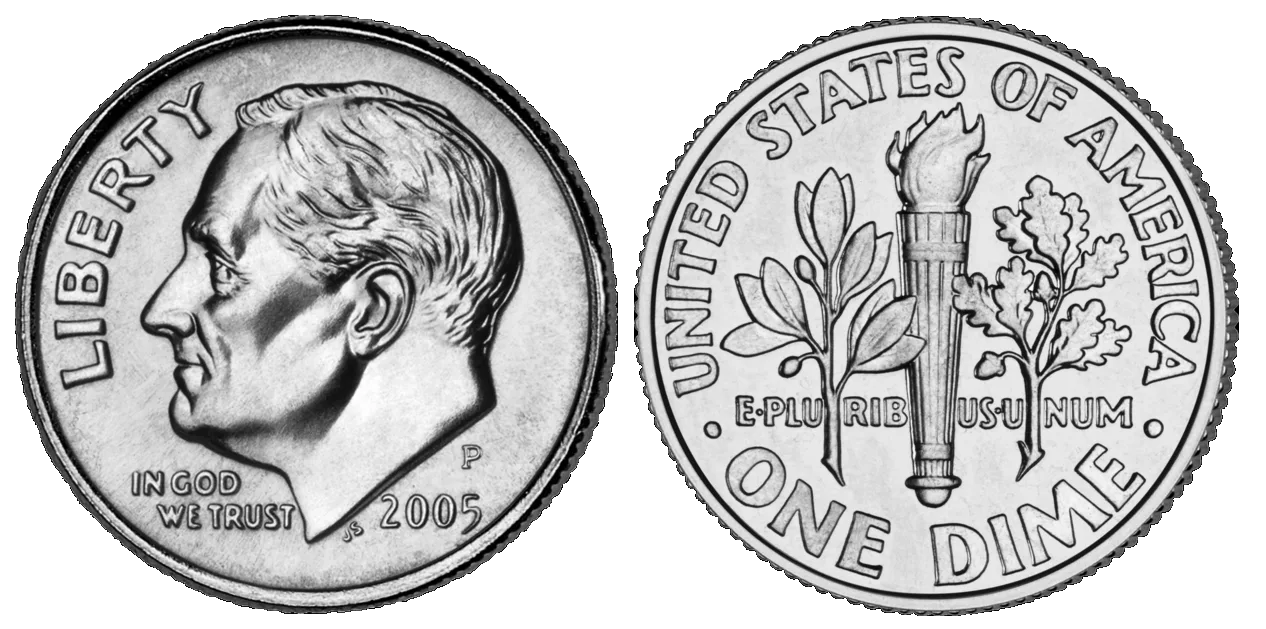
The Roosevelt Dime is the workhorse of modern American pocket change and the longest-running ten-cent design in United States history. First struck in 1946 to honor President Franklin Delano Roosevelt — who had led the March of Dimes fundraising effort against polio — the series has now run for eight decades without a single obverse redesign. Despite that continuity, the Roosevelt Dime is surprisingly rich for collectors: it straddles the silver-to-clad transition of 1965, hides a handful of legitimately rare proof and error varieties, and offers condition-rarity challenges that rival any series in twentieth-century American numismatics.
Most people who sort through a jar of inherited coins will find Roosevelt Dimes outnumbering every other denomination. The vast majority are common clad pieces worth face value, but scattered among them are 90% silver coins dated 1946 through 1964, the transitional 1965-1967 no-mint-mark issues, scarce proof errors like the 1975 No-S and 1982 No-P, and a quietly valuable group of West Point and burnished silver specials. The difference between a ten-cent find and a four-figure find usually comes down to a single glance at the date and mint mark — and knowing which rare varieties exist in the first place.
This guide covers everything you need to identify, grade, authenticate, and value Roosevelt Dimes across the entire series. We walk through the design origins, the silver-to-clad composition change, mint mark placement across four minting facilities, the full list of key and semi-key dates, proof varieties, Full Torch (Full Bands) designation, error coins, counterfeit detection, and current market values. If you are brand new to the denomination, our Mercury Dime guide and Barber Dime guide cover the two predecessors, and the broader coin identification guide is a good foundation for general grading and authentication skills.
History and Origins of the Roosevelt Dime
Franklin Delano Roosevelt died on April 12, 1945, just months before the end of World War II. Within weeks of his passing, Treasury Secretary Henry Morgenthau Jr. and Mint Director Nellie Tayloe Ross began discussions about honoring the late president on a circulating coin. The choice of denomination was deeply personal: Roosevelt had founded the National Foundation for Infantile Paralysis in 1938 — later renamed the March of Dimes — which collected small donations from millions of Americans to fund polio research and treatment. Placing his portrait on the ten-cent piece was, in effect, a permanent tribute to that grassroots campaign.
The Mercury Dime (technically the Winged Liberty Head) had been in production since 1916 and was eligible for replacement under the 25-year minimum design rule. Chief Engraver John R. Sinnock was assigned the design work in the summer of 1945. Sinnock based his obverse portrait on a bust he had sculpted of Roosevelt for a 1933 appreciation medal, then refined the relief for the coin format. His reverse features a lit torch flanked by olive and oak branches, symbolizing liberty, peace, and strength.
First Strikes and Release
Production began at the Philadelphia Mint in late January 1946. The first Roosevelt Dimes were released to the public on January 30, 1946 — the anniversary of Roosevelt’s birthday and the traditional kickoff date of the March of Dimes campaign. Denver and San Francisco joined production the same year. Public reception was warm: unlike the Kennedy Half that would appear two decades later, Roosevelt Dimes circulated widely from day one and have continued to do so for eighty years.
The “JS” Controversy
Almost immediately after release, rumors spread that the designer’s initials “JS” at the truncation of Roosevelt’s neck stood for “Joseph Stalin” — a product of early Cold War paranoia. The Mint was forced to issue multiple public statements confirming the initials belonged to John R. Sinnock. The controversy had no lasting effect on the coin’s reception but remains a curious footnote in the series’ history.
The Silver Transition of 1965
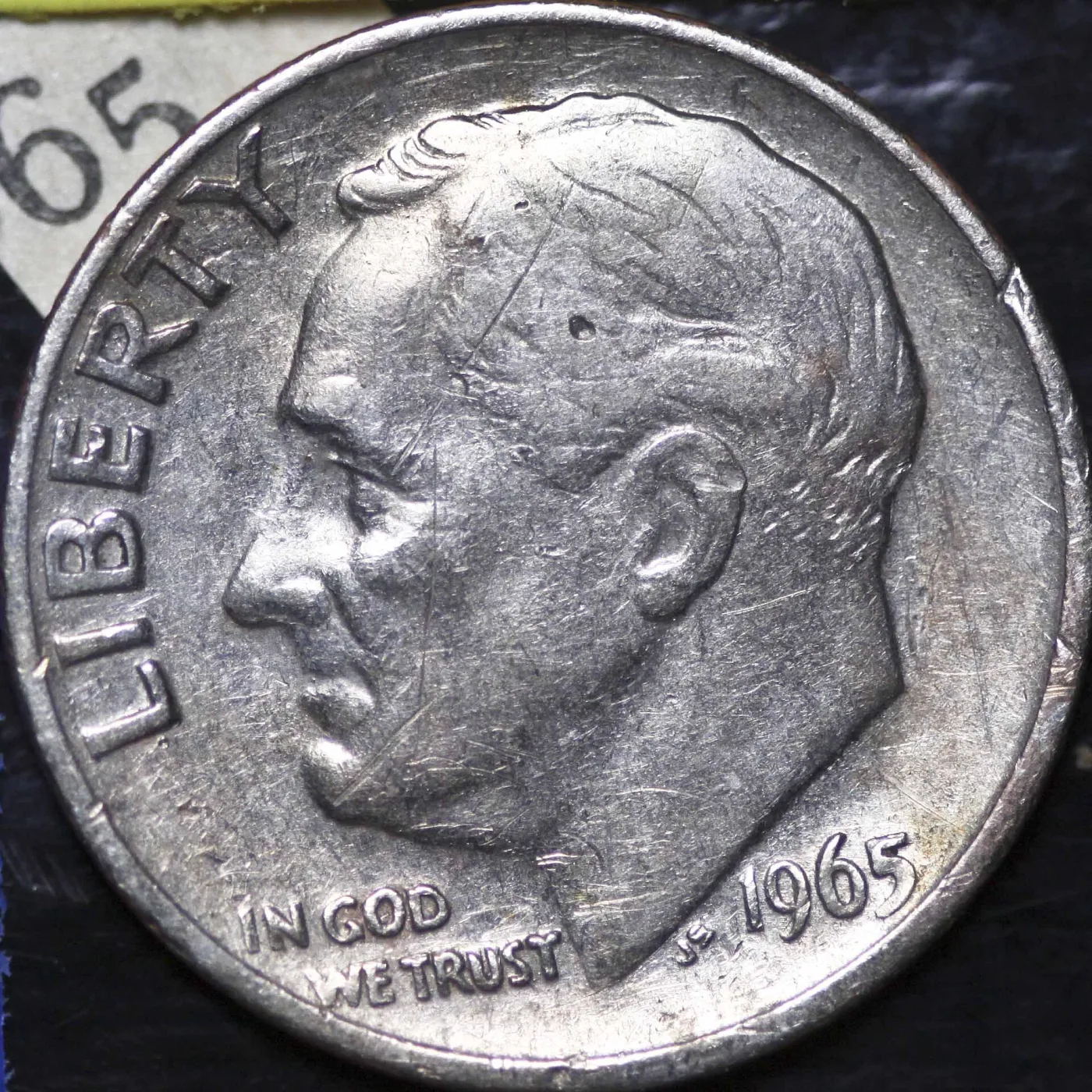
Rising silver prices and public hoarding of silver coins forced the Coinage Act of 1965. Beginning mid-1965, Roosevelt Dimes were struck in copper-nickel clad composition rather than 90% silver. The Mint deliberately continued using 1964 dies well into 1965 to discourage hoarders from saving transitional-year coins. As a result, 1965, 1966, and 1967 dimes carry no mint mark regardless of their origin, and the first “D” and “S” mint marks returned in 1968. The silver versus clad boundary is the single most important fact to know about any raw Roosevelt Dime.
Design Elements and How to Identify a Roosevelt Dime
Every Roosevelt Dime uses the same obverse and reverse Sinnock design. Only minor die refinements have occurred since 1946, the most notable being the 1981 hub modification that sharpened the torch bands. Identification is straightforward once you can read the date, mint mark, and edge.
Obverse (Front) Design
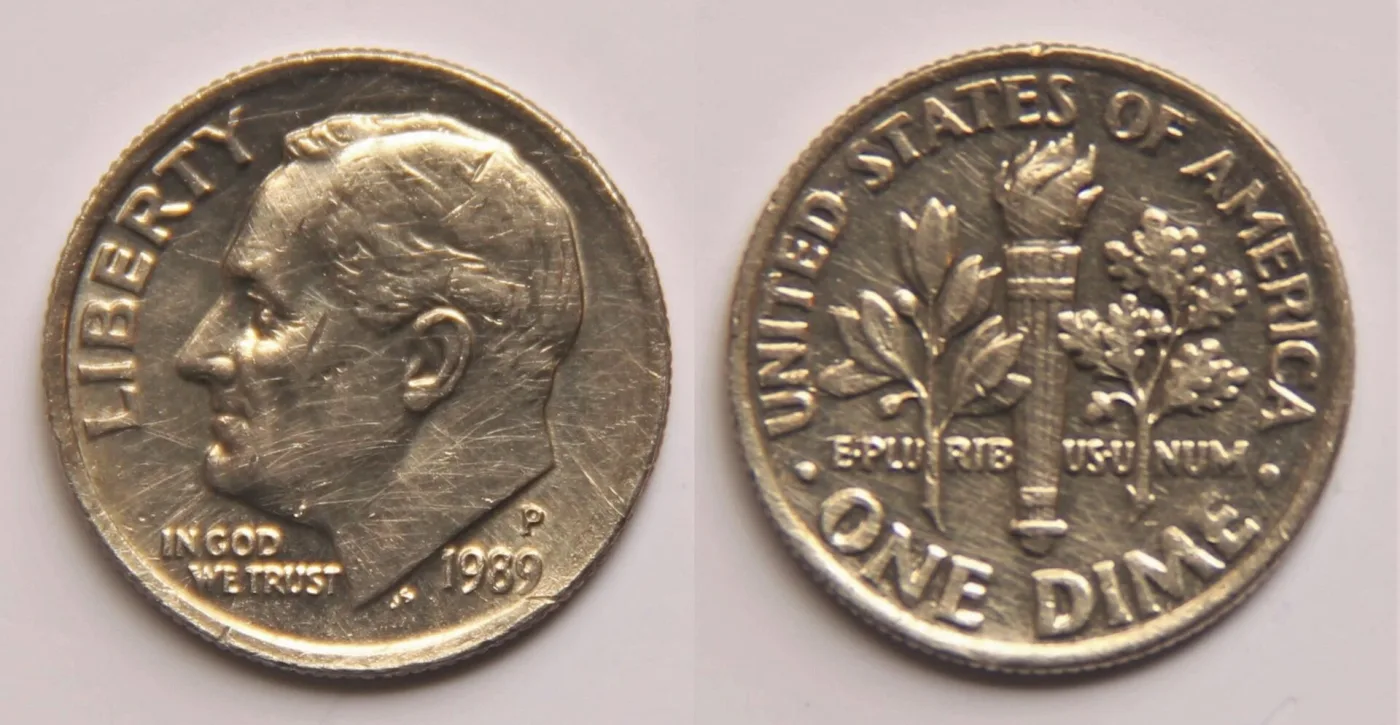
The obverse shows a left-facing bust of Roosevelt, cropped at the shoulders. “LIBERTY” arcs across the left side, following the curve of the rim. “IN GOD WE TRUST” runs along the bottom, split by Roosevelt’s neck truncation. The date appears at the lower right. Sinnock’s initials “JS” sit in small capital letters on the truncation of Roosevelt’s neck, just forward of the collar — do not confuse these with a scratch or blemish.
Reverse (Back) Design
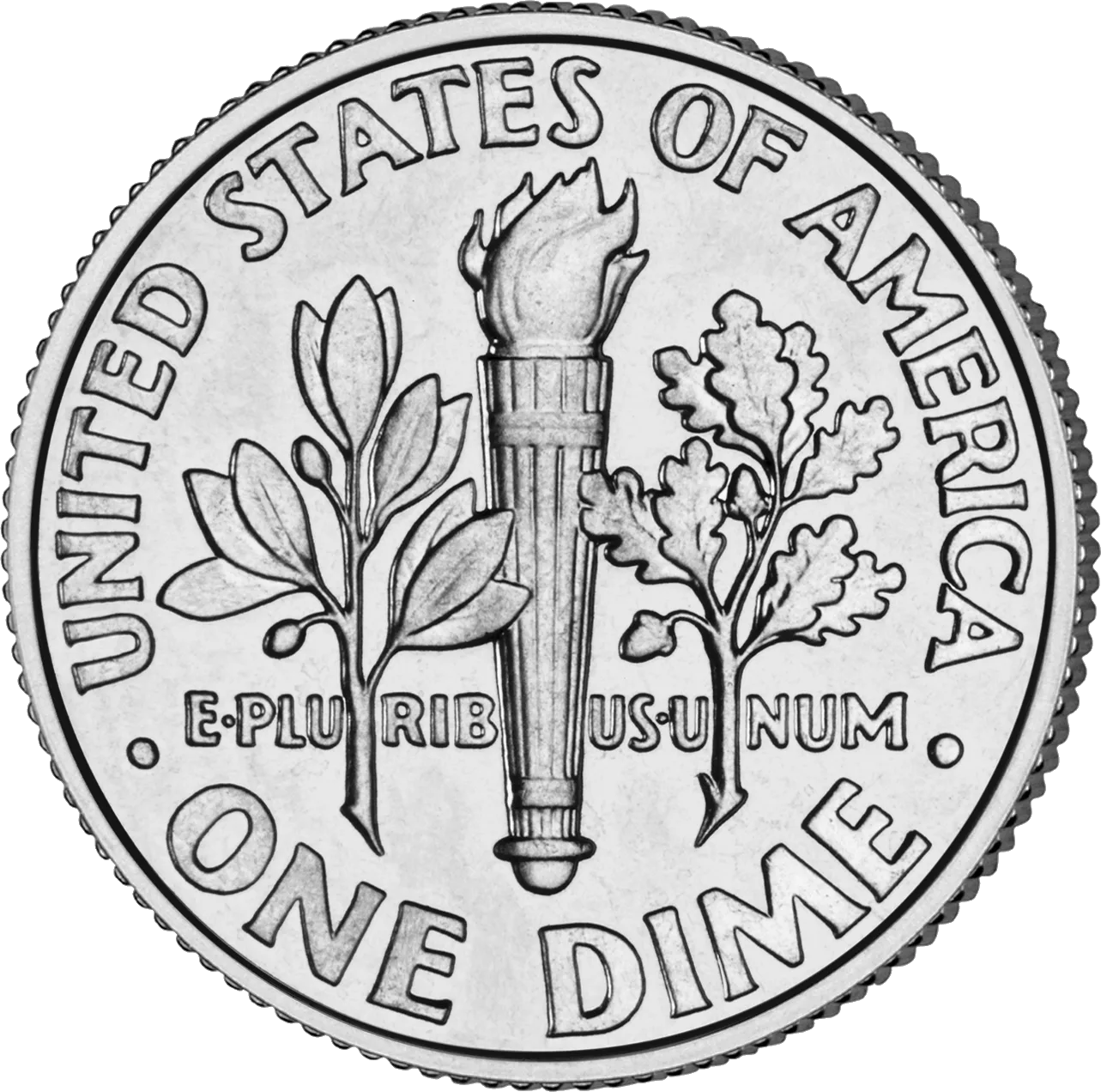
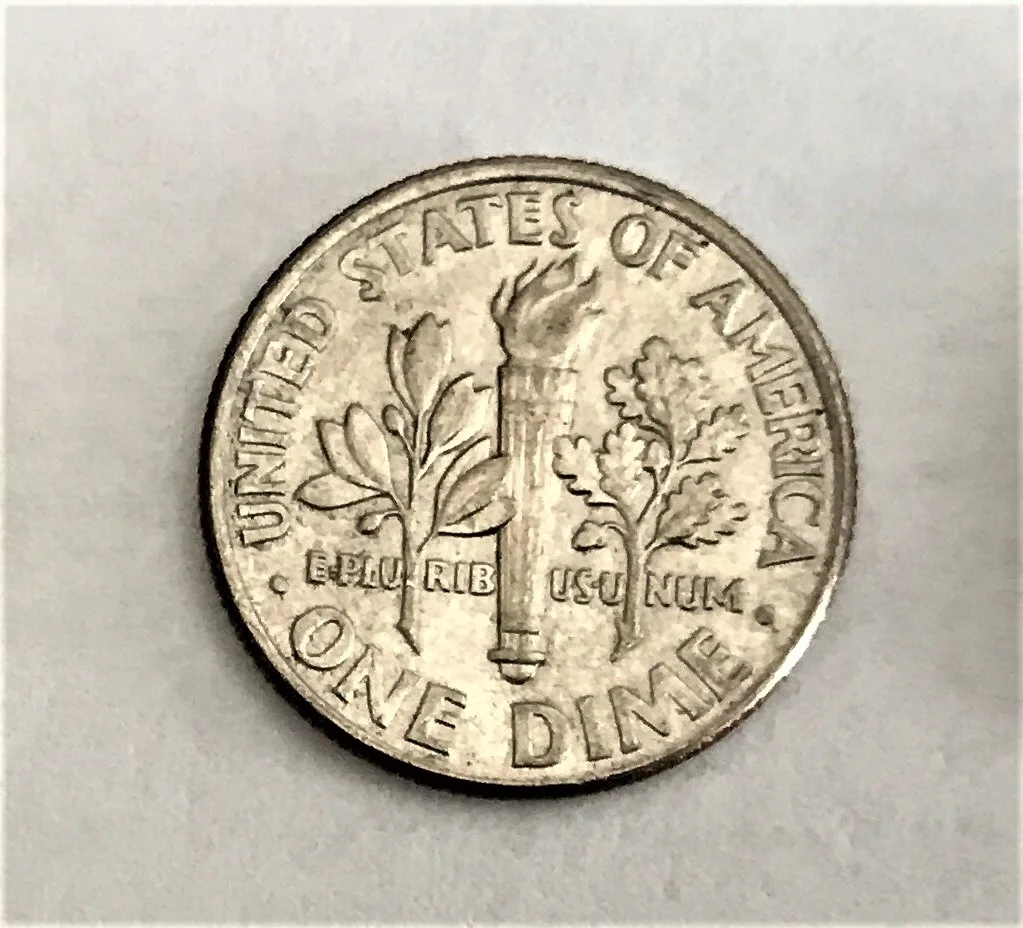
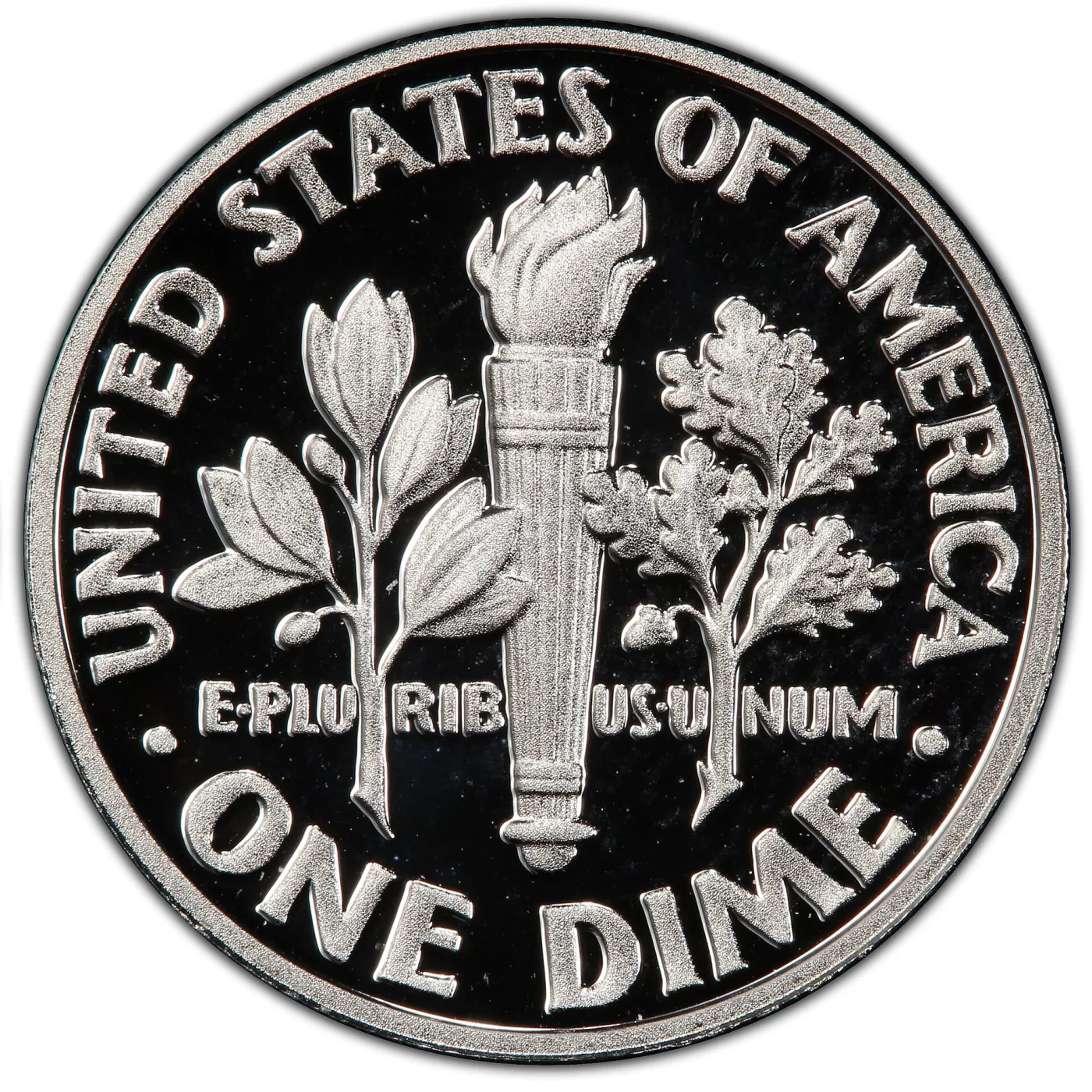
The reverse centers a tall, lit torch with the flame pointing up toward “E PLURIBUS UNUM,” which runs horizontally through the flame and the torch head. An olive branch sits at left, and an oak branch at right, both running vertically alongside the torch. “UNITED STATES OF AMERICA” arcs across the top. “ONE DIME” runs along the bottom. The torch handle features a series of horizontal bands — these bands are the focal point of the Full Torch (or Full Bands) strike designation discussed below.
Physical Specifications
All Roosevelt Dimes share a 17.9 mm diameter and a reeded edge with 118 reeds, identical to the Barber and Mercury predecessors. Weight differs by composition: 2.50 grams for 90% silver (1946-1964 and most modern silver proofs), 2.268 grams for copper-nickel clad (1965-present business strikes). The 0.23-gram weight difference is the fastest way to separate silver from clad when the date is not visible.
The Edge Test for Silver vs Clad
A copper stripe on the edge identifies a clad dime instantly. Silver dimes (1964 and earlier, plus modern silver proofs) show a uniform silver-gray edge. Clad dimes from 1965 onward reveal a distinct orange-copper layer sandwiched between the silver-colored outer cladding. Hold the coin edge-on under good light — the stripe is unmistakable on clad issues and completely absent on silver ones.
Silver vs Clad: The 1965 Transition
Roosevelt Dimes exist in two fundamentally different compositions, and the split year of 1965 is the most important date line in the series. Everything before the transition contains 90% silver and carries meaningful melt value, making pre-1965 Roosevelt dimes a staple of 90% junk silver holdings. Everything after it is clad and generally worth face value unless it is a specific scarce variety.
1946-1964: 90% Silver, 10% Copper
All business strikes and proofs from 1946 through 1964 are 90% silver and 10% copper. Each coin contains 0.07234 troy ounces of pure silver. At current silver prices, a circulated silver Roosevelt Dime carries roughly $1.50 to $2.00 in melt value, regardless of date or mint — so even the commonest dates are worth many times face value if you can find them in a pocket-change hoard.
1965-Present: Copper-Nickel Clad
From mid-1965 onward, regular-issue Roosevelt Dimes are copper-nickel clad: 75% copper and 25% nickel outer cladding bonded to a pure copper inner core. The clad composition matches the modern Washington Quarter, Kennedy Half Dollar, and Eisenhower Dollar — though the later golden-colored Sacagawea Dollar uses a different manganese-brass alloy entirely. Clad dimes have no precious-metal content and are worth face value unless they carry a specific variety premium, a Mint State condition premium, or a major error.
Modern Silver Proofs (1992-Present)
Beginning in 1992, the Mint resumed striking silver Roosevelt Dimes as part of the annual Silver Proof Set. These carry the “S” mint mark and were struck in 90% silver through 2018, then in .999 fine silver from 2019 onward. They are sold directly to collectors in sealed proof sets and never entered circulation. A complete run of silver-proof Roosevelt Dimes since 1992 makes an affordable parallel collection to the business-strike set.
The 1946-1964 Silver Composition Test
Three checks confirm a silver Roosevelt Dime. First, check the date — any date from 1946 through 1964 is silver. Second, check the edge — no copper stripe means silver. Third, weigh the coin — 2.5 grams confirms silver versus 2.27 grams for clad. Any dime you can read that shows 1964 or earlier is silver by definition, but the weight and edge tests help when the date is worn or the coin is dirty.
Mint Marks and Where to Find Them
Roosevelt Dimes have been struck at four facilities: Philadelphia, Denver, San Francisco, and West Point. Mint mark placement moved once — from the reverse to the obverse — in 1968, and a few years in the series carry no mint mark at all.
1946-1964: Mint Mark on Reverse
On silver-era Roosevelt Dimes, the mint mark appears on the reverse, to the left of the torch base, just above the “E” in “ONE.” Philadelphia coins have no mint mark; Denver coins show a “D”; San Francisco coins show an “S.” The mark is small and can be easy to miss at first glance, but it sits in a clean field that makes it readable once you know where to look. This reverse placement matches the Mercury Dime that preceded the series.
1965-1967: No Mint Marks
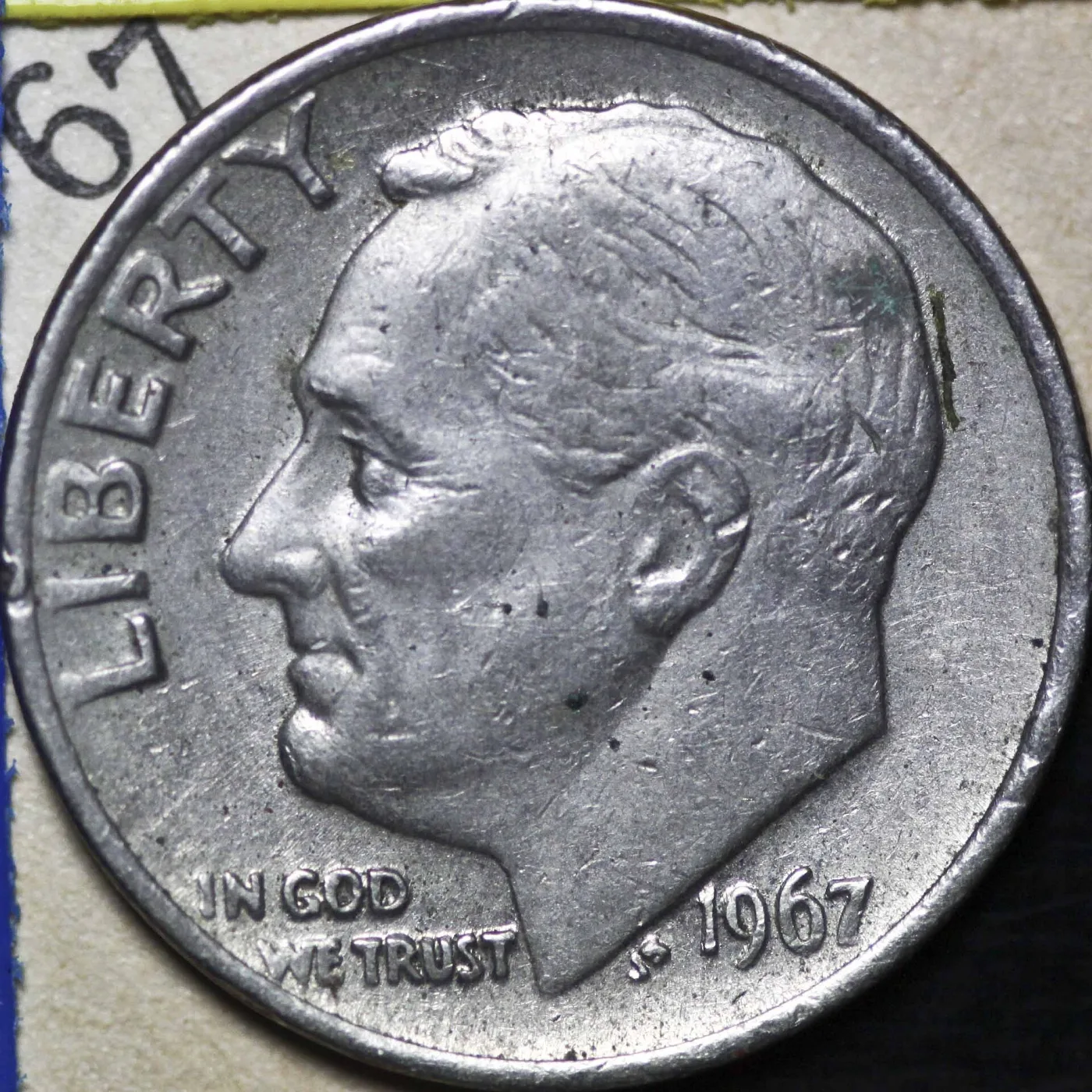
No Roosevelt Dime dated 1965, 1966, or 1967 carries a mint mark, regardless of where it was struck. The Mint deliberately removed mint marks during the transition years to discourage hoarding. Special Mint Set coins from 1965-1967 — struck in a satin finish at San Francisco and sold at a premium — also carry no mint mark.
1968-Present: Mint Mark on Obverse
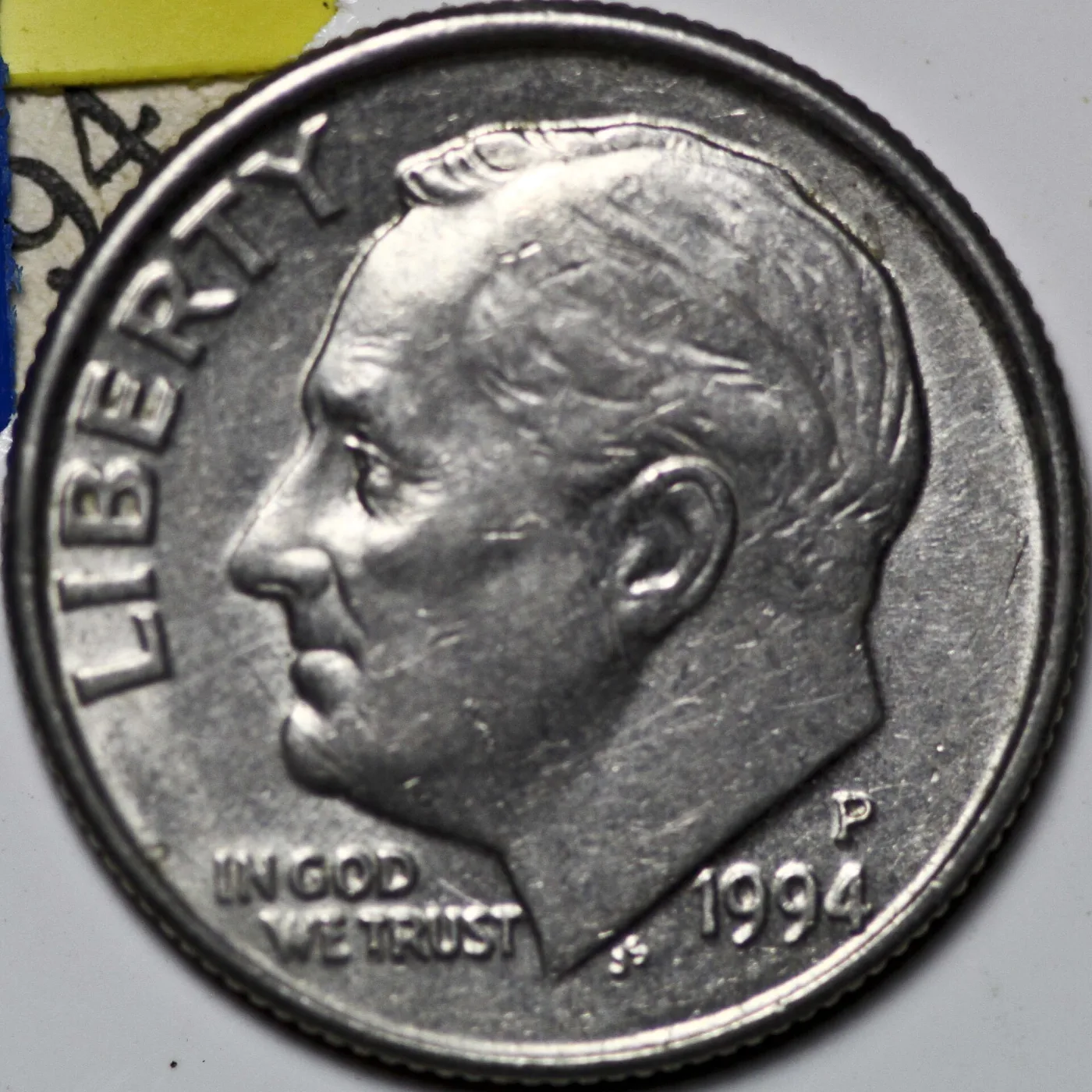
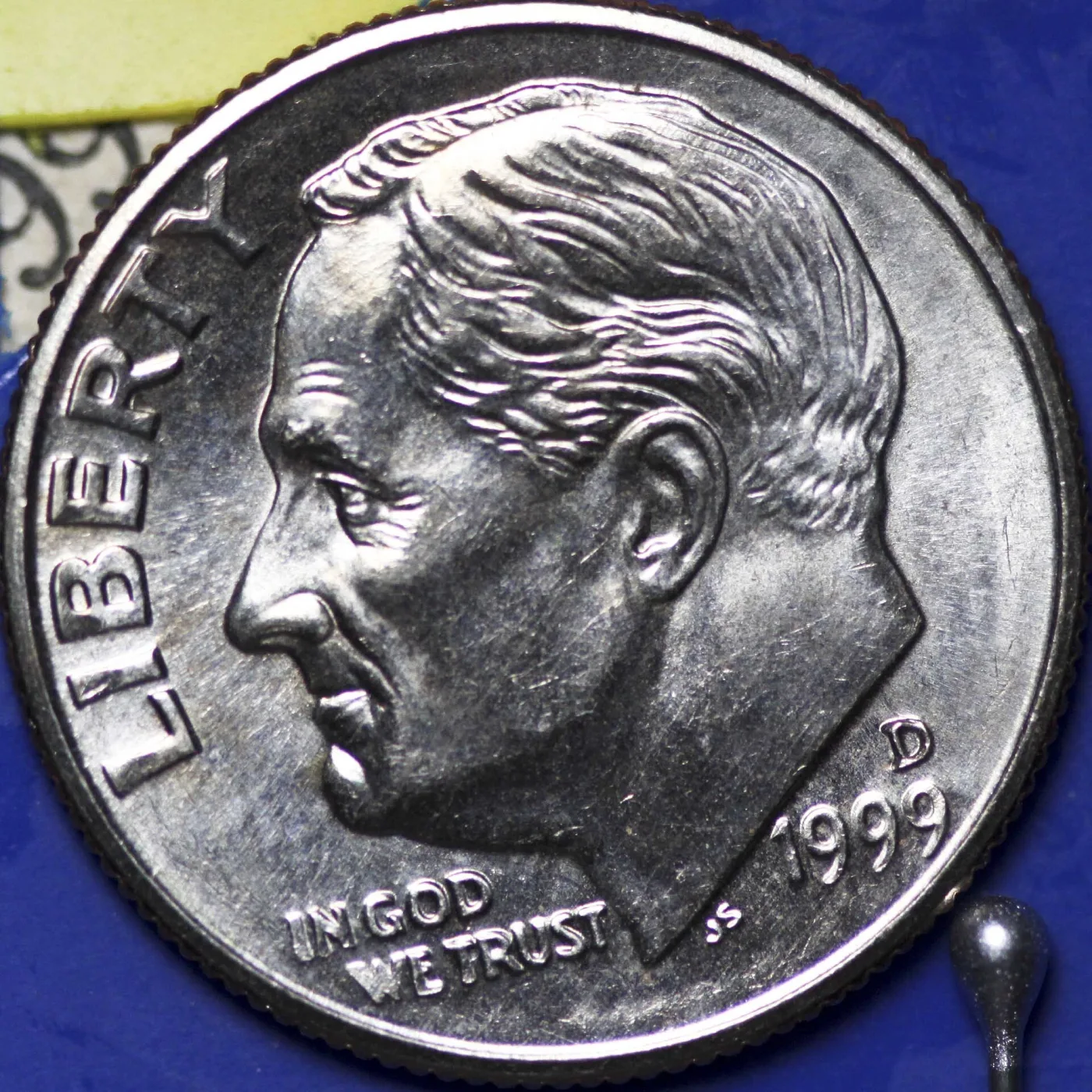
Starting in 1968, the mint mark moved to the obverse, appearing just above the date at the lower right. Philadelphia coins remained unmarked until 1980, when a “P” was added to circulation strikes and proofs. Denver coins show a “D”; San Francisco proofs show an “S”; West Point anniversary and special issues show a “W.”
The Four Mints
Philadelphia (no mint mark 1946-1979, “P” from 1980): Philadelphia has struck Roosevelt Dimes every year since 1946 and remains the primary production facility today.
Denver (D): Denver has struck Roosevelt Dimes every year since 1946 except for the no-mint-mark years 1965-1967. Denver dimes are generally as common as Philadelphia dimes for most dates.
San Francisco (S): San Francisco struck business-strike Roosevelt Dimes from 1946 to 1955 and again in 1968. Since 1968 the “S” has appeared primarily on proofs. The 1996-S and later silver-proof dimes represent the bulk of modern San Francisco production.
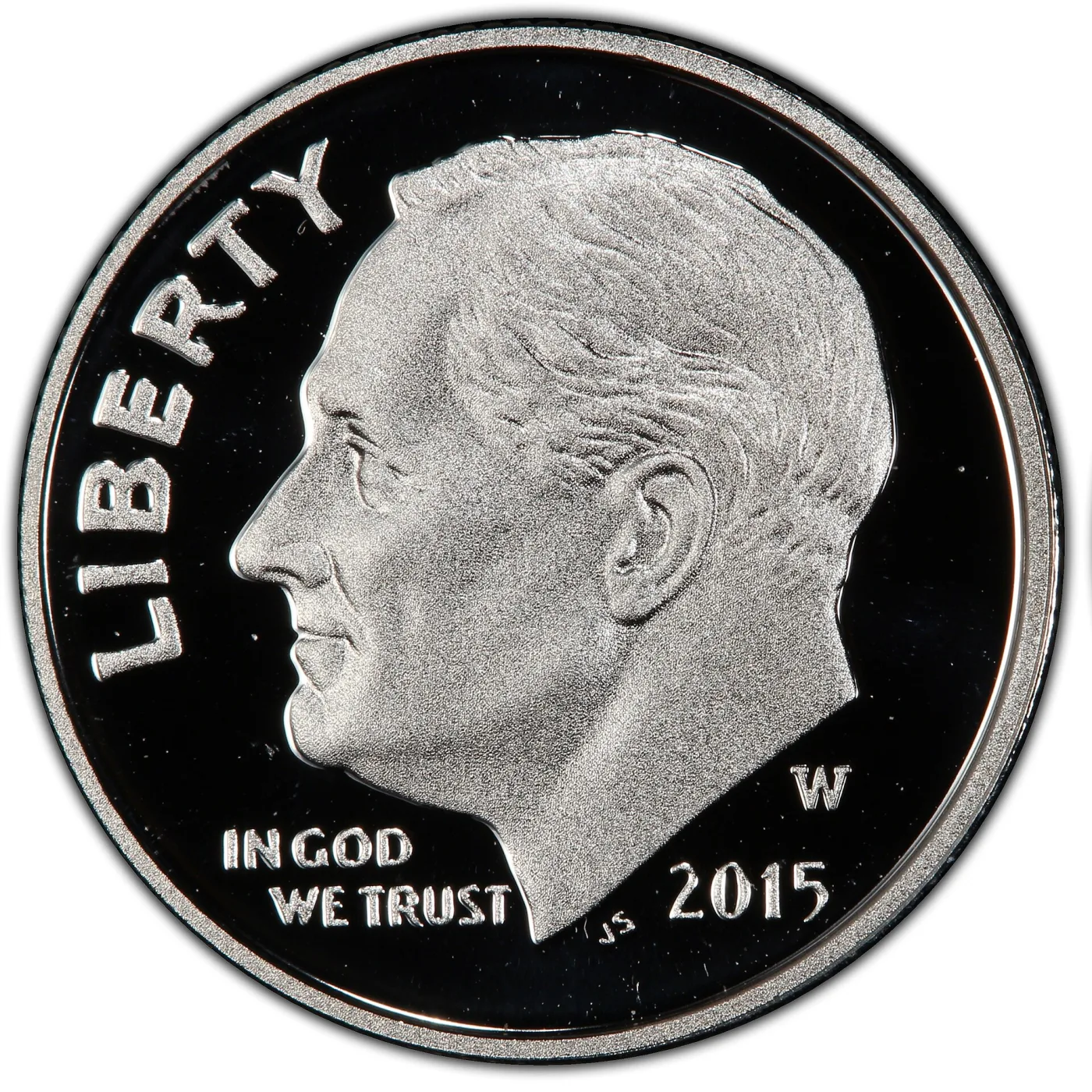
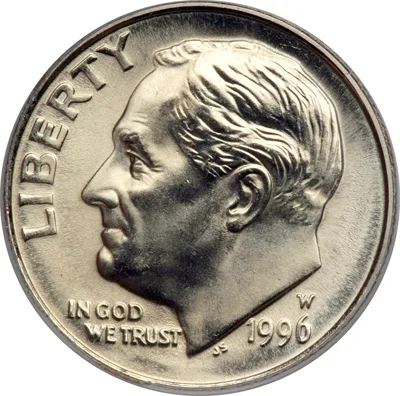
West Point (W): West Point has struck Roosevelt Dimes only for special sets, never for circulation. The 1996-W was a fiftieth-anniversary issue sold inside that year’s Mint Set, and a 2015-W proof followed nearly two decades later in a commemorative set of its own. Both are set-only coins: a W dime does not turn up in change. See the 1996-W section below for details.
Key Dates, Semi-Keys, and Low-Mintage Issues
Roosevelt Dimes do not have mintage-driven keys on the scale of the 1916-D Mercury Dime or the 1894-S Barber Dime. The series was struck in very large quantities from the start, and most dates remain abundant even in Mint State. Instead, Roosevelt keys are driven by proof errors, special issues, and condition rarity.
1949-S: The Business-Strike Semi-Key
With a mintage of 13,510,000, the 1949-S is the lowest-mintage regular-issue Roosevelt Dime and the closest thing the series has to a traditional business-strike key. Circulated examples run $3 to $5, MS-63 grades around $30 to $45, MS-65 around $70 to $100, and MS-67 Full Torch examples can exceed $1,500 at auction.
1955 Trio (P, D, S)
The 1955 coins from all three mints share unusually low mintages: 12,828,381 (P), 13,959,000 (D), and 18,510,000 (S). A complete 1955 set in original BU rolls was a popular way to hold uncirculated silver Roosevelts through the 1960s and 1970s, and survivors remain readily available. Circulated examples run $2 to $4 each; MS-65 grades run $20 to $40.
1950-S and 1951-S
Both are semi-keys at mintages around 20 to 31 million. Neither commands a major premium circulated, but both are condition rarities in MS-67 Full Torch, with certified populations under 100.
1996-W: The Collector-Only Issue
Included only in the 1996 Uncirculated Mint Set with a mintage of 1,457,000, the 1996-W is the lowest-mintage Roosevelt Dime struck for collectors in the clad era. Raw BU examples run $15 to $25, certified MS-67 examples $35 to $60, and MS-69 examples $200 to $400. See the dedicated section below.
Modern Condition Rarities
The clad era hides dozens of condition-rarity keys that cost nothing in lower grades but command four-figure prices in MS-68 Full Torch. Notable examples include the 1968-D, 1970-D, 1975-D, 1982-P, 1982-D, 1983-P, and 1984-P in MS-68 FT. These are coins nobody saved carefully from circulation rolls, so perfectly struck survivors with pristine surfaces are genuinely scarce.
Full Torch (Full Bands) Designation
The Full Torch (FT) designation — also called Full Bands (FB) by some graders — is the Roosevelt Dime’s strike-quality premium. It functions similarly to Full Bands on the Mercury Dime, Full Steps on the Jefferson Nickel, and Full Bell Lines on the Franklin Half Dollar. A Full Torch coin commands meaningful premiums in Mint State grades because clean strikes on the torch are far less common than high surface quality.
What “Full Torch” Means
The torch on the reverse carries two sets of horizontal bands: an upper pair and a lower pair, separated by a vertical slice of shadow. To earn the Full Torch designation, both the upper and lower bands must be completely separated from each other and fully defined, with no merging or weakness across the entire length of each band. Any bridging or incompleteness — however minor — disqualifies the coin from the FT designation.
Which Dates Are Scarce with FT
Early silver dates are generally well-struck and often come Full Torch. The harder coins to find with FT are in the clad era, where mint production speed often sacrificed strike quality. The 1968-D, 1975-D, 1979-D, 1982-P, 1982-D, and 1996-D are particularly difficult in MS-67+ FT. PCGS and NGC publish detailed population reports, and any modern Roosevelt in MS-68 Full Torch is likely to bring a three- or four-figure premium.
PCGS FB vs NGC FT vs CAC Designation
PCGS uses “FB” (Full Bands) and NGC uses “FT” (Full Torch). The criteria are essentially identical, but cross-grading between services occasionally disagrees on borderline strikes. A CAC green bean on either designation adds liquidity and often modest premium, particularly for modern condition rarities.
The 1975 No-S Proof Rarity
The 1975 No-S Proof Roosevelt Dime is arguably the most famous post-1970 United States coin rarity — and one of the most valuable modern coins of any denomination. Only two confirmed examples exist in private hands, and their combined history has produced auction results rivaling classic rarities like the 1894-S Barber Dime.
How the Error Happened
In 1975, the San Francisco Mint prepared working dies for the annual proof set. At least one obverse die was punched and polished without its “S” mint mark being added — an oversight that should have been caught during quality control. The bad die was paired with a standard reverse and struck into proof sets that were then sealed and shipped to collectors. Unlike business-strike errors that can escape in any quantity, the 1975 no-S was caught quickly, and only two examples have ever been publicly authenticated.
How to Identify It
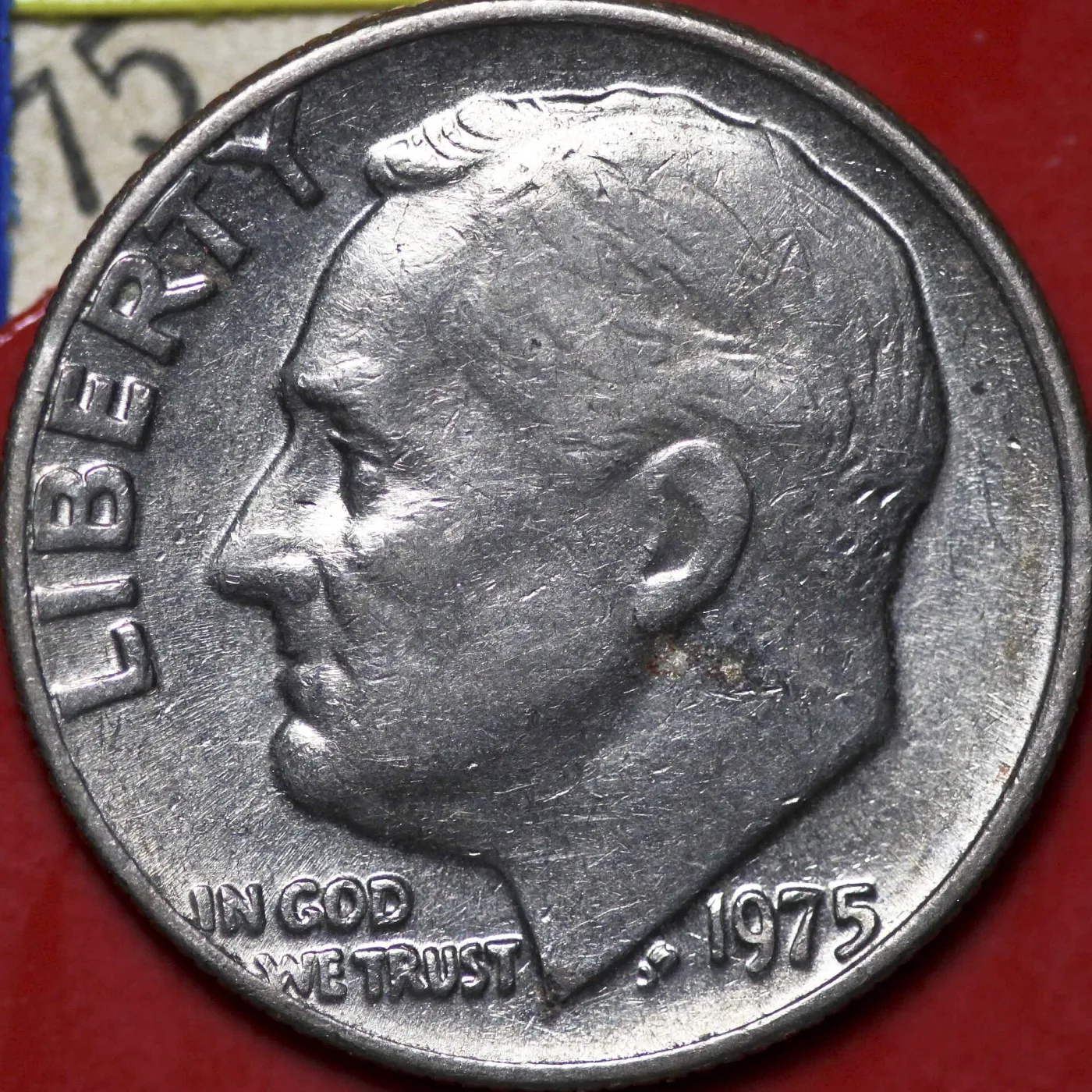
Any 1975-dated Roosevelt Dime from a proof set with no “S” mint mark above the date warrants immediate professional authentication. The coin must come from an unopened original proof set to establish provenance — loose “1975 no-S” coins are almost certainly business-strike Philadelphia pieces that naturally have no mint mark and never should have been confused with the proof rarity. A genuine 1975 No-S shows mirror-finish proof fields, squared rims, and the distinctive proof die polish typical of that year’s San Francisco production.
Known Auction Results
One of the two confirmed 1975 No-S Proof Dimes sold at Heritage in 2019 for $456,000. The same coin or its sibling has changed hands multiple times over the past three decades at six-figure levels. Because only two examples are known, any new discovery would be an event; suspect coins must be authenticated by PCGS or NGC with the proof-set provenance documented.
The 1982 No-P Error
The 1982 No-P Roosevelt Dime is the business-strike counterpart to the 1975 No-S proof — but far more accessible to regular collectors. Beginning in 1980, Philadelphia was supposed to place a “P” mint mark on all Roosevelt Dimes. In 1982, at least one obverse die at Philadelphia entered production without the “P” punch, creating a variety that escaped into general circulation in significant but limited numbers.
Strong P vs Weak P vs No P
Three 1982 Philadelphia Roosevelt Dime varieties exist. The “Strong P” is the normal issue, showing a bold, full mint mark. The “Weak P” shows a partial mint mark caused by a worn or filled die — these are common and carry no real premium. The true “No P” shows a completely smooth obverse field above the date with no trace whatsoever of a mint mark, not even under magnification. The No P is the variety to look for and authenticate.
How to Confirm a Genuine No-P
Use a 10x loupe minimum — 20x is better — on the obverse field directly above the date. Tilt the coin under a point light source. A genuine No-P shows a smooth, clean field with no depression, no rounded outline, and no remnant of an “S”-shaped area. Weak P varieties show either a faint outline, a partial top curve, or an obvious greasy smear. Authenticate any suspect coin through PCGS or NGC — a certified No-P 1982 is worth the $25 to $40 grading fee many times over.
Values
Circulated 1982 No-P examples sell for $50 to $150 depending on grade. MS-63 examples run $150 to $250. MS-65 examples sell for $300 to $500. MS-67 Full Torch examples can reach $1,500 to $3,000 at auction. This remains one of the best roll-hunting error finds for modern dime collectors because the coin exists in enough quantity to occasionally appear in circulation but is valuable enough to meaningfully reward the search.
The 1996-W Anniversary Dime
To mark the fiftieth anniversary of the Roosevelt Dime, the United States Mint produced a special 1996-W issue struck at the West Point Mint and included only in the 1996 Uncirculated Mint Set. It was the first Roosevelt Dime to bear the “W” mint mark and remains one of the most popular moderns for collectors building a complete date-and-mintmark set. It is not the only one, though — a 2015-W proof exists as well, so a W on the obverse identifies the mint but not automatically the year.
Mintage and Distribution
The 1996-W has a mintage of 1,457,000, matching the Mint Set distribution that year. The coins were not released into circulation and were available only to buyers of the complete Mint Set at the standard subscription price. As a result, nearly all surviving 1996-W dimes are in original holders or uncirculated condition.
How to Identify It
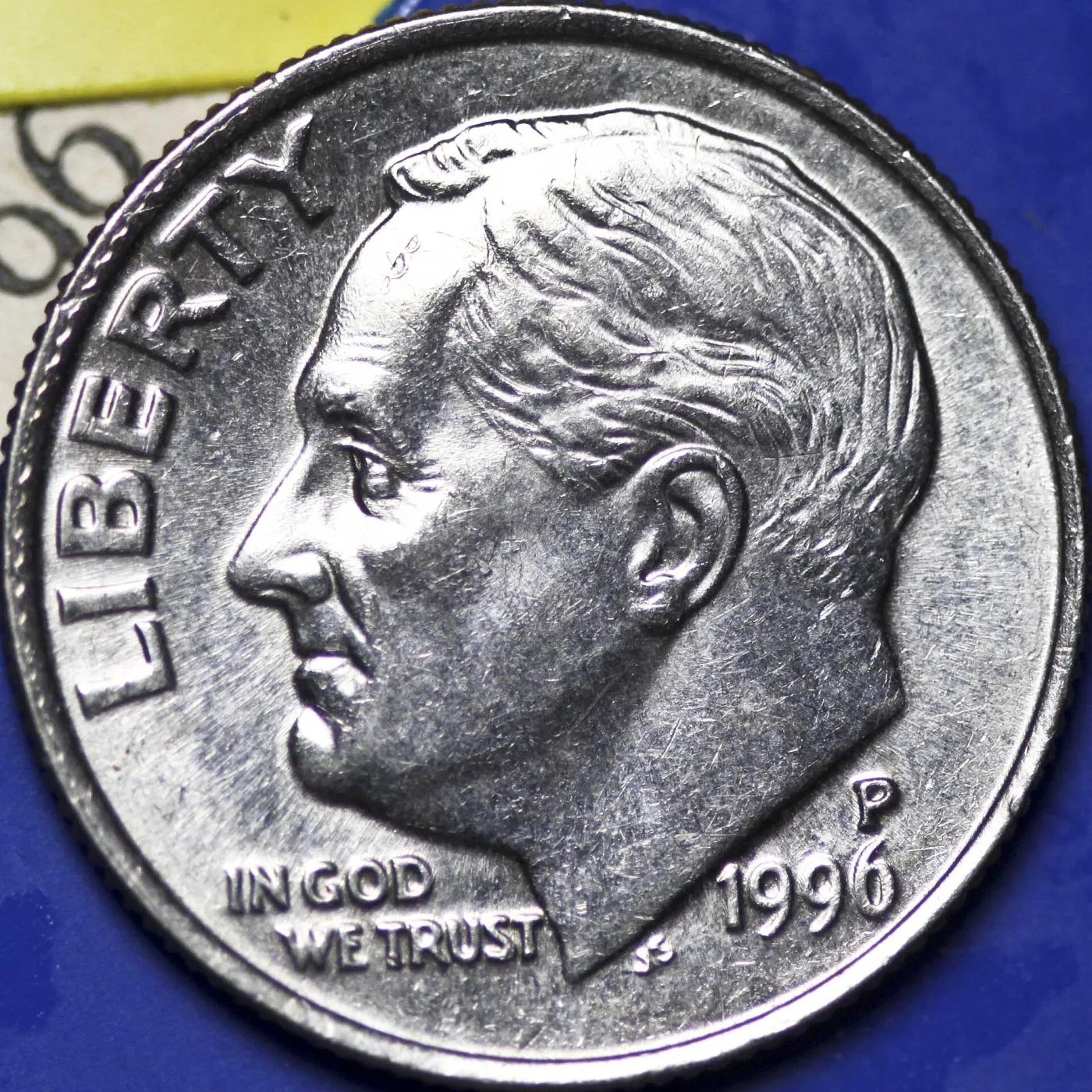
Look for “W” above the date on an obviously 1996-dated Roosevelt Dime. The “W” is small but clearly formed, and it appears in the same location where Denver dimes show “D” and San Francisco proofs show “S.” The 1996-W is a business-strike clad coin — not a proof — so the fields are satin rather than mirrored.
Values
Original Mint Set examples run $15 to $25. Certified MS-66 pieces run $25 to $35, MS-67 $35 to $60, MS-68 $80 to $150, and MS-69 Full Torch examples can reach $250 to $500 at auction. The 1996-W is one of the most affordable modern Roosevelt Dime keys and a cornerstone of any complete set.

Proofs, Silver Proofs, and Reverse Proofs
Roosevelt Dime proofs have been produced almost every year since 1950, with a gap from 1965 to 1967 (replaced by Special Mint Sets) and variations in composition that parallel the business-strike silver-to-clad transition.
1950-1964 Silver Proofs
All Philadelphia proofs from 1950 through 1964 are 90% silver. Mintages grew steadily — the 1950 proof is the scarcest at 51,386, while the 1964 proof exceeds 3.9 million. PR-65 Cameo examples of 1950 through 1954 can run $50 to $150; later dates are commonly available for $10 to $30 in PR-67 Cameo.
1968-Present Clad Proofs
All regular-issue proofs from 1968 onward carry the “S” mint mark and are struck in copper-nickel clad. They are sold in annual Proof Sets and are broadly available at modest premiums over face value. PR-69 DCAM examples of most modern dates run $5 to $15.
Silver Proofs (1992-Present)
Beginning in 1992, the Mint returned to striking silver proof dimes for inclusion in annual Silver Proof Sets. These carry the “S” mint mark and were 90% silver through 2018, then .999 fine silver beginning in 2019. Silver proofs trade at roughly $5 to $20 premium over clad proofs.
Reverse Proofs
The Mint has produced Roosevelt Dime reverse proofs in several special sets — most notably the 2018 50th Anniversary Silver Reverse Proof Set honoring the 1968 resumption of mint marks. Reverse proofs feature frosted fields and mirrored devices, the opposite of standard proof finish. Certified PR-70 reverse proofs run $30 to $80.
Doubled Dies and Other Varieties
Several Roosevelt Dime doubled dies and major varieties reward careful roll searching. None rival the 1955 Lincoln Wheat Penny Doubled Die in visibility, but they deliver meaningful premiums when correctly attributed.
1960 Doubled Die Obverse
The 1960 DDO shows doubling on “IN GOD WE TRUST” and “LIBERTY.” Under 10x magnification, strong doubling is visible on the letters of “TRUST” particularly. FS-101 examples run $75 to $150 in MS-63 and $200 to $400 in MS-65.
1963 and 1964 Doubled Dies
Both years carry multiple known DDO varieties with doubling on the motto and date. The 1964 DDO-002 is the most visible, with strong doubling on “IN GOD WE TRUST.” MS-65 examples run $50 to $120.
1968-S Doubled Die Obverse
The 1968-S DDO shows doubling on “LIBERTY” and appears on proof strikes. PR-65 examples run $40 to $80, PR-67 Cameo $100 to $200.
1983-P Doubled Die Reverse
The 1983-P DDR shows clear doubling on “ONE DIME” and “E PLURIBUS UNUM.” MS-65 examples run $50 to $120.
Repunched Mint Marks (RPMs)
Before the 1990s, mint marks were hand-punched into working dies and occasionally received multiple strikes in slightly different positions. Silver-era Roosevelt Dimes from 1946 through 1964 include dozens of known RPMs, most commanding modest $5 to $30 premiums in Mint State. The 1946-D/D and 1949-S/S are among the more popular varieties.
Error Coins and Mint Mistakes
Roosevelt Dimes are struck in the billions annually, and major mint errors appear regularly in circulation. Because the coins are small and uniform, dramatic errors tend to be quickly noticed by roll searchers and dealers.
Clipped Planchets
Straight or curved clips occur when the planchet punch slightly misaligns before striking. A classic curved clip shows the arc of the punch on one side of the finished coin. Clip errors sell for $5 to $30 depending on size and grade.
Off-Center Strikes
Off-center errors range from 5% off (minor) to 50% off (dramatic). The most valuable off-center strikes show the full date and mint mark but have 30-50% of the design missing. These sell for $20 to $200 depending on dramatic presentation.
Struck on Wrong Planchet
Roosevelt Dimes occasionally struck on cent planchets produce undersized, copper-colored dimes that are highly collectible. These sell for $150 to $500 depending on date and condition. The reverse situation — cents struck on dime planchets — is even rarer and more valuable.
Double Strikes and Broadstrikes
Broadstrikes (struck without the collar) produce oversized, reeded-less coins. Double strikes show two overlapping impressions. Both sell for $20 to $100 for minor examples and $200+ for dramatic ones.
Transitional Planchet Errors
The 1965 silver-to-clad transition produced rare errors: 1964-dated dimes struck on clad planchets and 1965-dated dimes struck on leftover silver planchets. A 1965 struck on a silver planchet (weighing 2.50 g instead of 2.27 g) is a legitimate transitional error worth $5,000 to $15,000 at auction. Check weight on any 1964 or 1965 dime that looks unusual.
How to Grade Roosevelt Dimes
Roosevelt Dimes grade on the standard 70-point Sheldon scale. Because the design is modern and detailed, grading focuses on cheek wear, high points of the hair, and strike quality on the reverse torch.
Circulated Grades
Good (G-4): Outline of Roosevelt is clear but much interior detail is worn smooth. LIBERTY and date are readable.
Very Good (VG-8): Major hair detail visible on the top of Roosevelt’s head. Torch bands are partially worn but visible.
Fine (F-12) to Very Fine (VF-20): Most hair detail is sharp. Torch bands are clear and separated.
Extremely Fine (EF-40): Only light wear on the highest points — Roosevelt’s cheek and hair above the ear.
About Uncirculated (AU-50 to AU-58): Trace of wear only on Roosevelt’s cheek; luster remains in protected areas.
Mint State Grades
MS-60 to MS-62: No wear but heavy bag marks, dull luster, and/or weak strike.
MS-63 to MS-64: Moderate marks, good luster.
MS-65 (Gem): Minimal marks, strong luster, attractive eye appeal.
MS-66 to MS-67: Nearly mark-free with exceptional luster.
MS-68 to MS-70: Essentially perfect. MS-70 is achievable only for modern silver proof issues, never for business strikes in any meaningful frequency.
Strike Designations
Full Torch (FT) or Full Bands (FB) designation is an additional premium indicator at any Mint State grade. A coin can be MS-65 without FT/FB, or MS-65 FT — the latter often worth 2x to 10x the former depending on date.
Authentication: Detecting Counterfeits
Counterfeit Roosevelt Dimes are rare in the United States market for several reasons: the face value is low, the silver content (for pre-1965 coins) is modest, and the design is easily verified. The main authentication risks involve altered mint marks, fake errors, and “no-mintmark” claims.
Altered Mint Marks
The 1975 No-S proof’s high value creates strong incentive to alter a regular 1975 proof by grinding off the S. Under magnification, altered surfaces show tooling marks, abraded proof finish, or an unnatural depression where the S should have been. Any 1975 No-S proof must be in an original sealed proof set or professionally authenticated.
Fake 1982 No-P
Counterfeiters occasionally grind or fill the P on ordinary 1982 Philadelphia dimes to simulate a No-P. Under 20x magnification, a genuine No-P shows a perfectly smooth, undisturbed field. An altered coin shows abrasion, polishing marks, or fresh metal displacement around the former mint-mark area.
Silver vs Silver-Plated Modern Counterfeits
Chinese counterfeits of 90% silver Roosevelt Dimes occasionally surface in online bulk listings. Weight is the fastest test (2.5 g genuine; counterfeits often weigh 2.3 to 2.7 g). Magnetic attraction is another red flag — silver is not magnetic. Authentic coins also show a clean, sharp reeded edge; counterfeits often show weak or inconsistent reeds.
Professional Authentication
Any raw Roosevelt Dime in the $50+ range should be authenticated by PCGS, NGC, or ANACS before sale. The $20 to $40 grading fee is modest insurance against altered or counterfeit coins, and certified holders improve both liquidity and the realized sale price.
Current Market Values by Date and Mint
Most circulated Roosevelt Dimes carry either silver melt value (pre-1965) or face value (1965+). Real premium emerges in Mint State grades, Full Torch designations, and specific scarce varieties. Market values below reflect recent PCGS and NGC auction results and retail dealer asking prices as of 2026.
Silver Era (1946-1964) Common Dates
Circulated: $1.50 to $2.50 (roughly silver melt). MS-63: $5 to $12. MS-65: $10 to $25. MS-67 FT: $75 to $200 for common dates.
Silver Era Semi-Keys
1949-S: MS-65 $70 to $120; MS-67 FT $1,500 to $3,000.
1950-S: MS-65 $40 to $70; MS-67 FT $500 to $1,000.
1955-P/D/S: MS-65 $20 to $40 each; MS-67 FT $200 to $500.
1963/1964 DDO varieties: MS-65 $50 to $120 depending on variety.
Clad Era (1965+) Common Dates
Circulated: face value. MS-63: $1 to $3. MS-65: $3 to $10. MS-67: $10 to $40. MS-68 FT: $200 to $2,000+ for scarce dates.
Clad Era Notable Issues
1982 No-P: Circulated $50 to $150; MS-65 $300 to $500; MS-67 FT $1,500+.
1996-W: BU $15 to $25; MS-67 $35 to $60; MS-69 FT $250 to $500.
1975 No-S Proof: Known examples $300,000 to $500,000+ at auction.
Modern Silver Proofs (1992+)
PR-69 DCAM: $5 to $15. PR-70 DCAM: $20 to $50 for common dates, $100+ for early silver-proof years.
Storage, Handling, and Preservation
Because Roosevelt Dimes are small, lightweight, and produced in huge numbers, collectors often undervalue storage. For silver coins especially, proper storage prevents toning, environmental damage, and surface contamination that can permanently reduce value.
Handling
Always handle Mint State or proof Roosevelt Dimes by the edges only. Skin oils and salts cause permanent surface spots that develop over months or years. Use cotton gloves for rare pieces. Never clean a Roosevelt Dime — cleaning destroys luster and tanks value more than any other single mistake.
Holders
Inert flips (Mylar or polypropylene) are safe for short-term storage. Avoid PVC-containing “soft” flips, which leach chemicals that green-stain silver and clad coins alike. For long-term storage of valuable pieces, use certified third-party holders (PCGS, NGC, ANACS) or inert coin capsules such as Air-Tite. Cardboard 2x2 flips with Mylar windows work well for middle-value coins.
Environment
Store coins in a cool, dry, climate-controlled environment. Silica gel packets in the storage container help control humidity. Avoid basements, attics, and garages, where humidity and temperature swings accelerate toning. A dehumidified safe or dedicated cabinet in a living area is ideal for a meaningful collection.
Building a Roosevelt Dime Collection
Roosevelt Dimes offer one of the most approachable collecting paths in American numismatics. The full business-strike set from 1946 to present runs roughly 200 coins across dates and mint marks, most of which can be assembled in circulated or BU grade for well under $500.
The Starter Set: 1946-1964 Silver
A complete silver set of 48 coins (all dates and mint marks from 1946 through 1964) can be assembled in average circulated grade for $100 to $200. In Brilliant Uncirculated, the same set runs $500 to $1,200. This is the perfect first collection for a young collector or a new numismatist building toward the full series.
The Complete Business-Strike Run
Adding the clad era (1965-present) brings the set to roughly 160 coins, most of which are available at face value or modest premium. The 1996-W is the only significant cost for the clad run, budgetable at $20 to $40 in BU. A complete circulated set plus a BU 1996-W runs $200 to $500 total.
The Complete Proof Set
A complete proof collection of Roosevelt Dimes (every year 1950-present) runs roughly 75 coins. Individual proof prices range from $2 for common modern issues to $150 for the early 1950-1954 silver proofs in Cameo grades. Budget $500 to $1,500 for a complete proof set in PR-65+ grades.
The Full Torch Challenge
For advanced collectors, a complete Mint State set with Full Torch designation on every issue is the series’ endgame. Expect to spend $10,000 to $50,000+ depending on the grade target (MS-65 FT vs MS-67 FT across all dates). The 1949-S, 1968-D, 1975-D, 1982-P, and 1982-D are the typical bottlenecks.
Specialty Collections
Variety collectors can build parallel sets focused on doubled dies, RPMs, or transitional errors. Topical collectors sometimes pair Roosevelt Dimes with Jefferson Nickels or Washington Quarters as a “modern circulating” set running from 1932 to today.
Frequently Asked Questions
Are all Roosevelt Dimes before 1965 silver?
Yes. Every business strike and proof Roosevelt Dime dated 1946 through 1964 is 90% silver. The switch to copper-nickel clad composition happened partway through 1965, with all 1965-dated dimes being clad.
How can I tell if a Roosevelt Dime is silver without weighing it?
Check the edge. Silver dimes show a uniform silver-gray edge. Clad dimes show a clear orange-copper stripe sandwiched between the outer cladding. The date is also definitive: 1964 or earlier is silver; 1965 or later is clad (except for dedicated silver-proof issues).
What does "FT" or "FB" on a Roosevelt Dime holder mean?
Full Torch (NGC) or Full Bands (PCGS) — both designations indicate that both sets of horizontal bands on the reverse torch are completely separated and fully struck. It is a strike-quality premium adding significant value in Mint State grades.
Is my 1975 dime without an S mint mark the rare one?
Almost certainly no. The 1975 No-S rarity exists only on proof coins from that year's proof sets — business-strike 1975 Philadelphia dimes normally carry no mint mark and are worth face value. Check for proof-quality mirrored fields before getting excited. If the coin is from a sealed proof set, have it authenticated.
Is my 1982 Philadelphia dime the No-P error?
Maybe. Use a 10x or 20x loupe to examine the field directly above the date. A genuine No-P shows a completely smooth field with no mint mark whatsoever — no outline, no depression, no trace. A "Weak P" shows partial mark and is not the valuable variety. Authenticate any suspect No-P through PCGS or NGC.
What is the 1996-W and how do I identify it?
The 1996-W is a fiftieth-anniversary issue struck at the West Point Mint and included only in the 1996 Uncirculated Mint Set. It bears a small "W" mint mark above the date. Mintage was 1,457,000. Check the date before assuming a W dime is the 1996: a 2015-W proof carries the same mint mark in the same position.
Should I clean my Roosevelt Dimes?
Never. Cleaning destroys luster and permanently reduces collector value, often by 70% to 90%. Original toning — even dark toning — is far more desirable to serious collectors than a cleaned coin will ever be. Leave the coin as-is.
Are modern clad Roosevelt Dimes worth anything?
Most are worth face value. Exceptions include the 1982 No-P, the 1996-W, condition rarities in MS-68+ Full Torch, significant errors, and specific doubled-die varieties. Roll searching remains a viable hobby because these exceptions do occasionally surface in circulation.
Where can I sell my Roosevelt Dimes?
Silver-era dimes in bulk are most easily sold to local coin dealers at roughly 90-95% of silver melt value. Certified coins sell best through eBay, Heritage, Great Collections, or Stack's Bowers — choose the venue based on expected sale price. Avoid mail-in gold-and-silver bulk buyers, who typically offer 60-70% of actual melt.