Russian Imperial Coins: How to Read the Date, Denomination and Mint
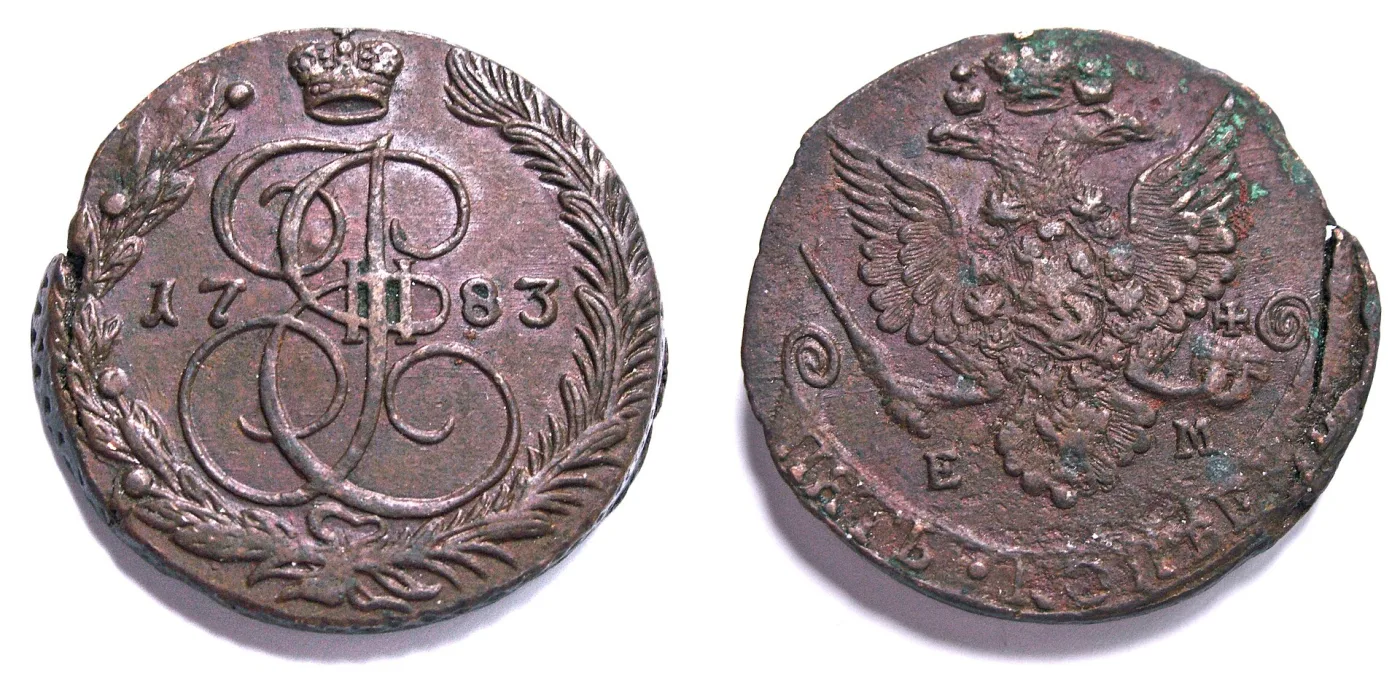
Old Russian coins turn up in inherited coin jars, metal detector finds and dealers’ world-coin trays, and they look harder to read than they are. The legends are Cyrillic, some dates are written in letters, and the denominations use words like kopeck, denga and rouble that do not appear on Western coins. Once you know where to look, most Imperial Russian coins can be placed by ruler, date, denomination and mint in a minute or two.
This guide works through that process from the oldest pieces you are likely to see, the tiny wire kopecks, to the gold of Nicholas II. For the general method that applies to any coin, start with the coin identification guide.
The Denominations: Rubles, Kopecks, Dengas and Polushkas
The modern system dates from Peter the Great. In 1704 his reform divided the ruble into 100 kopecks, making it one of the earliest decimal currencies anywhere. The units below the kopeck survived the reform and were struck periodically until the end of the Empire.
| Denomination | Russian on the coin | Value |
|---|---|---|
| Polushka | ПОЛУШКА | ¼ kopeck |
| Denga | ДЕНГА, ДЕНЬГА | ½ kopeck |
| Kopeck | КОПѢЙКА, plural КОПѢЕКЪ | 1/100 ruble |
| Grivennik | ГРИВЕННИКЪ, later 10 КОПѢЕКЪ | 10 kopecks |
| Poltina | ПОЛТИНА | 50 kopecks |
| Ruble | РУБЛЬ, plural РУБЛЕЙ | 100 kopecks |
Two spelling details help you read them. The letter Ѣ (yat) appears in КОПѢЙКА, and words ending in a consonant carry a final hard sign Ъ. Both were dropped by the Soviet spelling reform of 1917–1918, so seeing them is a quick sign that a coin predates the Soviet era.
Before Peter: Wire Kopecks
The kopeck itself goes back to the monetary reform begun in 1535, while Elena Glinskaya ruled as regent for the young Ivan IV. Until the early 18th century kopecks were not round coins at all. They were struck on short lengths of flattened silver wire, so each one is an irregular oval, often smaller than a fingernail. Collectors call them wire kopecks or “scales”.
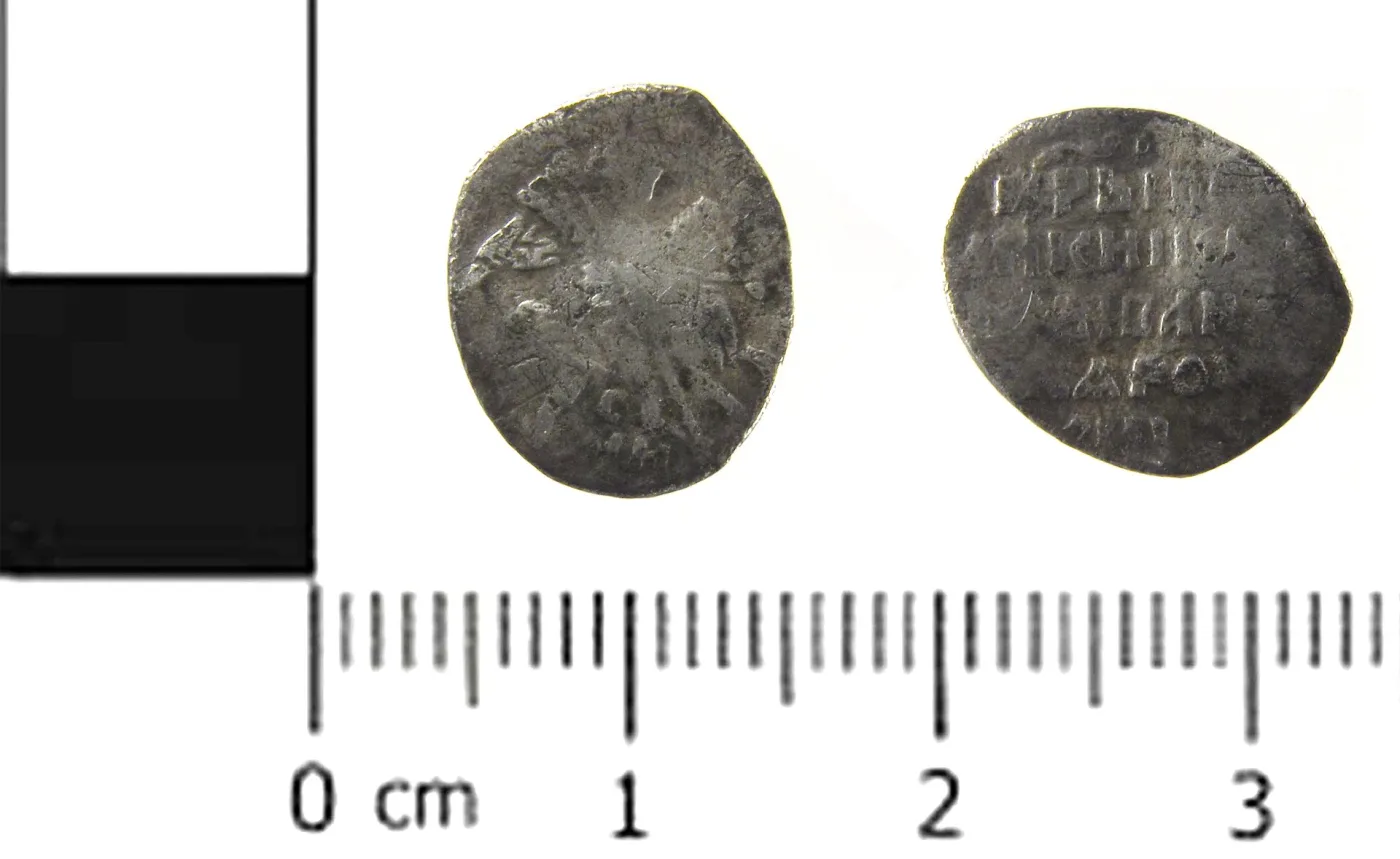
Three features identify one:
- Shape: an oval or teardrop, never a true circle, often with part of the design running off the edge.
- The horseman: from 1535 the kopeck showed a rider with a spear. The coin’s name is usually traced to kopyo, the Russian word for a spear or lance, although some numismatists dispute that derivation.
- Text in lines: the reverse carries the ruler’s name and title across the face, not around the rim.
The last wire kopecks were struck in 1718. A coin of this shape therefore belongs to the 16th or 17th century or to the first years of Peter’s reign, and the ruler’s name on the reverse narrows it from there.
Reading Cyrillic Letter Dates
Round, machine-struck coins arrived with Peter, but for two decades many of them still dated themselves in Cyrillic letters used as numbers rather than in digits. Such dates appear on round silver and copper coins struck from 1700 to 1722, and 1722 is the last year the old system was used, with some silver of that year found in both forms.
The key letter is Ψ (psi), which stands for 700. A complete date starts with the thousands sign А for 1000, then Ψ, then the tens and units. One trap: the numbers 11 to 19 are written in the order they are spoken, units first. So 1715 appears as АΨЕІ, which is 1000 + 700 + 5 + 10, not АΨІЕ. On some coins the thousands sign is left out and the date simply reads ΨВІ for 1712.
If a date contains no Ψ, it is either a modern Arabic date or, on wire coins from the 1690s and earlier, a year counted from the Creation of the World, which runs 5,508 years ahead of the Christian calendar.
The 18th Century: Copper and Gold
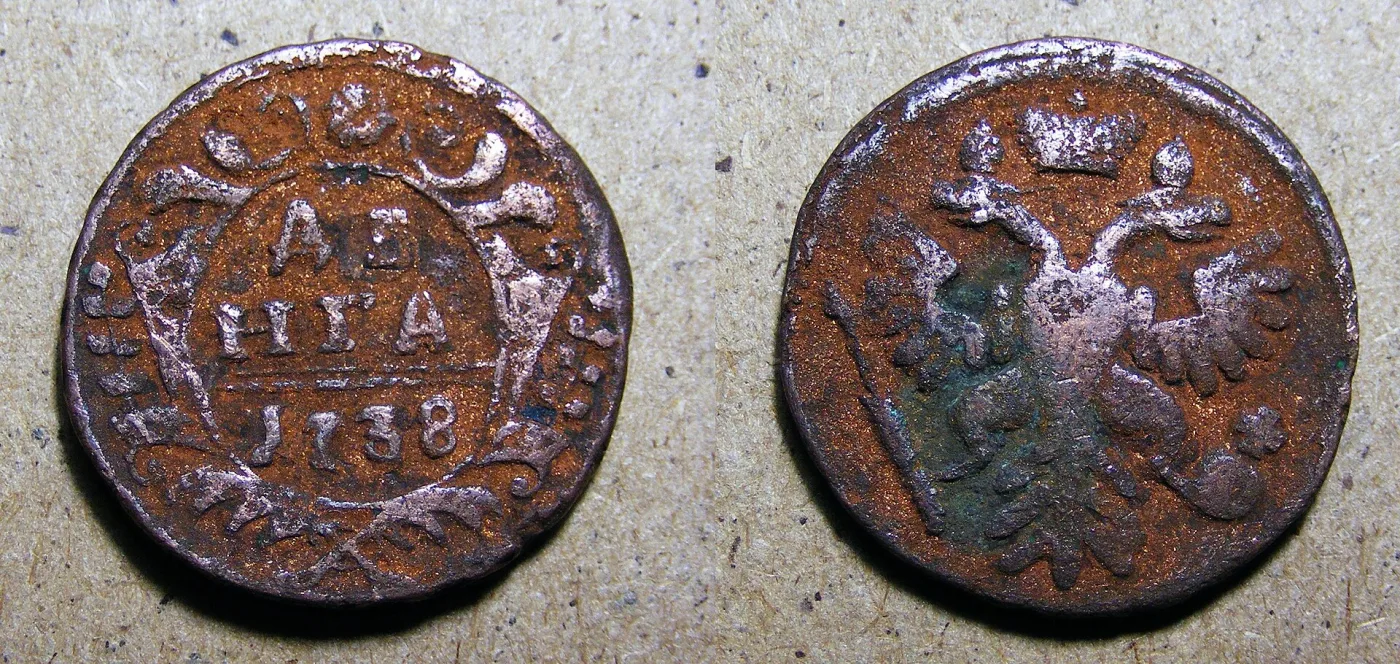
After Peter’s reform the small change became copper, and it became large. A copper coin had to contain something close to its face value in metal, which is why 18th-century Russian copper is so heavy.
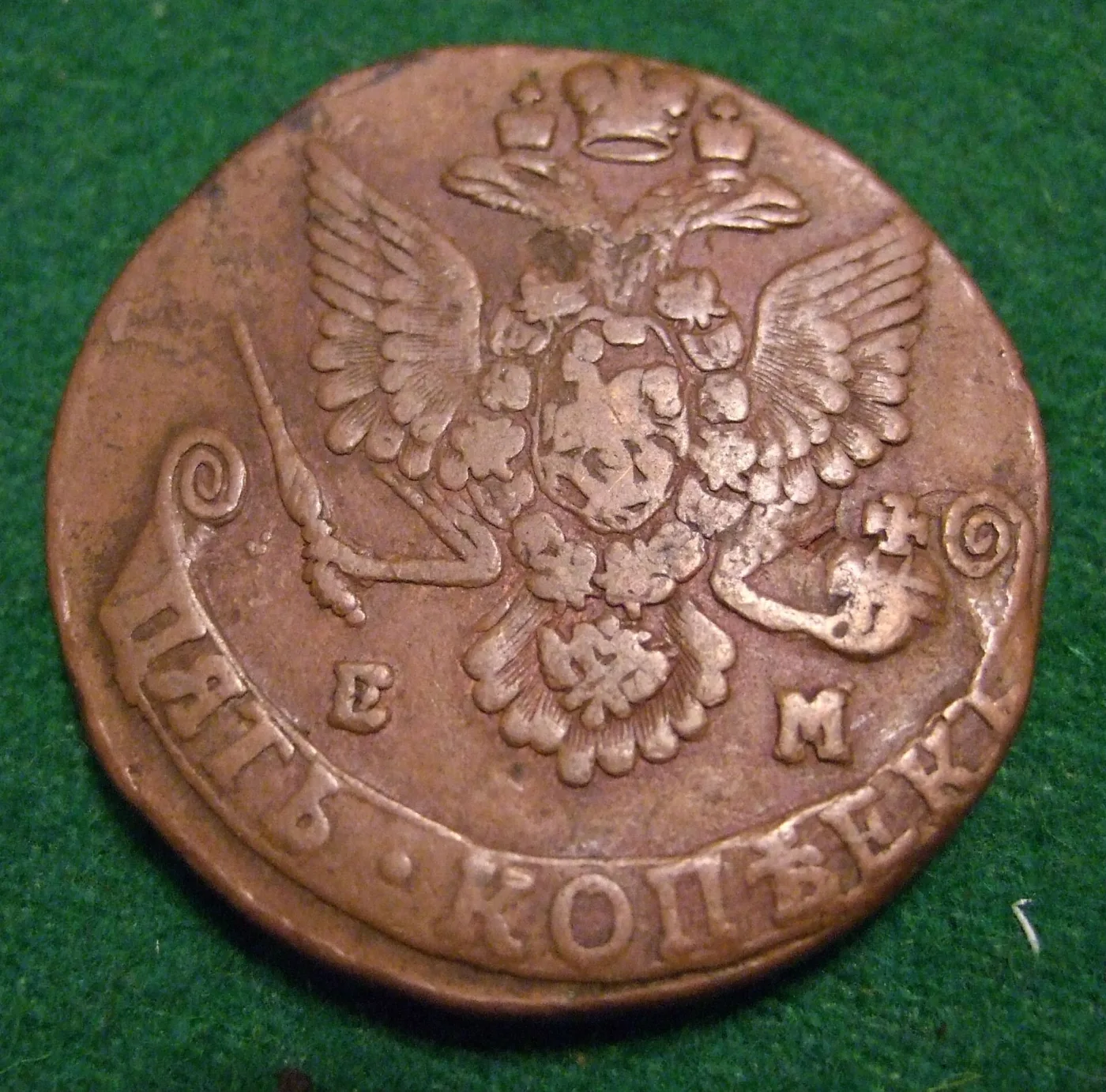
The best-known piece of the century is Catherine II’s 5 kopecks. Its crowned monogram, a looped Cyrillic Е with II inside it, sits in a wreath with the date split on either side, and the eagle side carries the mint letters. Specimens from Ekaterinburg are listed at about 51 grams and 42 millimetres, about as much as nine modern US quarters.

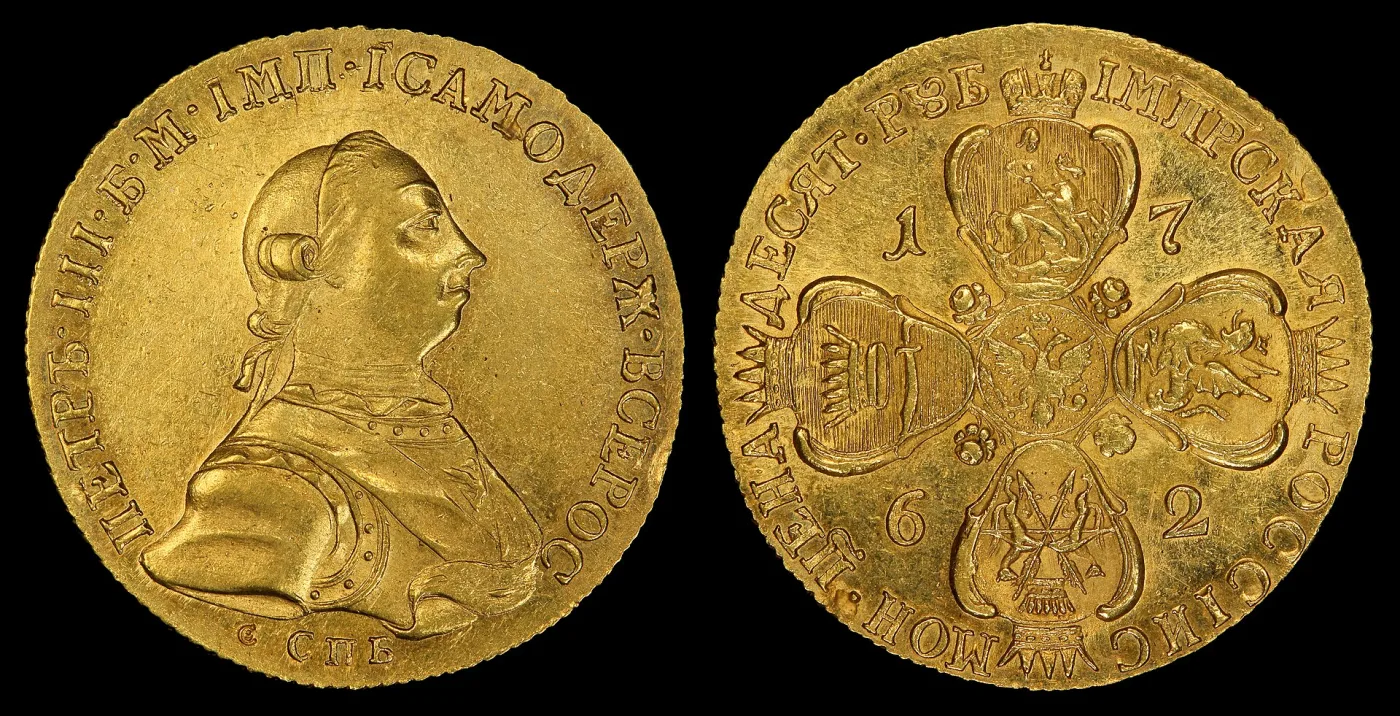
Gold of the period is rare and usually shows the ruler’s portrait. A 1762 10 roubles of Peter III shows his bust with СПБ below it, and on the reverse four crowned shields arranged in a cross with the date split between them.
Where Is the Mint Mark?
Most Imperial coins name their mint in two or three Cyrillic letters, usually below the eagle or the portrait. These are the ones you will meet most often:
| Mark | Mint | Typical coins |
|---|---|---|
| СПБ | St. Petersburg | Silver and gold, many coppers |
| ММД | Moscow | 18th-century silver and copper |
| ЕМ | Ekaterinburg, in the Urals | Heavy copper |
| КМ | Suzun, in Siberia | Copper |
On 19th and early 20th century silver a second pair of letters often follows СПБ. That second pair is a mintmaster’s initials, not another mint, so СПБ followed by two more letters is still a St. Petersburg coin. For how mint marks work on coins in general, see the mint marks guide.
Rarities You Are More Likely to See as Restrikes
Two famous Imperial pieces illustrate a word every collector of Russian coins needs: novodel. A novodel is a coin struck by the Russian mint later than its date, for collectors, from original or remade dies. It is a genuine mint product, not a counterfeit, but it is catalogued and valued separately from the original strike.
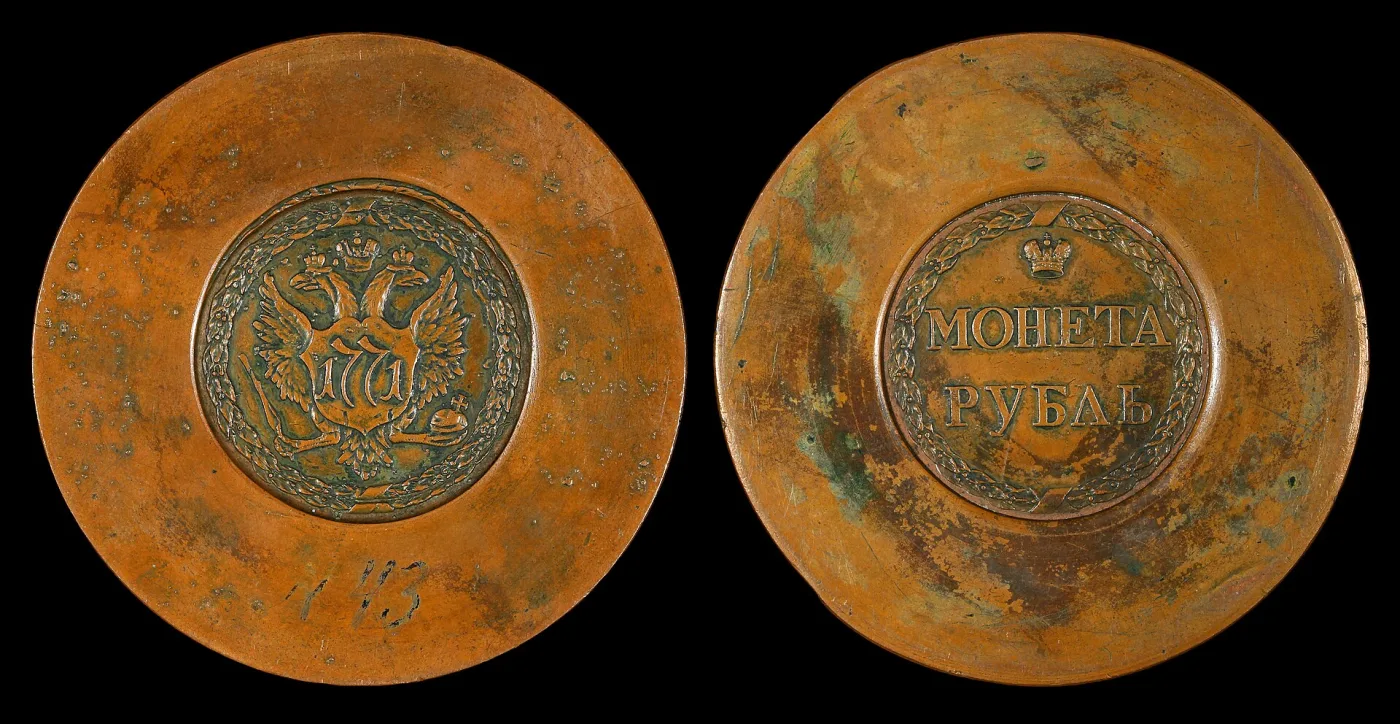
The Sestroretsk rouble of 1770–1771 was an experiment in a full copper rouble. To hold a rouble’s worth of copper it had to be enormous: the pieces offered at auction weigh a little over a kilogram, the size of a small saucer with a lettered edge. Most that appear on the market are novodels.
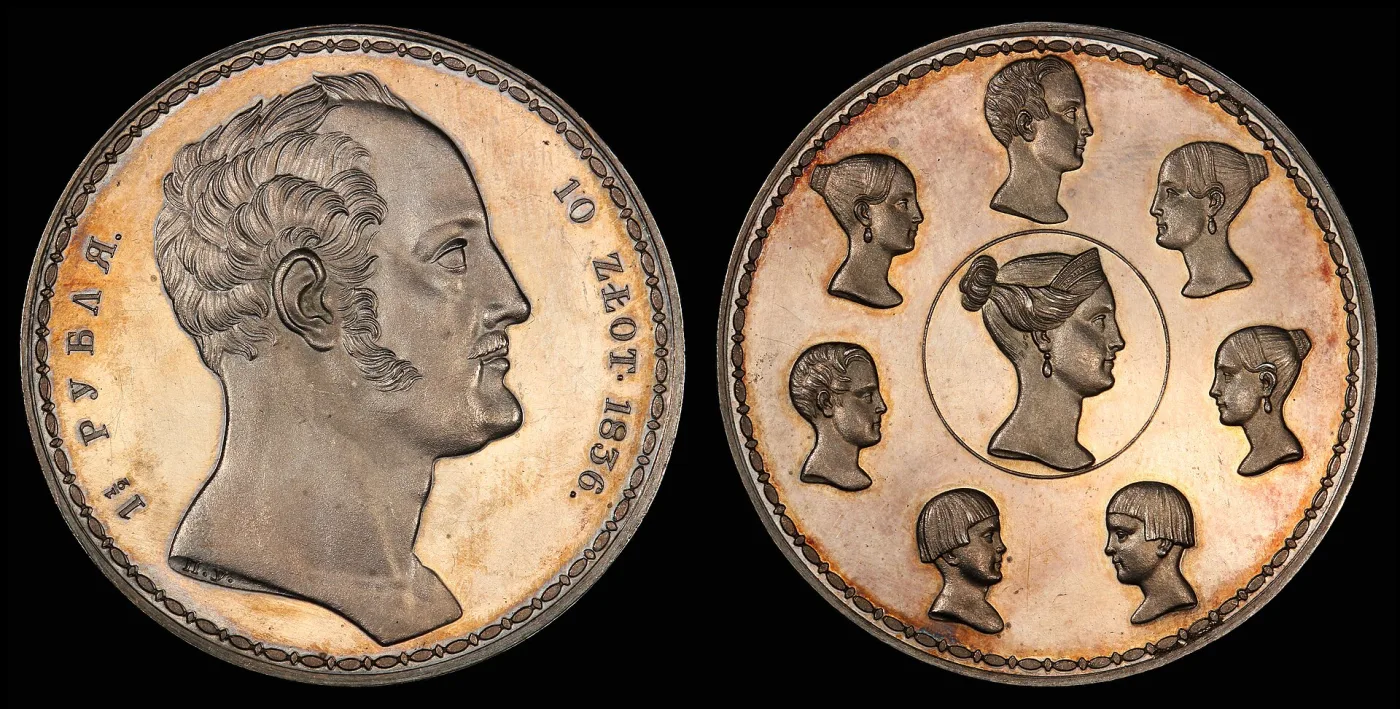
The family rouble of 1836 shows Nicholas I on one side and the Empress Alexandra Feodorovna surrounded by their seven children on the other. Its denomination is double, 1½ roubles and 10 złoty, because it also served the Kingdom of Poland, then joined to the Russian Empire, where the złoty was the unit, and it was made as a presentation piece rather than for circulation. The original issue was tiny, and many surviving examples, including the one below, are restrikes.
Nicholas II: Silver, Billon and Gold
The coins of the last tsar are the Imperial pieces most often found today, and they are the easiest to read: Arabic dates, a clear denomination and a stated metal content.
- Silver roubles and poltinas. A Nicholas II rouble states on its edge that it holds 4 zolotniks 21 doli of pure silver, about 18 grams in metric terms.
- Small silver. The 10 and 20 kopecks of 1867–1917 are .500 silver, half the fineness of the rouble. They were struck in huge numbers, with tens of millions of each dated 1915.
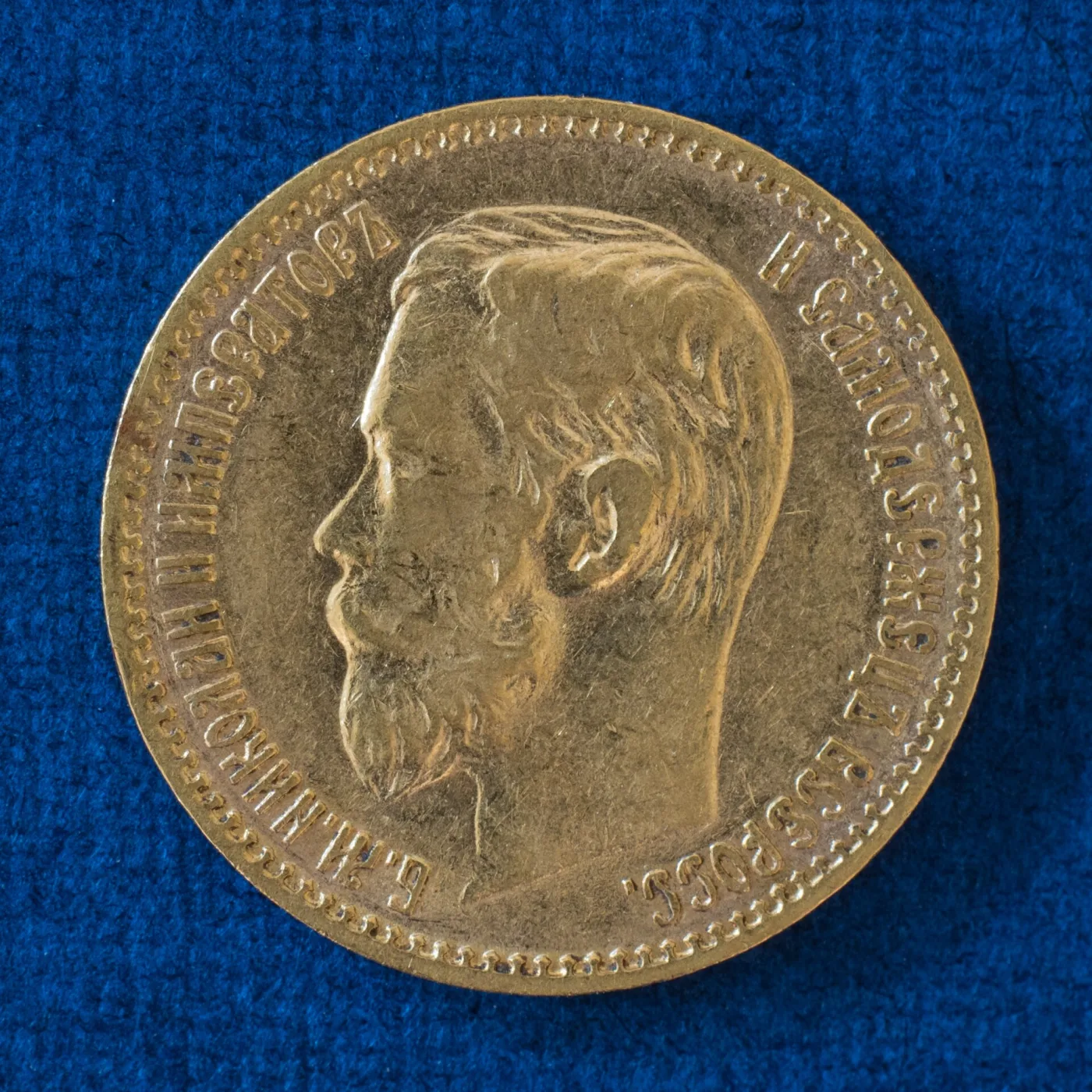
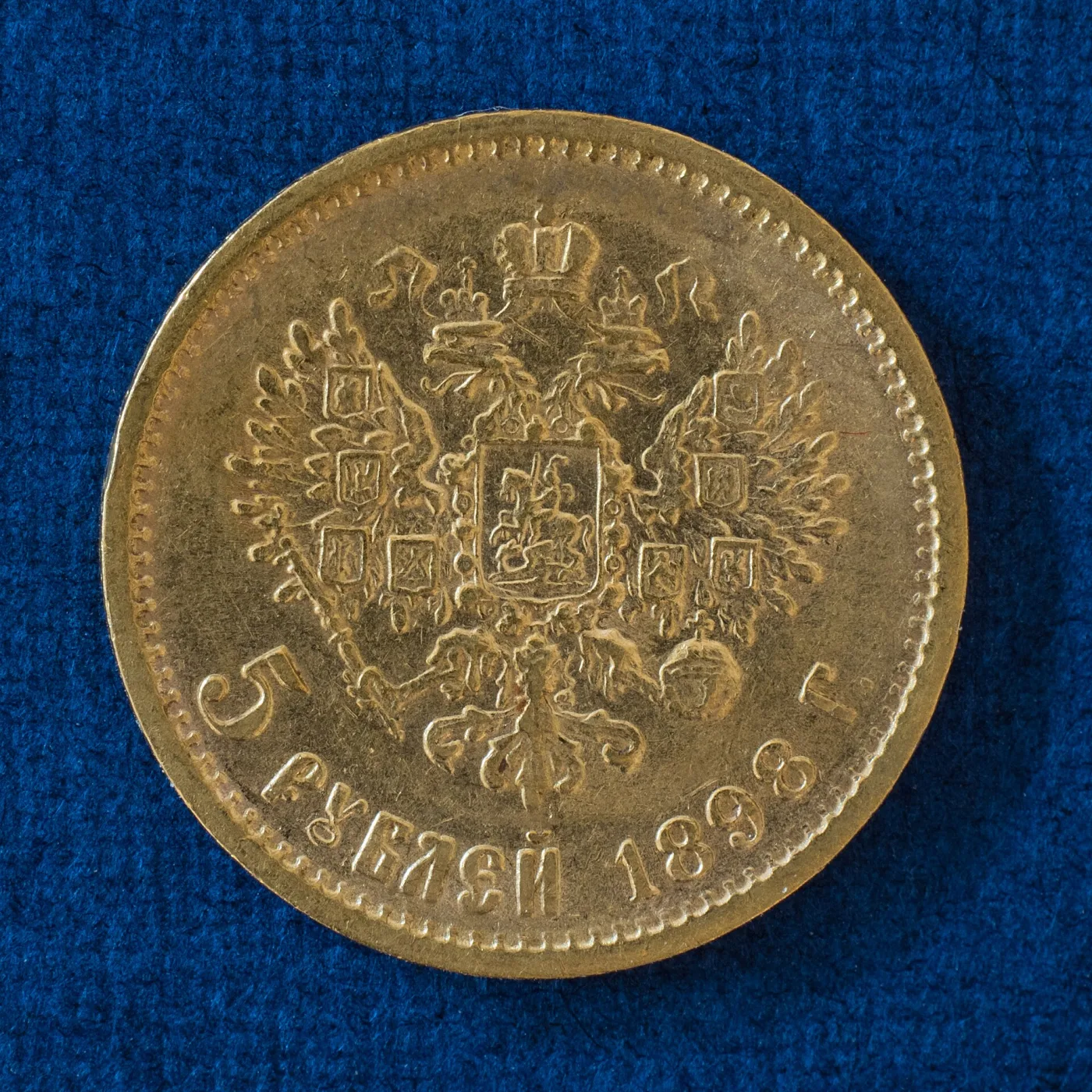
- Gold. The currency reform of 1897 cut the rouble’s gold content to two-thirds of its former value. The old 10-rouble imperial was struck in that year at the same weight but marked 15 roubles, and a 7½ roubles was issued alongside it. Both were single-year coins. The 5 and 10 roubles then took over, the 5 roubles struck from 1897 to 1911 at 4.3 grams of .900 gold.
Counterfeits and How to Check
Russian gold attracts forgers. NGC’s list of the world coins it most often sees counterfeited is headed by the Russia 1897 15 roubles, and NGC notes that the coin’s collector premium, despite a mintage of nearly 12 million, is what makes it worth faking. The same Korean 5 yang that sits second on that list is covered in the Korean coins guide.
Before paying anything above bullion for Russian gold or a scarce silver rouble:
- Weigh it on a scale that reads to 0.01 gram. A 5 roubles of Nicholas II should come in at about 4.3 grams.
- Measure the diameter and compare it with a catalogue entry for the exact date and mint.
- Look for the same marks on several coins. NGC describes transfer-die fakes, copied from a genuine coin, that repeat the original’s small depressions in exactly the same places.
- Have expensive coins certified. The counterfeit detection guide covers the general tests, and the third-party grading guide explains what a slab does and does not tell you.
A Quick Identification Checklist
- Shape. An irregular oval on a scrap of wire is a wire kopeck from before 1718.
- Date. Arabic digits are normal from the 1720s. A Ψ means a Cyrillic letter date from 1700 to 1722.
- Denomination. Find ПОЛУШКА, ДЕНГА, КОПѢЙКА or КОПѢЕКЪ, ПОЛТИНА, or РУБЛЬ.
- Ruler. Read the name in the legend or identify the monogram: Catherine II’s crowned Е with II is the one you will see most.
- Mint. Look below the eagle or portrait for СПБ, ММД, ЕМ or КМ.
- Metal and weight. Weigh the coin and compare it with the catalogue figure before deciding whether it is silver, gold or a later copy.
If a coin is too worn to read, a clear photo of each side is often enough for the Coin Identifier app to suggest the type, which you can then confirm against the features above. Russian coins also travel in the same accumulations as the pieces in the German coins guide, whose eagle-and-legend approach works the same way here.
Frequently Asked Questions
How do I read the date on an old Russian coin?
From the 1720s on, the date is in ordinary Arabic numerals, usually followed by the letter Г. (short for year) on later coins. On round coins struck from 1700 to 1722 the date may instead be written in Cyrillic letters used as numbers, where Ψ stands for 700. Earlier wire kopecks, if they carry a date at all, use the old count of years from the Creation of the World.
What is a kopeck worth compared with a ruble?
One ruble is 100 kopecks. Peter the Great fixed that decimal relationship in 1704. The smaller units were the denga, worth half a kopeck, and the polushka, worth a quarter of a kopeck.
What do the letters under the eagle on a Russian coin mean?
They are usually the mint mark. СПБ is St. Petersburg, ММД the Moscow mint, ЕМ Ekaterinburg in the Urals, and КМ the Suzun mint in Siberia. On many 19th and early 20th century silver coins a second pair of letters after СПБ names the mintmaster, not a mint.
Are old Russian coins silver?
Some are. Rubles and poltinas of the 19th and early 20th century are silver, and a ruble of Nicholas II states on its edge that it holds 4 zolotniks 21 doli of pure silver, about 18 grams. The small 10 and 20 kopecks of 1867 to 1917 are only half silver (.500). Copper denominations such as 1, 2, 3 and 5 kopecks contain no silver at all.
Is my Russian gold 5 or 15 roubles real?
Check it carefully before paying a gold premium. A Nicholas II 5 roubles should weigh about 4.3 grams of .900 gold. The 1897 15 roubles heads NGC's list of the most commonly counterfeited world coins, so weigh, measure, and have any expensive piece certified.
What is a novodel?
A novodel is a coin the Russian mint struck later, from original or newly made dies, for collectors rather than for circulation. Many famous rarities, including the giant Sestroretsk copper rouble and the 1836 family rouble, are known mostly from novodels. They are real mint products but are valued differently from originals, so the catalogue entry matters.