Presidential Dollar Identification Guide: Edge Lettering, Errors, and Values
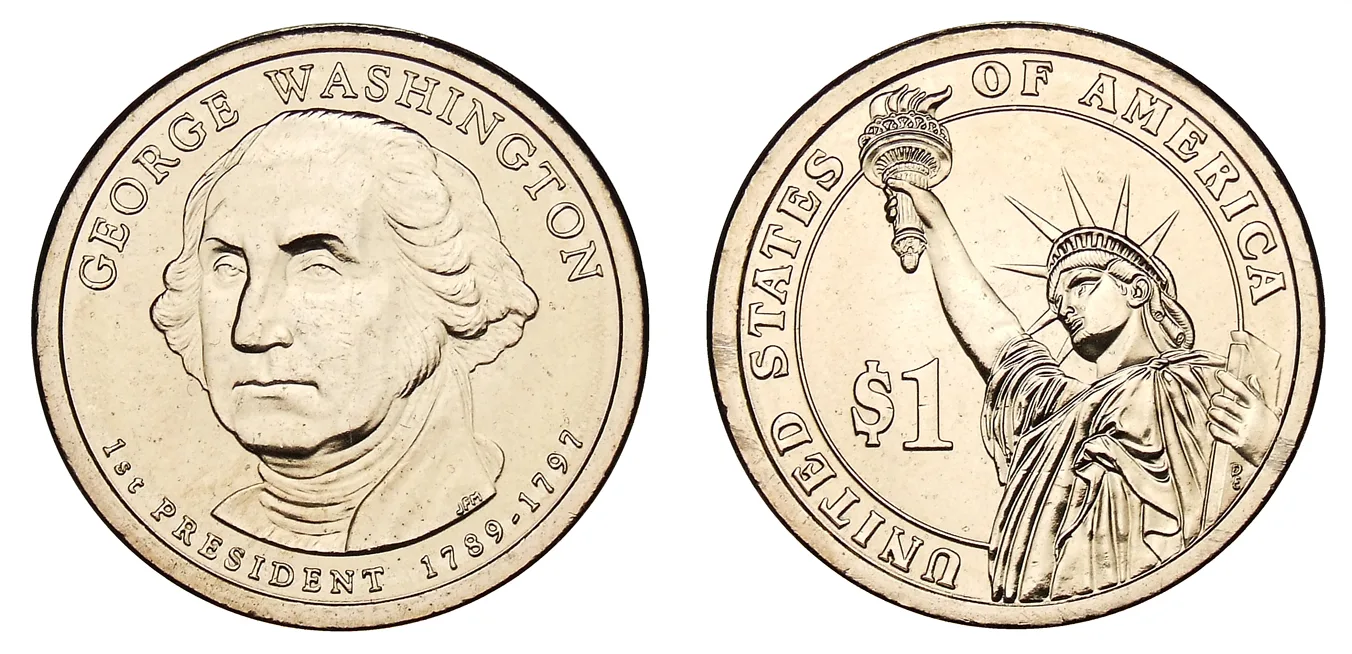
The Presidential Dollar — the golden manganese-brass coin honoring America’s deceased presidents in order of service — ran from 2007 through 2016 for circulation, with a final 2020 issue for George H.W. Bush. Modeled directly on the wildly successful 50 State Quarters program, the series put a new president on a coin roughly every three months, eventually picturing 39 of the 45 men who had held the office. It shares the golden alloy, 26.5 mm diameter, and edge-lettering technology of the Sacagawea Dollar, and like its predecessors the Eisenhower and Susan B. Anthony dollars, it never truly circulated.
What makes the Presidential Dollar fascinating to collectors is not rarity — billions were struck — but its errors. The decision to move the date, mint mark, and mottoes to the edge of the coin created an entirely new family of mistakes: the famous “Godless dollars” (2007 Washington pieces missing IN GOD WE TRUST), plain-edge coins with no lettering at all, doubled and inverted edge lettering, and lettered-edge mules. This guide explains how to identify every president in the series, read the edge inscriptions, attribute the major errors, grade your coins, and price them at today’s market.
Whether you pulled a Presidential Dollar from a roll, inherited a Mint set, or are hunting the edge errors that turn a face-value coin into a hundred-dollar find, this guide gives you the working knowledge to identify any Presidential $1 Coin with confidence.
History: A Dollar for Every President
By 2005, the US Mint had a proven blueprint for getting Americans to notice a coin: rotate the design. The 50 State Quarters program, launched in 1999, had been an extraordinary success, drawing tens of millions of casual collectors into pulling quarters from change and assembling folders. Congress wanted to repeat that magic on the unloved dollar coin — and so the Presidential $1 Coin Act of 2005 was born.
The Act directed the Mint to issue four new dollar coins each year, each honoring a former president in the order he served, at a pace of one new design roughly every three months. There were two rules built into the law: a president had to be deceased to appear, and he had to have been dead for at least two years before his coin could be issued. The program began on February 15, 2007, with George Washington, and continued in strict chronological order.
The series ran for circulation from 2007 through 2011, when the Treasury — facing roughly 1.4 billion surplus dollar coins sitting unused in Federal Reserve vaults — ordered that Presidential Dollars from 2012 onward be struck only for collectors, not for general circulation. The collector-only program continued through 2016, completing the roster of eligible presidents through Ronald Reagan. Then, in 2020, a single additional coin was authorized and struck for George H.W. Bush, who had died in 2018, bringing the series to a close at 39 distinct presidents.
Why Some Presidents Are Missing
The series honors 39 men, not 45, because of the “deceased and two years dead” requirement and a quirk of history. Grover Cleveland served two non-consecutive terms (as the 22nd and 24th president), so he received two different coins. Presidents living when the series wound down — and those who died too recently — were not eligible. The program ended at Reagan in 2016; Gerald Ford had died in late 2006 and was covered in 2016, but later presidents fell outside the program’s window. George H.W. Bush received a special 2020 coin under the original law’s two-year rule after his 2018 death.
The Companion Programs
Two related programs ran alongside the dollars. The First Spouse Gold Coin program issued half-ounce $10 gold coins honoring each president’s spouse (with special designs where a president had no spouse during his term). And the Native American $1 Coin program — the rotating-reverse continuation of the Sacagawea series described in our Sacagawea Dollar guide — shared press time and the same edge-lettering machines, which matters for understanding certain mule errors.
Design: Obverse, Reverse, and Edge
Unlike most US coin series, the Presidential Dollar splits its inscriptions across three surfaces: a portrait on the obverse, a single fixed reverse used for the whole series, and the legally required mottoes and date on the edge. Understanding this three-part layout is the key to both identification and error-spotting.
Obverse (Heads Side)
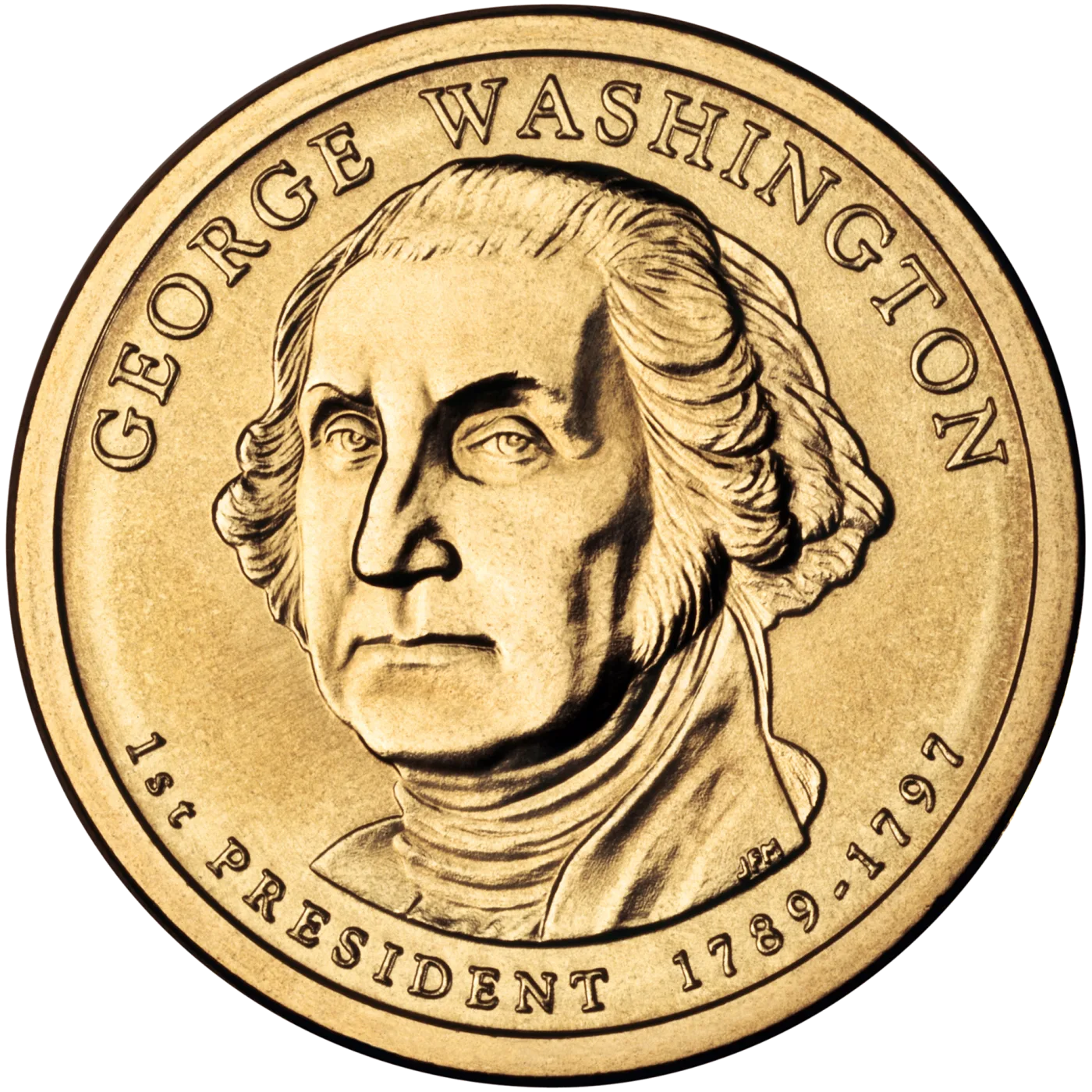
Each obverse carries a portrait of one president, facing left or right depending on the design, with the president’s name arched around the rim. Below or beside the portrait appear the order of the presidency (e.g., “1st PRESIDENT”) and the years of his term (e.g., “1789-1797”). The obverses were designed by various Mint sculptors and artists from the Artistic Infusion Program; Washington’s portrait, for example, was designed by Joseph Menna after the famous Houdon bust. Crucially, the obverse carries no date and no mint mark — those moved to the edge.
Reverse (Tails Side)
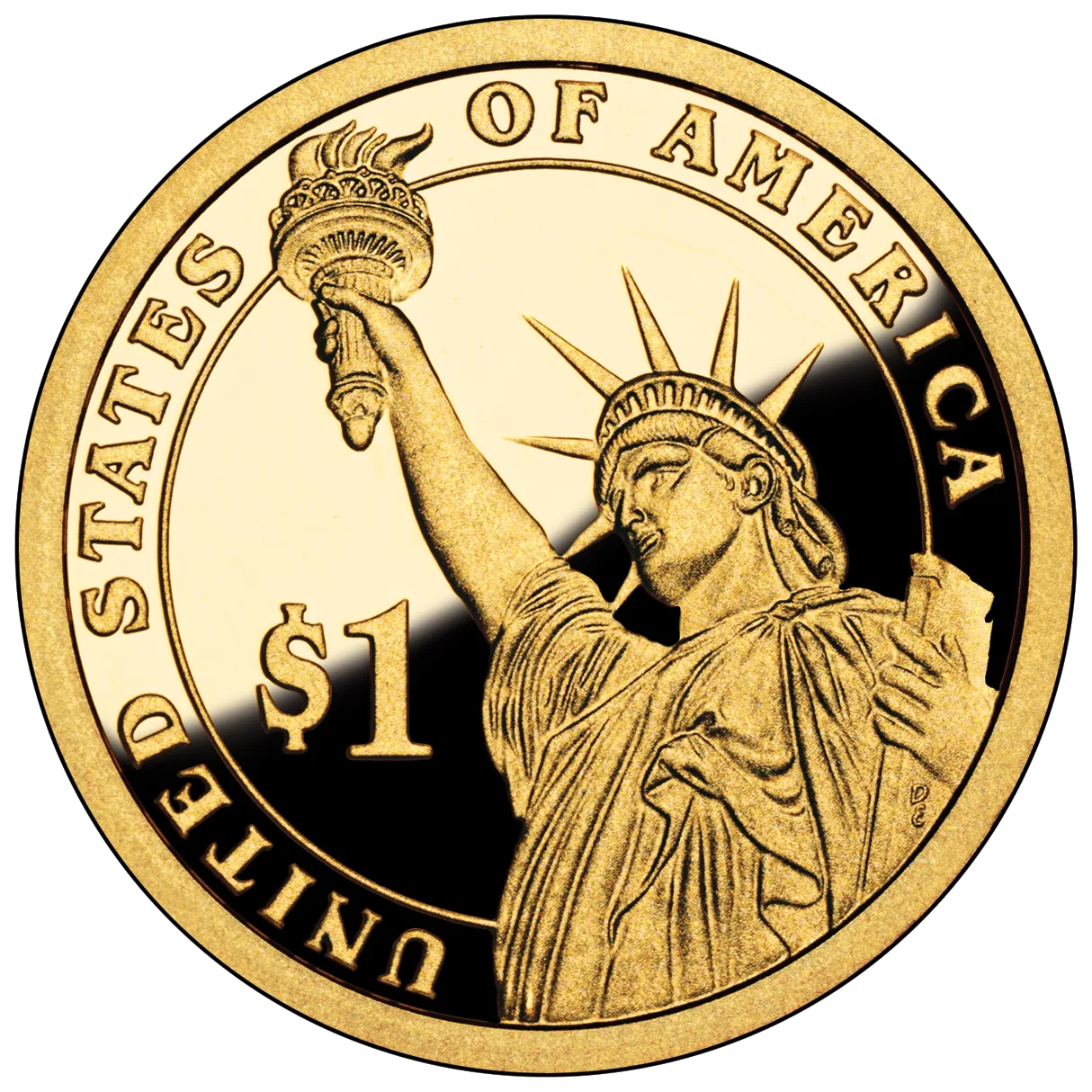
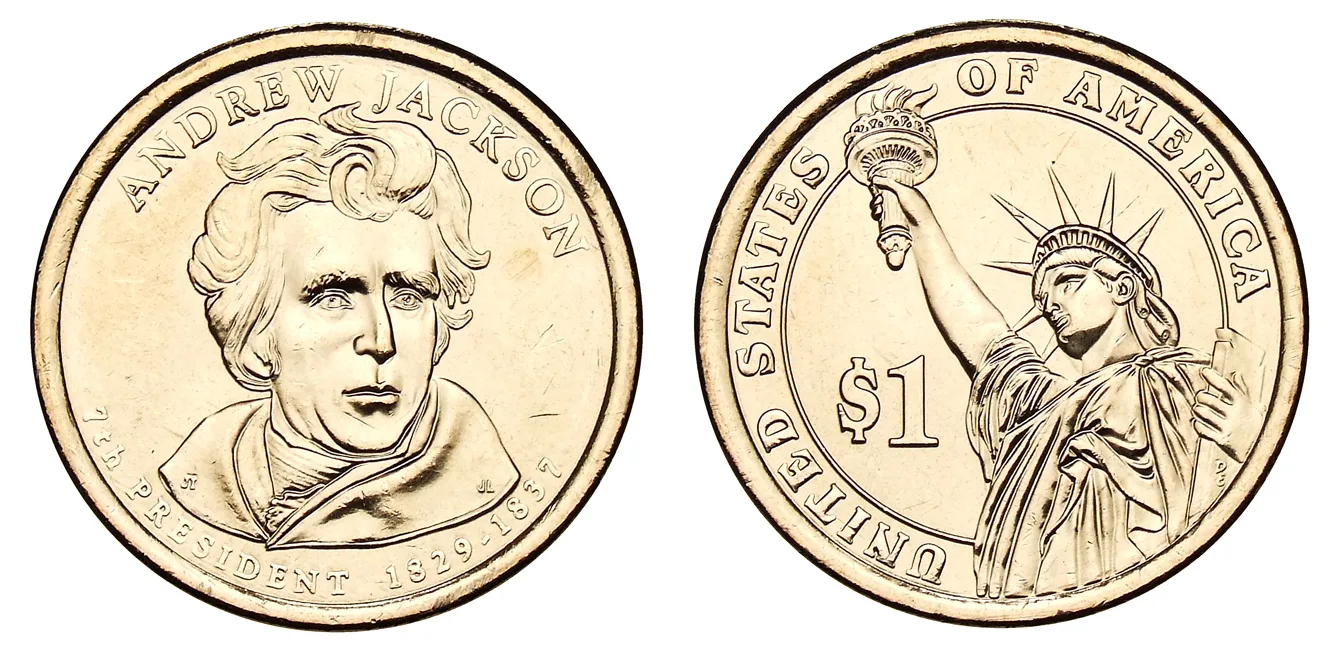
Every Presidential Dollar from 2007 to 2016, plus the 2020 Bush coin, shares the same reverse: a dramatic rendering of the Statue of Liberty designed by Mint sculptor-engraver Don Everhart. The legends UNITED STATES OF AMERICA and the denomination $1 appear on the reverse. Because the reverse never changes, you cannot identify which president a coin honors from the tails side — you must read the obverse name or, if worn, the order and term dates.
Edge
The edge carries the incused (sunken) inscriptions: the year of minting, the mint mark (P, D, or S), E PLURIBUS UNUM, and — from late 2007 onward — IN GOD WE TRUST. On the very first 2007 Washington coins, IN GOD WE TRUST was also on the edge, but a production error left some without it entirely (the “Godless dollar,” covered below). Starting in 2009, the Mint moved IN GOD WE TRUST from the edge back to the obverse to reduce the risk of it being omitted. This single design change explains why edge errors are concentrated in the 2007-2008 issues.
Designer Initials
Look for small initials near the truncation of the bust on the obverse and below the Statue of Liberty on the reverse (DE for Don Everhart). These help confirm authenticity and are useful diagnostic points under magnification, much as designer initials matter on the Eisenhower Dollar and Sacagawea series.
Composition and Specifications
Presidential Dollars use exactly the same manganese-brass-clad composition as the Sacagawea Dollar — they are physically interchangeable in vending machines and weigh the same. The coin looks golden but contains no gold whatsoever.
The Manganese Brass Alloy
- Composition: 88.5% copper, 6% zinc, 3.5% manganese, 2% nickel (outer clad layer).
- Core: Pure copper.
- Diameter: 26.5 mm.
- Thickness: 2.00 mm.
- Weight: 8.1 grams.
- Edge: Incused lettering (year, mint mark, E PLURIBUS UNUM, and on 2007-2008 issues IN GOD WE TRUST).
Why It Looks Gold But Isn’t
The manganese-brass outer layer was engineered to give the coin a golden appearance distinct from the silvery clad of quarters and dimes. The coin contains no gold and almost no intrinsic metal value — its worth is entirely numismatic. Manganese darkens the brass to a richer golden tone and helps it tarnish to a coppery-rose patina rather than the green oxidation typical of plain brass.
Tarnishing Behavior
Like Sacagawea Dollars, Presidential Dollars darken and spot readily. Uncirculated coins stored in rolls develop carbon spots and patina within months to a few years. A perfectly bright coin claimed to be many years old has likely been cleaned or dipped. This tarnishing behavior is itself a useful authentication clue.
Complete List of Presidents and Release Years
The series ran in strict order of service. Use this list to confirm which year a given president’s coin was issued — a quick way to verify that a coin’s edge date matches its obverse portrait.
2007
- George Washington (1st)
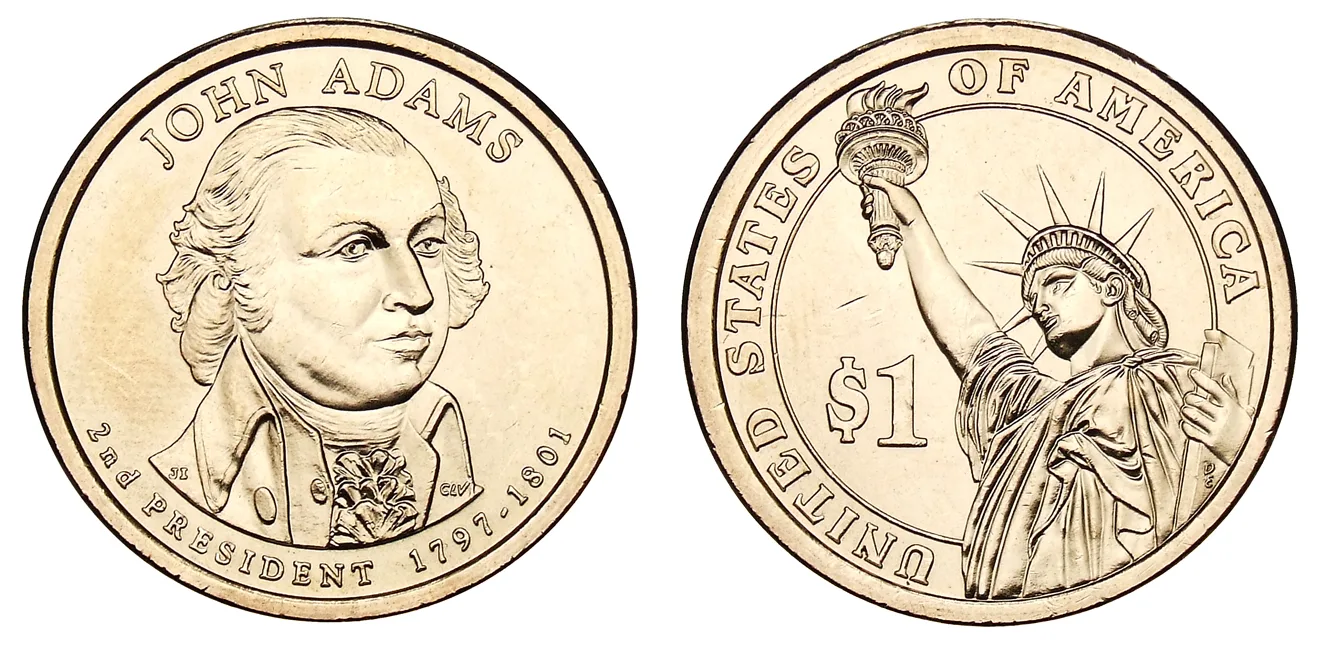
- John Adams (2nd)
- Thomas Jefferson (3rd)
- James Madison (4th)
2008
- James Monroe (5th)
- John Quincy Adams (6th)
- Andrew Jackson (7th)
- Martin Van Buren (8th)
2009
- William Henry Harrison (9th)
- John Tyler (10th)
- James K. Polk (11th)
- Zachary Taylor (12th)
2010
- Millard Fillmore (13th)
- Franklin Pierce (14th)
- James Buchanan (15th)
- Abraham Lincoln (16th)
2011
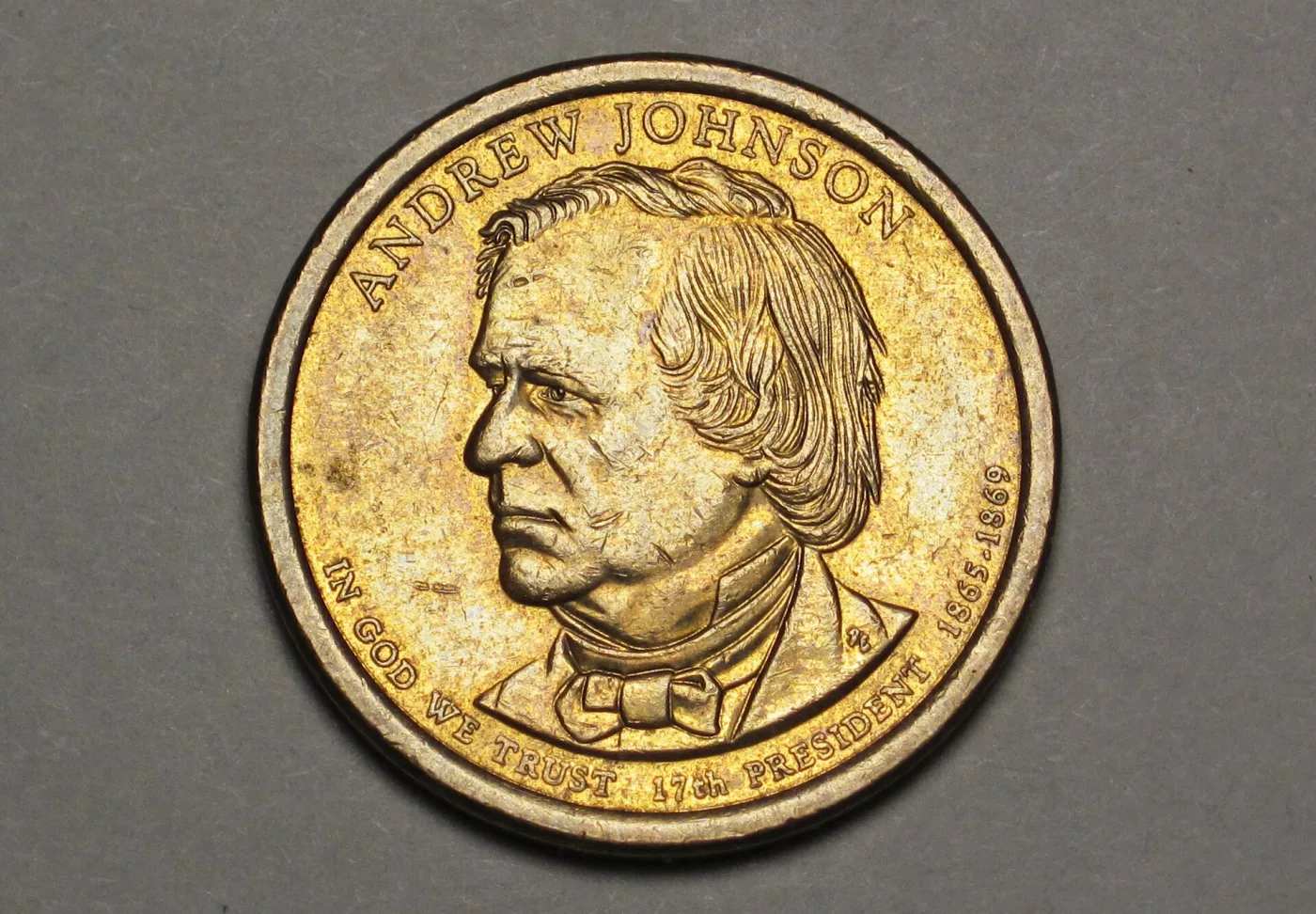
- Andrew Johnson (17th)
- Ulysses S. Grant (18th)
- Rutherford B. Hayes (19th)
- James A. Garfield (20th)
2012
- Chester A. Arthur (21st)
- Grover Cleveland, first term (22nd)
- Benjamin Harrison (23rd)
- Grover Cleveland, second term (24th)
2013
- William McKinley (25th)
- Theodore Roosevelt (26th)
- William Howard Taft (27th)
- Woodrow Wilson (28th)
2014
- Warren G. Harding (29th)
- Calvin Coolidge (30th)
- Herbert Hoover (31st)
- Franklin D. Roosevelt (32nd)
2015
- Harry S. Truman (33rd)
- Dwight D. Eisenhower (34th)
- John F. Kennedy (35th)
- Lyndon B. Johnson (36th)
2016
- Richard M. Nixon (37th)
- Gerald R. Ford (38th)
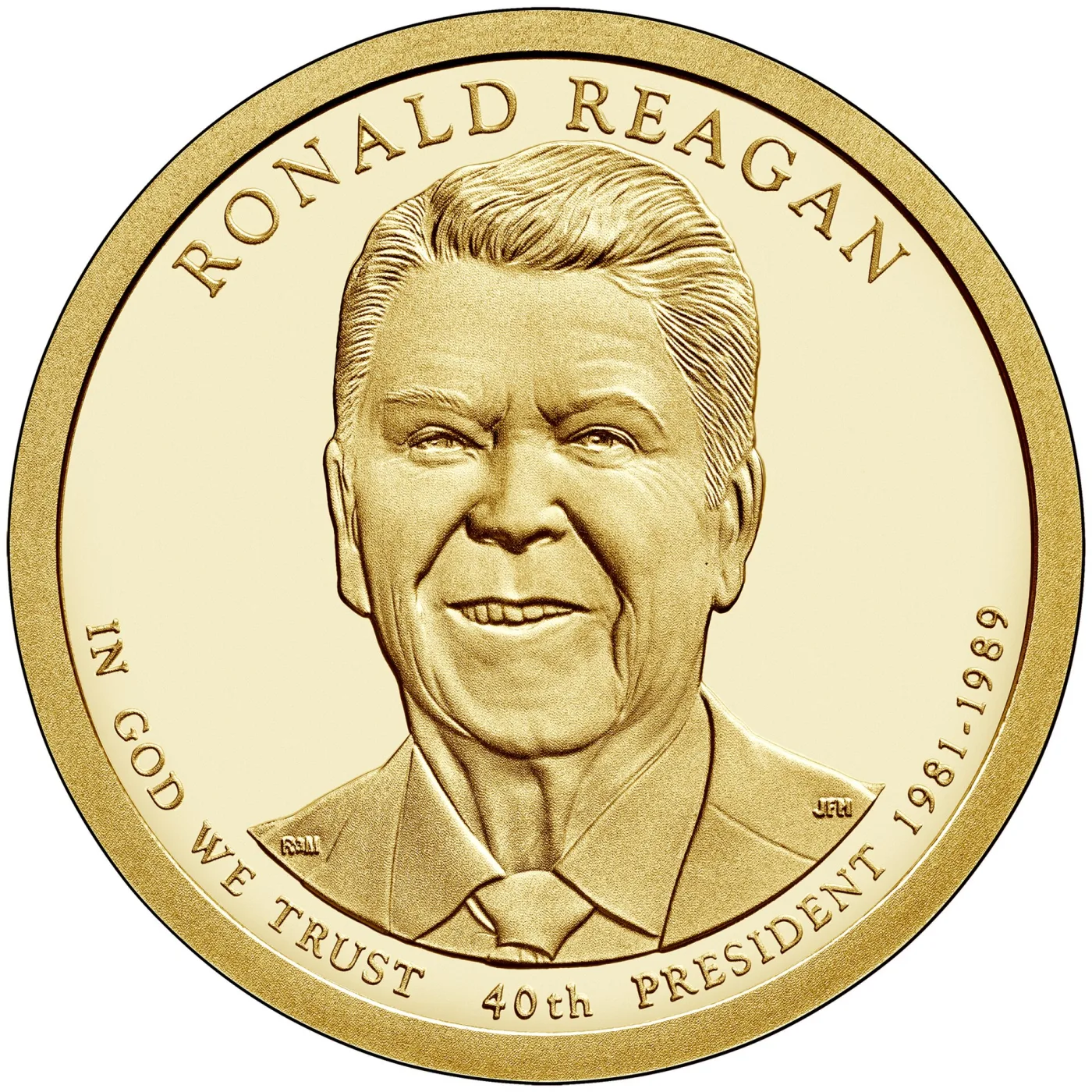
- Ronald Reagan (40th)
2020
- George H.W. Bush (41st) — final coin in the series, struck for collectors.
Note that Jimmy Carter (39th) was alive throughout the program and so received no coin, which is why 2016 jumps from Ford (38th) to Reagan (40th). Likewise no coins exist for the 42nd president onward within this series.

Understanding the Edge Lettering
The edge of a Presidential Dollar is where the most important identification and error information lives. Reading it correctly is the single most useful skill for this series.
What the Edge Says
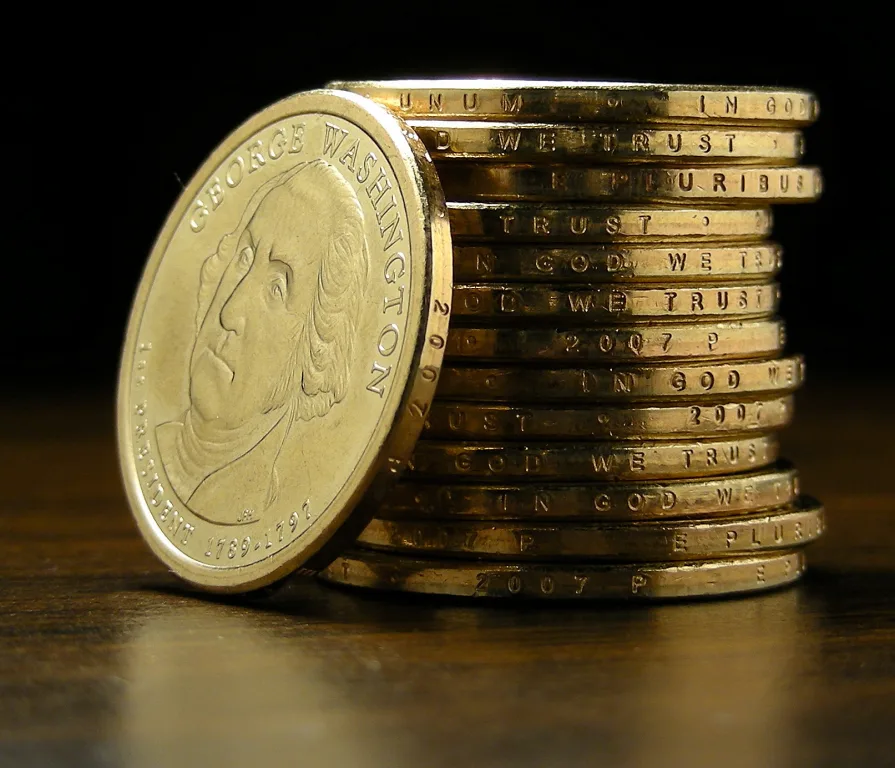
A normal Presidential Dollar edge carries, in incused letters: the four-digit year, the mint mark (P or D for business strikes, S for proofs), E PLURIBUS UNUM, and — on 2007 and 2008 coins only — IN GOD WE TRUST. From 2009 onward, IN GOD WE TRUST was moved to the obverse, so 2009-and-later edges read only the date, mint mark, and E PLURIBUS UNUM.
How the Edge Lettering Is Applied
Unlike older reeded-edge coins where the edge is formed during striking by a collar, the Presidential Dollar’s edge lettering is applied after striking, in a separate edge-lettering machine. Finished blank-edged coins are fed through a machine that rolls the inscription into the edge. Because this is a second, independent operation, coins can skip it (producing a plain edge), pass through twice (doubled lettering), or be fed in upside down relative to the obverse (inverted lettering). This post-strike process is the root cause of nearly every famous Presidential Dollar error.
Edge Orientation Is Random
Because the edge lettering is applied separately, the orientation of the edge text relative to the obverse portrait is random — about half of all coins read “right side up” and half “upside down” when the portrait faces you. This is normal and is not an error. Only a true inversion combined with other diagnostics, or a missing/doubled inscription, has premium value.
Mint Marks and Where to Find Them
Presidential Dollars were struck at three mints, and the mint mark is always on the edge — never on the obverse or reverse. This trips up many new collectors who look in vain at the faces of the coin.
Mint Mark Locations
- Philadelphia (P): Business strikes 2007-2016 and the 2020 issue. Edge mark.
- Denver (D): Business strikes 2007-2016 and the 2020 issue. Edge mark.
- San Francisco (S): Proofs only, found in annual Proof Sets. Edge mark. San Francisco also struck special collector issues for the 2020 Bush coin.
Reading the Mint Mark
To find the mint mark, hold the coin by its faces and read the edge. The mint mark sits immediately after the four-digit year. Rotate the coin slowly under a good light — the incused letters can be hard to see, especially on toned coins. A loupe helps. Remember that orientation is random, so you may need to flip the coin to read the edge comfortably.
Why Both P and D Are Common
For the 2007-2011 circulation years, both Philadelphia and Denver struck the coins in the hundreds of millions per design, so neither mint mark carries a premium for common dates. From 2012 onward, the collector-only mintages are far lower (typically 1-2 million per mint per design), which gives every 2012-2016 and 2020 coin a small premium over face value.
The 2007 “Godless Dollar” Error
The most famous Presidential Dollar error — and the one that made national news — is the so-called “Godless dollar”: a 2007 coin that left the Mint with no IN GOD WE TRUST inscription at all because it skipped the edge-lettering step entirely.
How It Happened
On the first 2007 Washington coins, all the inscriptions — year, mint mark, E PLURIBUS UNUM, and IN GOD WE TRUST — were on the edge. When a coin missed the edge-lettering station, it came out completely blank-edged, which meant it had no motto, no date, and no mint mark. The press picked up the story under the catchy “In God We Trust missing” headline, and the nickname stuck. Estimates run to tens of thousands of these coins escaping into circulation, primarily 2007 Washington pieces, with smaller numbers of the other 2007 presidents.
How to Identify a Godless Dollar
Look at the edge. A genuine plain-edge 2007 dollar has a completely smooth, blank edge — no year, no mint mark, no E PLURIBUS UNUM, and no IN GOD WE TRUST. It must be a 2007 design (Washington, Adams, Jefferson, or Madison). The edge must be original: crisp, with no file marks, scratches, or evidence of metal having been removed. The diameter and weight must match a normal coin (26.5 mm, 8.1 g).
Values
Despite the fame, Godless dollars are common enough that prices are modest. A genuine plain-edge 2007 Washington in uncirculated grade typically sells for $25-$75; the scarcer Adams, Jefferson, and Madison plain-edge coins bring more, often $100-$300. Certified examples (PCGS, NGC) command stronger and safer prices than raw coins, because filed-smooth fakes are common. Do not expect retirement money — the “missing motto” headline made these famous, but tens of thousands exist.
A Word on Terminology
Technically, the “Godless dollar” is simply a missing-edge-lettering error that happens to fall in the brief window when IN GOD WE TRUST was on the edge. After 2009, a plain-edge coin is missing the date, mint mark, and E PLURIBUS UNUM, but IN GOD WE TRUST is safely on the obverse — so later plain-edge coins are still errors, just not “Godless.”
Plain Edge (Missing Edge Lettering) Errors
The plain-edge error is the broadest and most collected Presidential Dollar error category. It occurs whenever a struck coin bypasses the edge-lettering machine.
Identification
A plain-edge error has a totally smooth edge with no inscriptions whatsoever. To confirm it is genuine and not a filed coin, examine the edge under magnification: an authentic missing-edge coin shows the natural, slightly rounded edge created during striking, with no tool marks, no flattened lettering remnants, and no disturbance of the metal flow lines. The faces (obverse and reverse) must be normal and fully struck.
Plain Edge by Year
- 2007 plain edge (Godless): Missing date, mint mark, E PLURIBUS UNUM, and IN GOD WE TRUST. Most famous; $25-$300 by president and grade.
- 2008 plain edge: Also missing IN GOD WE TRUST (still on edge in 2008). Scarcer than 2007; $50-$200.
- 2009 and later plain edge: Missing only date, mint mark, and E PLURIBUS UNUM (IN GOD WE TRUST is on the obverse). Generally $20-$100 depending on design and grade.
Why Plain-Edge Coins Are Easy to Fake
Because the “error” is simply the absence of edge lettering, dishonest sellers file or sand the edge of an ordinary coin to remove the inscription, then sell it as a missing-edge error. This is the single most important authentication issue in the series, so the next section on doubled lettering and the authentication section both return to it. For any plain-edge coin above a few dollars, insist on third-party certification.
Doubled and Inverted Edge Lettering
Beyond the missing-edge errors, the edge-lettering machine produces two other notable error types: doubled lettering and (in specific circumstances) inverted lettering.
Doubled Edge Lettering
If a coin passes through the edge-lettering machine twice, it receives two overlapping sets of inscriptions. The result is a doubled or overlapping edge legend — sometimes neatly offset, sometimes jumbled. Identification requires careful edge examination under magnification, ideally rotating the coin fully to confirm the inscription repeats. Values typically run $30-$150 depending on how dramatic and clear the doubling is, and whether it is certified.
Overlapped / Partial Edge Lettering
A milder version shows part of the inscription doubled while the rest is single — for example, the date appears twice but E PLURIBUS UNUM only once. These transitional cases are more common and less valuable, often $15-$40.
Inverted Edge Lettering — The Important Caveat
Here is where many collectors are misled. Because edge lettering is applied after striking, the orientation of the edge text relative to the obverse is random by design. Roughly half of all Presidential Dollars have edge lettering that reads “upside down” relative to the portrait. This is normal and carries no premium. Sellers who advertise an “inverted lettering error” for a coin that is simply showing the common upside-down orientation are either mistaken or dishonest. A genuinely collectible inverted-lettering variety requires specific die-pairing diagnostics that go beyond mere orientation, and such pieces are rare and best left to specialists with certified examples.
Weak or Missing Lettering Segments
Partial edge lettering, where some characters are weak, light, or missing while others are full, is common and generally low-value ($5-$25). It results from uneven pressure in the edge-lettering machine and is not the same as a fully missing (plain) edge.
Other Notable Errors and Mules
Presidential Dollars share the standard repertoire of US mint errors, plus a few that are specific to the golden-dollar platform. Many of these overlap with the error types catalogued in our error coins and mint errors guide.
Missing Clad Layer
If the manganese-brass clad layer fails to bond or peels away, the underlying copper core shows through, giving the coin a distinctly reddish-copper appearance on one or both faces. These “missing clad layer” coins are dramatic and collectible, typically $50-$200.
Wrong Planchet and Off-Metal Strikes
Because the dollar shares press lines with quarters and the Sacagawea/Native American dollar, occasional wrong-planchet strikes occur — a Presidential Dollar design struck on a quarter planchet, or a dollar design struck on a planchet intended for another denomination. These are scarce and valuable ($200-$1,000+) and must be certified, since weight and diameter are the diagnostic evidence.
Lettered-Edge Mules
The shared edge-lettering machines occasionally cross series. A coin can in principle receive Native American $1 edge lettering on a Presidential Dollar (or vice versa), or carry mismatched edge content. Such mules are rare, specialized, and command strong premiums when authenticated — comparable in spirit to the famous Sacagawea/Washington Quarter mule covered in our Sacagawea guide, though far less valuable.
Standard Striking Errors
Off-center strikes, broadstrikes (struck without the collar), double strikes, die cracks, cuds, and struck-through errors all occur on Presidential Dollars and are valued like their counterparts on other modern coins. A dramatic off-center Presidential Dollar showing a full presidential portrait offset to one side is a popular and affordable error, often $20-$100.
Satin Finish Issues (2007-2010)
From 2007 to 2010, the Mint included Presidential Dollars in its Annual Uncirculated Coin Sets with a special satin (matte) finish distinct from both circulation strikes and proofs. These satin-finish coins are a legitimate collectible sub-type — not an error — and are identified by their soft, even luster and their origin in the Mint’s Uncirculated Sets. They typically sell for a few dollars each.
The First Spouse Gold Companion Series
Running alongside the dollars, the First Spouse Gold Coin program (2007-2016, plus 2020) honored the spouses of the presidents featured each year. Though not dollar coins themselves, they are part of the same legislative program and frequently come up when collectors research Presidential Dollars.
Specifications
- Metal: 99.99% pure gold (24-karat).
- Weight: One-half troy ounce of gold.
- Denomination: $10 (face value), though intrinsic gold value is vastly higher.
- Formats: Proof and Uncirculated, sold directly by the Mint.
Designs Without a First Spouse
Several presidents had no spouse serving during their term — Thomas Jefferson (widower), Andrew Jackson (widower), Martin Van Buren (widower), James Buchanan (lifelong bachelor), and Chester A. Arthur (widower). For these, the Mint issued First Spouse coins bearing an emblematic Liberty design drawn from circulating coinage of that president’s era rather than a portrait. The James Buchanan issue, for instance, depicts a Liberty design based on coinage of his period.
Values
First Spouse gold coins trade primarily on their gold content (half an ounce) plus a numismatic premium. Mintages were low — often just a few thousand for many issues — so some scarce dates carry significant collector premiums above melt. Because they are real gold, authentication and weight verification matter; treat them like the bullion-grade pieces discussed in our American Gold Eagle guide.
Key Dates and Best Issues to Keep
Presidential Dollars have no traditional rarities — no single date is genuinely scarce — but a clear hierarchy of desirability exists based on circulation status and errors.
Most Valuable: The Errors
- 2007 plain-edge (Godless) Adams, Jefferson, Madison: $100-$300+ by grade.
- Wrong-planchet and off-metal strikes: $200-$1,000+.
- Lettered-edge mules: Specialized; strong premiums when certified.
- Missing clad layer: $50-$200.
- 2007 plain-edge Washington: $25-$75 (most common error).
Best Conventional Issues
- 2012-2016 P and D issues: Collector-only releases with mintages around 1-2 million per mint. Uncirculated singles run $2-$6; the lowest-mintage designs (several 2012 issues) bring slightly more.
- 2020-P, 2020-D, 2020-S George H.W. Bush: The series’ final coin, struck only for collectors. Singles run $3-$8; the reverse-proof and other special 2020 formats command more.
- Proof issues (S mint): $4-$15 each in PR-69/PR-70.
The 2012 Low-Mintage Story
2012 was the first collector-only year, and several 2012 designs (Arthur, both Clevelands, Benjamin Harrison) have the lowest mintages in the series. While not rare, these are the closest the series comes to “key dates” and are worth setting aside in high grade. Compare this to how a single low-mintage year can anchor a whole series, as the 1916 issue does in our Standing Liberty Quarter guide.
Grading Presidential Dollars
Like all modern US coins, Presidential Dollars are graded on the 70-point Sheldon scale but in practice occupy only the upper range, since most surviving coins are mint-state. The grading principles parallel those in our general coin grading guide.
Key Grade Points
- MS-60 to MS-62: Uncirculated but with noticeable bag marks, contact marks, or fingerprints. Many circulated-era 2007-2011 coins fall here.
- MS-63 to MS-64: Cleaner surfaces, modest marks. Typical roll-grade quality.
- MS-65 to MS-66: The “gem” range. Few contact marks, full luster, minimal spotting.
- MS-67 to MS-68: Top-quality coins. Where collector premiums concentrate for common dates.
- MS-69 to MS-70 / PR-69 to PR-70: Essentially perfect coins, more common among proofs and satin-finish issues than business strikes.
The Spot Problem
As with Sacagawea Dollars, manganese-brass carbon spots are the grade-killer. A spot on the president’s cheek or in a prime focal area can pull a coin from MS-67 down to MS-64. When buying certified coins, examine high-resolution images for spots; when storing your own, control humidity (see the storage section).
Strike and Edge Considerations
Look for full detail in the president’s hair and facial features and in the Statue of Liberty’s torch and crown on the reverse. For this series uniquely, the edge is part of the grade conversation: a strong, full, well-centered edge inscription is preferred, and graders note weak or partial edge lettering.
Authentication and Spotting Fakes
Most Presidential Dollars are too low in value to counterfeit outright, but the error premiums attract a specific kind of fakery: altered edges. Knowing what to check protects you from the most common scams.
Filed-Smooth “Plain Edge” Fakes
The number-one fraud is filing or sanding the edge of an ordinary coin to remove the lettering, then selling it as a missing-edge (Godless) error. Authentic missing-edge coins have a natural, original edge with intact metal-flow lines and no tool marks. A filed edge shows abrasion, flat spots, a slightly reduced diameter, or remnants of the original lettering. Always weigh the coin (filing removes metal, dropping it below 8.1 g) and examine the edge under magnification. For any valuable plain-edge coin, demand PCGS or NGC certification.
Gold-Plated Coins
Some sellers offer “gold Presidential Dollars” that are ordinary manganese-brass coins privately gold-plated. The Mint never issued the circulating Presidential Dollar in gold (only the separate First Spouse program was gold). A plated coin weighs the normal 8.1 g; real gold would be far heavier, and the plating wears at high points. These have novelty value only, not numismatic value.
Colorized and “Enhanced” Coins
Privately colorized Presidential Dollars (painted or with applied images) are altered novelty items, not Mint products, and carry no numismatic premium regardless of seller claims. The same applies to coins set in jewelry or with applied holograms.
The Magnet Test
Genuine manganese-brass Presidential Dollars are non-magnetic. A coin that sticks to a magnet is not authentic. This simple test, combined with the weight check, quickly screens many fakes — the same approach used to screen modern copies of the 1943 copper Lincoln cent, where weight and magnetism are decisive.
Verifying Edge Date Against Portrait
Always confirm the edge year matches the president on the obverse using the release-year list above. A 2009 edge date on a Washington (a 2007 design) would indicate a fantasy or altered piece. Genuine coins always pair the correct president with the correct year.
Current Market Values and Price Guide
These are approximate 2026 retail values for problem-free coins. Raw coins generally trade at 50-75% of certified prices. Common circulated coins are worth face value.
Circulation-Era Business Strikes (2007-2011)
- Circulated P or D: Face value ($1).
- Uncirculated (MS-65) P or D: $2-$4.
- MS-67: $10-$30 for most designs.
Collector-Only Business Strikes (2012-2016, 2020)
- Uncirculated (MS-65) P or D: $2-$6.
- MS-67: $15-$50, more for the lowest-mintage 2012 designs.
- 2020 Bush special formats: Reverse proof and S-mint issues, $10-$40.
Proof and Satin Issues
- S-mint proofs (PR-69/PR-70): $4-$15 each.
- 2007-2010 satin-finish (Uncirculated Set) coins: $2-$8 each.
Major Errors
- 2007 plain-edge Washington (Godless): $25-$75.
- 2007 plain-edge Adams/Jefferson/Madison: $100-$300.
- 2008-and-later plain edge: $20-$200.
- Doubled edge lettering: $30-$150.
- Missing clad layer: $50-$200.
- Wrong planchet / off-metal: $200-$1,000+.
Bullion Floor
None for the circulating dollars — manganese-brass has negligible metal value. The First Spouse gold coins are the exception, trading on half an ounce of pure gold plus numismatic premium.
Building a Presidential Dollar Collection
The Presidential Dollar series is one of the most beginner-friendly in all of US numismatics: complete, affordable, and recently issued, with a clear roster of exactly 39 designs.
Approach Strategies
- Type Set: One of any president, plus one each of the major error types. Cheapest entry point.
- Complete Date Set (P or D): All 39 designs from one mint. Achievable for well under $100 in circulated grade.
- Complete P and D Set: Both mints for all 39 designs (78 coins). Still affordable; the workhorse goal for most collectors.
- Proof Set: All S-mint proofs. Sold by the Mint in annual sets; easy to assemble.
- Error Specialty: Godless dollars, plain edges, doubled edges, and clad-layer errors. The exciting frontier, and where condition and certification matter most.
- First Spouse Companion: For collectors with a gold budget, pairing each dollar with its First Spouse gold coin.
Where to Buy
Modern dollar coins are widely available from Heritage, Stack’s Bowers, GreatCollections, and eBay. Mint roll boxes and the original Uncirculated and Proof Sets are often the cheapest way to acquire many designs at once in high grade. For certified errors and high-grade gems, stick to PCGS or NGC slabs.
Set Registry Participation
PCGS and NGC both operate Presidential Dollar set registries. Because the series is complete and affordable, building a competitive high-grade registry set (MS-67/MS-68) is achievable on a modest budget — a stark contrast to classic series like the Morgan Dollar, where top sets require serious investment.
Storage and Preservation
Manganese-brass is uniquely prone to spotting, so careful storage matters more for Presidential Dollars than for many other modern coins.
Best Practices
- Sealed inert holders: PCGS, NGC, or Mylar 2x2 flips. Avoid soft PVC flips, which off-gas and damage surfaces.
- Low humidity: Below 50% relative humidity. Use silica gel packets and replace them annually.
- Stable temperature: 60-70°F. Avoid attics, basements, and garages.
- Handle by the edge: Never touch the faces with bare fingers — though for this series, even edge handling should be careful to preserve edge lettering on uncertified coins. Wear cotton gloves for valuable pieces.
- Do not clean: Once a coin has toned or spotted, cleaning almost always destroys numismatic value. Original surfaces, even with patina, are worth more than “improved” ones.
The Sealed-Pack Strategy
Many collectors keep Mint-issue Presidential Dollars in their original sealed government packaging (Proof Sets, Uncirculated Sets, and roll boxes). The packaging provides adequate protection for routine storage, and the moment you open it, the patina clock starts. For coins you intend to hold long-term, leaving them sealed is often the best preservation choice.
Frequently Asked Questions
Are Presidential Dollars made of gold?
No. The golden color comes from a manganese-brass clad layer (88.5% copper, 6% zinc, 3.5% manganese, 2% nickel) over a pure copper core. The circulating Presidential Dollar contains no gold. Only the separate First Spouse program issued actual gold coins.
What is a Godless dollar and is it valuable?
A "Godless dollar" is a 2007 Presidential Dollar that missed the edge-lettering step and so has no IN GOD WE TRUST (and no date or mint mark) on its blank edge. The 2007 Washington version is common and worth $25-$75; the scarcer Adams, Jefferson, and Madison versions bring $100-$300. Beware filed-edge fakes — certified examples are safest.
Why is the date on the edge instead of the front?
To keep the obverse and reverse free for the presidential portrait and the Statue of Liberty, the Mint moved the year, mint mark, and mottoes to the edge using a post-strike edge-lettering machine. This design choice is also what created the series' famous edge errors.
Is upside-down edge lettering an error?
No. Because the edge lettering is applied after striking, its orientation relative to the portrait is random — about half of all coins read upside down. This is completely normal and carries no premium. Only missing, doubled, or specifically diagnosed inverted-die lettering has value.
Which presidents are not in the series?
Any president who was still living during the program (most notably Jimmy Carter, the 39th president) received no coin, and presidents who died too late to qualify are absent. The series covers 39 presidents from Washington (1st) through Reagan (40th), plus a special 2020 coin for George H.W. Bush (41st). Carter's absence is why 2016 skips from Ford to Reagan.
Why did Grover Cleveland get two coins?
Cleveland served two non-consecutive terms and is counted as both the 22nd and the 24th president. The Mint honored each term with its own coin, both issued in 2012, with different term-date inscriptions.
Are Presidential Dollars still being made?
No. Circulation production ended in 2011, collector-only production ran through 2016, and a final commemorative coin for George H.W. Bush was issued in 2020. The series is complete at 39 presidents.
What is the rarest Presidential Dollar?
No regular issue is truly rare. The lowest mintages belong to several 2012 collector-only designs (Chester Arthur and the two Grover Cleveland coins). Among errors, wrong-planchet strikes and lettered-edge mules are the genuinely scarce and valuable pieces.
Should I clean my Presidential Dollar?
No. Manganese-brass patina is part of the coin's natural history, and cleaning removes original surfaces and almost always reduces value. If your coin has spotted or toned, leave it alone — collectors price patinated coins fairly.