Maria Theresa Thaler Dated 1780: Original or Restrike?
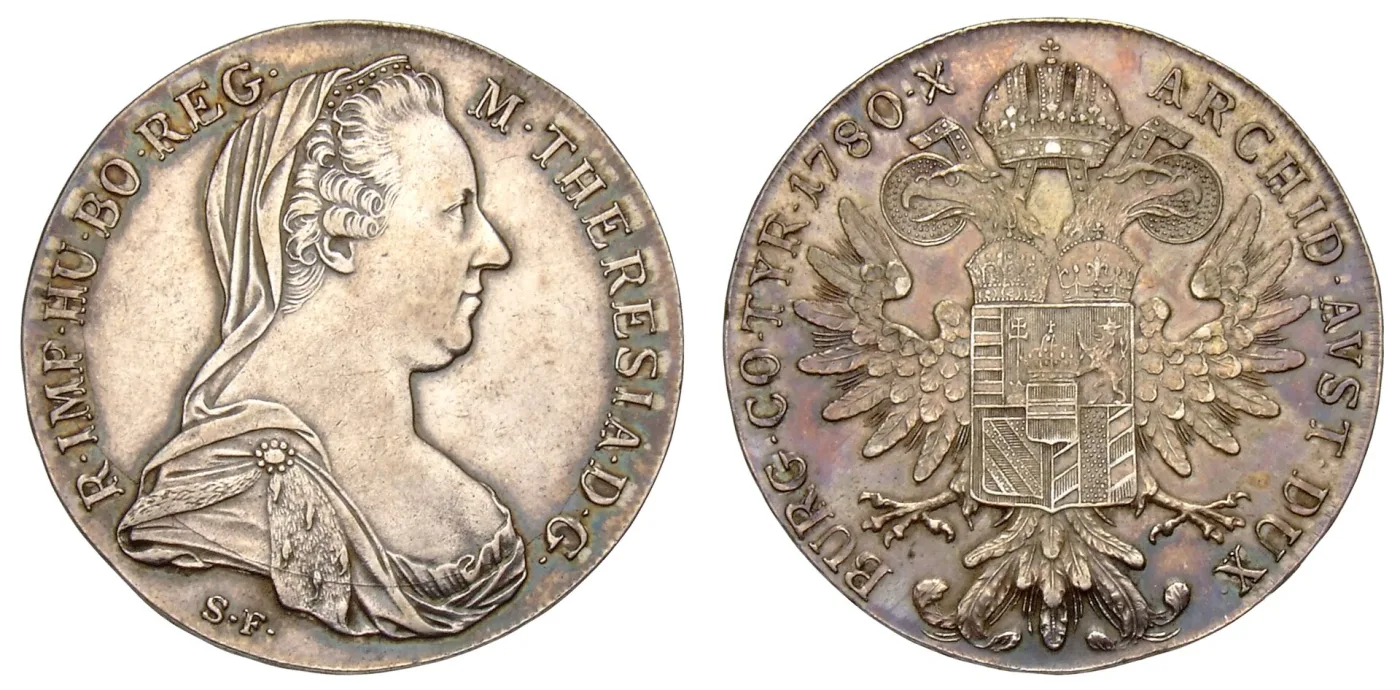
A large silver coin with a veiled woman on one side, a crowned double-headed eagle on the other, and the date 1780 is one of the most common old-looking coins to turn up in an inheritance, a souk or a jewellery box. It is a Maria Theresa thaler, and it is very probably not from 1780.
That is not because it is fake. After the empress died in 1780 the date on the coin was frozen, and mints kept striking it, with the same date, for nearly two centuries. The Austrian Mint still makes it. This guide covers how to read the coin, what the S.F. and the X mean, why the date cannot tell you its age, who struck it, the checks that a genuine one passes, and what it is worth.
What the Maria Theresa Thaler Is
The coin is named for Maria Theresa (1717–1780), who ruled Austria, Hungary and Bohemia from 1740 until her death. Her thaler was first struck in 1741. Since 1780, every newly struck Maria Theresa thaler has carried that year, whichever mint made it and whenever it was made.
The design outlived her because it was trusted in trade. It became a trade coin across the Arab world and Africa: in Yemen, Saudi Arabia and Oman, along the East African coast, and above all in Ethiopia, where it was still legal tender when Italy invaded in 1935. A coin found in any of those places, or brought home from one, is very likely to be one of these.
Nobody knows exactly how many were made. One count gives about 389 million struck between 1751 and 2000. Other estimates run as high as 400 to 800 million. Both put it among the most-struck silver coins in history, and that matters for value: a 1780 thaler is not scarce.
How to Read the Coin
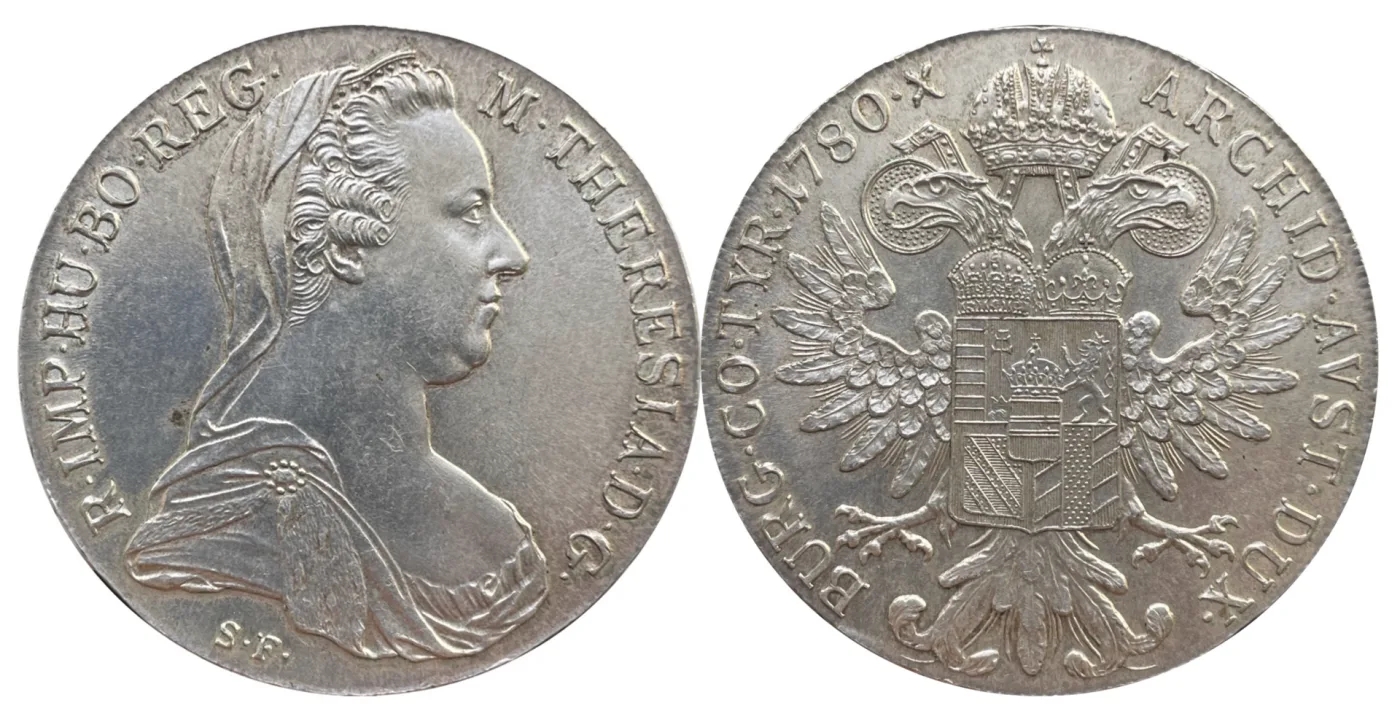
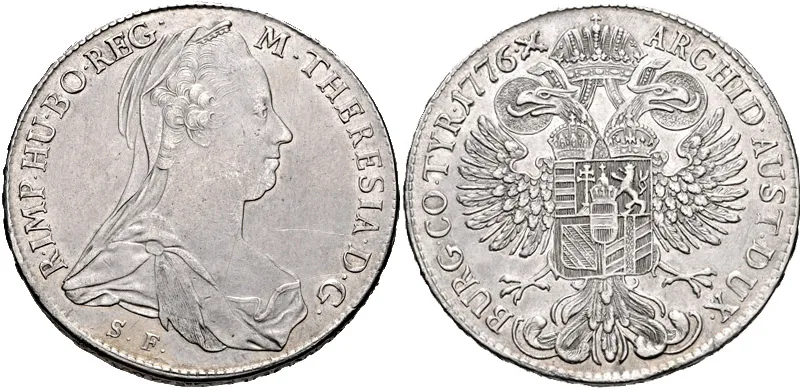
Every part of a 1780 Maria Theresa thaler is a Latin abbreviation, and together they spell out her titles.
| What you see | Where | What it means |
|---|---|---|
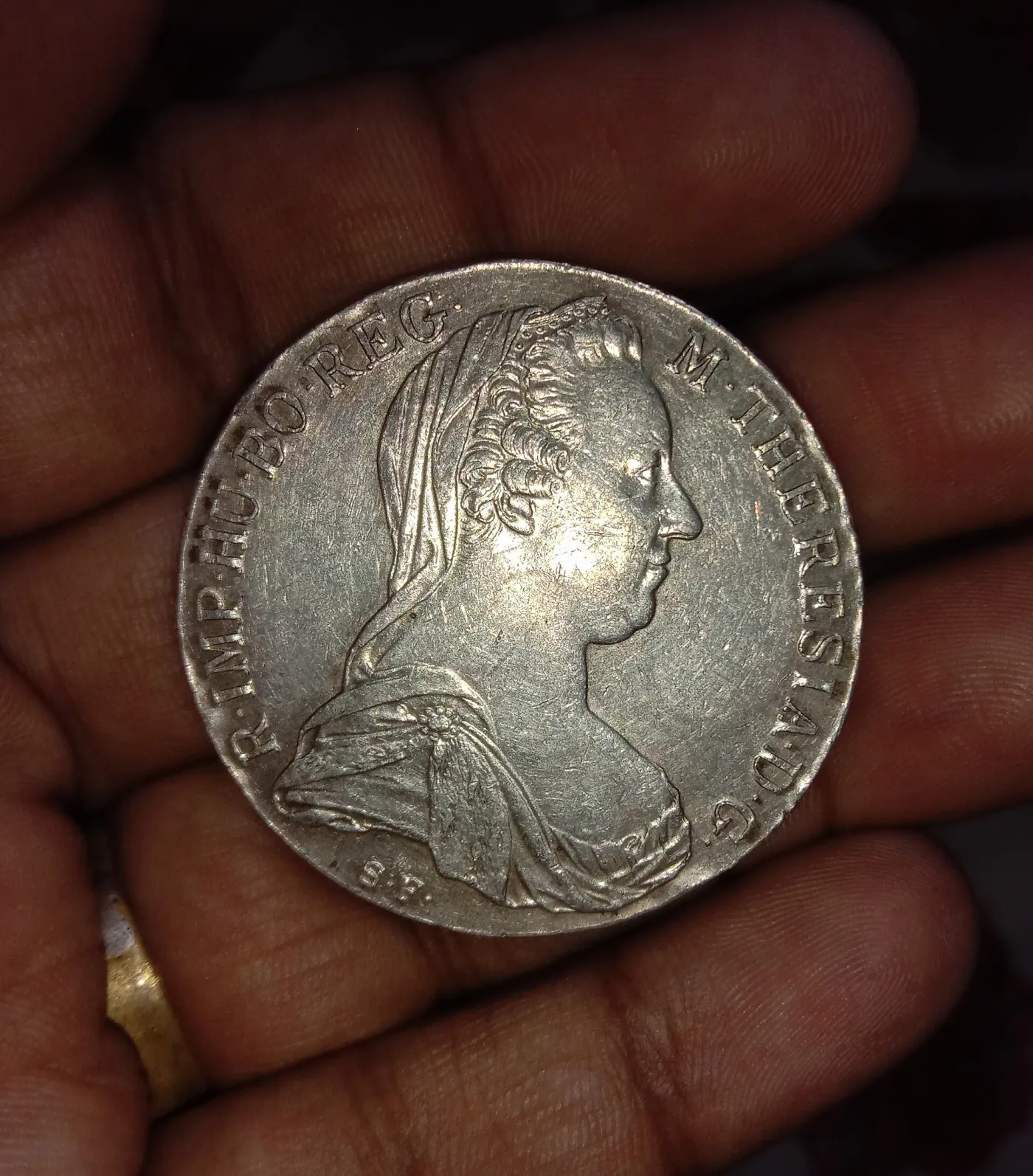
| M·THERESIA·D·G·R·IMP·HU·BO·REG | Obverse legend | Maria Theresa, by the grace of God, Empress of the Romans, Queen of Hungary and Bohemia |
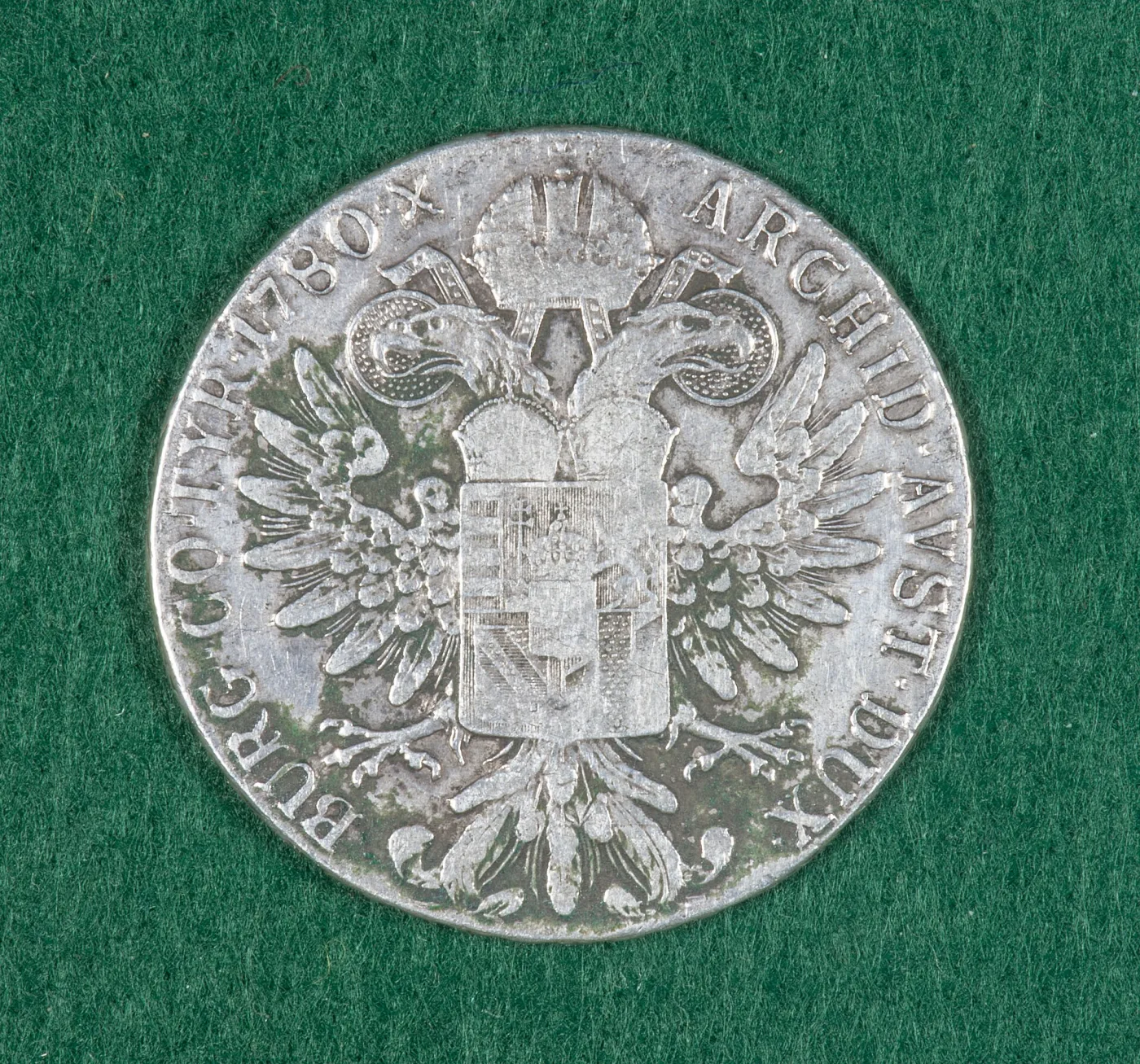
| ARCHID·AVST·DUX·BURG·CO·TYR | Reverse legend | Archduchess of Austria, Duchess of Burgundy, Countess of Tyrol |
| 1780 | Reverse, upper left | The year she died, frozen on the design ever since |
| X after the date | Reverse | A saltire, the Burgundian cross, marking the silver standard of the early 1750s |
| S.F. | Obverse, below the bust | Schöbl and Faby, officials of the Günzburg mint |
| IUSTITIA ET CLEMENTIA | Edge | "Justice and Clemency", the motto of her reign |
The X. It is not a Roman ten and not a mint mark. It is a heraldic saltire, added to mark the lighter standard the thaler was struck to from the early 1750s, when the coin became the Conventionsthaler. Sources date the change to 1750 or to 1753. Both put it in the early 1750s, which is all the X can tell you: the coin follows the post-reform standard, as every 1780-dated thaler does.
S.F. The letters stand for Tobias Schöbl, mint master, and Joseph Faby, mint warden, of the Habsburg mint at Günzburg. Their initials were the Günzburg signature on the 1780 coin, and the later strikes kept S.F. on the obverse whichever mint made them. On a 1780 thaler, then, S.F. is part of the design and does not mean the coin came from Günzburg.
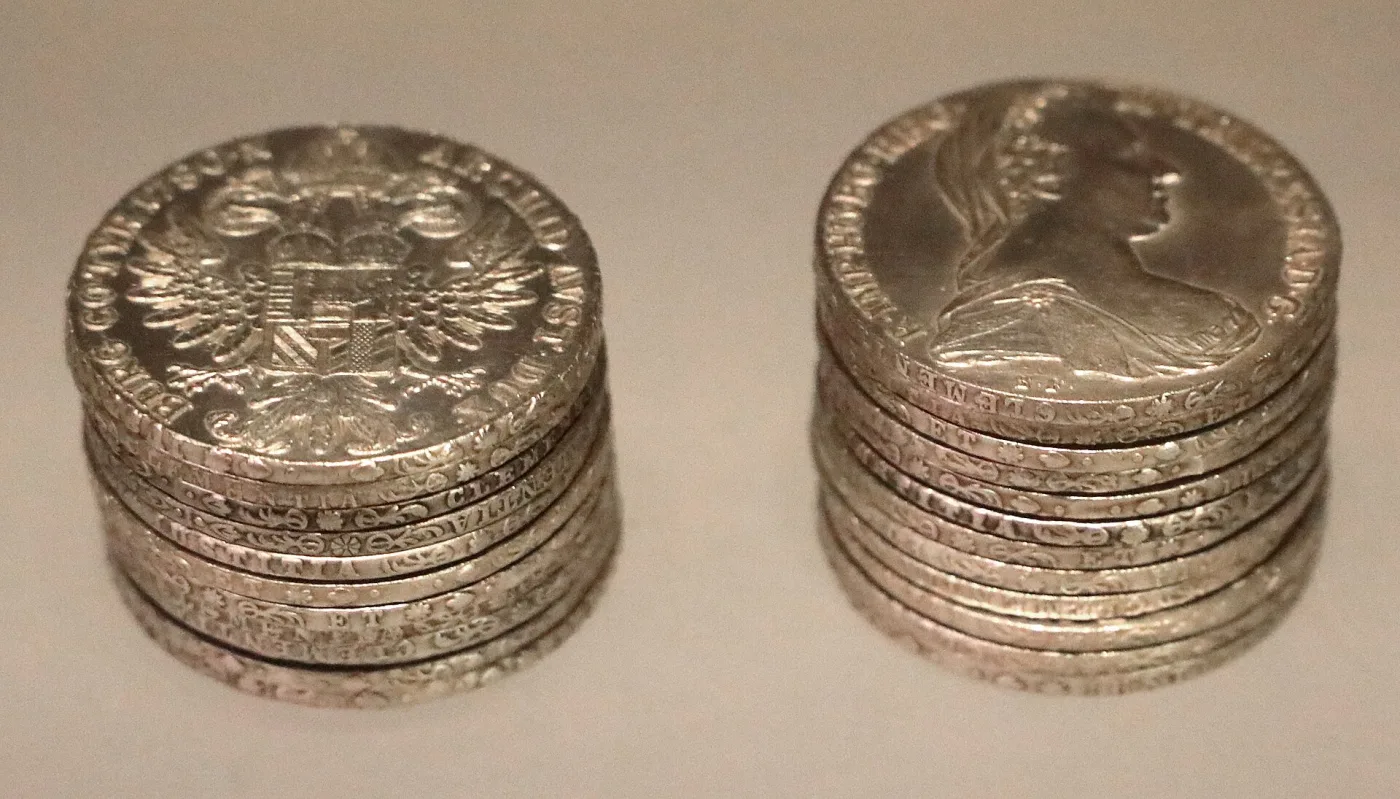
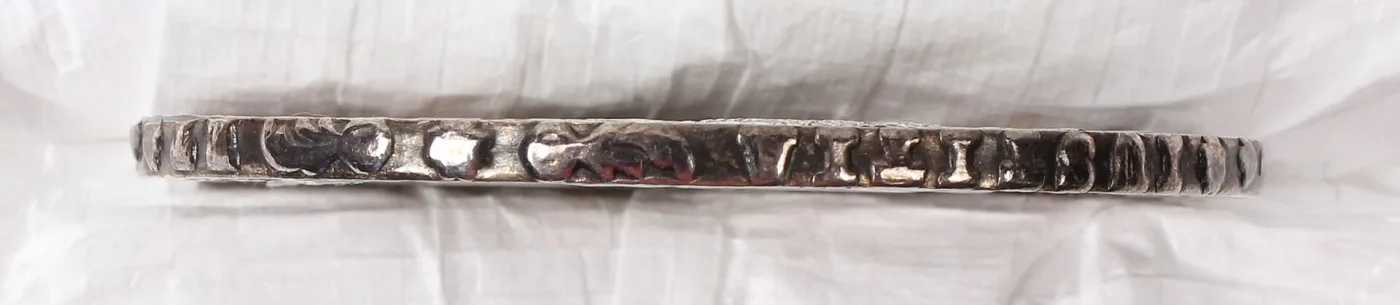
The edge. A genuine thaler has a raised, lettered edge reading IUSTITIA ET CLEMENTIA, with ornaments between the words. A plain or reeded edge on a coin of this design means it is not a regular strike.
Original or Restrike?
This is the question that brings most people to the coin, and the honest answer has two parts.
A thaler dated 1780 is almost always a restrike. The date was frozen at her death and production continued: at the Habsburg mints straight away, under concession abroad in the twentieth century, and at the Austrian Mint in Vienna to this day. Coins struck in 1780 itself also carry that date, and nothing as simple as a date or a letter separates them from the hundreds of millions that came after. The date does not do it, and neither do the S.F. initials, since later strikes kept them. Telling an early strike from a late one is specialist work, done die variety by die variety with dedicated references. A coin you believe is early belongs with a third-party grading service, not a guess. Our third-party grading guide covers how that works.
A thaler with any other date was struck during her reign. From 1741 until 1780 the coin carried the year it was struck, and only after her death did the date stop moving. A different date is the clearest sign that a coin is a lifetime piece.
So read the date first. If it says 1780, the coin is almost certainly a restrike, and its value is mostly its silver. If it says anything else, check the edge and the weight, then have it looked at properly.

Who Struck Them
The 1780 coin was struck far beyond Austria, which is why so many survive.
| Mint | When | Note |
|---|---|---|
| Vienna, Günzburg, Prague, Kremnica, Milan, Hall, Karlsburg | From 1780 on | The Habsburg mints. Vienna is the one still striking |
| Rome | From 1935 | A 25-year concession from Austria. About 19.5 million struck, 835 fine instead of 833 |
| London (Royal Mint) | From 1936 | Struck for the Africa and Arabia trade |
| Paris, Brussels, Utrecht, Bombay, Birmingham | 20th century, ended by 1962 | Struck under concession with little change to the design |
In Austria itself the coin had a separate legal history. On 19 September 1857 Emperor Franz Joseph made it an official trade coin, and from 31 October 1858 it was no longer currency in Austria. After that it was struck for export and for the silver trade, not for use at home.
The foreign strikes ended at Austria’s request when the Italian concession ran out. By 1962 they had stopped, and since then every new Maria Theresa thaler has come from Vienna. All of these mints used the same 1780 design with S.F. and the X, with only small differences between them. A Rome thaler is the one you can sometimes separate, since its silver is 835 fine rather than 833.
Weight, Size and Silver
A genuine thaler, from any of these mints, is a heavy coin with a precise weight. These are the figures to check against.
| Specification | Figure |
|---|---|
| Weight | 28.07 g (28.0668 g) |
| Fineness | 833 silver, the rest copper (Rome strikes: 835) |
| Pure silver | About 23.39 g, or 0.752 troy oz |
| Diameter | About 39.5 to 42 mm (sources differ; see below) |
| Thickness | About 2.5 mm |
| Edge | Lettered: IUSTITIA ET CLEMENTIA |
The weight figures agree across sources. Diameter does not: reference works give 39.5 to 41 mm, while the Austrian Mint’s own product page lists 42 mm and a museum record of a boxed 1780 thaler measures 42.2 mm. A ruler is a weaker test than a scale here. A coin within a few tenths of 40 mm is consistent with a genuine thaler. A coin that weighs well short of 28 grams, rings dull, or has a plain edge is not a regular strike and needs a closer look. The counterfeit detection guide walks through the weight, ring and magnet tests.
What a Maria Theresa Thaler Is Worth
For a 1780-dated coin, value starts with the silver. Multiply 0.752 by the day’s silver price per troy ounce, and that is the melt value. Dealers usually sell restrikes at a modest premium over melt, and the Austrian Mint lists new ones among its investment coins, alongside bullion. A coin worn smooth by circulation is still worth its silver, though wear removes a little metal.
A thaler with a date other than 1780 is a different matter. It was struck during her reign, it is far scarcer than the 1780 restrikes, and it is priced as a collector coin, by type and condition, not by weight. That is the coin worth having authenticated and graded.
Two things do not add value to a 1780 coin. One is the S.F., which every later strike carries. The other is a story about where it came from. A thaler from a grandparent’s trip to Aden or Addis Ababa is a lovely piece of family history, but it is still priced like its hundreds of millions of siblings. If you have a box of them, our guide to junk silver explains how coins are bought and sold for their metal.
Related Silver Trade Coins
The Maria Theresa thaler was one of several silver coins that crossed oceans because merchants trusted their weight. The Spanish colonial 8 reales did the same job across the Americas and Asia. The US trade dollar was built for the China trade on the same idea. For the thalers of the German states, see the German coins guide.
Frequently Asked Questions
Is my 1780 Maria Theresa thaler from 1780?
Almost certainly not. Maria Theresa died in 1780, and every Maria Theresa thaler struck after her death kept the date 1780. Mints in Austria and half a dozen other countries struck them for nearly two centuries, and the Austrian Mint in Vienna still does. A 1780 date tells you the design, not the year your coin was made.
What does S.F. mean on a Maria Theresa thaler?
S.F. stands for Schöbl and Faby, the mint master and the mint warden of the Günzburg mint, whose initials were on the 1780 coins struck there. Later strikes kept S.F. on the obverse whatever mint actually made them, so the initials do not identify where or when your coin was struck.
How much silver is in a Maria Theresa thaler?
A Maria Theresa thaler weighs about 28.07 grams and is 833 fine silver, which works out to about 23.39 grams, or 0.752 troy ounces, of pure silver. Thalers struck in Rome after 1935 are 835 fine. Multiply 0.752 by the day's silver price per ounce for the melt value.
How much is a Maria Theresa thaler worth?
A 1780-dated restrike is valued mainly on its silver: about 0.752 troy ounces at the day's price, plus a modest dealer premium. The Austrian Mint sells new ones as investment coins. A thaler with a date other than 1780 was struck during Maria Theresa's reign and is a collector coin, priced by its type and condition rather than by weight.
What does the X after 1780 mean?
The X is a saltire, the Burgundian cross. It was added in the early 1750s to mark the new, lighter silver standard the thaler was then struck to. It is not a mint mark and not a Roman numeral, and it appears on 1780-dated thalers of every mint.