Draped Bust Half Dollar Identification Guide: 1796 Small Eagle, Heraldic Eagle, 15 vs 16 Stars, 1806/5 Overdate, and Values
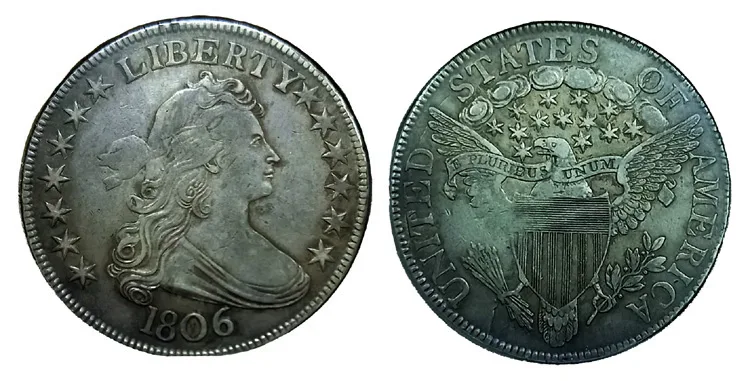
The Draped Bust Half Dollar — struck from 1796 through 1807 — is one of the most fascinating and unevenly distributed type coins in all of American numismatics. It splits cleanly into two reverse types separated by a long production gap: the exceedingly rare Small Eagle issue of 1796 and 1797, and the far more available Heraldic Eagle issue of 1801 through 1807. Designed by chief engraver Robert Scot from a Gilbert Stuart drawing — the model traditionally identified as Philadelphia socialite Ann Willing Bingham — the half dollar carries the same elegant draped Liberty portrait used across the early silver series, replacing the windswept Flowing Hair design that critics had disliked.
The two-year Small Eagle half dollar is a coin of legend. Across all of 1796 and 1797 the Mint struck only about 3,918 half dollars combined — a mintage so tiny that the 1796 and 1797 Draped Bust halves rank among the most coveted and valuable type coins in the entire US series, with the celebrated 15 Stars and 16 Stars 1796 varieties commanding six and even seven figures in high grade. Then the denomination went dark for three years before returning in 1801 with the heraldic, shield-bearing eagle that would carry the type to its close in 1807.
This guide walks through every aspect of identifying, attributing, grading, and valuing Draped Bust Half Dollars. You will learn how to separate the two reverse types at a glance, recognize the 15-star and 16-star 1796 varieties, understand the seven-year gap in production, attribute Overton (O-) die varieties, identify the famous 1806/5 overdate and the 1806 Knobbed 6 and Pointed 6 reverses, read the lettered edge, tell genuine adjustment marks and strike weakness from damage, detect the counterfeits that plague this high-value type, and price coins in every grade — from an affordable, well-worn 1806 or 1807 to a six-figure 1796. Whether you are evaluating an inherited type coin, weighing a major purchase, or simply studying early American silver, this guide gives you the working knowledge to handle these coins with the seriousness they deserve.
History: From Flowing Hair to Draped Bust
The half dollar entered American coinage in 1794 with the Flowing Hair design, a coin of exactly half the silver dollar’s weight authorized by the Coinage Act of 1792. The windswept Flowing Hair portrait by Robert Scot drew immediate criticism for looking undignified, and Mint Director Henry William DeSaussure, who took office in mid-1795, made replacing it a priority. By 1796 the more classical Draped Bust portrait — based on a Gilbert Stuart drawing commissioned for the purpose — had supplanted Flowing Hair across the silver denominations, from the Draped Bust Half Dime up through the Draped Bust Dollar.
For the half dollar, however, the transition produced one of the great rarities of the series. The Mint struck Draped Bust Half Dollars in only two years of the Small Eagle era — 1796 and 1797 — and in microscopic quantity: roughly 934 pieces dated 1796 and about 2,984 dated 1797, for a combined total of just 3,918 coins. By comparison, the Mint had struck nearly 300,000 Flowing Hair halves in 1795 alone. The reasons for the collapse were practical: depositors of silver bullion preferred to receive silver dollars, the Mint’s resources were stretched, and the half dollar simply fell out of the production queue.
The Seven-Year Gap
After 1797 the half dollar disappeared entirely. No Draped Bust Half Dollars are dated 1798, 1799, or 1800 — a three-year gap in the dated record, and effectively a seven-year interruption in meaningful production between the small 1797 issue and the resumption of the denomination in earnest. When the half dollar returned in 1801, it wore a completely redesigned reverse: the large heraldic eagle with a shield on its breast, clutching arrows and an olive branch, modeled on the Great Seal of the United States. This Heraldic Eagle reverse had already appeared on the dollar, the quarter eagle, and other denominations.
The Heraldic Eagle Era and the Type’s Close
From 1801 the half dollar became a workhorse coin again, struck in growing quantities through 1807. Because the silver dollar’s production was suspended after 1804, the half dollar became the largest US silver coin in regular production — a role it would hold for decades. The Draped Bust design ran on the half dollar through 1807, when chief engraver John Reich’s new Capped Bust portrait replaced it. The Capped Bust Half Dollar that followed would run from 1807 to 1839 and become the heartland of the Overton die-variety collecting tradition. The Draped Bust half thus bridges the Mint’s chaotic first decade and the more settled production of the 1810s and beyond.
Design: Robert Scot’s Draped Bust Liberty
Understanding every element of the Draped Bust design is essential for accurate attribution and counterfeit detection. The half dollar uses the same conceptual obverse as the dollar, dime, and half dime, scaled to a 32.5 mm planchet.
Obverse (Heads Side)
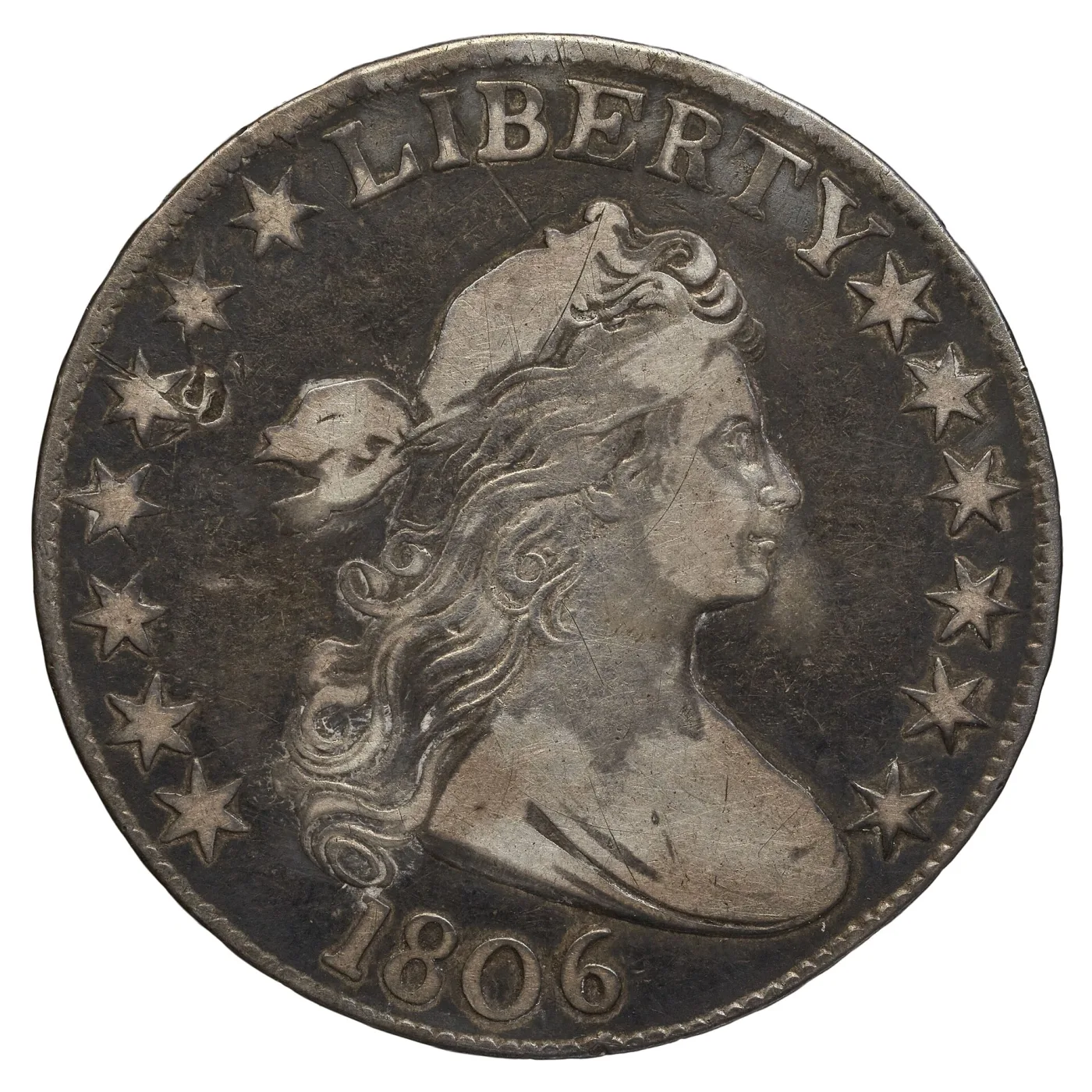
The obverse shows Liberty facing right, her hair flowing back but arranged and tied with a ribbon, and a drape of cloth gathered across the bust — the feature that gives the type its name. The portrait is fuller and more matronly than the wild Flowing Hair head it replaced. The legend LIBERTY arches across the top above the head, the date sits below the bust truncation, and stars surround the portrait — fifteen or sixteen on the 1796-1797 issue, and thirteen on the 1801-1807 issue (more on this below). No designer’s initials appear on the coin. The portrait derives from a Gilbert Stuart drawing; the model is traditionally identified as Ann Willing Bingham, a celebrated Philadelphia beauty of the era, though this attribution is not documented with certainty.
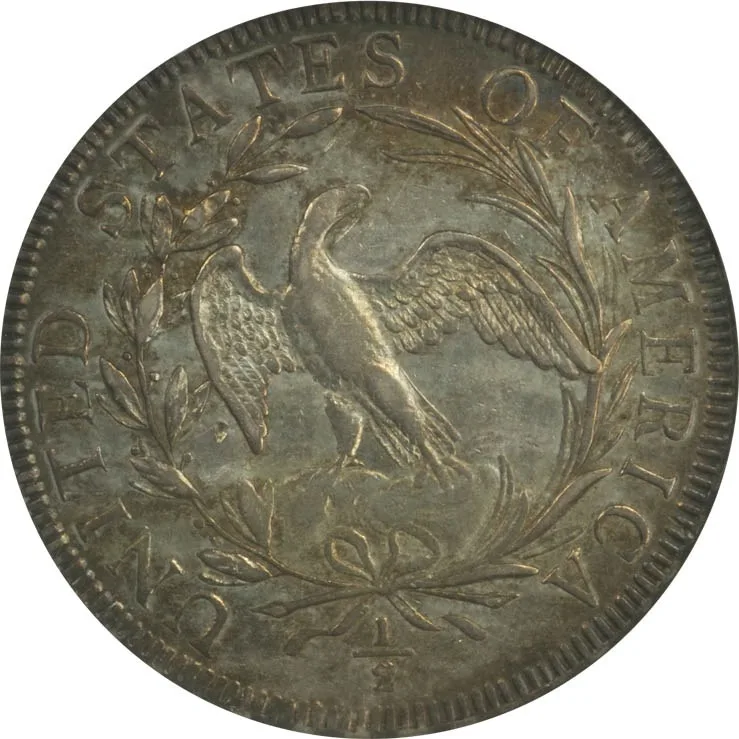
Reverse (Tails Side) — Small Eagle, 1796-1797
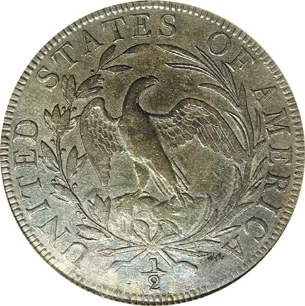
The first reverse type shows a small, delicate, naturalistic bald eagle with wings raised, perched on a cloud, enclosed by an open wreath of palm and olive branches. The legend UNITED STATES OF AMERICA arches around the rim. As on the early dollar and dime, this is a believable bird rather than a heraldic device — but unlike them, this reverse does state its value: a small fraction 1/2 is struck low in the field, directly below the bow of the wreath. It is easy to miss on a worn coin and it is the only mark of value anywhere on either face. The Small Eagle reverse is the rarer and more sought-after of the two types.
Reverse (Tails Side) — Heraldic Eagle, 1801-1807
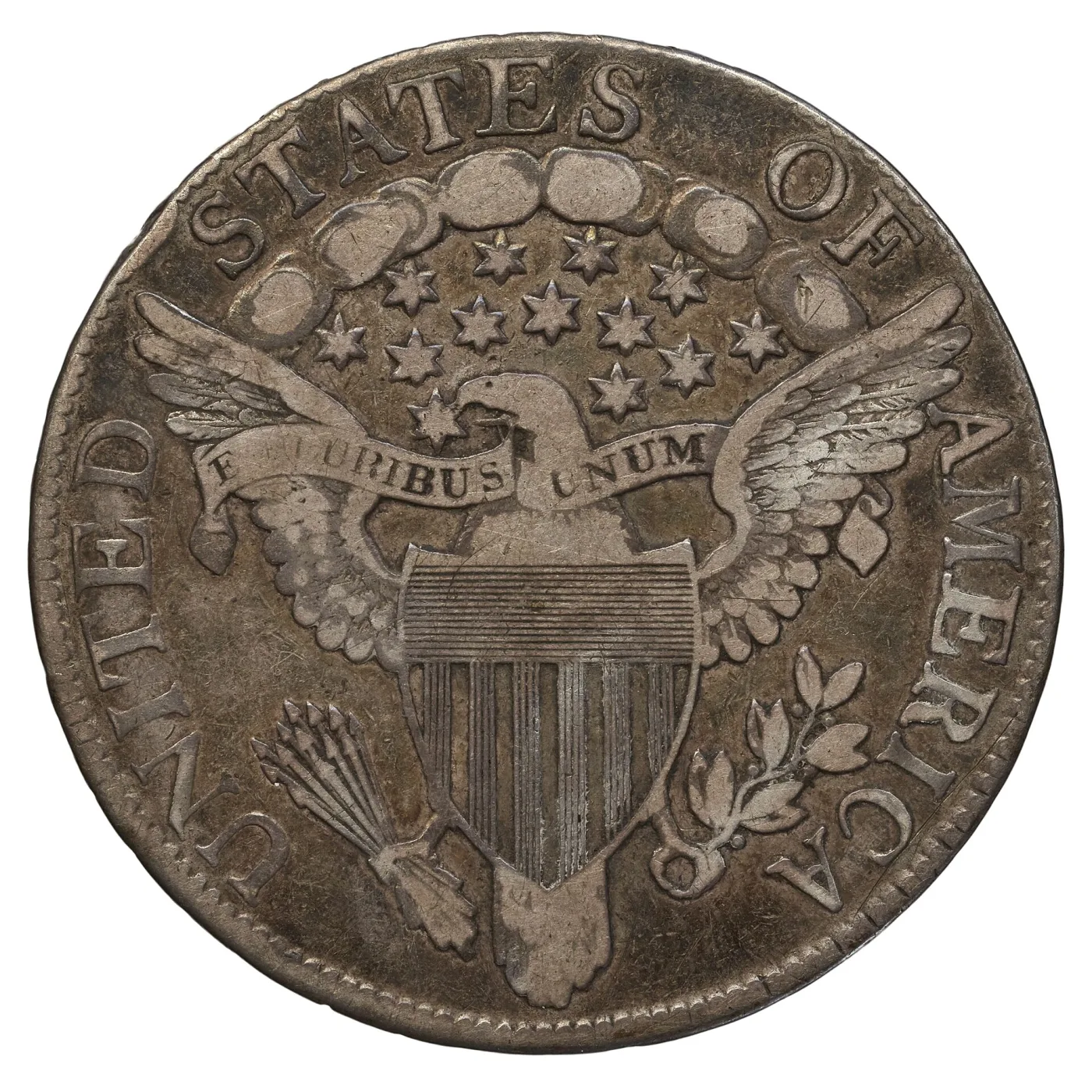
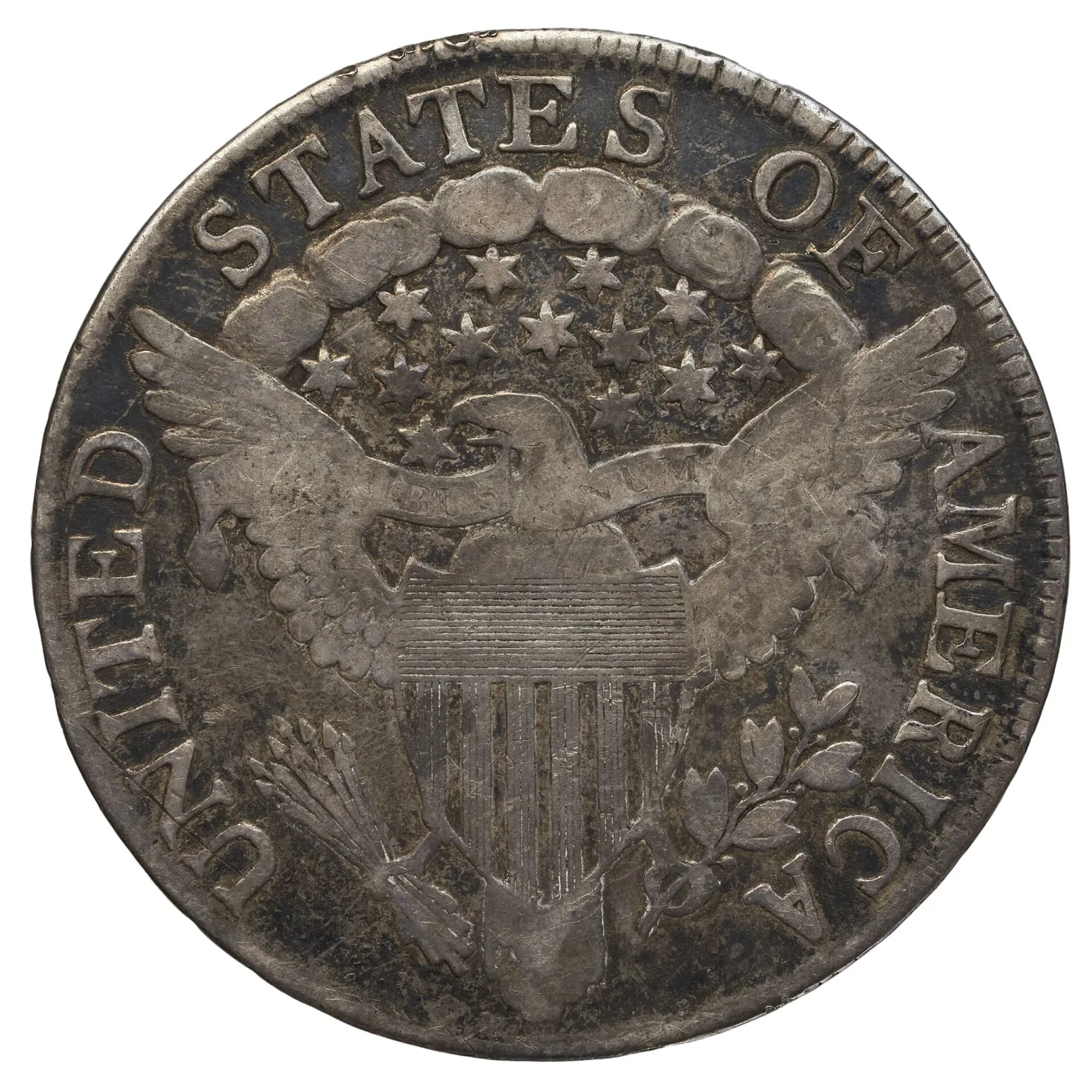
The second reverse type shows a large heraldic eagle with a shield (the Union shield) on its breast, holding a bundle of arrows in its right talon and an olive branch in its left, with a ribbon reading E PLURIBUS UNUM in its beak and a cloud of stars above its head. The legend UNITED STATES OF AMERICA arches around the rim. This design, derived from the Great Seal, is the same heraldic eagle used across the early silver and gold series. Unlike the Small Eagle reverse, it carries no mark of value at all: the 1/2 below the wreath bow disappears with the wreath, so from 1801 the edge lettering is the only statement of the denomination on the coin.
Edge
Both types carry the same edge lettering: FIFTY CENTS OR HALF A DOLLAR, with decorative ornaments between the words. On the Heraldic Eagle coins this lettered edge is the only place the denomination appears at all; on the Small Eagle coins it repeats what the 1/2 below the wreath bow already says. The lettering was applied with a Castaing machine before striking, so its orientation may run in either direction relative to the dies. The edge is a key authentication checkpoint: any Draped Bust Half Dollar with a plain, reeded, or smooth edge is either a counterfeit or a damaged piece whose edge lettering has been lost.
The Two Reverse Types at a Glance
The single most important identification step for a Draped Bust Half Dollar is determining which of the two reverse types you hold, because it instantly tells you roughly when the coin was made and places it in a very different rarity and value class.
Quick Visual Test
- Small Eagle (1796-1797): A small, thin, lifelike eagle with raised wings perched on a cloud inside an open wreath. No shield, no arrows, no motto ribbon. If the eagle looks like a real bird sitting in a wreath, it is the Small Eagle type — and an extraordinarily rare coin.
- Heraldic Eagle (1801-1807): A large, spread-winged eagle with a striped shield on its breast, arrows and an olive branch in its talons, E PLURIBUS UNUM on a ribbon, and stars in a cloud above. If the eagle looks like a coat of arms, it is the Heraldic Eagle type.
The two reverses side by side, on halves of the same denomination struck ten years apart:
What the Type Tells You About the Date
The reverse type narrows the date immediately. A Small Eagle half dollar can only be dated 1796 or 1797. A Heraldic Eagle Draped Bust half can only be dated 1801, 1802, 1803, 1805, 1806, or 1807 (there are no 1804-dated Draped Bust halves of this type, and none dated 1798-1800). This pairing of reverse type with a narrow date range is itself an authentication checkpoint: a “Small Eagle” half dated 1805, or a “Heraldic Eagle” half dated 1796, is impossible and signals a counterfeit or altered coin.
The Same Split Appears Across the Series
This Small Eagle / Heraldic Eagle split is a recurring theme in the Draped Bust era. The same two reverses appear on the Draped Bust Dime, the Draped Bust Quarter, and the dollar. Learning to recognize the two eagles on one denomination makes identifying the others straightforward, since the reverse designs are conceptually identical from coin to coin.
Composition and Specifications
Knowing the metal content and physical specs is essential for both authentication and for understanding how these coins were made and circulated. The specifications are identical for both reverse types.
Specifications
- Composition: .8924 silver, .1076 copper (the original US standard authorized by the 1792 Coinage Act; often rounded to “90% silver” in modern listings, though the legal figure was .8924 fine).
- Weight: 13.48 grams (208 grains — exactly half the silver dollar’s 416 grains).
- Diameter: 32.5 mm (variable on early hand-finished planchets).
- Edge: FIFTY CENTS OR HALF A DOLLAR with decorative ornaments.
- Net silver weight: approximately 12.03 grams (0.387 troy oz pure silver).
Why the .8924 Standard?
The Coinage Act fixed the silver alloy at 1485 parts silver to 179 parts copper, working out to .8924 fine. The choice mirrored the silver content of the Spanish 8-reales coin that dominated American commerce, so that US silver would exchange smoothly against the Spanish dollar and its fractions. With the silver dollar suspended after 1804, the half dollar became the largest US silver coin in circulation and a fixture of bank reserves — which is why so many Heraldic Eagle halves survive in low, well-circulated grades while remaining genuinely scarce in high grade.
Why Composition Matters for Authentication
An authentic Draped Bust Half Dollar weighs very close to 13.48 grams. Two-plus centuries of circulation may shave 0.3 to 1.0 gram from a well-worn coin, but a piece dropping below roughly 12.5 grams is suspicious. Specific gravity should fall near 10.3. The .8924 alloy lends genuine coins a slightly warmer tone than the colder .900 silver of post-1837 federal coinage. Any candidate that is markedly off these specs, or that shows a yellowish, pinkish, or unnaturally bright cast, demands professional testing before purchase.
The 1796-1797 Small Eagle: 15 vs 16 Stars
The 1796 and 1797 Draped Bust Half Dollars with the Small Eagle reverse are the crown jewels of the type and among the most famous rarities in all of US coinage. With a combined mintage of only about 3,918 pieces and a surviving population estimated in the low hundreds across both dates, every genuine Small Eagle half is a major coin, regardless of grade or variety.
The 15 Stars and 16 Stars 1796
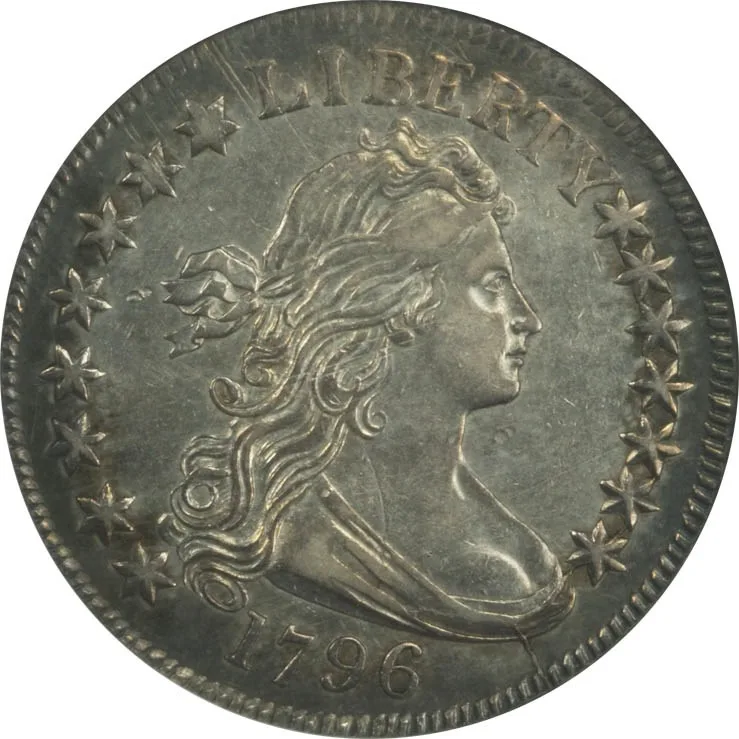
The 1796 half dollar comes with two obverse star counts, and the distinction is one of the most celebrated in American numismatics:
- 1796 15 Stars: Fifteen stars around Liberty, representing the fifteen states in the Union at the time (the original thirteen plus Vermont and Kentucky). The standard arrangement is eight stars left and seven right.
- 1796 16 Stars: Sixteen stars, adding a star for Tennessee, which was admitted as the sixteenth state on June 1, 1796. When Tennessee joined, the engraver added a sixteenth star to a new obverse die — but the Mint soon abandoned the practice of adding a star for each new state (otherwise the obverse would become impossibly crowded), so the sixteen-star configuration was short-lived.
Both the 15 Stars and 16 Stars 1796 are extreme rarities. The 16 Stars variety is generally considered slightly scarcer, but both are six-figure coins in any collectible grade and seven-figure coins at the top of the population. The 1796 half dollar — in either star count — is routinely cited as one of the key coins needed to complete a US type set, and assembling a high-grade example is a milestone achievement for advanced collectors.
The 1797 Small Eagle
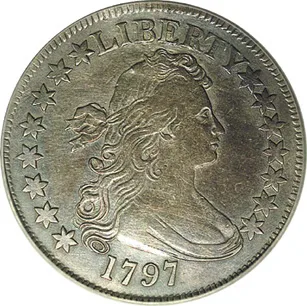
The 1797 half dollar uses the same Small Eagle reverse and carries fifteen obverse stars. With a mintage of roughly 2,984 it is marginally more available than the 1796 but is still a tremendous rarity. Like the 1796, the 1797 was struck from a very small number of dies, and surviving examples are concentrated in lower and mid grades, with Mint State coins of either date being landmark rarities.
A 1797 obverse beside a Small Eagle reverse — the two faces you have to read together on this type:
Identification of the Small Eagle Halves
- Reverse: Small naturalistic eagle on a cloud inside an open wreath — no shield, no arrows, no motto.
- Date: 1796 or 1797 below the bust truncation.
- Stars: Count them carefully — 15 or 16 on the 1796; 15 on the 1797. The star count is central to the coin’s identity and value.
- Strike: Like all early silver struck on undersized equipment, these coins often show peripheral weakness — soft stars, soft date, soft wreath detail — even in higher grades.
- Edge: FIFTY CENTS OR HALF A DOLLAR.
Because the Small Eagle halves are so valuable, they are among the most heavily counterfeited and altered US coins. Treat any “1796” or “1797” half dollar as suspect until it has been authenticated by PCGS or NGC. Many “1796 halves” offered raw are altered from other dates or are outright fakes.
The 1801-1807 Heraldic Eagle Issue
The Heraldic Eagle Draped Bust Half Dollar is the type most collectors will actually own. Struck from 1801 through 1807, it is far more available than the Small Eagle issue, though early dates (1801 and 1802) are scarce and the type as a whole is genuinely difficult in high grade.
The Thirteen-Star Obverse
Beginning with the Heraldic Eagle reverse, the obverse reverted to thirteen stars — seven left and six right — honoring the original thirteen colonies rather than tracking the growing number of states. This is the same thirteen-star arrangement used on the contemporary Heraldic Eagle dollars, dimes, and quarters. A Draped Bust half with a Heraldic Eagle reverse should always show thirteen obverse stars; a different count signals a problem.
Production and Survival
Mintages climbed through the period: roughly 30,000 in 1801, about 30,000 in 1802, around 188,000 in 1803, none dated 1804, about 212,000 in 1805, roughly 840,000 in 1806, and approximately 301,000 in 1807. Because the half dollar served as a primary store of value once the dollar was suspended, enormous numbers entered bank vaults and circulated heavily. The result is a type that is available in low to middle grades — especially for 1805, 1806, and 1807 — but becomes scarce in XF, rare in AU, and very rare in Mint State.
Identification of the Heraldic Eagle Halves
- Reverse: Large heraldic eagle with shield, arrows, olive branch, E PLURIBUS UNUM ribbon, and stars in a cloud above.
- Date: 1801, 1802, 1803, 1805, 1806, or 1807 below the bust.
- Stars: Thirteen obverse stars (7 left + 6 right).
- Strike: Peripheral weakness and uneven striking are common; expect soft stars and soft high points on many examples.
- Edge: FIFTY CENTS OR HALF A DOLLAR.

Overdates and Key Varieties
The Heraldic Eagle years are rich in overdates and die varieties, several of which are popular enough to be collected as distinct coins. Because the Mint reused and re-engraved dies to save money, blunders and overdates are part of the character of the series.
The 1806/5 Overdate
The most famous variety of the type is the 1806/5 overdate, on which a 1806 date was punched over a leftover 1805 die, leaving the remnant of the 5 visible beneath the 6. The overdate is bold enough to confirm with a loupe and is a perennial favorite among variety collectors. It is one of several distinct 1806 varieties recognized by the major grading services and listed separately in price guides.
1806 Knobbed 6 vs Pointed 6
The 1806 issue is the most variety-rich date of the type. Collectors distinguish two principal styles of the 6 in the date:
- Knobbed 6: The 6 has a small knob or loop at the top of its upper terminal. Certain Knobbed 6 marriages are further divided by reverse details — most famously the rare 1806 Knobbed 6, Stem Not Through Claw variety, a significant rarity, versus the more available Stem Through Claw.
- Pointed 6: The 6 has a plain pointed terminal with no knob.
These distinctions, combined with the 1806/5 overdate and an “E over A” lettering blunder known on the type, make 1806 a date that variety specialists can pursue for years.
1805/4 Overdate
The 1805 issue includes a 1805/4 overdate, on which the 5 was punched over a 4. Because so few 1804-dated dies were ever prepared (and no 1804 half dollars were released), the 1805/4 is the closest thing the type has to an “1804” coin and is collected as a distinct variety.
The 1807 Transitional Year
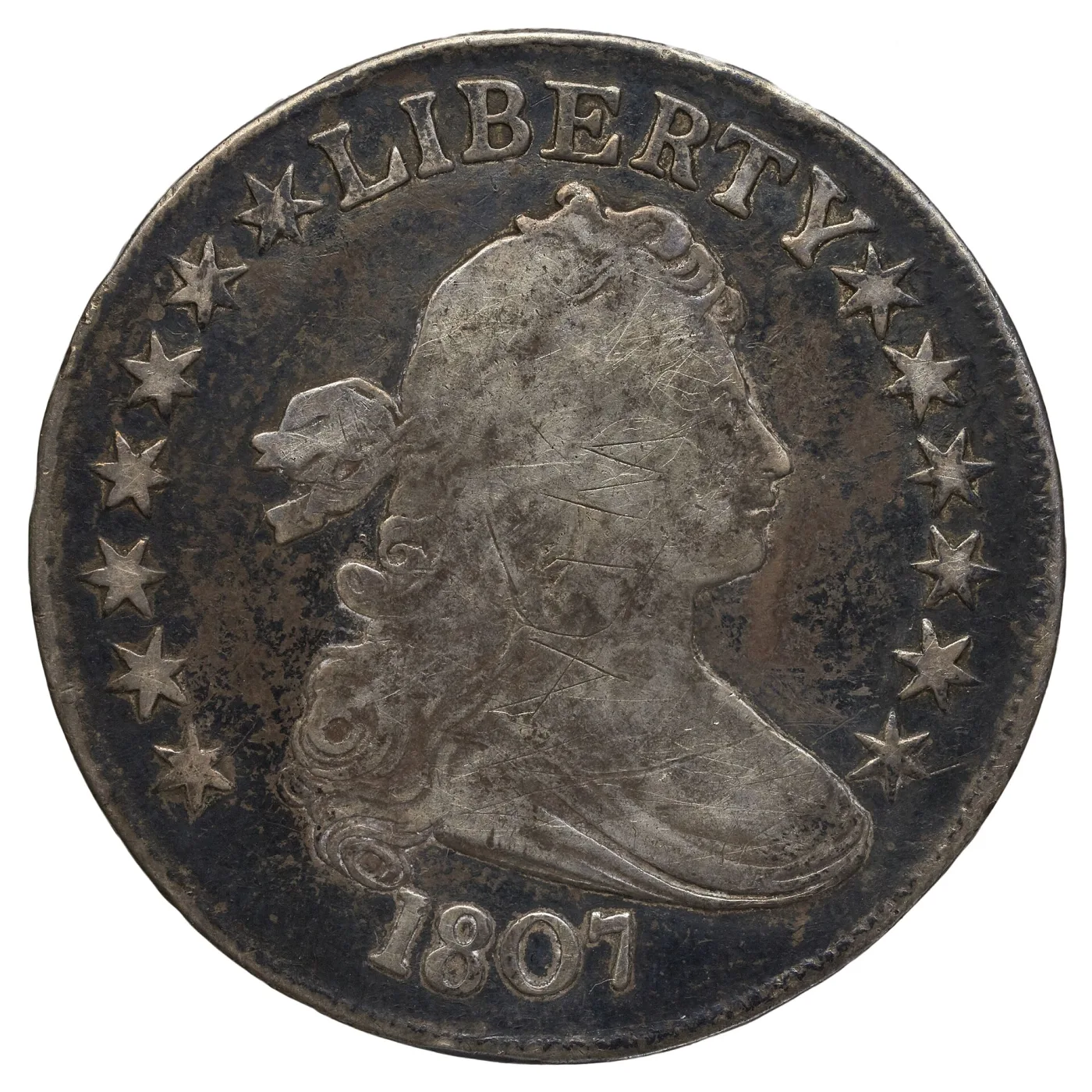
1807 is a transitional year: the Mint struck Draped Bust Half Dollars early in the year and then switched to John Reich’s new Capped Bust design later in 1807. As a result, 1807 exists in both designs. A 1807 Draped Bust half (Heraldic Eagle, thirteen stars, draped Liberty) is the final year of this type; a 1807 Capped Bust half (a turbaned Liberty with a very different look) is the first year of the next. Do not confuse the two — the portraits are unmistakably different, and the Capped Bust half belongs to a separate guide.
Overton (O-) Die Varieties
The standard reference for early half dollar die varieties is Early Half Dollar Die Varieties 1794-1836 by Al C. Overton (updated by Donald Parsley), universally cited by the “O-” or “Overton” number. The Overton system is the variety attribution standard used by PCGS, NGC, the major auction houses, and serious early-half specialists. The same Overton reference that covers the Flowing Hair Half Dollar and the long Capped Bust Half Dollar series also catalogs the Draped Bust halves.
Small Eagle Marriages (1796-1797)
The 1796 and 1797 halves were struck from only a handful of die marriages each. For these rarities, the Overton number is interesting to specialists, but the overriding facts are the date and the 1796 star count; a collector who owns any genuine 1796 or 1797 half, of any Overton marriage, owns a landmark coin. Because so few dies were used, the Overton attribution for a given Small Eagle half is usually straightforward for an expert.
Heraldic Eagle Marriages (1801-1807)
The Heraldic Eagle years offer dozens of Overton marriages spanning common to rare, with the richest selection in 1806 and 1807. Notable marriages include the various 1806 Knobbed 6 and Pointed 6 dies, the 1806/5 overdate, the 1805/4 overdate, and the scarce 1806 Stem Not Through Claw. Rarity ratings range from common (R-1 to R-3) for the workhorse 1806 and 1807 marriages to genuinely rare (R-5 and higher) for a handful of die pairs.
Why Overton Numbers Matter
For collectors building a simple type set, the Overton number matters far less than the major distinctions — reverse type, 1796 star count, and the popular overdates. For specialists, Overton attribution can mean large price differences: a common 1806 in Very Fine might bring a few hundred dollars, while a rare marriage of the same date and grade could bring several times that. If you are buying a high-value Draped Bust Half Dollar, request the Overton attribution and confirm it against the certification holder. An Overton-attributed coin in a PCGS or NGC slab is the gold standard.
Date-by-Date Rarity Guide
The following summary captures the relative rarity and character of each issue. All dates are scarce in absolute terms compared with later US coins, but the spread from the 1796 to the 1806 is enormous.
Small Eagle Type
- 1796 15 Stars: Extreme rarity; mintage shared with the 16 Stars at roughly 934 total. Six figures in any grade, seven figures at the top.
- 1796 16 Stars: Extreme rarity, generally considered slightly scarcer than the 15 Stars; among the most famous of all US type coins.
- 1797 15 Stars: Extreme rarity; about 2,984 struck; marginally more available than the 1796 but still a landmark coin.
Heraldic Eagle Type
- 1801: Scarce; about 30,000 struck; the first Heraldic Eagle date and difficult in all grades, especially XF and above.
- 1802: Scarce; about 30,000 struck; comparable to 1801 in difficulty.
- 1803: More available; about 188,000 struck; comes with Small 3 and Large 3 varieties.
- 1805: Available; about 212,000 struck; includes the 1805/4 overdate.
- 1806: The most available date; about 840,000 struck; the variety-rich date with the 1806/5 overdate, Knobbed 6 and Pointed 6, and the rare Stem Not Through Claw.
- 1807: Available; about 301,000 struck; the final Draped Bust year before the Capped Bust transition.
The Missing Dates
There are no Draped Bust Half Dollars dated 1798, 1799, 1800, or 1804. The 1798-1800 gap reflects the suspension of half dollar production during those years; the absence of an 1804 simply means no half dollars were struck or released bearing that date. A coin purporting to be a half dollar of any of these dates is either a misread date, an altered coin, or a counterfeit. The closest thing to an 1804 half is the 1805/4 overdate.
Grading Draped Bust Half Dollars
Grading Draped Bust Half Dollars is among the more difficult tasks in American numismatics. The coins were struck on hand-prepared planchets with primitive equipment, so strike weakness, adjustment marks, planchet flaws, and uneven surfaces are common even on uncirculated examples. Distinguishing original surface from wear, and strike weakness from circulation, takes practice and good reference coins.
Key Wear Points
Wear shows first on the high points: Liberty’s cheek, bust, and the high curls of her hair on the obverse; the eagle’s head, breast, and the tops of the wings on the reverse. Specific checkpoints:
- Liberty’s cheek and bust: The smoothest areas; light friction shows here first as a loss of original surface texture.
- Liberty’s hair: The high curls above the forehead and the drapery lose definition early.
- Stars: Star centers flatten with wear; in high grades the radial lines are visible.
- Eagle (Small Eagle): The breast and head feathers go first.
- Eagle (Heraldic Eagle): The shield lines, the eagle’s head, and the tops of the wings are the key checkpoints; clouds and stars above flatten with wear.
Grade Estimates by Detail
- AG-3 (About Good): Design outline visible; rim worn into the legend; LIBERTY partly legible.
- G-4 (Good): LIBERTY worn but readable; date clear; major design outline complete.
- VG-8 (Very Good): Some hair and drapery detail; eagle outline strong with feathers blended.
- F-12 (Fine): Partial hair separation; partial shield lines on the Heraldic Eagle.
- VF-20 (Very Fine): Most hair detail clear; most shield lines visible; some feather separation.
- XF-40 (Extremely Fine): Sharp hair and shield detail; light high-point wear only.
- AU-50 (About Uncirculated): Trace wear only on the highest points; underlying luster present in protected areas.
- MS-60+ (Mint State): No wear; original surface preserved (may show planchet flaws, adjustment marks, or strike weakness, but no rubbing).
Adjustment Marks Are Acceptable
Heavy file-like adjustment marks are normal on Draped Bust Half Dollars — a manufacturing artifact, not damage. Mint workers used files to reduce overweight planchets to the legal standard before striking, and PCGS and NGC straight-grade coins with even substantial adjustment marks. The marks may reduce eye appeal and lower the grade slightly but do not warrant a “details” designation. A common amateur mistake is to condemn a perfectly genuine coin as “damaged” because it shows the same file marks nearly every early silver coin of the era carries. The same logic applies across the Mint’s first decade — collectors of the Draped Bust Dime and other early types learn to read adjustment marks as history, not harm.
Strike Weakness vs Wear
Distinguishing strike weakness from circulation wear is critical, especially on the Small Eagle issues. Weakly struck areas retain their original luster and surface texture — they were simply never fully impressed by the die. Worn areas show flattening and friction with a different surface character. On early halves, peripheral weakness is common and expected; a coin showing such weakness can still grade high if luster is intact in the surrounding fields. Calling a soft-struck early half a lower grade because of “missing” detail is a common and costly error.
Authentication and Counterfeit Detection
Draped Bust Half Dollars — especially the 1796 and 1797 Small Eagle issues — are heavily counterfeited and altered. Both contemporary (period) counterfeits and modern fakes exist in significant numbers. Because genuine pieces are scarce and valuable, any candidate should be treated as suspect until authenticated by PCGS or NGC.
Altered Date and Altered Star Counts
The 1796 is worth many times any Heraldic Eagle date, so the most common alteration is creating a “1796” or “1797” from a more common coin — or, worse, attempting to add or remove a star to convert a 16 Stars into a 15 Stars or vice versa. Diagnostics include tool marks around the date or stars, field disturbance, mismatched die characteristics, and a date or star style that does not match genuine examples. Because the genuine Small Eagle halves pair with a known short list of dies, any “1796” or “1797” that does not match a documented die marriage is automatically suspect.
Contemporary Counterfeits
Period counterfeits were typically struck or cast in base metal and silvered to pass in circulation. They have their own collector following but must be identified as such. Diagnostics include wrong weight, wrong specific gravity, soft details that match no known die marriage, and incorrect edge lettering. A Draped Bust Half Dollar that fits no Overton marriage is almost always a contemporary counterfeit.
Modern Counterfeits
Modern (often Chinese-origin) counterfeits proliferated in the 2000s and now appear on auction sites, at estate sales, and on inexperienced dealer tables. Common diagnostics:
- Wrong weight (frequently light at 11-12.5 grams; occasionally heavy).
- Wrong color (too bright, too yellow, or pinkish).
- Pebbled, “soapy,” or porous surface texture from cast manufacture.
- Wrong, missing, or too-sharp edge lettering.
- Mushy or “blobby” detail that does not match Robert Scot’s die work.
- Die markers (cracks, cuds, repunching) that correspond to no genuine marriage.
- A reverse type that cannot pair with the date (Small Eagle on an 1805, for example).
Always Submit to PCGS or NGC
For any Draped Bust Half Dollar — even a heavily worn 1806 worth a few hundred dollars — certification by PCGS or NGC is strongly advised, and for the 1796 and 1797 it is essential. Raw (uncertified) examples trade at substantial discounts to certified coins precisely because buyers must price in authentication risk. For a five- or six-figure Small Eagle half, the cost of grading is negligible relative to the protection it provides and is effectively mandatory for any future sale at fair value.
Current Market Values and Price Guide
The following ranges are approximate retail values for problem-free, certified coins as of 2026. Auction results, Overton variety, eye appeal, CAC stickers, and provenance can move values significantly. The 1796 and 1797 are key-date rarities in a class of their own; the Heraldic Eagle dates are far more affordable in circulated grades but climb sharply in XF and above.
1796-1797 Small Eagle Half Dollars
- 1796 15 Stars / 16 Stars, G-4: $40,000-$70,000.
- 1796, VG-8 to F-12: $70,000-$130,000.
- 1796, VF-20 to XF-40: $150,000-$350,000.
- 1796, AU and Mint State: $400,000-$1,000,000+ (the finest known have realized seven figures).
- 1797, G-4 to F-12: $35,000-$110,000.
- 1797, VF-20 and up: $130,000-$800,000+.
1801-1807 Heraldic Eagle Half Dollars (Common Dates/Varieties)
- 1806 or 1807, G-4: $90-$160.
- 1806 or 1807, VG-8: $130-$220.
- 1806 or 1807, F-12: $200-$350.
- 1806 or 1807, VF-20: $350-$600.
- 1806 or 1807, XF-40: $700-$1,300.
- 1806 or 1807, AU-50: $1,800-$3,500.
- 1806 or 1807, MS-60 to MS-63: $5,000-$15,000+.
- 1801 or 1802 (scarce dates): Add a substantial premium — roughly 3-6x the common-date price in circulated grades, far more in high grade.
Variety Premiums
- 1806/5 overdate: A modest-to-moderate premium over a common 1806 in the same grade, more in higher grades.
- 1805/4 overdate: A solid premium for a popular and scarce overdate.
- 1806 Knobbed 6, Stem Not Through Claw: A major rarity commanding strong multiples of common-1806 money.
- Rare Overton marriages: Premiums vary widely by rarity rating and demand; rare R-5+ marriages can multiply the common-variety price.
Problem Coins and Details Grades
Coins with cleaning, scratches, environmental damage, holes, or repairs grade “Details” by PCGS and NGC and trade at substantial discounts to problem-free examples. A “Cleaned” XF Details 1806 might bring 50-70% of straight-graded XF money; a holed example perhaps 30-40%. Even a damaged genuine 1796 remains a five-figure coin because of the type’s extraordinary rarity and the historical significance of the 15/16 Stars varieties.
Notable Specimens and Auction Records
The Draped Bust Half Dollar includes some of the most celebrated trophy coins in the American series, driven almost entirely by the Small Eagle rarities.
The Finest 1796 Halves
The handful of Mint State 1796 half dollars — in both the 15 Stars and 16 Stars varieties — reside in advanced type and specialist collections and trade for seven figures when they appear. A superb-gem 1796 is one of the most expensive type coins a collector can pursue, on par with the great rarities of the dollar and early gold series. Each public appearance of a high-grade 1796 or 1797 is a significant event closely watched by the entire numismatic community.
The 1806 Knobbed 6, Stem Not Through Claw
Among the Heraldic Eagle varieties, the 1806 Knobbed 6, Stem Not Through Claw is the standout rarity. Known from only a small number of examples, it commands strong prices well beyond ordinary 1806 money and is a prize for Draped Bust half specialists working the Overton list.
Auction Resources
The Heritage Auctions and Stack’s Bowers archives are the best public databases of Draped Bust Half Dollar sale prices and provenance. Many notable specimens are illustrated and described there and in the Overton reference, which remains the standard for die-variety attribution. For the Small Eagle rarities in particular, studying the documented die marriages and pedigrees is essential before any purchase.
Building a Draped Bust Half Dollar Collection
Several collecting approaches are possible depending on budget and patience.
Type Set (One Coin of Each Reverse)
The most common approach is to acquire one Heraldic Eagle half (typically a 1806 or 1807 in Good to Fine, attainable for a few hundred dollars) to represent the Draped Bust half in a type set, and — for those with the means — a Small Eagle 1796 or 1797 to represent the rare first type. The Heraldic Eagle half is one of the more affordable early silver type coins; the Small Eagle half is one of the most expensive coins in the entire US type set, and many collectors complete their type set in every other denomination before tackling it.
Date and Variety Set
A complete date set of the Heraldic Eagle issue (1801, 1802, 1803, 1805, 1806, 1807) is an achievable long-term goal, with 1801 and 1802 the gating scarce dates. Adding the popular 1806/5 and 1805/4 overdates and the major 1806 die varieties turns the project into a rewarding variety set. The Small Eagle dates (1796 in both star counts, plus 1797) are a separate and far more expensive pursuit, usually reserved for advanced collectors.
Comparison to Other Early Silver
Collectors who enjoy Draped Bust Half Dollars typically work across the whole early silver series. The Flowing Hair Half Dollar of 1794-1795 is the immediate predecessor; the Capped Bust Half Dollar of 1807-1839 is the successor and the heartland of Overton collecting. The smaller early silver denominations — the Draped Bust Half Dime, the Draped Bust Dime, and the Draped Bust Quarter — share the same Small Eagle and Heraldic Eagle reverses and offer similar challenges at varying prices. The half dollar sits at the center of this family as the largest regularly struck silver coin once the dollar was suspended.
Storage and Preservation
Draped Bust Half Dollars have survived more than two centuries; preserving them for another two requires sensible storage. Every certified example should remain in its slab unless there is a compelling conservation reason to remove it.
Holders
If holding raw, use inert holders: PVC-free flips, Mylar 2x2s, or — best — PCGS or NGC slabs. Avoid any holder that smells of plastic softener. PVC contamination produces green slime that eats into the silver and is hard to remove without professional conservation. Even brief contact with PVC-bearing material can cause permanent damage to a coin this important.
Environment
Store in a cool, dry environment with stable humidity below 50%. Silica gel packs in the storage box help. Avoid storing near wood (which off-gasses acids), rubber, or sulfur-bearing materials. Sulfur is the primary cause of silver tarnish and is present in wool, rubber bands, cardboard, and many fabrics. A safe deposit box with the coin in an inert holder and silica gel is the standard for high-value early halves.
Handling
Hold only by the edge, ideally with clean cotton or nitrile gloves. Skin oils contain salts and acids that etch silver. Never wipe a Draped Bust Half Dollar. Even gentle cleaning destroys numismatic value — a bright, cleaned surface on an early half is worth a fraction of an originally toned example. Original surfaces, even dark or heavily toned, are dramatically preferred to “improved” ones.
Conservation
If a coin has active PVC contamination or unsightly residue, professional conservation (NCS, the conservation arm of NGC) can remove harmful substances without leaving cleaning evidence. Never attempt home cleaning with dips, polishes, or abrasive cloths — these destroy more value in seconds than two centuries of circulation accumulated.
Frequently Asked Questions
How can I tell a Draped Bust Half Dollar from a Flowing Hair Half Dollar?
The portrait. Flowing Hair (1794-1795) shows Liberty with wild, untamed hair flowing freely behind, no ribbon and no drape. The Draped Bust half (1796-1807) shows Liberty with hair arranged and tied with a ribbon and a drape of cloth across the bust. The dates separate them cleanly too: a Flowing Hair half is dated 1794 or 1795, while the Draped Bust half begins in 1796. For the full picture of the earlier type, see our Flowing Hair Half Dollar guide.
What is the difference between the Small Eagle and Heraldic Eagle reverses?
The Small Eagle (1796-1797) is a small, lifelike bird with raised wings perched on a cloud inside an open wreath — no shield, no arrows, no motto. The Heraldic Eagle (1801-1807) is a large coat-of-arms eagle with a striped shield on its breast, arrows and an olive branch in its talons, E PLURIBUS UNUM on a ribbon, and stars in a cloud above. The Small Eagle type is far rarer and far more valuable.
Why is the 1796 half dollar so valuable?
Rarity and demand. Only about 934 half dollars were struck dated 1796 (across both the 15 Stars and 16 Stars varieties), and the 1796 is one of the key coins needed to complete a US type set. That combination of tiny mintage and universal demand drives prices into six and seven figures even though the coin's design is shared with far cheaper denominations.
What is the 15 Stars vs 16 Stars 1796 variety?
It refers to the number of stars around Liberty on the obverse. The 15 Stars version honors the fifteen states then in the Union; the 16 Stars version adds a star for Tennessee, admitted in June 1796. The Mint quickly abandoned adding a star per state, so the 16 Stars die was short-lived. Both varieties are extreme rarities; the 16 Stars is generally considered slightly scarcer.
Are there any 1798, 1799, 1800, or 1804 Draped Bust Half Dollars?
No. The half dollar was not produced from 1798 through 1800, and no half dollars were struck or released dated 1804. A coin claiming to be a half dollar of any of these dates is a misread, an altered coin, or a counterfeit. The closest thing to an 1804 half is the 1805/4 overdate, on which a 5 was punched over a 4.
What are adjustment marks and do they reduce value?
Adjustment marks are file-like marks made by Mint workers reducing overweight planchets to the legal standard before striking. They are normal on Draped Bust Half Dollars and are not damage. PCGS and NGC straight-grade coins with even heavy adjustment marks; the marks may lower eye appeal and the grade slightly but do not warrant a "details" grade. They are part of the coin's manufacturing history.
Should I clean my Draped Bust Half Dollar?
Absolutely not. Cleaning destroys most of the value of any early half dollar. Original surfaces, even with dark toning or haze, are far preferred to bright cleaned surfaces. If a coin has problematic contamination such as PVC residue, submit it to NCS for professional conservation — never attempt home cleaning.
Where can I sell a Draped Bust Half Dollar?
The best venues for high-value examples are the major numismatic auction houses — Heritage Auctions, Stack's Bowers Galleries, and Legend Rare Coin Auctions — all experienced with early silver and commanding strong realized prices. For circulated Heraldic Eagle dates, established early-type dealers (members of the Professional Numismatists Guild) are also a strong option. Avoid pawn shops and "we buy gold" walk-in shops, which consistently pay well below market for early type coins.
Can the Coin Identifier app help me identify a Draped Bust Half Dollar?
Yes. The app's AI can identify the design type, distinguish the Small Eagle from the Heraldic Eagle reverse, estimate the grade, and flag obvious counterfeits from photographs. For high-value coins like the 1796 and 1797 Small Eagle halves, always confirm with PCGS or NGC certification — no app replaces physical examination by certified experts for a coin in this price range. Use the app for initial triage and education; use certified grading services for final authentication and resale preparation.