Roman Coins Found in Germany: The Wesseling Hoard and How to Identify Its Denarii
In September 2026 the heritage office of the Rhineland announced that a man with a metal detector had found 934 Roman silver coins in a field near Wesseling, south of Cologne. The authorities call it the largest hoard from the time of the emperor Hadrian ever found in Germany, and the story travelled fast under headlines about a record find.
The coins themselves are denarii, the everyday silver coin of Rome, and the same emperors and types turn up in collections everywhere. Learning to read a German hoard is learning to read your own coin.
This guide covers the Wesseling hoard, three other German finds that between them span three and a half centuries of Roman silver, how to identify the coins they contain, what the money meant to its owner, and who owns a Roman coin found in Germany today. For the full system of Roman denominations, legends and emperors, see the ancient Roman coins identification guide.
The Wesseling hoard at a glance
Every figure below is reported in the same terms by the Associated Press, Euronews and the Italian art journal Finestre sull’Arte, all drawing on the LVR office for archaeological heritage in the Rhineland (LVR-Amt für Bodendenkmalpflege im Rheinland).
| Found | Autumn 2025, field near Wesseling, south of Cologne |
| Finder | Oliver Riedl, searching with authorisation |
| Coins | 934 silver denarii |
| Weight | 3.1 kg (6.8 lb) |
| Oldest coin | 148 BC, Roman Republic |
| Newest coin | AD 124/125, reign of Hadrian (117–138) |
| Container | A ceramic vessel padded with straw, seen on X-ray |
| Buried | Probably the second quarter of the 2nd century AD |
| Owner today | State of North Rhine-Westphalia |
| Where to see it | LVR-LandesMuseum Bonn |
Two details matter for identification. First, the hoard mixes coins struck more than 270 years apart, which means Republican denarii were still being saved alongside Hadrian’s coins. Second, its date comes from its newest coin. A hoard cannot have been closed before its latest coin was struck, so the AD 124/125 piece sets the earliest possible burial date. Both Euronews and Finestre sull’Arte report that only four larger Roman hoards from this period are known anywhere.
Why the owner never came back to collect it is still unknown.
Four German finds, four slices of Roman silver
Three other finds show how different a “Roman hoard from Germany” can be.
| Find | Announced | Coins | Date range | What it shows |
|---|---|---|---|---|
| Halle (Saale), Saxony-Anhalt | July 2025 | 5 denarii | 148 BC; 82–79 BC | Republican silver far beyond the frontier |
| Kalkriese, Lower Saxony | Excavated over decades | About 2,000 coins on the battlefield | Up to the Varus battle, AD 9 | Money lost by an army |
| Wesseling, North Rhine-Westphalia | September 2026 | 934 denarii | 148 BC – AD 124/125 | A long-saved private fortune |
| Augsburg, Bavaria | November 2021 | More than 5,500 denarii | Nero (54–68) to Septimius Severus (193–211) | The largest Roman silver hoard found in Bavaria |
Halle: five worn Republican denarii
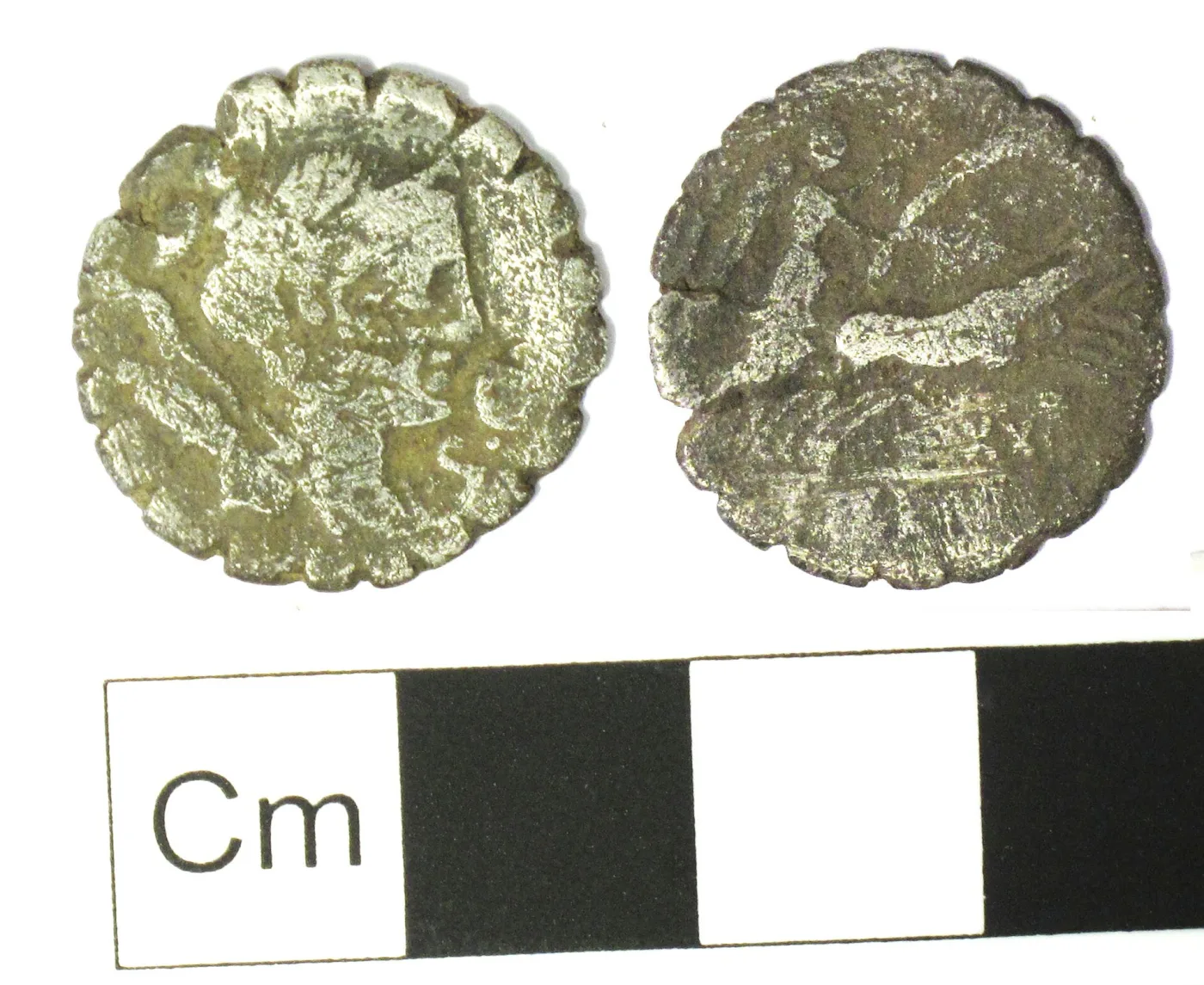
Near Halle, volunteer heritage steward Dirk Braungardt found five Republican denarii lying close together, probably once in a small pouch. One was struck in 148 BC and four between 82 and 79 BC. Three are serrati, denarii with a notched, saw-toothed edge, and two of those carry scratched graffiti. The state heritage office calls it the first documented Republican hoard in Saxony-Anhalt. Because there are no imperial coins in it, researchers think it reached the area around the start of the Common Era, evidence of contact between Rome and the peoples beyond its frontier.
Kalkriese: the coins of a lost army
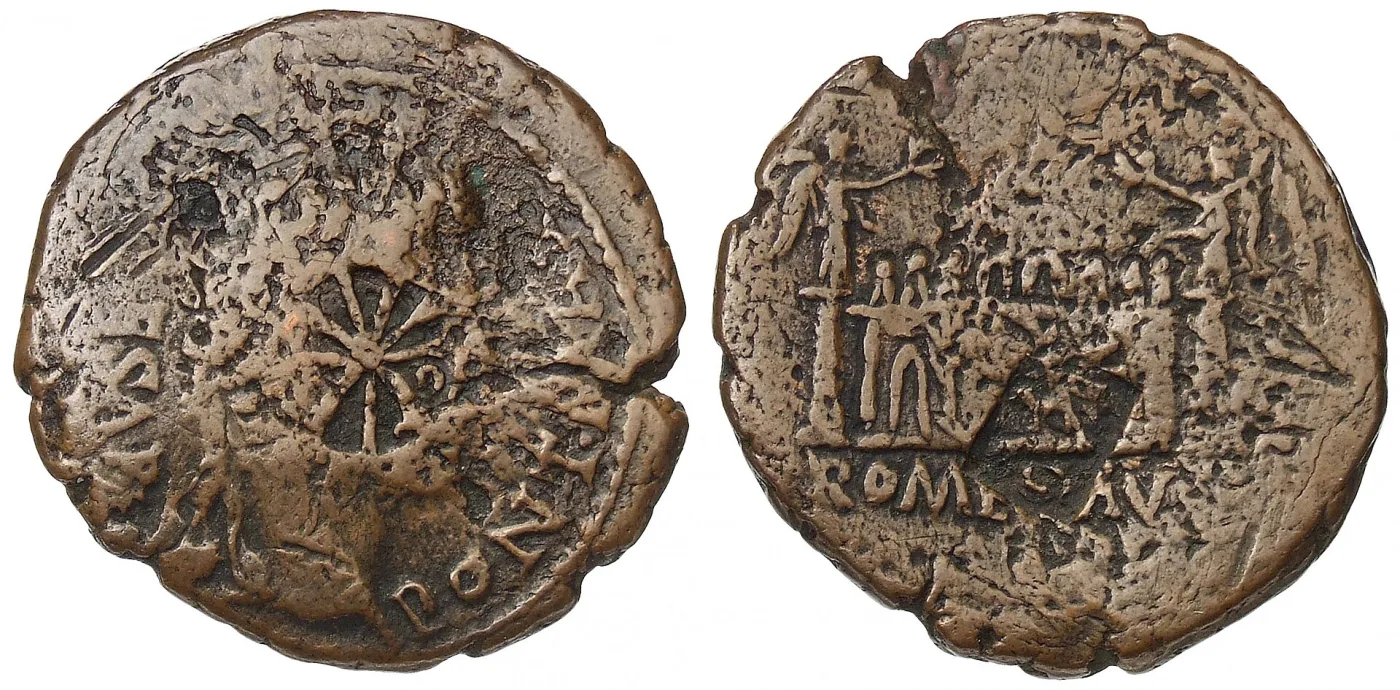
At Kalkriese near Osnabrück, the site identified with the destruction of Varus’s legions in AD 9, the museum holds about 2,000 Roman coins. In 2016 excavators found eight gold aurei lying within a few metres of each other, adding to seven found earlier. They show Augustus on the obverse and his grandsons and heirs Gaius and Lucius Caesar on the reverse, and all were struck before the battle. The most famous small find is a copper coin countermarked VAR, stamped while Varus commanded on the Rhine, between AD 7 and 9. The photograph at the top of this page shows the countermark on a bronze of Augustus from the Lugdunum mint, now in the Berlin coin cabinet.
Augsburg: 5,500 denarii from a riverbed
In 2021, digging ahead of a housing project in Augsburg, archaeologists recovered more than 5,500 denarii, about 15 kg (33 lb) of coins, from an old riverbed. The coins run from Nero to Septimius Severus and include Didius Julianus, who held the throne for only a few months in 193. Reports differ on the length (Smithsonian says two months, The History Blog March to June), and the dates fit about nine to ten weeks.

How to identify the denarii in these hoards
The four finds cover the main kinds of Roman silver you are likely to meet. Start with the obverse and work through this table.
| What you see | What it is | Rough date | Seen in |
|---|---|---|---|
| A god or the helmeted head of Roma, no emperor; maybe a notched edge | Republican denarius (a serratus if notched) | 3rd–1st century BC | Halle, Wesseling |
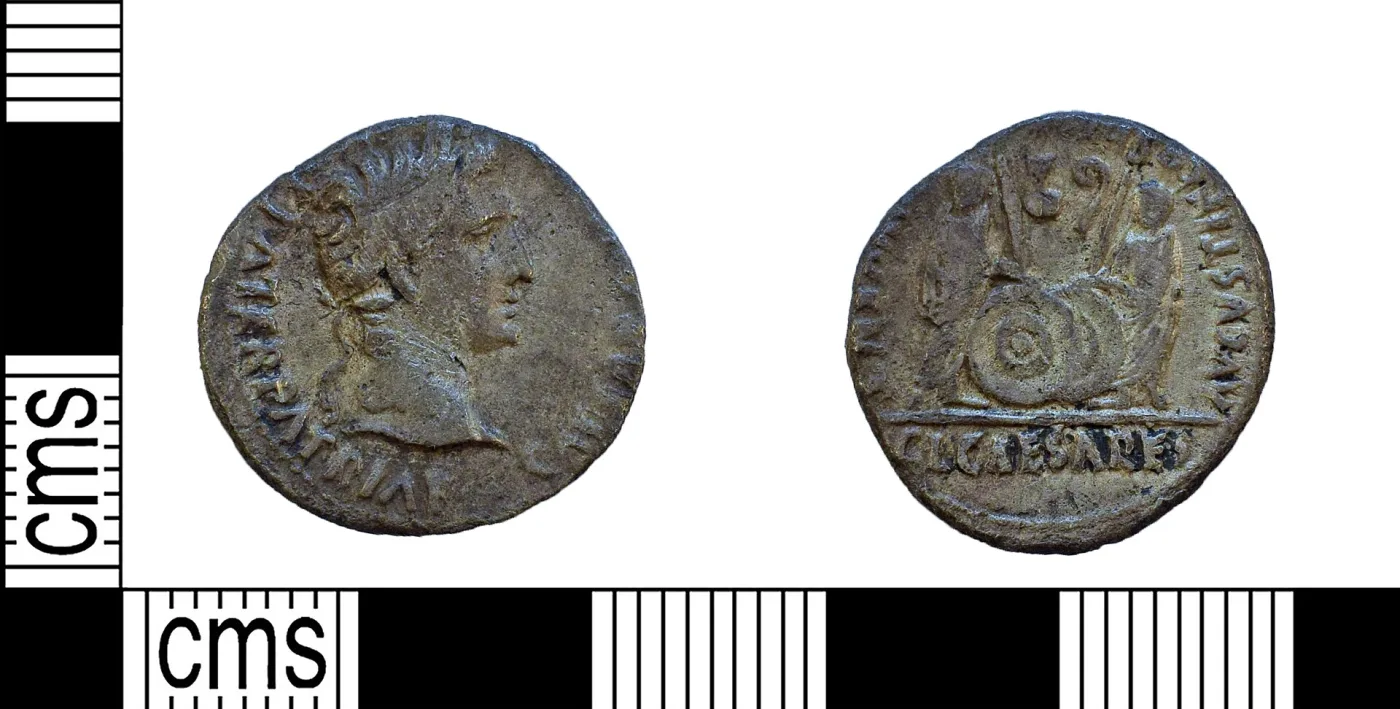
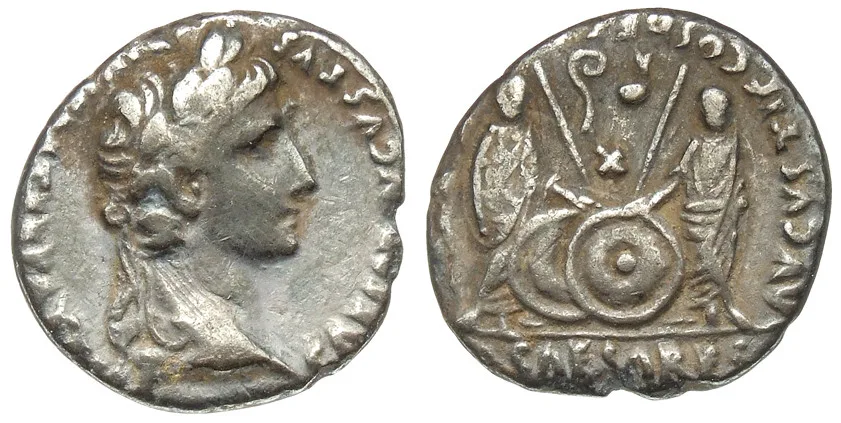
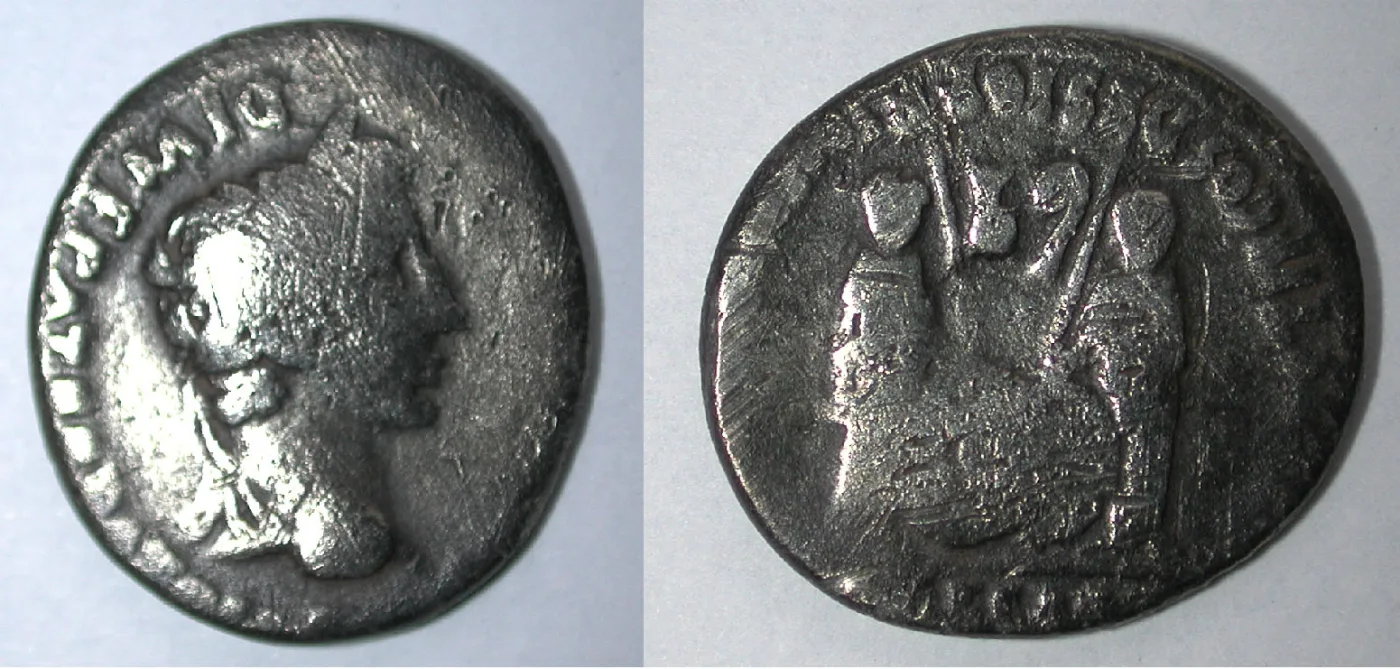
| Augustus’s bare head; reverse with two togate figures, shields and spears, C L CAESARES below | Gaius and Lucius denarius | From 2 BC | Kalkriese |
| Emperor’s head, coin feels slightly light | Post-reform imperial denarius | From c. AD 64 | Augsburg, Wesseling |
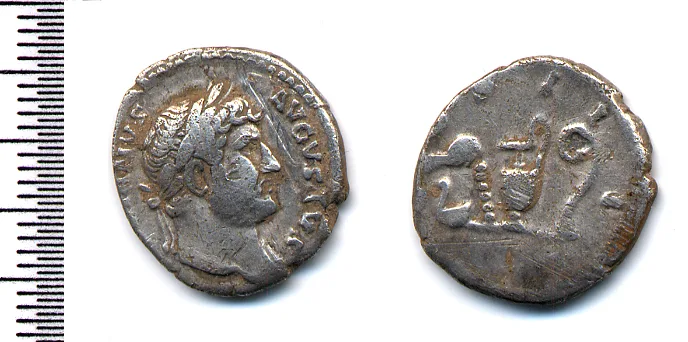
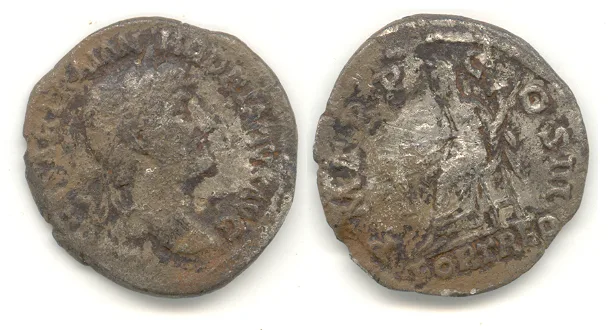
| Bearded emperor, legend naming HADRIANVS | Denarius of Hadrian | AD 117–138 | Wesseling, Augsburg |
| A small stamped rectangle on a bronze coin reading VAR | Varus countermark | AD 7–9 | Kalkriese |
Republican denarii do not show a living ruler until Julius Caesar’s portrait coins of 44 BC. They carry deities, Roma and the names of the annual mint officials, so the date is read from the type and the moneyer, not from a portrait. A notched edge marks a serratus.
The Gaius and Lucius type has a reverse that is easy to recognise: two young men in togas with shields and spears between them, and C L CAESARES in the exergue. The same pair of heirs appears on the gold found at Kalkriese.
After Nero’s reform, around AD 64, the denarius got lighter and less pure. Wikipedia’s denarius article and a CoinWeek survey of Roman silver agree on the change: from about 3.85 g of almost pure silver to roughly 3.2–3.5 g at about 80–85% silver. That is why a scale is useful. A denarius of Augustus and one of Hadrian may look alike in size but should not weigh the same.
Hadrian’s coins are the reason Wesseling made headlines. His bearded portrait and a legend naming HADRIANVS make his denarii easy to name. A hoard whose latest coins are his was closed during or after his reign.
Why the newest coin dates the hoard
A hoard is dated by its latest coin, not its average. Wesseling’s oldest coin is from 148 BC, but its newest, from AD 124/125, is what places the burial in Hadrian’s reign. Augsburg closes with Septimius Severus, so it was buried no earlier than the 190s. At Kalkriese the coin evidence is consistent with a battle in AD 9: the aurei and the Gaius and Lucius coins were all struck before it, and the VAR countermark belongs to Varus’s command.
The same reasoning works on a small group of coins found together or inherited as a lot. List each coin’s date range, then take the latest one.
What the money meant to its owner
Roman pay gives a sense of scale. Soldiers’ pay rose over time, so the comparison depends on the date.
| Period | A legionary’s basic pay per year |
|---|---|
| Julius Caesar to Domitian | 225 denarii |
| From Domitian (81–96) | 300 denarii |
| From Septimius Severus (193–211) | Raised again; sources give from about 400 to 600 |
At 300 denarii a year, the rate in force when the Wesseling hoard was closed, 934 denarii is a little over three years of a legionary’s gross pay, before any deductions. Augsburg’s 5,500 denarii were buried after Severus’s raise, and because the sources disagree on how big that raise was (one gives 500 denarii a year, another 600), any “years of pay” figure for Augsburg is a range, roughly 9 to 11 years at those two rates.
Who owns a Roman coin found in Germany?
Germany’s 16 states each have their own heritage law, and all of them now apply the Schatzregal, which makes archaeological treasure the property of the state. Bavaria was the last: it applies to finds made there from 1 July 2023. Before that, Bavaria followed section 984 of the Civil Code, which splits a treasure between finder and landowner half and half. That rule is known as the Hadrianic division, after the emperor whose coins made Wesseling famous.
In practice this is why the Wesseling hoard belongs to North Rhine-Westphalia, and why its finder was paid a reward for reporting it promptly. Riedl was searching with authorisation, and after his first 15 coins the heritage office took over the excavation. This is a summary, not legal advice. Check the rules of the state you are in before you search.
Buying a “German hoard” coin
Wesseling, Augsburg and Kalkriese are state property and are not for sale. Coins of the same emperors and types are widely available, but a listing that ties an ordinary denarius to a recently announced hoard is adding a story the coin cannot prove. Ask for documentation, and judge the coin on its own merits. The checks in the counterfeit detection guide apply here: weight, edge, and surface. If you have a later German coin, the German coins identification guide picks up the story from the Holy Roman Empire onward.
Frequently Asked Questions
What is the biggest Roman coin hoard found in Germany?
It depends on what is being compared. The Wesseling hoard of 934 silver denarii, announced in September 2026, is described by the Rhineland heritage office as the largest hoard from the time of Hadrian found in Germany. The Augsburg hoard, found in 2021, is larger at more than 5,500 denarii and is called the largest Roman silver hoard ever found in Bavaria, but its coins run later, to Septimius Severus.
How old are the coins in the Wesseling hoard?
The oldest coin was struck in 148 BC under the Roman Republic and the newest in AD 124 or 125, in the reign of Hadrian, so more than 270 years separate them. The hoard was probably buried in the second quarter of the second century AD.
Who owns a Roman coin found in Germany?
In every German state, archaeological treasure now belongs to the state under a rule called the Schatzregal. Bavaria was the last to adopt it, for finds made from 1 July 2023. Before that, Bavaria applied the Civil Code's half-and-half split between finder and landowner, known as the Hadrianic division. The Wesseling hoard became the property of North Rhine-Westphalia, and the finder received a reward for reporting it promptly.
How can I tell a Republican denarius from an imperial one?
Republican denarii do not show a living ruler. They carry gods, the helmeted head of Roma and the names of the annual mint officials, and some have a notched, saw-toothed edge (serrati). From Augustus onward, the emperor's portrait and titles fill the obverse. A denarius with a named emperor's head is imperial.
Can I buy a coin from the Wesseling hoard?
No. The hoard belongs to the state of North Rhine-Westphalia and is going on display at the LVR-LandesMuseum Bonn. Coins of the same emperors and types are common on the market, but a seller who claims a coin came from a recently announced German hoard is making a claim that should come with documents.
Why were so many Roman coins buried in Germany?
There were no banks, so people kept savings in containers and sometimes buried them. When the owner died or could not come back, the money stayed in the ground. Coins also crossed the frontier through contact with the peoples beyond it, which is how Republican denarii reached Saxony-Anhalt, far outside the empire.