What Were Roman Coins Called? The Republic's Denominations and Their Value Marks
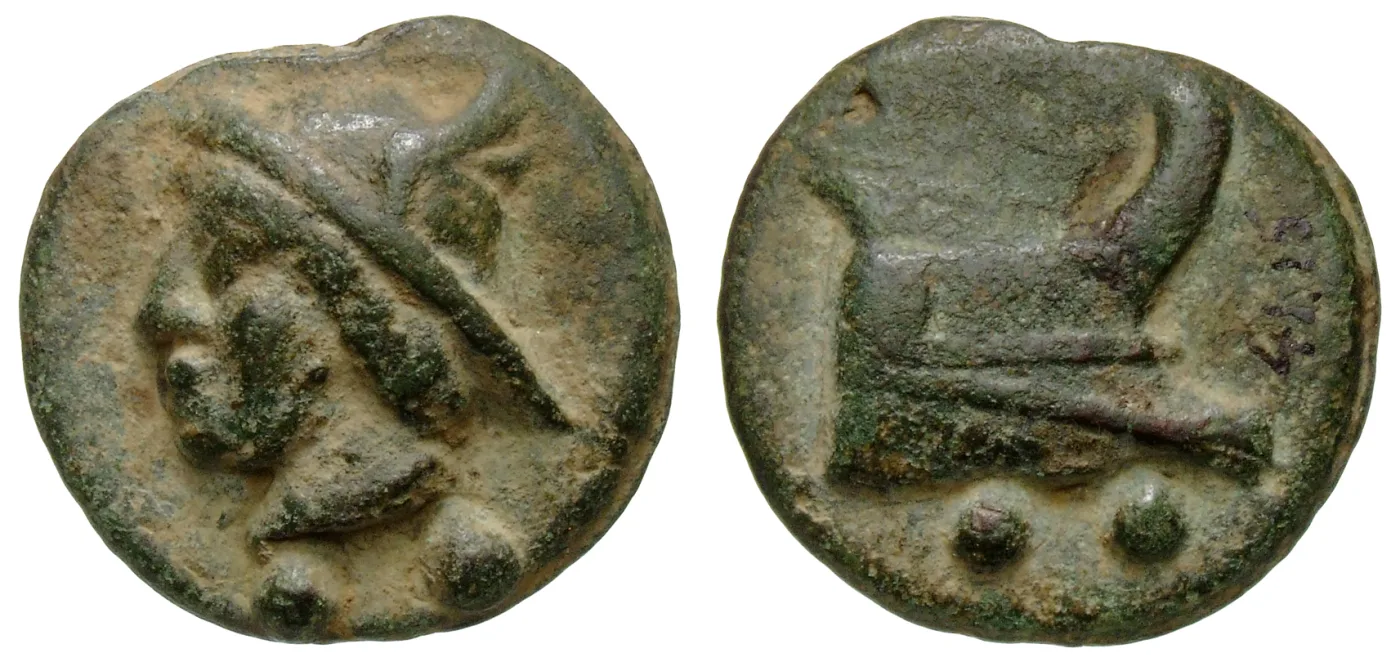
If someone asks what Roman coins were called, the usual answer is a list of names: denarius, sestertius, aureus. That list belongs to the Empire. The Roman Republic used the same few words and a set of older ones that most people have never heard: the semis, the triens, the quadrans, the sextans and the uncia. Unlike the emperors’ coins, which never name their denomination, many of these early coins state their value on their face, in letters or in raised dots.
This guide covers the Republic’s coins, roughly the third to the first century BC: what each one was called, what it was worth, and how to read the value mark that tells you which one you are holding. For the gold, silver and bronze of the emperors (aureus, solidus, antoninianus, follis), see the denominations section of our ancient Roman coins guide.
Every coin was a fraction of the as
Rome’s first official bronze coins were cast in moulds, not struck, and are known today as aes grave, “heavy bronze”. Sources date the first of them differently: one museum exhibit puts it around 300 BC, while the standard catalogue (Crawford’s Roman Republican Coinage) dates the first cast as to 280–276 BC. Either way, it was early in the third century BC.
The unit was the as. At first it was meant to weigh one Roman pound, the libra, and like the pound it was divided into twelve unciae, or ounces. Every smaller coin was named after its share of the as:
| Name | Share of the as | Unciae | Value mark | Usual obverse head |
|---|---|---|---|---|
| As | 1 | 12 | I | Janus, two-faced |
| Semis | 1/2 | 6 | S (sometimes six dots) | Saturn |
| Triens | 1/3 | 4 | four dots | Minerva, helmeted |
| Quadrans | 1/4 | 3 | three dots | Hercules |
| Sextans | 1/6 | 2 | two dots | Mercury |
| Uncia | 1/12 | 1 | one dot | Roma, helmeted |
The dots (numismatists call them pellets) are simply a count of unciae. Four dots means four ounces, which is a third of a twelve-ounce as, so the coin is a triens. The S on the half is for semis, “half”. Read the marks this way and you can name a coin that has lost its face.
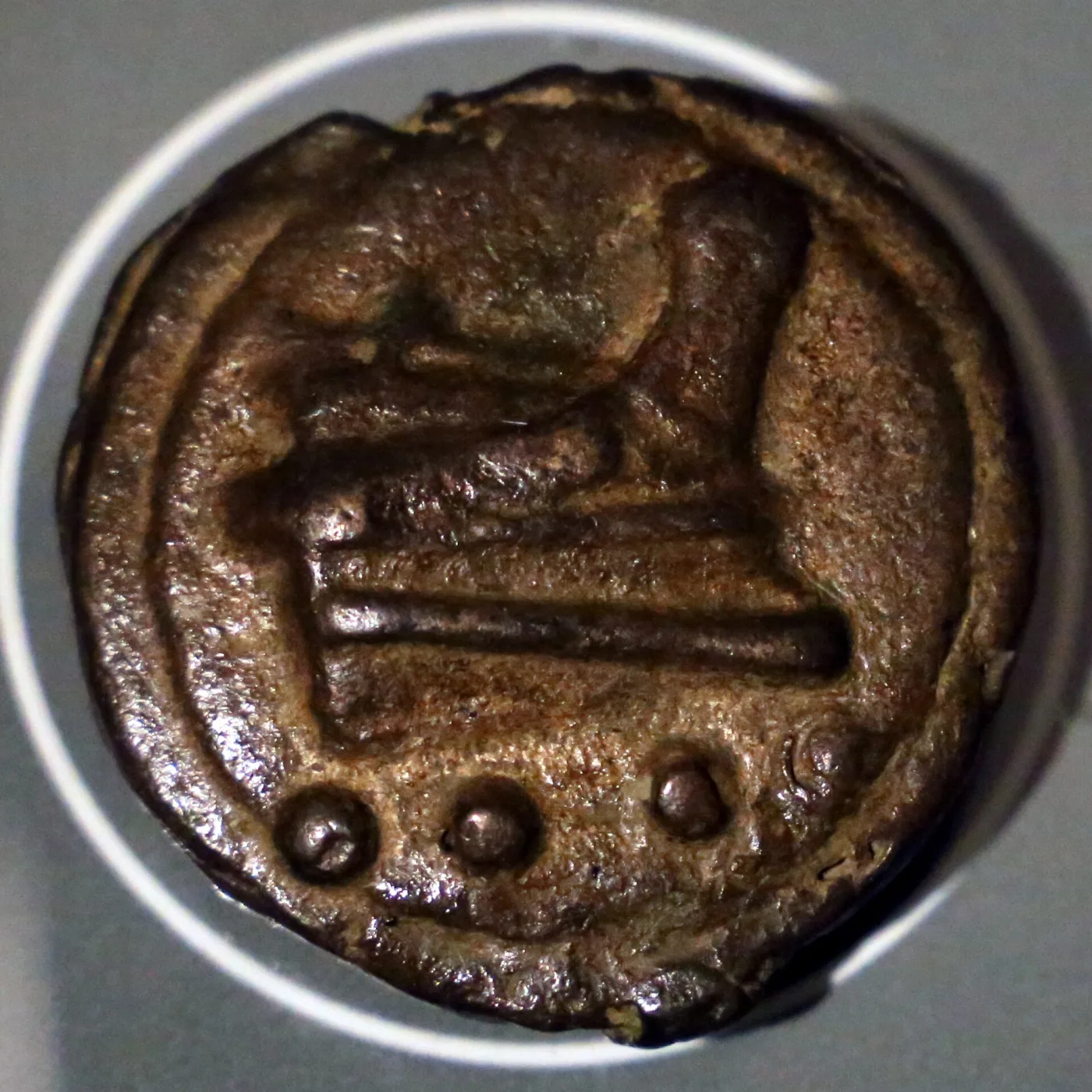
The heads are the usual set on the series with a ship’s prow on the reverse, which became the standard bronze design. Sources agree on all of them except the semis. Most give Saturn; one museum exhibit gives Jupiter. Both are bearded, laureate men, and the S mark settles the denomination whichever god it is.
How to read a Republican bronze, step by step
- Look for dots first. Count the raised dots on both sides. Many coins carry them on both sides, which helps when one side is worn. One to four dots gives you the uncia, sextans, quadrans or triens.
- No dots? Look for a letter. A large S means a semis. A vertical stroke, I, means an as.
- Check the reverse. On the common prow series the reverse is the front of a war galley, often with ROMA below it. A prow tells you the coin belongs to this system even when the value mark is gone.
- Use the head as a cross-check. A two-faced head is an as. A helmeted woman with four dots is a triens; Hercules with three dots is a quadrans.
Do not identify these coins by weight or size alone. The as did not stay at a pound.

Why two coins of the same name can weigh very differently
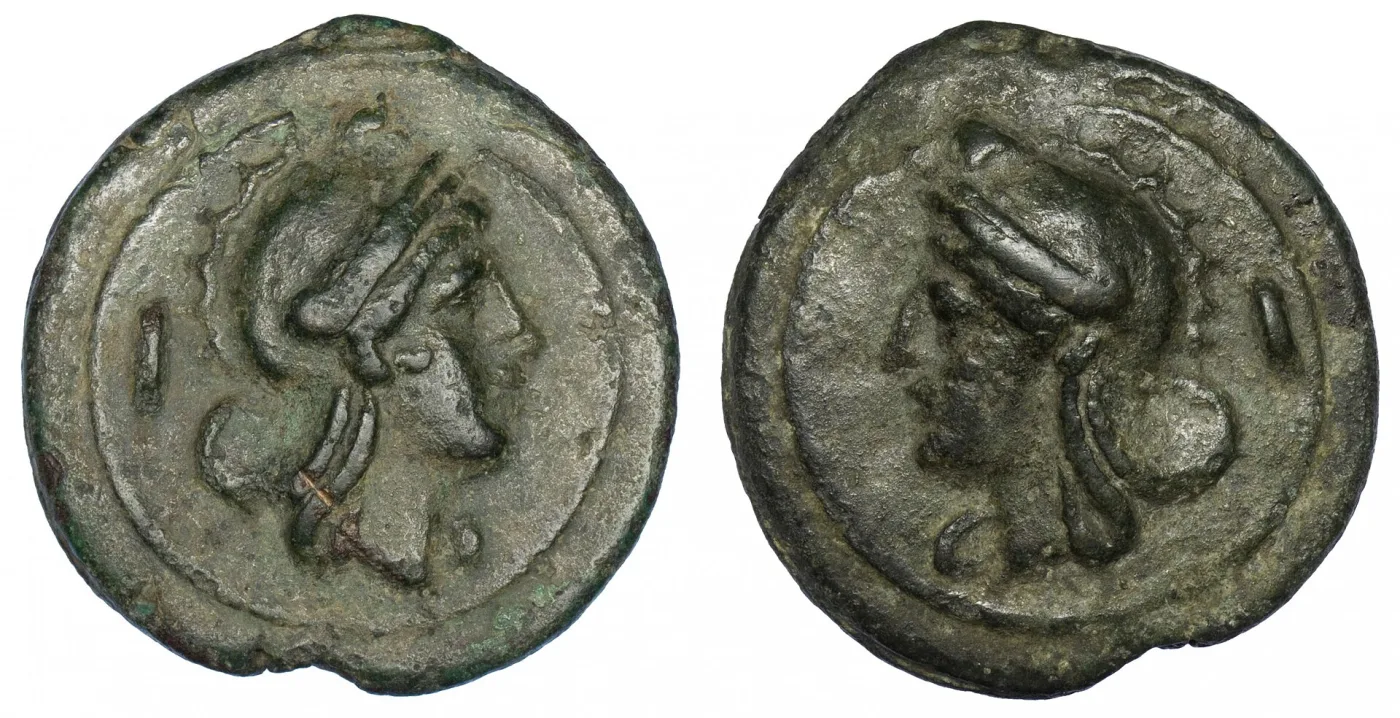
The as kept its name while it lost most of its metal. By about 270 BC it had already dropped to a lighter, reduced standard. During the war with Hannibal it was cut again several times, between about 218 and 211 BC, and as the coins got smaller Rome stopped casting them and began striking them like other coins. By the middle of the second century BC the as was down to about one Roman ounce, a twelfth of its original weight.
So a cast triens of the early third century BC can be heavier than a struck as from a century later. That is why the value mark matters more than the scale: the name followed the mark, not the weight.
The silver coins: denarius, quinarius and sestertius
Around 211 BC, during the Second Punic War, Rome introduced a new silver coin, the denarius. Two other silver coins came with it, and all three carried their value in asses:
| Silver coin | Mark | Value at introduction | Value after c. 141 BC |
|---|---|---|---|
| Denarius | X | 10 asses | 16 asses |
| Quinarius (half denarius) | V | 5 asses | 8 asses |
| Sestertius (quarter denarius) | IIS | 2½ asses | 4 asses |
The marks are Roman numerals. X is ten. V is five. IIS reads “two and a half”: II for two asses and S for a semis, the half.
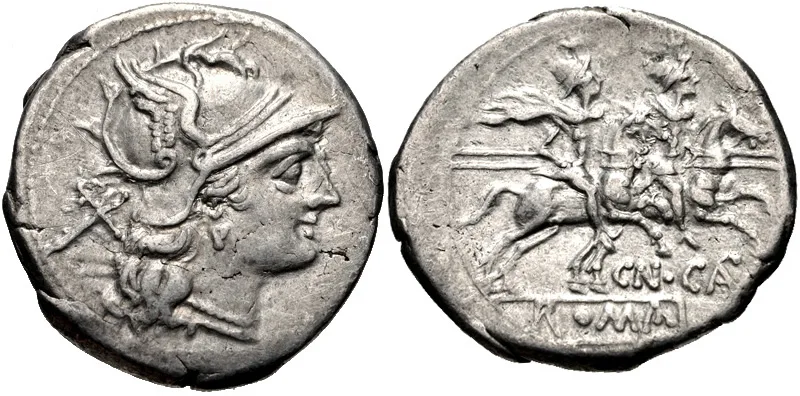
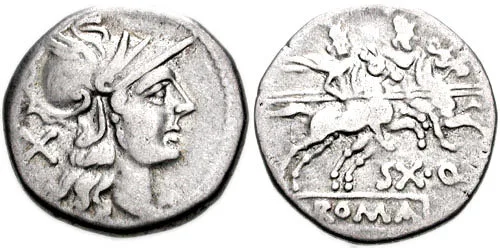
In about 141 BC the denarius was retariffed to sixteen asses. For a short time the new value was written XVI. The mark then became an X with a horizontal bar through the middle, a monogram of XVI. If the X on your denarius is crossed, it was struck after the change. Republican denarii also turn up in hoards; our guide to Roman coins found in Germany shows how to tell them from imperial ones.
The small silver sestertius is a different coin from the large brass sestertius of the Empire. The name survived; the coin did not. The emperors’ sestertius is the 30–35 mm brass coin covered in our Roman bronze coins guide.
The coin with no value mark: the victoriatus
One Republican silver coin breaks the rule. The victoriatus carries no mark of value at all. It is named for its reverse, the goddess Victory placing a wreath on a trophy, and its obverse shows the laureate head of Jupiter. It was struck alongside the early denarius, in silver of a lower fineness than the denarius, and was valued at about three-quarters of a denarius.
If you have a small Republican silver coin with Victory and a trophy and no X, V or IIS, it is very likely a victoriatus.
Names you will see on the coins themselves
Republican coins carry a few words that are not denomination names. ROMA is the issuing authority, Rome. Many later coins also carry the name of the moneyer, the official responsible for the issue. Neither one tells you what the coin was called. For that, go back to the dots, the S, the I and the numerals.
Quick reference
- One to four dots: uncia (1), sextans (2), quadrans (3), triens (4).
- S: semis, half an as.
- I: as.
- X on silver: denarius, 10 asses. Crossed X or XVI: denarius after c. 141 BC.
- V on silver: quinarius. IIS on silver: sestertius.
- Silver, Victory with a trophy, no mark: victoriatus.
Frequently Asked Questions
What were Roman coins called?
Under the Republic the bronze coins were the as and its fractions: the semis (half), triens (third), quadrans (quarter), sextans (sixth) and uncia (twelfth). The silver coins were the denarius, the quinarius (half a denarius), the sestertius (a quarter) and the victoriatus. Under the Empire the best-known names are the aureus, denarius, sestertius, dupondius and as.
What do the dots on a Roman coin mean?
On Roman Republican bronze, raised dots (pellets) count unciae, twelfths of an as. One dot is an uncia, two a sextans, three a quadrans and four a triens. A half, the semis, is usually marked S instead.
How many asses were in a denarius?
Ten when the denarius was introduced around 211 BC, which is why early denarii are marked X. Around 141 BC it was retariffed to sixteen asses; for a short time the mark read XVI, and then became an X with a horizontal bar through it.
What does IIS mean on a Roman coin?
IIS is the value mark of the small silver sestertius: II for two asses and S for a semis, a half, so two and a half asses, a quarter of the original ten-as denarius. After the retariffing of about 141 BC the sestertius was worth four asses.
Which Roman silver coin has no value mark?
The victoriatus. It shows the laureate head of Jupiter and, on the reverse, Victory crowning a trophy, and it carries no X, V or IIS. It was valued at about three-quarters of a denarius.