Ottoman Coins: How to Read the Tughra, the Mint and the Date
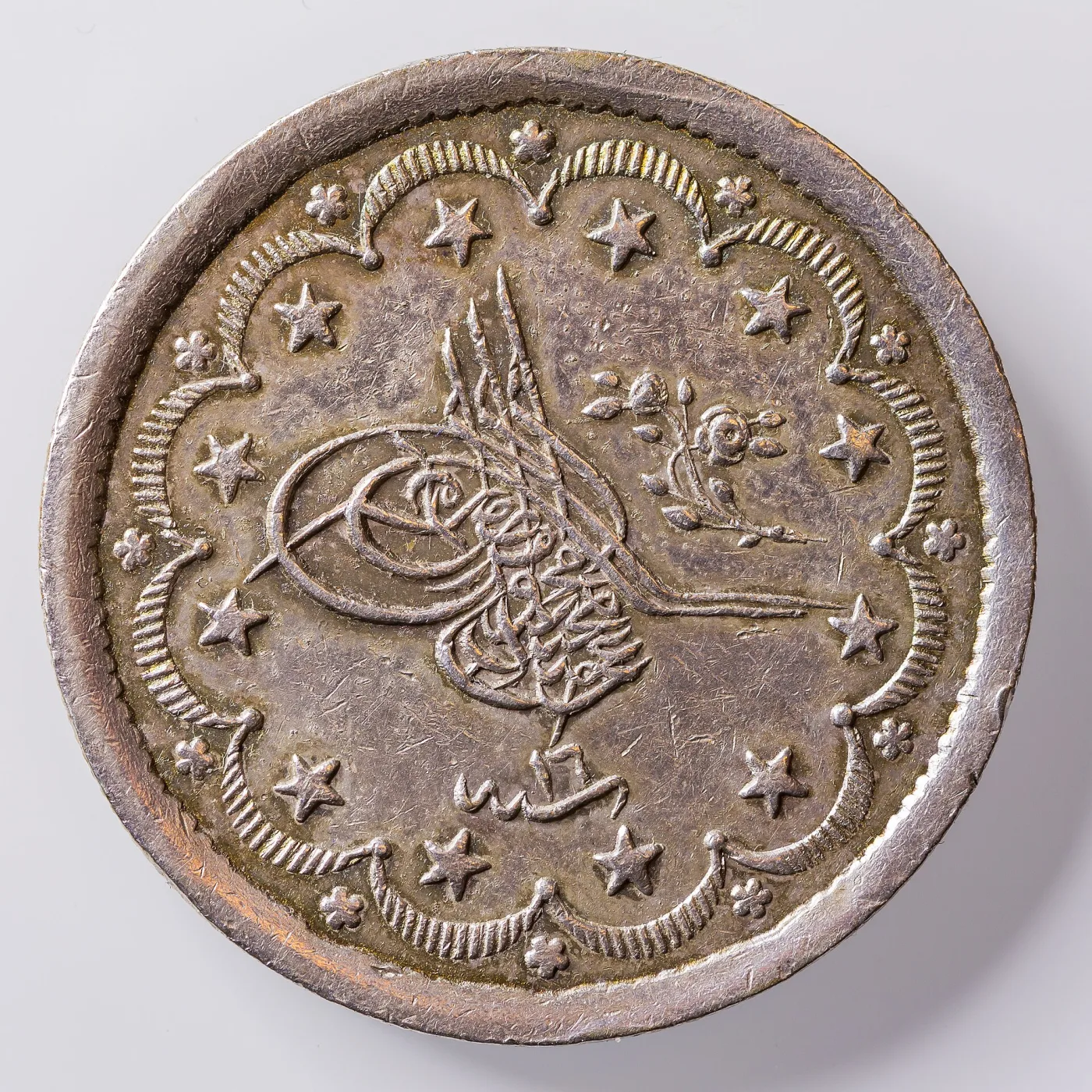
Coins of the Ottoman Empire turn up in old family tins all over Europe and the Middle East, and they tend to be set aside as “Turkish” or “Arabic” and never read. That is a pity, because the later ones are among the easiest coins with Arabic script to identify. Almost every one carries the same three pieces of information in the same places: the sultan’s monogram, the name of the mint, and a pair of numbers that together give the year.
This guide shows where to find each of them, how to turn the numbers into a date, and where the traps are. For the general method that works on any coin, start with the coin identification guide.
The Three Things to Find
Lay the coin down and look for these, in this order.
| What | Where it usually is | What it tells you |
|---|---|---|
| The tughra | Centre of one side, large | Which sultan |
| The mint name | Middle line of the other side, after “duriba fi” | Where it was struck |
| The accession year | Bottom of the mint side, four digits | When that sultan came to the throne |
| The regnal year | A small number, often just below the tughra | How many years into his reign |
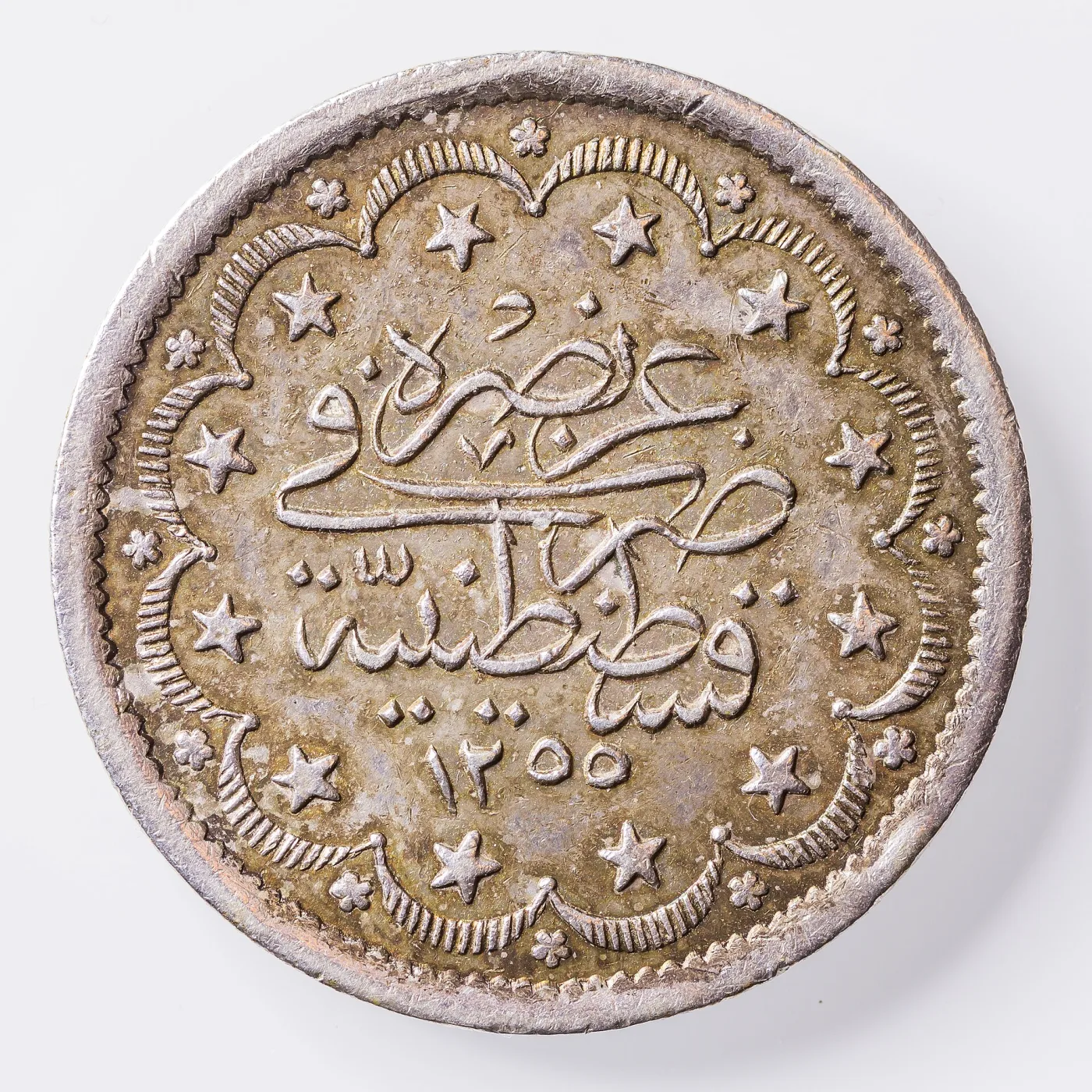
The two coins below are the same piece, front and back, and show all four.
The Tughra: the Sultan’s Signature
The tughra is a calligraphic monogram: the sultan’s name and titles written into one fixed emblem, with three tall upright strokes and a large loop sweeping out to the left. Each sultan had his own, and it served as his signature on documents as well as on coins. It appears on Ottoman coins as early as an akçe of Süleyman Çelebi dated AH 806 (1404), and on later coins it is the standard design of one side.
Tughras of different sultans look alike at a glance, so do not try to match one by eye alone. Read the accession year on the other side first (see below), which names the sultan far more reliably, and then use the tughra to confirm it.
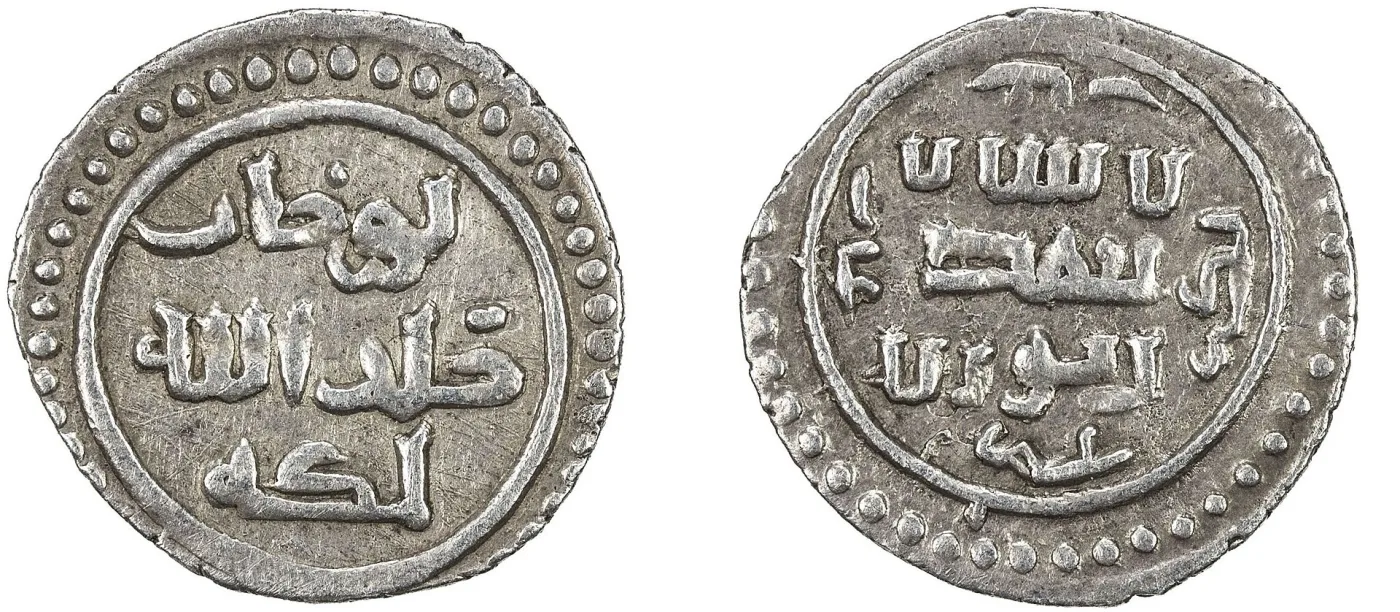
Older coins, before the tughra became the usual design, carry the sultan’s name and titles written out in lines of script instead. The akçe, the small Ottoman silver coin, was struck in quantity from about 1326 under Orhan, and early ones look like the pair below: small, thin, and covered in text on both sides.
Reading Eastern Arabic Numerals
Ottoman dates are written in Eastern Arabic numerals. Most are easy once you know two of them: zero is a dot and five is a small circle, which is the opposite of what a Western eye expects.
| Western | 0 | 1 | 2 | 3 | 4 | 5 | 6 | 7 | 8 | 9 |
|---|---|---|---|---|---|---|---|---|---|---|
| Eastern Arabic | ٠ | ١ | ٢ | ٣ | ٤ | ٥ | ٦ | ٧ | ٨ | ٩ |
The digits run left to right, as ours do, even though the words around them read right to left. On the coin above, the date at the bottom is ١٢٥٥, which is 1255: a one, a two, and two small circles.

Accession Year and Regnal Year: Finding the Real Date
This is where most people go wrong. On most later Ottoman coins, the four-digit date is the year the sultan came to the throne, and it stays the same on every coin of his reign. The year the coin was actually struck is given by the small regnal year number, often placed below the tughra.
To get the year of striking:
Hijri year of striking = accession year + regnal year − 1
The minus one is there because the first year of a reign is year 1, not year 0. On the 20 kuruş above, the accession year is 1255 and the regnal year is 16, so the coin was struck in AH 1270.
Two cautions. A regnal year begins on the day the sultan took the throne, not on the first day of a Hijri year, so each regnal year overlaps two Hijri years and some references add without subtracting one. Allow a year either way. And the result is still a Hijri (AH) year, which needs converting.
Converting AH to AD
The Hijri calendar is lunar, so 33 Hijri years pass in about 32 of ours. The usual rule of thumb:
AD ≈ AH − (AH ÷ 33) + 622
For AH 1270: 1270 ÷ 33 is about 38.5, and 1270 − 38.5 + 622 gives 1853.5, so the coin dates to 1853 or 1854. The same conversion is worked through in the calendars section of our Indian coins guide, which covers the Mughal rupees that use the same system.
Which Sultan? Accession Years to Know
The accession year is the quickest way to name the sultan. These are the reigns whose coins are most often found:
| Accession year on the coin (AH) | Sultan | Came to the throne (AD) |
|---|---|---|
| 1171 | Mustafa III | 1757 |
| 1187 | Abdülhamid I | 1774 |
| 1203 | Selim III | 1789 |
| 1223 | Mahmud II | 1808 |
| 1255 | Abdülmecid I | 1839 |
| 1277 | Abdülaziz | 1861 |
| 1293 | Abdülhamid II | 1876 |
| 1327 | Mehmed V Reşad | 1909 |
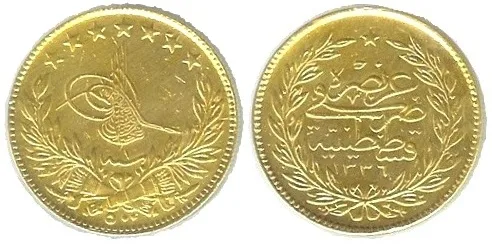
| 1336 | Mehmed VI | 1918 |
Mehmed VI was the last sultan. The Republic of Turkey began issuing its own coins in 1924, starting with the 10 kuruş that August, so any coin with a tughra predates that.
The Mint Name
The mint is named in a short formula, duriba fi, “struck in”, followed by the place. On coins of the capital it is usually Kostantiniye, the Ottoman name for Istanbul. In some 18th-century reigns, including Mustafa III, Abdülhamid I and Selim III, coins of the same mint read Islambol instead.
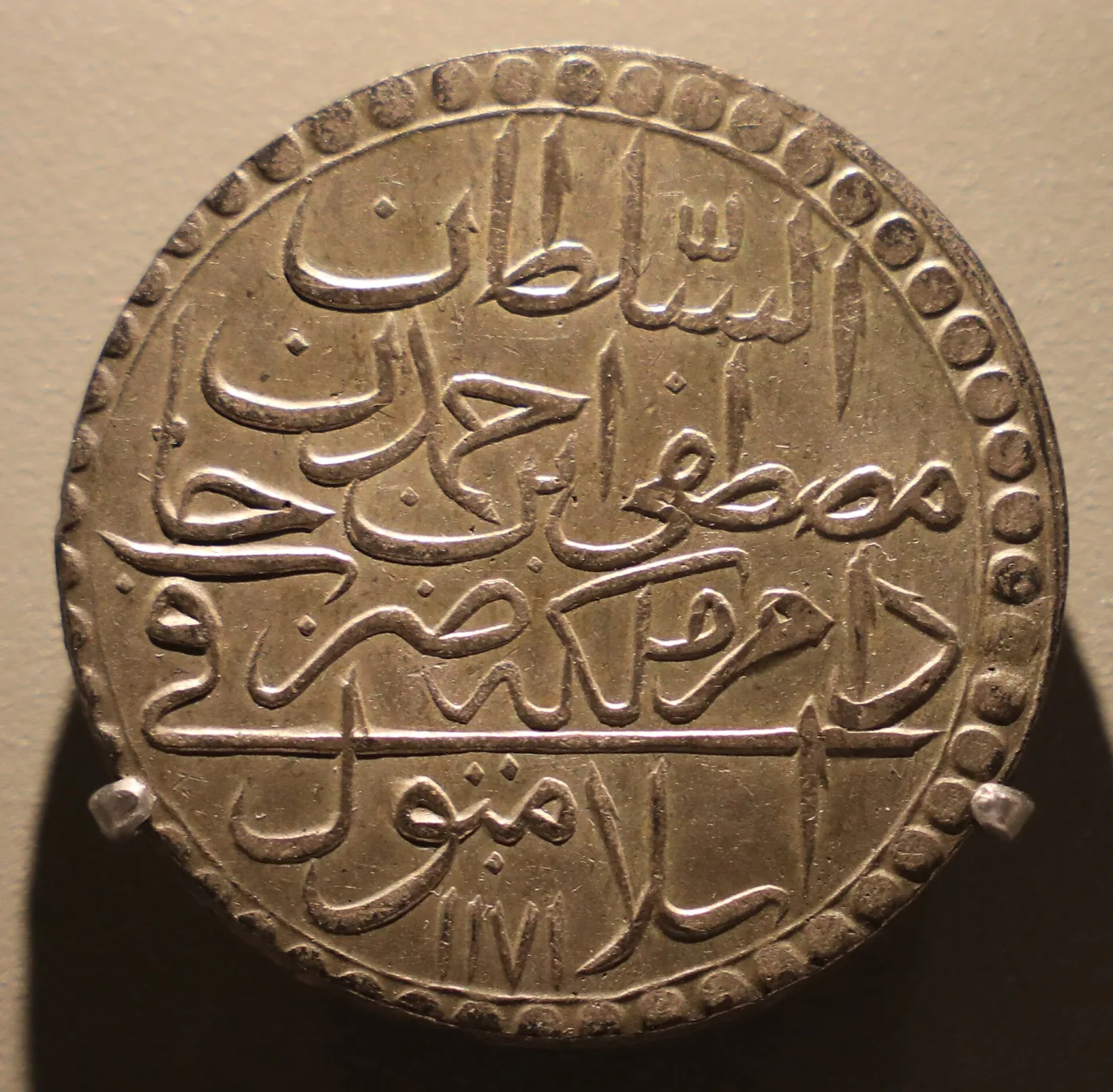
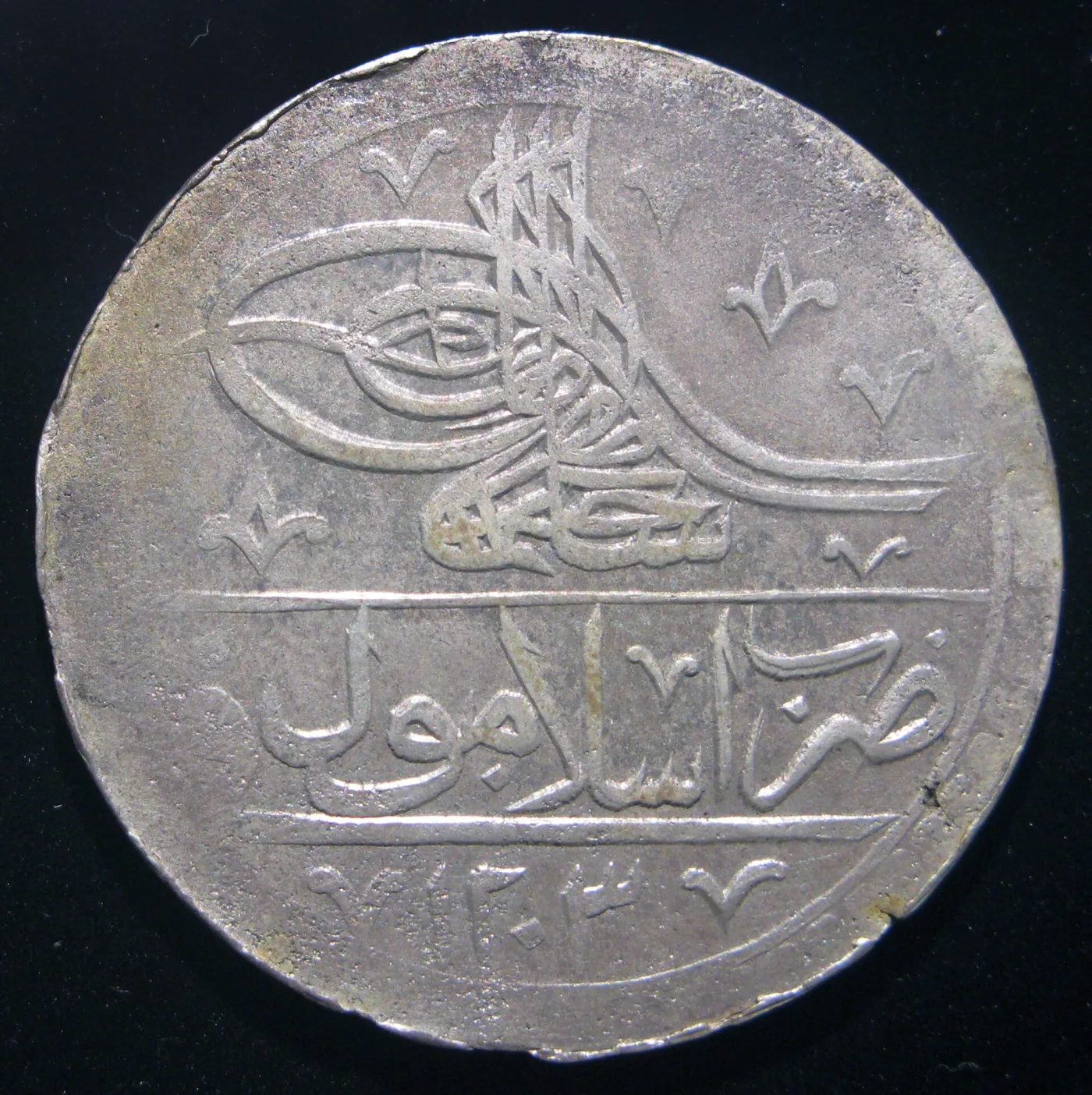
Coins struck away from the capital name their own mint, and the major provincial ones are worth recognising:
| Mint name on the coin | Place |
|---|---|
| Misr | Egypt |
| Tunis | Tunis |
| Jaza’ir | Algiers |
| Tarablus Gharb | Tripoli, in Libya |
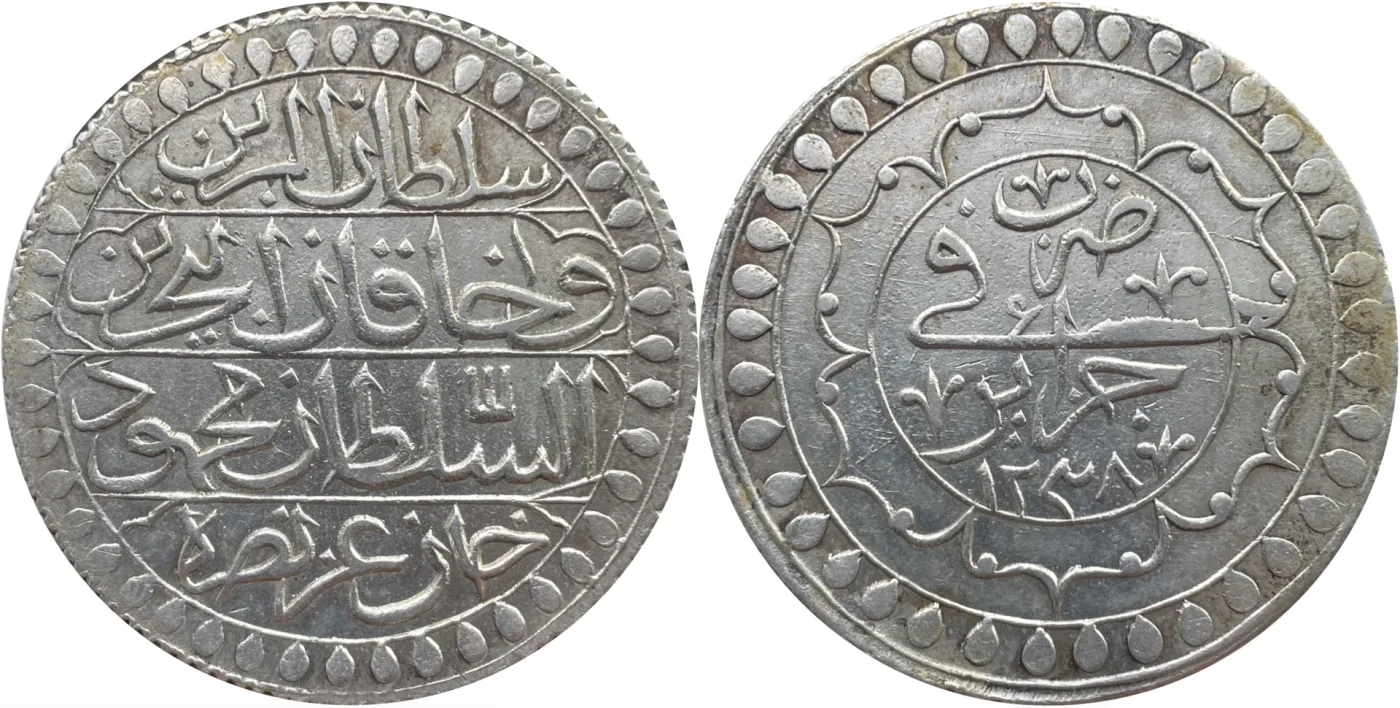
Some of these issues have their own denominations. Algiers struck the budju, and the coin below, dated 1238 (1823), is a 2 budju of Mahmud II with “struck in Jaza’ir” on the reverse.
Denominations: Akçe, Para, Kuruş, Lira
| Denomination | Metal | When | Value |
|---|---|---|---|
| Akçe | Silver | From about 1326 (Orhan) | The original small silver coin |
| Kuruş (piastre) | Silver | From 1688 (Süleyman II) | 40 para |
| Para | Small change | Alongside the kuruş | 1/40 kuruş |
| Lira | Gold | From the 1844 reform | 100 kuruş |
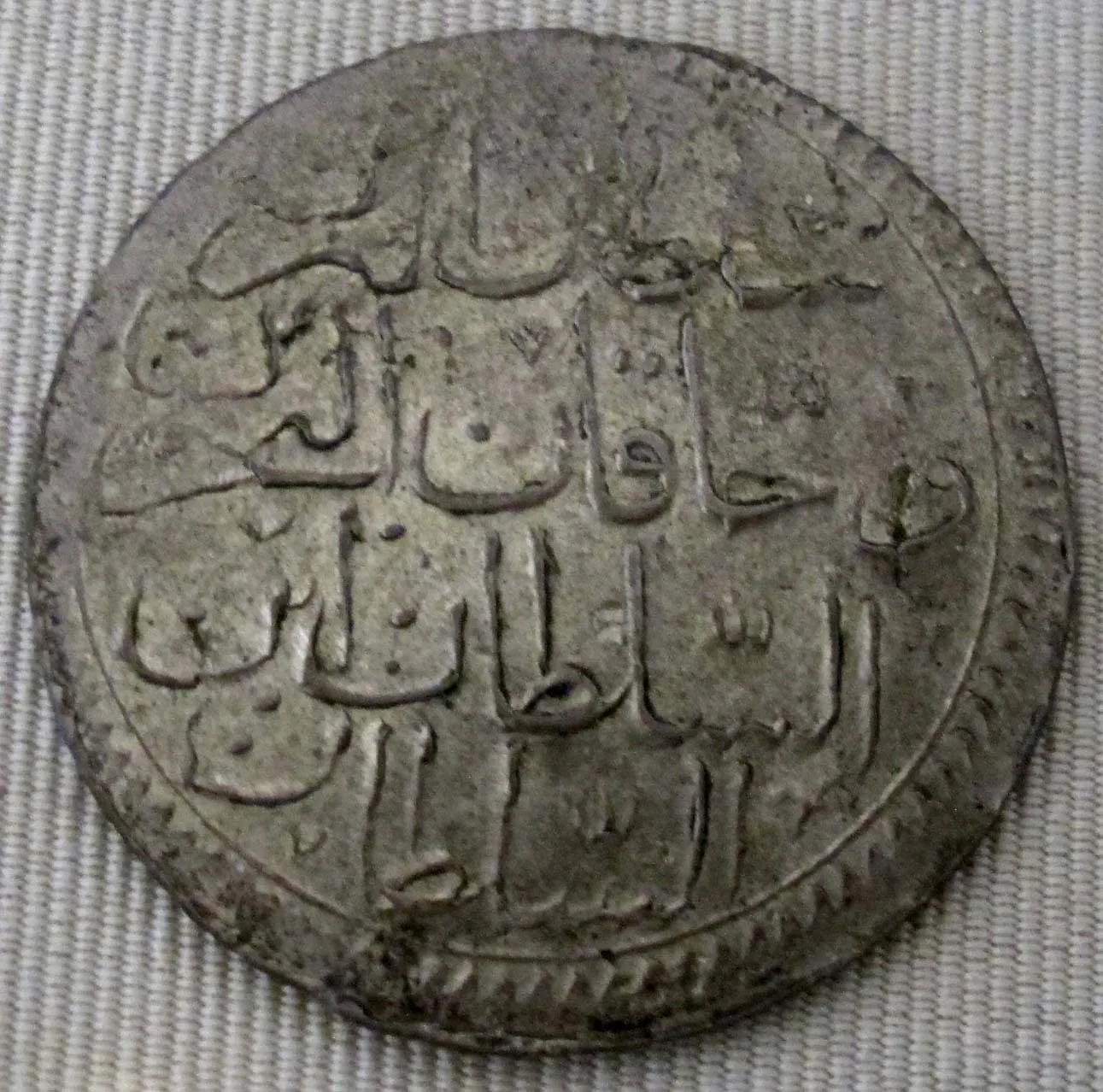
The kuruş was the large silver coin of the late 17th and 18th centuries; the reign of Süleyman II, in which it was introduced, is the one in the photograph below. The reform of 1844 under Abdülmecid I made the gold lira of 100 kuruş the top of the system, with the kuruş divided into 40 para, and the first 100 kuruş gold coins date from that year.
Worn and Damaged Coins
Many Ottoman coins that come out of the ground or old jewellery are bent, holed or corroded, and the date is often the first thing to go. Even then the tughra, with its three tall strokes and big loop, usually survives well enough to say “Ottoman”, as on this find.
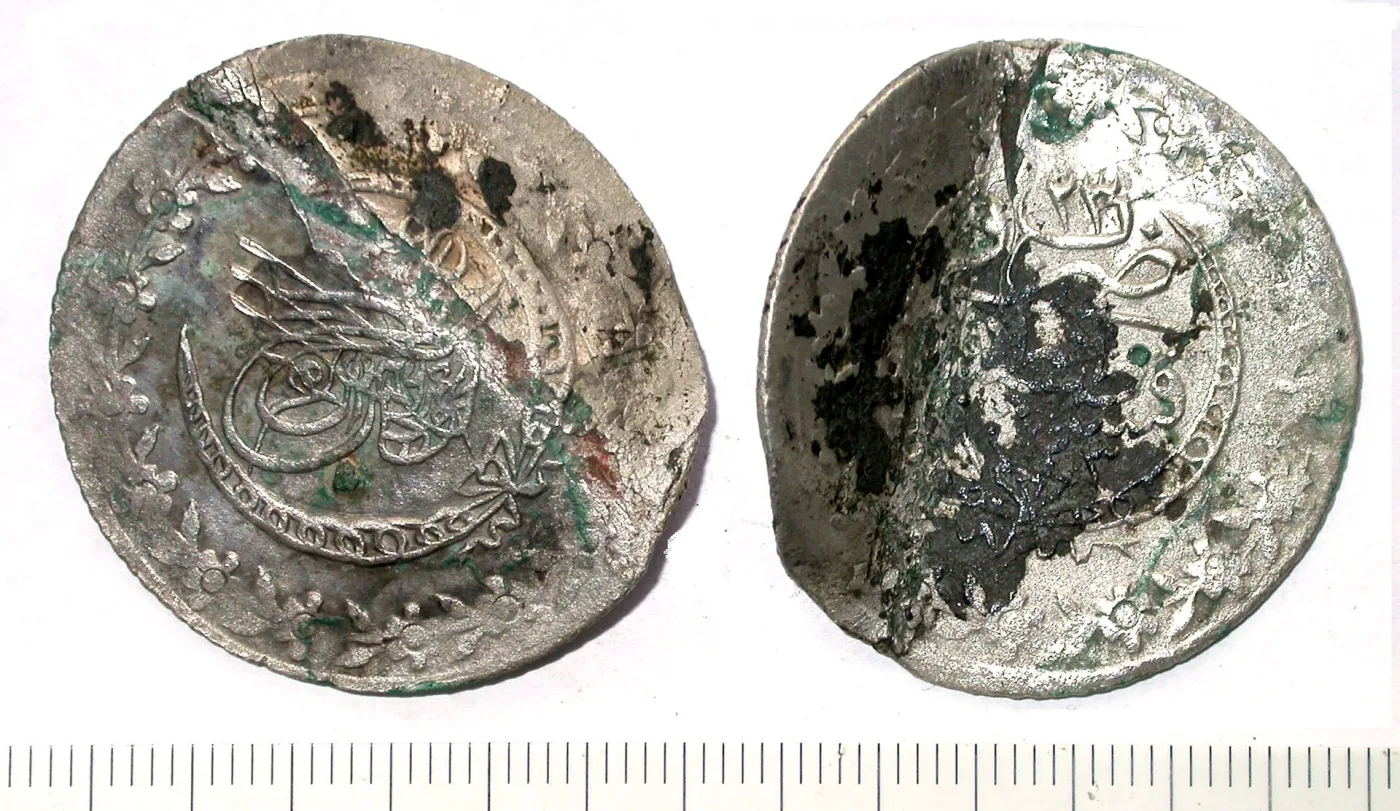
When the mint line survives but the date does not, the mint name still narrows the reign: Islambol, for example, points to the 18th-century sultans listed above.
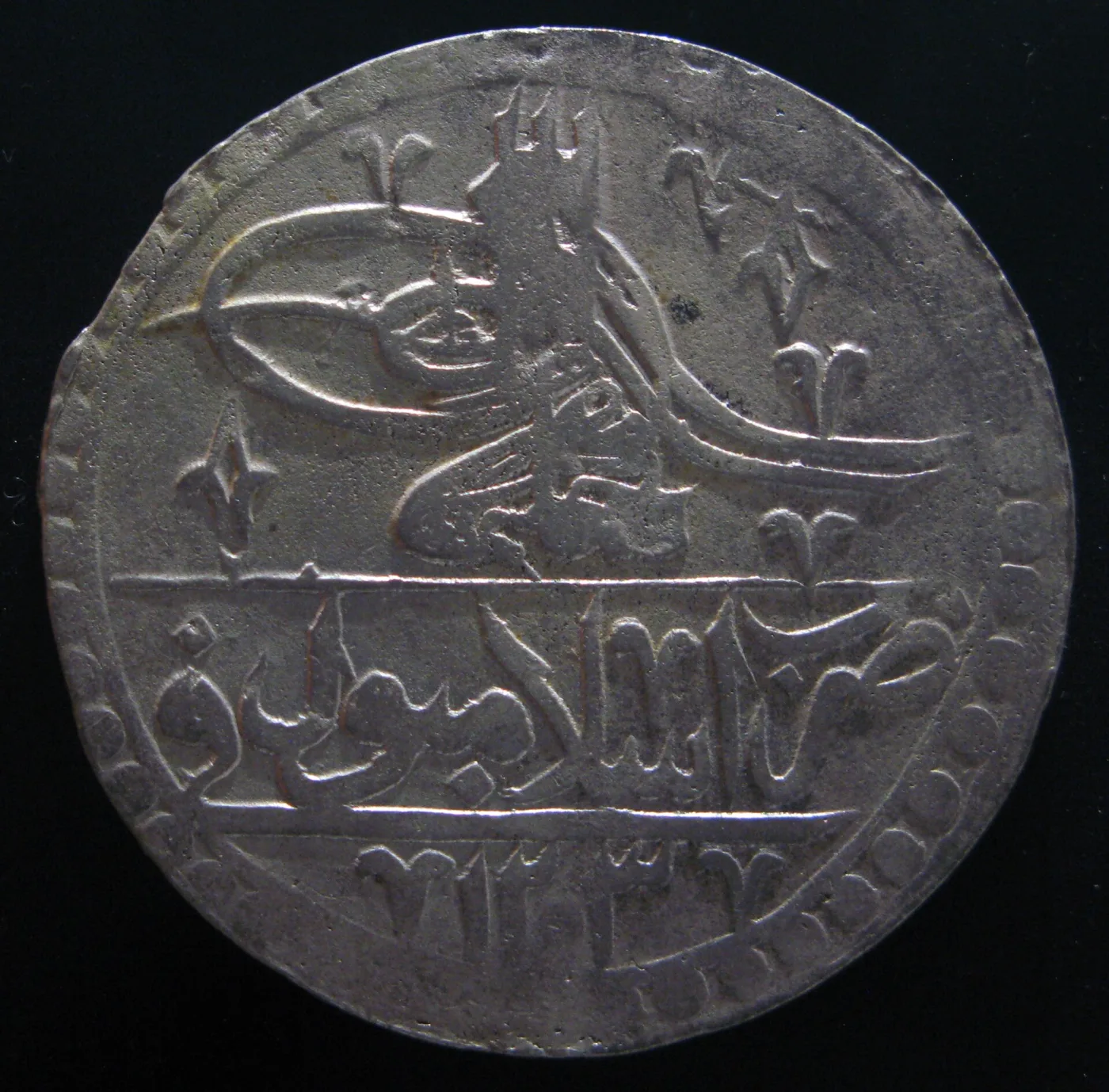
Gold: Restrikes and Copies
Ottoman gold needs extra care. Copies of the gold of Mehmed V Reşad, the coins dated 1327 with the word Reşad near the tughra, were already a known problem decades ago. In 2022 the Turkish state mint began striking the Reşat gold design again, with the original 1327 date.
So a gold coin reading 1327 can be an original of 1909 to 1918, a modern official strike, or a counterfeit. The date cannot tell you which. Weight, diameter and a professional test can.
For the general checks on any gold coin, see the counterfeit detection guide.
A Quick Checklist
- Find the tughra. If there is one, the coin is Ottoman or from an Ottoman province.
- Find the line after “duriba fi” and read the mint name.
- Read the four-digit date at the bottom and match it to the accession table.
- Find the small regnal number, add it to the accession year, subtract one.
- Convert that AH year to AD, and give the answer as two possible years.
If the script still beats you, a clear photo of each side is enough for Coin Identifier to suggest the type. For the older coins with Arabic script that came before the Ottomans, see the Umayyad dirham guide, and for the empire the Ottomans replaced in Constantinople, the Byzantine coins guide.
Frequently Asked Questions
How do I know if my coin is Ottoman?
Look for a coin covered in Arabic script with no portrait, and on the later coins a large calligraphic emblem on one side: the tughra, the sultan's monogram. The other side usually carries a few lines of text with a mint name such as Kostantiniye or Islambol and a four-digit date in Eastern Arabic numerals, usually beginning 11, 12 or 13.
Why is the same date on so many Ottoman coins?
Because the big date on later Ottoman coins is the year the sultan came to the throne, not the year the coin was struck. A whole reign of coins can read 1255 or 1293. The year of striking comes from the small regnal number, usually near the tughra: add it to the accession year and subtract one.
How do I convert an Ottoman date to a Western year?
First work out the Hijri year of striking: accession year plus regnal year, minus one. Then subtract one thirty-third of it and add 622. A coin reading 1255 with regnal year 16 was struck in AH 1270, which is about 1853 to 1854. Give the answer as two possible years, because a Hijri year straddles two of ours.
What does Kostantiniye mean on a coin?
It is the Ottoman name for Istanbul, the empire's main mint, and it follows the words 'duriba fi', meaning 'struck in'. Some 18th-century coins of the Istanbul mint use the name Islambol instead. Other mint names, such as Misr (Egypt), Tunis, Jaza'ir (Algiers) and Tarablus Gharb (Tripoli), mean a provincial coin.
Is my Ottoman gold coin genuine?
Be careful. Ottoman gold, above all the coins of Mehmed V Reşad dated 1327, has been copied for decades, and the Turkish state mint began restriking that design in 2022 with the original date. A coin that reads 1327 can therefore be anything from an original to a recent strike or a fake. Weight, size and a professional test settle it, not the date.
When did Ottoman coinage end?
With the last sultan, Mehmed VI, whose coins carry the accession year 1336 (1918). The Republic of Turkey put its own coins into circulation in 1924, beginning with the 10 kuruş in August of that year.