Medieval English Silver Penny: Short Cross, Long Cross or Edwardian?
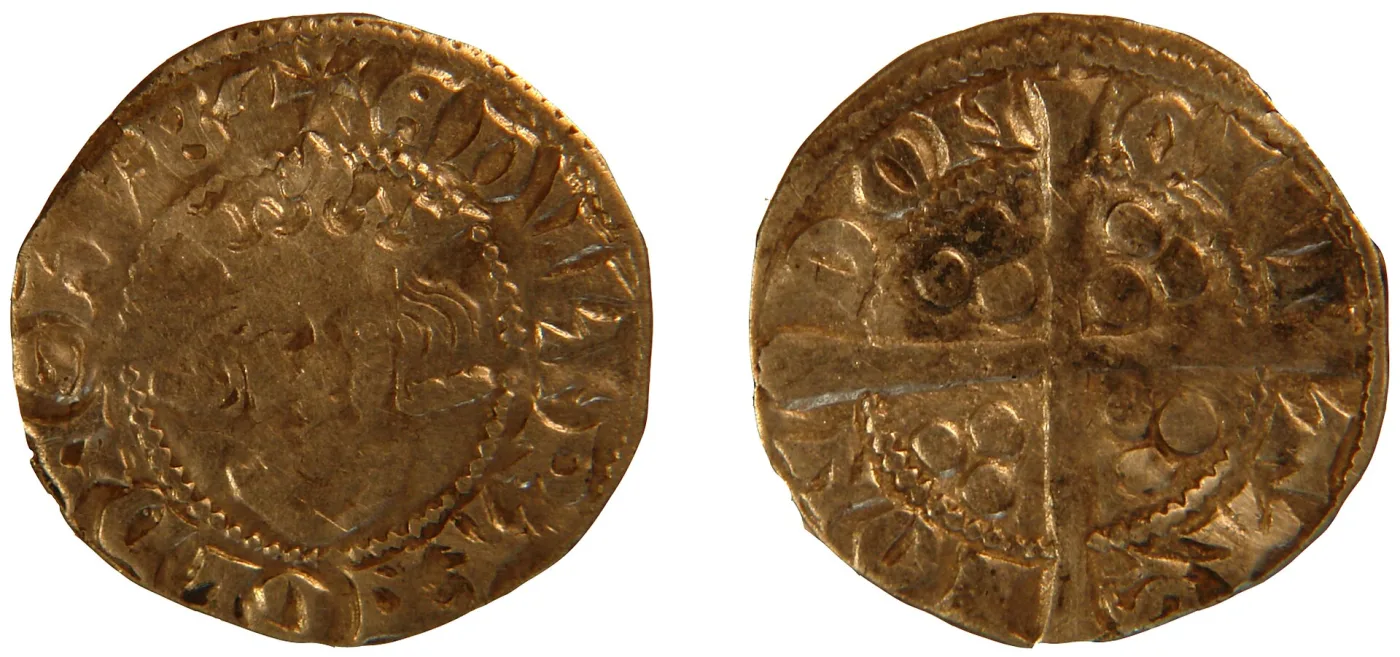
The small, thin silver coin with a cross on one side and a crowned face on the other is the commonest medieval coin found in English soil. Most of them were struck in a single century and a half, between Henry II’s recoinage of 1180 and the middle of Edward III’s reign, and nearly all of them belong to one of three types. Those three are told apart by one feature you can read even on a worn coin: the cross on the reverse.
This guide shows how to place a penny in its type, what the legend can and cannot tell you about the king, how to read the mint, and which coins found alongside English pennies are not English at all. For British coins after the Middle Ages, from the milled era to decimalisation, see the British coins guide; for the general method behind any identification, start with the coin identification guide.
The Three Types at a Glance
Turn the coin to the side with the cross. Everything else follows from it.
| Short Cross | Voided Long Cross | Edwardian | |
|---|---|---|---|
| Dates | 1180 to 1247 | 1247 to 1279 | 1279 onward |
| Reverse cross | Double-lined, stops at the inner circle | Double-lined, runs through the legend to the edge | Single-lined, runs to the edge |
| In the angles | A small cluster of four pellets | Three pellets | Three pellets |
| King’s name | HENRICVS REX, whoever reigned | Henry, with his number (TERCI or III) | Edward, with no number |
| Reverse legend | Moneyer, then ON, then mint | Moneyer, ON, mint, split into four by the cross | The mint only, after CIVITAS or VILLA |
A double line is what numismatists call a voided cross: two parallel lines with a gap between them, rather than one solid bar. The voiding is the fastest test between the second and third types, and the length of the cross is the fastest test between the first and second.
Short Cross Pennies, 1180 to 1247
Henry II replaced his earlier Tealby coinage with the Short Cross penny in 1180. The obverse shows the crowned king facing, holding a sceptre, inside an inner circle. The reverse has a short voided cross with a quatrefoil of pellets in each angle, all inside the inner circle, and a legend naming the moneyer and then the mint, usually abbreviated, with the word ON between them.
The surprise is the obverse legend. It reads HENRICVS REX on every Short Cross penny, for sixty-seven years. Richard I and John never put their own names on an English penny; the coins struck in their reigns kept Henry’s name and the same design, and the series carried on into Henry III’s reign until 1247. So a penny that says Henry may well be a coin of Richard or John.
Specialists divide the series into eight numbered classes by the style of the bust, the crown and the lettering, and it is the class, not the name, that attributes a coin to a reign. Separating them needs a good coin and a reference; the type itself needs only a glance at the cross.
Voided Long Cross Pennies, 1247 to 1279
By the 1240s the Short Cross coinage had been circulating for more than sixty years, much of it worn and clipped. Clipping was the trick of shaving silver from the edge of a coin and passing it at full value, and the Short Cross design made it easy: the cross stopped well inside the rim, so nothing showed how large the coin was supposed to be.
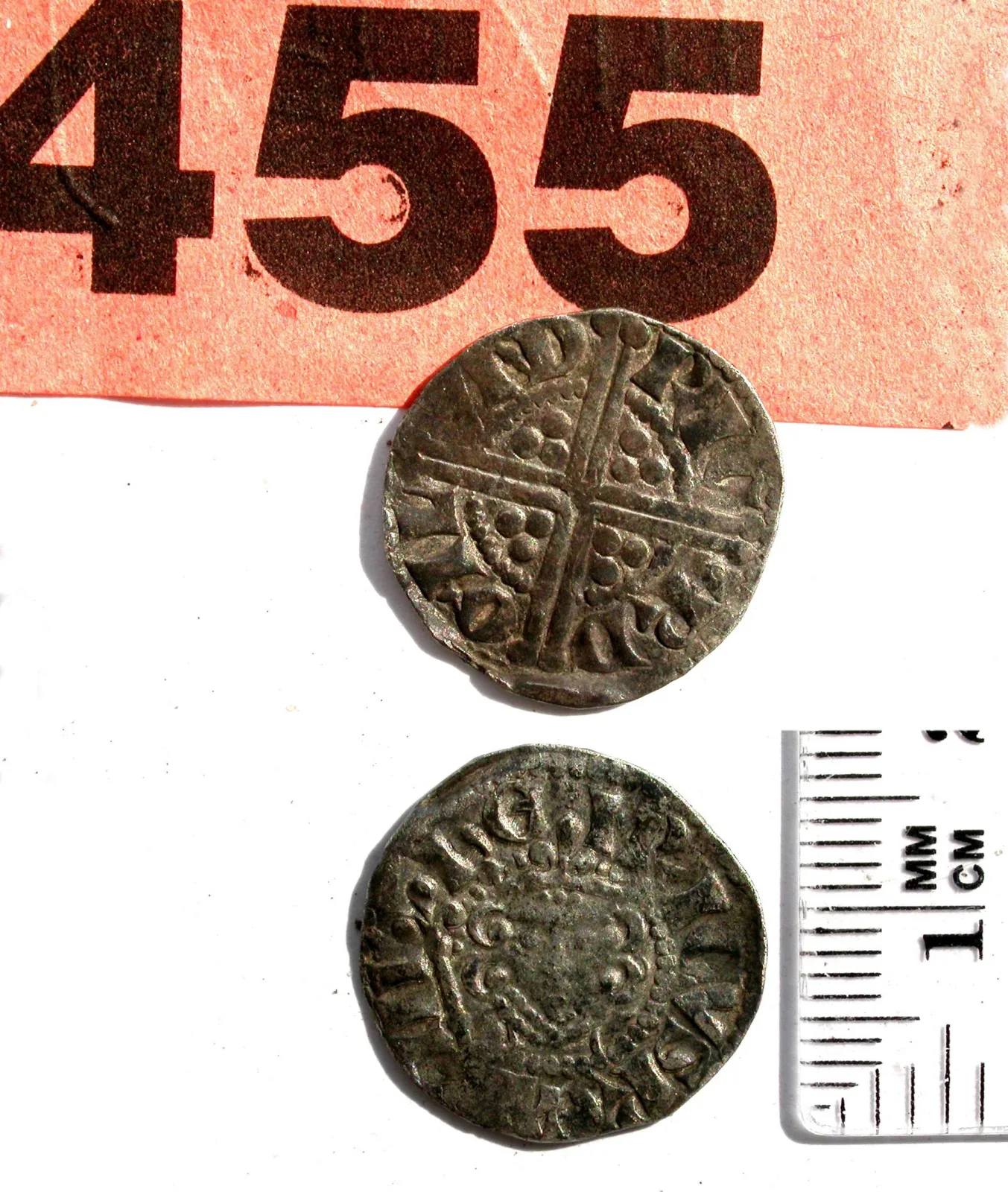
The answer, in 1247, was to run the voided cross out to the edge. A Long Cross penny with the ends of its cross missing has visibly been clipped. The reverse carries three pellets in each angle, and the moneyer-and-mint legend is now split into four by the arms of the cross. The obverse adds something the Short Cross penny never had: Henry’s number, written out as TERCI on the earliest coins and as III later. The earliest classes show the king without a sceptre; later ones put a sceptre in his hand. On a typical reverse the legend reads in four parts, such as NIC / OLE / ON C / ANT, the moneyer Nicole at Canterbury.
To cope with the recoinage, many provincial mints were reopened alongside London and Canterbury, so a Long Cross penny can carry the name of a town that has not had a mint for centuries. Production of the type carried on for seven years after Henry III died in 1272, into the reign of Edward I, until it was replaced in 1279.

Edwardian Pennies, from 1279
Edward I’s new coinage of 1279 changed three things at once, and each is visible.
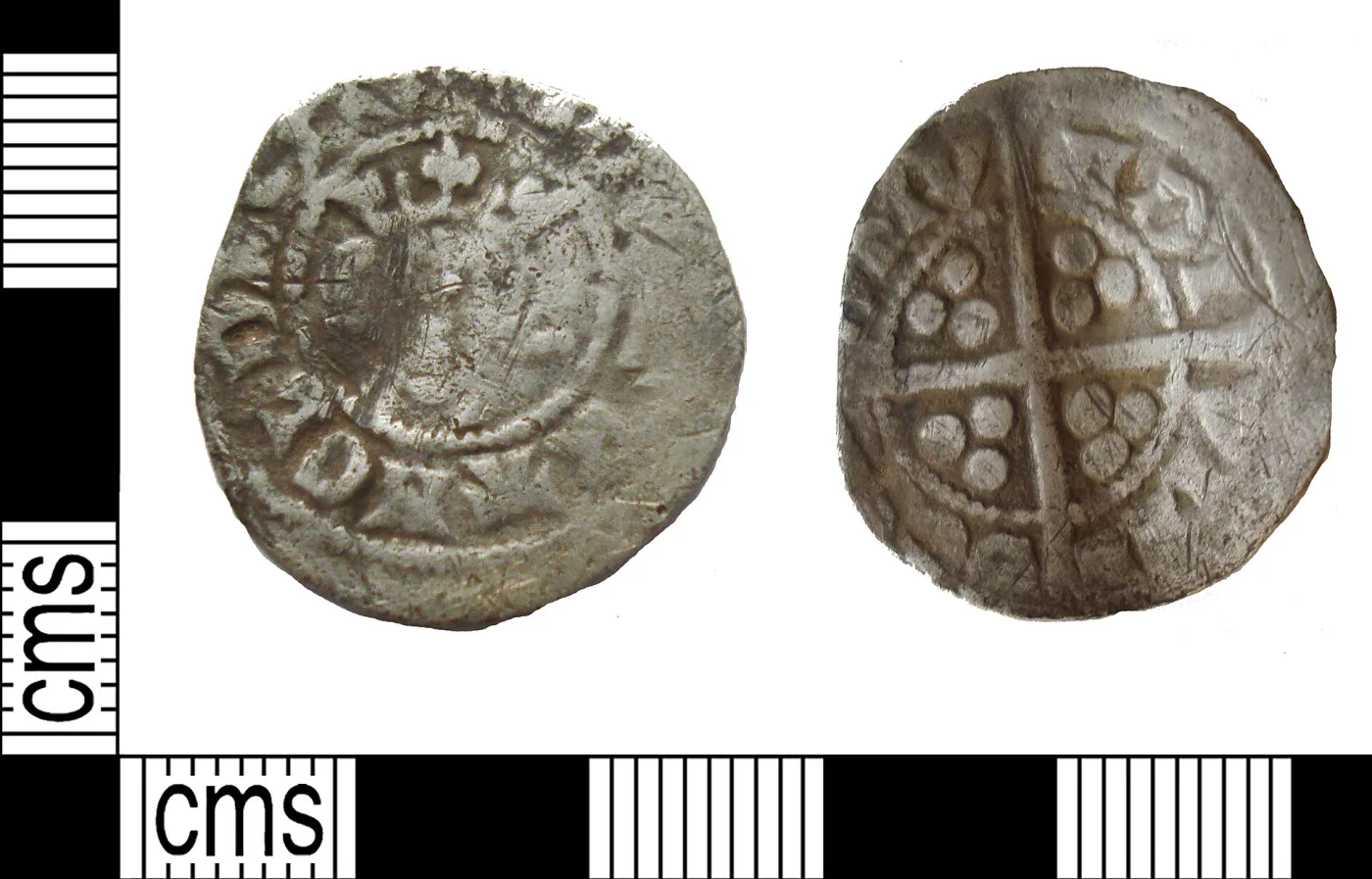
- The cross became a single solid line, still reaching the edge, with three pellets in each angle.
- The moneyer disappeared. The reverse names only the mint, usually after CIVITAS (“city”) or VILLA (“town”): CIVITAS LONDON for London, CIVITAS CANTOR for Canterbury, and VILLA SCI EDMVNDI, in several spellings, for Bury St Edmunds. Large numbers were struck at London and Canterbury.
- The king lost his number. The obverse reads an abbreviation of EDWARDVS REX ANGLIE DOMINVS HYBERNIE, Edward, King of England, Lord of Ireland, written in forms such as EDW R ANGL DNS HYB. The abbreviation varies, but the initials E, R, A, D and H are always there.
The same recoinage brought in round halfpennies and farthings, and a fourpenny groat. The basic penny design stayed in use, with changes of detail, through the later Middle Ages.
Which Edward?
Because the legend never carries a number, an Edwardian penny says Edward whether it was struck under Edward I (1272 to 1307), Edward II (1307 to 1327) or early in Edward III’s reign. Collectors sort these coins into the fifteen numbered groups of the Fox classification, published by the brothers H. B. Earle Fox and J. S. Shirley-Fox in the British Numismatic Journal. Groups 1 to 10 cover Edward I, and Edward II’s coins sit in the later groups.
The features that decide a group are small: the shape of the crown, especially whether its side ornaments have three leaves or two; the forms of letters such as N and S; and marks on the king’s breast. Specialists warn that almost every pointer has exceptions, because crown punches stayed in use for years and across reigns, so a two-leaved crown alone does not prove Edward II. On a worn find, “Edwardian penny, 1279 to 1344” is an honest attribution. Edward III’s later pennies, from 1344, were lighter and are distinguished by their own legends and portraits.
Cut Halfpennies and Farthings
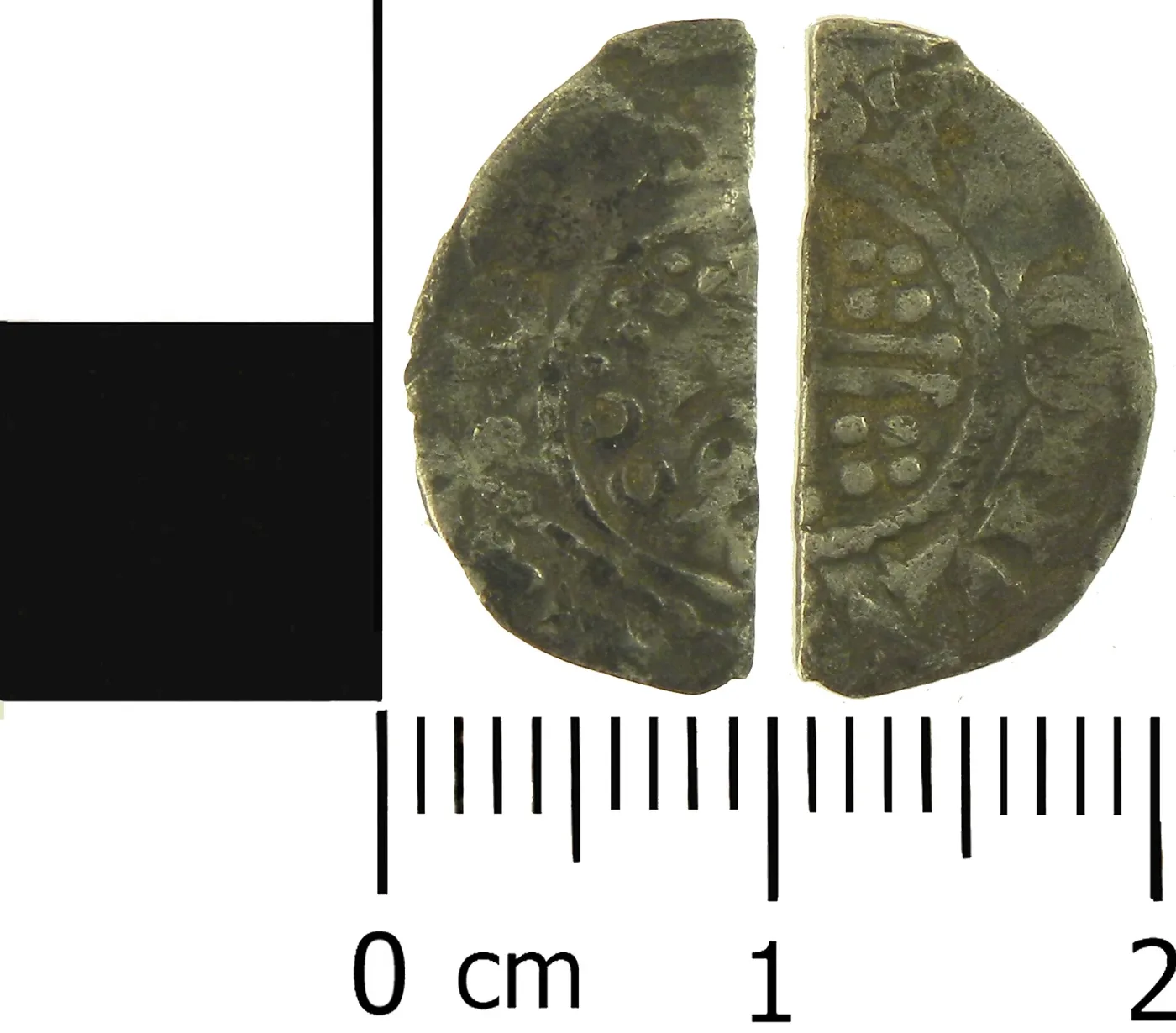
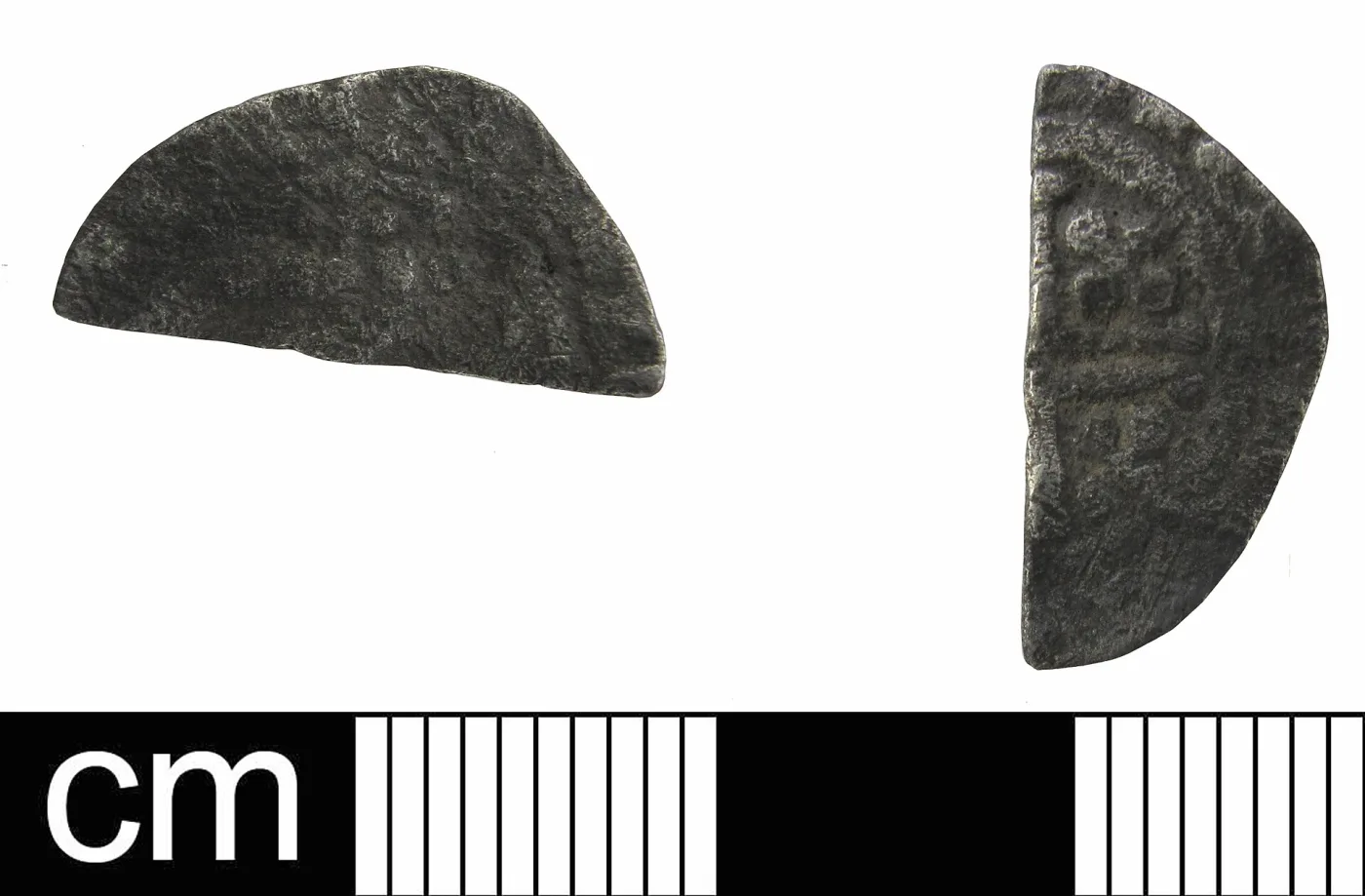
Until 1279 the penny was almost the only English coin. A few round halfpennies and farthings were struck in 1222, during Short Cross class 7, and they are very rare. Everyone else made change with a knife, cutting pennies along the arms of the reverse cross into halves and quarters. The voided cross made the cut easy to place.
A half-moon or quarter-circle of silver with a straight edge running along the cross is therefore a cut halfpenny or cut farthing, not damage, and Short Cross and Long Cross examples are routine detector finds. Edward I’s round halfpennies and farthings of 1279 made cutting unnecessary, and with them the voided cross was dropped.
Is It English? Scottish Pennies and Imitations
English pennies were good silver and widely trusted, so they were copied, and neighbouring coinages circulated with them.
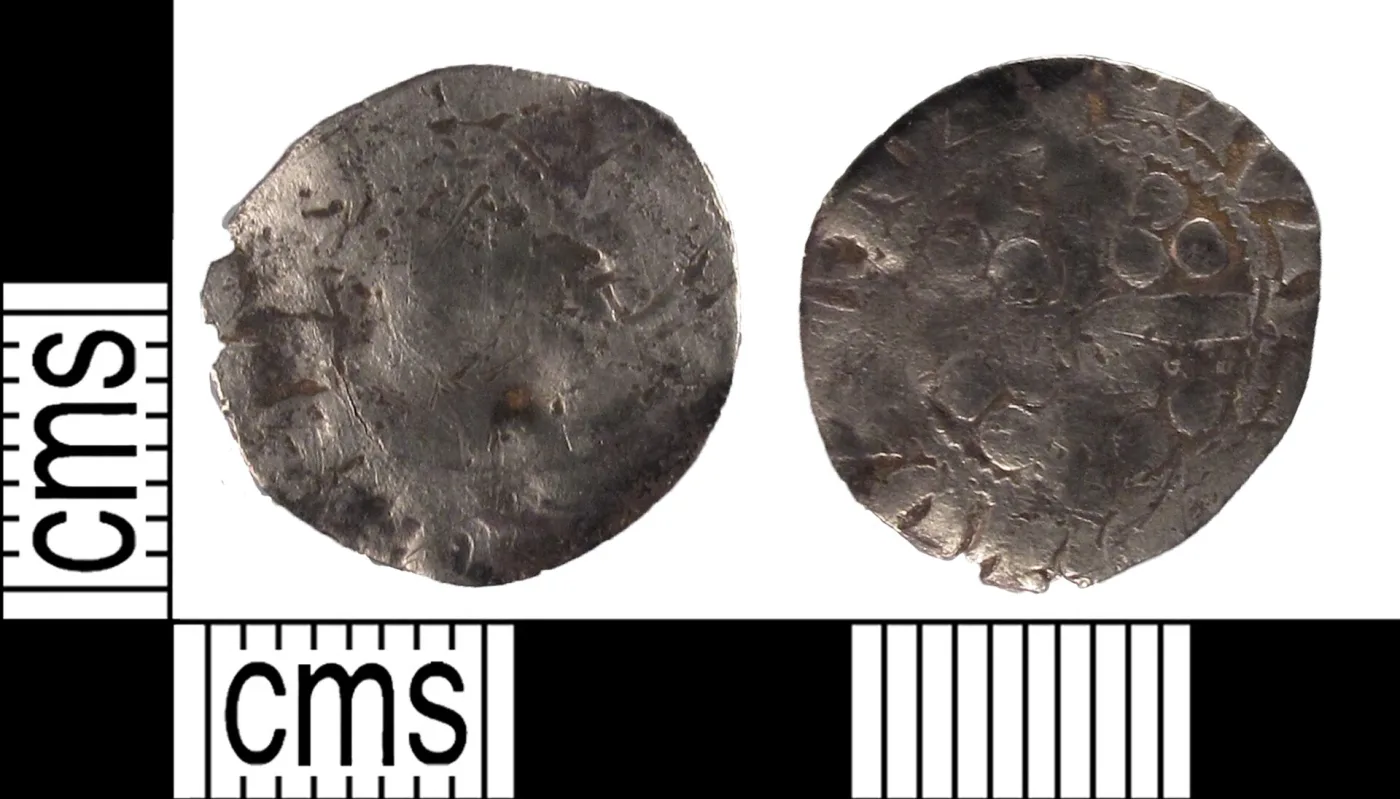
- Scottish pennies of Alexander III. From about 1250 Scotland struck long cross pennies too, and they circulated in England. They show the king’s head in profile, not facing, and the reverse has stars or mullets in the angles of the cross instead of three pellets.
- Continental imitations. Edward I’s pennies were imitated abroad in lower-grade silver, and these “sterling imitations” turn up in English finds. Coins known as crockards and pollards were at first accepted in England as the equivalent of halfpennies and then banned as counterfeit by 1300.
For fakes in general, the counterfeit detection guide works through the tests, and it includes a suspected forgery of an Edward I penny.
Size, Weight and Clipping
A Long Cross penny of the standard of 1247 is sterling silver, about 18 mm across and close to 1.4 grams. Short Cross and Edwardian pennies are close to the same size. Weight is the best test for clipping: a coin noticeably lighter than its type, or one whose cross ends are missing, has lost silver.
| Period | Typical penny | What to check |
|---|---|---|
| 1180 to 1247 | About 1.4 g | Clipping is common and hard to see |
| 1247 to 1279 | About 1.4 g, about 18 mm | Are all four ends of the cross on the coin? |
| 1279 to 1344 | About 1.4 g | Is the coin round, or cut into a half or quarter? |
| After 1464 | About 0.8 g (12 grains) | Later, much smaller pennies |
The penny shrank in the later Middle Ages. Under Edward IV the heavy penny of 1461 to 1464 weighed 15 grains, about 1.0 gram; from 1464 it weighed 12 grains, about 0.8 gram. A penny much lighter than 1.4 grams is either clipped or from that later period, and the portrait and legend will tell you which.
A Five-Step Routine for a Worn Penny
- Find the cross. Short and double-lined, long and double-lined, or long and single-lined: that is the type.
- Count what is in the angles. Four pellets in a cluster, three pellets, or stars.
- Find the face. Facing is English; a profile bust points to Scotland.
- Read the reverse for a word you know. ON followed by a town means a moneyer’s name came first; CIVITAS or VILLA means Edwardian.
- Weigh it and look at the edge. Clipped, cut or whole.
That routine places almost every find to within a few decades, which is as far as most medieval pennies can honestly be taken without a specialist catalogue. For grading and cleaning, the coin grading guide and the cleaning and preservation guide apply: never clean a hammered silver penny, which loses value as soon as its surface is disturbed.
Found One in England?
A single coin found on its own is not Treasure under the Treasure Act 1996. Two or more coins from the same find that are at least 300 years old and contain at least 10 per cent gold or silver are Treasure, and must be reported. A scatter of single pennies lost one at a time does not count as a find of that kind. Single finds can be recorded voluntarily with the Portable Antiquities Scheme, and most of the photographs on this page are records from it.
Frequently Asked Questions
How do I tell a Short Cross penny from a Long Cross penny?
Look at how far the cross on the reverse reaches. On a Short Cross penny (1180 to 1247) the double-lined cross stops at the inner circle, and the legend runs unbroken round it. On a Voided Long Cross penny (1247 to 1279) the same double-lined cross runs out through the legend to the edge of the coin and splits the legend into four parts.
Why does my medieval penny say Henry when it was struck under Richard or John?
Because the Short Cross coinage kept the name HENRICVS REX for its whole life, from Henry II's recoinage of 1180 through Richard I and John into the reign of Henry III. The name on the coin does not tell you the king; the class of the bust and lettering does, and specialists attribute Short Cross pennies to a reign by class.
Which Edward is on my penny?
The legend will not tell you. Edwardian pennies read an abbreviated EDWARDVS REX ANGLIE DOMINVS HYBERNIE with no regnal number, so Edward I, Edward II and early Edward III pennies all just say Edward. Collectors sort them into the fifteen Fox groups, using the shape of the crown, the letter forms and small marks on the bust, and even then several features have to be read together.
Is a cut half of a medieval penny a broken coin?
Usually not. Before 1279 England struck almost no round halfpennies or farthings, so people cut pennies along the arms of the reverse cross to make change. A neat half or quarter with a straight edge along the cross is a cut halfpenny or cut farthing, and it is a normal find. Edward I's recoinage of 1279 brought in round halfpennies and farthings, which ended the need to cut.
My penny has stars instead of pellets in the angles of the cross. Is it English?
Probably not. Scottish long cross pennies of Alexander III look much like English ones, but they show the king's head in profile, and their reverse has stars or mullets in the angles of the cross where English pennies have three pellets. They circulated in England and turn up in English finds.
Do I have to report a medieval penny I found in England?
A single coin found on its own is not Treasure under the Treasure Act 1996. Two or more coins over 300 years old from the same find, each with at least 10 per cent gold or silver, are, and must be reported to the coroner. Recording single finds with the Portable Antiquities Scheme is voluntary, and it is how most of the photographs in this guide came to be published.