American Platinum Eagle Identification Guide: Sizes, Finishes, Changing Reverses, Key Dates, and Values
The American Platinum Eagle is the official platinum bullion coin of the United States and the rarest, most exclusive of the U.S. Mint’s three precious-metal eagle programs. Launched in 1997, eleven years after the gold and silver eagles, it was the first platinum coin ever issued by the United States and remains the only American coin struck in .9995 fine platinum. It is also the only U.S. coin to carry a denomination of $100 — the highest face value of any American coin ever made for the public. With far lower mintages than its gold and silver siblings and a price that tracks one of the world’s scarcest precious metals, the Platinum Eagle occupies a special niche prized by both bullion stackers and serious collectors.
What makes the Platinum Eagle genuinely unique — and what trips up newcomers — is its reverse. Unlike the gold and silver eagles, whose reverses stayed fixed for decades, the proof Platinum Eagle changes its reverse design almost every single year. Since 1998 the Mint has run a series of rotating themes — the “Vistas of Liberty,” the “Foundations of American Democracy,” the “Preamble to the Constitution,” and more — so that virtually every year’s proof coin tells a different story. This makes the Platinum Eagle the most artistically varied coin in modern American numismatics, and it means identifying a specific coin requires reading the reverse design and date together, not just the obverse.
This guide walks through the complete American Platinum Eagle story: the history behind the program, John Mercanti’s Statue of Liberty obverse, how to identify each size and finish, the bewildering parade of changing reverse designs year by year, where mint marks appear, the genuine key dates and ultra-low-mintage rarities (especially the 2008-W burnished coins), how platinum coins are graded, how to spot fakes of this dense metal, and what your coins are worth in 2026. If you are brand new to coins, start with our broad coin identification guide, then return here. If you already own the other two eagles, you will recognize this as the platinum capstone of the trio that begins with the American Silver Eagle and the American Gold Eagle.
History and Origins of the Platinum Eagle
The American Platinum Eagle was authorized in 1996 and first struck in 1997, completing the trio of U.S. bullion coins that had begun with the simultaneous 1986 launch of the gold and silver eagles. Its creation responded to growing investor interest in platinum, a metal even rarer than gold, and to competition from foreign platinum coins such as the Australian Platinum Koala and the Canadian Platinum Maple Leaf, both of which had reached American buyers in the early 1990s. By issuing its own platinum coin, the United States offered a homegrown, government-guaranteed way to own the white metal — and did so with a coin of unusually high artistic ambition.
From the very first year, the Mint made the Platinum Eagle stand apart. It was struck in .9995 fine platinum — a higher purity than the 22-karat gold eagle — and it debuted in all four sizes at once, each with a face value double that of the corresponding gold eagle. Most strikingly, the one-ounce coin was assigned a $100 denomination, making it the highest-denomination coin the U.S. government had ever issued for general purchase. From the start the program was aimed at a more sophisticated buyer: someone who understood platinum, appreciated fine design, and was willing to pay the premiums that a low-mintage coin commands.
The Decision to Change the Reverse Every Year
The boldest choice came in 1998, the program’s second year. Rather than keep a single fixed reverse like the gold and silver eagles, the Mint decided that the proof Platinum Eagle would feature a new reverse design each year, organized into multi-year thematic series. The bullion (investment) coins kept the original soaring-eagle reverse for continuity, but the collector proofs became a rotating art gallery in miniature. Over the years these series have celebrated America’s natural vistas, its democratic foundations, its founding documents, and its core liberties — turning the proof Platinum Eagle into the most design-rich modern U.S. coin and a favorite of collectors who value variety.
An On-Again, Off-Again Production History
Unlike the gold and silver eagles, which have been struck continuously, the Platinum Eagle has had a stop-and-start life that strongly affects which coins are scarce. Bullion (investment) Platinum Eagles were issued in all four sizes from 1997 to 2008, then suspended entirely for several years during the financial crisis, and later resumed in the one-ounce size only. Proof coins were struck in all four sizes from 1997 to 2008 as well, paused, and returned as a one-ounce-only collector product. These gaps mean that the four-size sets only exist for the 1997–2008 era, and that certain years simply do not exist in certain formats — a crucial fact when you are trying to identify or complete a set.
Design Elements and How to Identify the Coin
Identifying an American Platinum Eagle starts with the obverse, which has remained constant for the entire program, and then turns to the reverse, which is where the real detective work happens because it changes from year to year on the proofs.
Obverse (Front) Design — The Statue of Liberty
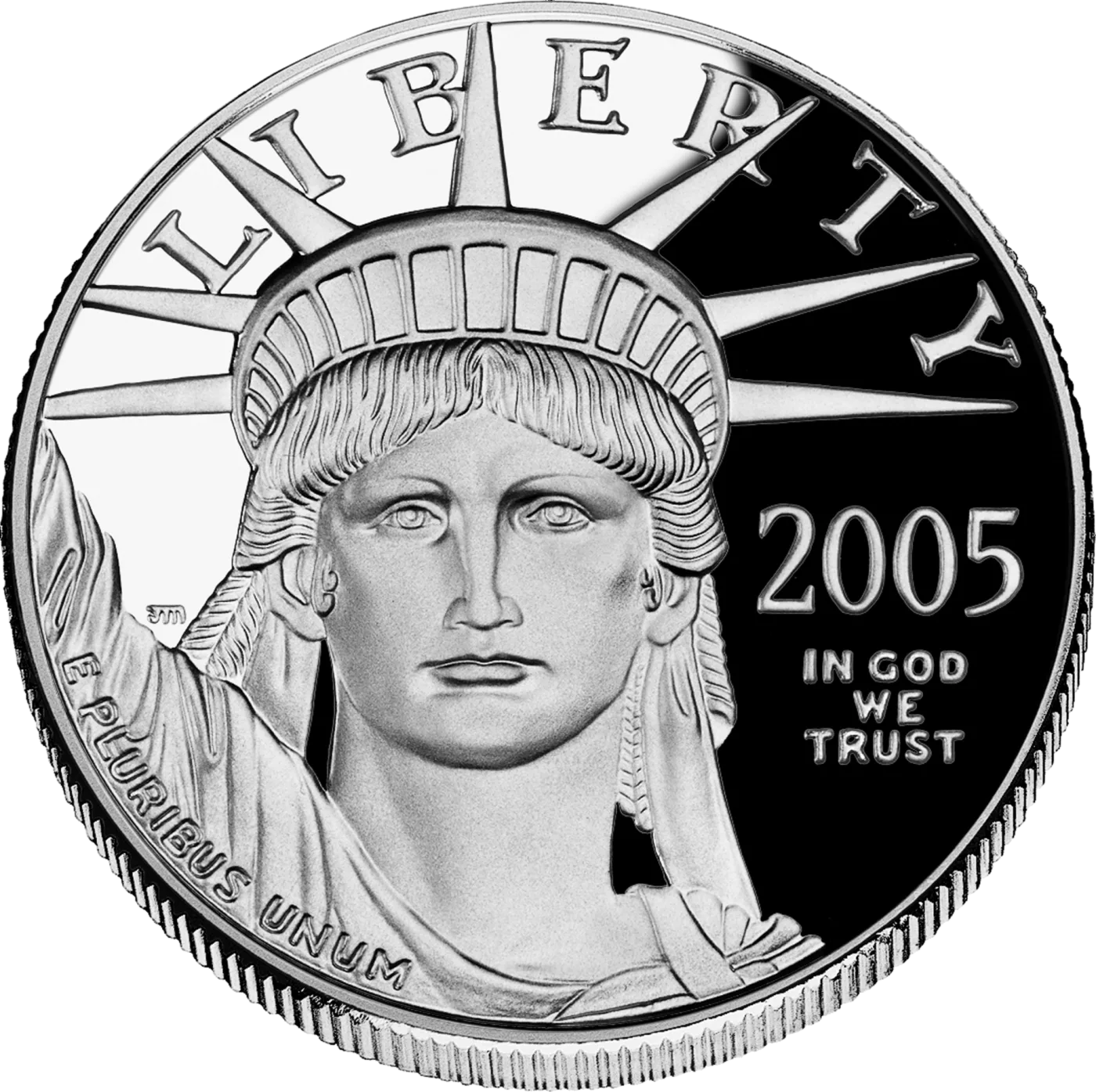
The obverse, designed by longtime Mint sculptor-engraver John Mercanti, is a close-up of the face of the Statue of Liberty, shown full on rather than in profile — she looks straight out of the coin at you, both eyes visible, under her radiate crown. The design is officially titled “Liberty looking to the future.” As the photograph at the top of this page shows, the inscriptions on this side are LIBERTY across the top, the date at the right with IN GOD WE TRUST beneath it, E PLURIBUS UNUM curving up the lower left, and Mercanti’s JM initials in the field. That frontal portrait has appeared on every Platinum Eagle since 1997 and is the single fastest way to recognize the coin: no other American eagle puts a face this close to the viewer, and none uses the Statue of Liberty at all. John Mercanti is the same celebrated engraver whose heraldic-eagle reverse appeared for decades on the American Silver Eagle.
Reverse (Back) Design — The Soaring Eagle (Bullion)
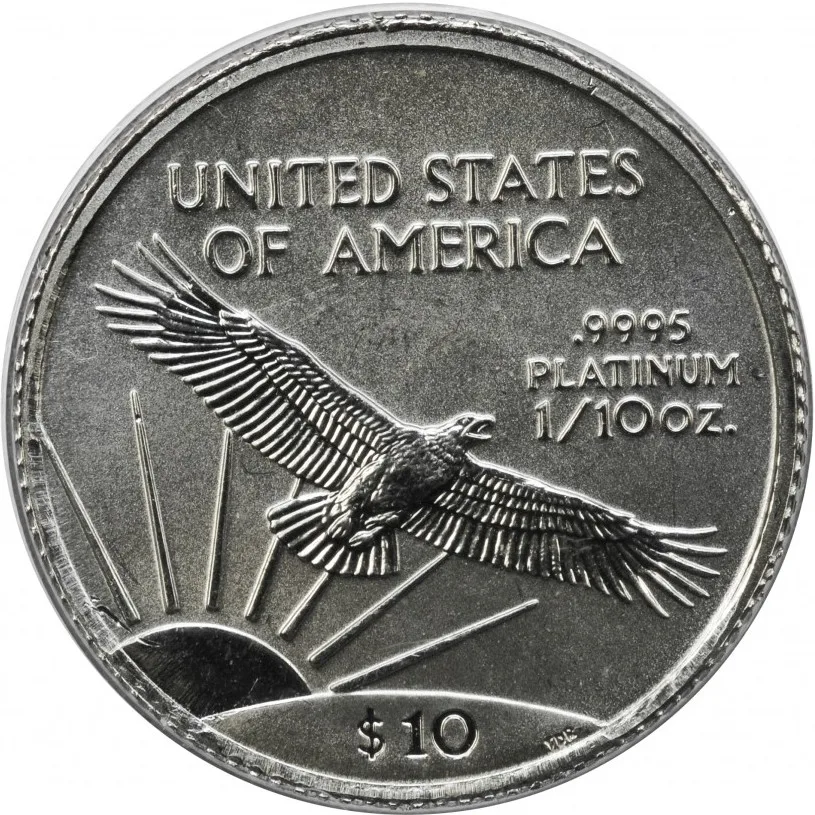
The bullion Platinum Eagle’s reverse, used every year on the investment coins, is Thomas D. Rogers’ “Eagle Soaring Above America” (often described as a “Soaring Eagle over Sunshine”): a bald eagle in flight above a stylised sunburst rising over a curved horizon. Three inscriptions share the field — UNITED STATES OF AMERICA across the top, the purity and weight stacked at the right as .9995 / PLATINUM / 1/2 OZ., and the denomination at the bottom as a numeral with a dollar sign rather than the word DOLLARS. There is no E PLURIBUS UNUM on this side; that motto lives on the obverse. Because the bullion coin keeps this reverse permanently, a Platinum Eagle showing the soaring eagle over a sunrise is almost always a bullion strike (or a 1997 first-year proof, which used the same design before the annual changes began).
Reverse (Back) Design — The Changing Proof Reverses
From 1998 onward, proof Platinum Eagles abandoned the fixed soaring-eagle reverse in favor of a new design each year, grouped into themed series (detailed in the next section). These reverses depict everything from regional American vistas with eagles to allegorical figures representing the branches of government to symbolic scenes illustrating phrases from the Constitution’s Preamble. Identifying a proof Platinum Eagle therefore means matching the specific reverse scene to its year and series — a richer identification challenge than any other modern U.S. coin presents.
How to Quickly Recognize a Platinum Eagle
If the obverse shows the face of the Statue of Liberty with her radiate crown, and the reverse legend reads “.9995 PLATINUM” with a $100, $50, $25, or $10 denomination, you are holding an American Platinum Eagle. The Statue of Liberty face plus the platinum purity statement is the fastest confirmation. The $100 denomination in particular is a dead giveaway, since no other U.S. coin carries it. Do not confuse the soaring-eagle bullion reverse with the gold eagle’s family-of-eagles design — the metal statement (“.9995 PLATINUM” versus “FINE GOLD”) settles it instantly.
The Four Sizes and Face Values
Like the gold eagle, the Platinum Eagle was issued in a family of four sizes, but with a key difference: each Platinum Eagle’s face value is exactly double that of the matching gold eagle. The denominations are purely symbolic — every Platinum Eagle is worth many times its stamped value in platinum.
The Four Versions
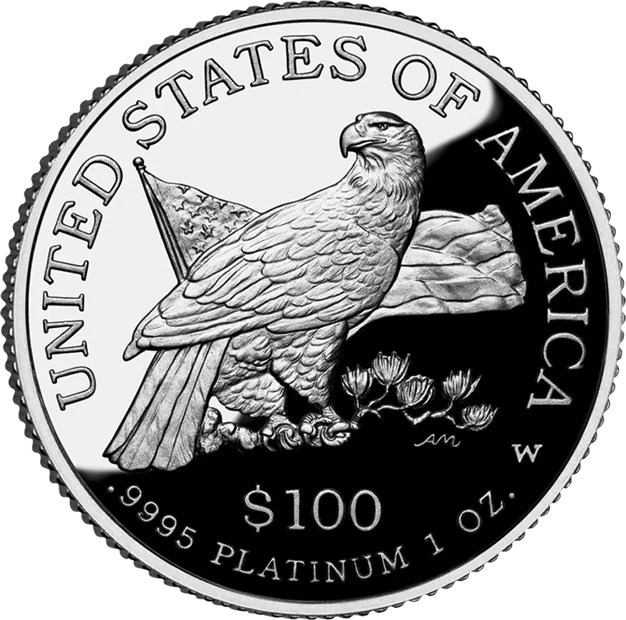
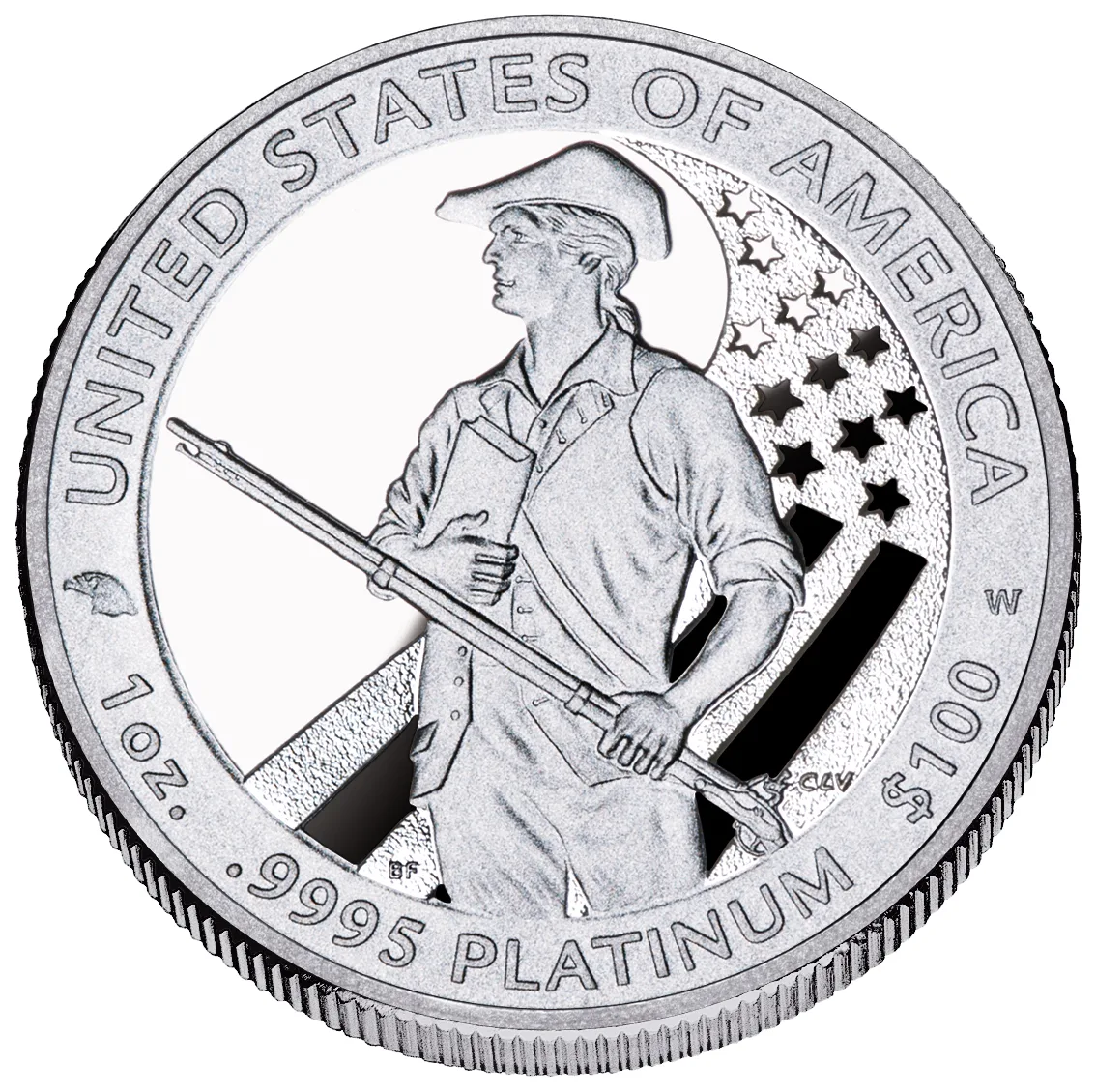
- One ounce — $100 face value: Contains 1 troy ounce of pure platinum; 32.7 mm diameter. The flagship size, and the only size still produced today. Reads .9995 PLATINUM 1 OZ. with $100 below.
- Half ounce — $50 face value: Contains 0.5 troy ounce of platinum; 27.0 mm diameter. The reverse reads .9995 PLATINUM 1/2 OZ. at the right and $50 at the bottom. Issued 1997–2008 only.
- Quarter ounce — $25 face value: Contains 0.25 troy ounce of platinum; 22.0 mm diameter. Reads .9995 PLATINUM 1/4 OZ. with $25 below. Issued 1997–2008 only.
- Tenth ounce — $10 face value: Contains 0.10 troy ounce of platinum; 16.5 mm diameter. Reads .9995 PLATINUM 1/10 OZ. with $10 below. The smallest and most affordable entry point; issued 1997–2008 only.
How to Tell the Sizes Apart
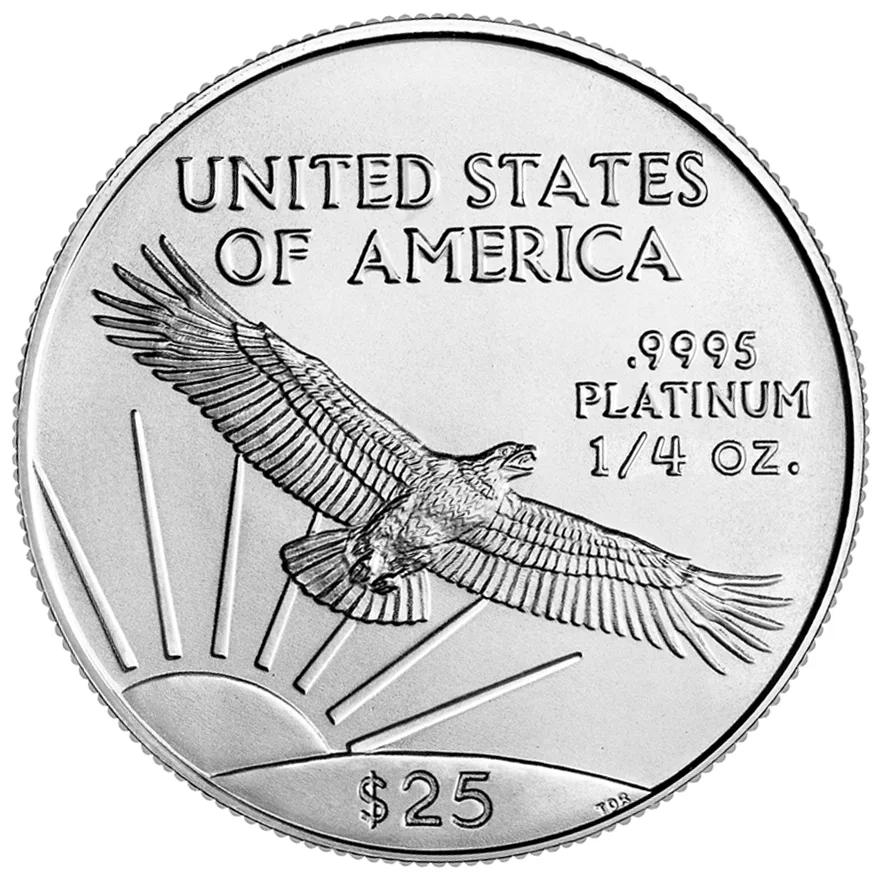
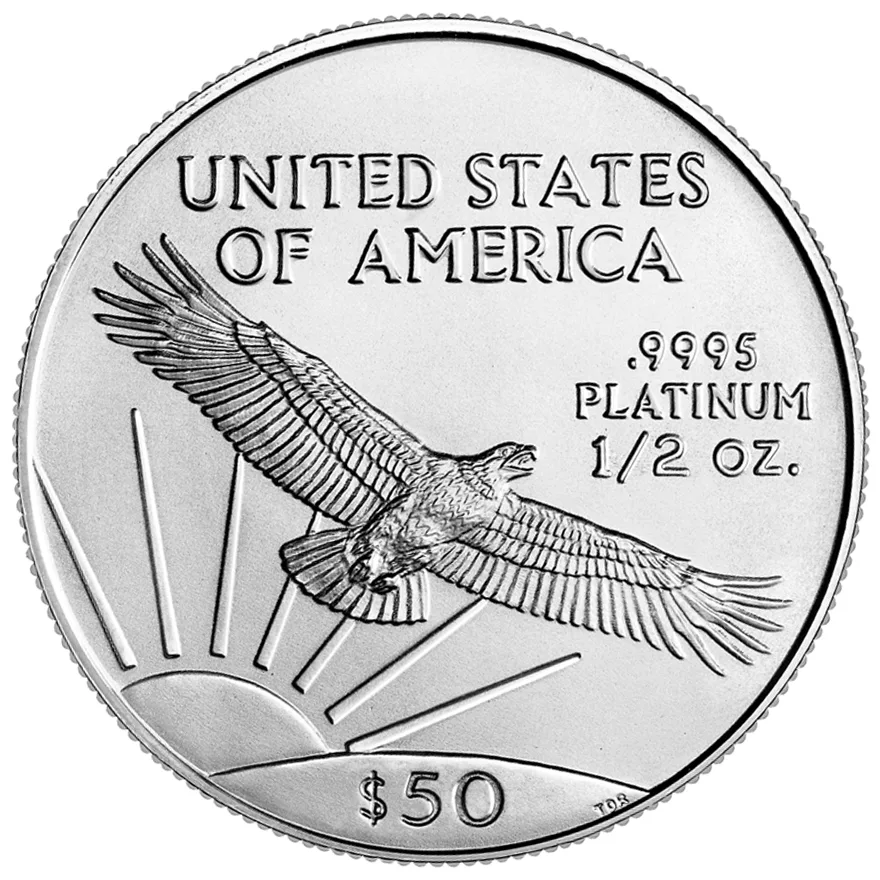
The reverse inscription states the exact weight and purity, so reading “.9995 PLATINUM 1/4 OZ.” with $25 at the bottom tells you instantly that it is the quarter-ounce coin. If the legend is worn or unclear, measure the diameter: 32.7 mm (one ounce), 27.0 mm (half), 22.0 mm (quarter), or 16.5 mm (tenth) — the same diameters as the corresponding gold eagles. Weight is the definitive test, because each size has a precise total weight (see the Specifications section). Because the fractional sizes were only made from 1997 to 2008, any fractional Platinum Eagle is automatically from that twelve-year window.
Why the Fractional Sizes Are Scarce
The fractional Platinum Eagles had low mintages even when they were in production, and because they were discontinued after 2008, no new ones have been made in over a decade and a half. This makes complete four-size sets a finite, closed pursuit, and it gives the half, quarter, and tenth-ounce coins genuine collector appeal beyond their platinum content. As with the gold eagle, the small coins also carry higher premiums per ounce because the Mint’s fixed striking costs are spread over less metal.
The Changing Reverse Designs (Year by Year)
The annually changing proof reverse is the defining feature of the Platinum Eagle and the heart of its identification challenge. While the bullion coins always show Thomas Rogers’ soaring eagle, the proofs march through a sequence of multi-year themed series. You do not need to memorize every design, but understanding the major series lets you place any proof coin in its proper context.
1997: The Original Soaring Eagle (Proof and Bullion)
In the first year, both the bullion and proof coins used the Rogers soaring-eagle reverse. The 1997 proof is therefore the only proof Platinum Eagle that shares the bullion design, which gives it special “first-year, original-reverse” status among collectors.
1998–2002: Vistas of Liberty
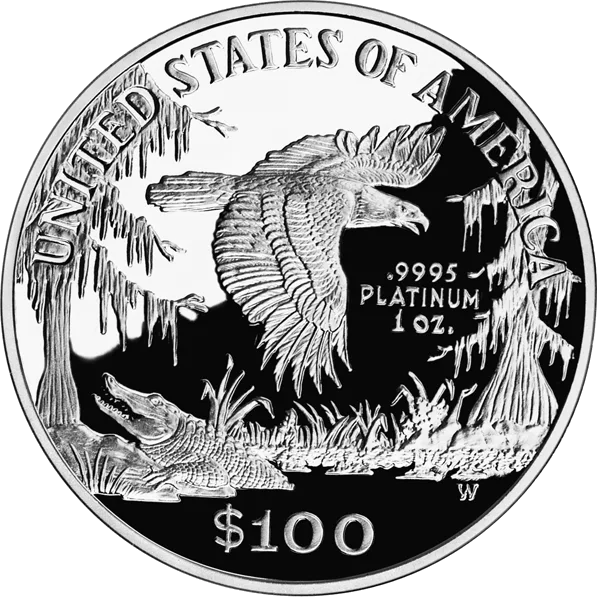
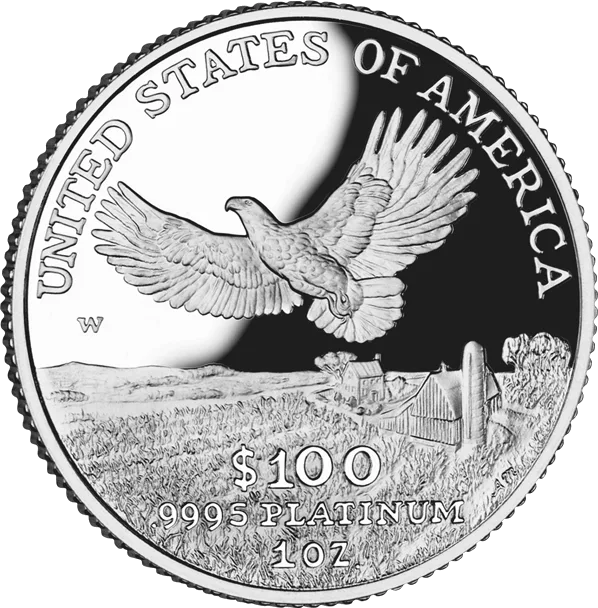
The first themed series for proofs depicted a bald eagle soaring over five great American regions — New England woodlands, the Southeastern wetlands, the heartland, the Southwestern desert, and the Northwest. Each year’s proof showed the eagle in a different regional landscape, celebrating the breadth of the American continent. These early themed proofs established the rotating-design tradition.
2002–2008 Era: Allegorical and Symbolic Series
Through the 2000s the Mint ran several allegorical series on the proof reverses, including designs that paired the eagle with patriotic symbols and figures. Each year’s reverse was a distinct artwork, so a 2004 proof looks entirely different from a 2006 proof. Because the fractional sizes ended after 2008, the four-size proof sets from this era capture some of the most varied reverse art in the whole program.
2009–2014: Preamble to the Constitution Series
After the bullion coin’s hiatus, the resumed one-ounce proof launched perhaps the most beloved series: a six-year program illustrating the principles of the Preamble to the U.S. Constitution — “To Form a More Perfect Union,” “To Establish Justice,” “To Insure Domestic Tranquility,” “To Provide for the Common Defence,” “To Promote the General Welfare,” and “To Secure the Blessings of Liberty.” Each year’s reverse used rich allegorical imagery to represent one phrase, making this a deeply collectible six-coin set.
2015–2017 and Beyond: Liberty and Torch Themes
Subsequent proof series continued the tradition with designs celebrating American liberty and freedom, and later issues have featured themes such as a series illustrating phrases of the national anthem and, more recently, multi-year programs built around the torch and figure of Liberty. The 2018 reverse, for example, introduced a “Life, Liberty, and the Pursuit of Happiness” preamble-to-the-Declaration concept. The key takeaway: every year’s proof reverse is its own design, so always identify a proof by matching its reverse scene to the year.
How to Use the Reverse to Identify a Coin
For bullion coins, the reverse is always the soaring eagle, so you identify by size, date, and (rarely) mint mark. For proofs, the reverse design itself is a powerful clue: if you can recognize the scene — a regional vista, an allegorical figure, a Preamble phrase — you can often narrow the year before you even read the date. When buying online, always confirm both the date and the reverse image, since the changing designs mean a single date can be confused with neighboring years if the photo is poor.

Bullion, Proof, and Burnished Finishes
As with the other eagles, the Platinum Eagle’s finish is just as important as its date and size in determining value. The three finishes look distinct once you know what to look for, and they also differ in which reverse they carry.
Bullion (Business Strike)
Bullion Platinum Eagles are the standard investment version, struck for sale through authorized purchasers and always bearing Thomas Rogers’ soaring-eagle reverse. They have a bright, frosty luster but no mirror finish, and they carry no mint mark. Bullion coins were made in all four sizes from 1997 to 2008, suspended, and later resumed in the one-ounce size only. These are the coins bought and sold “by the ounce” by platinum stackers.
Proof
Proof Platinum Eagles are struck on polished planchets with mirror-finish dies, producing deep reflective fields and frosted, cameo devices. They are sold directly to collectors in elegant Mint packaging with a certificate of authenticity, carry a “W” mint mark for West Point, and — crucially — bear the changing annual reverse design rather than the soaring eagle (except in 1997). Proofs are the artistic heart of the program and the reason most collectors are drawn to it.
Burnished (Uncirculated with Mint Mark)
For a brief period, the Mint also issued a collector “uncirculated” Platinum Eagle struck on specially burnished planchets, giving a soft satin finish distinct from both the brilliant bullion coin and the mirrored proof. These carry a “W” mint mark. The burnished Platinum Eagles were made in very limited quantities and only for a short window, which makes them — especially the 2008-W issues — among the rarest and most valuable coins in the entire series (see the dedicated section below).
Why Finish Determines Value
A bullion Platinum Eagle is worth its platinum content plus a premium. A proof of the same date is a collectible worth a substantial premium, and its specific reverse design adds to its desirability. A burnished coin — identifiable by its “W” mint mark and satin surface — can be worth far more still, because so few were made. The presence of a “W” mint mark immediately tells you the coin is a collector issue, not plain bullion, so always identify the finish before assigning a value.
Mint Marks and Where to Find Them
Mint marks on Platinum Eagles follow the same logic as the gold eagle: bullion coins are unmarked, and a mint mark signals a more valuable collector coin.
Where the Mint Mark Appears
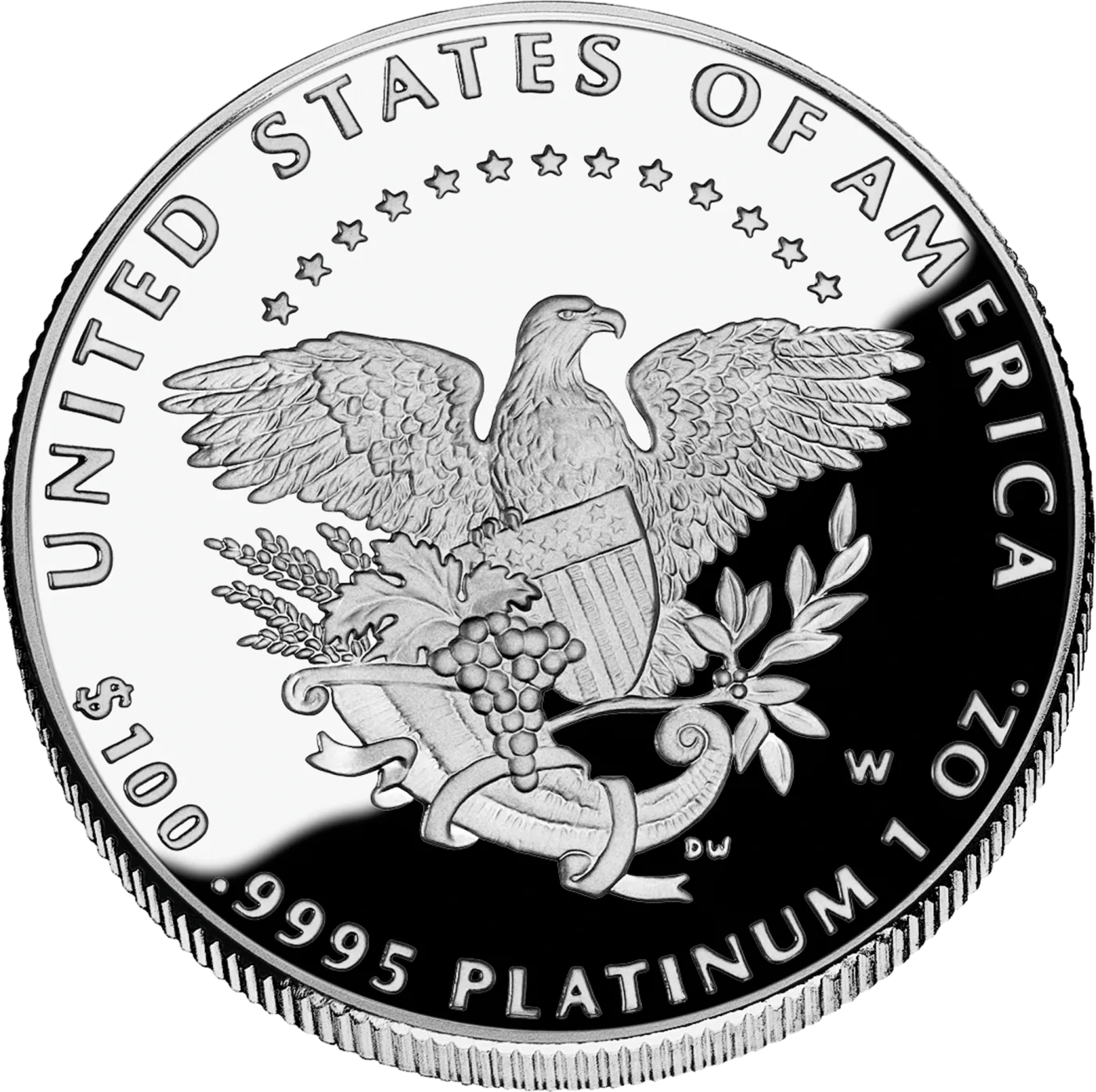
When present, the mint mark on a Platinum Eagle is a small “W” for the West Point Mint, and it is on the reverse, not the obverse — the Statue of Liberty side carries the date and the mottos and nothing else. Because the proof reverse is redrawn every year, the W has no fixed position: it is fitted into whatever open field the design leaves, which is why it sits at the lower right on the 1999 wetlands coin, out at the left on the 2000 heartland coin, and level with the eagle at the right on the 2005 and 2012 issues. Look for a single isolated letter anywhere in the field, and use a loupe. Bullion coins carry no mint mark at all, regardless of where they were struck.
The Marks You Will See
- No mint mark (bullion): Standard investment Platinum Eagles carry no mint mark. The majority of one-ounce coins fall in this category.
- “W” (West Point): Every proof and every burnished Platinum Eagle carries a “W” mint mark, because all collector Platinum Eagles are struck at the West Point Mint. A “W” is the signature of a collector coin.
Why Mint Marks Matter So Much
Because bullion coins are unmarked, any “W” mint mark immediately identifies a collector issue worth far more than plain bullion. A no-mint-mark one-ounce Platinum Eagle is investment metal; a “W” coin of the same date is either a proof (with a special reverse) or a scarce burnished coin worth a strong premium. Always check for the “W” first — on the Platinum Eagle, where burnished issues can be worth thousands, the mint mark is the gateway to knowing what you truly hold. This same “no mark equals bullion, W equals collector” rule governs the modern American Gold Eagle as well.
Key Dates and Low-Mintage Issues
The Platinum Eagle is a series of low mintages across the board, but several issues stand out as genuine keys. Because production was so much smaller than the gold and silver eagles — and because of the multi-year hiatus — even “common” dates can be scarcer than key dates in other series.
First-Year 1997 Coins
As the inaugural year, the 1997 Platinum Eagles in all four sizes carry first-year collector demand. The 1997 proofs, which uniquely share the soaring-eagle reverse with the bullion coins, are especially prized as the only proofs with the “original” reverse. First-year coins are anchors of any complete collection.
Low-Mintage Fractional Proofs and Bullion
The fractional proofs and bullion coins (half, quarter, and tenth ounce) had small mintages during their 1997–2008 run, and certain dates are genuinely scarce. Because the fractional sizes were discontinued, demand for complete four-size sets keeps pressure on these dates. High-grade certified examples of low-mintage fractionals can be worth multiples of their platinum value.
The Hiatus-Era Scarcities
Years immediately before and after the production suspension are often the scarcest. As platinum bullion demand collapsed during the financial crisis, the Mint cut production sharply before halting the fractional and (temporarily) the bullion programs. The coins from these transitional years exist in small numbers and are sought by date collectors. This bullion-versus-rarity dynamic mirrors what collectors see across U.S. gold, from the modern eagles back to the classic Liberty Head Double Eagle.
The 2008-W Burnished Coins
The single most important keys in the entire Platinum Eagle series are the 2008-W burnished (uncirculated) coins, which had tiny mintages and are covered in detail in the next section. If you own a 2008-W burnished Platinum Eagle in any size, you hold one of the rarest modern U.S. coins.
The 2008-W Burnished Rarities
Every series has its famous keys, and for the Platinum Eagle they are the 2008-W burnished coins. Their story explains why a single year’s coins can tower over the rest of the series in value.
What Happened in 2008
The collector “burnished” uncirculated Platinum Eagle — struck on specially prepared planchets and carrying a “W” mint mark — had only a short production life, and 2008 was its final year for the fractional sizes. Coming during the financial crisis, when collector spending was collapsing, the 2008-W burnished coins sold in extremely small numbers. The result is a set of coins with some of the lowest mintages of any modern U.S. issue, particularly in the half-ounce, quarter-ounce, and tenth-ounce sizes.
Why They Matter
Because so few 2008-W burnished Platinum Eagles were produced and survive, they command enormous premiums far above their platinum content — often many thousands of dollars for the fractional sizes in top certified grades. They are the coins that separate a casual Platinum Eagle holding from a serious collection, and completing the 2008-W burnished set is a marquee achievement. The Mint’s 2008 pullback hit gold too — the same year produced the one-and-only fractional and burnished issues of the American Gold Buffalo, whose 2008-W burnished coins are likewise the great keys of that series. Their scarcity also makes them a target for misrepresentation, so genuine examples should always be certified.
How to Identify a 2008-W Burnished Coin
Look for three things together: the date 2008, a “W” mint mark on the obverse, and a satin (not mirrored, not brilliant frosty) finish. A 2008 coin with no mint mark is ordinary bullion; a 2008-W with deep mirrors is a proof; only the 2008-W with a soft satin finish is the rare burnished coin. Because the value gap is so large, treat any claimed 2008-W burnished coin as requiring PCGS or NGC certification before you pay a key-date price.
Physical Specifications
The Platinum Eagle’s specifications have been constant since 1997, which makes precise weight-and-diameter checks one of the best defenses against counterfeits. Because the coin is struck in nearly pure .9995 platinum, its total weight is essentially its pure-platinum content plus a trace.
Composition (All Sizes)
- Metal: .9995 fine platinum (99.95% platinum) — the purest of the three eagle metals.
- Edge: Reeded.
- Designers: John Mercanti (Statue of Liberty obverse); Thomas D. Rogers (soaring-eagle bullion reverse); various artists for the annual proof reverses.
Size-by-Size Specifications
- One ounce ($100): 1.0000 oz pure platinum; total weight 31.120 g; diameter 32.7 mm; thickness 2.39 mm.
- Half ounce ($50): 0.5000 oz pure platinum; total weight 15.560 g; diameter 27.0 mm.
- Quarter ounce ($25): 0.2500 oz pure platinum; total weight 7.780 g; diameter 22.0 mm.
- Tenth ounce ($10): 0.1000 oz pure platinum; total weight 3.112 g; diameter 16.5 mm.
Platinum is extraordinarily dense (21.45 g/cm³ — even denser than gold), so a genuine Platinum Eagle feels remarkably heavy for its size. Each size has a precise total weight that is very hard to fake, because matching platinum’s density in a coin of the correct dimensions is nearly impossible with base metals. A Platinum Eagle that is the right diameter but noticeably light — or the right weight but too thick — is almost certainly counterfeit. These weight-and-caliper checks are the same first-line tests that protect buyers of any precious-metal coin.
How to Grade Platinum Eagles
Platinum Eagles are graded on the 70-point Sheldon scale, and as modern coins struck to high standards the meaningful range is compressed near the top. The same fundamental grading methods used across U.S. coins apply, with particular attention to the high points of the Statue of Liberty portrait and the delicate proof reverses.
Bullion (Mint State) Grading
- MS-69: The workhorse grade for bullion Platinum Eagles — nearly flawless with one or two tiny ticks under magnification. Most certified bullion coins grade MS-69.
- MS-70: Perfect under 5x magnification with full luster and no contact marks. MS-70 commands a strong premium, especially for the fractional sizes where perfect survivors are scarcer.
- MS-68 and below: Less common for certified Platinum Eagles; usually the result of handling marks. Platinum is a hard, durable metal that resists marking, which helps these coins grade well.
Proof Grading
Proofs are graded PR (or PF) on the same scale, almost always with a “Deep Cameo” (DCAM) or “Ultra Cameo” designation reflecting the frosted-device-on-mirror-field contrast. PR-69 DCAM is common; PR-70 DCAM is the premium grade. For proofs, the enemies of a perfect grade are hairlines, tiny mirror disturbances, and handling marks — and the elaborate annual reverses give graders a lot of fine detail to scrutinize.
Special Designations and Labels
Third-party graders offer first-strike / early-release labels, signature labels, and special holders. These can add collector value but do not change the coin’s technical grade. As with all the eagles, a “First Strike MS-70” and a regular “MS-70” are the same coin technically — pay for the coin, not the sticker, unless you specifically collect labeled examples.
Should You Grade a Bullion Platinum Eagle?
For common-date one-ounce bullion, certification often makes sense even though the coin trades on metal, because platinum’s high value and the prevalence of fakes make a sealed, authenticated slab reassuring. Certification clearly pays off for the 2008-W burnished keys, low-mintage fractionals where MS-70 carries a real premium, all proofs, and any high-value purchase you want protected against counterfeits.
Bullion Value vs Numismatic Premium
Understanding the difference between a Platinum Eagle’s melt value and its collector premium is the key to buying and selling intelligently — the same bullion-versus-numismatic tension collectors weigh across all U.S. precious-metal coinage, from the Gold Dollar to the great double eagles.
The Bullion Floor
Every Platinum Eagle contains a known, precise amount of pure platinum, so its value can never fall below its platinum content (less a small dealer spread). Platinum’s price is famously volatile — it has at times traded above gold and at other times well below it — so the floor under a Platinum Eagle moves more than that of a gold coin. This volatility is part of what attracts speculators to platinum and part of why premiums can swing.
The Standard Premium
Bullion Platinum Eagles trade at a premium over the platinum spot price, and that premium is usually higher than the gold eagle’s because the coins are produced in much smaller numbers and platinum is a thinner, less liquid market. The premium widens during shortages and narrows in calm markets. Fractional sizes carry the steepest premiums per ounce, just as with the gold eagle.
The Numismatic Premium
Key dates, proofs with sought-after reverse designs, the 2008-W burnished coins, low-mintage fractionals, and top-grade examples carry numismatic premiums far above platinum value. A complete Preamble proof set or a 2008-W burnished fractional is worth a premium because of rarity and demand, not just metal. The art of Platinum Eagle collecting is knowing which coins are “just platinum” and which are genuine numismatic items — a distinction driven by date, size, finish, reverse design, and grade.
Stacking vs Collecting
People own Platinum Eagles for two different reasons. Stackers buy common-date one-ounce bullion for the metal and to diversify beyond gold and silver. Collectors pursue dates, sizes, finishes, reverse designs, and grades — building proof sets, four-size sets, or complete thematic series like the Preamble. Both are valid; just know which game you are playing before you pay a premium, because overpaying for a “collectible” common date is the most frequent beginner mistake.
Why Platinum Is Different from Gold and Silver
Platinum behaves differently from the other two eagle metals, and understanding those differences helps you identify, value, and care for the coin correctly.
Rarity and Color
Platinum is far rarer in the earth’s crust than gold — annual platinum production is a small fraction of gold’s — which is part of why the Platinum Eagle has such low mintages. Its color is a distinctive bright, silvery white, cooler and whiter than gold and slightly different from silver. A genuine Platinum Eagle has a clean, lustrous white tone; an off-color or yellowish hue is a warning sign of a plated fake.
Density and Weight
At 21.45 g/cm³, platinum is one of the densest metals used in coinage — even denser than gold (19.3 g/cm³) and roughly double the density of silver. This is why a one-ounce Platinum Eagle feels strikingly heavy and compact. That extreme density is also the counterfeiter’s greatest obstacle, since almost no affordable base metal can match platinum’s weight in a coin of the correct size.
Price Volatility
Platinum has an industrial side — it is heavily used in automotive catalytic converters and chemical processing — so its price responds to industrial demand as well as investment demand. This makes platinum more volatile than gold, and the platinum-to-gold price ratio swings widely over time. For collectors this means the “melt floor” under a Platinum Eagle can rise or fall sharply, and it explains why premiums on platinum coins can be unpredictable.
Durability and Tarnish
Platinum is highly resistant to tarnish and corrosion — even more so than gold — and as a nearly pure .9995 coin it has no reactive alloy metals to worry about, unlike the silver-and-copper alloy of the gold eagle. This makes Platinum Eagles relatively low-maintenance, though they still require careful handling to avoid contact marks and fingerprints that can lower a grade.
Authentication and Counterfeit Detection
Because of platinum’s high value, Platinum Eagles are counterfeited, and some fakes are sophisticated. Authentication discipline is essential, especially when buying key dates or from unfamiliar sellers. The good news is that platinum’s extreme density makes convincing fakes unusually hard to produce.
Weight and Dimension Checks
The first and best test is weight: each size has a precise total weight (31.120 g for one ounce, down to 3.112 g for tenth ounce). Check the diameter and thickness with calipers against the specifications above. Because platinum is so dense, base-metal fakes almost always come up light or are too thick for the diameter. A coin that fails the weight-and-caliper test is a fake. These density-based checks are the same logic that protects silver buyers on coins like the Morgan Silver Dollar — matching a precious metal’s density is the counterfeiter’s hardest obstacle, and with platinum it is harder still.
The Magnet Test
Platinum is essentially non-magnetic, so a Platinum Eagle should show no meaningful attraction to a strong neodymium magnet. Many cheap fakes contain ferromagnetic metals and will react. A magnet test alone cannot confirm authenticity, but it quickly rules out a class of crude counterfeits.
Visual and Strike Quality
Genuine Platinum Eagles have crisp, fully detailed designs — a sharp Statue of Liberty portrait, clean fields, and the bright white color of pure platinum. Counterfeits often show mushy details, incorrect font shapes, weak or uneven reeding, a too-gray or yellowish color, or a slightly cast surface texture. Compare a suspect coin side-by-side with a known-genuine eagle under magnification, and inspect the edge for casting seams.
Conductivity and Ultrasound Testing
For serious buyers, a precious-metal verifier (such as a Sigma Metalytics device) reads electrical conductivity through the coin and can detect base-metal cores that pass weight and dimension checks; platinum has a characteristic conductivity signature distinct from gold, silver, and common fakes. Because high-value keys justify the effort, professional testing or certification is wise for any expensive Platinum Eagle.
Buy Certified for Key Coins
For any high-value Platinum Eagle — the 2008-W burnished keys, scarce proofs, low-mintage fractionals, or any coin carrying a large premium — buy it certified by PCGS or NGC in a tamper-evident holder. The certification cost is trivial compared to the loss from a convincing counterfeit, and a sealed slab also protects the coin’s grade and delicate proof surfaces.
Current Market Values
Platinum Eagle values fall into two worlds: common coins that track the platinum spot price, and key dates, special reverses, and the 2008-W burnished rarities that carry large numismatic premiums. The figures below are approximate 2026 relationships rather than fixed dollar amounts, because the platinum spot price moves daily and sets the floor for every coin.
Common-Date Bullion
Common-date bullion Platinum Eagles trade at the platinum spot value of their size plus a premium, which is generally higher than the gold eagle’s premium because of lower production and a thinner platinum market. Certified MS-69 common dates add a small premium; MS-70 examples add more, especially in the discontinued fractional sizes where perfect coins are scarcer.
Key Dates and Rarities
- 2008-W burnished coins (all sizes) — the series keys; large premiums over platinum, reaching many thousands of dollars for fractional sizes in top grades.
- 1997 first-year coins — a premium over common dates, with the original-reverse proofs especially desirable.
- Low-mintage fractional proofs and bullion (1997–2008) — multiples of platinum value in high certified grades, driven by four-size set demand.
- Sought-after proof reverses (e.g., complete Preamble series) — premiums tied to the popularity of the design and series completion.
Proofs and Sets
Proof Platinum Eagles always carry a numismatic premium above bullion, and complete themed sets — such as the six-coin Preamble proof series — trade above the sum of their platinum content. Four-coin proof sets from the 1997–2008 era in original packaging are popular and command premiums for completeness and the variety of their reverse designs.
Factors Affecting Value
Beyond the platinum spot price, Platinum Eagle value is driven by size, finish, date, the specific reverse design (for proofs), the 2008-W burnished rarity factor, grade (MS-70/PR-70 vs 69), and any special label. In a rising platinum market even common eagles appreciate with the metal; in a falling market the keys, special reverses, and the 2008-W coins hold their numismatic premium far better than plain bullion.
Storage, Handling, and Preservation
Although platinum is extremely resistant to tarnish and corrosion, Platinum Eagles still need proper handling to preserve their grade and eye appeal. Contact marks and fingerprints can permanently reduce value, especially on the mirror-finished proofs.
Handling
Always hold eagles by the edge, never touching the faces. Fingerprints leave oils that can etch into the surface over time and are very difficult to remove from a proof. Wear cotton or nitrile gloves for proofs and high-grade coins, and work over a soft cloth to guard against drops — a single drop can put a rim ding on an otherwise perfect coin and cost a premium grade.
Holders and Capsules
For raw eagles, use rigid Air-Tite capsules sized to the specific coin diameter (32.7, 27.0, 22.0, or 16.5 mm) for an airtight seal that never contacts the surface. Avoid soft PVC flips, which off-gas plasticizers that can leave residue. For valuable coins — and certainly for the 2008-W keys and scarce proofs — a PCGS or NGC slab is the best long-term protection. Keep proofs in their original government packaging when possible, but inspect periodically.
Environmental Controls
Store eagles in a cool, dry, stable environment. Platinum itself does not corrode and, as a nearly pure metal, has no reactive alloy to tone — an advantage over the 22-karat gold eagle. Even so, surface contaminants and humidity can dull a coin’s eye appeal over time, so silica gel packets and the avoidance of sulfur sources (cardboard, rubber bands) remain good practice. The same preservation principles apply across all U.S. precious-metal coinage, including the classic Saint-Gaudens Double Eagle.
Cleaning: Don’t
Never clean a Platinum Eagle. Cleaning leaves hairlines, dulls luster, and can drop a coin from a premium grade to a “details” coin worth little more than melt. Even a coin with minor haze should be left alone. If a coin shows a genuine problem, consult a professional conservation service rather than attempting any home remedy — on a coin where MS-70 versus MS-69 can mean a large price difference, an amateur cleaning is an expensive mistake.
Building a Platinum Eagle Collection
The American Platinum Eagle offers some of the most rewarding collecting paths in modern numismatics, precisely because of its changing reverses and low mintages — though it is the priciest of the three eagle programs to pursue.
Size Set (One of Each)
A classic collection is one coin of each size — tenth, quarter, half, and one ounce — from a single year in the 1997–2008 window when all four were made, ideally in matching grade. The Mint sold four-coin proof sets for exactly this purpose, and assembling one showcases the full family. Because the fractionals are discontinued, this is a finite, satisfying goal.
Proof Series Sets
The most distinctive Platinum Eagle pursuit is completing a themed proof series — the six-coin Preamble to the Constitution series (2009–2014) is the most beloved, but the earlier Vistas of Liberty and later torch-and-Liberty series are equally collectible. Because each coin in a series has a unique reverse, a completed set is a genuine gallery of American allegorical art.
Date Set (One Ounce)
Collecting one one-ounce coin per year is achievable but punctuated by the hiatus years, which means a true date set requires hunting down the scarcer transitional issues. Many collectors build the one-ounce proof run, enjoying a different reverse design every year.
Key-Rarity Focus
Budget permitting, advanced collectors target the recognized keys: the 2008-W burnished coins (the marquee rarities), the 1997 first-year original-reverse proofs, and the scarcest low-mintage fractionals. Owning these few coins captures the series’ most important issues without buying every common date — though the 2008-W set alone is a major investment.
Budget and Buying Tips
Buy common one-ounce dates as bullion — never pay a numismatic premium for a coin that is “just platinum.” Buy keys, proofs, and the 2008-W burnished coins certified to avoid counterfeits and misrepresentation. Track the platinum spot price closely, since it is more volatile than gold and sets the floor under your entire collection, and compare premiums across dealers because the thin platinum market produces wider spreads than gold or silver. For broader context on building any precious-metal holding, our coin identification guide covers the fundamentals every collector should master first.
Frequently Asked Questions
How much is an American Platinum Eagle worth?
A common-date Platinum Eagle is worth its pure-platinum content plus a premium — and because the coins are produced in small numbers and platinum is a thinner market, that premium is typically higher than the gold eagle's. Key dates are worth far more: the 2008-W burnished coins can bring many thousands of dollars in top grades, and low-mintage fractionals and sought-after proofs carry strong premiums above platinum value.
Why does the Platinum Eagle's reverse change every year?
Starting in 1998, the U.S. Mint decided that the proof Platinum Eagle would feature a new reverse design each year, grouped into multi-year themed series such as the Vistas of Liberty, the Foundations of American Democracy, and the Preamble to the Constitution. The bullion coins keep Thomas Rogers' soaring-eagle reverse for continuity, but the collector proofs rotate — making the Platinum Eagle the most design-varied modern U.S. coin.
What sizes does the Platinum Eagle come in?
Four: one ounce ($100 face value, 32.7 mm), half ounce ($50, 27.0 mm), quarter ounce ($25, 22.0 mm), and tenth ounce ($10, 16.5 mm). All four were made from 1997 to 2008; since the program resumed, only the one-ounce size has been produced. The reverse states the exact weight and purity, and each size has a precise total weight, so reading the legend or weighing the coin identifies the size with certainty.
Is the American Platinum Eagle pure platinum?
Nearly — it is struck in .9995 fine platinum (99.95% platinum), the highest purity of the three U.S. eagle metals and purer than the 22-karat gold eagle. A one-ounce coin contains a full troy ounce of platinum and weighs about 31.12 grams total, because platinum's extreme density means little extra metal is needed.
What is the $100 denomination about?
The one-ounce Platinum Eagle carries a $100 face value — the highest denomination of any coin the U.S. has issued for general purchase. The half, quarter, and tenth-ounce coins carry $50, $25, and $10 face values respectively. These denominations are symbolic legal-tender values; every Platinum Eagle is worth many times its face value in platinum.
What are the key dates of the Platinum Eagle series?
The most important keys are the 2008-W burnished (uncirculated) coins, which had tiny mintages during the financial crisis and can be worth thousands of dollars, especially in the fractional sizes. Other keys include the 1997 first-year coins (the proofs uniquely share the bullion reverse), low-mintage fractional proofs and bullion from 1997–2008, and the scarcer transitional dates around the production hiatus.
Where is the mint mark on a Platinum Eagle?
When present, the mint mark is a small "W" (West Point) in the obverse field near the Statue of Liberty portrait. Standard bullion coins carry no mint mark at all; every proof and burnished coin carries the "W." A mint mark always signals a collector coin worth more than plain bullion, so check for the "W" first.
Is platinum a good investment compared to gold?
Platinum is rarer than gold and has both investment and industrial demand (it is used in catalytic converters and chemical processing), which makes its price more volatile than gold's. The platinum-to-gold ratio swings widely over time, so platinum can outperform or underperform gold depending on the market. Platinum Eagles are the most recognizable American way to own physical platinum, but you pay a premium over spot and the metal's volatility means a longer time horizon is wise.
How can I tell if my Platinum Eagle is fake?
Start with weight, which is precise for each size (31.120 g for one ounce, down to 3.112 g for tenth ounce), and check the diameter and thickness with calipers. Platinum is essentially non-magnetic, so the coin should not stick to a strong magnet, and it has a distinctive bright white color. Because platinum is the densest of the three eagle metals, base-metal fakes almost always fail the weight test — but for high-value coins, use a conductivity tester or simply buy them certified by PCGS or NGC.
How is the Platinum Eagle different from the gold and silver eagles?
The Platinum Eagle uses a unique Statue of Liberty obverse (versus Saint-Gaudens' striding Liberty on the gold eagle and Weinman's Walking Liberty on the silver eagle), is struck in .9995 platinum rather than 22-karat gold or .999 silver, carries doubled face values up to $100, and — most distinctively — changes its proof reverse design almost every year. It also has far lower mintages and a stop-and-start production history, with only the one-ounce size still made today.