1907 Double Eagle: MCMVII or Just 1907?
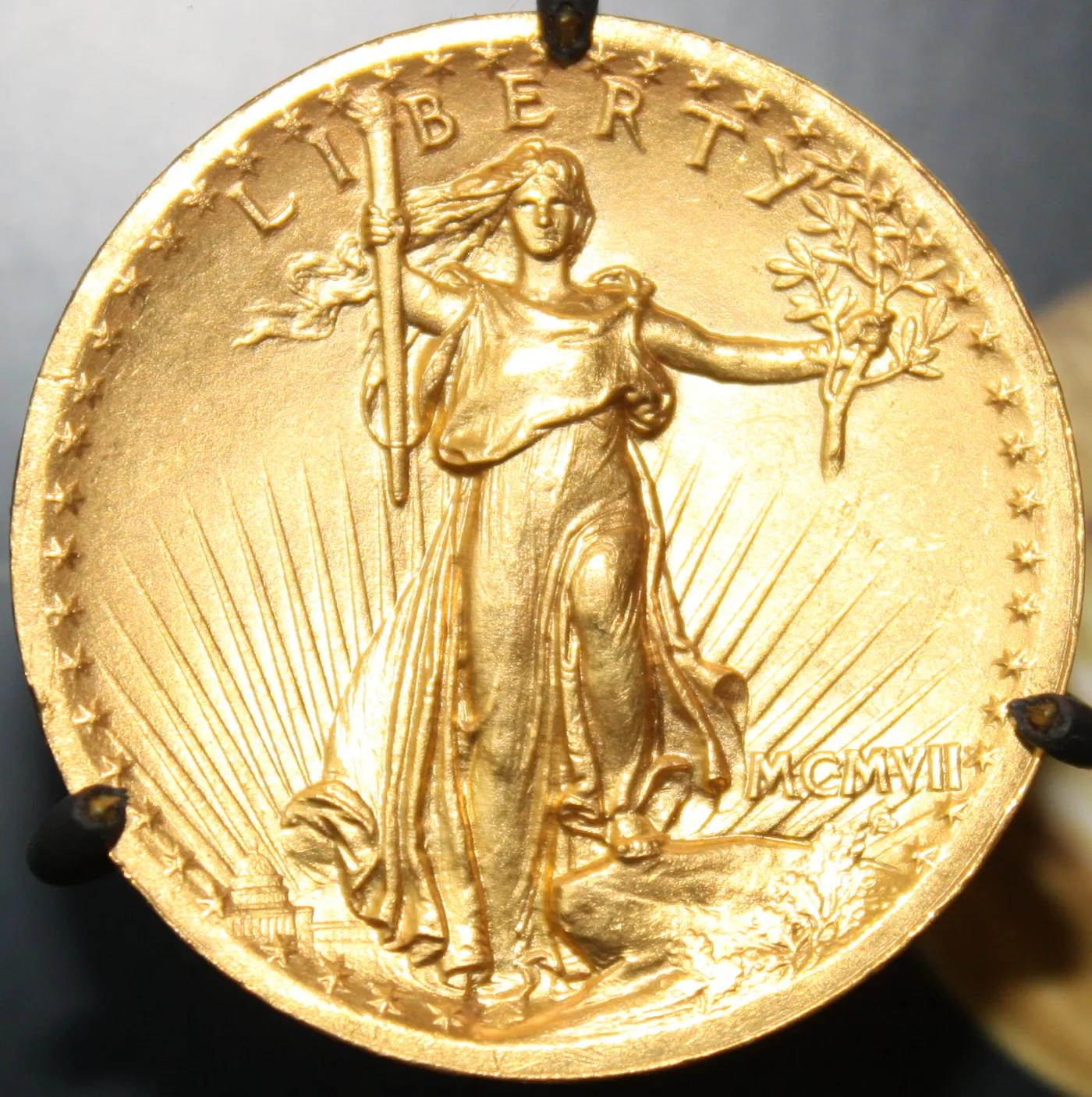
Four different twenty-dollar gold pieces carry the date 1907, and they are nothing like equal. Two are ordinary coins that trade on their gold content. One is a five-figure rarity that turns up in estates precisely because nobody in the family knew what it was. All of them were struck inside the same twelve months.
That happened because 1907 is the year the double eagle was replaced, and the replacement went wrong twice before it worked. Sorting out which one you are holding takes about ten seconds and needs no equipment: the date, the edge and one missing line of text settle it.
Why 1907 Has So Many Double Eagles
Theodore Roosevelt thought American coinage was ugly and said so. He commissioned the sculptor Augustus Saint-Gaudens to redesign it, a project Roosevelt privately called his “pet crime”. What Saint-Gaudens delivered was a coin in the relief of a medal, and the Mint could not strike it at production speed.
So 1907 produced a pile-up. The Liberty Head double eagle, in production since 1850, kept running all year at three mints. Alongside it came a handful of Ultra High Relief patterns, then a short run of High Relief coins for circulation, and finally a flattened version that could be made in quantity. Saint-Gaudens died in August 1907 and never saw a circulating example of any of them.
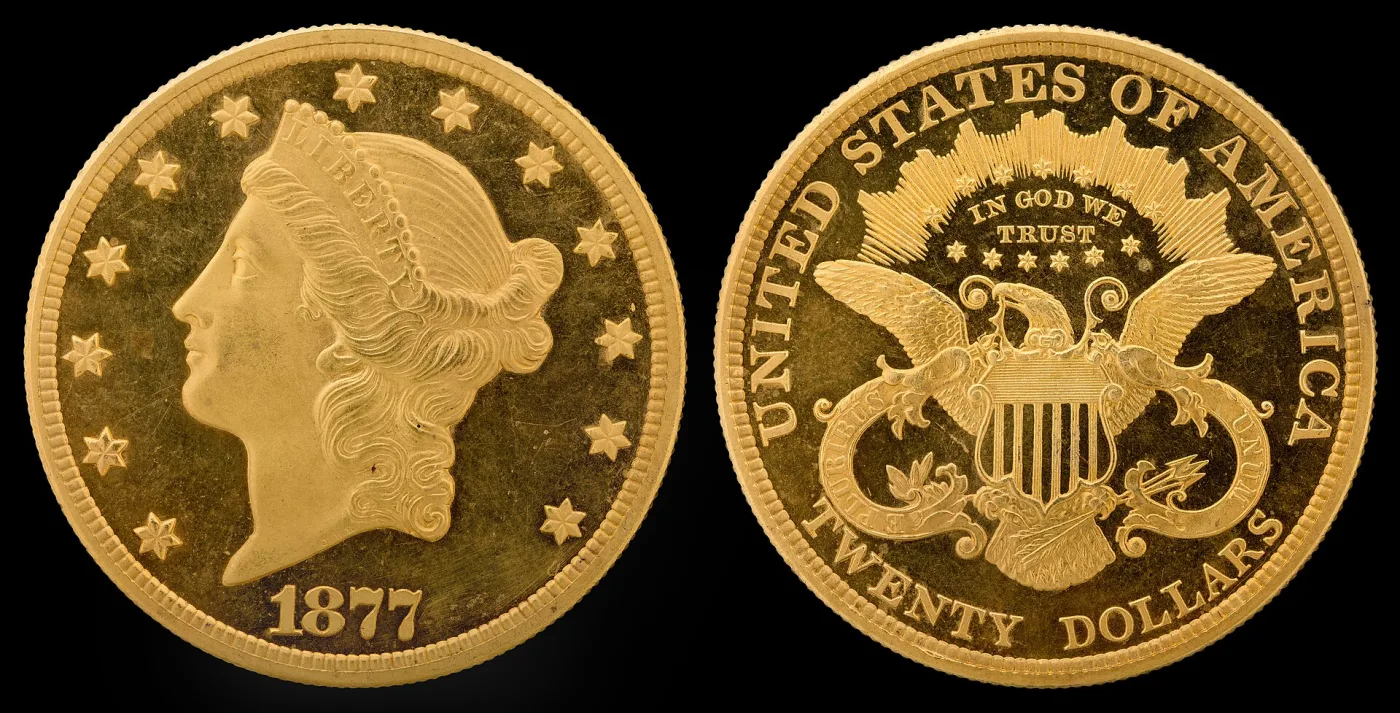
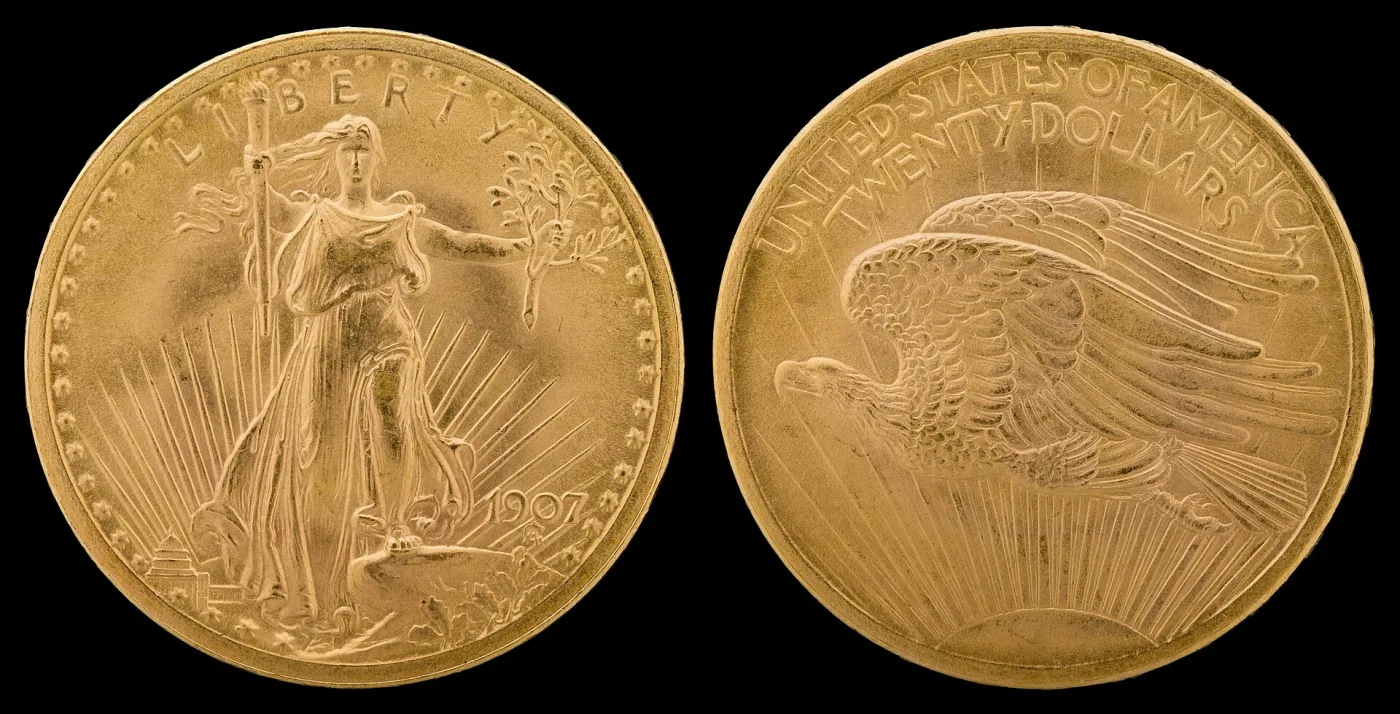
Neither the mint mark nor the weight will help you here. Both designs are 90% gold, both weigh about 33.4 grams, both measure roughly 34 mm across, and both spell the denomination TWENTY DOLLARS. Everything that separates them is on the surface.
Step One: Portrait or Striding Figure
Look at the obverse. A head in profile facing left, wearing a coronet lettered LIBERTY, with thirteen stars around it and the date below, is the Liberty Head design. A full-length female figure walking towards you out of a burst of sun rays, torch in her right hand and olive branch in her left, is Saint-Gaudens.
If the coin is too worn or too badly held to read that, the reverse gives the same answer faster. Liberty Head reverses carry a heraldic eagle with a striped shield on its breast, wings spread and stationary. Saint-Gaudens reverses show a single eagle in flight, low across the field, above a rising sun.
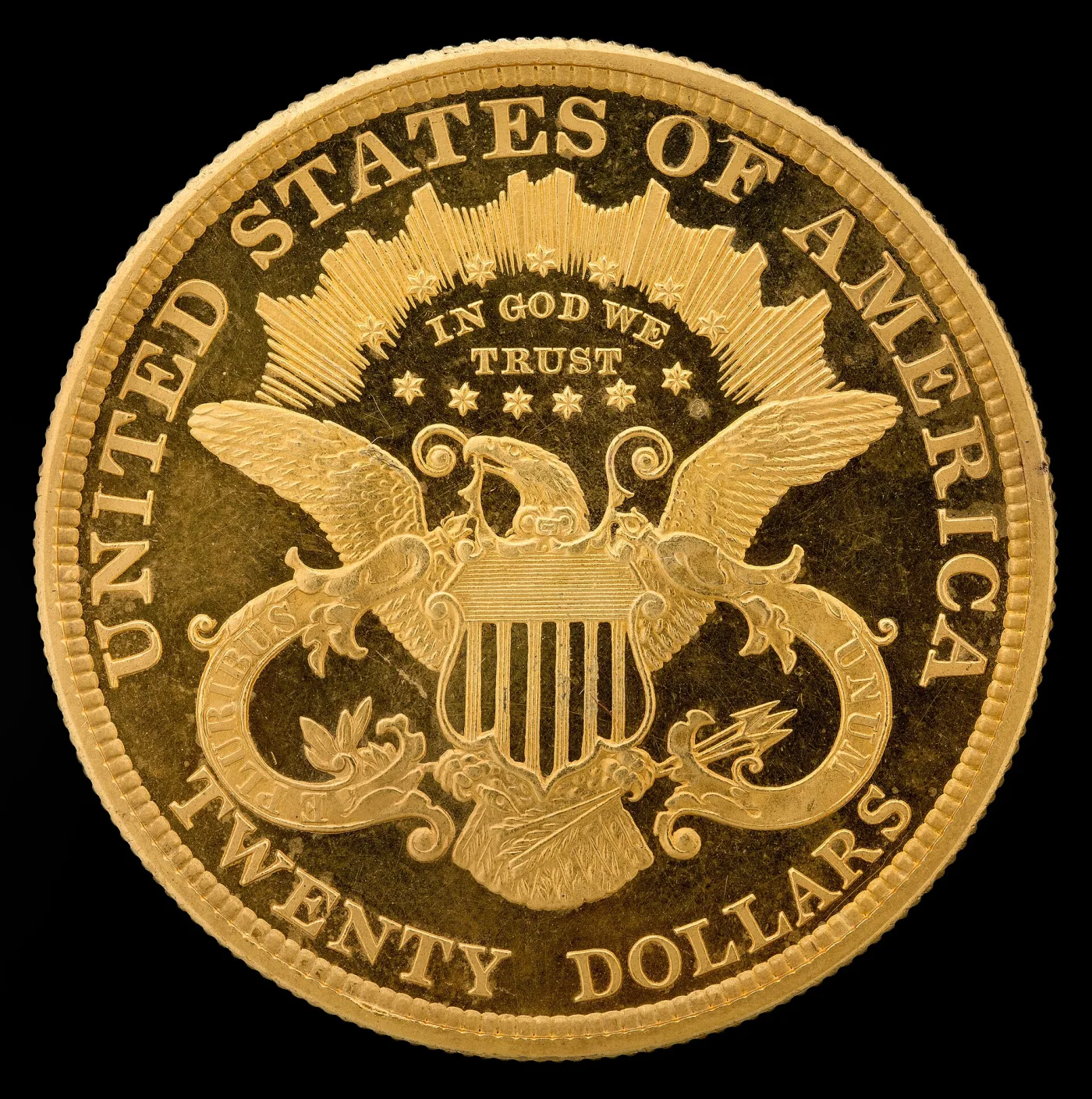
That motto is a diagnostic in its own right. The Liberty Head has carried IN GOD WE TRUST since 1866; every 1907 Saint-Gaudens lacks it entirely, because Roosevelt had it removed on the grounds that the name of God did not belong on money handled in commerce. Congress disagreed loudly and it returned partway through 1908. A Saint-Gaudens double eagle with no motto is therefore dated 1907 or early 1908 and nothing else — the gap is not damage.
Step Two: MCMVII or 1907
Once the coin is a Saint-Gaudens, the date does the rest of the work. It sits in the lower right field, level with Liberty’s knee. Written as MCMVII, it is a High Relief coin. Written as 1907, it is the ordinary low relief issue.
The gap between those two is the whole reason this article exists. The low relief 1907 is a bullion-grade coin: 361,667 were struck and they trade close to their gold content. The High Relief runs to a little over twelve thousand pieces and sells in five figures in any honest grade.
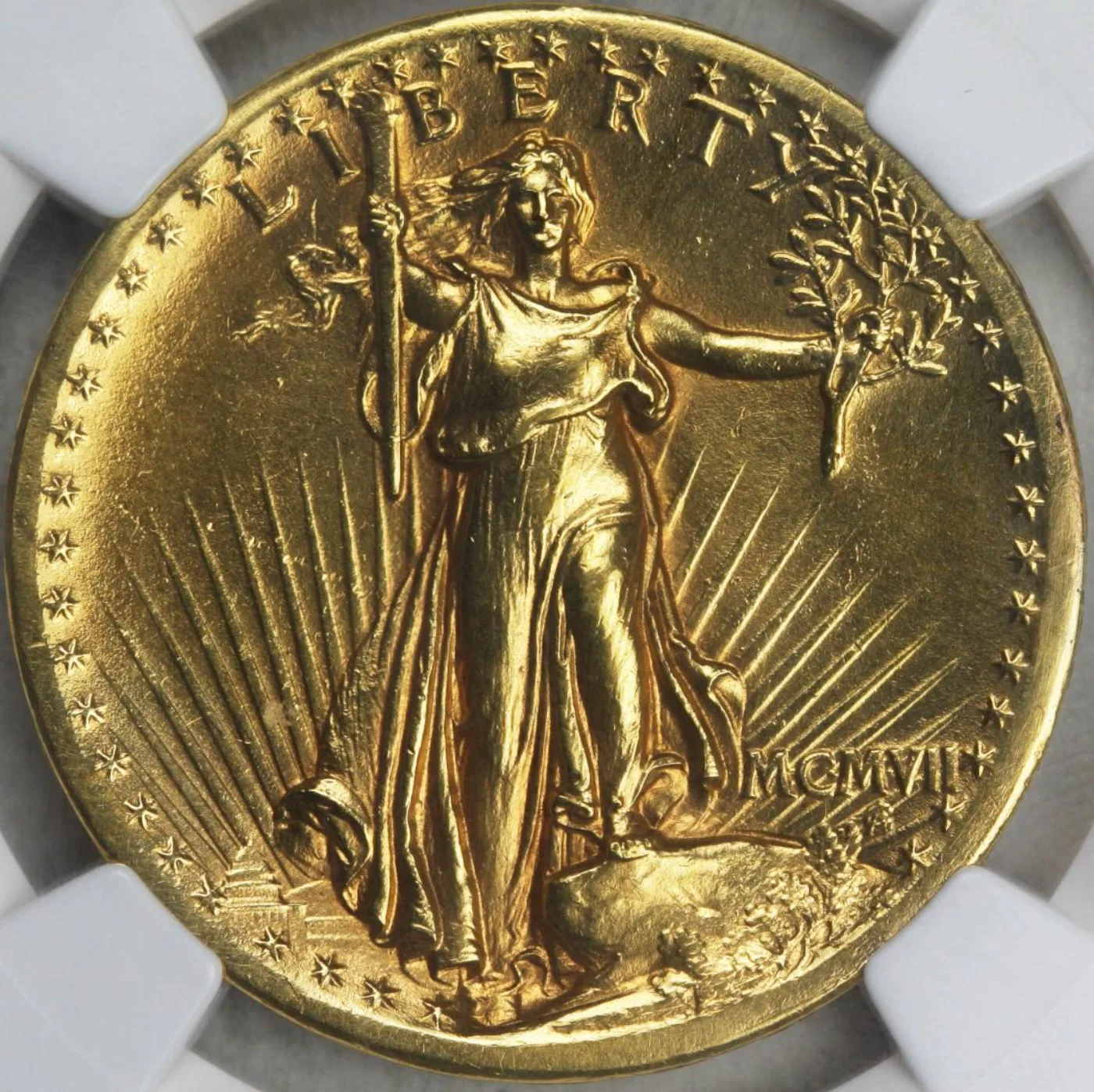
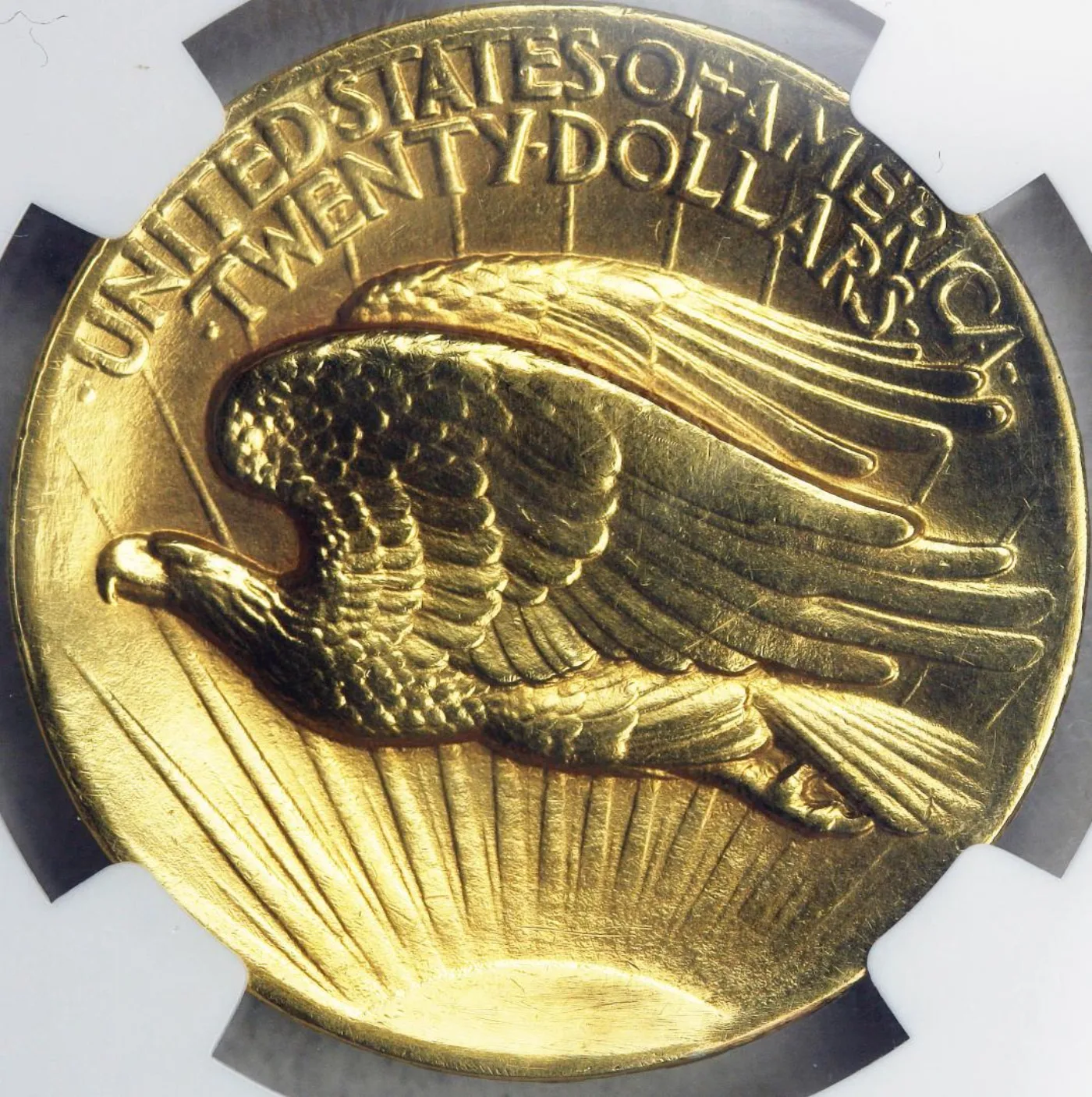
Relief is the confirming check when the date is worn or hidden by a holder’s edge. The High Relief took several blows from a medal press; Liberty stands almost free of the field, and tilted to the light the coin reads as a small sculpture. Charles Barber’s low relief was cut specifically to come up in a single blow, and it looks stamped rather than modelled.

Step Three: What the Edge Settles
The third of these coins’ faces is the one nobody looks at, and on a 1907 double eagle it is the most decisive of the three.
Every Saint-Gaudens double eagle has a lettered edge: E PLURIBUS UNUM incused into the metal with small stars between the words, applied by a segmented collar at the moment of striking. Every Liberty Head double eagle has a plain reeded edge — closely spaced vertical grooves running the full circumference, and no lettering anywhere.
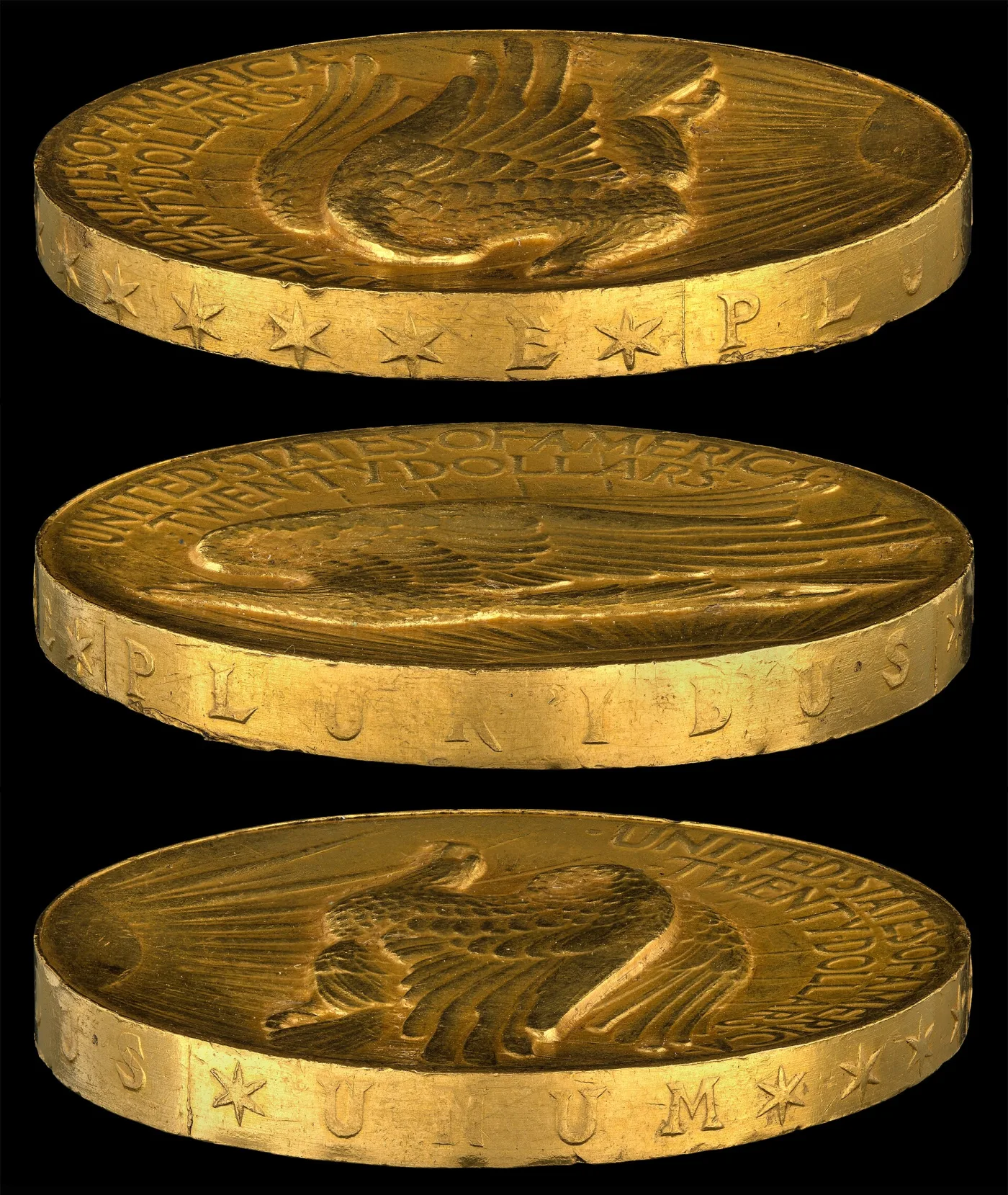
This matters beyond sorting the two designs. Large gold coins carrying real premiums are among the most faked US issues, and edge lettering is hard to reproduce convincingly: cast copies blur the letters, and two-piece struck fakes give themselves away at the join. Weighing the coin and reading the edge under a loupe rules out most of what circulates. The wider checklist is in our guide to detecting counterfeit coins.
Every 1907 Double Eagle, by the Numbers
Here is the full year in one place — the four designs, with the Liberty Head split across the three mints that struck it. The last column is the part worth internalising: each row’s share of every twenty-dollar gold piece dated 1907, which is a better guide to what you are likely to be holding than any single mintage figure.
| Coin | Date reads | Edge | Motto | Mintage | Share of all 1907 $20s |
|---|---|---|---|---|---|
| Liberty Head, Philadelphia | 1907 | Reeded | Yes | 1,451,786 | 30.0% |
| Liberty Head, Denver (D) | 1907 | Reeded | Yes | 842,250 | 17.4% |
| Liberty Head, San Francisco (S) | 1907 | Reeded | Yes | 2,165,800 | 44.8% |
| Saint-Gaudens, low relief | 1907 | Lettered | No | 361,667 | 7.5% |
| Saint-Gaudens, High Relief | MCMVII | Lettered | No | 12,367 | 0.26% |
| Saint-Gaudens, Ultra High Relief | MCMVII | Lettered | No | about 22 | 0.0005% |
| All 1907 double eagles | — | — | — | 4,833,892 | 100% |
Put another way: out of every thousand twenty-dollar gold pieces dated 1907, about 923 are Liberty Heads, 75 are low relief Saints, between two and three are High Reliefs, and roughly one in every 220,000 is an Ultra High Relief. San Francisco alone struck more Liberty Heads that year than the entire Saint-Gaudens output of 1907, in all three of its forms combined.
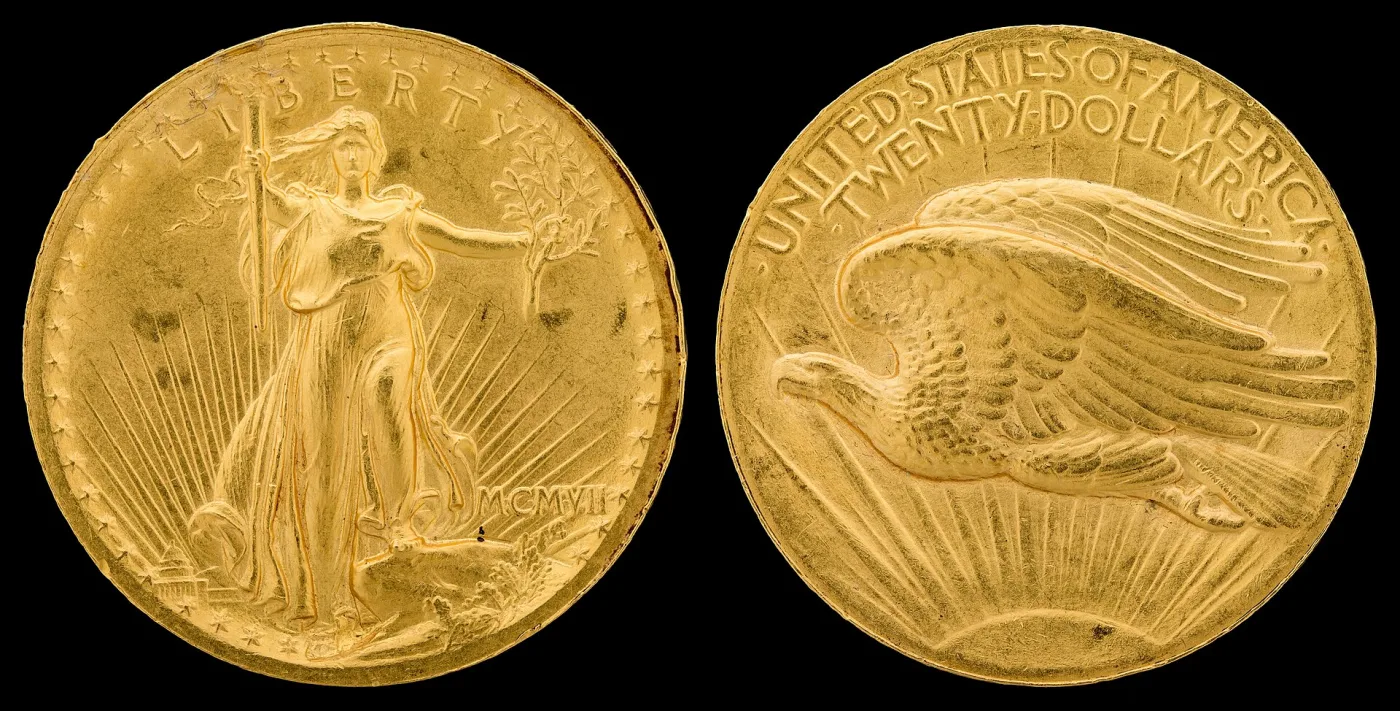
The High Relief is a genuine key date by any reasonable definition, and a coin at that price should never change hands raw. Have it certified first — the reasoning is set out in our guide to third-party grading.
Wire Rim, Flat Rim, and the Twenty at the Top
Two rim varieties exist within the High Relief, and one is roughly five times harder to find than the other. The collar used for the first coins was not tight enough, so the pressure needed to raise the design forced a thin fin of metal up where the coin met it. That fin is the Wire Rim. In December 1907 the Mint changed how blanks were upset before striking, largely suppressing the fin and producing the broader Flat Rim.
Flat Rims are much the scarcer: combined NGC and PCGS populations run to a few thousand Wire Rims against a few hundred Flat Rims. Neither is a different coin — same dies, same date, same mintage — so the distinction shows up only on a certification label.
That mintage figure deserves a caveat, because it is quoted with a confidence the records do not support. 12,367 is the number in most references, but published totals range from 11,250 to about 12,867, and archival work in the Mint’s own papers points to roughly 12,867 struck with 80 melted afterwards. Every credible account exceeds 12,000; past that, treat the precision as conventional rather than established. A related dispute runs alongside it — some High Reliefs are certified as proofs, though no Mint order authorising a separate proof run has ever surfaced, and our guide to proof coins covers what that designation normally means.
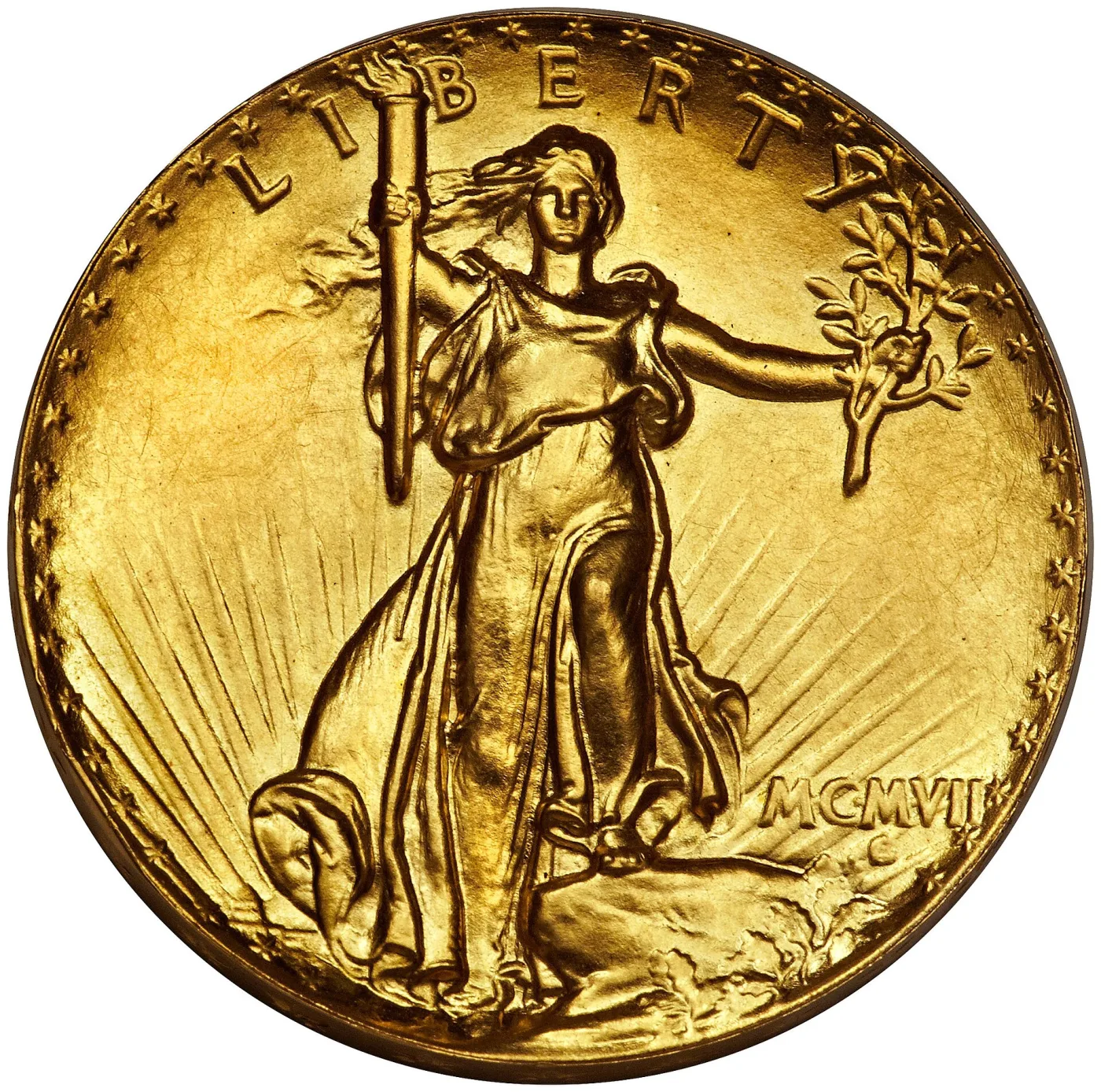
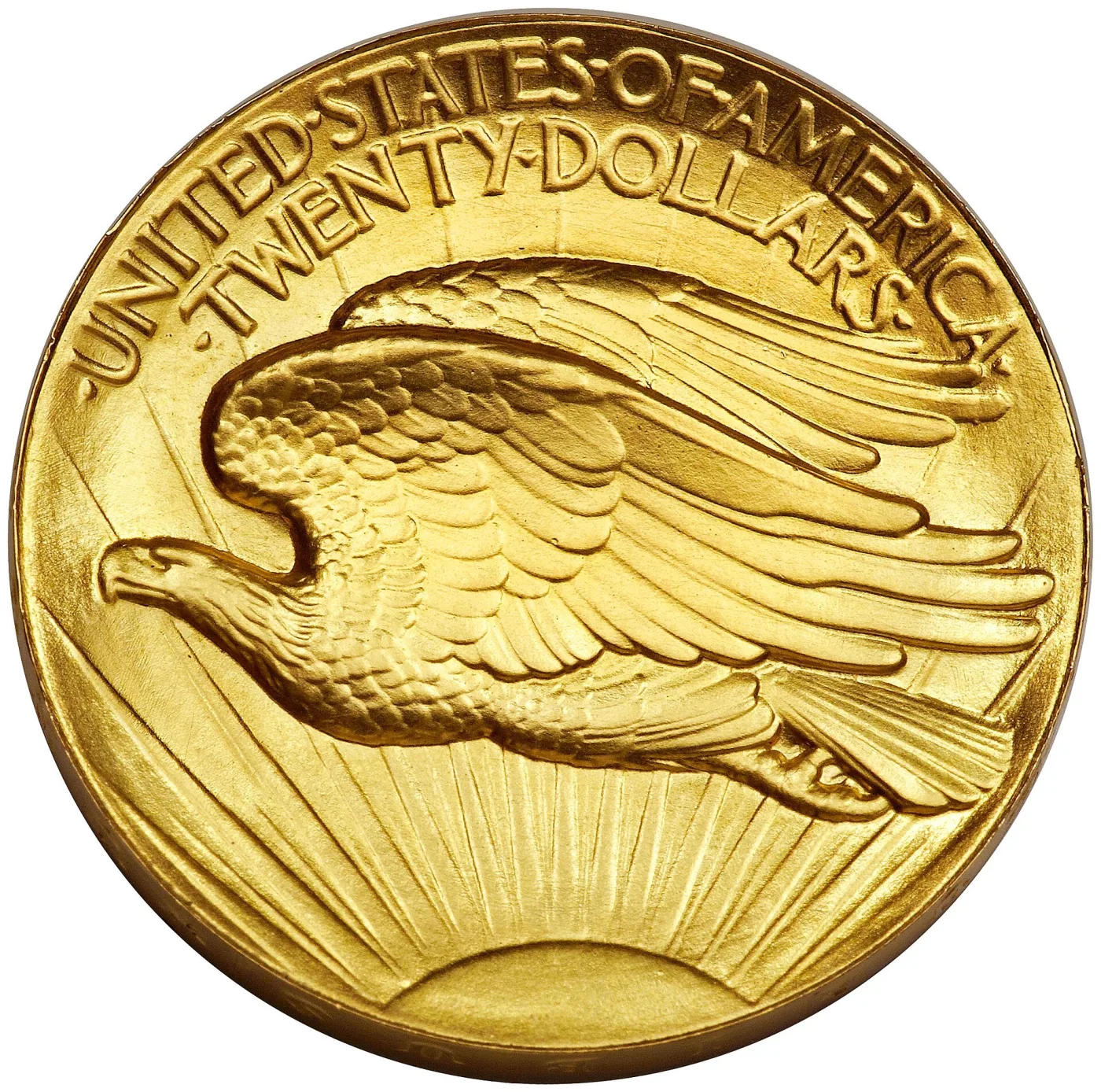
The Ultra High Relief is the one you almost certainly do not have. Between 22 and 24 were struck as experiments, about 20 survive, and their whereabouts are largely known. It is here only so the MCMVII date does not mislead: a Roman-numeral 1907 is a High Relief unless proven otherwise, because the difference is depth, not date.
Everything else about the series after 1907 — the 1933 that never legally circulated, the 1927-D, and the year-by-year mintages — is in the full Saint-Gaudens double eagle guide. If a worn mint mark is what is holding you up, the placement conventions across US series are in our guide to mint marks.
The Short Version
Portrait facing left means Liberty Head, and a reeded edge confirms it. Striding figure means Saint-Gaudens, and the edge will read E PLURIBUS UNUM. No motto anywhere on a Saint-Gaudens narrows it to 1907 or early 1908.
Then read the date at Liberty’s knee. Arabic 1907 is the ordinary coin, one of 361,667. Roman MCMVII is the High Relief, one of roughly twelve thousand, and worth taking somewhere before you do anything else with it.
Frequently Asked Questions
How do I tell a High Relief 1907 double eagle from an ordinary one?
Read the date. The High Relief carries the year in Roman numerals as MCMVII, and the ordinary 1907 Saint-Gaudens carries it in Arabic numerals as 1907. The relief confirms it: on a High Relief the figure of Liberty stands well clear of the field and the coin looks sculpted rather than stamped. There is no year where the rule fails, because the two came from different dies inside the same twelve months.
Are all 1907 double eagles Saint-Gaudens?
No, and most are not. Philadelphia, Denver and San Francisco struck about 4.46 million Liberty Head double eagles dated 1907, against roughly 374,000 Saint-Gaudens pieces. Around nine in every ten twenty-dollar gold coins dated 1907 carry Longacre's older portrait design rather than Saint-Gaudens' striding figure.
Why does my 1907 gold coin not say IN GOD WE TRUST?
Because Theodore Roosevelt had it left off. He considered putting the name of God on money handled in ordinary trade irreverent, and the first Saint-Gaudens double eagles were struck without it. Congress overruled him and the motto was restored during 1908. Every 1907 Saint-Gaudens lacks it, so its absence is normal rather than an error or a sign of damage.
What does MCMVII mean on a gold coin?
It is 1907 written in Roman numerals: M is 1000, CM is 900, V is 5 and II is 2. Augustus Saint-Gaudens preferred Roman numerals on artistic grounds. Only the Ultra High Relief patterns and the High Relief issue use them, because the Mint switched to Arabic numerals when it flattened the design at the end of 1907.
Is there a mint mark on a 1907 double eagle?
It depends which one you have. Liberty Head double eagles dated 1907 exist with a D or an S immediately below the eagle on the reverse, or with no mark at all for Philadelphia. Every 1907 Saint-Gaudens was struck at Philadelphia and therefore carries none, because Denver and San Francisco did not begin striking the new design until 1908.
How many 1907 High Relief double eagles were made?
The figure usually printed is 12,367, but the Mint's own records do not settle it. Published totals range from 11,250 to about 12,867, and archival research points to roughly 12,867 struck with 80 of them later melted. What every credible account agrees on is that the total sits somewhere above 12,000, which makes the High Relief genuinely scarce without being unobtainable.