1804 Silver Dollar Identification Guide: Class I, II, and III
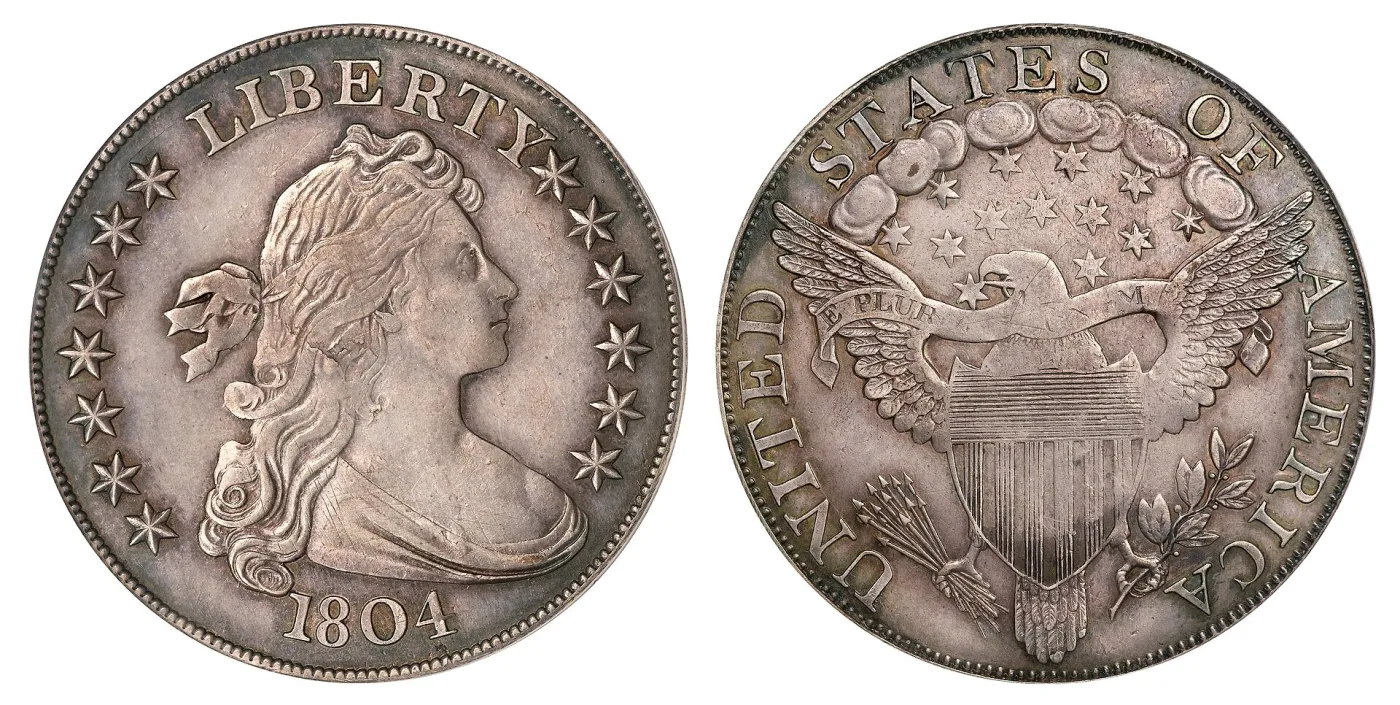
The 1804 Draped Bust silver dollar is known across numismatics as the “King of American Coins.” It is one of the most famous, romanticized, and heavily forged coins in the world. Single genuine specimens routinely command multi-million-dollar auction hammer prices, with the finest Class I example selling for over $7.6 million.
Yet the central paradox of the 1804 dollar is something every collector must understand: not a single silver dollar dated 1804 was struck in 1804.
Sorting through the history, the fifteen genuine museum-grade specimens, and the thousands of cast copies and altered dates begins with understanding why the coin was created thirty years after its date, how three distinct classes emerged, and what die diagnostics separate each one.
Why No 1804 Dollar Was Struck in 1804
In the early years of the United States Mint, steel dies were expensive and labor-intensive to engrave by hand. As a standard cost-saving practice, coining dies were used until they cracked or broke, regardless of the calendar year. Mint accounting records show that 19,570 silver dollars were delivered in 1804, but archival research confirmed that every one of those coins was struck using leftover dies dated 1802 and 1803.
Production of circulating silver dollars was suspended entirely by order of President Thomas Jefferson in 1804 to stop speculators from exporting full-weight American dollars to the Caribbean and melting them down. The denomination remained dormant for three decades until the introduction of the Gobrecht dollar in 1836 and the Seated Liberty dollar in 1840.
The 1804-dated dollar was born in November 1834. The Department of State, under President Andrew Jackson, commissioned special diplomatic presentation sets of United States coinage to be carried by envoy Edmund Roberts aboard the USS Peacock. These sets were presented as diplomatic gifts to the King of Siam (Rama III), the Sultan of Muscat (Said bin Sultan), and the Emperor of Japan.
When Mint Chief Coiner Adam Eckfeldt consulted official records to determine the last year silver dollars had been produced, the ledger stated 1804. Unaware that the 1804 deliveries were struck from 1802 and 1803 dies, the Mint prepared brand-new dies bearing the date 1804, paired with the heraldic eagle reverse of the late Draped Bust dollar series.
The Three Classes of 1804 Dollars
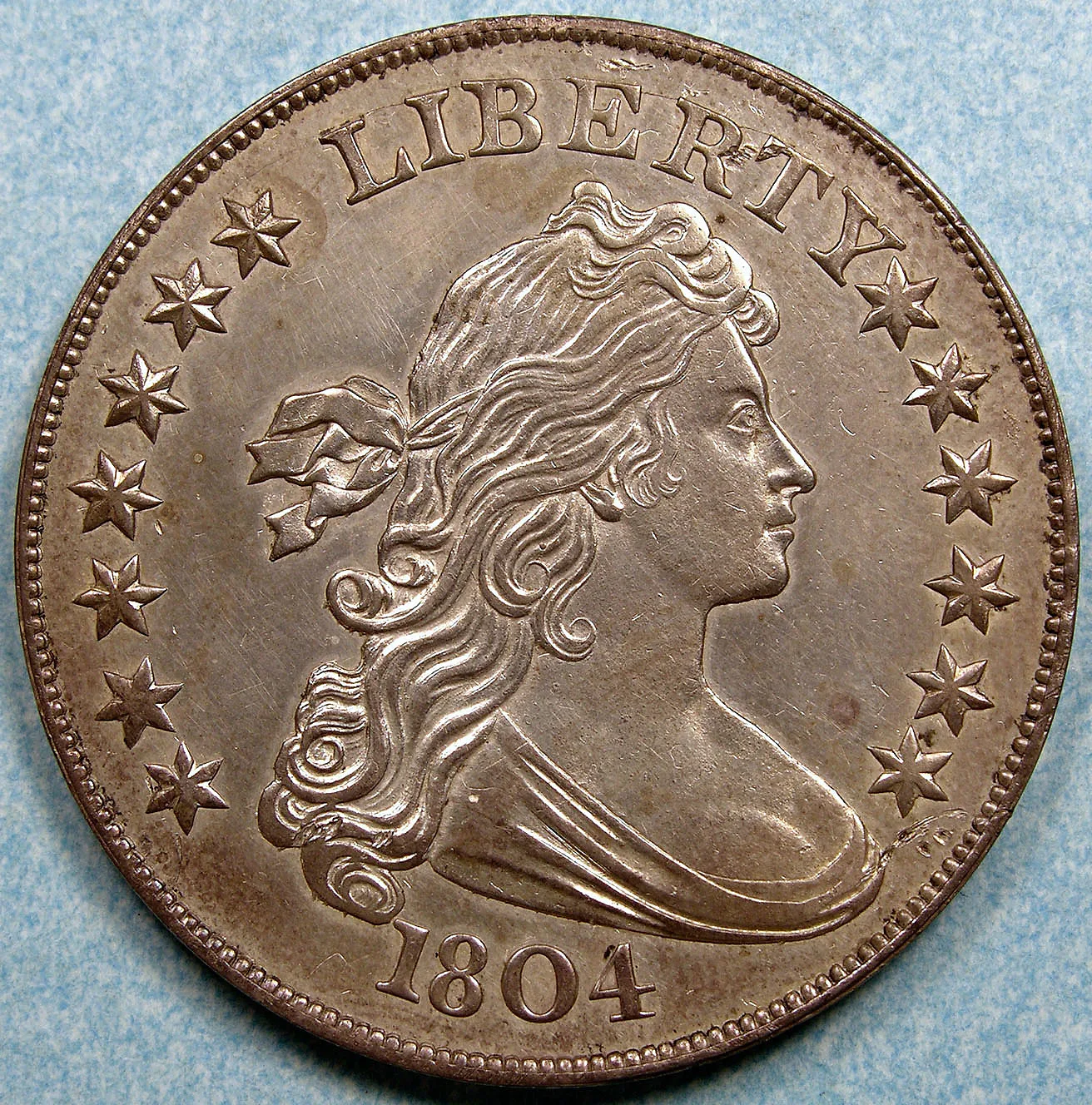
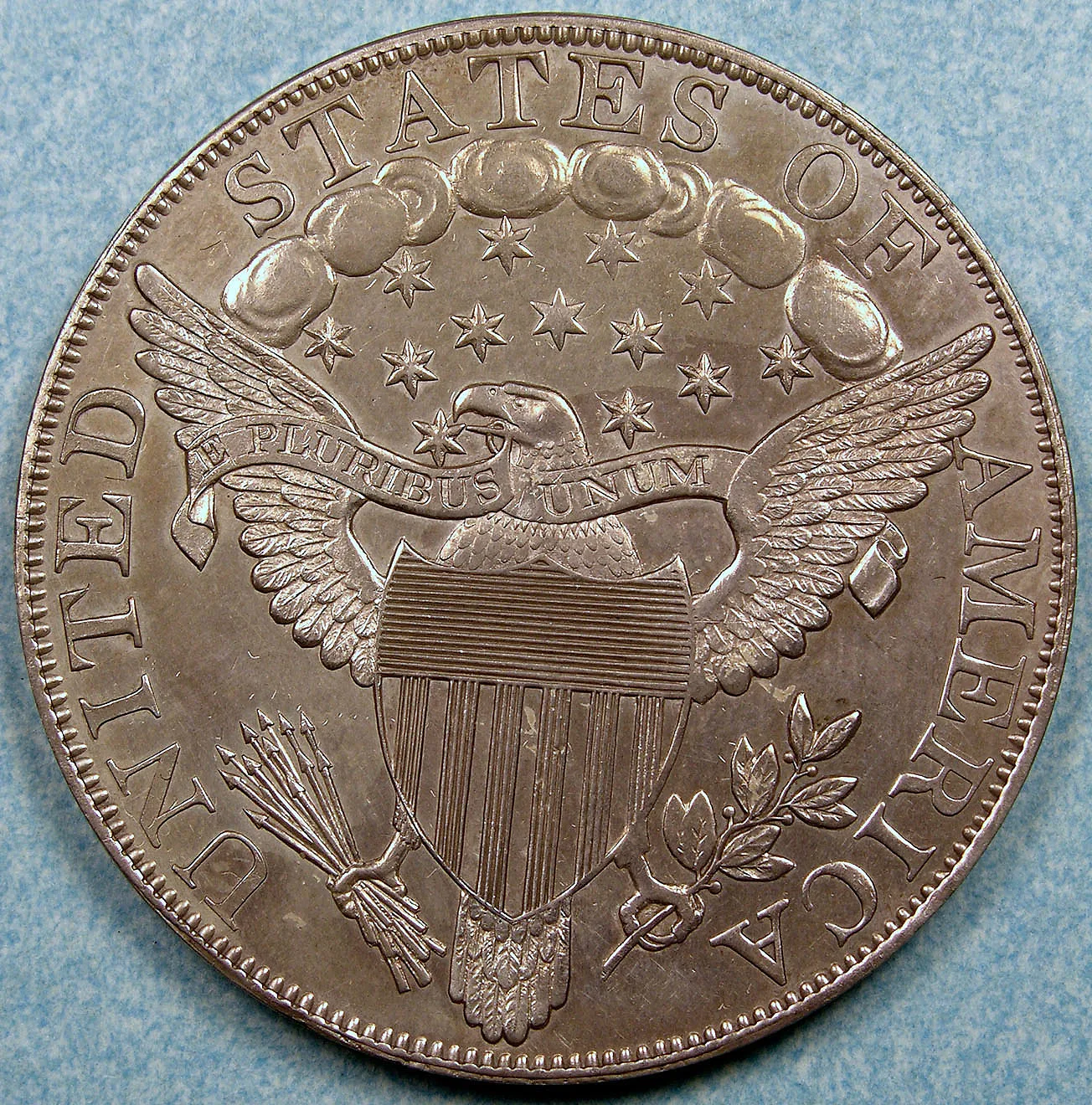
Numismatists divide the fifteen known genuine 1804 silver dollars into three distinct groups based on when they were struck, their edge lettering, and their reverse die state:
1. Class I: The “Originals” (Struck c. 1834–1835)
Eight specimens are known. These are the original presentation pieces struck on a medal press with proof surfaces. They were struck on blank silver planchets that received standard edge lettering before striking using the Castaing machine: HUNDRED CENTS ONE DOLLAR OR UNIT with decorative stars and bars separating the words. The reverse die is designated Reverse A, where the letter E in STATES is centered directly over the fourth cloud.
2. Class II: The Unique Restrike on a Swiss Thaler (Struck c. 1858–1860)
Only one specimen exists, permanently preserved in the Smithsonian National Numismatic Collection. In the late 1850s, Mint employee Theodore Eckfeldt produced clandestine restrikes using the original 1804 obverse die paired with a newly modified reverse die (Reverse B). To obtain a suitable blank planchet, Eckfeldt overstruck an uncirculated 1857 Swiss Shooting Thaler (Bern Confederation Shooting Festival). The coin was struck without an edge collar, resulting in a smooth, plain edge with no lettering. Traces of the underlying Swiss shooting thaler design are visible under magnification.
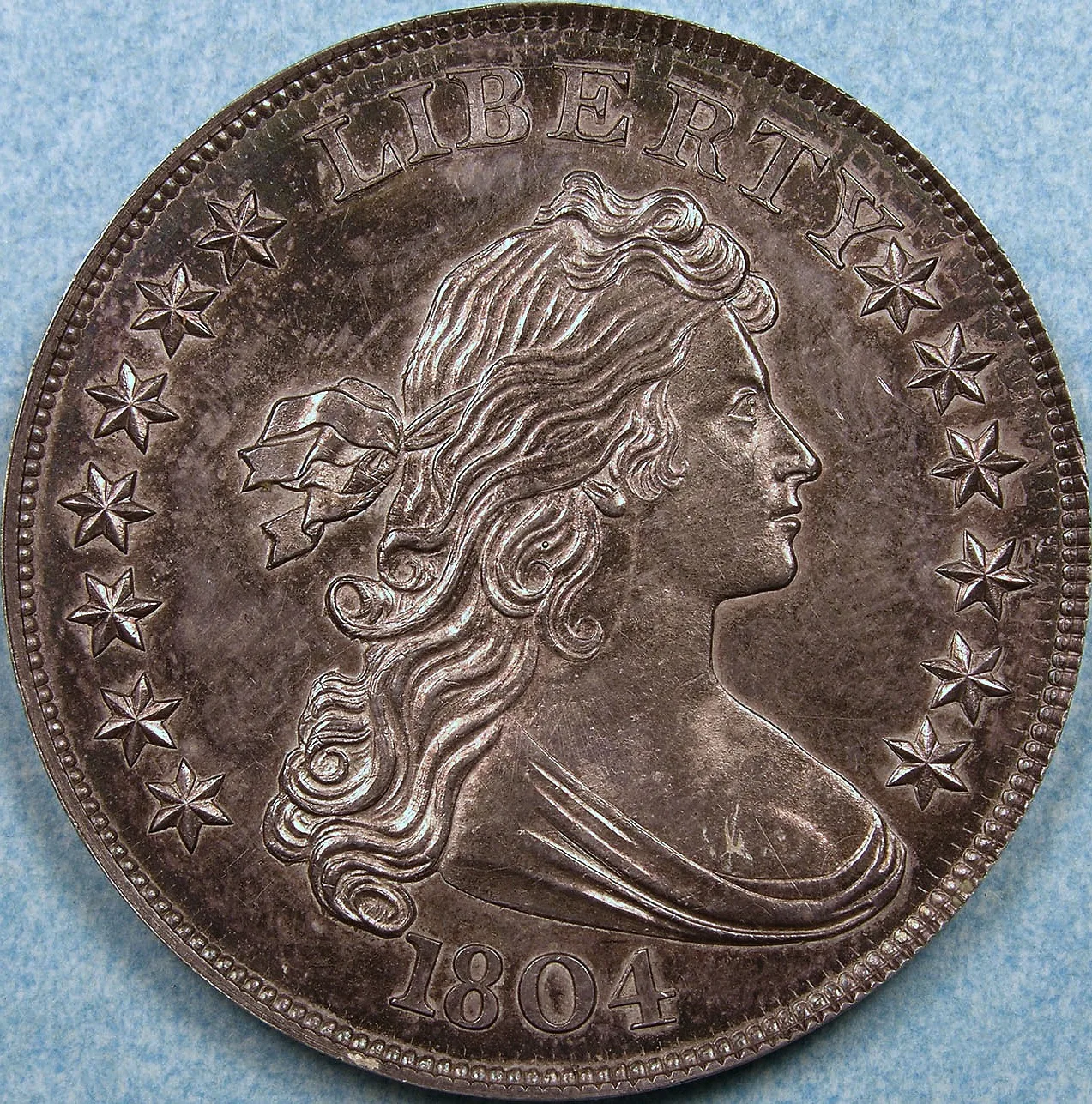
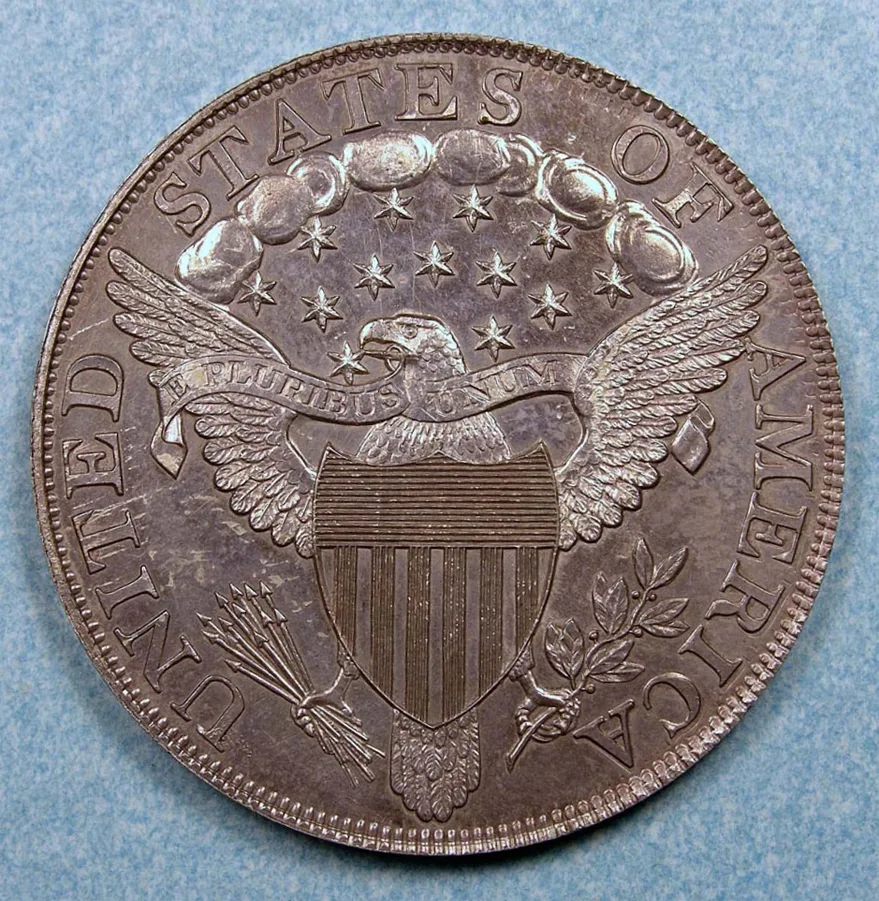
3. Class III: The Second Restrikes (Struck c. 1859–1876)
Six specimens are known. After Mint Director James Ross Snowden halted Eckfeldt’s illicit restriking operations and recovered the Class II dies, a small batch of restrikes was produced under controlled conditions for favored collectors. These were struck on silver planchets using Reverse B. Because collectors expected edge lettering on early silver dollars, edge lettering was applied after the coins were struck, which caused noticeable deformation and crushed denticles along the coin’s rims.
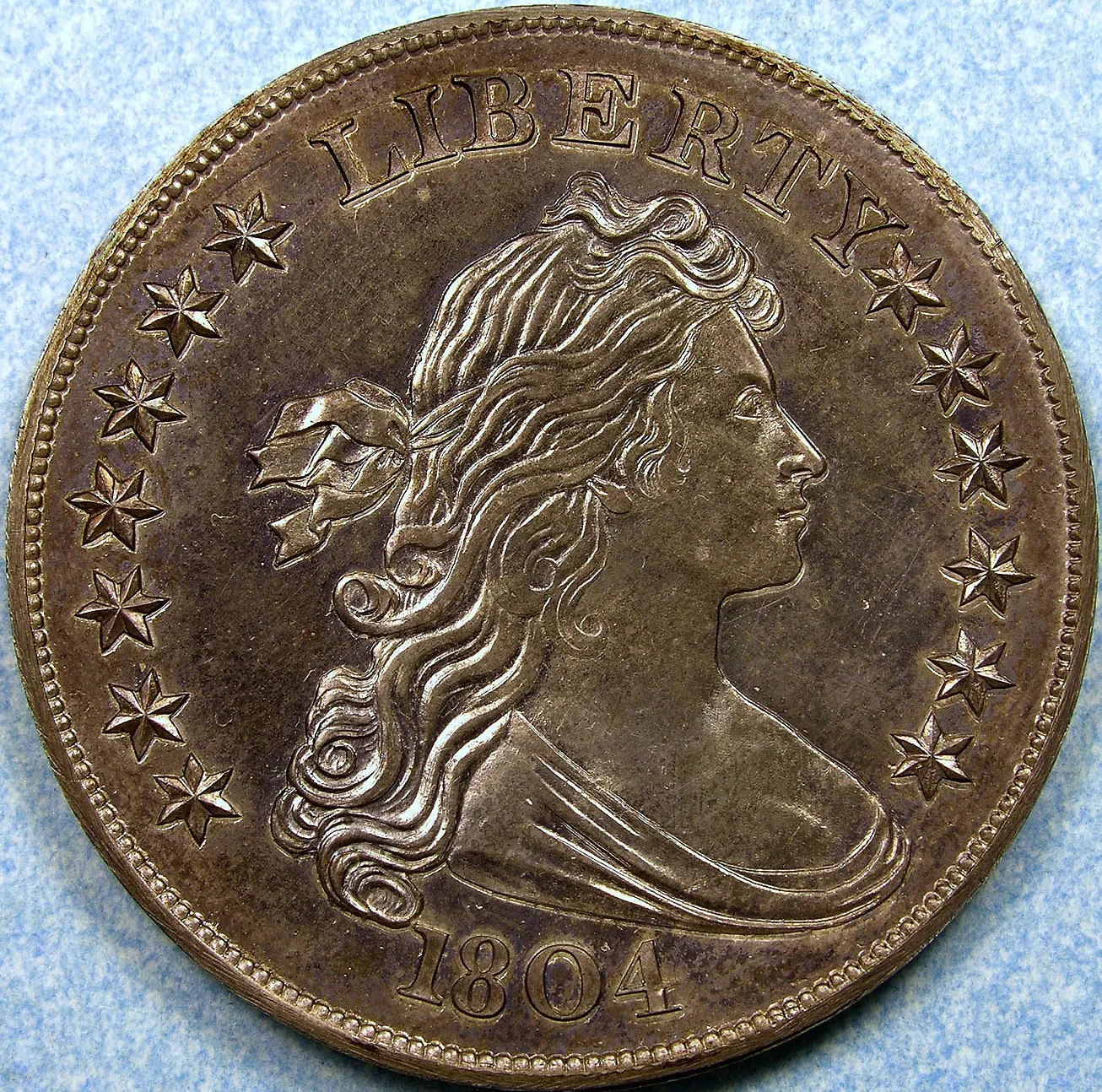
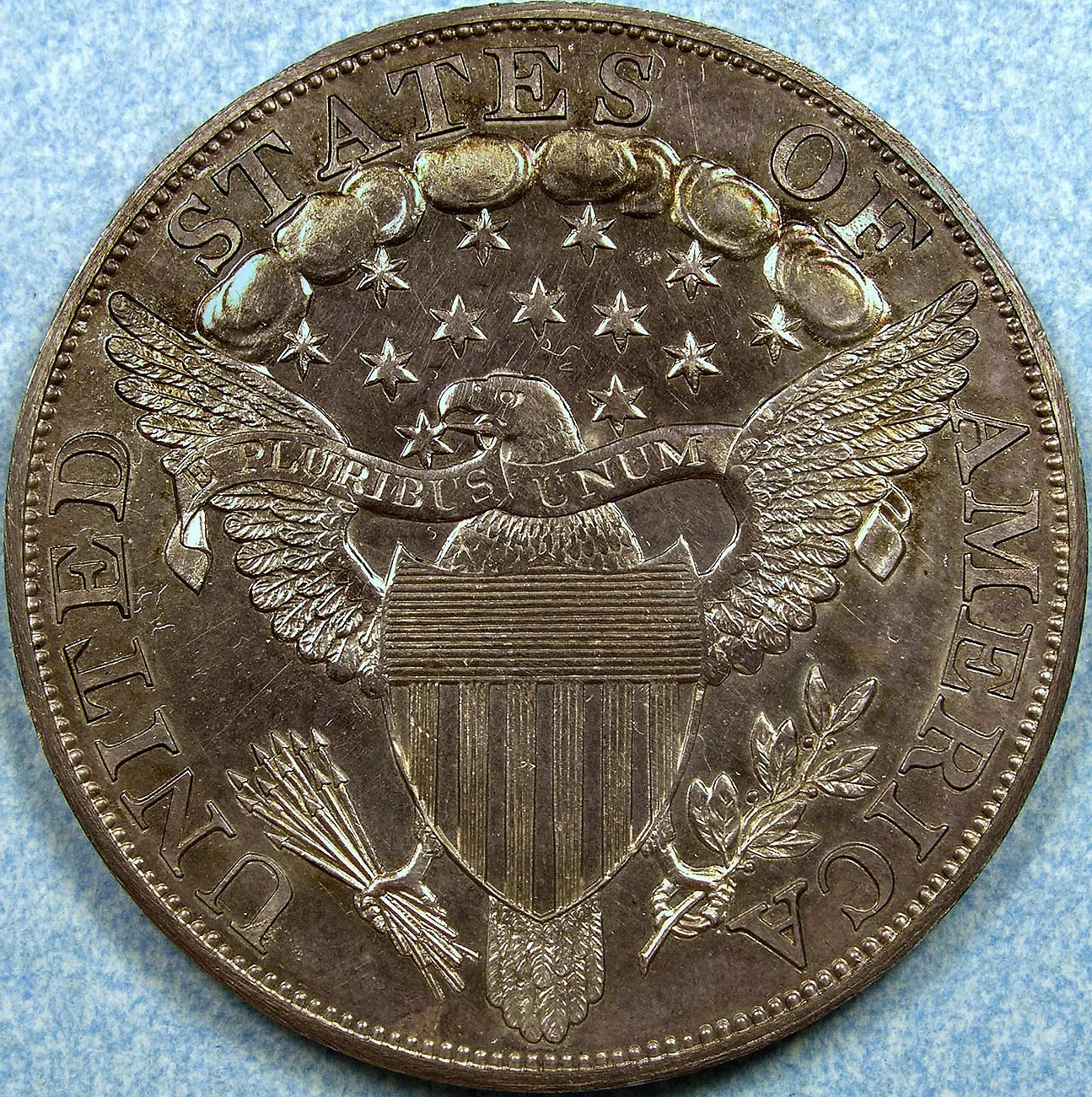
Diagnostic Comparison Table
The technical specifications and die markers for each class are summarized below:
| Feature | Class I (Originals) | Class II (First Restrike) | Class III (Second Restrikes) |
|---|---|---|---|
| Production Period | c. 1834–1835 | c. 1858–1860 | c. 1859–1876 |
| Known Population | 8 confirmed | 1 (Smithsonian unique) | 6 confirmed |
| Obverse Die | Die 1 (1804 date) | Die 1 (1804 date) | Die 1 (1804 date) |
| Reverse Die | Reverse A | Reverse B | Reverse B |
| Reverse ‘E’ Position | Centered directly over cloud 4 | Over space between cloud 3 & 4 | Over space between cloud 3 & 4 |
| Edge Type | Lettered edge (pre-strike) | Plain / Smooth edge | Lettered edge (post-strike) |
| Planchet / Undertype | Standard silver blank (26.96 g) | 1857 Swiss Shooting Thaler | Standard silver blank |
| Edge Rim Denticles | Sharp, undisturbed | Sharp, undisturbed | Crushed/flattened by edge press |
| Legal Status / Location | Private collections & Museums | Smithsonian Collection | Private collections & Museums |

The Decisive Reverse Diagnostic: The “STATES OF” Cloud Alignment
When authenticating an 1804 dollar, the most critical visual check is the alignment of the letters in STATES OF relative to the cloud puffs directly beneath them.
On early United States coinage, the heraldic eagle reverse features a constellation of thirteen stars enclosed within an arch of clouds. On the 1804 dies, there are two distinct reverse arrangements:
- Reverse A (Class I Originals): Look at the letter E in
STATES. The vertical upright and central spine of theEline up directly above the apex (highest rounded point) of the fourth cloud from the left. Furthermore, the letter S inSTATESsits well clear of the eagle’s wingtip. - Reverse B (Class II and III Restrikes): The reverse die was re-engraved with subtle differences in letter placement. On Reverse B, the letter E in
STATESis shifted leftward and sits directly over the valley/notch between cloud 3 and cloud 4. The relationship between the clouds and the letters is invariant and cannot be altered by wear or cleaning.
Edge Lettering and Planchet Diagnostics
Under the Coinage Act of April 2, 1792, all United States silver dollars were required to carry edge lettering specifying their legal tender value: HUNDRED CENTS ONE DOLLAR OR UNIT.

HUNDRED CENTS ONE DOLLAR OR UNIT with decorative elements between words.
Wikimedia Commons, public domain
The timing of how the edge lettering was applied creates a permanent fingerprint:
- Class I Originals: Lettering was applied to the blank planchet using a Castaing machine before the coin was placed in the screw press. When the coin was struck, the expanding metal pushed against the open die collar, leaving the peripheral rim denticles crisp, tall, and uniform.
- Class II Restrike: No edge lettering was applied at all. The edge is completely plain and smooth.
- Class III Restrikes: The coins were struck first on a press with smooth collars, and the edge lettering was applied afterwards by forcing the struck coin through an edge-lettering device. This second mechanical operation squeezed the outer borders of the coin, noticeably flattening and distorting the rim denticles adjacent to the lettering.
Famous Pedigrees: The Dexter Specimen
Because only 15 genuine specimens exist, every single 1804 dollar possesses a documented provenance extending back over a century. The most famous individual example is the Dexter Specimen (Class I).
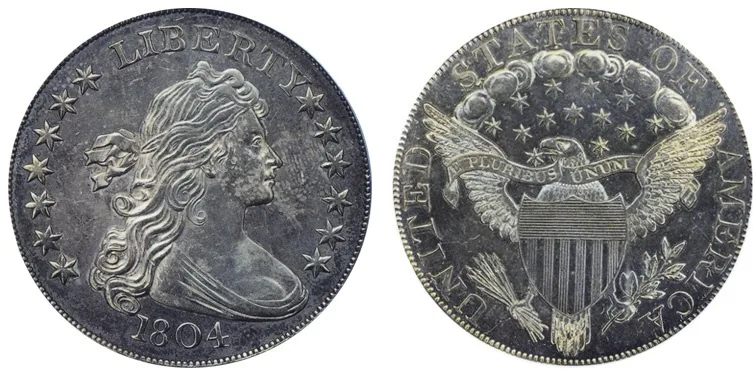
In 1885, wealthy Denver numismatist James V. Dexter purchased the coin at auction from the Chapman brothers for $1,000. Determined that his specimen could never be substituted or stolen without detection, Dexter used a jewelers punch to counterstamp a minuscule letter D inside cloud 6 on the reverse. Today, the Dexter Specimen is one of the most famous coins in American history, having realized over $4.1 million at auction.
How to Spot Counterfeits and Altered Dates
Because genuine 1804 dollars are worth millions of dollars, the numismatic market is inundated with fakes. Virtually every “1804 dollar” discovered in an old desk drawer, estate box, or uncertified holder is not genuine. The most common varieties of counterfeits include:
1. Altered Dates on Genuine Early Dollars
Fraudsters frequently take a genuine, common-date Draped Bust dollar dated 1801, 1802, or 1803 and tool the final digit under high magnification to resemble a ‘4’.
- The check: Examine the numeral
4under 30× magnification. On a genuine 1804 dollar, the 4 is bold, crosslet-free, and shares exact die characteristics with the other three digits. On an altered coin, the metal around the final digit will show tool marks, uneven field depth, or discoloration from laser-soldering. Furthermore, the obverse and reverse die marriages of genuine 1801–1803 dollars do not match the single obverse die used on the 1804.
2. Electrotype Replicas
In the 19th and early 20th centuries, museums and private electrotypists produced copper shell electrotype copies of genuine 1804 dollars (such as the British Museum and Mint collection pieces) for display.
- The check: Electrotypes are formed by joining two separate copper shells together with lead or solder. Look closely at the coin’s edge: an electrotype will display a faint seam running along the circumference. An electrotype will also fail a specific gravity test, ring dull when tapped, and weigh significantly less or more than the official 26.96 g standard.
3. Cast and Struck Base-Metal Counterfeits
Modern souvenir fakes manufactured from copper-nickel, zinc alloy, or silver-plated brass are widespread.
- The check:
- Weight: A genuine 1804 dollar weighs exactly 26.96 grams (416 grains) with an allowable tolerance of less than 0.1 g. Base-metal fakes often weigh between 18 and 23 grams.
- Magnet Test: Early American silver is non-magnetic. If the coin adheres to a neodymium magnet, it is a steel-cored modern counterfeit.
- Edge Lettering: Genuine dollars possess incuse lettering pressed into the edge metal. Cast fakes show fuzzy, raised seams or crude stamped letters with incorrect font spacing.
For any coin claiming to be an early American rarity, submission to a major certification service (PCGS or NGC) is the only accepted method for establishing authenticity. You can learn more about third-party authentication standards in our Coin Grading Guide and Counterfeit Detection Guide.
Frequently Asked Questions
Was any 1804 silver dollar actually struck in the year 1804?
No. Although United States Mint records show 19,570 silver dollars delivered in calendar year 1804, all were struck from leftover dies dated 1802 and 1803. The first genuine silver dollars bearing the date 1804 were produced in late 1834 for diplomatic presentation sets.
How many genuine 1804 silver dollars exist today?
Exactly 15 genuine specimens are confirmed across three classes: eight Class I 'Originals', one unique Class II restrike (permanently housed in the Smithsonian National Numismatic Collection), and six Class III restrikes.
What is the single best diagnostic to tell Class I from Class II or III?
Look at the reverse letter 'E' in STATES. On Class I originals, the letter E is positioned directly centered over the crest of cloud 4. On Class II and Class III restrikes, the letter E is shifted to the left, sitting directly over the junction between cloud 3 and cloud 4.
Why is the Class II 1804 silver dollar unique?
The Class II specimen was struck between 1858 and 1860 by Mint employee Theodore Eckfeldt over a 1857 Swiss Shooting Thaler (Bern). It has a plain edge with no lettering and is the only known specimen of its type in existence.
How do I know if an 1804 silver dollar is a counterfeit or replica?
The overwhelming majority of 1804 dollars encountered are replicas, electrotypes, or altered dates. Check the weight on a digital scale (genuine is 26.96 g of 89.24% silver), inspect the edge for genuine incuse lettering rather than a cast seam, and match the obverse and reverse die markers against verified museum specimens.